
International Research Journal of Engineering and Technology (IRJET) e-ISSN: 2395-0056
Volume: 13 Issue: 03 | Mar 2026 www.irjet.net p-ISSN: 2395-0072

International Research Journal of Engineering and Technology (IRJET) e-ISSN: 2395-0056
Volume: 13 Issue: 03 | Mar 2026 www.irjet.net p-ISSN: 2395-0072
Huzaifa Zombarkar, Omer Syed, Shehzad Shaikh, Arsalan Surme
Huzaifa Zombarkar, Dept. of Computer Engineering, AIARKP, Maharashtra, India
Omer Syed, Dept. of Computer Engineering, AIARKP, Maharashtra, India
Shehzad Shaikh, Dept. of Computer Engineering, AIARKP, Maharashtra, India
Arsalan Surme, Dept. of Computer Engineering, AIARKP, Maharashtra, India
Abstract - Meaningful engagementwithacademicresearch remains difficult for most students due to the fragmented and informal nature of existing pathways. Current platforms such as ResearchGate, Academia.edu, Google Scholar,andLinkedIn each address only a narrow slice of the problem they either serve researchers exclusively, lack interactive features, or are too general to support structured student-researcher collaboration. StudyLink is a proposed web-based platform designed to address this gap by providing a unified space where researchers can publish papers, post internship and mentorship opportunities, and build topic-based academic communities, while students can discover research, connect with researchers, and apply for opportunities through a structured interface. What distinguishes StudyLink from existing platforms is its simultaneous focus on research discovery and human connection, making research an active and participatory experience rather than a passive one. The platform is designed as a full-stack web application built on React with TypeScript and Chakra UI on the frontend,FastAPI on the backend, and PostgreSQLastheprimarydatabase, with real-time communication supported via WebSockets. This paper presents the motivation behindStudyLink,adescription of its architecture and core features, a comparative analysis with existing platforms, an assessment of its projectedimpact, and a discussion of its limitations and future development directions. The overarching goal of StudyLink is to democratize access to research mentorship and internship opportunities for students across all institutions, regardlessof their personal networks or institutional prestige.
Key Words: Research Platform, Student-Researcher Collaboration, Academic Mentorship, Research Internship, Community Building, Knowledge Sharing, Web Application, Academic Networking
Table -1: ListofAbbreviations
Abbreviation Full Form
AI ArtificialIntelligence
API ApplicationProgrammingInterface
CI/CD ContinuousIntegrationandContinuous Deployment
DM DirectMessage
E2E End-to-End
EdTech EducationalTechnology
HTTPS HypertextTransferProtocolSecure IISER IndianInstitutesofScienceEducation andResearch
IIT IndianInstitutesofTechnology
IOS
iPhoneOperatingSystem
JSON JavaScriptObjectNotation
JWT
JSONWebToken
ORM ObjectRelationalMapper
PDF PortableDocumentFormat
REST RepresentationalStateTransfer
SQL
UI
StructuredQueryLanguage
UserInterface
URL UniformResourceLocator
The gap between the student body and the research community is a defining feature of the contemporary academic ecosystem. Every year, researchers from universities and other institutions publish thousands of papers, carry out innovative research, and provide invaluabledomainexpertise.However,students,especially thosepursuingundergraduateandgraduatedegrees,arestill largely cut off from this activity. The methods by which a student can find an ongoing research internship, connect witharesearcherformentorship,orengageinanacademic communityaredispersed,unofficial,andlargelyrelianton cold outreach or personal networks with little chance of response.
The platforms currently available are only able to do this partially. ResearchGate [1] and Academia.edu [2] are repositories for research papers but are focused on interaction between researchers and do not offer a mechanismforstudentsto get involved,apply,orinteract
International Research Journal of Engineering and Technology (IRJET) e-ISSN: 2395-0056
Volume: 13 Issue: 03 | Mar 2026 www.irjet.net p-ISSN: 2395-0072
with researchers. Google Scholar [3] is simply a search enginewithnointeractivefeatureswhatsoever.LinkedIn[4] is a popular networking site but does not have depth for academic use and does not offer research discovery or mentorship structuring within a domain-specific context. Thisleavesaholeinthemarket,ascurrently,noplatformis able to offer all of research paper discovery, mentorship, internship,andinteractionwithstudentsasaprimaryfocus StudyLinkisproposedasasolutionfortheaforementioned problem.StudyLinkisaweb-basedplatformdevelopedasa full-stackapplication.ThebackendisbuiltontopofFastAPI, andthefrontendisbuiltontopofReactandTypeScriptwith theChakraUIlibrary.Inaddition,theplatformisequipped with a WebSocket-based messaging system for direct communicationbetweentheresearcherandthestudent.The platform is designed to support two types of users: Researchers and Students. Each type of user is supported throughtherespectivedashboardsandfeatures.
1.1
ThemotivationbehindStudyLinkisderivedfromarecurring situationfacedbyacademicinstitutionsacrossIndia,wherein studentsarekeenonparticipatinginresearchactivitiesbut are not able to do so because of a lack of a structured, accessible, and centralized platform through which they coulddoso.Coldemailingprofessorsresultsinaresponse rateoflessthan5%mostofthetime.Researchinternship opportunities are not posted on any platform, but rather through word of mouth. Communities for a particular research domain do not exist, nor are they available in an accessible manner for students. StudyLink aims to replace this informal, luck-based mechanism with a transparent, structured,andscalablemechanism.
The organization of this paper is as follows: in Section 2, related platforms are discussed and their limitations are identified. In Section 3, the problem statement is formally defined. In Section 4, the proposed StudyLink system is discussed. In Section 5, a comparison of the proposed StudyLinksystemandexistingplatformsismade.InSection 6, the projected impact of the proposed platform is discussed.InSection7,thechallengesandlimitationsofthe proposed platform are discussed. In Section 8, the future scope of the platform is presented. In Section 9, the conclusionofthepaperispresented.
Theneedforacademiccollaborationplatformshasincreased inthepastfewyears,andasaresult,severalplatformshave been designed to cater to the need for such collaboration. However, if these platformsare analyzed in the context of student involvement and the interaction of the researcher
with the student, the limitations of such platforms can be understood.
ResearchGate [1] is one of the most popular social networkingsitesfortheacademiccommunity,withover20 millionregisteredresearchersaroundtheworld.Researchers canuploadpublishedarticles,askdomain-specificquestions, and follow other domain-specific researchers on the site. Thoughthesiteisveryeffectiveforresearcher-to-researcher networking,itdoesnottargetstudents.Thereisnowayfor the researcher to post internship opportunities or mentorship opportunities, or for community building for domain-specificdiscussion.
Academia.edu [2], for instance, is a platform dedicated to papersharingandreadershiptrackingmetricsfortheauthor. Itprovidesasimpleinterfaceforpaperdiscoverybutdoes not have any interactive or community-based elements. Therearenodirectmessagesforresearchersandstudents, no internship or mentorship opportunities, and no communitybuildingtools.
LinkedIn is the largest professional networking site in the world and is sometimes used for disseminating research articles and for internshipsearches by students. However, LinkedIn is not suited for academic or research-based applications. Research articles are scattered and not discoverableonLinkedInduetotheirpostingstyleasarticles or individual posts. Internships are mostly industry-based andnotrelatedtoresearch-basedopportunitiesonLinkedIn. Additionally,thereisnooptionforpublishingpapersorfor academic networking or mentorship in a research-based scenario on LinkedIn, making it unsuitable for solving the student-researcherinteractionproblem.
GoogleScholarisawidelyusedtoolforacademicsearching. Google Scholar is a search engine for scholarly literature, including articles, theses, conference papers, and books. Google Scholar is an invaluable tool for finding scholarly research, and there is absolutely no interactive featureon Google Scholar. Students can simply search and read the scholarly material, but there is nooptionto follow people, communities,sendmessages,orevenapplyforopportunities. GoogleScholarisjustatoolforfindingscholarlymaterialand hasnofeatureforhumanconnection.
International Research Journal of Engineering and Technology (IRJET) e-ISSN: 2395-0056
Volume: 13 Issue: 03 | Mar 2026 www.irjet.net p-ISSN: 2395-0072
Eachoftheplatformsreviewedabovehasaspecificfocuson a limited aspect of the overall issue. ResearchGate and Academia.eduarefocusedonpapersharingforresearchers. LinkedIn is focused on professional networking but lacks depthforacademics.GoogleScholarisfocusedonsearchbut lacksinteractioncapabilities.Noneoftheplatformsreviewed above cater to the student-researcher mentorship issue. Thereisnosingleplatformtodaythatoffersacombinationof research discovery, mentorship opportunities, internship opportunities, and community building with a focus on students as a primary stakeholder group. StudyLink is intendedtofillthisneed.
In spite of the rapid increase in academic research output worldwide, the processes by which students are exposed, engaged, and participate in academic research remain informal,fragmented,andinaccessible.Themainchallenges areidentifiedacrossfourdimensions:
Internship opportunities in research internships are not usually advertised anywhere. Students who want to gain experienceinthefieldofresearchhavetoresorttosending coldemailstoprofessorsandresearchersinthefield,which is a highly ineffective strategy with a high dependency on personalrelationshipsandthereputationoftheinstitution. Thisisahighlyunfairsysteminwhichstudentsfromwellknown universities have a much higher advantage over equally talented students from unknown universities, just becauseoftheabsenceofanopenplatformfordiscovering opportunities.
Thereisnosuchverifiedorstructuredmediumforastudent toaskforamentorshipfromaresearcher.Althoughemailis thepreferredmethodofcontactingpotentialmentors,itis unstructuredanddoesnotguaranteearesponse.Students areunawareofwhichresearchersarewillingtobementors, whatdomaintheyareactivein,orwhatthementorshipwill look like. The lack of a formal mentorship discovery and applicationmediummeansthatamajorityofstudentsare unable to access research mentors outside of their immediatesurroundings.
Thenumberofresearchpaperspublishedinthousandsof researchjournals,conferencearticles,andpreprintservers makes it impossible for students to be aware of research
articlespublishedontheirareasofinterestwithouttheaid ofefficientsearchtoolsandaccesstoresearchjournals.Even ifresearcharticlesaremadepubliclyavailable,theredoes not exist a platform where students are made aware of relevantresearcharticlesbasedontheiracademicinterests or notified when their followed authors publish new research articles. The research, though publicly funded, remainsinvisibletothestudentcommunity.
Forexample,studentsinterestedinaparticulardomain,like artificialintelligence,biotechnology,orquantumcomputing, lackcommunityspaceswheretheycaninteractwithothers interestedinthesamedomainanddiscussideasrelatedto thedomain.Forthem,theexistingsocial networkingsites arenotappropriate,astheyaretoobroad,whiletheexisting academic networking sites lack community aspects. The absenceofcommunityspacesforparticulardomainsleaves the students intellectually isolated, while the researchers lackanactivecommunitythatcanprovidevaluableinsights intotheirresearch.
In summary, these four challenges highlight a general problem:thelackofaunifiedandstudent-centricplatform to facilitate students and researchers in a systematic, transparent,andinteractivemanner.Thecurrentecosystem only enables students to be passive actors as casual consumers of research material and offers no option for furtherengagement.StudyLinkispresentedasasolutionto thisproblembyeffectivelyaddressingtheabove-mentioned challenges through the development of a set of platform featuresasdiscussedinSection4.
StudyLinkisafull-stackweb-basedplatformintendedtofill the existing gap between researchers and students by providingaplatformfortheintegrationoftheentireprocess of research, mentorship, internship, and community building.Thissectiondescribesthesystemoverview,rolesof users, features of the proposed system, architecture, and technologystack.
StudyLink has a two-fold purpose in that it provides a platformforbothresearchersandstudentstointeractwithin a structured and feature-rich interface. At a high level of abstraction,StudyLinkisdesignedtoprovideaplatformfor researchers to publish their research, advertise their mentorshipandinternshipopportunities,andcreatetopicbasedacademiccommunities.Ontheotherhand,itprovides aplatformforstudentstoaccessresearchpapersofinterest
International Research Journal of Engineering and Technology (IRJET) e-ISSN: 2395-0056
Volume: 13 Issue: 03 | Mar 2026 www.irjet.net p-ISSN: 2395-0072
tothem,applyformentorshipandinternshipopportunities, access academic communities of interest to them, and communicate with researchers in real-time using a messaginginterface.StudyLinkisaweb-basedinterfacethat issimpletouseforbothnoviceandexpertusersofcomputer interfaces.AllinteractionswithinStudyLinkarerole-based and authenticated; therefore, the interface provided for a researcher is vastly different from that provided for a studentwhilebothareconnectedwithinthesameinterface.
StudyLink has two major types of users that can use the system: Researcher and Student. Both of these roles are associatedwithauniquedashboardandasetofpermissions. AresearcheronStudyLinkwillbeanauthenticatedacademic or a domain expert who has the capability to publish research papers, create internship and mentorship opportunities,buildcommunitiesaroundspecifictopicsof interest,andcommunicatewithstudentsthroughtherealtimemessagingsystem.
A student on StudyLink will be an undergraduate or a postgraduate student who has the capability to view and save research papers of interest, follow a researcher of interest,applyforinternshipandmentorshipopportunities, joincommunitiesofinterest,andcommunicatedirectlywith the researcher. Students also have a profile where their academic background, areas of interest, and application history are displayed, helping the researcher to filter applicantseffectivelywithinthesystem.
Theplatformisdesignedtoallowresearcherstouploadtheir researchpapersinPortableDocumentFormat(PDF)with relevant details such as title, abstract, domain tags, and keywords. The research paper goes through a process of peerreviewbeforeitismadeavailabletothepublicthrough the platform. The research paper is sent to relevant reviewers in the domain to ensure academic validity, originality, and relevance. The research paper is accepted and made available to the public only after the review processissuccessful.Thisensuresthatallresearchpapers available to students through the platform have a certain level of academic credibility. Once the research paper is available through the platform, it can be searched by studentsusingfilterssuchasdomain,keyword,publication date,andnameoftheresearcher.Thestudentsalsohavethe optionofaddingtheresearchpapertotheirreadinglistand beingnotifiedbytheresearcherstheyfollowifanewpaper hasbeenpublished.Thiscompletelychangesthenatureof theplatform.
Researcherswillbeabletopoststructuredinternshipand mentorshipopportunitiesdirectlyontheplatform,including information such as the domain of research, duration of research,andapplicationinstructionsforthestudents.The studentscanthenviewtheseopportunitiesandapplyforthe research opportunities using a built-in application management system. This removes the need for email outreachandreplacesitwithastructuredandtransparent applicationprocessforbothparties.
StudyLinkisintendedtoenableresearcherstosetuptopicbased communities of scholars in academia, such as communities for artificial intelligence research, biotechnology research, or climate change research. Studentsareabletofindthesecommunitiesandparticipate inthesecommunitiesofscholarsfortherespectiveresearch domain. These communities are persistent knowledgesharingenvironmentsthatareactivebeyondthepublication ofaresearchpaperorevenaninternshipperiod.
StudyLinkisdesignedtoofferareal-timemessagingsystem using WebSockets, which can facilitate one-on-one conversationsbetweenresearchersandstudents,aswellas groupconversationswithincommunities.Thesystemoffers features such as typing indicators, online tracking, and message history with pagination. There are four types of roomsavailable:DirectMessages,groupchat,mentorship, and research project discussions. The interaction context variesineachcase.AlltheWebSocketconnectionsuseJSON WebToken(JWT)forauthentication.
International Research Journal of Engineering and Technology (IRJET) e-ISSN: 2395-0056
Volume: 13 Issue: 03 | Mar 2026 www.irjet.net p-ISSN: 2395-0072
StudyLink follows a three-tier architecture comprising a presentationlayer,anapplicationlayer,andadatalayeras showninFig.1.
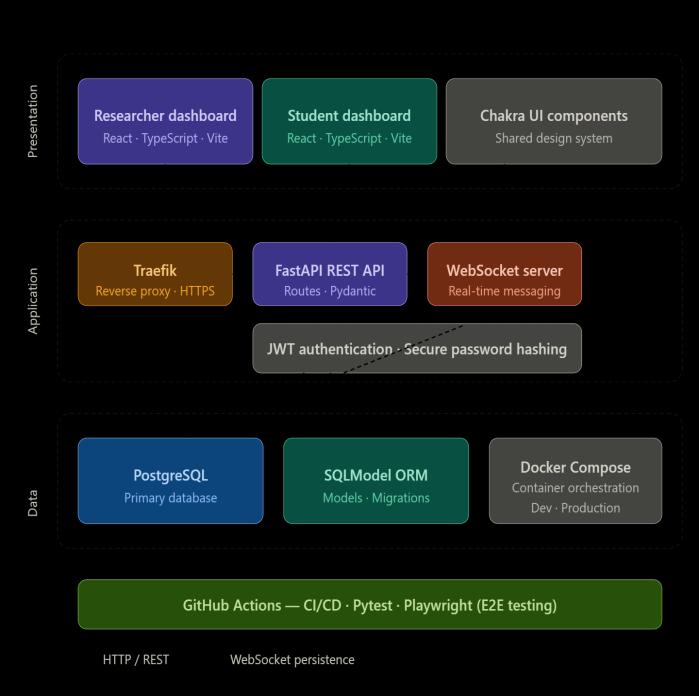
Fig -1:StudyLinkSystemArchitectureDiagram
PresentationLayer-Tworole-baseddashboards,Researcher andStudent,builtwithReact,TypeScript,andVite,andthey bothutilizethesameChakraUIdesignsystem. Application Layer - Traefik is the entry point for the application,anditmanagestheHTTPSrequestsandroutes them to the FastAPI-based REST API or the WebSocket server for the real-time message functionality. JWT and passwordhashingformasharedsecuritylayerforboth Data Layer - PostgreSQL istheprimarydatabase,andit is accessed through the SQLModel ORM. Docker Compose manages all the containers for the application in both developmentandproductionenvironments. The bottom green section represents the CI/CD pipeline, whichismanagedthroughGitHubActionsandcoversboth PytestandPlaywrightforbackendandend-to-endtesting, respectively.
ThepresentationallayerutilizesReactwithTypeScriptand Chakra User Interface (UI) components. The application layerutilizesFastAPI,whichisahigh-performancePython web framework. This exposes a Representational State Transfer(REST)ApplicationProgrammingInterface(API) forstandardoperationsandaWebSocketendpoint.Thedata layerutilizesPostgreSQLastheprimaryrelationaldatabase. SQLModelisutilizedastheObjectRelationalMapper(ORM) to interact with the database. Pydantic is utilized in the entire application layer for data validation and settings management.
TheapplicationutilizesDockerComposetocontainerizethe entire application. This allows the application to have a consistentdeploymentacrossdevelopmentandproduction. Traefikisutilizedasareverseproxyandloadbalancer.This manages incoming traffic and automatic issuance of HypertextTransferProtocolSecure(HTTPS)certificates.
The technology stack of StudyLink has been selected to ensure scalability, maintainability, and developer productivityacross boththefrontendandbackendlayers. Table2summarizesthecompletetechnologystack.
Table -2: StudyLinkTechnologyStack
Layer Technology Purpose
Frontend ReactwithTypeScript User interface and client-sidelogic
Frontend ChakraUI Componentlibraryand styling
Frontend Vite Frontendbuildtool
Frontend Playwright End-to-End (E2E) testing
Backend FastAPI REST API and WebSocketserver
Backend Pydantic Data validation and settings
Backend SQLModel Object Relational Mapper
Backend JWT Authentication and authorization
Database PostgreSQL Primary relational database
DevOps DockerCompose Containerization and deployment
DevOps Traefik Reverseproxyandload balancer
DevOps GitHubActions ContinuousIntegration and Continuous Deployment(CI/CD) Testing Pytest Backend unit and integrationtesting
The backend offers a fully documented interactive API through FastAPI's native OpenAPI support, which can be leveraged by the frontend team and integrators. The ContinuousIntegrationandContinuousDeployment(CI/CD) workflowisimplementedusingGitHubActions,whichtests anddeploysthecodewitheverypushtothemainbranch.
International
Volume: 13 Issue: 03 | Mar 2026 www.irjet.net p-ISSN: 2395-0072
To highlight the unique features of the system being proposed, a feature-based comparison of StudyLink with existing systems like ResearchGate, LinkedIn, and Academia.eduisprovidedinthissection.Thecomparisonis madeonsevenmajorfeaturesthatareconsideredtobeof utmostimportancewithrespecttothestudent-researcher interaction issue identified in Section 3. The complete comparisonisprovidedintheformofatablebelow.
Table -3: FeatureComparisonofStudyLinkwithExisting Platforms
Feature Study Link
Paper publishing
Studentfocused
Mentorship
Internship listings
Verified profiles
Real-time messaging
for students
AsisclearfromTable3,eachoftheseplatformsisgoodat somethingbutfailstoaddressotheraspectsoftheacademic networking problem. ResearchGate is good at publishing papers and networking between researchers but fails to servestudentsasendusersandalsolacksmentorshipand internship features. LinkedIn is good at professional networking and verified profiles but fails to serve the academic community as end users and lacks features for publishing papers and reviewing them. Academia.edu is good at publishing papers but fails to serve the academic communityasendusersandlacksinteractivityandfeatures for students to leverage opportunities. Each of these platformsiswell-establishedintheirowndomainandserves theirpurposewellfortheirendusers. But none of these platforms serve the academic paper publishing and reviewing need along with the studentresearcher mentorship need and the internship need for researchersandthedomain-basedcommunity-buildingneed withinasingleplatform.StudyLinkaimstoservethisneed byprovidingaplatformforalltheseneedswithinasingle platformforstudentsasendusers.Itispertinenttomention herethatasStudyLinkisaproposedplatform,acomparison
of its performance with other platforms is not within the scopeofthispaperandisadirectionforfuturework.
ThissectionelaboratesontheprojectedimpactofStudyLink across four dimensions: impact on students, impact on researchers,impactonthebroaderacademicecosystemin India,andscalabilitypotential.AsStudyLinkisaproposed platform that has not yet been deployed, the impact assessment presented here is based on the problem statementidentifiedinSection3andthefeaturesdescribed inSection4,ratherthanempiricaldatafromliveusage.
ThemostsignificantanddirectimpactofStudyLinkisonthe student community. Currently, students interested in research exposure rely on word of mouth, contacts, and emails,allofwhichareineffectiveandonlyfavorstudents fromwell-connectedinstitutions.StudyLinkaimstoreplace thisineffectivesystemwith atransparent,structured,and accessibleplatform through which researchopportunities arepubliclypostedandhencediscoverablebyeverystudent, irrespectiveoftheirinstitutions.
The paper discovery feature gives students access to a curated list of peer-reviewed research work, which is actively promoted based on their interests, rather than relying on advanced search skills or journal subscription statusfromtheirinstitutions.Thementorshipandinternship listingfeaturegivesstudentsastructuredplatformthrough which they can connect with researchers, eliminating the need for personal networks and contacts. The community building feature gives students a platform through which they can participate in domain-specific academic discussions, promoting their intellectual growth beyond theirowninstitutions.
Thus,allthesefeatureshavethepotentialtobringsignificant democratizationofresearchmentorshipandearlyresearch experiencesforstudentsacrossIndia.
For researchers, StudyLink provides a larger and more engagedcommunitytosharetheirpublishedresearchwith. Currently, research papers published through existing mediums are only being accessed by other researchers. StudyLink is projected to provide access to the student community as well. This will provide more relevance to publishedresearch.Researcherswouldhaveaccesstoapool ofstudents whoareself-selectedandhaveshowninterestin the domain of the researcher by following their profile or readingtheirresearchpapersiftheypostmentorshipand internshipopportunities.Theplatformisexpectedtoreduce the administrative burden on researchers in finding mentorships. Instead of receiving unsolicited emails and
Volume: 13 Issue: 03 | Mar 2026 www.irjet.net p-ISSN: 2395-0072
sorting through them, researchers will have the ability to post mentorships with specific eligibility criteria. The communitybuildingfeaturewillallowresearcherstobuilda community of engaged students and researchers around specificresearchthemes.Thiswillprovideresearcherswith a large community over time. This will make StudyLink a toolfortalentdiscoveryaswell.
India generates a high volume of research material every year, and while there is a gap between the generated materialandtheawarenesslevelofthestudents,StudyLink, being tailored for the Indian context, can help bridge this gap. By creating a space where researchers across the countrycanindextheirmaterial,StudyLinkcanhelpcreatea more interconnected and collaborative community of researchersacrossthenation. Thementorshipandinternshipsystemcanhelpbridgethe gap in the overall research participation rates of undergraduate and postgraduate students. While the scenario is quite different in premier institutes like the Indian Institutes of Technology (IITs) and the Indian Institutesof ScienceEducationand Research(IISERs),the availabilityofformalresearchmentorshipopportunitiesis limited in India. By offering the opportunity for research mentorship,StudyLinkcanhelpbridgethegapintheoverall distributionofresearchopportunitiesacrossthenation.
The technical architecture of StudyLink is also geared towards scalability. For instance, the use of a containerbased approach through Docker Compose is designed to enable horizontal scaling by adding more services as the numberofusersincreases.Thereal-timemessagingsystem based on WebSockets is also designed to scale well to increasingnumbersofconcurrentusersthroughconnection poolinganddisconnectioncleanups.Additionally,theuseof PostgreSQLastheunderlyingrelationaldatabaseandproper indexing of frequently accessed columns such as message timestampsandroomIDsensuresthatdataretrievalisalso performed efficiently as the amount of stored content increases.
Intermsofapplication-levelscalability,theplatformcanbe expandedtoaccommodatetie-upswithvariousuniversities and research centers across the country and the globe, thereby allowing institutional users to be added to the platformaswell.ThemodularFastAPI-basedbackendalso enables the integration of additional features such as artificial intelligence-based paper recommendations and mobile application support without having to change the underlying architecture of the platform. Overall, these various aspects of the StudyLink platform make it highly scalablefromasmallacademicnetworktoanational-level platformforresearchnetworkingandcollaboration.
AlthoughStudyLinkfillsarecognizednichewithinacademic networking, there are a number of challenges associated with its implementation, which must be recognized and addressedforitssuccessandgrowth.
The first and most immediate problem for any two-sided platform such as StudyLink is the cold start problem. The valueoftheplatformcomesfromthesimultaneouspresence of both researchers and students; researchers are only incentivizedtocontributecontentandopportunitieswhen thereisasufficientnumberofstudentstocontributeto,and studentsareonlyincentivizedtocontributewhenthereis sufficientcontentandopportunitiesfromtheresearchers.To solve the cold start problem, a deliberate onboarding strategy will be needed, such as working with a small numberofuniversitiesorresearchinstitutionstoensurea critical mass of verified researchers and active students beforerollingouttheplatformtothewiderworld.
The credibility of StudyLink as an academic platform is heavily dependent on the authenticity of its researcher profiles. Without a proper mechanism of verification, the platform may be flooded with unverified or even fake accountspretendingtoberesearchers,whichcouldfurther lowertheacademiccredibilityoftheplatformforstudents. Adding a verification mechanism, whether through email verification, cross-referencing with existing databases, or evenmanuallythroughamoderationteam,addstechnical and operational complexity, which must be managed, especiallyduringtheearlystageswhenthemoderationteam issmall.
ThefeatureofcommunitybuildingwithinStudyLink,though importantforacademicdiscussions,alsoposesthechallenge ofmoderationofthecontentwithinthesecommunities.For instance, academic communities can be open to off-topic discussions or the presence of spams and inappropriate content if not moderated properly. The need to develop guidelines for these communities and to moderate the contentwithinthesecommunitiesisessentialforensuring the quality of the interactions within these communities. This is an ongoing challenge for the platform and is proportionaltothenumberofcommunitiesandactiveusers withintheplatform.
Volume: 13 Issue: 03 | Mar 2026 www.irjet.net p-ISSN: 2395-0072
StudyLink is entering a domain where there already exist well-establishedplatformssuchasResearchGate,LinkedIn, andAcademia.edu,eachofwhichhasalargeandactiveuser base.Amajorchallengefortheadoptionofthenewplatform is to convince the existing users of the other platforms to invest their time in developing a presence on the new platformaswell.Thisiswherethenewplatformneedsto haveadifferentiatedvalueproposition,especiallyintermsof itsstudent-centricfeaturesandthesystemofmentorship,to warranttheadditionaleffortrequiredfromtheresearchers todevelopapresenceonthenewplatform.
Asaconcept,StudyLinkhastremendousopportunitiesfor growth and development, and several areas have been identifiedforitsfuturedevelopment.
The inclusion of Artificial Intelligence (AI) based paper recommendation systems will allow the platform to proactively recommend relevant research content to studentsbased ontheirreadinghistory,followedauthors, andexpressedinterests,thustakingthesearchforresearch content to the next level. This will greatly enhance the overallstudentexperienceontheplatform. Institutionaltie-upswithuniversities,colleges,andresearch organizations will be one of the major growth areas for StudyLink. The inclusion of verified institutional accounts willallowuniversitiestoonboardtheirfacultymembersand studentsinbulk,thuslendingcredibilitytotheplatform.In addition,thiswillalsoallowStudyLinktobeintegratedinto the overall learning environment of the university, thus becoming an extension of the university’s learning managementsystem.
ThedevelopmentofamobileapplicationforbothAndroid andiOSplatformswouldfurtherenhancetheaccessibilityof StudyLink, especially for students from India, as most studentsareusedtoconsumingonlinecontentthroughtheir smartphonedevices.
Theabilityforresearcherstotracktheircitationsthrough theplatformwouldallowthemtokeeptrackoftheacademic footprintoftheirpublishedcontent,providinganadditional layer of research analytics currently not offered through otherplatforms,suchasGoogleScholar. The gamification of the platform, including providing researcherswithachievementbadges,contributionpoints, and leaderboards for active community members, would furtherincreasestudentengagementandparticipation. Theabilityforresearcherstoearnresearchpointsthrough activities on the platform, such as reading papers, participating in community discussions, and completing mentorshipprograms,couldbeusedasa credibleform of academicengagementbystudentsontheirprofiles.
The current research ecosystem has suffered from a fundamentaldisconnectbetweentheneedsofresearchers and those of students for a long period of time. Current platforms have tried to solve this problem only partially; somehavefocusedonpapersharingforresearchers,while others have focused on professional networking for researchers. None of these platforms have attempted to integrate a single platform where students can discover research,networkwithresearchers,receivementorship,and findresearchinternshipswithinasingleplatform.StudyLink isproposedasadirectsolutionfortheseproblemswithina single platform for paper publishing for researchers, mentorshipforstudents,research-specificinternshiplistings for students, domain-specific community building for researchersandstudents,andreal-timecommunicationfor researchersandstudents.
Out of the many features proposed in StudyLink, the structured mentorship and research-specific internship listingareproposedasthemostimpactfulcontributionsto the current research ecosystem for the following reasons: thesetwofeaturesdirectlytacklethebiggestproblemfacing studentstoday:thelackofaverifiedmethodofcontacting researchers for mentorship and the lack of a transparent methodofdiscoveringresearchinternshipopportunities.By replacing the current informal method of cold-emailing researchers with a structured application-based method accessibletoallstudentsacross allinstitutions,StudyLink hasthepotentialtodirectlytackletheinequalityofresearch opportunitiesthatexistsacrossinstitutionsinIndiatoday. ThelargerpotentialofStudyLinkgoesbeyond thecurrent scopeofaplatform;itisasteptowarddemocratizingaccess to research mentorship and creating a world where academicresearchbecomesaninclusiveandparticipatory experience for all students across all institutions in India, regardless of their personal or institutional networks. StudyLinkhasthepotentialtobecomeastructuralshiftin howthenextgenerationofresearchersdiscovers,engages with,andcontributestotheworldofacademicresearch.
International Research Journal of Engineering and Technology (IRJET) e-ISSN: 2395-0056
[1] ResearchGate GmbH, "ResearchGate Find and share research," ResearchGate, 2008. [Online]. Available:https://www.researchgate.net
[2]Academia,Inc.,"Academia.edu Shareresearch," Academia.edu, 2008. [Online]. Available: https://www.academia.edu
[3]GoogleLLC,"GoogleScholar Searchenginefor scholarlyliterature,"Google,2004.[Online].Available: https://scholar.google.com
[4] LinkedIn Corporation, "LinkedIn Professional networking platform," LinkedIn, 2003. [Online]. Available:https://www.linkedin.com
[5]T.Peoples,"Theroleofonlineacademicnetworks in research collaboration," Journal of Academic Librarianship,vol.44,no.3,pp.314–322,2018.
[6]S.MancaandM.Ranieri,"IsResearchGateusefulfor scholarlycommunication?Adescriptivestudy,"Journal ofComputerAssistedLearning,vol.33,no.2,pp.112–122,2017.
[7]A. Thelwall andK.Kousha, "Academia.edu: Social network or academic network?" Journal of the Association for Information Science andTechnology, vol.65,no.4,pp.721–731,2014.
[8]R.BhattandP.Sharma,"Bridgingthegapbetween studentsandresearch:Challengesandopportunitiesin EdTech platforms," International Journal of EducationalTechnologyinHigherEducation,vol.18, no.1,pp.1–19,2021.
[9]FastAPI,"FastAPI Modern,fastwebframework for building APIs with Python," Tiangolo, 2019. [Online].Available:https://fastapi.tiangolo.com
[10]React,"React AJavaScriptlibraryforbuilding userinterfaces,"MetaPlatforms,Inc.,2013.[Online]. Available:https://react.dev
Volume: 13 Issue: 03 | Mar 2026 www.irjet.net p-ISSN: 2395-0072 © 2026, IRJET | Impact Factor value: 8.315 | ISO 9001:2008 Certified Journal | Page2037