
International Research Journal of Engineering and Technology (IRJET) e-ISSN: 2395-0056
Volume: 12 Issue: 11 | Nov 2025 www.irjet.net p-ISSN: 2395-0072
International Research Journal of Engineering and Technology (IRJET) e-ISSN: 2395-0056
Volume: 12 Issue: 11 | Nov 2025 www.irjet.net p-ISSN: 2395-0072
TEGACHARLA VENKATA RATNAM [1], I.V. RAMANA REDDY [2]
1PG Student, Dept. of Civil Engineering, SV University College of Engineering, Tirupati, Andhra Pradesh India
2Professor, Dept. of Civil Engineering, SV University College of Engineering, Tirupati, Andhra Pradesh, India. *** -
Abstract: Concrete’s versatility, durability, and cost-effectiveness, it as the most widely used construction material globally. It is typically a composite mixture of fine aggregates (such as sand), coarse aggregates (like gravel or crushed stone), and a binding paste made from water and cement often Ordinary Portland cement (OPC). Admixtures are frequently added to enhance specific properties. A proper understanding of concrete fundamentals and an optimized mix design are essential for achieving the desired strength, workability, and durability, while also maintaining cost efficiency and minimizing material waste. This experimental study focuses on evaluating the strength characteristics of M25 grade concrete produced in both laboratory and site environments. Given that site conditions such as exposure to varying temperatures, curing methods, and casting durations differ significantly from controlled laboratory conditions, this investigation aims to assess whether laboratory-tested concrete strength translates effectively to real-world site performance. The study further examines how concrete strength varies over time (0h, 1h, and 2h) through slump tests conducted at 30-minute intervals for simulate site conditions, both with and without the addition of admixtures. Compressive strength is evaluated for 7, 28, and 90-day cured specimens.
Keywords: Concrete Mix Design, M25 Grade Concrete, Admixture, Compressive Strength, Slump Test.
1 INTRODUCTION: Thestudyinvestigatesoverallperformanceofconcretedependsnotonlyonthemixdesignbutalsoon site-specificfactorssuchasmixingmethods,placingtechniques,andcuringconditions.Laboratory-mixedconcreteisprepared undercontrolledconditionsusingstandardizedequipment,whichallowsprecisecontrolovermixproportionsanduniform mixing. However, small-scale laboratory mixers may not always replicate the mixing efficiency of commercial Ready-Mix Concrete (RMC) plants. RMC benefits from mechanized, large-capacity mixers that generally provide more uniform and consistentmixing,potentiallyresultinginimprovedworkabilityandstrength.Despitetheseadvantages,site-specificfactorssuch astransportationdelays,temperaturefluctuations,andcuringpracticescanaffectthestrengthdevelopmentandperformanceof RMCon-site.ComparingthebehaviourofM25gradeconcreteproducedinlaboratoryandRMCenvironmentsisessentialto identifydiscrepanciesinstrength,workability,anddurability.Suchevaluationenablesbetterunderstandingandoptimizationof mixdesignsandhandlingprocedures,ensuringreliableandconsistentconcretequalityinreal-worldconstructionprojects.
2 Review of Literature
2Er.Khalil Rahman Farhat and Er. Masood Jamali (2022)., ThisresearchpapergivestheEffectofAdmixtureonPropertiesof Concrete.Concreteisamanormachine-madeconstructionmaterial,andthathasmoreusageintheconstructionfield,itis necessarytomakeconstructionsecureandsafeformakinghighstrengthconcrete.
3Izabela Skrzypczak, Agnieszka Le´sniak, Piotr Ochab, Monika Górka, Wanda Kokoszka and Anna Sikora (2021)., This studyshowsRMCconcretequalityperformedforconcretemixandhardenedconcrete,whereasindividualanalysisoftheresults allowsthelaboratoryqualitysystemtobeimproved.
6S. Manikandan and P. Jaya Karthik Reddy (2022)., ExploredArtificialIntelligence(AI)inconcretequalitycontrol.Byusing sensors to analyse water-cement ratio and mix proportions, their approach reduces manual labour, cost, and time while improvingconcretequality.
4Ishfaq Bashir Wani, Dr. R. VenkataKrishnaiah (2022).,Thispapershowsthebehaviourofhighstrengthconcreteadditionof superplasticizer,stonedustandlaboratoryinvestigation.High-gradestrengthConcreteismostlyusedforvariousapplications intheconstructionofconcretestructures.
5Prashant M.Dhamanageand V.Nagendra(2020).,examinedhighstrengthconcreteusingmineraladmixtures.Theirfindings suggest that partial cement replacement enhances workability, strength and making it suitable for specialized structures.
1Akoba A.S, Phulari R.C, Kembhavi S.B(2020)., This study shows Materials scientists, substances named admixtures. developed Eco and Crack-Free High-performance concrete incorporating recycled recycled (Eco-HPC), materials for sustainability. Their study optimized binder systems, aggregate packing, and shrinkage resistance, validating structural performanceforpavements(Eco-Pave-Crete)andbridges(Eco-Bridge-Crete).
International Research Journal of Engineering and Technology (IRJET) e-ISSN: 2395-0056
Volume: 12 Issue: 11 | Nov 2025 www.irjet.net p-ISSN: 2395-0072
3. Objectives: Thepresentinvestigationaimstoachieveseveralkeyobjectives(1)Tocomparethestrengthparametersof concreteproducedatanRMCplantandattheconstructionsite,(2)Toestimatetheeffectivestrengthdevelopmentofconcrete overtime,withandwithouttheuseofadmixtures,underlaboratoryconditions,(3)Tocomparethestrengthparametersof concrete from site-cast samples and laboratory-prepared specimens, (4) To assess the variation in concrete strength correspondingtochangesinslumpoverdifferenttimeintervals.
4. Materials and Methodology
4.1 Cement: TheexperimentmadeuseofregularOrdinaryPortlandCement(OPC)53asperIS12269:1987andThebelow Table1showsthePhysicalpropertiesoftheCement.
Table 1 PhysicalPropertiesofOPC53gradeCement(UltraTech)
Physical Properties
CompressiveStrength (N/mm2) 3days
3.1–3.5asperIS4031 part11(1988)
Min27N/mm2
Min37N/mm2
days 62 Min53N/mm2 InitialSettingTime(min) 160 Notlessthan30min FinalSettingTime(min) 250 Notmorethan600min
4.2 Fine Aggregate: Thefineaggregateswerecollectedfrompachikapallem,nearbyTirupatiandtheirpropertiesare presentedinTable2
Table 2 Physical Properties of Manufacture Sand
Physical Properties
4.3 Coarse Aggregate: The20mmand12.5mmtwotypesofcoarseaggregateswereusedinthisproject,propertiesare shownintable3and4
Table 3 Physicalpropertiesof20mmcoarseaggregate
Properties
per IS 383-2016 and IS 2386(Part-1)
International Research Journal of Engineering and Technology (IRJET) e-ISSN: 2395-0056
Volume: 12 Issue: 11 | Nov 2025 www.irjet.net p-ISSN: 2395-0072
Table 4 Physicalpropertiesof12.5mmcoarseaggregate
Sieveanalysis Single
4.4 Water: Twotypeofwatersamplesareusedintheproject,onesampleatsiteandanothersampleatlaboratory.Thetest datais
pH value at Site -8
pH value at Laboratory -6.52
4.5 Chemical Admixture: TheSuper-PlasticizerofSCMaximoPlastPC200isusedintheconcreteforthepreparationof concretemix,propertiesareshowninTable5.
Table 5 PropertiesofSuper-Plasticizer
S. No Tests Obtained Values IS: 9103 Limits (Re affirmed 2018) UOM 1 Appearance Lightbrown
5ofvaluestatedby themanufacturer
bymass 3
1.078 0.02ofthevalue statedbythe manufacturer -
Within10percentofthe valueorwithin0.2 percentwhicheveris greaterasstatedbythe manufacturer %bymass 5 pH 7.61 Min.6 Nounit
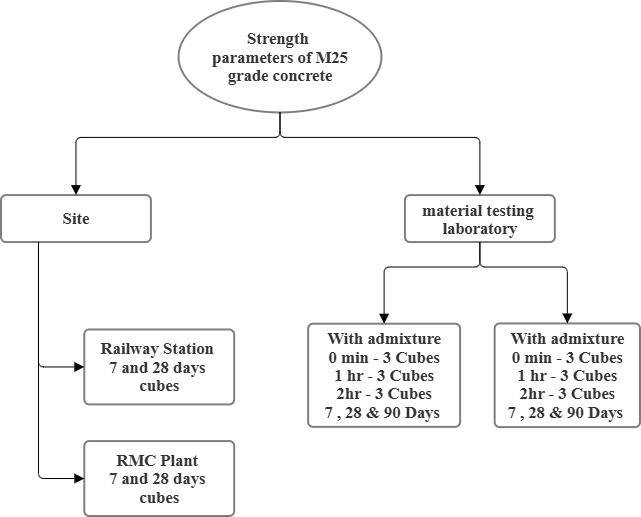
4.6 Methodology: ThisstudyinvestigatesthestrengthperformanceofM25gradeconcretethroughacombinationoffieldand laboratory testing. Standard cubes (150 mm × 150 mm × 150 mm) were cast and tested at 7, 28, and 90 days. Field investigations involved concrete site inspections at an in-situ. In the laboratory, concrete mixes were prepared with and withoutpolycarboxylate-basedsuperplasticizeradmixturesandtestedatdifferenttimeintervalstostudystrengthvariations fordetailedinvestigationshowninbelowFig1.
International Research Journal of Engineering and Technology (IRJET) e-ISSN: 2395-0056
Volume: 12 Issue: 11 | Nov 2025 www.irjet.net p-ISSN: 2395-0072
4.7 Mix Design
ThetwotypesofM25gradeconcretemixdesignsareusedinthisprojectlikewithandwithoutadmixturedesignedas percodesIS10262-2019,IS456-2000andproportionsarelistedbelowTable6and7
Table 6 M25GradeConcreteDesignMixwithAdmixture
5 Tests Conducted on Concrete
Table 7 M25GradeConcreteDesignMixwithoutAdmixture
5.1 Wet Concrete: Slump Cone Test
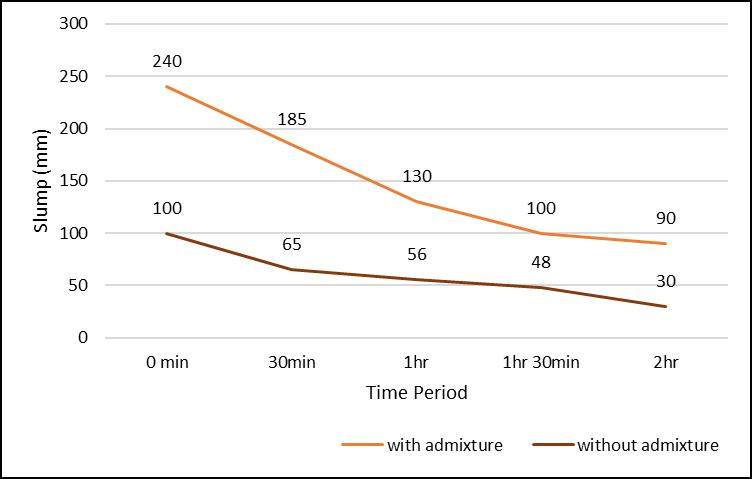
The below Fig 2 graphically compares the change in slump value (workability) over time for concrete mixes with admixture(ModifiedMix)andwithoutadmixture(ControlMix),demonstrating theadmixture'scriticalroleinslump retention
International Research Journal of Engineering and Technology (IRJET) e-ISSN: 2395-0056
Volume: 12 Issue: 11 | Nov 2025 www.irjet.net p-ISSN: 2395-0072
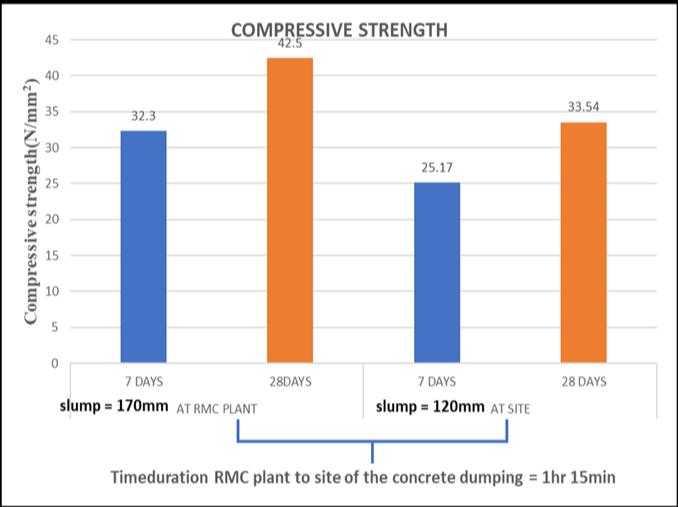
6.1 Compressive Strength Test:ThebelowFig3,showsthevariationincompressivestrengthofconcretebetweentheRMC plantandthesite.Thecompressivestrengthvaluesat7and28daysare32.3 N/mm²and42.5 N/mm²attheRMCplant,and 25.17 N/mm²and33.54 N/mm²atthesite,respectively.Thesevariationsareobservedalongwiththeslumpchangesandare basedonconsiderationsoftransportationtimeandconcretedumpingatthesite.
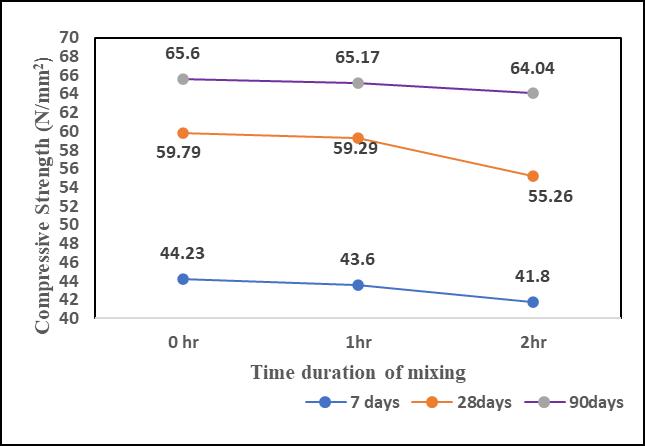
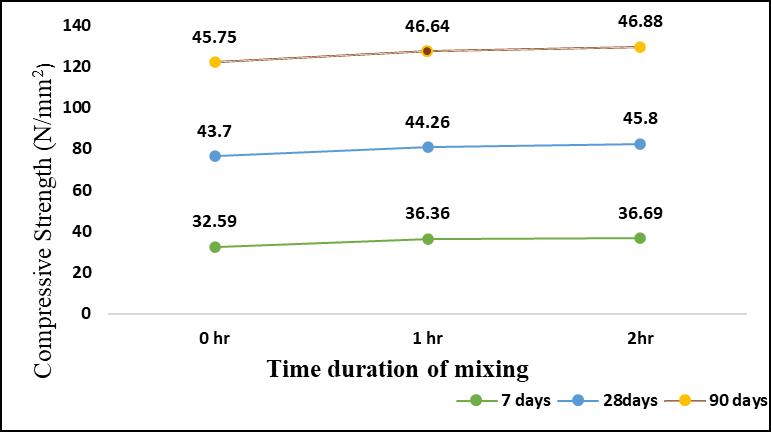
ByobservingthetwoFiguresbelow,thebehaviourofconcretewithandwithouttheadditionofadmixtureovertimecanbe understood.Fromthe referenceofthesegraphs,itisobserved thatwhenadmixturesareused,thecompressivestrength decreaseswithtime,asshowninFig4.Incontrast,theconcretewithoutadmixtureshowsanincreaseincompressivestrength withtimeduration,asillustratedinFig5.
International Research Journal of Engineering and Technology (IRJET) e-ISSN: 2395-0056
Volume: 12 Issue: 11 | Nov 2025 www.irjet.net p-ISSN: 2395-0072
AttheRMCplantoffreshconcreteis29%and27%higherthecompressivestrengththansiteconcrete7and28days respectively.
Theusageofconcretewithadditionofadmixturesleadstodecreaseinstrengthinlinearmannerwithtimeduration.
TheMaximoPlastPC200waspreparedbyPolycarboxylicetherchemical,thiswillcauseair-entrainmentinconcrete andtheimprovementofworkabilityalsocausesair-entrainmentinconcrete.
Theair-entrainmentinconcretereducesthecompressivestrengthofconcretealongwithtimeduration.
Concretewithoutadmixturestendstogainstrengthgraduallyinalinearmannerwithtimeduration.
Along-timemixingofconcrete willresultinincreaseofcompressivestrengthofconcretewithinlimits,duetomixing overlongperiodstheeffectivewater/cementratiogetsreduced,owningtotheabsorptionofwaterbyaggregateand evaporationanditisalsopossiblethattheincreaseinstrengthmaybeduetotheimprovement workabilityonaccount ofexcessfines,resultingfromtheabrasionandattritionofcoarseaggregateinthemix,andfromthecoarseaggregate becomingrounded.
At laboratory fresh concrete is 24% and 27% higher the compressive strength than site concrete 7 and 28 days respectively.
International Research Journal of Engineering and Technology (IRJET) e-ISSN: 2395-0056
Volume: 12 Issue: 11 | Nov 2025 www.irjet.net p-ISSN: 2395-0072
Addingadmixtureinconcreteoverallstrengthabout30%highthannormalconcreteanddurabilityoftheAdmixtures arehelpingtocontrolthewatercontentinconcrete,therebyimprovingitsworkabilityandenhancingmix.
Theworkabilityofconcretehasadirectinfluenceonitsstrengthdevelopmentabout27%,asproperworkability ensuresadequatecompactionandgaintheuniformstrength.
1. AkobaA.S,PhulariR.C,KembhaviS.B,N.A.Gram,DepartmentofCivilEngineering/internationaljournalonhuman computingstudiesComparisonofstrengthbetweennormalconcrete&admixtureconcrete”Volume:02Issue:02| 2020.
2. “Er. Khalil Rahman Farhat and Er. Masood Jamali/ International Research Journal of Engineering and Technology (IRJET)“EffectofAdmixtureonPropertiesofConcrete”Volume:09Issue:10|Oct2022.
3. IzabelaSkrzypczak,AgnieszkaLe´sniak,PiotrOchab,MonikaGórka,WandaKokoszkaandAnna“SikoraInterlaboratory ComparativeTestsinReady-MixedConcreteQualityAssessment”materials2021.
4. Ishfaq Bashir Wani, Dr. R. Venkata Krishnaiah/ International Research Journal of Modernization in Engineering TechnologyandScience”experimentalinvestigationonhighgradeconcreteaddingwithadmixturesandstonedust” Volume:03/Issue:01/January2022.
5. PrashantM.Dhamanage,Student,V.NagendraProfessor.,CivilEngineeringDepartment,P.V.P.I.T.BudhgaonSangli MaharashtraIndia/InternationalResearchJournalofEngineeringandTechnology(IRJET)“highstrengthconcrete usingadmixtures”Volume:07Issue:08|Aug2020.
6. S. Manikandan (Assistant Professor, Civil Engineering, Panimalar Engineering College, Chennai and P. Jayakarthikreddy(UGScholar,CivilEngineering,PanimalarEngineeringCollege,Chennai)“realtimeconcretequality controlatsiteusingartificialintelligence”2022IJNRD|Volume7,Issue5May2022|ISSN:2456-4184|IJNRD.ORG.