
International Research Journal of Engineering and Technology (IRJET) e-ISSN: 2395-0056
Volume: 13 Issue: 02 | Feb 2026 www.irjet.net p-ISSN: 2395-0072
STUDENT PERFORMANCE PREDICTION SYSTEM
Shruti Lokhande1 , Anjali Shendge2 , Asmita Lahane3 , Poonam Pawar4, PROF. Manisha Kapse5
1,2,3,4 (Students, Department of Computer Engineering), S.Y.P Shreeyash College Of Engineering And Technology (Polytechnic), Chh. Sambhajinagar , India 5(Professor, Dept. of Computer Engineering), S.Y.P Shreeyash College Of Engineering And Technology (Polytechnic), Chh.Sambhajinagar , India
Abstract - Student performancepredictionisanimportant area in the field of education and data analysis. This paper presents a Student Performance Prediction System that uses machine learning techniques to predict students’ academic results based on various factors such as attendance, previous marks, study time, participation, and other personal or academic details. The main goal of the system is to identify students who may need extra support at an early stage. The proposed system collects and processes student data, applies data preprocessing techniques, and trains different machine learning models to predict performance outcomes. The model with the best accuracy is selected for final prediction. The system helps teachers and educational institutions make informed decisions to improve student success rates.
Key Words: Student Performance Prediction, Machine Learning, Educational Data Mining, Academic Analysis, Predictive Modelling, Learning Analytics
1. INTRODUCTION
Education plays a very important role in personal and professionaldevelopment.Academicperformance,especially of students, is considered a supportive key indicator reflecting their progress of learning and future success. However, many students undergo a lot of difficulties in studying due to different academic, personal, and social factors.Theidentificationofsuchstudentsatanearlystage would assist teachers and institutions in providing timely supportandguidance.
Inthismodernage,withthegrowthoftechnologyanddigital learning systems, a lot of data about students can be obtained. They include attendance, previous examination marks, assignment scores, study hours, participation in activities,andeveryrelevantfactor.Suchdatacanthenbe usedtomakemoreaccuratepredictionsconcerningstudent performancebyutilizingdataminingandmachinelearning analysis.
These techniques analyze the historical data and identify patternsintheStudentPerformancePredictionSystemthat influence academic outcomes. It will classify students in terms of their expected performances and highlight those students who may need special attention. This will help
teachersmakeinformeddecisionsandenhancethequalityof educationoverall.
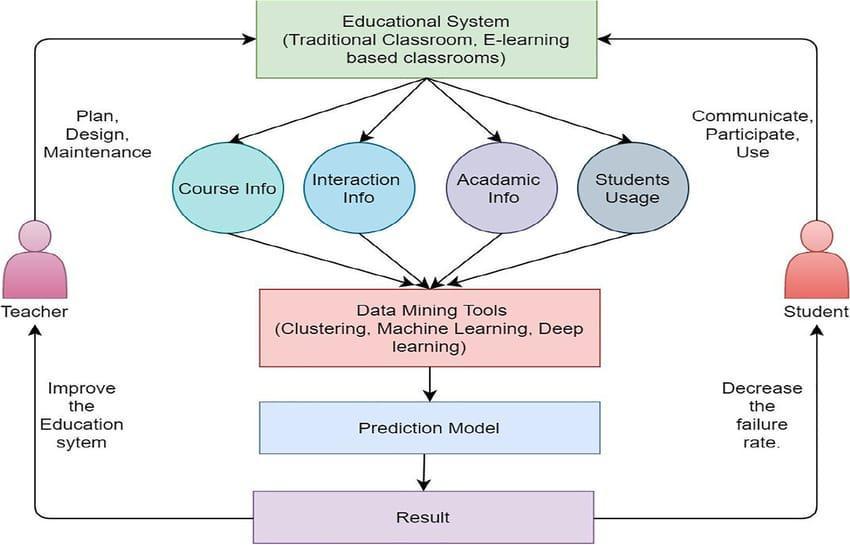
1. Educational System Layer
Atthetoplevel,the Educational System formsthe operationalenvironment.Itincludes:
Traditionalclassroomlearning
E-learningoronlinelearningplatforms
Hybridlearningenvironments
Theeducationalsystemactsastheprimarysourceofdata andinteractionbetweenteachersandstudents.
1) Roles in the System
Teachers:Responsibleforplanning,designing, andmaintainingcoursestructureandcontent.
Students:Engagewiththesystemby communicating,participating,andusingacademic resources.
International Research Journal of Engineering and Technology (IRJET) e-ISSN: 2395-0056
Volume: 13 Issue: 02 | Feb 2026 www.irjet.net p-ISSN: 2395-0072
2. Data Collection Layer
Thesystemcollectsmultipletypesofstudent-relateddata fromtheeducationalenvironment:
2) a) Course Information
Includes:
Coursematerials
Syllabusstructure
Assignmentsandquizzes
Teachingstrategies
Coursedifficultylevel
3) b) Interaction Information
Includes:
Student-teachercommunication
Forumdiscussions
Onlineactivitylogs
Attendancerecords
Participationfrequency
4) c) Academic Information
Includes:
Previousgrades
Internalassessmentscores
Examinationresults
GPA
Academichistory
5) d) Student Usage Data
Includes:
Loginfrequency
Timespentonlearningplatforms
Resourceaccesspatterns
Submissiontimelines
Clickstreamdata
Thesedatasetscollectivelyprovideamultidimensional viewofstudentbehaviorandacademicengagement.
3. Data Mining Layer
Allcollecteddataisprocessedusing Data Mining Tools, whichmayinclude:
Clusteringalgorithms
Classificationtechniques
Regressionmodels
Machinelearningalgorithms
Deeplearningapproaches
Thepurposeofthislayeristo:
Identifyhiddenpatterns
Detectat-riskstudents
Discoverbehavioraltrends
Extractmeaningfulfeaturesfromrawdata
Thisstagetransformsraweducationaldatainto structuredandanalyzableknowledge.
4. Prediction Model Layer
Theprocesseddataisfedintoa Prediction Model,which mayinclude:
LogisticRegression
DecisionTrees
RandomForest
SupportVectorMachines
NeuralNetworks
DeepLearningmodels
Thepredictionmodelaimsto:
Predictstudentacademicperformance
Forecastpass/failoutcomes
Estimategraderanges
Identifydropoutrisk
Measureprobabilityofacademicsuccess
5. Result and Feedback Layer
Thefinaloutputofthesystemisthe Result,which provides:
Performanceprediction
Riskclassification(low,medium,highrisk)
Personalizedrecommendations
Earlywarningalerts
6) Impact of Results:
For Teachers:
o Improvecoursedesign
o Modifyteachingstrategies
o Providetargetedinterventions
o Enhanceoveralleducationalquality
For Students:
o Reducefailurerate
o Receivepersonalizedacademicguidance
o Improvestudystrategies
o Increaseacademicsuccessprobability
II. LITERATURE SURVEY
Predicting student academic performance has become a prominentresearchareaineducationaldatamining(EDM) due to the increasing availability of student-related data generatedbylearningmanagementsystems(LMS),online platforms,andtraditionalclassrooms.Theobjectiveofthese systems is to leverage historical and real-time data to identify at-risk students, enhance instructional strategies, andimproveoveralleducationaloutcomes.
International Research Journal of Engineering and Technology (IRJET) e-ISSN: 2395-0056
Volume: 13 Issue: 02 | Feb 2026 www.irjet.net p-ISSN: 2395-0072
Early studies focused primarily on the use of traditional statistical techniques to explore relationships between student demographic attributes and academic success. Romero and Ventura (2007) pioneered the use of educationaldataminingtoextractpatternsfromeducational datasets, demonstrating that student behavior, when analyzedcorrectly,canforecastfutureoutcomes.Theirwork laidthefoundationforlinkingacademicdatawithpredictive modelsthatassisteducatorsindecision-makingprocesses.
Inthelastdecade,researchershavetransitionedfromsimple statisticalmethodssuchaslinearregressionandcorrelation analysistomoresophisticatedmachinelearningapproaches. Forexample,Kotsiantisetal.(2004)comparedclassification algorithmssuchasDecisionTrees,NaiveBayes,andSupport VectorMachinesinpredictingstudentgrades,findingthat ensemblemethodsoftenoutperformtraditionalclassifiers. These studies highlight the benefit of machine learning in handling complex and non-linear relationships within educationaldatasets.
Recent literature reflects a noticeable shift toward deep learninganddata-drivenapproaches.Deepneuralnetworks, suchasLongShort-TermMemory(LSTM)andConvolutional NeuralNetworks(CNN),havebeenappliedtosequentialand behavioral data tocapturetemporal engagement patterns that traditional techniques cannot extract. Al-Balawi et al. (2018) successfully utilized recurrent neural networks to model student activity logs in online courses, showing significantimprovementinpredictionaccuracycomparedto baselinemodels.
Several researchers have also emphasized feature engineering as a critical step in performance prediction. Studentinteractionlogs,resourceaccesspatterns,time-ontask measurements,and forumparticipation metricshave been shown to contribute strongly to predictive accuracy. For example, Yang and Liu (2019) demonstrated that combiningacademicscoreswithinteractiondatafromLMS platformssignificantlyenhancesthemodel’sabilitytodetect earlysignsofstudentdisengagement.
III. Proposed Methods
1. Overview
This study proposes a data-driven Student Performance Prediction System that integrates educational data collection, preprocessing, feature engineering, machine learningmodeling,andperformanceevaluation.Theprimary objective of the proposed method is to accurately predict studentacademicoutcomesandidentifyat-riskstudentsat anearlystagetoenabletimelyintervention.
2. Data Collection
Theproposedsystemcollectsmultidimensionaldatafrom the educational environment (traditional and e-learning platforms).
3. Data Preprocessing
Beforemodeldevelopment,thecollecteddataundergoes preprocessingtoimprovequalityandconsistency.
4. Feature Engineering and Selection
Featureengineeringisperformedtoenhancemodel performance.Derivedfeaturesinclude:
Engagementscore(basedonloginfrequencyand timespent)
Assignmentconsistencyindex
Participationratio
Performanceimprovementtrend
5. Model Development
Theproposedsystememploysahybridmachinelearning approachcombiningsupervisedlearningtechniques.
6. Model Evaluation
Theperformanceoftheproposedmodelsisevaluated usingstandardmetrics
7. Prediction and Early Warning Mechanism
Thefinaltrainedmodelisintegratedintotheeducational systemtoprovidereal-timepredictions.
8. System Workflow Summary
1. Collectmultidimensionalstudentdata.
2. Cleanandpreprocessthedataset.
3. Extractandselectrelevantfeatures.
4. Trainmultiplemachinelearningmodels.
5. Evaluateandselecttheoptimalmodel.
6. Deploythemodelforcontinuouspredictionand intervention.
9. Advantages of the Proposed Method
Earlyidentificationofat-riskstudents
Data-drivenacademicdecision-making
Improvedteachingstrategies
Reducedfailureanddropoutrates
Scalableforbothtraditionalandonlineeducation systems
International Research Journal of Engineering and Technology (IRJET) e-ISSN: 2395-0056
Volume: 13 Issue: 02 | Feb 2026 www.irjet.net p-ISSN: 2395-0072
IV. OBJECTIVES OF THE PROJECT
The primary objective of this project is to design and implement an intelligent Student Performance Prediction Systemcapableofanalyzingacademicandbehavioraldatato forecast student outcomes accurately. The system aims to support educators and institutions in making data-driven decisions that enhance learning effectiveness and reduce academicfailurerates.
Thespecificobjectivesoftheprojectareasfollows:
1. To Develop a Data-Driven Prediction Framework
To design a comprehensive framework that integrates academicrecords,interactiondata,courseinformation,and studentusagepatternsintoaunifiedpredictivemodel.The system should efficiently handle structured and semistructurededucationaldatacollectedfromtraditionalandelearningenvironments.
2. To Identify Key Factors Influencing Student Performance
Toanalyzeanddeterminethemostsignificantacademicand behavioralfeaturesthatinfluencestudentsuccessorfailure. This includes evaluating factors such as attendance, participation,assignmentsubmissionpatterns,assessment scores,andengagementlevels.
3. To Implement and Compare Machine Learning Models
To implement multiple machinelearning and data mining algorithms(e.g.,LogisticRegression,DecisionTrees,Random Forest, Support Vector Machines, Neural Networks) and evaluate their effectiveness in predicting student performance.Theobjectiveistoidentifythemostaccurate andreliablemodelforthegivendataset.
4. To Predict Academic Outcomes at an Early Stage
Todevelopapredictivemechanismcapableofidentifyingatrisk students early in the academic term. Early prediction enables timely intervention strategies, mentoring, and personalizedacademicsupport.
5. To Design an Early Warning and Feedback System
To create a system that provides actionable insights and performance reports to both educators and students. Teachers can use this information to modify instructional strategies, while students can receive personalized recommendationstoimprovetheirperformance.
6. To Improve Educational Quality and Reduce Failure Rates
To contribute to the enhancement of overall educational effectivenessbyreducingstudentdropoutrates,minimizing
academicfailures,andpromotingstudentsuccessthrough data-driveninterventions.
7. To Ensure Scalability and Adaptability
Todesignthesysteminascalablemannersothatitcanbe appliedacrossdifferentinstitutions,courses,andlearning environments, including traditional classrooms, blended learningsystems,andfullyonlineplatforms.
8. To Enhance Model Accuracy and Generalization
Toapplyappropriatepreprocessing,featureselection,and validation techniques to ensure that the developed model maintains high accuracy, robustness, and generalizability acrossdifferentstudentpopulations.
CONCLUSIONS
ThisstudypresentedacomprehensiveStudentPerformance Prediction System designed to analyze academic and behavioral data for forecasting student outcomes. By integrating course information, academic records, interaction logs, and usage patterns within a unified framework, the proposed system demonstrates the effectiveness of data-driven approaches in educational environments.
The implementation of machine learning and data mining techniquesenablesaccurate identificationofpatternsand relationships that influence student success. Through preprocessing, featureengineering,andmodel evaluation, thesystemeffectivelypredictsacademicperformanceand classifiesstudentsbasedonrisklevels.Comparativeanalysis ofmultiplealgorithms ensurestheselection ofanoptimal predictivemodelwithhighaccuracyandreliability.
Oneofthekeycontributionsofthisworkisthedevelopment ofanearlywarningmechanismthatallowsinstitutionsand educatorstodetectat-riskstudentsatanearlystage.This proactive approach supports timely interventions, personalized guidance, and improved teaching strategies, ultimatelyreducingfailureanddropoutrates.
Furthermore,thesystemestablishesacontinuousfeedback loop between students, teachers, and the educational platform.Theinsightsgeneratedfrompredictiveanalytics assisteducatorsinrefiningcoursedesignandinstructional methods, while students benefit from actionable recommendationsthatenhancetheirlearningoutcomes.
Although the proposed model demonstrates promising results, challenges such as data heterogeneity, privacy concerns, and model generalization across institutions remainareasforfurtherresearch.Futureworkmayfocuson incorporatingadvanceddeeplearningtechniques,real-time analytics,explainableAImethodsformodelinterpretability,
International Research Journal of Engineering and Technology (IRJET) e-ISSN: 2395-0056
Volume: 13 Issue: 02 | Feb 2026 www.irjet.net p-ISSN: 2395-0072
andcross-institutionalvalidationtoenhancerobustnessand scalability.
Inconclusion,theStudentPerformancePredictionSystem representsasignificantsteptowardintelligent,data-driven education. By leveraging predictive analytics, the system contributesto improvedacademic performance,informed decision-making, and the overall enhancement of educationalquality.
[1]C.RomeroandS.Ventura,“EducationalDataMining:A ReviewoftheStateoftheArt,” IEEETransactionsonSystems, Man, and Cybernetics, Part C (Applications and Reviews),vol. 40,no.6,pp.601–618,2010.
[2]C.RomeroandS.Ventura,“Data Mining inEducation,” WileyInterdisciplinaryReviews:DataMiningandKnowledge Discovery,vol.3,no.1,pp.12–27,2013.
[3] S. B. Kotsiantis, C. J. Pierrakeas, and P. E. Pintelas, “Predicting Students’ Performance in Distance Learning Using Machine Learning Techniques,” Applied Artificial Intelligence,vol.18,no.5,pp.411–426,2004.
[4] A. L. Asif, A. Merceron, S. A. Ali, and N. G. Haider, “Analyzing Undergraduate Students’ Performance Using EducationalDataMining,” Computers & Education,vol.113, pp.177–194,2017.
[5] M. Dekker, M. Pechenizkiy, and J. M. Vleeshouwers, “PredictingStudentsDropOut:ACaseStudy,”in Proceedings of the International Working Group on Educational Data Mining,2009.
[6] E. Fernandes, M. Holanda, M. Victorino, V. Borges, R. Carvalho, and G. Van Erven, “Educational Data Mining: Predictive Analysis of Academic Performance of Public SchoolStudentsintheCapitalofBrazil,” Journal of Business Research,vol.94,pp.335–343,2019.
[7]A.M.Shahiri,W.Husain,andN.A.Rashid,“AReviewon Predicting Student’s Performance Using Data Mining Techniques,” Procedia Computer Science, vol. 72, pp. 414–422,2015.
[8]J.XuandK.H.Moon,“AMachineLearningApproachfor Tracking and Predicting Student Performance in Degree Programs,” IEEE Journal of Selected Topics in Signal Processing,vol.11,no.5,pp.742–753,2017.
[9] S. Helal, J. Li, L. Liu, E. Ebrahimie, S. Dawson, and D. J. Murray,“PredictingAcademicPerformancebyConsidering StudentHeterogeneity,” Knowledge-BasedSystems,vol.161, pp.134–146,2018.
[10] H. Al-Balawi, M. Al-Ajlan, and A. Al-Ajlan, “Predicting Students’ Performance in MOOCs Using Deep Learning Approaches,” International Journal of Advanced Computer Science and Applications,vol.10,no.6,pp.1–7,2019.
BIOGRAPHIES
MS.SHRUTI LOKHANDE
PursuingPoly(Co)S.Y.P SHREEYASHCOLLEGEOF ENGINEERINGANDTECHNOLOGY (POLYTECHNIC)
MS. ANJALI SHENDGE PursuingPoly(Co)S.Y.P SHREEYASHCOLLEGEOF ENGINEERINGANDTECHNOLOGY (POLYTECHNIC)
MS. ASMITA LAHANE PursuingPoly(Co)S.Y.P SHREEYASHCOLLEGEOF ENGINEERINGANDTECHNOLOGY (POLYTECHNIC)
MS. POONAM PAWAR PursuingPoly(Co)S.Y.P SHREEYASHCOLLEGEOF ENGINEERINGANDTECHNOLOGY (POLYTECHNIC)
PROF. MANISHA KAPSE
PROF,Dept.ofComputer EngineeringS.Y.PSHREEYASH COLLEGEOFENGINEERINGAND TECHNOLOGY(POLYTECHNIC).