
International Research Journal of Engineering and Technology (IRJET) e-ISSN: 2395-0056
Volume: 13 Issue: 04 | Apr 2026 www.irjet.net p-ISSN: 2395-0072

International Research Journal of Engineering and Technology (IRJET) e-ISSN: 2395-0056
Volume: 13 Issue: 04 | Apr 2026 www.irjet.net p-ISSN: 2395-0072
Vishal Dnyaneshwar Shete1 , Prathamesh Ganesh Karanjkar1 , Shaikh Moaaviya Mohd Anjum1 , Snehal Mohan Patel2
1Department of Computer Engineering, Shatabdi Institute of Engineering and Research, Nashik, Maharashtra, India
2Head of Department, Computer Engineering, Shatabdi Institute of Engineering and Research, Nashik, Maharashtra, India
Abstract – Solid-state drives (SSDs) have become the backbone of modern data-center storage systems, yet their reliability continues to pose significant operational challengesastheyage.
A comprehensive examination of SSD failures by analyzing large-scale field data collected from production environments. We explore how intrinsic flash memory reliability factors such as wear-leveling behavior, program/erase cycles, and bit error characteristics contributetodevicedegradationandeventualfailure.
Building on these insights, we design a predictive frameworkthatmodelsSSD healthdynamicsthroughstateawarelearningandoptimizedsampleselectionstrategies.
The proposed approach improves both the accuracy and timeliness of failure prediction, enabling data-center operators to take proactive maintenance actions before severedegradationoccurs.
Extensive real-world evaluations demonstrate that our methodachieveshighrecallandlowfalse-alarmrateswhile providing actionable lead time for fault mitigation. These findings highlight the importance of flash-level reliability characteristics in guiding effective SSD failure analysis and predictioninlarge-scaleinfrastructures.
Key Words: SSD Failure Prediction, Flash Memory Reliability, Machine Learning, Predictive Maintenance, Data Center Storage, Feature Extraction
With the rapid growth of digital information, the demand for fast, reliable, and energy-efficient storage has driven the widespread adoption of Solid-State Drives (SSDs). Compared to traditional Hard Disk Drives (HDDs), SSDs offer superior performance, lower latency, and reduced power consumption. However, as SSD deployment expands,ensuringtheirlong-termreliabilityhasbecomea criticalchallenge.
The intricate internal structure of flash memory and its wear-out mechanisms often lead to unpredictable failures that can disrupt data-center operations and compromise serviceavailability.
Unlikemechanical drives, SSDsrelyonNANDflashmemory cellstostoredata,whichdegradegraduallyduetorepeated program/erase (P/E) cycles, retention loss, and charge leakage.
These physical wear mechanisms directly influence device lifespanandperformance.AlthoughmostSSDsincludebuiltin monitoring tools such as Self-Monitoring, Analysis, and Reporting Technology (SMART), these high-level indicators often fail to capture the complex behavior of flash-level degradation.
As a result, data-center operators face difficulties in accuratelyidentifyingearlysignsofSSDfailuresbeforethey impactworkloadsorcausedataloss.
To address this limitation, research and industry efforts have increasingly focused on developing predictive maintenance solutions that utilize machine learning and data-drivenanalytics.
By analyzing operational metrics and reliability patterns, these approaches aim to forecast device health and enable proactive replacements. However, many existing prediction models emphasize general health parameters without fully considering the detailed reliability characteristics of flash memoryitself.
This gap reduces the precision and timeliness of failure predictions, limiting their effectiveness in real-world datacenter environments where workload diversity and operationalstressvarywidely.
Thestudytitled“SSDFailureAnalysisandPredictionGuided byFlashReliabilityCharacteristicsinDataCenters”seeksto overcome these challenges by integrating flash-level reliability insights into the failure analysis and prediction process.
Theproposedframeworkcollectslarge-scalereliabilitydata, extracts critical flash-specific features, and employs advancedlearningalgorithmstoidentifydegradationtrends.
BymodelingSSDhealththroughstate-awarepredictionand adaptive data sampling, the approach provides early
International Research Journal of Engineering and Technology (IRJET) e-ISSN: 2395-0056
Volume: 13 Issue: 04 | Apr 2026 www.irjet.net p-ISSN: 2395-0072
warning signals for potential failures while maintaining highaccuracyandlowfalse-alarmrates.
This combination of statistical reliability analysis and intelligent prediction supports more proactive and costeffectiveSSDmanagement.
Ultimately, the integration of flash reliability characteristics into SSD failure prediction contributes to improved operational resilience and sustainability in data centers.
It allows administrators to plan maintenance actions efficiently,minimizeunplanneddowntime,andextendthe overallservicelifeofstoragedevices.
Beyond failure prevention, the insights derived from this research can also guide future SSD design, workload optimization,andreliabilityengineeringpractices.
By bridging the gap between device-level physics and system-level analytics, this study represents a significant step toward smarter, data-driven storage management in moderncomputinginfrastructures.
SSD failures in data centers are often unpredictable, leading to system downtime and potential data loss. Traditional monitoring tools like SMART provide only high-level insights and fail to capture detailed flash-level degradation, making early failure detection difficult. Existing prediction methods also lack the ability to fully utilize flash reliability characteristics, resulting in limited accuracyanddelayedpredictions.
Additionally,data centersoperate with diverse workloads and heterogeneous SSD environments, which further complicates failure prediction. There is a need for models that can handle such variability while maintaining high accuracy and low false alarm rates. Addressing these challenges is essential to enable proactive maintenance, improvesystemreliability,andreduceoperationalcosts.
TheTheproposedsystempresentsaweb-basedintelligent framework for SSD failure analysis and prediction, leveraging flash reliability characteristics. The architecture is designed using a modular and layered approach to ensure scalability, maintainability, and efficientdataprocessing.
The system consists of five major layers: Presentation Layer, Application Layer, Data Processing Layer, PredictionLayer,andDataStorageLayer.
The Presentation Layer provides a user-friendly interface throughawebbrowser,enablinguserstointeractwiththe system. It is implemented using standard web technologiessuchasHTML,CSS,andJavaScript.Userscan perform operations such as registration, authentication,
datasetupload,andvisualizationofresults.
The Application Layer is implemented using the Flask web framework, which acts as a bridge between the user interfaceandbackendprocessingmodules.IthandlesHTTP requests, manages user sessions, and routes data between different system components. This layer ensures seamless communicationandsystemcoordination.
TheData Processing Layer isresponsible for preparing raw SSD datasets for analysis. It includes preprocessing techniques such as data cleaning, handling missing values, normalization, and transformation. Additionally, relevant features related to SSD reliability, such as program/erase cycles, read/write error rates, and wear-leveling indicators, areextracted.
ThePredictionLayerformsthecoreofthesystem.Itutilizes machinelearningandreliability-basedanalyticaltechniques to predict SSD failures. The model processes extracted features to estimate failure probability and classify SSD health status. This enables proactive detection of potential failures, improving system reliability in data center environments.
The Data Storage Layer employs a SQLite database for storinguserdata,uploadeddatasets,andpredictionresults. The database ensures persistent storage, efficient querying, andhistoricalanalysiscapabilities.
Overall, the architecture supports a scalable and efficient pipeline for SSD failure prediction, enabling real-time monitoringanddecision-making.
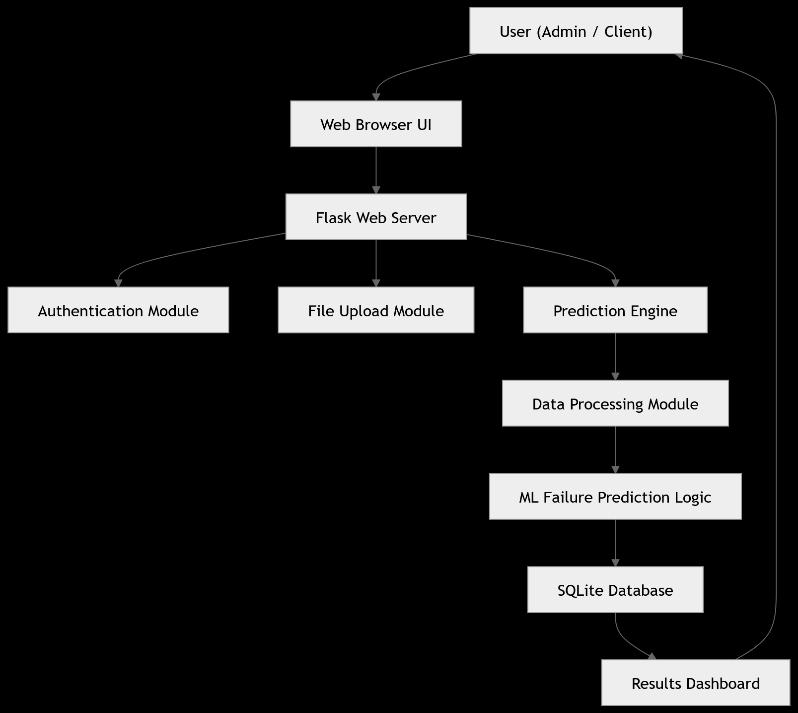
Fig -1:LayeredarchitectureoftheSSDFailurePrediction
International Research Journal of Engineering and Technology (IRJET) e-ISSN: 2395-0056
Volume: 13 Issue: 04 | Apr 2026 www.irjet.net p-ISSN: 2395-0072
Data Collection Module: Collects operational data from SSDs, including SMART attributes and flash-level metrics like P/E cycles, error rates, wear-leveling, and temperature.
Provides the foundation for reliability analysis and predictive modeling. Uses advanced logging and filtering toensuredataaccuracyandcompleteness.
Data Preprocessing and Feature Extraction Module: Cleans and normalizes SSD data by removing noise, inconsistencies, and missing values. Extracts meaningful features like trends and correlations to represent SSD health.Prepares structured and optimized data for machinelearningmodels.
Reliability Analysis Module: Applies statistical and correlationtechniquestoidentifykeyfactorsaffectingSSD degradation. Analyzes flash-level parameters and error patterns to understand failure probability. Provides insights to guide model design and differentiate normal agingfromcriticalissues.
Failure Prediction Module: Implements machine/deep learning models to predict SSD failures. Uses extracted features to classify drives into different health states. Incorporates state-aware modeling to improveaccuracyandenableearlyfaultdetection.
The proposed system is implemented using Python in the Anaconda environment, where SSD operational data is first collected from available datasets or simulated logs containing SMART attributes and flash-level reliability parameters such as program/erase cycles, wear-leveling count, and error rates. The collected data is processed through a preprocessing pipeline that performs data cleaning, normalization, and feature extraction using libraries like NumPy and Pandas. Relevant features representing SSD health are then fed into a machine learning model built using Scikit-learn or TensorFlow. A supervised learning algorithm such as Random Forest or GradientBoostingistrainedtoclassifySSDsintodifferent health states and predict potential failures. The model incorporates state-aware learning and temporal analysis to capture degradation patternsovertime.
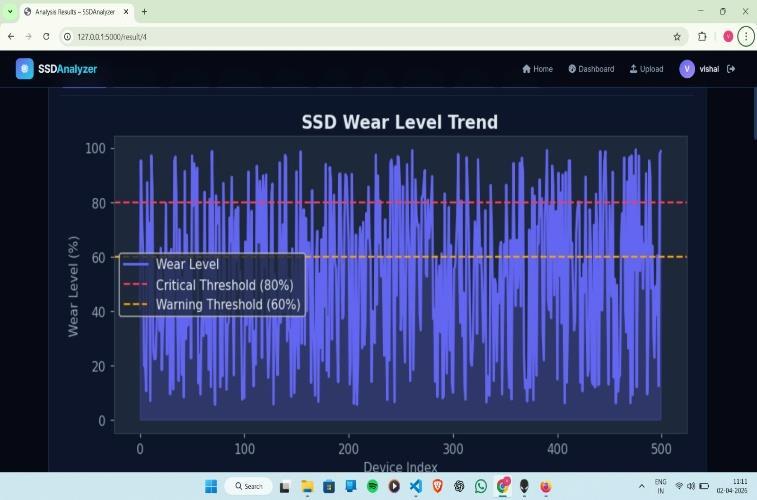
Once trained, the model is deployed to continuously monitor incoming SSD data and evaluate failure probabilitiesinrealtime.Ifthepredictedfailurelikelihood exceeds a predefined threshold, the system generates alerts for proactive maintenance. Performance evaluation is carried out using metrics such as accuracy, precision, recall, and false positive rate to ensure reliability. Additionally,visualizationtoolslikeMatplotliborSeaborn are used to display SSD health trends and prediction results through graphs and dashboards. This
implementation enables early failure detection, reduces unexpected downtime, and supports efficient SSD managementindatacenterenvironments.
SoftwareArchitecture
Theproposedsystemadoptsalayeredsoftwarearchitecture toenableefficientSSDfailureanalysisandpredictionbased on flash reliability characteristics. The architecture is designed to ensure modularity, scalability, and maintainability, allowing seamless integration of data processingandmachinelearningcomponentswithinawebbasedenvironment.
The system is structured into five primary layers: Presentation Layer, Application Layer, Processing Layer, Prediction Layer, and Data Storage Layer. Each layer is responsible for a specific set of functionalities, ensuring clear separation of concerns and improved system performance.
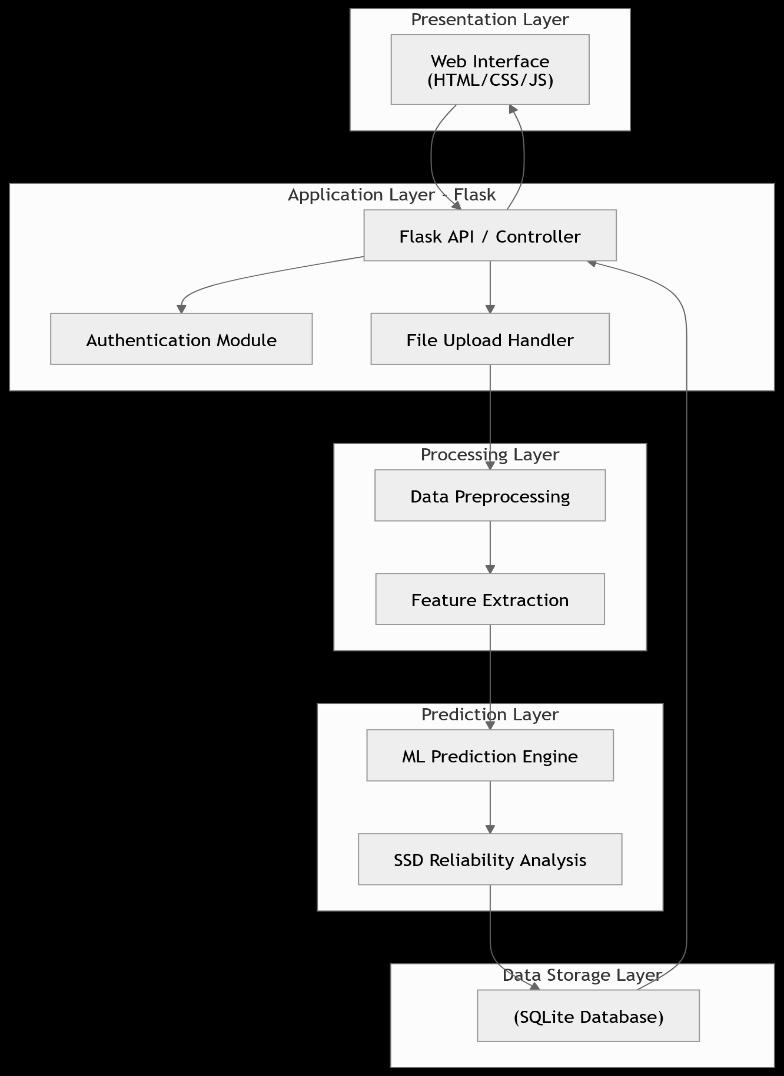
Fig -5:Classdiagram
The Presentation Layer serves as the user interface of the system. It is implemented using web technologies such as HTML, CSS, and JavaScript, enabling users to interact with the system through a browser. This layer allows users to perform operations such as registration, login, dataset
International Research Journal of Engineering and Technology (IRJET) e-ISSN: 2395-0056
Volume: 13 Issue: 04 | Apr 2026 www.irjet.net p-ISSN: 2395-0072
upload, and visualization of prediction results. It ensures easeofuseandaccessibility withoutrequiringspecialized technicalknowledge.
The Application Layer is built using the Flask web framework, which acts as the central controller of the system. It manages client requests, processes user inputs, and coordinates communication between different modules
The system architecture flow describes the end-to-end operational sequence of the proposed SSD failure prediction system, illustrating how data moves through various components from user interaction to final output generation. The workflow is designed to ensure efficient data processing, accurate prediction, and seamless user interaction.
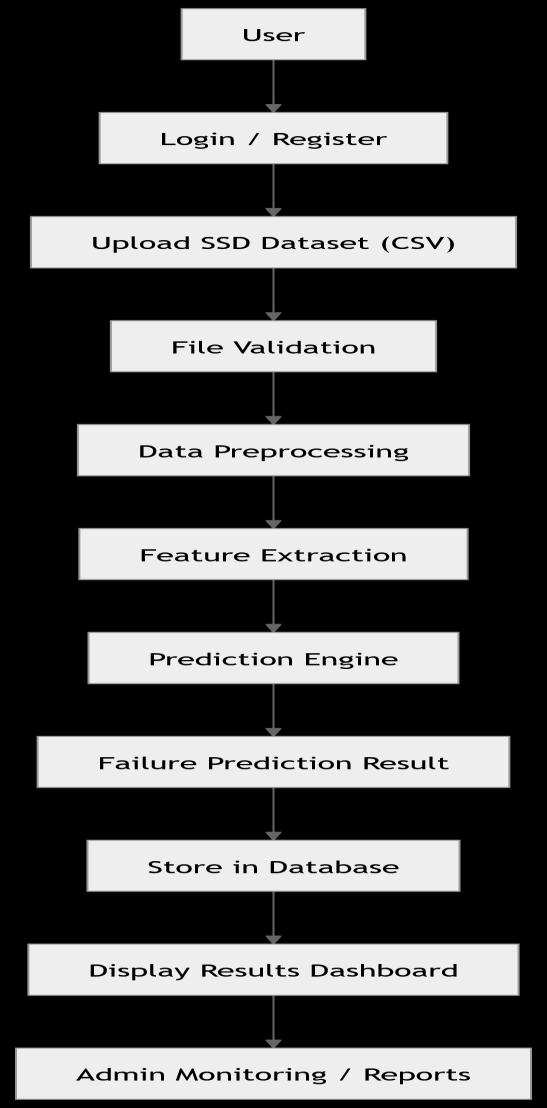
Fig -6:SystemArchitectureFlow
The system architecture flow provides a structured and efficient pipeline for SSD failure prediction. By integrating data validation, preprocessing, feature extraction, and machine learning–based prediction, the system ensures accurate and reliable results. The seamless interaction between components enhances usability and makes the system suitable for real-world deployment in large-scale storageenvironments.UserInterface
Volume: 13 Issue: 04 | Apr 2026 www.irjet.net p-ISSN: 2395-0072

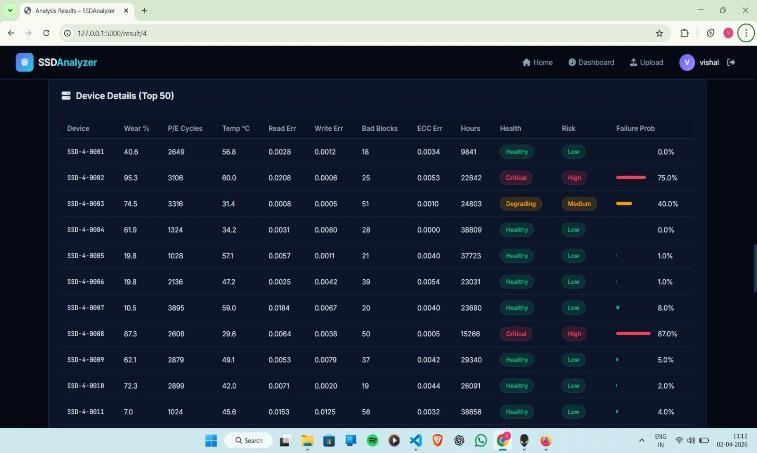
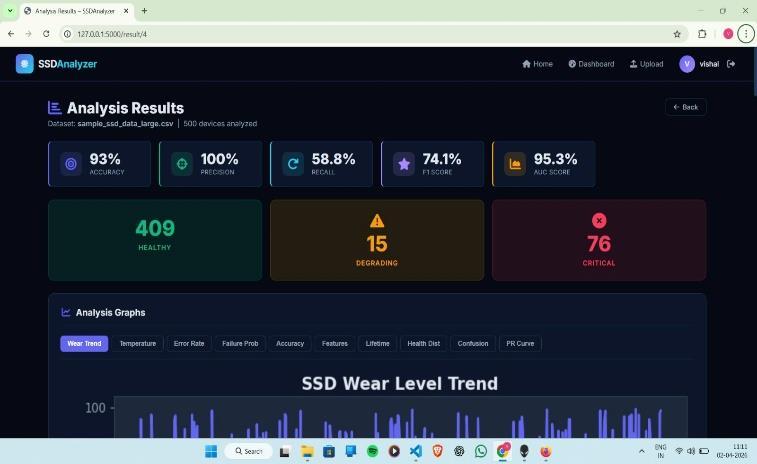
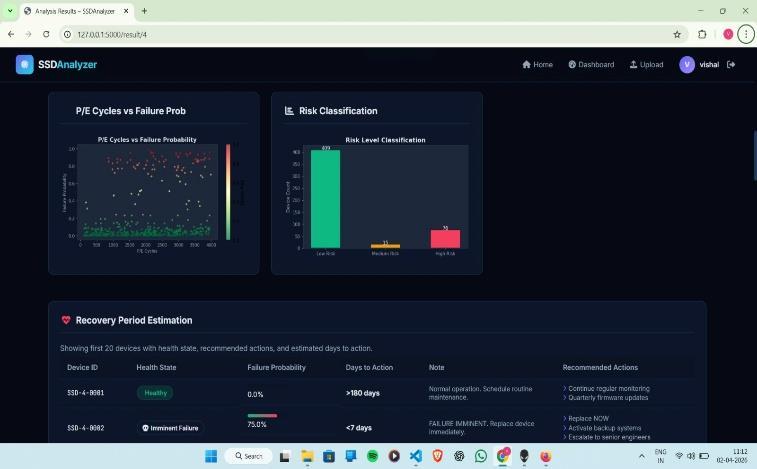
The performance of the proposed SSD failure prediction systemisevaluatedtoanalyzeitseffectivenessintermsof prediction accuracy, reliability, and computational efficiency. The evaluation focuses on both the machine learning model performance and the overall system behaviorunderpracticalconditions.
To assess the prediction capability, standard evaluation metrics from Machine Learning are utilized, including Accuracy, Precision, Recall, and F1-Score. Accuracy measures the proportion of correctly predicted instances, while Precision evaluates the correctness of predicted failure cases. Recall determines the system’s ability to identify actual SSD failures, and the F1-Score provides a balanced measure by combining Precision and Recall. Additionally, a confusion matrix is used to analyze the classification results in detail, including true positives, falsepositives,truenegatives,andfalsenegatives.
The experimental setup involves SSD datasets containing criticalreliabilityattributessuchasprogram/erasecycles, read/write error rates, temperature variations, and wearleveling indicators. The system is implemented using a Flask-based backend, SQLite database, and a web-based frontend interface. The experiments are conducted in a standard computing environment to simulate real-world deploymentscenarios.
The results demonstrate that the proposed system achieves high prediction accuracy and effectively identifies early signsofSSDfailure.Themodelshowsstrongperformancein detectingfailure-pronedevices,resultinginimprovedRecall and a balanced F1-Score. This indicates that the system can minimize both false positives and false negatives, which is essential for reliable failure prediction in data center environments.
In terms of system efficiency, the proposed framework exhibits low processing latency during data preprocessing and prediction stages. The lightweight architecture ensures optimal utilization of computational resources, making the system scalable for large datasets. The integration of automated data processing and prediction modules reduces manual intervention and enhances overall system performance.
Acomparativeanalysiswithtraditionalmonitoringandrulebasedapproacheshighlightstheadvantagesoftheproposed method. Conventional techniques often rely on thresholdbased detection and manual analysis, leading to delayed failure identification. In contrast, the proposed machine learning–based system provides early and accurate predictions, enabling proactive maintenance and reducing theriskofunexpectedfailures.
Overall, the performance evaluation confirms that the proposed system delivers accurate, efficient, and scalable SSD failure prediction. The use of reliability-driven features and machine learning techniques significantly improves prediction capability, making the system suitable for realworldapplicationsinmoderndatacenterinfrastructures.
Inmoderndatacenters,SSDsplayacriticalroleinensuring high-speed, low-latency storage, but their complex flashbasedarchitecturemakesthemsusceptibletounpredictable failures.
The importance of analyzing flash-level reliability characteristics, such as wear patterns, error rates, and program/erasecycles,tounderstandSSDdegradationmore accurately.
By integrating these insights into predictive models, it is possible to detect potential failures early, allowing datacenteroperatorstotakeproactivemaintenancemeasures. Such an approach not only reduces the risk of unexpected downtime and data loss but also optimizes resource allocation and extends the operational lifespan of storage devices.
The proposed reliability-guided prediction framework demonstrates that combining detailed flash telemetry with advanced machine learning techniques can significantly enhancefailureforecastingaccuracyandtimeliness.
By enabling early alerts and informed maintenance planning, this methodology strengthens overall system resilience and operational efficiency in large-scale storage
International Research Journal of Engineering and Technology (IRJET) e-ISSN: 2395-0056
Volume: 13 Issue: 04 | Apr 2026 www.irjet.net p-ISSN: 2395-0072
Looking forward, the integration of emerging flash technologies, standardized reliability metrics, and adaptive predictive models promises to further improve SSD management. Ultimately, the adoption of such datadriven strategies supports more reliable, cost-effective, andsustainabledata-centeroperations.
[1]Y.Song,Y.Liang,J.Liu,andL.Shi,“Prophet:SSDFailure Analysis and Prediction Guided by Flash Reliability Characteristics in Data Centers,” IEEE Computer Society, 2025.
[2]J.Meza,Q.Wu,S.Kumar,O.Mutluetal.,“SSDFailuresin Datacenters,”ACMDigitalLibrary,2015.
[3] J. Alter, “Machine Learning Models for SSD and HDD ReliabilityPrediction,”2022.
[4] F. Xu et al., “General Feature Selection for Failure PredictioninLarge-ScaleDataCenters,”2021.
[5] S. Cho et al., “AERO: Adaptive Erase Operation for Improving Lifetime and Performance of Modern NAND Flash-BasedSSDs,”arXiv,2024.
[6] S. Xu et al., “PS-WL: A Probability-Sensitive Wear LevelingSchemeforSSDArrayScaling,”arXiv,2025.
[7]N. Khatri and S. Chakrabarti, “NVMe and PCIe SSD MonitoringinHyperscaleDataCenters,”arXiv,2020.
[8]Y. Cai et al., “Experimental Characterization, Optimization, and Recovery of Data Retention Errors in MLCNANDFlashMemory,”2018.
[9]Facebook Research, “A Large-Scale Study of Flash MemoryFailuresintheField,”2015.
[10]S.Hanetal.,“AnIn-DepthStudyofCorrelatedFailures inProductionSSD-BasedDataCenters,”USENIX,2021.
[11]C. Chakrabortti, “Improving the Accuracy, Adaptability, and Interpretability of SSD Failure Prediction,”2020.
[12]S. Liang, “In-Depth Reliability Characterization of NANDFlash-BasedSSDs,”2018.
[13]V.Luković, “Solid-State Drive FailurePrediction Using AnomalyDetection,”MDPI,2025.
© 2026, IRJET | Impact Factor value: 8.315 | ISO 9001:2008 Certified Journal | Page719 infrastructures.