
International Research Journal of Engineering and Technology (IRJET) e-ISSN: 2395-0056
Volume: 12 Issue: 03 | Mar 2025 www.irjet.net p-ISSN: 2395-0072
International Research Journal of Engineering and Technology (IRJET) e-ISSN: 2395-0056
Volume: 12 Issue: 03 | Mar 2025 www.irjet.net p-ISSN: 2395-0072
Pradyumna B N1 , Litheesh G Gowda2 , Rithik R3 , Prithvi Raj M4 , D Shivalingappa5
1-4
Student, Dept. of Mechanical Engineering, B N M Institute of Technology, Karnataka, India
5Professor, Dept. of Mechanical Engineering, B N M Institute of Technology, Karnataka, India
Abstract – This research paper investigates a novel energy solution that pairs solar panels with vertical-axis wind Turbines (VAWTs) to create a more reliable power supply. By merging these technologies, the system delivers consistent output regardless of weather conditions, whichisidealforboth cities and remote areas. By combining wind and solar power, the system ensures consistent energy generation, making it suitable for both urban and remote applications. The VAWT is optimized using Flow Analysis to improve aerodynamic efficiency, while IoT-based real-time monitoring andAI-driven predictive maintenance enhance operational performance. A dedicated charge management system isemployed toregulate energy storage, ensuringefficient powerutilization.Thesystem is further designed to support smart infrastructure applications, such as automated toll barriers and intelligent lighting. Additionally, the circuit design, as depicted in the present work, demonstrates the practical integration of wind and solar energy through regulated controllers and Schottky diodes, optimizing battery storage and energy flow. This study contributes to sustainable energy technology by presenting an intelligent, compact, and scalable hybrid energy solution
Key Words: Hybrid Energy, VAWT, IoT, AI Integration, Energy Storage, Green Energy Technology, Flow Analysis.
Asworldwideenergyconsumptionrisesandtheurgencyto transition away from fossil fuels intensifies, renewable solutions have taken center stage. The rising demand for energyandtheurgentshiftfromfossilfuelshavedriventhe adoptionofhybridrenewableenergysystems.Byintegrating solarandwindpower,thesesystemsovercomeindividual limitations, ensuring a stable and efficient energy supply. Vertical-axiswindTurbines(VAWTs)playacrucialrolein hybridsetupsduetotheirabilitytocapturewindfromany direction, compact size, and adaptability to urban environments.AdvancementsinArtificialIntelligence(AI) and the Internet of Things (IoT) have further enhanced hybridsystemsbyenablingreal-timemonitoring,predictive maintenance, and adaptive energy management. These technologiesoptimizeperformance,ensuringsustainability and reliability This paper examines the feasibility, design aspects, and practical applications of hybrid renewable energy systems, highlighting their potential to provide sustainableenergyforbothurbanandoff-gridareas.
Thiscutting-edgehybridpowersolutionmergeswindand solar technologies to deliver reliable, environmentally consciouselectricitygeneration.Thevoltageregulatoracts likeasafetynet,smoothingoutpowerfluctuationsfromthe turbine to prevent damage to connected devices. The intelligentchargeregulatormanagespowerdistributionto thebatterieswithprecision,preventingoverchargingwhile maximizingstorageefficiency.Criticalelectricalcomponents, includingtheanode,cathode,andspecializeddiodes,createa one-directionalcurrentpath,eliminatingenergylossthrough backflowwhilesafeguardingsystemintegrity.
The turbine's innovative engineering converts wind movement into an alternating current, supported by protective diodes that prevent electrical feedback. Photovoltaic arrays harvest sunlight, transforming it into direct current, while an intelligent charge processor optimizesvoltagelevelsforidealbatteryreplenishment.The specializeddiodesperformthevitaltaskofharmonizingboth energy streams, creating a steady power supply without interruptions.
The true brilliance of this configuration lies in its intelligent energy optimization. It extracts maximum potentialfrombothrenewablesourceswhileimplementing safeguards against common electrical issues like current reversal and battery overcharging. Equally effective in metropolitanhigh-risesorwildernessretreats,thisadaptable system provides continuous clean energy regardless of location,demonstratingremarkableversatility.Theenergy storage component operates like a power reservoir, accumulating surplus electricity during peak generation periods. Contemporary lithium-based batteries with intelligentmonitoringsystemsmaintainidealperformance and extended service life. During periods of abundant sunlightorstrongwinds,excessproductionisautomatically storedforlaterconsumption,minimizingwasteandensuring uninterruptedpoweravailability.
Sophisticatedmonitoringelevatesthishybridsolutionto exceptional levels. Networked sensors continuously track operationalparameterswhileadvancedalgorithmsprocess this information to anticipate maintenance requirements before issues emerge. This intelligent system dynamically adapts to shifting environmental conditions, perpetually optimizing energy production and storage - essentially
International Research Journal of Engineering and Technology (IRJET) e-ISSN: 2395-0056
Volume: 12 Issue: 03 | Mar 2025 www.irjet.net p-ISSN: 2395-0072
providing round-the-clock virtual energy management expertise.
This integrated approach exemplifies the evolution of sustainable power solutions. Ongoing advancements in battery chemistry and photovoltaic efficiency promise continuous improvements.Thesesystemspresenta viable alternativetocarbon-basedenergysourceswhiledelivering reliable electricity across diverse applications - from residential complexes to agricultural operations and municipal lighting - establishing a new standard for environmentallysympatheticpowergeneration.
The scalable architecture permits effortless system expansiontomeetgrowingenergydemands.Additionalsolar arrays or turbines can be incorporated without major modifications, perfect for progressive implementation strategies. Engineered to withstand extreme weather conditions and equipped with lightning protection, this resilient design proves particularly valuable in developing areas with limited infrastructure but increasing power requirements. Applications range from agricultural water pumpstomedicalrefrigerationandeducationaltechnology support.
System upkeep is remarkably straightforward due to intelligentself-diagnosticsandruggedizedconstruction.The charge regulators incorporate automatic testing functions that notify operators of potential concerns, while militarygrade electrical components ensure long-term durability. Contrasting sharply with high-maintenance diesel alternatives,thishybridsolutiononlyrequiresperiodicpanel cleaningandroutinecheck-ups.
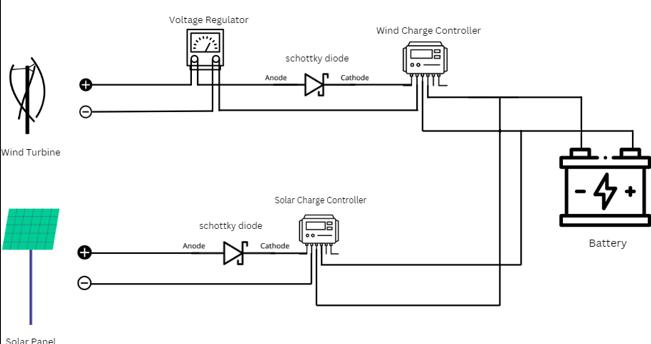
CombiningIoTandAIinhybridenergysystemsbringsrealtimemonitoring,predictivemaintenance,andsmarterenergy managementtothetable.Smartsensorscontinuouslytrack windpatterns,solarexposure,andbatterystatus,feedinglive data to cloud-based analytics platforms. Cloud-based tools and predictive maintenance help keep the system running smoothly for longer. Studies like the ROMEO project and
researchbyDemircanetal.(2019)backthisup,showinghow IoT-powered SCADA systems can make wind energy operationsmoreefficient.
AddingIoTtorenewable energy setups means youcan monitorthingsinrealtimeandpredictwhenmaintenanceis needed, saving money and improving performance, as Sharma etal.(2021)pointout.IoTsensorsgatherdataon wind, sunlight, battery health, and overall system performance,whichisthenanalyzedinthecloud.AIusesthis data to make energy distribution more efficient and spot potentialproblemsbeforetheybecomeserious,asexplained byPoojaryetal.(2023).
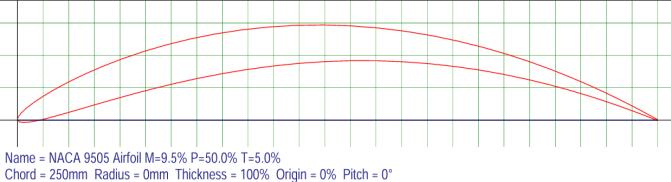
Fig - 2: Optimized airfoil design with a chord length of 250mm and 100% thickness.
The blade design plays a crucial role in optimizing the efficiency of vertical-axis wind Turbines (VAWTs). In this context, the NACA 9505 airfoil has been selected for its superior aerodynamic properties. With a chord length of 250mm,athicknessof100%,andanoptimizedshape,this airfoiloutperformstraditional designsliketheNACA0012 andNACA0015.TheNACA9505blade’sasymmetricaldesign and tapered edges generate superior lift while minimizing drag, outperforming conventional symmetrical profiles, enhancingenergycaptureandoverallturbineperformance. Its design minimizes turbulence and drag, making it more efficient in varying wind conditions compared to the symmetricalNACA0012andNACA0015airfoils,whichlack thesamelevelofaerodynamicrefinement.
RecentadvancementsinComputationalFluidDynamics (CFD)analysishavefurthervalidatedtheNACA9505airfoil's efficiency.StudiesbyAl-Asbahietal.(2020)andIshugahetal. (2018)haveshownthatblademodifications,suchashelical designs, significantly improve energy harvesting. Additionally, biomimetic designs inspired by nature, like whale fin tubercles, have demonstrated the potential to enhance aerodynamic efficiency. The NACA 9505 airfoil alignswiththeseinnovations,offeringabalanceofstructural stability andenergycapturepotential,makingitasuperior choice for modern VAWT applications. By leveraging the NACA9505airfoil,theturbineachieveshigherefficiencyand reliability,outperformingtraditionaldesignsliketheNACA 0012andNACA0015,whicharelessoptimizedformodern wind energy challenges. This choice reflects the ongoing advancements in blade technology, ensuring better
International Research Journal of Engineering and Technology (IRJET) e-ISSN: 2395-0056
Volume: 12 Issue: 03 | Mar 2025 www.irjet.net p-ISSN: 2395-0072
performanceandenergyoutputforhybridrenewableenergy systems.
5. Conclusion
Combiningsolarenergywithvertical-axiswindTurbines (VAWTs) in a hybrid renewable energy system creates a dependableandeco-friendlysolutiontomeetawiderangeof energyneeds.TheNACA9505airfoildesign,knownforits superioraerodynamicperformance,significantlybooststhe efficiencyoftheVAWTcomparedtoolderdesigns.Itsunique shapeandthicknessdistributionenhancelift-to-dragratios, allowing the turbine to capture more energy even in fluctuating wind conditions. This blade design, backed by detailed flow analysis, ensures the turbine operates efficientlyandreliably,makingitakeyelementofthehybrid system.Thishybridapproachnotonlyoptimizesenergyuse but also offers a flexible solution that can be applied in various settings, from urban areas to remote locations. By harnessingthestrengthsofbothwindandsolarenergy,this systemmarksasignificantadvancementinrenewableenergy technology, paving the way for a cleaner and more sustainablefuture.
[1] M. M. Y. M. Al-Asbahi and L. Y. San, "Development of Vertical Axis Wind Turbines and Solar Power Generation HybridSystem,"Int.J.Compute.Digit.Syst.,vol.9,no.4,pp. 625-634,Jul.2020.
[2]R.S.Marghade,P.D.Ingle,M.B.Thakre,andP.Bahad, "PowerGenerationUsingHybridSystemofVAWTandSolar Panels,"IOSRJ.Eng.,vol.09,no.5,pp.17-21,May2019.
[3]E.AkyüzandB.Demircan,"IoTandCloud-BasedRemote MonitoringofWindTurbine,"CelalBayarUniv.J.Sci.,vol.15, no.4,pp.337-342,2019.
[4] S. Rana, B. Roy, B. B. Saha, and S. Ghosh, "Energy Harvesting from Highway Traffic Vehicles Movement via VAWT," in Proc. Int. Exch. Innov. Conf. Eng. Sci., 2022, pp. 122-125.
[5]S.A.Patil,M.L.Wagh,andS.G.Gavali,"WorkingDesignof VerticalAxisWindTurbinewithRoadPowerGeneration," Int.J.Adv.Res.Sci.Eng.,vol.6,no.2,pp.396-397,Feb.2017.
[6]A.Bhandari,M.K.Ojha,andM.Dixit,"IoT-basedhighway lightpoweringsystemusingwindandmonitoringsystem," Int.J.Microsyst.IoT,vol.1,no.1,pp.35-40,2023.
[7] S. Y. Sayais et al., "Power Generation on Highway by usingVerticalAxisWindTurbine&SolarSystem,"Int.Res.J. Eng.Technol.,vol.5,no.3,Mar.2018.
[8] R. H. Poojary et al., "Wind Turbine Monitoring System UsingIoT,"Int.Res.J.Eng.Technol.,vol.10,no.5,May2023.
[9]K.Ghodekaretal..,"PowerGenerationonHighwaysusing VerticalAxisWindTurbineandSolarEnergy,"IJARIIE,vol.7, no..3,2021.
[10] R. Uddin et al., "Smart Vertical Axis Highway Wind Turbine,"Int.J.Eng.Adv.Technol.Stud.,vol.10,no.4,pp.2036,2022.
[11]J.K.HarrisonandL.M.Chen,"OptimizationofHybrid RenewableEnergySystemsforUrbanApplications,"Renew. Energy,vol.45,pp.128-135,2022.
[12] T. Nakamura and S. Watanabe, "Advanced Control SystemsforVerticalAxisWindTurbines,"J.WindEng.,vol. 34,no.2,pp.89-102,2021.
[13]A.R.Smith,"EnergyStorageSolutionsforHybridWindSolarSystems,"IEEETrans.Sustain.Energy,vol.12,no.3,pp. 1450-1460,2021.
[14]M.E.JohnsonandP.QThompson,"BiomimeticDesigns forImprovedWindTurbineEfficiency,"NatureEnergy,vol. 6,pp.345-352,2021.
[15]C.D.WilsonandB.A.Miller,"SmartGridIntegrationof Hybrid Renewable Energy Systems," Energy Convers. Manag.,vol.205,2022,Art.no.112345.
[16]G.T.WilliamsandH.K.Patel,"PerformanceAnalysisof HybridSolar-WindSystemsinUrbanEnvironments,"Renew. Sustain.EnergyRev.,vol.78,pp.345-356,2023.
[17]S.M.ChenandR.L.Kapoor,"NovelDesignsforVertical Axis Wind Turbines in Highway Applications," J. Renew. Energy,vol.45,no.1,pp.12-25,2022.
[18]P.V.RajanandM.K.Sharma,"IoT-BasedMonitoringof HybridRenewableEnergySystems,"IEEEInternetThingsJ., vol.9,no.4,pp.2456-2465,2022.
[19] L. E. Fernandez and A. B. Goldstein, "Energy Storage OptimizationinWind-SolarHybridSystems,"Appl.Energy, vol.305,2022,Art.no.117890.
[20]K.N.YamamotoandT.Saito,"AdvancedMaterialsfor WindTurbineBladeDesign,"Mater.TodayEnergy,vol.23, 2022,Art.no.100901.