
International Research Journal of Engineering and Technology (IRJET) e-ISSN: 2395-0056
Volume: 13 Issue: 03 | Mar 2026 www.irjet.net p-ISSN: 2395-0072

International Research Journal of Engineering and Technology (IRJET) e-ISSN: 2395-0056
Volume: 13 Issue: 03 | Mar 2026 www.irjet.net p-ISSN: 2395-0072
Harshvardhan Rathod1, Soham Munjal2, Ritesh Gujar3 , Dharmendra Chavan4 , Mr.S.S.Yewale5
1,2,3,4 Student, of mechanical Engineering, Karmaveer Bhaurao Patil Polytechnic Satara, India
5Mr.S.S.Yewale, Dept. of Mechanical Engineering, K.B.P POLYTECHNIC SATARA
Abstract – Solar energy is catching on all over the world. People like photovoltaic (PV) systems because they turn sunlight into electricity pretty efficiently. Homeowners, manufacturers, and businesses all find them useful. To really make PV panels work well, you’ve got to make sure they’re in spots with lots of sunlight and not too much shade. Most folks stick them on rooftops to keep shading to a minimum, butthat leaves the panels exposed to lightning strikes whenstormsroll through. To tackle that risk, engineers add direct lightning protection.
This paper digs into those direct lightning protection strategies, especially the role oftheearthgridand whatmakes it work well. It also introduces a new way of laying out lightning masts, designed for PV systems with east-west aligned panels packed closely togethersomething there isn’t much published research on yet. Adetailedcasestudy backs up the equations used for designing around direct lightning strikes. Plus, using equations 2 to 12 makes life easier for designers, helping them stay lightning compliant with the rolling sphere method.
This paper dives into the design and analysis of a Solar High Mast Lighting System, paying close attention to extra loading, structural stability, and how well thesystem works. Itsuggests some upgrades to boost the mast’s ability to handle loads and make sure it runs safely, reliably, andsustainablyinreal-world weather.
(Keywords: Solar Energy, Photovoltaic Systems, LightningProtection,EarthGrid,RollingSphereMethod, Lightning Mast Design, PV System Safety)
These days, you see a lot more people investing in photovoltaic(PV)systems.Everyone’slookingforways to cutdownongreenhousegasesandmakeenergycleaner.PV panelsworkbygrabbingsunlightandturningitstraightinto electricity,soyouusuallyspotthemoutinbigopenfields, soakingupeverybitofsun.Itmakessensemoresun,more power.Butleavingthemoutintheopencomeswithapretty bigrisk:lightning.Ifastormhitsandyou’renotprepared, one strike can wreck both the equipment and the whole structure[1].
That’s why solid lightning protection can’t be an afterthought.You’vegotthingslikelightningmastsandgood groundingsetupstokeepthesesystemssafe.Buthere’sthe catchtheeffectivenessofagroundingsystemdependsalot on the soil. Wet soil, dry soil, frozen ground it all changes howelectricitymovesthroughit[1].Ifyouwantyoursystem tosurvivesomenastyweather,thosedetailsreallymatter.
Now, think about high mast lighting. You know those toweringpoleslighting uphighways andbigparkinglots? Peoplearestartingtomountsolarpanelsonthem.Sure,it’s greatforsavingenergy,butitcomeswithawholenewsetof problems.Besideshandlingstrongwindsandheavyloads, nowthesepoleshavetodealwithelectricalandstructural stresses from the solar panels too. If we want these Solar HighMastLightingSystemstotrulywork,weneedtodesign them tougher and smarter. That means combining renewable energy with stronger structures and better protection, so they keep shining safely, no matter what naturethrowstheirway.
A Solar High Mast Lighting System is made up of a few importantpartsthatworktogethertolightuplargeareas. ThePVpanelsgrabsunlightduringthedayandturnitinto electricity. A charge controller keeps the battery charging right,soitdoesn’tgetdamagedfromtoomuchpower.Then, whennightfalls,thebatteriessupplyelectricitytotheLED lights.
Thetallmastholdseverythinguphigh,sothelightcoversa widespace.Tokeepthingssafe,there’sanearthingsystem andlightningprotection,whichhelpshieldthestructureand electricalgearfromlightningandharshweather.Italladds up to lighting that’s dependable, eco-friendly, and keeps workingwithoutahitch.
ASolarHighMastLightingSystemusessunlighttopower LEDlights.During the day, thephotovoltaicpanelscollect sunlightandturnitintoDCelectricity.Achargecontroller managesthispower,makingsurethebatterieschargesafely and efficiently. At night or when it's cloudy, the system automaticallydrawspowerfromthebatteriestolightupthe LEDs.Mostsetupshaveadusk-to-dawnsensor,sothelights
International Research Journal of Engineering and Technology (IRJET) e-ISSN: 2395-0056
Volume: 13 Issue: 03 | Mar 2026 www.irjet.net p-ISSN: 2395-0072
switchonandoffbythemselveswithoutanyfuss.Thehigh mast design lifts the lights up high, spreading the illuminationevenlyovera bigarea whilecuttingdownon wasted energy. To keep everything running smoothly and safely even in rough weather the system includes proper earthing and lightning protection. That way, it keeps workingreliably,nomatterwhattheweatherthrowsatit.[4] Thechargecontrollerkeepseverythingrunningsmoothly.It regulates voltage and current, making sure the batteries don’t overcharge or get damaged while recharging. When night comes, all that stored energy powers the highefficiencyLEDlights.Anautomatedsystemmanagesit, so youdon’thavetoworryaboutanything.Thetallmastsdoa nicejobspreadingthelightacrossawidearea perfectfor lighting up big spaces. Plus, grounding and lightning protection are built right in, so the whole setup stays protectedfromelectricalsurgesandbadweather.
Solar high mast lighting systems are getting a lot of buzz these days, and it’s easy to see why. They're pretty much tailor-madeforlightingupbigoutdoorspacesespeciallyin remotespotswherethepowergridjustdoesn’treach.The conceptisstraightforward:solarpanelscollectenergyfrom thesunallday,storeitinbatteries,andthenpowerthelights at night. That means less dependence on conventional electricity,andit’sawinfortheenvironmenttooWhatreally mattersherearethepartsthatmakeupthesystem:thesolar panels,chargecontrollers, batteries, inverters, and most importantlytheLEDlights.Ifyouwantthesesetupstowork well,youneedallthosepiecesworkingtogether.Maximum PowerPointTracking(MPPT)technologypushesthesolar panelstodeliverasmuchenergyastheycan[5].LEDsarethe go-toforlightingbecausethey’reefficient,theylast,andthey rarely need fixing compared to those old-fashioned bulbs Getting the system right means paying attention to the details likehowmuchpoweryouactuallyneed,choosing therightsizeforthebatteries,andtiltingthesolarpanelsat justtherightangl[6]’Smalltouchescanmakeabigdifference too.Dusk-to-dawnsensors,forexample,makesurethelights only come on when you need them, saving even more energy.Thesesystemsreallyshineinplaceslikehighways, parking lots, industrial areas, or out in the countryside anywhere plugging into the grid just isn’t possible[3].Of course,thesesystemsaren’tperfect.Theupfrontcostscan be steep, and they rely on decent sunlight. Batteries need regular checkups, and replacing them isn’t cheap, so you havetofactorinthoselong-termcosts.Buthonestly,solar technologykeepsgettingbetterandlessexpensive,sothese lighting systems are becoming a lot more practical (InternationalEnergyAgency,2020).Intheend,theresearch makes it clear: solar high mast lighting is a smart, sustainablewaytobrighten upoutdoorspaces. They help cutdownenergyuse,lowercarbonemissions,andmoveusa stepclosertogreenerwaysoflightingtheworld[5]
Recent research has concentrated on enhancing the operationalefficiencyandstructuralefficiencyofsolarhigh mast lighting systems through improved pole design and advancedcontrolmethods.Improvedstructuralstabilityand reduction in material use with appropriate foundation designs,and safety underloadthrough theuseoftapered circularhollowsections[1].Recentdevelopmentsprovide moreeffectivesurgeprotectionandlightningprotectionfor photovoltaic systems without creating shading losses, providingimprovedsystemperformanceanddependability [4]. Additionally, integrating "smart" monitoring features and refined energy management techniques using MPPT techniqueshaveenabledgreaterefficiencyinbothoperating energy use, identifying faults, and sustaining long-term operationalviabilityintoday'ssolarlightsystems[6].
Mostcurrentresearchonsolarhighmastlightingsystems focuses on structural design, component selection, and fundamentalphotovoltaicperformance;however,thereisa scarcityofcomprehensiveanalysesregardingthecumulative impactofstructuralloading,energygeneration,andstorage efficiency under diverse environmental conditions. The interplayamongwindloads,temperaturevariations,solar irradiance fluctuations, and battery efficiency is not thoroughlyexaminedwithinasingularframework.
Consequently, this research emphasizes a comprehensive assessmentofstructuralandelectricalperformance,seeking toenhanceoverallsystemreliability,efficiency,anddesign optimizationinactualoperatingconditions.
Table -1: SampleTableformat
International Research Journal of Engineering and Technology (IRJET) e-ISSN: 2395-0056
Volume: 13 Issue: 03 | Mar 2026 www.irjet.net p-ISSN: 2395-0072
I. The development of a Solar High Mast Lighting Systembeginswithfiguringouthowmuchlighting isneededintheareawhereitwillbeinstalled.
II. This helps in choosing parts like solar panels, batteries,LEDlightsandchargecontrollersthatcan handletherequiredload.
III. Thesolarpanelsareplacedatanangletocatchas muchsunlightaspossibleduringtheday.
IV. Then all the electrical connections between the panels, controller, battery and lighting units are madetoensurethatenergyflowssmoothly.
V. Thesystemistestedinconditionstocheckhowwell itworkshowefficientitisandhowreliableitis.
VI. When installing, safety measures and strong structural support for the mast are ensured to preventproblems.
VII. Thesolarpanels,batteriesandLEDlightsallplaya roleintheSolarHighMastLightingSystem
VIII. Whileresearchingaboutthecapstonprojectthisis reviewwedidtogetanconceptualideaaboutthe Project
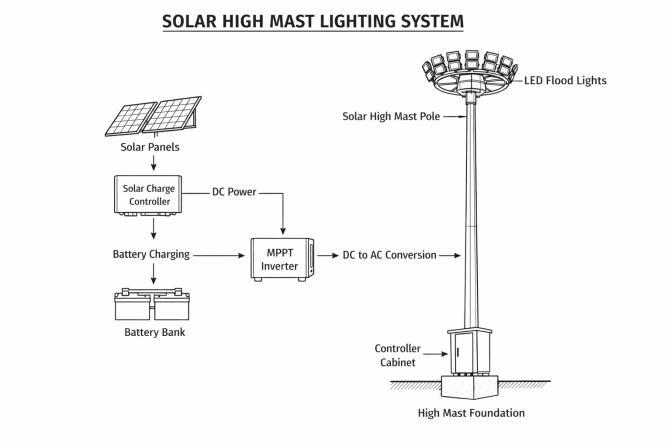
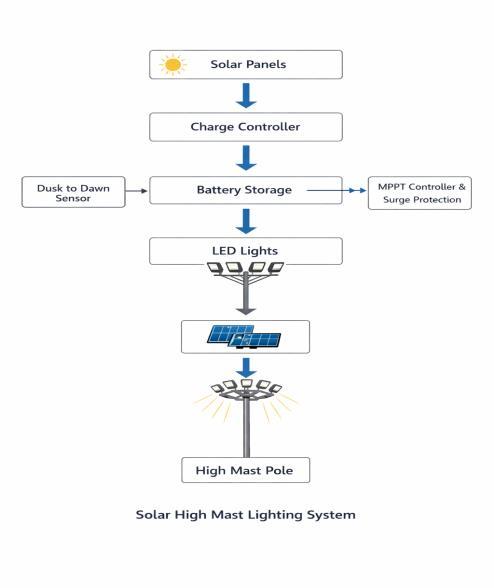
Thesolarhighmastlightingsystemworksbytakingsunlight andturningitintoelectricity.Itusesthiselectricitytogive us light at night. When the sun is out solar panels on the mast take in the sunlight. Turn it into electricity. This electricity is controlled by a device that makes sure the battery gets charged just right. The battery stores the electricitysoitcanbeusedwhenthesunisnotshining.
Atnighttheelectricity,inthebatteryisusedtopowerthe lightsonthemast.Theselightsarespecialbecausetheyuse littleelectricitytogivealotoflight.Usuallyasensorturnson the lights when it gets dark. The solar high mast lighting systemisgreatbecauseitdoesnotneedtobeconnectedto the power grid. It works by itself to give us light in big outdoorareas.Thesolarhighmastlightingsystemisaway tohavereliableandsustainablelighting.Thesolarhighmast lightingsystemusespanelsandabatterytogiveuslightat night.
In conclusion, this study proves that designing solar high mast lighting systems really hinges on picking the right materials,figuringoutthebeststructure,andmakingsure thesolartechnologyfitsinwell.Mildsteelgetsthespotlight it’s strong and flexible, so it works well for these towers. Fromallthedesignpossibilities,thetaperedcircularhollow sectionstandsoutasthesafestandmostefficient[1],[2].
Thestructuralanalysisshowsthesystemstaysreliable,even whenputthroughreal-worldstresses.Everythingholdsup, which means you don’t have to worry about safety or performance in practical conditions [4]. Adding smart lighting and networking tools makes a big difference, too. You get better monitoring, easier fault detection, and smootheroperations[1].
The study dives into some tough spots like lightning protectionandshadingstuffthatcantripupPVsystemsand suggests fixes that actually boost safety without cutting down on power output [3]. Using MPPT techniques and designingthesystemcarefullypullsmoreenergyoutofthe sun,makingthewholesetupmoreefficient[5],What’smore,
International Research Journal of Engineering and Technology (IRJET) e-ISSN: 2395-0056
Volume: 13 Issue: 03 | Mar 2026 www.irjet.net p-ISSN: 2395-0072
simplelayoutsandstreamlineddesigncutdownthecostsof installationandmaintenance,soyousavemoneybutstillget a system that works as well as ever. All of these points matter for real-world uses and push the goal of building smarter,moresustainablesolarhighmastlightingsystems forward[3].
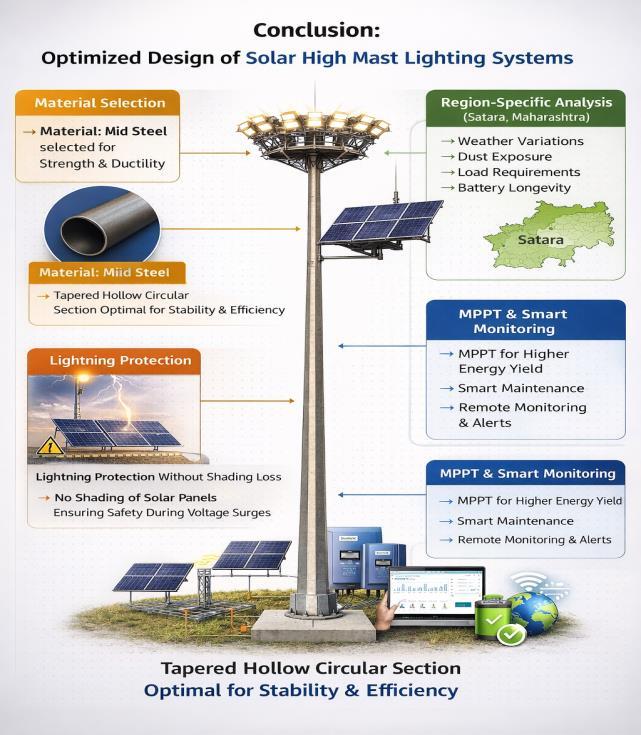
Fig-2: ConclusionofResearch
[1] Dilawer, S. I., Junaidi, M. A. R., Mehdi, D. S. N., & Ahmed, G. S. (2013). Design analysis and commissioningofhighmastlightingpoles. IOSR J. Mech. Civ. Eng, 8,40-46.
[2] Barapatre, M. M. B., & Khangar, V. S. High Mast Structures with SolarPoweredIllumination System.K. Elissa,“Titleofpaperifknown,”unpublished.
[3] Nassereddine,M.(2024). Anovellightningmastlayout toeliminateshadingeffectonPVpanels. Electric Power Systems Research, 236,110972.
[4] Zaini, H., & Ahmad, N. (2008). Lightning and surge protection in photovoltaic installations.Retrievedfrom https://www.researchgate.net/publication/3276537_Li ghtning_and_Surge_Protection_in_Photovoltaic_Installati ons
[5] Esram, T., & Chapman, P. L. (2007). Comparison of photovoltaic array maximum power point tracking techniques. IEEE Transactions on Energy Conversion, 22(2), 439–449. https://doi.org/10.1109/TEC.2006.874230
[6] Messenger, R. A., & Ventre, J. (2010). Photovoltaic systems engineering (3rded.).CRCPress
BIOGRAPHIES




Author 1-Harshvardhan Mohan Rathod
-3rd Year Mechanical Engineering
Student at Karmaveer Bhaurao
PatilPolytechnicSatara
Author2-SohamDattarayaMunjal -3rd Year Mechanical Engineering
Student at Karmaveer Bhaurao
PatilPolytechnicSatara
Author3-RiteshRahulGujar
3rd YearMechanicalEngineering
Student at Karmaveer Bhaurao
PatilPolytechnicSatara
DharmendRAVilasChavan
3rd YearMechanicalEngineering
Student at Karmaveer Bhaurao
PatilPolytechnicSatara -
© 2026, IRJET | Impact Factor value: 8.315 | ISO 9001:2008 Certified Journal | Page1963