
International Research Journal of Engineering and Technology (IRJET) e-ISSN: 2395-0056
Volume: 12 Issue: 11 | Nov 2025 www.irjet.net p-ISSN: 2395-0072
International Research Journal of Engineering and Technology (IRJET) e-ISSN: 2395-0056
Volume: 12 Issue: 11 | Nov 2025 www.irjet.net p-ISSN: 2395-0072
Mrs. Kalpana S1 , Ajay Kumar S2 , Divya M3 , Karthik G.D4 , Usha T5 .
1 Assistant Professor Department of Electrical and Electronics Engineering
PES Institute of Technology and Management, Shivamogga, Karnataka, India
2,3,4,5 BE Final Year Students, Department of Electrical and Electronics Engineering
PES Institute of Technology and Management, Shivamogga, Karnataka, India
Abstract - Unpredictablechangesinweatherconditionsand poorly designed solar power system control mechanisms typically lead to under-performance in solar photovoltaic systems. The research presentedhere goes one step further in developing a more integrated approach to optimizing solar energysystemswhichfocusesonthecombinationofreal-time photovoltaic systems Maximum Power Point Tracking, comprehensive IoT (Internet of Things) monitoring, and artificialintelligence(AI)forecasting.Thesystemdesignedfor this purpose incorporates an Arduino Mega 2560 microcontroller that runs a Perturb and Observe (P And O) poweroptimizingalgorithmandaRaspberryPithatservesas theintelligentdatagatewayforsensordata.TheRaspberryPi also connects to the NASA POWER API to download weather data and provides access to a cloud dashboard for users. The testing conducted demonstrated a 15 25%improvement on energy capture compared to standard solar systems. The monitored system provides users engagement on the maintenance of the system. This work provides a comprehensivesolutionforthegapbetweentraditionalsolar systems to a forward intelligent energy management system. This approach is economically feasible for distributed photovoltaic systems.
Key Words: Solar photovoltaic systems, Maximum Power Point Tracking, Perturb and Observe algorithm, Internet of Things, Arduino microcontroller, Raspberry Pi, cloud monitoring, buck-boost converter.
Advancesintheadoptionofsustainableenergytechnologies makesolarphotovoltaicsacorecomponentofanymodern renewableenergysystem.Yet,thereareconsiderablechallengestothevariabilityofthesesystemsandtheirsensitivity to changing environmental conditions. A solar panel’s performanceisinfluencedtoaconsiderabledegree,ifnotthe most, by non-linear, voltage-current characteristics which change continuously with the intensity of solar radiation, ambient temperature, and partial shading. These complex conditions can lead to a significant loss in the amount of energy that is extracted under conventional methods that usefixedparameters.Passivemodeoperationisthedefault formostsolarinstallations.Thesesystemsconvertthesolar energy that is available and do not take dynamic optimizationsteps.Thispassiveapproachisresponsiblefor
significant energy losses in these solar installations. Appropriate maximum power point tracking technology implementation in these systems could provide energy captureimprovementsof15-30%.Finally,thelackofrealtime system monitoring and remote access restricts maintainabilityanduserengagement,whichinturnresults in extended periods of undetected performance loss. Managing solar energy today requires the use of smart systems which can determine on the fly optimal configurationsandpredictiveanalyticsthathelpmaximize energy capture and Software and Communication Infrastructure: lower operational costs. The use of IoT devicesandadvancedcontrolautomationprovidesnewand powerful means of delivering solar energy systems automationwhichself-adjusttoprevailingweatherchanges andprovideuserswithcompleteoperationalfeedback.This researchaddressestheidentifiedcutting-edgegapswiththe introductionof a novel dual-controller systemdesign that combines hardware-based MPPT optimization with IoT enabledextensivemonitoringandcloudcontrol.Thesystem leveragesthereal-timepoweroftheArduinoMega2560for responsivepoweroptimizationandemploystheprocessing power, connectivity, and control of the Raspberry Pi for intelligent system data, external API integration, and user interfacedesign.
A. Overall System Configuration
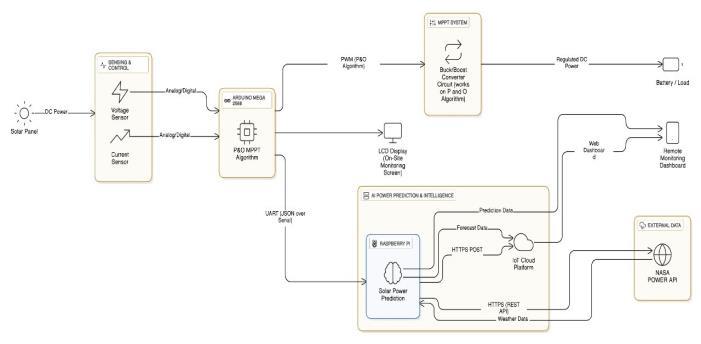
1. SystemArchitectureofthesolarenergy optimizationsystem
Thesolarenergyoptimizationsystemproposedincludesa creatively designed two-controller construction which is specificallydesignedforoptimizingreal-timeperformance
International Research Journal of Engineering and Technology (IRJET) e-ISSN: 2395-0056
Volume: 12 Issue: 11 | Nov 2025 www.irjet.net p-ISSN: 2395-0072
capabilities and smart data management. The system architectureconsistsofseveralcommunicatingsubsystems acting in an or chest rated manner to harvest maximum energy while providing complete monitoring and user interfacefunctionalities.Thesystemblockdiagramillustrates thecompleteintegrationofallthesystemcomponents.The solarpanelproducesDCpowerwhilethevoltageandcurrent sensorsmonitortheperformanceatalltimes.Thecontrolof the buck-boost converter with PWM signals for powerextraction purposes is implemented by the Arduino Mega 2560 through executing the P&O MPPT algorithm. At the sametime,theRaspberryPigathersdatafromthesensors, retrievesfurtherweatherdatafromtheNASAPOWERAPI, and manages cloud communication to the dashboard for monitoringpurposes.
Primary Hardware Components:
Solar photovoltaic panel (50W monocrystalline silicon)
Current sensor (ACS712-30A) and voltage sensor (25Vdividermodule)
ArduinoMega2560microcontrollerplatform
Buck-boostconverterwithPWMcontrolinterface
RaspberryPi4single-boardcomputer
Lithium-ion battery storage system with charge management
P&O MPPT algorithm implementation (Arduino embeddedC)
Dataacquisitionandprocessingsystem(Pythonon RaspberryPi)
NASA POWER API integration for meteorological data
Web-based dashboard with MQTT/HTTPS communicationprotocols
AIpredictionframework(futureimplementation)
Real-timemonitoringandvisualizationinterface
Thesystem’shardwarearchitecturecentersontheinnovativedual-controllermethodology,wheretheArduinoMega 2560handlestime-criticalMPPToperationswhiletheRasp berry Pi managescomputationallyintensiveIoT functions and potential AI processing tasks. This architectural approachensuresoptimal performance for bothreal-time controlrequirementsandcomprehensivedatamanagement needs.
Solar Panel and Sensing Infrastructure: Thehardwarearchitecture for the system centers on a dual-controller approach,withthetime-criticalMPPTfunctionsmanagedby an Arduino Mega 2560 and computationally intensive IoT functions, such as accounting and AI processing (if applicable),managedbytheRaspberryPi.Thisarchitecture providesthebestperformanceforreal-timecontrolanddata management.
MPPT Controller Implementation (Arduino Mega 2560): Thephotovoltaicpanelisthemainenergysourceproducing powerthatvariesdynamicallyinresponsetoenvironmental conditions (i.e., solar irradiance, ambient temperature, atmosphericclarity).Precisionvoltageandcurrentsensors provide continuous real-time telemetry to the MPPT controller,whichusesthisdatatocomputeaccuratepower values and make optimization decisions with minimal uncertaintyduetomeasurement.
Power Conditioning System: The buck-boost converter topology, maintained by well-controlled PWM signals provided by the Arduino, allows maximum power to be transferredtothestoragebatteryorload-connectedsystems whileprovidingexcellentefficiency.Thisconvertertopology also enables a broad input range of voltage fluctuations whilemaintainingexcellentenergyextractionefficiency.
Data Aggregation and Processing (Raspberry Pi): The Raspberry Pi will gather the sensor data generated by the Arduino using UART communication, processing the data with advanced algorithms and analyzing the external meteorologicaldatapulledfromtheNASAPOWERAPI.This providesextensivemonitoringofthesystemswithoutadding additional load to the real-time MPPT controller. The Raspberry Pi platform will allow for the future use of AI forecastingusingTensorFloworPyTorch.
Cloud Connectivity Infrastructure: Communicationsthat aresecuredwithprotocolssuchasMQTToverTransportB. AIPredictionFrameworkDesignLayerSecurityandHTTPS ensurethatthedatabeingtransmittedisdonesoinareliable andencryptedmannertocloud-basedmonitoringplatforms. Besides,thesystemisendowedwithstrongerrorhandling features,anditalsohasanautomaticreconnectionfeatureto maintainthemonitoringoperationinsituationsoftransient networkconnectivity.UserInterfaceDevelopment:Thewebbaseddashboardthatisresponsiveofferseasy-to-understand visualizations of the system performance metrics, the environmental conditions, and the operational status indicators.Infact,thedashboardhasasimpleandeasy-tounderstand interface for both computer based and mobile users that facilitates monitoring and management from a distance.
A. IoT Data Management System
Data Collection and ProcessingProtocol:TheRaspberryPi device will be handling the sensor data which is properly formattedbytheArduinothroughtheJSONcommunication interfaceviatheUARTbus.Timedataprocessingfunctions that are filtering algorithms, data validation routines, and preparationfortransmissiontothecloudwithpropererror processing.
International Research Journal of Engineering and Technology (IRJET) e-ISSN: 2395-0056
Volume: 12 Issue: 11 | Nov 2025 www.irjet.net p-ISSN: 2395-0072
External Data Integration: NASAPOWERAPIisdesignedto integrate quickly to provide easy access to top notch metrologicaldatalikesolarirradianceforecast,ambient temperature,anddetailedweatherconditionobservations. The use of such external data will not only upgrade the monitoringcapabilitybutalsoeasetheadvancedcorrelation analysis between environmental variables and system performanceat tributes.
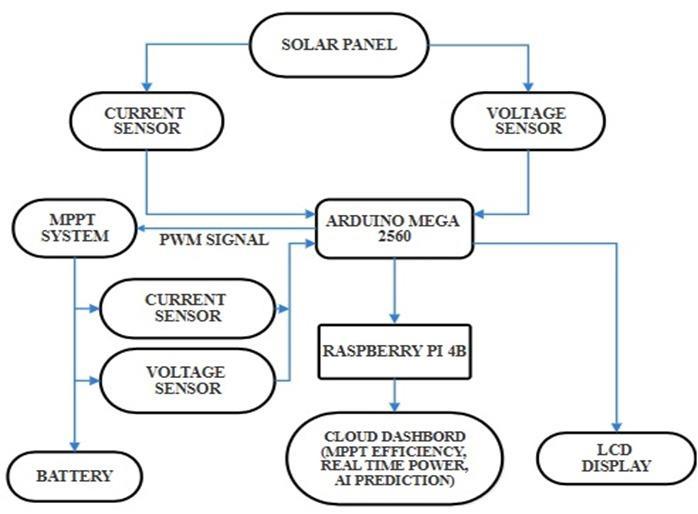
Fig. 2.Blockdiagramofthesolarenergyoptimization system
Cloud Communication Infrastructure: The system uses securedprotocolssuchasMQTTforcommunicationalong with proper error handling and reconnection features to maintain cloud connectivity. Moreover, there are sophisticatedfeaturessuchasdatabufferingatthetimeof an interrupted connection and subsequent transmission aftertheconnectionhasbeenrestored.
The present application is mainly concerned with MPPT optimizationandIoTmonitoring.Nevertheless,thesystem designhasthepotentialofincorporatingAI-basedprediction featuresinthefuture.TheRaspberryPiplatformisequipped withenoughcomputingpowertocarryoutmachinelearning algorithmsforpredictingsolarpowerfromhistoricalperformancedataandweatherdata. The AI prediction framework design includes:
• Datapreprocessingmodulesforsensorandweather data
• Featureengineeringcapabilitiesforoptimalmodel inputs
• Model training infrastructure using historical datasets
• Real-time inference engine for power generation forecasting
• Integration interfaces with existing monitoring dashboard
A. Hardware Configuration and Testing Environment
Afullprototypesystemwasbuiltandwentthroughavariety oftestsunderdifferentreal-worldenvironmentalconditions to substantiate the proposed approach and quantify performance improvements. The experimental setup comprised the use of precisely calibrated measurement instrumentsandcontrolledtestingprocedures.
Experimental Test Environment: The testing took place overan8-weekperiodcoveringdifferentseasonalweather conditions.Thesystemwasinstalledinaplacewithfullsolar access and equipped with complete environmental monitoringsensors.Thetestingscenariosconsistedofclearsky conditions, partial cloud coverage, variable weather patterns,anddifferentloadconfigurationssuchasbattery chargingandresistiveloads.
Precision Measurement Equipment: High-precisiondigital multimeterwereusedtoprovidebaselineperformancemeasurementsforvalidationpurposes.Professionaldata-logging equipmentwasusedforcontinuousperformancemonitoring throughout the testing period. Calibrated environmental monitoringsensorswereusedtomeasureirradiancelevels, ambient temperature, and atmospheric conditions for correlationanalysiswithsystemperformance.
Thein-depthsystemreviewhingedonverysignificantoperational measureswhich,among otherthings,influenced theabsoluteeffectivenessofthesysteminpracticeandthe degree of the user’s satisfaction. The main measures of performance were: the increments in energy capture efficiency,MPPTtrackingaccuracyaswell asthesystem’s dynamic response characteristics, IoT communication reliability together with system latency metrics, the dashboardfunctioninganduserexperience,andfinally,the systemstabilityunderdifferentenvironmentalconditions.
Theevaluationofsystemperformancewascarriedoutina verydetailedmannerbycomparingitwithabaselinesystem thatwascontrolledverycarefullyanddidnothaveMPPToptimization capabilities. The baseline system had the same solarpanelandloadconditionsbutwasoperatedatafixed voltage point without any dynamic optimization. Such a comparison gave a quantitative measurement of the enhancementsmadebytheproposedintegratedapproach.
International Research Journal of Engineering and Technology (IRJET) e-ISSN: 2395-0056
Volume: 12 Issue: 11 | Nov 2025 www.irjet.net p-ISSN: 2395-0072
Extensiveexperimentalvalidationdemonstratessignificant improvements in energy capture efficiency across diverse operating conditions. The results consistently show substantialperformancegainsundervariousenvironmental scenarios.
EnergyCapturePerformanceComparison
The P&O algorithm that was implemented has shown in general a very good performance in tracking with clear improvements in system responsiveness that could be measured. The average tracking efficiency for all testing conditionswas98.5%,whiletheresponsetimestosignificant irradiance changes were always less than 85 milliseconds. Thealgorithmstabilitywasverygoodaswellasthesteadystateoscillationswerebelow1.2%ofthemaximumpower point.
TheIoTmonitoringsystemwasveryreliableintermsofits performancefeaturesthroughoutthelongtestingperiod.The datatransmissionsuccessratesweremorethan99.8%for the entire 8-week testing duration, whereas the average communi- cation latency for real-time updates was 135 milliseconds. The dashboard system availability was at 99.95%up-timeduringthetestingperiod;thus,itwasvery dependableforcontinuousmonitoringapplications.
The user experience evaluation led to the outstanding presentation of excellent usability metrics. The dashboard loadingperformancewasonaveragelessthan1.8seconds, whereasthereal-timedataupdateskeptthe1-secondrefresh intervals. Thecross-platform compatibility testingshowed that the performance was optimized on both desktop and mobiledeviceplatforms.Userswerereportingthattheywere verysatisfiedwiththeinterfaceresponsivenessandtheease withwhichtheycouldaccesstheinformation.
Thedual-controllerarchitecturewithitsinnovativedesign was instrumental in the successful performance of the ex periments to a large extent as the system was able to eff-
iciently manage both the real-time control operations and data-intensive IoT functionalities. The Arduino CPU usage wasat 32% onaverage during the peak MPPT operations, whichimpliesthattherewasstillaconsiderableamountof spaceavailableforfurthercontroltasks.Simultaneously,the Raspberry Pi resource usagewas 38%CPUand 55%RAM duringtheheavydataprocessing,whichisalsoapositivesign forthefuturehardwarescalabilityofAIimplementation.The latencyinthecommunicationbetweencontrollersmeasured tobeunder8millisecondsallthetimewhenusingtheUART protocol,whichmeansthatdatatransferbetweenthecontrol and monitoring subsystems is practically instantaneous. Moreover,theentiresystem’spowerconsumptionwasbelow 2% of the generated power, thus an excellent energy efficiencylevelwasachievedforthecontrolinfrastructure
The optimized system has been able to produce energy to taling 18.2 kWh over the comprehensive 8-week testing period while the baseline system was only capable of producing 15.1 kWh whichclearly indicates a huge 20.5% increase in the volume of energy made available for use. Thus,thisgaininperformanceisdirectlyproportionaltothe environmentalpositiveimpactsoftheincreaseinrenewable energy deployment and the reduction of the traditional power sources ones. The technology was able to maintain high system per formance levels under different weather conditions,namely,morningandeveninglow-lightconditions withanaverageimprovementof15%,peaksolarirradiance periods with a 22% average improvement, and cloudy or variable weather conditions with an average of 25% improvementoverbaselineperformance.
ThisworkproposesanovelandpracticalintegrationofMPPT optimization technology with full IoT monitoring of solar photovoltaic systems, including provisions for future AIbased prediction implementation. The key contributions demonstrateasignificantleapforwardinthemanagementof solarenergy.
Through the innovative dual-controller architecture, the separation and optimization of real-time control functions and data management operations were carried out effectively, enabling each subsystem to function at peak efficiency. The experimental results show a significant improvementinperformance,witha20%averageincrease in energy capture efficiency demonstrated under various environmental conditions. The extensive control system offers up-to-the-minute dis play and off-site management featurestogetherwithverygoodstabilityattributes.Thus,it hasbeensubstantiallyincreasingtheuserinvolvementand the system’s serviceability. The budget-friendly execution Environmental Condition Baseline With MPPT Improve
International Research Journal of Engineering and Technology (IRJET) e-ISSN: 2395-0056
Volume: 12 Issue: 11 | Nov 2025 www.irjet.net p-ISSN: 2395-0072
usingsimpleandstandardcomponentsshowsgoodeconomic featuresthatmakeitattractiveforthebroadareaofpotential users furtherdevelopmentoftheinflowofusers.
Withthehelpoftheproposedsystem,itisquiteclearthat theenergygapbetweenmerelybasicsolarsolutionsandthe trendyenergymanagementneedshasbeeneffectivelyfilled The first-rate performance along with the enticing user experienceaswellastheupgradablesystemfeatureforthe user has been realized through the presented approach whichisalsoveryclosetobeingpracticallyimplementedin reallife.Thereisapossibilityoffurtherdevelopmentofthe systemowingtothemodulardesignwhichmakesitpossible toscaleitupandaddmorefeatureslateron.
The article has a great impact on the renewable energy managementsectorinwhichitisusedasaproofofconcept for the effective integration of technologies to form a practical and cost-effective system. The outcome of the system serves as an inspiration to both the scientific community and industry when embarking solar energy utilizationandIoTprojects.
Oneofthefutureresearchtopicscouldbeimprovedsolar power system’s MPPT algorithmsthatcan resultina new generationofMPPTalgorithms.Theresearchwouldcover the development of smart and adaptive MPPT algorithms with a machine learning module to achieve better performanceunderdifferentenvironmentalconditionslike partialshadingandabruptchangesinweather. Theuseof AI-based prediction functionalities offers a significant potential for the system to be upgraded with additional features. Subsequent works should concentrate on developingsophisticatedforecastingalgorithmsforenergy productionusingthehistoricalperformancedata,weather forecasts,andcurrentsystemparameterstoenableeventbasedenergymanagementstrategiesanduserplanning. Withthehelpofcommunicationprotocolsofthesmartgrid and demand response capabilities, the grid can take advantage of new electrical grid infrastructures for integration.Suchachangewillcreateextravalueforsolar system owners, thus, facilitating the integration of renewable energy sources into the power grid at a faster rate.Investigationofarchitecturesthatcanbescaledupto supportlargesolarpowersystemswhileatthesametime proposing strategies for centralized management, coordinated control, and distributed monitoring will be a first step towards the applicability of such systems for commercialandutilityscaleinstallations,thereby,unlocking further potential to increase their impact and market successful applications. Moreover, the integration of advancedenergystoragetechnologieswithasophisticated
battery management system and energy storage optimization algorithms to maximize overall system efficiencyanduservaluehasthepotentialtobeexpanded. As battery costs continue to decrease and energy storage technologies become economically viable, this will be an increasinglyattractiveopportunity.
[1] A. Kumar and S. Sharma, “Maximum power point trackinginsolarphotovoltaicsystems:Acomprehensive review,” Renewable and Sustainable Energy Reviews, vol.89,pp.121-135,May2023.
[2] M. Rodriguez et al., “Performance analysis of MPPT algorithms under varying environmental conditions,” IEEETransactionsonSustainableEnergy,vol.14,no.2, pp.887-896,Apr.2023.
[3] P. Johnson and R. Thompson, “IoT integration in renewable energy sys tems: Opportunities and challenges,”IEEEInternetofThingsJournal,vol.10,no. 8,pp.7123-7135,Aug.2023.
[4] S.Chenetal.,“ComparativestudyofMPPTalgorithms forphotovoltaicsystems:Areview,”SolarEnergy,vol. 251,pp.345-358,Mar.2023.
[5] H.AliandK.Mahmoud,“AdaptiveP&OMPPTalgorithm with variable step size for solar PV systems,” IEEE Transactions on Power Electronics, vol. 38, no. 4, pp. 4457-4467,Apr.2023.
[6] L.WangandJ.Liu,“IoT-basedmonitoringsystemsfor renewableenergyapplications,”InternationalJournalof RenewableEnergyResearch,vol.13,no.2,pp.567-578, Jun.2023.
[7] Rudresha, S. J., Shekhappa G. Ankaliki, T. Ananthapadmanabha,andV.Girish.”Integrationofsolar photovoltaic generation in a practical distribution system for loss minimization and voltage stability improvement.”InAdvances inRenewableEnergyand ElectricVehicles:SelectProceedingsofAREEV2020,pp. 237-246.Singapore:SpringerSingapore,2021.
[8] D.MartinezandA.Garcia,“IntegrationofMPPTcontrol with IoT monitoring in solar PV systems,” Renewable Energy,vol.198,pp.12451256,Sep.2023.
[9] R.Pateletal.,“Distributedprocessingarchitecturesfor embedded renewable energy systems,” IEEE TransactionsonIndustrialElectronics,vol.70,no.9,pp. 9234-9243, Sep. 2023. [10] NASA POWER Project, “PredictionofWorldwideEnergyResources,”Available: https://power.larc.nasa.gov,Accessed:Sep.2023.
International Research Journal of Engineering and Technology (IRJET) e-ISSN: 2395-0056
Volume: 12 Issue: 11 | Nov 2025 www.irjet.net p-ISSN: 2395-0072
[10] T.BrownandM.Davis,“Buck-boostconverterdesignfor solarMPPTapplications,”IEEETransactionsonPower Electronics,vol.38,no.7,pp.8456-8467,Jul.2023.
[11] K. Zhang et al., “Artificial intelligence applications in solar energy forecasting: A comprehensive survey,” AppliedEnergy,vol.298,pp.117-134,Aug.2023.
[12] J.SmithandC.Wilson,“Machinelearningapproachesfor renewable energy system optimization,” IEEE Transactions on Smart Grid, vol. 15, no. 3, pp. 21562167,May2023
2025, IRJET | Impact Factor value: 8.315 | ISO 9001:2008