
International Research Journal of Engineering and Technology (IRJET) e-ISSN:2395-0056 p-ISSN:2395-0072

Volume:13Issue:04|Apr2026 www.irjet.net

SOLAR-POWERED TERRAIN-ADAPTIVE CONTROL &AI- DRIVEN
LOCOMOTION FOR AUTONOMOUS ECOROVER NAVIGATION
Ashuthosh VP1 , Adarsh KB2 , Rishwan K3 , Fathima Sapna P4 , Jasmine P5
123Graduate Student, 45Associate Professor Department of Electrical and Electronics
AWH Engineering College Calicut, Kerala, India ***
Abstract - This paper presents the design, modeling, and implementation of a solar-powered terrain-adaptive autonomous Eco-Rover intended for sustainable coastal and outdoor environmental applications. The proposed system integrates a photovoltaic energy harvesting module, lithiumion battery storage with Battery Management System (BMS), Maximum Power Point Tracking (MPPT), closed-loop PWMbased motor control, and AI-assisted navigation using multisensor fusion. A tracked skid-steer locomotion mechanism ensures improved traction and reduced ground pressure over deformable sandy terrain. Real-time feedback from encoders and IMU enables adaptive slip correction and stability enhancement. Obstacle detection is achieved using ultrasonic sensing and camera-based perception, while GPS-based geofencing ensures boundary- constrained operation. Experimental validation demonstrates improved energy efficiency, terrain adaptability, and autonomous reliability, establishing the Eco-Rover as a scalable platform for renewable-poweredroboticmobilitysystems.
Key Words: Autonomous Rover, Solar Energy System, MPPT, Terrain-Adaptive Control, Skid Steering, GPS Geofencing,EmbeddedSystems
1. INTRODUCTION
Environmental degradation in coastal regionshasintensified due to plastic waste accumulation and human activities. Traditional manual cleaning approaches are labor-intensive, inconsistent, and inefficient for large- scale coverage. Autonomous robotic systems offer a scalable and energyefficient alternative capable of extended deployment with minimal human supervision. However, designing an outdoor rover for sandy terrain presents several engineering challenges.
Sand introduces high rolling resistance, reduced traction, and unpredictable slippage. Moreover, coastal deployment environments often lack reliable grid power, necessitating renewable energy integration. Therefore, an efficient robotic platform must simultaneously address mobility, energy sustainability,andintelligentnavigation.
TheproposedEco-Roverintegratesrenewablesolarenergy harvesting, hybrid battery storage, adaptive locomotion control, and sensor-fusion-based navigation into a unified embedded system. The objective is to develop a reliable, energy-independent, and terrain-adaptive robotic platform capable of autonomous outdoor operation under varying environmentalconditions.
2. LITERATURE REVIEW
Recent literature emphasizes the need for autonomous coastal cleanup to mitigate marine plastic accumulation [10] and reduce the occupational hazards associated with manualwastecollection[9].Earlyroboticsolutions,suchas the Prometeo platform [2] and FEM-analyzed trailers [4], effectively targeted debris removal but struggled with the high rolling resistance of sandy terrain. To overcome this, tracked platforms like the 'Hirottaro' robot [5] were introduced, significantly improving traction and maneuverabilityonunevensand.Thedesignandvalidation of such mobile robotic structures have been further accelerated by ROS and Gazebo simulation environments [8].
Concurrently, advancements in SLAM algorithms [7], GPSguided platforms like the 'Binman' robot [1], and radiocontrolled cleaning bots [3] have significantly improved outdoor autonomous routing. Additionally, studies by Begum et al. [6] have demonstrated the efficacy of IoTdriven predictive analytics for optimizing off-grid solar power.However,currentresearchlargelyaddressesterrain mobility, intelligent navigation, and renewable energy integrationasisolatedchallenges.TheproposedEco-Rover bridges this critical gap by integrating MPPT-optimized solar harvesting, tracked skid-steer locomotion, and AIassisted geofencing into a unified autonomous platform, uniquely equipped with a specialized cleaning module featuring round brushes and a board-mounted water sprinkler to maximize environmental adaptability. Ultimately, this research provides a scalable, energyindependent framework designed to significantly enhance continuous operational endurance in challenging coastal environments.
International Research Journal of Engineering and Technology (IRJET) e-ISSN:2395-0056 p-ISSN:2395-0072
Volume:13Issue:04|Apr2026 www.irjet.net
3. SYSTEM ARCHITECTURE
3.1 Overall Architecture
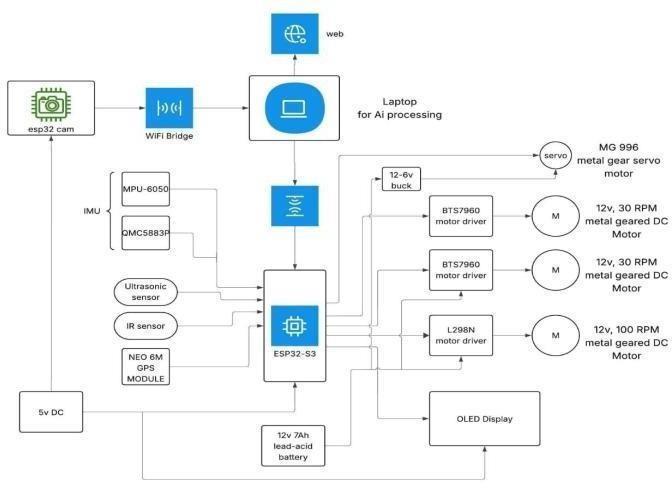
The Eco-Rover is centered around a ESP32 controller interfacing with sensing, power, and actuation modules. Thehardwarearchitectureincludes:
Photovoltaicpanel
MPPTchargecontroller
Lithium-ionbatterypackBatteryManagementSystem (BMS)
DualDCmotorswithtrackeddrive
Motordrivermodule
Ultrasonicsensors
Cameramodule
IMUsensor
GPSreceiver
The modular structure ensures scalability and simplified maintenance.
3.2 Power Management System
The photovoltaic module generates electrical energy governedby:
P=V×I wherePispoweroutput,Vispanelvoltage,andIiscurrent.
To maximize energy extraction, an MPPT controller continuously adjusts operating voltage to maintain operation at the maximum power point under varying irradianceconditions.
Theenergybalanceequationofthesystemisexpressedas:-
Psolar +Pbattery=Pmotors +Pcontrol +Psensors
Thisensuresthatenergydemanddoesnotexceedavailable supply. Excess solar energy charges the battery, while stored energy supports operation during low sunlight conditions.
TheBMSensures:
•Over-voltageprotection
•Under-voltageprotection
•Over-currentprotection
•Thermalmonitoring
•Balancedcharging
Regulatedoutputsprovide5Vforlogiccircuitsand 12Vfor locomotionmotors.
3.3 Locomotion System
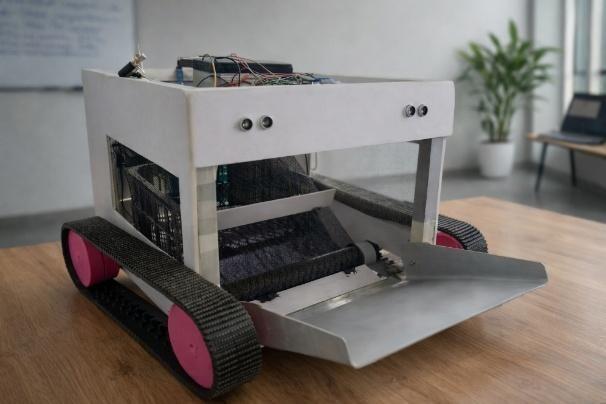
The rover employs a tracked skid-steer configuration to reduce ground pressure and improve traction. Ground pressureisdefinedas:
P=W/A
whereWistotalweightandAiscontactarea.Increasing contactareareducessinkinginsoftsand.
Turning is achieved through differential drive control. Angularvelocitydependsonspeeddifferencebetween left andrighttracks.
MotorvoltageiscontrolledusingPWMmodulation:Vavg=D ×Vsupply whereDrepresentsdutycycle.

Figure 2:-TrackedDriveMechanism
Volume:13Issue:04|Apr2026 www.irjet.net
4. CONTROL STRATEGY
4.1 Energy Management Layer
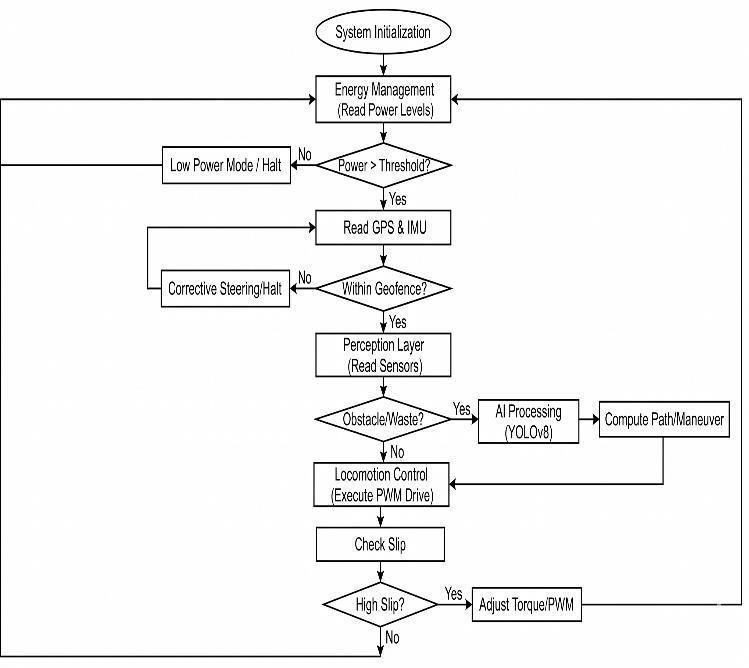
The energy management layer monitors battery voltage and solar input to ensure stable operation. The MPPT controller maximizes photovoltaic power extraction under varying irradiance conditions. Battery levels are maintained within safe limits to prevent over-discharge. When energy drops below a threshold, motor speed is reducedtoextendruntime.
4.2 Locomotion Control Layer
Encoder feedback enables closed-loop speed control. Slip ratio is calculated by comparing commanded speed with measuredRPM.Ifslipexceedsthreshold:
• PWMdutycycleisreduced
• Torquedistributionisadjusted Thisimprovestractionstabilityonunevensand.
4.3 Navigation and Obstacle Avoidance
Obstacle detection combines ultrasonic sensing and camera- based perception. Sensor fusion reduces false detectionunderunevenlightingconditions.
Whenobstacledistanced<dthreshold:-
• Roverhalts
• Directionalscanisperformed
• Alternatepathiscomputed
Afterclearance,theroverresumesoriginaltrajectory.
4.4 Vision System and AI Processing
To enable intelligent obstacle avoidance and waste identification, the Eco-Rover employs a vision-based Artificial Intelligencemodulepowered bythe YOLOv8(You Only Look Once) object detection algorithm. YOLOv8 was selected for its state-of-the-art processing speed and high mean Average Precision (mAP), making it highly suitable for real-time visual analysis in dynamic coastal environments.
The AI model was trained on a custom, domain-specific dataset tailored for beach environments. This dataset was systematically managed, augmented, and merged utilizing the Roboflow platform to ensure robust detection of various terrain obstacles and specific litter types. Model training was executed utilizing Google Colab to leverage cloud-basedGPUacceleration.
p-ISSN:2395-0072
Theresultingoptimizedmodelprocessesthelivevideofeed streamed from the rover's camera. During operation, the deep-learning algorithm continuously analyzes incoming visual frames, classifies detected objects (e.g., debris, natural obstacles), and relays directional feedback to the central control unit. Thisseamlessintegration between the YOLOv8 perception layerand the locomotion control layer allowstherovertodynamicallyexecutepathre-routingand intelligentnavigationwithminimal latency.
5. GPS-BASED GEOFENCING
Operational boundaries are defined using predefined latitude and longitude coordinates. Real-time GPS data is continuouslycomparedwithstoredlimits. Ifdeviationexceedstolerance:
Correctivesteeringisapplied
Emergencyhaltistriggeredifnecessary
Thispreventsunintended exitfromdesignated operational zones. Furthermore, upon stabilization, the navigation algorithm computes the optimal return trajectory to safely guidetheroverbackintotheactiveworkingarea.
International Research Journal of Engineering and Technology (IRJET) e-ISSN:2395-0056 p-ISSN:2395-0072
Volume:13Issue:04|Apr2026 www.irjet.net

6. PERFORMANCE ANALYSIS
Experimentalvalidationwasconductedundersimulated sandyterrainconditions.
Observationsinclude:
Trackedconfigurationreducedsinkingcomparedto wheeledsystems
Closed-loopcontrolmaintainedconsistentRPM underloadvariation
Solarchargingincreasedoperationalenduranceby 35–40%duringpeakirradiance
Sensorfusionreducedobstacledetectionerrors EnergyefficiencyimprovedduetoMPPToptimizationand intelligentloadmanagement
7. FUTURE ENHANCEMENTS
Futureimprovementsmayinclude:
LIDARintegration
Reinforcementlearningpathplanning
Cloudtelemetryforremotemonitoring
Lightweightcompositechassismaterials
8. CONCLUSION
The proposed Eco-Rover integrates renewable energy harvesting,adaptivelocomotion,intelligentnavigation, and geofencing into a unified embedded system. The hybrid solar-battery architecture ensures sustainable long duration operation, while closed-loop slip correction enhances terrain stability. The developed system establishes a scalable foundation for renewable-powered autonomous robotic platforms suitable for environmental andoutdoorapplications.
REFERENCES
[1] D. Varghese and A. Mohan, “Binman: An Autonomous BeachCleaningRobot,”IEEEMysuruCon,2022.
[2]O.Ciezaetal.,“Prometeo:BeachCleanerRobot,”2012.
[3] N. Bano et al., “Radio Controlled Beach Cleaning Bot,” IEEEICETAS,2019.
[4] K.Prakobkarnetal.,“DesignandConstructionofBeach CleaningTrailerbyFiniteElementMethod,”2012.
[5] S. Ichimura and S. I. Nakajima, “Development of an AutonomousBeachCleaningRobot‘Hirottaro’,”IEEEICMA, 2016.
[6] S. Begum et al., “Improving the Performance of Solar Power Plants through IoT and Predictive Data Analytics,” IEEEICEECCOT,2016.
[7]B. L. E. A. Balasuriya et al., “Outdoor Robot Navigation Using Gmapping-based SLAM Algorithm,” IEEE MERCon, 2016.
[8] K. Takaya et al., “Simulation Environment for Mobile RobotsTestingUsingROSandGazebo,”IEEEICSTCC, 2016.
[9] M. Velasco Garrido et al., “Health Status and HealthRelated Quality of Life of Municipal Waste Collection Workers,”J.Occup.Med.Toxicol.,vol.10,2015.
[10] D. B. Daniel et al., “Assessment of Fishing-Related Plastic Debris Along the Beaches in Kerala Coast, India,” Mar.Pollut.Bull.,vol.150,2020.