
International Research Journal of Engineering and Technology (IRJET) e-ISSN: 2395-0056
Volume: 12 Issue: 03| Mar2025 www.irjet.net p-ISSN:2395-0072
International Research Journal of Engineering and Technology (IRJET) e-ISSN: 2395-0056
Volume: 12 Issue: 03| Mar2025 www.irjet.net p-ISSN:2395-0072
Rishit Kantaria
Assistant Professor, Department of Information Technology, Dr Subhash University, Gujarat, India
Abstract – Software Bug Prediction is an important research domain which is much useful for the Software Developers and IT Industries. Software Bugs increases the costof wholeSoftwareDevelopment Life Cycle (SDLC).
This review paper consist of comprehensive analysis of recent advancements in Software Bug Prediction in field of Machine Learning , Deep Learning and Applying Models on Live Workflow. As data pre-processing plays a vital role in any of the Machine Learning Models , this paper also discuss the role of various pre-processing techniques like Dimensionality Reduction , Feature Extraction and FeaturePrediction to improvetheaccuracyofaModel.
Key Words: Bug Prediction, Machine Learning, Deep Learning, Dimensionality Reduction, Feature Extraction, EvaluationMetrics,Classification.
Software quality is a critical concern in modern software development, as defects and bugs can lead to significant financial losses, security vulnerabilities, and user dissatisfaction. To mitigate these risks, software bug prediction has emerged as a key research area, enabling earlyidentificationofpotentialdefectsbeforedeployment. By leveraging historical code metrics, machine learning, deeplearning,andstatisticaltechniques,researchershave developed various predictive models to enhance software qualityandreliability.
Traditional bug prediction approaches rely on supervised learningalgorithmssuchasdecision trees,supportvector machines, and artificial neural networks. More recent advancements include ensemble learning, hyper parameter optimization, and deep learning techniques that improve accuracy and scalability. Additionally, justin-timebugpredictionmodelsandexplainableAImethods aregainingtraction,offeringreal-timedefectidentification andinterpretability.
Despitesignificantprogress,softwarebugpredictionfaces challenges such as imbalanced datasets, feature selection complexity, and model generalization across different projects. This review paper provides a comprehensive analysis of existing bug prediction methodologies, evaluating their strengths, limitations, and emerging trends. Furthermore, it highlights the impact of
programming languages, feature engineering, and dimensionality reduction techniques on bug prediction accuracy. Finally, we discuss future research directions, emphasizing the need for hybrid models, explainable AI, and real-world applications of predictive analytics in softwareengineering.
The rest of this review paper is organized as follows: It provides an overview of traditional and modern software bugpredictiontechniques,includingmachinelearningand deep learning approaches. Focuses and discusses key challenges in bug prediction, such as data imbalance, feature selection, and model interpretability. Additionally, it presents a comparative analysis of existing methodologies, evaluating their effectiveness and limitations It also explores emerging trends, including explainableAIandjust-in-timedefectprediction.Finally,it alsosummarizesthefindingsandsuggestsfutureresearch directionsforimprovingsoftwarebugpredictionmodels."
Traditional Bug Prediction Techniques primarily focuses on Software Metrics such as Lines of Code, Coupling, Cohesion, and Cyclomatic Complexity. Various Machine Learning Algorithms are also used for Bug Prediction like Logistic Regression, SVM, and Decision Trees. The underlyinglimitationsinaboveTraditionalBugPrediction aretheHighFalsePositiveandHighFalseNegativeRates. The other limitation is the implementation of inappropriateDataPreProcessingTechniques.
Table-1: ComparisonofTraditionalandModernSoftware BugPredictionTechniques.
Feature TraditionalBug Prediction Models ModernSoftware BugPrediction Models
Approach Software Metrics,Code Metrics. DeepLearning andEnsemble Learning Techniques.
DataUsed
Algorithms
HistoricalData RealtimeData
Logistic Regression, DecisionTrees, SVM,Naïve
Neural Networks, RandomForest, XGBoost,
International Research Journal of Engineering and Technology (IRJET) e-ISSN: 2395-0056
Volume: 12 Issue: 03| Mar2025 www.irjet.net p-ISSN:2395-0072
Bayes Transformerbasedmodels
HandlingImbalanced Data Struggleswith classimbalance Usesresampling techniques, syntheticdata generation
Flexibility Requiresmanual tuningfor different projects
Adaptivemodels thatself-improve withmoredata
Cross-Validation Parameter Selection (CVParameter Selection),employingapredefinedsetofhyperparameter values for multiple learning algorithms. CVParameter Selection involves systematically trying out different hyper parameter values for multiple learning algorithms through cross-validation to explore the model’s performance under different configurations, ultimately selecting the hyper parameter values that result in the best model performance. Each algorithm has distinct hyper parameters chosen to maximize accuracy and performanceonthesoftwarebugpredictiondataset.[1]
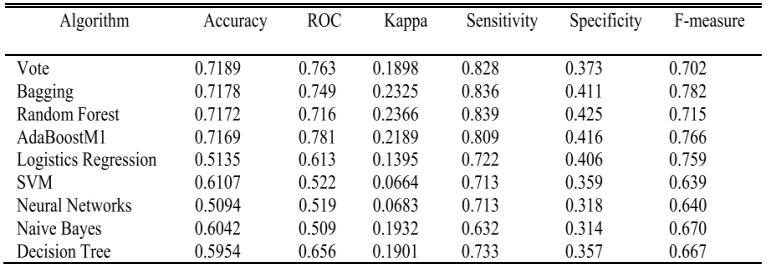
Evaluation Metrics [1]
The study conducted in "An Extensive Comparison of Bug PredictionApproaches"[2]providesacriticalevaluationof various models and their effectiveness. Key takeaways include:
Performance Metrics: The study compares traditional and modern techniques using accuracy, precision,recall,andAUC-ROCscores.
Key Features: It highlights the most influential softwaremetricsinbugprediction,suchascyclomatic complexity,codechurn,andcouplingmetrics.
Challenges Identified: The research discusses common issues, including data imbalance, scalability concerns,andfeatureengineeringcomplexity.
Dataset Usage: Benchmark datasets like PROMISE and NASA have been used to test the effectiveness of differentmodels.
Future Research Areas: The study suggests the adoption of hybrid AI models and real-time bug predictionintegrationinDevOpsworkflows.[2]
The study "Explainable Just-In-Time Bug Prediction: Are WeThereYet?"[3]emphasizestheneedforexplainability inJITbugpredictionmodels.Keyinsightsinclude:
Importance of Explainability: The paper highlights the role of explainable AI (XAI) in making JIT defect predictions interpretable for developers.
Techniques for Explainable JIT Bug Prediction: Methods such as SHAP (SHapley Additive Explanations), LIME (Local Interpretable ModelAgnostic Explanations), and attention-based deep learning models are explored to enhance interpretability.
Challenges in Explain ability: The study discusses difficulties in balancing predictive accuracy with interpretability, as well as limitations of current XAI techniques when appliedtocommit-levelbugprediction.
Experimental Findings: The paper provides a comparative analysis of explainable models versus traditional black-box JIT models, highlighting accuracy versus interpretability trade-offs.
Future Research Directions: Suggestions include the integration of hybrid models combining deep learning and rule-based techniques, incorporation of XAI techniques in real-time DevOps pipelines, and improvements in usertrustthroughenhancedtransparency.
Comparative Analysis from the Study Conducted in “A Novel Dimensionality Reduction-based Software Bug Prediction”[4]
Table-2: ComparisonofTraditionalFeatureSelectionand DimensionalityReductionTechnique
Method Traditional FeatureSelection Dimensionality Reduction Technique
Computational Efficiency
Higheroverfitting risk Limited generalization tospecific datasets
OverfittingRisk Manualor rule-based highfeature Slowerdueto
International Research Journal of Engineering and Technology (IRJET) e-ISSN: 2395-0056
Volume: 12 Issue: 03| Mar2025 www.irjet.net p-ISSN:2395-0072
selection count
Model Generalization Higheroverfitting risk Limited generalization tospecific datasets
The study conducted in “Bug Predictive Models based on Data Analytics and Soft Computing"[5] Key takeaways include.
Role of Data Analytics: Dataanalyticstechniques help identify patterns in defect datasets and improvepredictionaccuracy.
Soft Computing Models: Methodslikefuzzylogic, neural networks, and genetic algorithms enhance adaptability and handle uncertainty in bug prediction.
Performance Evaluation: The study compares models using accuracy, precision, and recall, showing that soft computing methods can reduce falsepositives.
Challenges: Scalabilityofsoftcomputingforlarge projects and the need for explain ability in these models.
The study conducted in “Software Bug Prediction Employing Feature Selection and Deep Learning" [6] Key takeawaysinclude.
Impact of Feature Selection: The study investigates how feature selection affects the performance of bug prediction models. By reducing the number of features, the models become more efficient and potentially more accurate.
Deep Learning Application: The research applies deep learning algorithms to software bug prediction, demonstrating that these advanced models can effectively learn from complex data patterns,leadingtoimprovedpredictionaccuracy.
Experimental Validation: Through empirical experiments, the study shows that combining feature selection with deep learning results in better performance compared to traditional methods,detectingupto32.22%morebugs.
The study conducted in “The Effect of Programming Language in Software Bug Prediction" [7] Key takeaways include.
Programming Language Influence: The study examines how different programming languages, such as Java, C, C++, and Python, impact software bugprediction.Ithighlightsthatlanguage-specific features can affect the accuracy of bug prediction models.
Empirical Analysis: Through empirical analysis, the research demonstrates that certain programming languages exhibit distinct bug patterns, which can be leveraged to improve the performanceofbugpredictionmodels.
Reference FocusArea KeyContributions
[1]D.AlFraihatetal. (2024) Hyperparamet er Optimization
[2]M. D'Ambrosetal. (2010) Comparative Analysis
[3]R.Aleithan (2021) ExplainableAI (XAI)
4]A.Gupta (2023) Dimensionality Reduction
[5]V.Jadhavet al.(2023) SoftComputing &Data Analytics
[6]S.M. Abozeed(202 0) Feature Selection& DeepLearning
[7]S. Sztwiertnia(2 021) Programming Language Impact
Optimizingbug predictionmodels usingensemble learningtechniques.
Extensive comparisonofbug prediction approachesbasedon historicaldefect data.
Discussesthe importanceofXAIin just-in-time(JIT) bugprediction models.
Highlightstheroleof dimensionality reductionin improvingbug predictionaccuracy.
Examinestheimpact ofsoftcomputing techniquesonbug predictionaccuracy.
Investigateshow deeplearningand featureselection improvebug predictionmodels.
Analyzeshow different programming languagesaffect softwarebug predictionaccuracy.
International Research Journal of Engineering and Technology (IRJET) e-ISSN: 2395-0056
Volume: 12 Issue: 03| Mar2025 www.irjet.net p-ISSN:2395-0072
The review of software bug prediction techniques demonstrates the significant evolution from traditional rule-based approaches to AI-driven methodologies. Research studies have shown that deep learning and ensemble learning models outperform conventional statistical methods by leveraging complex data patterns and optimizing hyperparameters [1]. The effectiveness of dimensionality reduction techniques in improving prediction accuracy and computational efficiency has also been highlighted [4]. Furthermore, the integration of explainableAI(XAI)methodsensurestransparencyinbug prediction models, which is essential for their practical adoptioninsoftwaredevelopment[3].
Soft computing-based models, including fuzzy logic and genetic algorithms, have emerged as promising alternatives to conventional techniques by enhancing adaptability and handling uncertainty [5]. Additionally, feature selection techniques, combined with deep learning, have been proven to improve model efficiency and reduce false positives [6]. The influence of programming languages on bug prediction further emphasizestheneedtotailorpredictivemodelsaccording tolanguage-specificcharacteristics[7].
Despite these advancements, key challenges such as data imbalance, feature selection complexity, and generalization across different software projects remain. Future research should focus on improving scalability, integrating predictive analytics with DevOps workflows, and further developing hybrid AI models that enhance both accuracy and interpretability. The continued evolutionofsoftwarebugpredictiontechniqueswillplaya crucial role in ensuring software quality and reducing maintenancecostsinreal-worldapplications.
1. D. Al-Fraihat, Y. Sharrab, A.-R. Al-Ghuwairi, H. Alshishani, and A. Algarni, "Hyperparameter Optimization for Software Bug Prediction Using Ensemble Learning," IEEE Access, vol. 12, pp. 5186951878,2024,doi:10.1109/ACCESS.2024.3380024.
2. M. D'Ambros, M. Lanza, and R. Robbes, "An Extensive Comparison of Bug Prediction Approaches," in Proceedings of the 7th IEEE Working Conference on Mining Software Repositories, 2010, pp. 31–41. doi: 10.1109/MSR.2010.5463279.
3. R. Aleithan, "Explainable Just-In-Time Bug Prediction: Are We There Yet?" in 2021 IEEE/ACM 43rd International Conference on Software Engineering: Companion Proceedings (ICSE-Companion), 2021, pp. 129–131. doi: 10.1109/ICSECompanion52605.2021.00056.
4. Gupta, "A Novel Dimensionality Reduction-based Software Bug Prediction," in 2023 13th International Conference on Cloud Computing, Data Science & Engineering (Confluence), Noida, India, 2023, pp. 123128.doi:10.1109/Confluence.2023.10048829.
5. V. Jadhav, P. Devale, and R. V. Bidwe, "Bug Predictive Models based on Data Analytics and Soft Computing Techniques: A Survey," in Proceedings of the International Conference on Intelligent Computing and ControlSystems(ICICCS),2023,pp.123-130.
6. S. M. Abozeed, M. Y. ElNainay, S. A. Fouad, and M. S. Abougabal, "Software Bug Prediction Employing Feature Selection and Deep Learning," in Proceedings of the 2019 International Conference on Advances in the Emerging Computing Technologies (AECT), 2020, pp.1-6.doi:10.1109/AECT47998.2020.9194215
7. S.Sztwiertnia,M.Grübel,A.Chouchane,D.Sokolowski, K. Narasimhan, and M. Mezini, "Impact of Programming Languages on Machine Learning Bugs," in Proceedings of the 1st ACM International Workshop on AI and Software Testing/Analysis (AISTA), Virtual, Denmark, 2021, pp. 9-12. doi: 10.1145/3464968.3468408.