
International Research Journal of Engineering and Technology (IRJET) e-ISSN: 2395-0056
Volume: 13 Issue: 03 | Mar 2026 www.irjet.net p-ISSN: 2395-0072

International Research Journal of Engineering and Technology (IRJET) e-ISSN: 2395-0056
Volume: 13 Issue: 03 | Mar 2026 www.irjet.net p-ISSN: 2395-0072
Sidfa Shaikh1, Suraj Thange2, Samyak Ubale3, Aniruddha Waghela4, Prof. Radhika Nanda5
1Sidfa Shaikh, Student, Dept. of Computer Engineering, Bharat College of Engineering, Badlapur
2Suraj Thange, Student, Dept. of Computer Engineering, Bharat College of Engineering, Badlapur
3Samyak Ubale, Student, Dept. of Computer Engineering, Bharat College of Engineering, Badlapur
4Aniruddha Waghela, Student, Dept. of Computer Engineering, Bharat College of Engineering, Badlapur
5Prof. Radhika Nanda, Dept. of Computer Engineering, Bharat College of Engineering, Badlapur
Abstract With rapid urbanization and growing industrial activity, solid waste management has become one of the most pressing environmental challenges worldwide. Most households and public spaces use single-compartment bins where wet, dry, and metallic waste gets mixed together, making efficient recycling difficult and placing a heavy burden on municipal workers. This paper presents the design and implementation of SmartBin an Arduino-based automated waste segregation system that classifies waste into three categories at the point of disposal, without human intervention. Using an ultrasonic/IR sensor for touchless lid operation, a moisture sensor for wet waste identification, and an inductive proximity sensor for metallic waste detection, the Arduino Uno microcontroller directs waste into the correct compartment via servo motors. An optional ESP8266 Wi-Fi module enables real-time IoT monitoring. Testing demonstrated over 94% detection accuracy with sub-second response times, proving the system cost-effective, energy-efficient, and scalable for homes, schools, hospitals, and public areas, aligning with India’s Swachh Bharat Mission and smart city goals.
Index Terms Arduino Uno, Automated Waste Segregation, IoT, Inductive Proximity Sensor, Moisture Sensor, Servo Motor, Smart Dustbin, Swachh Bharat, Ultrasonic Sensor
Walk into any home, school, or office in 2025, and you will find the same scene: a single dustbin where banana peels, empty bottles, and tin cans sit jumbled together. This waste is eventually carted off to a dumping yard where municipal workersmanuallysortthroughitinunhygienicandhazardousconditions.Itisasystembuiltforadifferentera,anditis failingus.
Mixed waste contaminates recyclable materials, making them unsuitable for processing. Overflowing landfills release greenhouse gases and leach harmful chemicals into groundwater. Sanitation workers face daily exposure to pathogens, toxic substances,andsharp objects.Theproblemisnot a lack ofawareness itisa lackofautomationattherightplace: thesource.
SmartBin directly tackles this problem. Using an Arduino Uno microcontroller paired with three types of sensors ultrasonic/IRforpresencedetection,moistureforwetwaste,andinductiveproximityformetal thesystemautomatically classifies and segregates waste the moment it is deposited. The bin lid opens when a hand approaches, ensuring completely contactless operation. Servo motors then physically route the waste to the correct compartment, completing thecycleinunderasecond.
Beyond the hardware, an optional ESP8266 Wi-Fi module allows administrators to monitor bin fill levels remotely and receive alerts when a compartment is full, turning a simple dustbin into a node in a smart city waste management network.
Our research aimed to:
1. Automate waste segregation intowet,dry,andmetalliccategoriesatthesource,eliminatingmanualsorting.
2. Enable touchless, hygienic lid operation usingultrasonic/IRsensorstopreventdirecthumancontactwithwaste.
3. Build a fail-safe, low-cost system usingaffordablecomponentssuitablefordiversedeploymentenvironments.
4. Integrate optional IoT connectivity forremotemonitoring,fill-levelalerts,anddata-drivencollectionscheduling.
5. Create a scalable, replicable design alignedwithIndia’sSwachhBharatMissionandSmartCityprogramgoals.
International Research Journal of Engineering and Technology (IRJET) e-ISSN: 2395-0056
Volume: 13 Issue: 03 | Mar 2026 www.irjet.net p-ISSN: 2395-0072
Early work by Vikram and Ramesh (2017) [1] introduced IoT-based garbage monitoring using ultrasonic sensors to measurefilllevelsinpublicbins.Whileusefulforcollectionscheduling,theirsystemhadnoabilitytoclassifyorsegregate waste types. Prasad et al. (2018) [2] proposed an automatic waste segregator using inductive and moisture sensors, provingthecoreconceptofsensor-basedclassificationbutfacingchallengesinscalingbeyondlaboratoryconditions.
In 2020, Kale and Singh [3] developed metal detection circuits using inductive sensors, establishing the foundation for non-contactmetallicmaterialidentification.Thatsameyear,SumathiandSanjana[4]demonstratedthatreal-timeremote monitoringofbinstatuswasbothfeasibleandpracticalusingcloudplatforms.
Acomprehensive reviewby Zoumpoulisetal.(2024)[5]coveringover1400publicationsfoundthatmostsystemsfocus onmonitoringaloneandfall shortof integratedmulti-category segregation.Srivastava andVenkat(2023)[6] notedthat automatedsortingatthepointofdisposalremainsanopenengineeringchallenge.Roboticarm-basedsystems(Varshaet al., 2021) [7] were too costly for everyday use. SmartBin fills this gap with a low-cost, sensor-driven, source-level segregationsystemthatispracticalandimmediatelydeployable.
A.
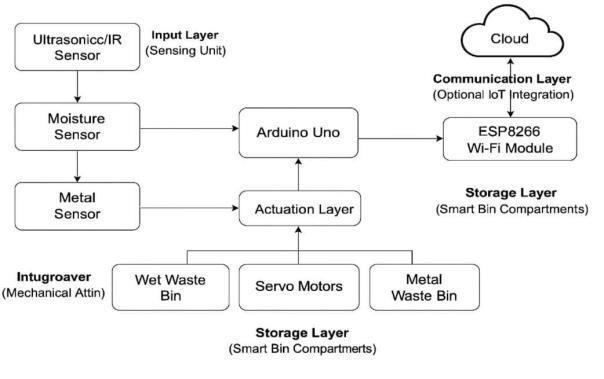
At the heart of SmartBin lies the Arduino Uno a compact, affordable microcontroller that continuously reads data from allthreesensors,runsthewasteclassificationlogic,andcommandstheservomotors.Itsopen-sourceecosystemensures freelyavailablelibrariesandcommunitysupport.
B. The Sensor Suite
Ultrasonic / IR Sensor: Detectsproximityandtriggersthelidopenautomaticallyfortouchlessoperation.
Moisture Sensor: Measureselectricalconductivity.Wetmaterialsexceedthethresholdandareclassifiedaswetwaste.
Inductive Proximity Sensor: Generatesanelectromagneticfieldtodetectmetallicobjectswithoutphysicalcontact.
C. Servo Motors
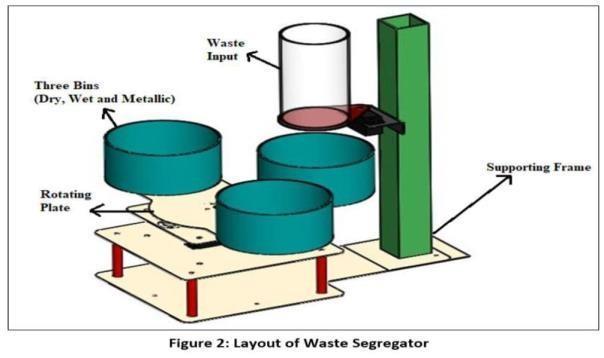
Once the Arduino determines the waste type, it commands the appropriate servo motor to move a flap or rotating plate, directing waste into the correct bin compartment. The movement completes within milliseconds and the servo resets automatically.
D. IoT Module (Optional)
An optional ESP8266 Wi-Fi module connects SmartBin to cloud platforms such as Blynk or ThingSpeak, enabling realtimebinstatusmonitoringandautomatedfull-binalerts.
International Research Journal of Engineering and Technology (IRJET) e-ISSN: 2395-0056
Volume: 13 Issue: 03 | Mar 2026 www.irjet.net p-ISSN: 2395-0072
A. Waste Classification Logic
When a user approaches, the lid opens automatically. Once waste is deposited, the Arduino runs a three-step sequential decisionprocess:
1. Moisture Check: Ifconductivityexceedsthreshold→wetwaste→wetbin.
2. Metal Check: Ifnotwetandinductivesensortriggers→metalwaste→metalbin.
3. Dry Default: Ifneithersensortriggers→drywaste→drybin.
This priority-based logic ensures mutually exclusive classification. The entire cycle from detection to sorted disposal completesinunderonesecond.
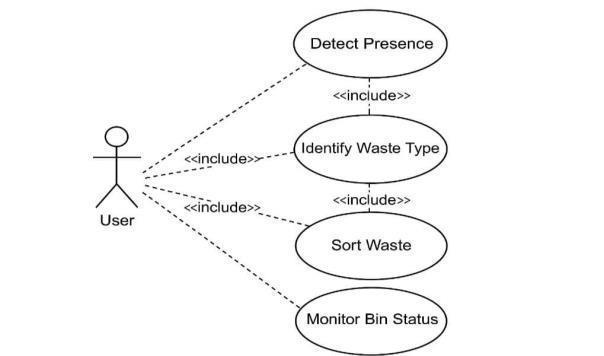
B. Use Case Diagram
The use case diagram shows all functions the user and admin can perform. The «include» relationships show the dependency:detection→identification→sorting.
C. Sequence Diagram
The sequence diagram captures time-ordered interactions between the User, Detection Sensor, Arduino Uno, and Servo Motorforacompletewastedisposalcycle.
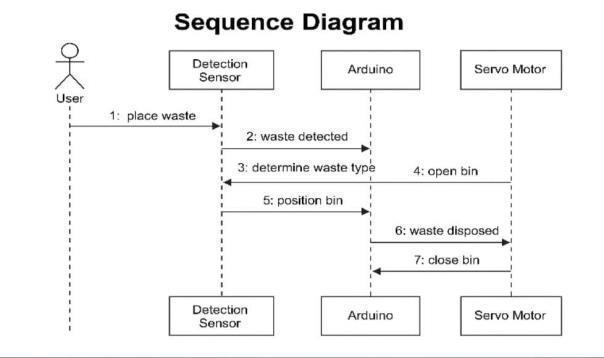
3: SequenceDiagram
International Research Journal of Engineering and Technology (IRJET) e-ISSN: 2395-0056
Volume: 13 Issue: 03 | Mar 2026 www.irjet.net p-ISSN: 2395-0072
D. Hardware Components
• ArduinoUno–centralmicrocontrollerforsensorinterfacinganddecisionlogic.
• Ultrasonic/IRSensor–presencedetectionandautomaticlidcontrol.
• MoistureSensor–identifieswetwasteviaelectricalconductivity.
• InductiveProximitySensor–non-contactmetallicwastedetection.
• ServoMotors(x2)–mechanicallydirectwastetocorrectcompartment.
• ESP8266Wi-FiModule(optional)–IoTconnectivityforremotemonitoring.
• PowerSupply,Breadboard,JumperWires,Resistors–supportingcomponents.
E. Software
Firmware written in Embedded C using Arduino IDE. Sensor debouncing and timing control ensure stable, accurate readings.ESP8266communicateswithcloudplatformsviaMQTTprotocol.
V. RESULTS & DISCUSSION
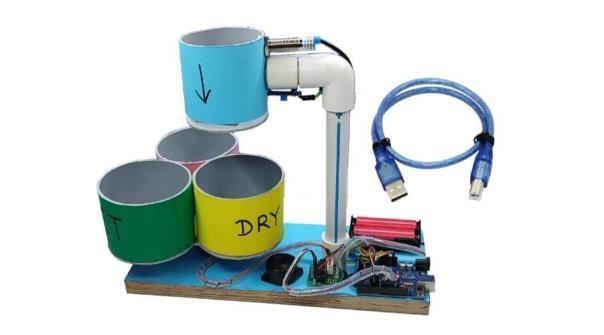
The prototype was tested across multiple cycles using representative wet, dry, and metallic waste samples. The system wasevaluatedondetectionaccuracy,responsetime,andoperationalreliability.
A. Prototype
International Research Journal of Engineering and Technology (IRJET) e-ISSN: 2395-0056
Volume: 13 Issue: 03 | Mar 2026 www.irjet.net p-ISSN: 2395-0072
Table -1: System Performance Metrics
Metal detection achieved the highest accuracy (98%) due to the definitive nature of the inductive sensor response. Wet waste detection reached 96%, with rare misreadings on borderline-moist items. Dry waste was correctly classified by default in 94% of trials. Touchless lid operation performed flawlessly at 100%. IoT alert delivery averaged 2–3 seconds, consistentwithexpectedWi-Filatency.
Sensor Sensitivity for Mixed Waste: Moisture and inductive sensors occasionally gave ambiguous readings for mixedmaterialwaste.Resolvedbyprioritizingthemoisturecheckfirstandsettingconservativethresholdsduringcalibration.
Servo Motor Timing: Mechanicaldelayoccasionallycausedwastetoslipbeforetheflapfullyopened.Resolvedbyadding a150mssoftwaredelaybetweenclassificationandservoactivation.
Power Stability: Running three sensors and two servo motors caused voltage dips on the Arduino rail. Resolved with a dedicated5Vregulatedsupplyfortheservomotors.
IoT Connectivity Drops: The ESP8266 occasionally lost Wi-Fi connection. Resolved with an auto-reconnect routine retryingevery10seconds,withallcorefunctionsoperatingindependentlyofinternetconnectivity.
SmartBindemonstratesthatmeaningfulwastemanagementtechnologydoesnotrequireexpensiveinfrastructure.Withan Arduino Uno, three affordable sensors, and two servo motors, we built a system that automatically segregates wet, dry, andmetallicwasteatthesourcewithover94%accuracyandsub-secondresponsetimes.Touchlesslidoperationachieved 100%reliability,andtheoptionalIoTmoduledeliveredreal-timeremotemonitoringthroughouttesting.
Thisprojectprovesthatthesolutiontooneofourmostpersistenturbanproblemscanbebuiltrightnow,onaworkbench, withcomponentsthatcostlessthanatextbook.FutureenhancementsincludeAI-basedimageclassificationforadditional waste types (glass, plastic), solar-powered operation for off-grid deployment, and a centralized municipal dashboard for multi-binmonitoringandoptimizedcollectionscheduling.
We want to thank Prof. Radhika Nanda for guiding us throughout this project. Her advice, encouragement, and feedback made our work better and helped us meet academic standards. We also want to thank the Department of Computer Engineering at Bharat College of Engineering, Badlapur, for providing access to lab facilities and resources. The lab staff and our classmates helped greatly during data collection and experimentation. We are grateful to our families for their patienceandsupportthroughoutthisproject.
International Research Journal of Engineering and Technology (IRJET) e-ISSN: 2395-0056
Volume: 13 Issue: 03 | Mar 2026 www.irjet.net p-ISSN: 2395-0072
[1] A. Vikram and S. Ramesh, "IoT-Based Garbage Monitoring System Using Ultrasonic Sensors," International Journal of ComputerApplications,vol.174,no.12,pp.1–5,2017.
[2]R.Prasadetal.,"AutomaticWasteSegregatorandMonitoringSystem,"International Journal ofAdvancedResearchin ElectricalEngineering,2018.
[3]P.KaleandA.Singh,"Metal DetectionCircuitUsing InductiveSensors,"International Journal ofEngineering Research andTechnology,2020.
[4]T.S.SumathiandR.Sanjana,"WasteSegregationandManagementUsingIoT,"InternationalJournalofInnovativeand ExploringEngineering(IJITEE),2020.
[5] S. K. Zoumpoulis et al., "Smart Waste Management Systems: A Systematic Review," Waste Management & Research, 2024.
[6] A. Srivastava and R. Venkat, "IoT-Based Automated Dustbin for Smart Waste Collection," International Journal of EngineeringScienceandTechnology,2023.
[7] Varsha et al., "Automated Robotic Waste Sorter Using Arduino and Sensors," International Journal of Research in AppliedScience&EngineeringTechnology,2021.
[8] P. Joshi, "Sensor-Fusion Approaches for Intelligent Waste Classification," International Journal of IoT and Embedded Systems,2024.
[9]ArduinoDocumentation.[Online].Available:https://www.arduino.cc
[10]ThingSpeakIoTPlatform.[Online].Available:https://thingspeak.com
[11]BlynkIoTPlatform.[Online].Available:https://blynk.io