
International Research Journal of Engineering and Technology (IRJET) e-ISSN: 2395-0056
Volume: 13 Issue: 04 | Apr 2026 www.irjet.net p-ISSN: 2395-0072

International Research Journal of Engineering and Technology (IRJET) e-ISSN: 2395-0056
Volume: 13 Issue: 04 | Apr 2026 www.irjet.net p-ISSN: 2395-0072
Muttholla Pravalika, Karre Bhargavi, Mojerla Priyanka, Pasupula Tejashwini
B. Tech Final Year Students, Department of ECE, JBIET, Hyderabad, Technology Dr.S. K. CHAYA DEVI , Professor -ECE Department, JB Institute of Engineering and Technology, Hyderabad, TG
Abstract – Thispaper presentsa smartwheelchairsystem withsafety,speechcommunication,andIoT- based control designedtoassistelderlyandphysicallychallengedpeople in daily mobility and communication. The system is built aroundanArduinoNanomicrocontrollerwhichactsasthe central control unit forall modules.The wheelchaircan be controlled manually using four control buttons for movement directions such as forward, backward, left, and right. In addition to manual operation, the wheelchair can also be controlled wirelessly through a mobile application usingtheBlynkIoTplatformwithanESP8266Wi-Fimodule. Thisprovidesremotemonitoringandcontrolcapability.For safetypurposes,alimitswitchisusedtodetectanycollision ordamagetothewheelchair.Whensuchaneventoccurs,the system automatically sends an alert message to the caretaker’s mobile phone using a GSM module via SMS, ensuring immediate notification in emergency situations. The system also includes a speech assistance feature for communication.Fourcommandbuttonsareprovidedforthe user to request help or basic needs such as food, water, medicine, or assistance. When a button is pressed, a prerecordedvoicemessagestoredintheDFMiniPlayermodule is played through a speaker, allowing the user to communicate easily. Atthesame time, the correspo- nding SMS notification is sent to the caregiver's mobile phone throughtheGSMmodule.
Mobilityandcommunicationaremajorchallengesfacedby elderly and physically disabled people. Traditional wheelchairs often require assistance from another person, which reduces the independence of the user. With the developmentofembeddedsystems,InternetofThings(IoT), and smart communication technologies, it is possible to designintelligentassistivedevicesthatimprovethequality of life for such individuals. The Smart Wheelchair with Safety, Speech and IoT-Based Control is developed to provideanadvancedmobilitysolutionwithadditionalsafety and communication features. The system uses an Arduino Nanoasthemaincontrollertomanagevariousmodulessuch asmotordriver,GSMmodule,Wi-Fimodule,DFMiniPlayer, LCD display, and safety sensors. The wheelchair can be controlledmanuallyusingdirectionalbuttonsorwirelessly usingamobileapplicationthroughWi-Fi.
To enhance safety, a limit switch is used to detect
collision or damage to the wheelchair. When such a situation occurs, an alert message is sent to the caregiver through the GSM module. The system also includes speech assistance, where the user can press predefined command buttons to requesthelp such as food, water, or medicine. These commands are announcedthroughaspeakerusingtheDFMiniPlayer andsentasSMSmessagestothecaregiver.
This system integrates mobility control, safety monitoring,speechassistance,andIoTcommunication, making the wheelchair more intelligent and useful for disabled individuals. The proposed design aims to improveuserindependence,safety,andcommunication.
Many researchers have worked on developing smart wheelchairs using different technologies to assist disabled people. Several studies proposed IoT-based smart wheelchair systems that allow remote monitoring and control through mobile applications. These systemsimproveuserconveniencebyenablingwireless controlandreal-timestatusmonitoring.Someresearch focused on voice-controlled wheelchairs, where users can control wheelchair movement through voice commands using speech recognition modules. These systems help users who cannot operate manual controls.
2.1. IoT-Based Smart Wheelchair with Multi- Model Interaction :
This paper studies the wheelchair’s multi-mode perception and control technology based on rocker, gesture recognition and mobile app, and the system is dividedintofivelayers:remoteend,maincontrollayer, communicationlayer,perceptionlayeranddrivelayer. The system is divided into a five-layer structure of remote terminal, master control layer, communication layer,perceptionlayeranddriverlayer.
2.2. Autonomous Wheelchair with IoT Health Monitoring:
In this paper we propose an intelligent autonomous wheelchairintegratedwithtelemedicinesensorsbased
International Research Journal of Engineering and Technology (IRJET) e-ISSN: 2395-0056
Volume: 13 Issue: 04 | Apr 2026 www.irjet.net p-ISSN: 2395-0072
onIoT,andthearchitectureofthewheelchair system Various sensors including wireless location, position accelerometer, seat cushion sensors, and biophysicalsensorsareembeddedinthewheelchairto collect users’ physiological and behavioral data in real time.
2.3. Smart Wheelchair Based on IoT for Disabled and Elderly:
This paper proposes a cost-effective IoT-based wheelchair focusing on mobility assistance. It highlights the importance of affordable assistive devices but lacks advancedsafetyalertsystems.
2.4. IoT-Based Smart Wheelchair for Healthcare Monitoring:
This paper presents the development and implementation of an Internet of Things (IoT) -enabled smart wheelchair designed to enhance mobility and independence for individuals with disabilities. By integrating advanced assistive technologies and internet connectivity,thesystemoffersacomprehensivesolution that addresses key challenges in wheelchair navigation and user autonomy. The smart wheelchair is equipped witha suiteofsensors,includingultrasonicandinfrared, toperceiveitsenvironment,detectobstacles,andprovide real-timefeedbacktotheuser.
2.5.IoT-Based Mobility Wheelchair :
The paper presents current mobility chair systems primarily offer manual controls like handles or buttons, whichcanbedifficultforuserswithrestrictedmovement the manual control provided by many mobility chair systems on the market today handles orbuttonscanbe challenging.Althoughthey exist,basicobstacledetection systems are frequently insufficient. Therefore, the requirement for an enhanced solution is evident. By combiningsophisticatedobstacledetectionwithjoystick control,thesuggestedsmartmobilitychairincreasesuser autonomyandsafety.
2.6. IoT-Based Smart Healthcare Wheelchair :
The paper presents is to fabricate a shrewd detecting wheelchair through the establishment of sensorsinside its structures. The innovation grasped is the Internet of Things, where sensors screen theheartbeat andblood oxygen levels, measure them through implanted frameworks, and move them to the cloud to initiate a triggerincaseofanyanomaly.Thetriggermadecanbeas anSMSandemail.
Main goal of the SMART WHEELCHAIR project is to control a wheelchair using a voice recognition module (HC-05). This system is designed. ed to control the wheelchairwithahumanvoice.Theaim of this project is to facilitate the mobility ofpeople withdisabilitiesand disabilities, as well as elderly people with mobility difficulties. The goal of this system is to allow certain people tolive theirlives less dependent on others for their dailymovements.Speechrecognitiontechnologyis a key technology that gives new ways of human Interaction with machines and tools. So, using voice recognition technology in the movement of the wheelchair can solve the problemtheyare facing.This can be achieved and optimized by using asmartphone device asanintermediary orinterface. This project uses anArduinoUNOmicrocontrollercircuit and four of his DC motors to generatemovementofthewheelchairand an ultrasonic sensor to control the movement of his hurdlesbetweenthewheelchairandthedirectiondetect. The results and analysis of these innovations are explained in this paper. This result indicates that the modulecanbeusedinfutureresearchworkanddevelop excellent innovations to meet market demands and publicinterest.
1.Peoplewithphysicaldisabilitiesandelderlyindividuals often face serious challenges in mobility due to the limitationsofconventional wheelchairs.Mosttraditional wheelchairs are either manually operated or controlled usingjoysticks,whichrequirephysicalstrengthandhand coordination.Thismakesthemunsuitableforuserswith severe disabilities, paralysis, or limited motor control, forcing them to depend heavily on caregivers for movementanddailyactivities.Suchdependencereduces theirindependenceandconfidenceinperformingroutine tasks.
2.Another major issue is the lack of built-in safety features. Conventional wheelchairs do not have obstacle detection systems, which increases the risk of collisions, especiallyincrowdedorunfamiliarenvironments.Users may accidentally hit objects, walls, or people, leading to injuries. Additionally, there is no automatic braking or alert mechanism to prevent accidents, making it unsafe forindependentuse.
3.Furthermore, traditional wheelchairs do not support real-time monitoring or communication. Caregivers and familymembershavenowaytotracktheuser’slocationor monitor their movement remotely. In emergency situationssuchasfalls,healthissues,oraccidents,thereis no alert system to inform others, which can delay immediateassistanceandincreaserisk.
International Research Journal of Engineering and Technology (IRJET) e-ISSN: 2395-0056
Volume: 13 Issue: 04 | Apr 2026 www.irjet.net p-ISSN: 2395-0072
4.Withtheadvancementoftechnology,thereisagrowing needforsmartersolutionsthatimprovethequality of life for disabled individuals. A smartwheelchairwithspeech control can allow users to operate itusingsimple voice commands, eliminating the need for physical effort. Integratingsafetyfeatureslikeobstacledetectionensures secure navigation, while IoT-based monitoring enables real-time tracking, data sharing, and emergency alerts. Therefore, developing a smart wheelchair system that combinessafety,speechrecognition,andIoTtechnologyis essential to provide safe, independent, and efficient mobilityforusers
5.Peoplewithphysicaldisabilitiesandelderlyindividuals often face serious challenges in mobility due to the limitationsofconventional wheelchairs.Mosttraditional wheelchairs are either manually operated or controlled usingjoysticks,whichrequirephysicalstrengthandhand coordination.Thismakesthemunsuitable for userswith severe disabilities, paralysis, or limited motor control, forcing them to depend heavily on caregivers for movementanddailyactivities.Suchdependencereduces theirindependenceandconfidenceinperformingroutine tasks.
6. Another major issue is the lack of built-in safety features. Conventional wheelchairs do not have obstacle detection systems, which increases the risk of collisions, especiallyincrowdedorunfamiliarenvironments.Users may accidentally hit objects, walls, or people, leading to injuries. Additionally, there is no automatic braking or alert mechanism to prevent accidents, making it unsafe forindependentuse.
7. Furthermore, traditional wheelchairs do not support real-time monitoring or communication. Caregivers and familymembershavenowaytotracktheuser’slocationor monitor their movement remotely. In emergency situationssuchasfalls,healthissues,oraccidents,thereis no alert system to inform others, which can delay immediateassistanceandincreaserisks.
4.1. Manual Wheelchairs:
A manual wheelchair typically consists of a lightweight frame, two large rear wheels, two smaller front caster wheels,aseat,backrest,footrests,andhandrimsattached to the rear wheels. The user propels the wheelchair by gripping and pushing the hand rims, or it can be moved withtheassistanceofacaregiver.Steeringisachievedby applyingdifferentlevelsofforcetoeachwheel,allowing directionalcontrol.
4.2. Electric Wheelchairs:
An electric wheelchair typically consists of a motorized base, rechargeable batteries, control system, and user interface. The main components include DC motors attachedtothewheels,abatterypack,ajoystickorcontrol panel, a motor driver, and a sturdy frame with seating support. The user operates the wheelchair using a joystick, which sends signals to the controller. The controller then regulates the speed and direction of the motors, allowing forward, backward, and turning movements.
The existing system for a joystick-based wheelchair is a commoncontrolmethodusedinmostelectric(powered) wheelchairs,wheretheuseroperatesthechairthrougha joystickinterfaceforsmoothandintuitivemovement.
4.4. BasicSafety Features:
The existing systemsfor safetyfeaturesin wheel- chairs especiallyelectricandsmartwheelchairsaredesignedto protect users, enhance stability, and pre- vent accidents during operation. These systems combine mechanical ,electrical,andsometimeselectronicsafetymechanisms.
4.5.Lack of IoT Integration:
ThelackofIoT(InternetofThings)integrationinexisting wheelchair systems is a major limitation, especially in traditional electric and joystick-based models. While thesesystemsprovidebasicmobilityandsafetyfeatures, they generally operate as standalone devices without connectivityorreal-timedatacapabilities.
4.6.Limitations of existing system:
Existingwheelchairsystems,includingmanualandbasic electricmodels,haveseverallimitationsthatreducetheir effectivenessforphysicallychallengedand elderly users. Manual wheelchairs require continuous physical effort, making them unsuitable for individuals with severe disabilities or low strength, while electric wheelchairs mainly rely on joystick control, which is difficult for users with limited hand movement or paralysis. These systems also lack advanced safety features such as obstacle detectionandautomaticbraking,increasing the riskof accidents. Moreover, there is no provision for real-timemonitoringorIoTintegration, so caregivers cannot track the user’s location or status remotely. In emergencysituations,theabsenceofanalert system can delay immediate assistance andpose serious risks to the user. Therefore, theselimitationshighlighttheneed for a more advanced and efficient smart wheelchair system.
International Research Journal of Engineering and Technology (IRJET) e-ISSN: 2395-0056
Volume: 13 Issue: 04 | Apr 2026 www.irjet.net p-ISSN: 2395-0072
The proposed system is a smart wheelchair designed to provide safe, independent, and intelligent mobility for physically challenged and elderly individuals. It overcomes the limitations of traditional wheelchairs by integratingadvancedtechnologiessuchasspeechcontrol, safety sensors, and IoT monitoring. The system reduces dependencyoncaregivers.Smart
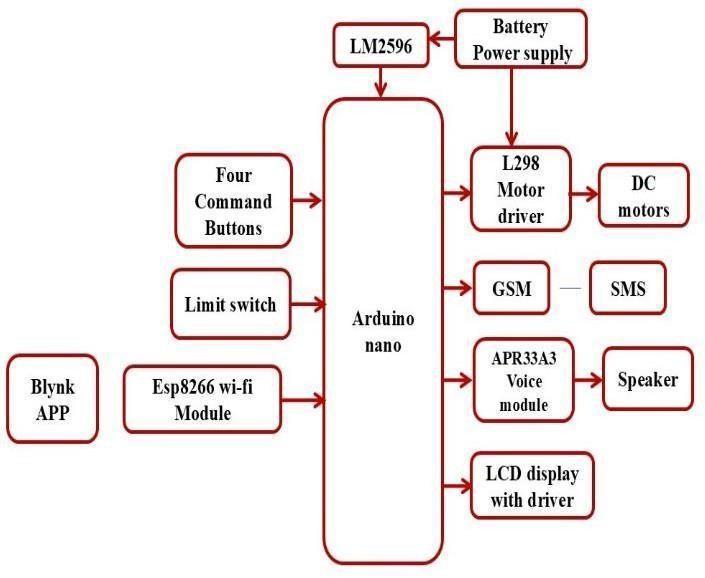
FIG:5.1BlockDiagram
Wheelchair with Safety, Speech Control and IoT Monitoringprojectfocusesondesigninganintelligentand user-friendly mobility system for physically challenged individuals.Thesystemintegratesadvancedtechnologies such as speech recognition, obstacle detection, and IoTbased remote monitoring to ensure safe and efficient operation. The overall design aims to provide independencetouserswhileallowingcaregiverstotrack andassistthemwhenneeded.
Intheinitialstage,thesystemarchitectureisdevelopedby combining both hardware and software components. A microcontroller acts as the central unit, connecting all modules such as sensors, motor drivers, and communicationdevices.
Properinterfacingofthesecomponentsiscarriedoutto ensuresmoothcommunicationandreliableperformance ofthewheelchairsystem.
The hardware implementation involves assembling componentslikeDCmotorsformovement,amotordriver forcontrollingspeedanddirection,ultrasonicsensorsfor obstacle detection, and a speech recognition module for voice commands. Additionally, aWi-FiorGSM moduleis included to enable IoT connectivity. These components are mounted onto the wheelchair and connected systematically.
5.1.Arduino Nano: This is a 3.3V Arduino running the 8MHz bootloader. Arduino Pro Mini does not come with connectors populated so that you can solder in any connectororwirewithanyorientation you need. We recommend first time Arduino users start withtheUnoR3.It'sagreatboardthatwillgetyouupand runquickly.TheArduinoProseriesismeantforusersthat understandthelimitationsofsystemvoltage(3.3V),lack ofconnectors,andUSBoffboard.
5.2.Li-ion Battery Power Supply:3.7v li-ion battery is usedtogivethepowersupplyoftheproject.
5.3.LED:A light-emitting diode (LED) is a semiconductor light source. LEDs are used as indicator lamps in many devicesandareincreasinglyusedforlighting.Introduced as a practical electronic component in 1962, early LEDs emittedlow-intensityredlight,but modernversionsare available across the visible, ultraviolet and infrared wavelengths,withveryhighbrightness.
5.4.DC Motor: A dc motor uses electrical energy to produce mechanical energy, very typically through the interaction of magnetic field and current carrying conductor. The reverse process, producing electrical energy from mechanical energy, is accomplished by alternator, generator or dynamo. Many types of electric motorscanberunasgenerators,andviceversa.Theinput ofaDCmotoriscurrent/voltageanditsoutputistorque.
5.5.DC Motor Driver: The L298N is an integrated monolithic circuit in a 15- lead Multiwatt and PowerSO20 packages. It is a high voltage, highcurrent dual full-bridgedriverde-signedtoacceptstandardTTL logic level sand drive inductive loads such as relays, solenoids,DCandsteppingmotors.Twoenableinputsare providedtoenableor disablethedeviceindependentlyof thein-putsignals.Theemittersofthelowertransistorsof each bridge are connected rand the corresponding externalterminal can be used for the connection of an external sensing resistor. An additional Supply input is providedsothatthelogicworksatalowervoltage.
5.6. Limit switch:Alimitswitchisa mechanicalswitch used to detect the physical position, movement, or collision of an object. It operates when a moving object presses the switch lever, causing the electrical contacts insidetheswitchtoopenorclose.InSmartWheelchairIn thesmartwheelchairsystem,the limit switchis used for safety purposes. It helps to detect damage, collision, or abnormalmovementofthewheelchair.
5.7. ESP8266 WI-FI:TheESP8266Wi-FiModule is a self-contained SOC with integrated TCP/IP protocol stackthatcangiveanymicrocontrolleraccesstoyourWiFi network. The ESP8266 is capableofeitherhostingan applicationoroffloading all Wi-Fi networking functions from another application processor. Each ESP8266 modulecomespre-programmedwithanATcommandset
International Research Journal of Engineering and Technology (IRJET) e-ISSN: 2395-0056
Volume: 13 Issue: 04 | Apr 2026 www.irjet.net p-ISSN: 2395-0072
firmware, meaning, you can simply hook this up to your Arduino device and getaboutas much Wi-Fi-ability asa Wi-FiShieldoffers.TheESP8266moduleisanextremely cost-effective board with a huge, and ever growing, community.
5.8. GSM: GSM, which stands for Global System for Mobilecommunications,reigns(important)astheworld’s mostwidelyusedcellphonetechnology.Cellphonesusea cellphoneservicecarrier’sGSMnetworkbysearchingfor cell phone towers in the nearby area. Global system for mobile communication (GSM) is a globally accepted standardfordigitalcellularcommunication.
5.9.Push Buttons: Buttonsaresimpleinputdevices used to send control signals to the microcontroller when pressed.Inthisproject,pushbuttonsareusedtocontrol the movement of the wheelchair and to send voice assistancecommands.
Thesebuttonsareusedtomovethewheelchairmanually.
▪ Forwardbutton–Movesthewheelchairforward
▪ Backward button Movesthe wheelchair back-ward
▪ Leftbutton–Turnsthewheelchairleft
▪ Rightbutton–Turnsthewheelchairright.
5.10. Working Principle
The smart wheelchair system works by combining control, communication, safety, and mobility features usingtheArduinoNanoasthemaincontroller.Whenthe systemispoweredon,allcomponentssuchastheArduino Nano,ESP8266Wi-Fimodule,GSMmodule,LCDdisplay, motordriver,andvoicemoduleareinitialized,andtheLCD shows that the system is ready. The wheelchair can be controlledremotelythroughtheBlynkmobileapp,where the user or caregiver sends movement commands like forward, backward, left, right, and stop via the internet usingtheESP8266module;thesecommandsarereceived andprocessedbytheArduino,whichthensendssignalsto the L298 motor driver to control the DC motors for smoothmovement.Forsafety,alimitswitchdetectscollisions,andwhentriggered,theArduinoimmediatelystops the motors and sends an alert message to the caregiver through the GSM module. The system also includes a speechassistancefeaturewithfourbuttonsforneedssuch as food, water, medicine, and help; when pressed, the Arduino activates the APR33A3 voice module to play a prerecorded message through a speaker and simultaneouslysends an SMS alert. The GSM module is used to send notifications during emergencies or user requestsusing AT commands. Additionally, a 16×2 LCD display provides real-time updates such as movement status, user commands, and alerts. Overall, the system continuouslymonitorsinputsfromtheapp,buttons,and sensors, processes them through the Arduino Nano,and
controlsoutputslikemotors,voicemessages,GSMalerts, and display, ensuring safe movement, effective communication,andeasyremotemonitoring.
6.1.Enhanced Independence:
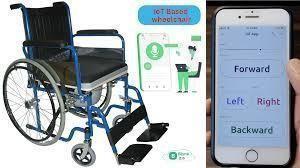
Speech control allows users to operate the wheelchair using voice commands, reducing the need for physical effort or assistance. This is especially helpful for individualswithseveremobilityimpairments.
6.2.Improved Safety Features
Built-in safety mechanisms such as obstacle detection, limit switches, and automatic braking help prevent collisions and accidents. Some systems can also send alertsduringemergencies.
6.3.Real-Time IoT Monitoring
With IoT integration, caregivers or family members can monitor the wheelchair remotely. Features like GPS tracking, health status updates, and system diagnostics ensure better supervision and quick response when needed.
6.4.Ease of Communication
Speechmodulesenablesmootherinteractionbetweenthe user and the wheelchair system, making operation intuitiveanduser-friendlyevenforelderlypeople.
6.5.Remote Control & Automation
Usingsmartphoneappsorwebinterfaces,thewheelchair can be controlled or monitored from anywhere, offering flexibilityandconvenience.
6.6.Increased Mobility Efficiency
Motorized control with intelligent navigation reduces manual effort and allows smoother, more precise movementindifferentenvironments.
6.7.Emergency Assistance
GSM or IoT modules can send alerts or messages to predefined contacts in case of danger, improving user safety.
International Research Journal of Engineering and Technology (IRJET) e-ISSN: 2395-0056
Volume: 13 Issue: 04 | Apr 2026 www.irjet.net p-ISSN: 2395-0072
6.8.Customization & Scalability
Thesystemcanbeupgradedwithadditionalfeatureslike healthmonitoringsensors, AI-basednavigation, or voice assistants.
6.9.Better Quality of Life
Overall, combining safety, speech recognition, and IoT helps users live more independently, confidently, and comfortablyintheirdailylives.
7. FUTURE SCOPE :
Thesystemcanbefurtherimprovedwithadvanced featuresinthefuture.
• Integration of voice recognition control for handsfreeoperation.
• Addition of obstacle detection sensors such as ultrasonicsensorsforautomaticobstacleavoidance.
• Implementation of GPS tracking to monitor the wheelchairlocation.
• Development of a mobile application with more advancedcontrolfeatures.
• Integrationofhealthmonitoringsensorssuchasheart rateandtemperaturesensors.
• ImplementationofAI-basedautonomousnavigationfor automatic wheelchair movement. These improvements canmakethesmartwheelchair more advanced, reliable, and helpful for disabledusers.
The Smart Wheelchair with Safety, Speech Control and IoTMonitoringsystemprovidesanadvancedandefficient solutionforassistingphysicallychallengedindividualsin their daily mobility. By integrating modern technologies such as voice recognition, obstacle detection, and IoT connectivity,thesystemenhancesuserindependenceand reduces the need for constant manual assistance. The implementationofspeechcontrolallowsuserstooperate the wheelchair easily without physical effort, making it highly beneficial for people with severe disabilities. The inclusionofultrasonicsensorsensuressafetybydetecting obstacles and preventing collisions, thereby creating a secureenvironmentformovement.
Furthermore, the IoT monitoring feature plays a significant role in improving caregiving. It enables realtime tracking and status monitoring of the wheelchair, allowing family members or caregivers to stay informed and respond quickly during emergencies. This adds an extra layer of security and reliability to the system. Overall, the proposed system successfully combines safety,convenience,and smart technology into a single platform. It is cost-effective, user-friendly, and highly
adaptableforfutureenhancementssuchasGPStracking, healthmonitoring,andmobileappintegration.Thus, this smart wheelchair system contributes significantly to improving the quality of life and independence of differentlyabledindividuals.
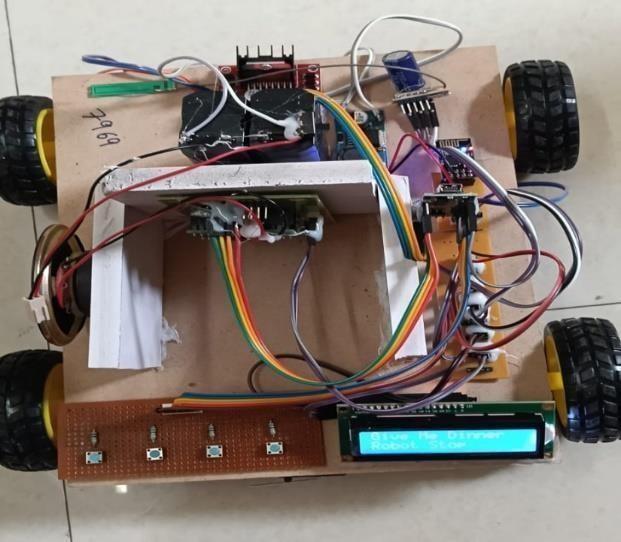
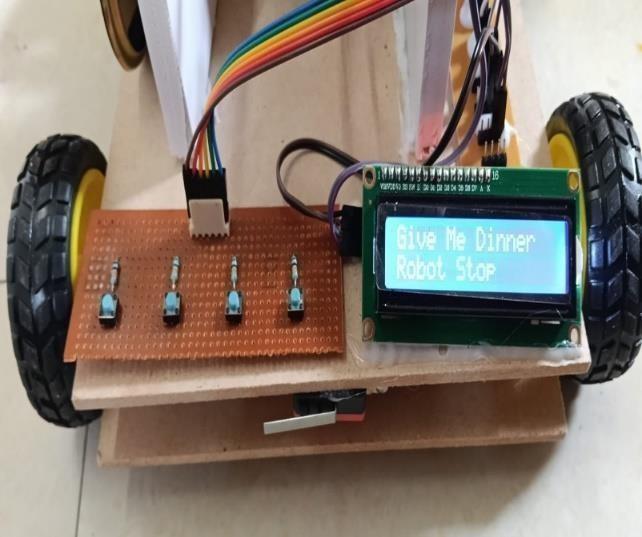
Fig8.2:OutputshowninLCDdisplay
TheSmartWheelchairwithSafety,Speech,andIoT-Based Control system was successfully designed and implemented using an Arduino Nano and other supportingmodules.Thewheelchairwasabletomovein different directions such as forward, backward, left, and rightusing manualcontrol buttons.The wirelesscontrol using the mobile application through the Wi-Fi module alsoworkedsuccessfully,allowingtheusertocontrolthe wheelchairremotely.ThemotordrivercontrolledtheDC motors effectively according to the commands received fromthecontroller.Thelimitswitchsuccessfullydetected collision or damage situations. When the switch was triggered, the GSM module sent an alert SMS to the caregiver’s mobile phone. The speech assistance system
International Research Journal of Engineering and Technology (IRJET) e-ISSN: 2395-0056
using the DF Mini Player played predefined voice messages 65 through the speaker when command buttons were pressed. At the same time, the corresponding request messagewassenttothecaregiverthroughSMS.The LCD display showed the system status clearly. Overall, the system worked properly and demonstrated improved mobility,safety,andcommunicationforwheelchairusers.
:
[1]R. Shyla and A. C. Megha Shree, “Intelligent Wheel ChairBasedonInternetof Things,” International Journal of Engineering Research & Technology (IJERT), vol. 6, no. 13,2018.
[2]A. Rushitha Lakshmi, M. Praveen Reddy, S. Ruchitha, andY.Sreenivasulu,“SmartWheelchairBasedonIoTfor Disabled and Elderly People,” International Journal for Research in Applied Science and Engineering Technology, 2022.
[3]S. Khamgal, S. Patil, R. Tare, and M. Patil, “IoT Based Smart Wheelchair,” International Journal of Innovative Science and Research Technology,vol.8,no.4,2023.
[4]R. A. Jha, Y. Sikchi, S. Khose, and R. Vetal, “Voice Controlled Smart Wheelchair for Physically Disabled Person,” International Advanced Research Journal in Science, Engineering and Technology,vol.10,no.5,2023.
[5]S. S. Kulkarni, A. B. Dhembare, P. D. Deshmukh, V.M. Marathe,M.U.Yelpale,andP.B.Tathe,“HomeAutomation bySmart Wheelchairfor PhysicallyHandicappedPerson UsingArduino,” InternationalJournal of Advance Research, Ideas and Innovations in Technology,vol.4,no.2,2018.
[6]“Arduino Based Wheelchair Fall Detection System UsingGPSandGSMModule,” IEEE Conference Publication, IEEEXplore,2023.
[7]“Arduino Based Voice Controlled Wheelchair for Physically Challenged Persons,” IEEE Conference Publication,IEEEXplore,2023.
[8]“IoT Based Smart Wheelchair for Disabled Person,” IEEE Conference Publication,IEEEXplore.
Volume: 13 Issue: 04 | Apr 2026 www.irjet.net p-ISSN: 2395-0072 © 2026, IRJET | Impact Factor value: 8.315 | ISO 9001:2008 Certified Journal | Page3825