
International Research Journal of Engineering and Technology (IRJET) e-ISSN: 2395-0056
Volume: 13 Issue: 03 | Mar 2026 www.irjet.net p-ISSN: 2395-0072
International Research Journal of Engineering and Technology (IRJET) e-ISSN: 2395-0056
Volume: 13 Issue: 03 | Mar 2026 www.irjet.net p-ISSN: 2395-0072
3Mr.K.R.Mohan Raj, asst.Professor, Department of Information Technology, Velammal Engineering college, Tamil Nadu, India ***
Abstract - In recent days, managing household waste has become a major challenge due to the increasing population and improper waste disposal practices. Our Smart Waste Segregation System aims to improve waste management by automatically identifying and separating different types of waste using simple sensors and a microcontroller. The system uses an IR sensor to detect waste entry, a metal detection sensor to identify metal waste, and a raindrop sensor to distinguish between wet and dry waste. Based on these inputs, the system processes the data and uses servo motors to direct the waste into the appropriate bins without any manual intervention. A 16×2 LCD display provides real-time information about the waste type and system status, making it user-friendly. The system is powered by a lithium-ion battery, ensuring portability and continuous operation. This approach not only reduces human effort but also improves waste segregation efficiency, leading to better recycling practices. By promoting proper waste disposal at the source, the system contributes to a cleaner environment and supports sustainable waste management solutions in households and small-scale applications.
Key Words: Smart Waste Segregation, Arduino Nano, Sensors, Automation, Recycling, Servo Motor.
In recent years, improper waste management has become a serious environmental concern due to rapid urbanizationandincreasingpopulation.Alargeamountofhouseholdwasteisgenerateddaily,andinmanycases,it isnotproperlysegregatedatthesource.Traditionalwastesegregationmethodsrelyheavilyonmanualeffortand public awareness, which often leads to mixing of wet, dry, andmetal waste. This reduces recyclingefficiency, increasesenvironmentalpollution,andmakeswasteprocessingmoredifficult.Toaddressthesechallenges,aSmart Waste Segregation System is proposed to provide an automated, efficient, and low-cost solution for waste classificationanddisposal.
ThesystemusesanArduinoNanoasthemaincontrolleralongwithsimplesensorstodetectdifferenttypesof waste.Itautomaticallyidentifieswasteanddirectsitintotheappropriatebinwithouthumanintervention.This approachminimizeserrors,improvesefficiency,andpromotesproperwastemanagementpractices.
Oneofthekeyfeaturesofthissystemisitsabilitytosegregatewasteautomatically.Whenwasteisplacedintothe system,anIRsensordetectsitspresenceandactivatestheprocess.Thesystemthenanalyzesthewasteusingother sensorsanddeterminesitscategory.Basedontheresult,thewasteisdirectedintothecorrectbinusing servo motors.Thisreducestheneedformanualsegregationandensuresbetterwastemanagementatthesource.
Thesystemusesmultiplesensorstoaccuratelyidentifywastetypes.Ametaldetectionsensorisusedtodetect metallic objects such as cans andmetal pieces. If no metal is detected, a raindrop sensor checks themoisture content to determine whether the waste is wetor dry. This combination of sensors improves the accuracy of classificationandensuresproperseparationofwastematerials.
Tomakethesystemeasytouse,a16×2LCDdisplayisintegratedtoshowreal-timeinformationaboutthedetected wastetypeandsystemstatus.Thishelpsusersunderstandhowthesystemisworking.Thesystemispoweredbya lithium-ionbattery,andanLM7805voltageregulatorensuresastablepowersupplyforsmoothoperation.
International Research Journal of Engineering and Technology (IRJET) e-ISSN: 2395-0056
Volume: 13 Issue: 03 | Mar 2026 www.irjet.net p-ISSN: 2395-0072
Thesystemisdesignedusingasimpleandefficientarchitectureconsistingofthreemainparts:
1. InputLayer:SensorssuchasIRsensor,metaldetectionsensor,andraindropsensorcollectdataaboutthe waste.
2. ProcessingLayer:ArduinoNanoprocessesthesensordataanddecidesthewastecategory.
3. OutputLayer:Servomotorsdirectthewasteintothecorrectbin,andtheLCDdisplayshowstheresult. Thisstructuredapproachensuresreliableandefficientperformanceofthesystem.
[1] IoT-based Smart Waste Segregation System that automatically classifies waste into metal, wet, and dry categories.Itusessensorssuchasmetal(proximity),IR,andmoisturesensorstodetectdifferenttypesofwaste. The system is controlled by an Arduino microcontroller, which processes sensor data and directs waste into appropriatebinsusingservomotors.Itreducesmanualeffortandimprovesefficiencyinwastemanagement.The systemcanalsobeenhancedusingAIandIoTforbetteraccuracyandreal-timemonitoring.Overall,itprovidesa smartandeco-friendlysolutionformodernwastemanagementchallenges.
[2]asmartandlow-costwastesegregationsystemthatautomaticallyclassifieswasteintodryandwetcategories.It usesamachinelearningmodelinPythontoidentifywastefromimagesandsendstheresulttoanArduinoUno.The Arduinothencontrolsaservomotortodirectwasteintothecorrectbin,whileanLCDdisplaystheresult.The systemworksoffline,makingitaffordableandeasytouseinhomes,schools,andpublicplaces.Itachievedaround 91%accuracyduringtestingandprovidesfastandreliableperformance.Overall,itoffersasimpleandefficient solutionforimprovingwastemanagement.
[3]DeepWaste,amobileapplicationthatusesdeeplearningtoclassifywasteintotrash,recycling,andcompost categories. It uses Convolutional Neural Networks (CNNs) like ResNet50 to achieve high accuracy in waste classification.Thesystemworksbycapturingimagesthroughamobilephoneandprovidinginstantresultswithout needinginternetconnectivity.Themodelwastrainedonadatasetofover1200imagesandachievedanaverage precisionofaround88.1%.Ithelpsreduceincorrectwastedisposalandpromotesbetterenvironmentalpractices. Overall,DeepWasteoffersasimple,fast,anduser-friendlysolutionforsmartwastemanagement.
[4]IoT-basedSmartTrashBindesignedtoimprovewastemanagementinurbanareas.ThesystemusesNodeMCU, ultrasonicsensors,IRsensor,andmoisturesensortomonitorgarbagelevelsandsegregatewasteintodryandwet categories.Itsendsreal-timenotificationstousersthroughtheBlynkappwhenthebinreachesathresholdlevel. Theservomotorautomaticallydirectswastebasedonmoisturedetection.Thissystemhelpsreduceoverflow, improvescleanliness,andsupportsefficientwastecollection.Overall,itprovidesasmartandcost-effectivesolution formanagingwasteinpublicplaces.
[5]automaticwasteidentificationsystems usedinsmart wastesegregation.It analyzessensors, datasets,and machinelearningtechniquesusedforclassifyingwastematerials.Image-basedsensorsandedgecomputingdevices are widely used for processing data. Convolutional Neural Networks (CNNs) are the most commonly used algorithmsforwasteclassification.Thestudyhighlightschallengessuchaslimiteddatasets,difficultyinreal-world conditions,andsimilaritybetweenwastematerials.Overall,thepaperemphasizestheneedforimproveddatasets, real-worldtesting,andsensorfusionforbetterperformance.
[6]reviewstheuseofhyperspectralimaging(HSI)andmachinelearningforplasticwastedetection.HSIusesnearinfraredsensorstocapturespectralinformationofplasticsforaccurateidentification.Itiseffectiveindetecting differenttypesofplasticsandmicroplastics.However,blackplasticsaredifficulttodetectduetocarbon-black absorbinglightinthespectrum.Machinelearningmodelsalsoshowgoodaccuracyinclassifyingplasticwasteusing datasets.Overall,combiningHSIwithmachinelearningimprovesplasticdetectionandwastemanagementsystems.
International Research Journal of Engineering and Technology (IRJET) e-ISSN: 2395-0056
Volume: 13 Issue: 03 | Mar 2026 www.irjet.net p-ISSN: 2395-0072
[7]anIoT-basedSmartWasteManagementSystemthatimprovesgarbagecollectionandenvironmentalsafetyin urbanareas.Thesystemusessensorssuchasultrasonic,moisture,metal,airquality(MQ135),andloadcellto monitorwastetype,level,andsurroundingairquality.Itsegregateswasteintowet,dry,andmetalliccategories automaticallyusingsensor-baseddetectionandservomechanisms.ThesystemalsotracksbinlocationusingGPS andsendsreal-timealertsthroughtheBlynkapp.Machinelearningmodelsareusedtoclassifyairqualitylevelsand garbageweightforbetterdecision-making.Overall,thesystemenhancescleanliness,reduceshealthrisks,and supportsefficientwastemanagement.
[1]
1. Reduceshumaneffortand improveswaste segregationefficiency.
2. Enhancesrecyclingby accuratelyseparating differenttypesofwaste.
1. Sensoraccuracymay reducewhenwaste materialsaremixed.
2. Initialsetupand maintenancecostcanbe higherforadvanced features.
[2]
[3]
[4]
[5]
1. Highaccuracy(around 91%)usingmachine learningforwaste classification.
2. Low-cost,portable,and workswithoutinternet connectivity.
1. Providesreal-timewaste classificationusingdeep learningwithgood accuracy(~88%).
2. Worksonmobiledevices withoutrequiring expensivehardwareor internet.
1. Providesreal-time monitoringandalerts usingIoT(Blynkapp).
2. Automaticallysegregates wasteandpreventsbin overflow.
1. UsesadvancedMachine Learning(CNN)for accuratewaste classification.
2. Supportsautomation, reducinghumaneffortin wastesegregation.
1. Limitedtoonlydryand wetwasteclassification.
2. Requirescamera/image input,whichmaybe affectedbylighting conditions.
1. Accuracymayvarydueto differentshapes,lighting, andimagequality.
2. Requiresalargedataset andtrainingforbetter performanceand generalization.
1. Requiresinternet/Wi-Fi connectionformonitoring andnotifications.
2. Limitedsegregation(only dryandwetwaste).
1. Requireslargedatasets andhighcomputational resources.
2. Performancemaydecrease inreal-worldconditions duetocomplexwaste variations.
International Research Journal of Engineering and Technology (IRJET) e-ISSN: 2395-0056
Volume: 13 Issue: 03 | Mar 2026 www.irjet.net p-ISSN: 2395-0072
[6]
[7]
1. Providesaccurate detectionusingspectral informationofmaterials.
2. Machinelearning improvesclassification andsortingofplastic waste.
1. Providesreal-time monitoringofgarbage level,airquality,andbin locationusingIoT.
2. Automaticallysegregates wasteintowet,dry,and metalliccategories, reducingmanualeffort.
1. Cannoteffectivelydetect blackplasticsduetolight absorption.
2. Technologyisstillinearly stagesandrequires advancedequipment.
1. Requireshighinitialsetup costandtechnical expertisefordeployment.
2. Dependsoninternet connectivityandsensor accuracyforproper functioning.
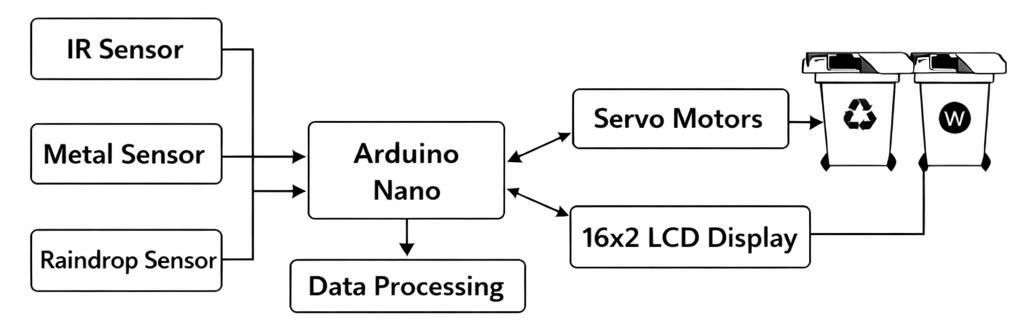
This system shows how a Smart Waste Segregation System automatically manages waste using simple sensors and a microcontroller.Itcollectsinputfroman IR sensor, metal detection sensor,and raindrop sensor (Fig1).TheIRsensor detectswhenwasteisplacedintothesystem,whilethemetalsensoridentifiesmetallicwasteandtheraindropsensorchecks formoisturecontent.Thisdataisprocessedbythe Arduino Nano,whichdecidesthetypeofwaste.Basedonthisdecision, servo motors areactivatedtodirectthewasteintotheappropriatebin.Thesystemalsousesa 16×2 LCD display toshowthe detectedwastetypeandsystemstatus.Thisautomatedprocessreducesmanualeffort,improvesaccuracy,andensuresproper wastesegregationatthesource.
International Research Journal of Engineering and Technology (IRJET) e-ISSN: 2395-0056
Volume: 13 Issue: 03 | Mar 2026 www.irjet.net p-ISSN: 2395-0072
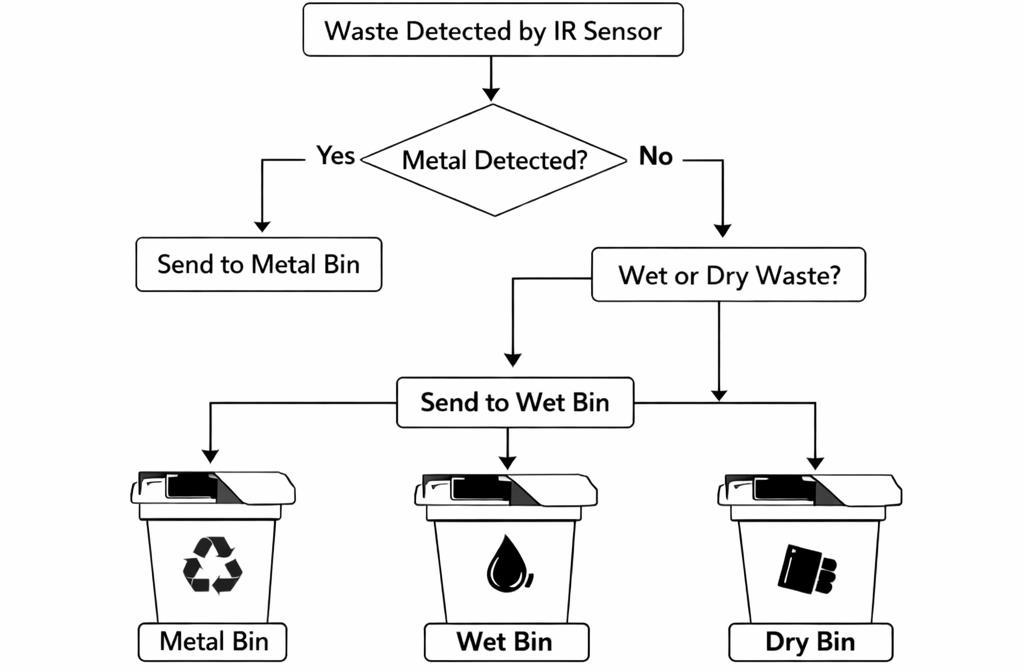
Fig2showstheworkingofthewastesegregationsystembasedonsensorinputs.Whenwasteisinserted,theIRsensordetects itspresenceandactivatesthesystem.Themetaldetectionsensorfirstcheckswhetherthewastecontainsmetal.Ifmetalis detected,itisimmediatelydirectedtothemetalbin.Ifnot,theraindropsensorcheckswhetherthewasteiswetordry.Based onthisresult,thesystemdecidesthecorrectcategoryandactivatestheservomotorstomovethewasteintotherespectivebin. Thisprocessisrepeatedcontinuouslyforeverywasteinput,ensuringefficientandreal-timewastesegregation.Thishelps reducewastemixing,improvesrecyclingefficiency,andsupportscleanerwastemanagementpractices.
The Smart Waste Segregation System isdesignedtoimprovewastemanagementbyautomaticallyidentifyingandseparating differenttypesofwaste.Thissystemusessensorsandamicrocontrollertoreducemanualeffortand improvesegregation accuracy.Byintegratingsimplehardwarecomponentslikesensors,servomotors,anddisplayunits,thesystemensuresan efficientanduser-friendlyapproachtowastehandling.Ithelpsinreducingwastemixing,improvingrecyclingefficiency,and promotingacleanerenvironment.
Atthecoreofthesystemisthe Arduino Nano,whichcontrolstheentireprocess.Itreceivesinputdatafromsensorsand processesittodeterminethetypeofwaste.Oncethewasteisidentified,thesystemautomaticallyactivatestheservomotorsto directthewasteintotheappropriatebin.Thisautomatedoperationensuressmoothfunctioningwithouthumanintervention.
International Research Journal of Engineering and Technology (IRJET) e-ISSN: 2395-0056
Volume: 13 Issue: 03 | Mar 2026 www.irjet.net p-ISSN: 2395-0072
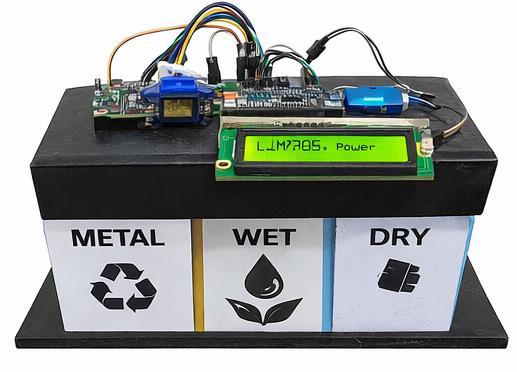
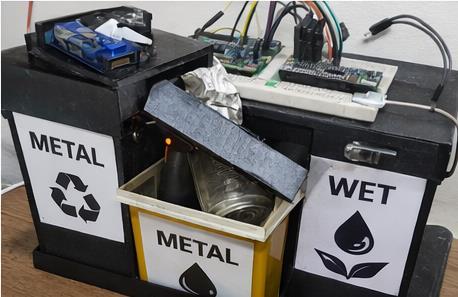
Figure3showstheworkingprototypeoftheSmartWasteSegregationSystem,includingsensors,ArduinoNano,andwaste bins.
Thesystemusesmultiplesensorstodetectdifferenttypesofwaste.The IR sensor detectswhenwasteisplacedintothe system. The metal detection sensor identifies metallic waste such as cans or metal pieces. If no metal is detected, the raindrop sensor checksformoisturetodeterminewhetherthewasteiswetordry.Thiscombinationofsensorsimproves classificationaccuracyandensurespropersegregation.
4.3
Oncethewastetypeisidentified,theArduinosendssignalstothe servo motors.Thesemotorsrotateandguidethewasteinto thecorrectbin,suchasmetal,wet,ordrywastebins.Thisprocesshappensautomaticallyandcontinuouslyforeachinput, ensuringefficientwastehandlingandreducinghumaneffort.
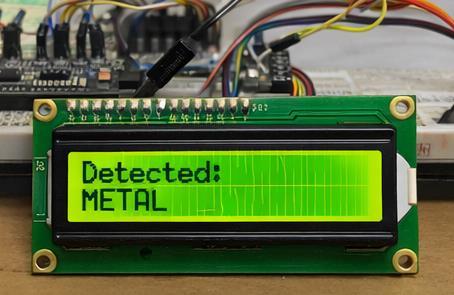
Thesystemincludesa 16×2 LCD display thatprovidesreal-timeinformationaboutthedetectedwastetypeandsystemstatus. Thismakesthesystemeasytounderstandanduser-friendly.Userscanclearlyseehowthewasteisbeingprocessed,which increasesawarenessaboutproperwastesegregation.
International Research Journal of Engineering and Technology (IRJET) e-ISSN: 2395-0056
Volume: 13 Issue: 03 | Mar 2026 www.irjet.net p-ISSN: 2395-0072
Figure5showstheLCDdisplayoutput,wherethedetectedwastetypesuchasmetal,wet,ordryisdisplayed.Thishelpsusers understandthesystem'soperationinrealtime.
4.5 Power Management
Thesystemispoweredbya lithium-ion battery,makingitportableandsuitableforsmall-scaleapplications.The LM7805 voltage regulator ensuresastable5Vpowersupplytoallcomponents,allowingthesystemtooperatesmoothlywithout fluctuations.
4.6 Performance and Accuracy
Theprototypesystemachievesanapproximateaccuracyof 80% to 90% inwasteclassification.Theaccuracydependson sensor performance and environmental conditions. While the system works effectively for basic waste segregation, improvementscanbemadebyusingadvancedsensorsorAI-baseddetectiontechniques.
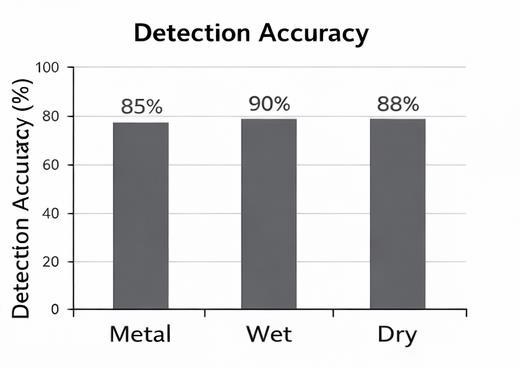
Figure6showstheaccuracyofthesystemindetectingdifferenttypesofwaste.Thegraphhighlightstheefficiencyofsensors usedinthesystem.
4.7 Applications
Thissystemcanbeusedinvariousenvironmentssuchashouseholds,offices,schools,andpublicplaces.Itcanalsobefurther developedfor smart city waste management systems,whereautomatedsegregationplaysanimportantroleinmaintaining cleanlinessandsustainability.
4.8 Challenges
Somechallengesfacedduringtheprojectincludesensorlimitations,especiallywhenwastematerialsaremixed.Environmental factorssuchasmoistureanddustcanalsoaffectsensorreadings.Additionally,properalignmentofservomotorsisnecessary foraccuratewastedirection.
4.9 Future Improvements
Thesystemcanbeenhancedbyintegrating IoT technology forreal-timemonitoringanddataanalysis.Machinelearning modelscanalsobeusedtoimproveclassificationaccuracy.Additionalsensorscanbeaddedtodetectmoretypesofwaste, makingthesystemmoreadvancedandefficient.
4.10 Comparative Analysis
Theproposedsystemismoreefficientcomparedtotraditionalmanualsegregationmethods.Itreduceshumaneffortand increasesaccuracy.Whileexistingsystemsrelyheavilyonmanualsorting,thissystemautomatestheprocessusingsensorsand
International Research Journal of Engineering and Technology (IRJET) e-ISSN: 2395-0056
Volume: 13 Issue: 03 | Mar 2026 www.irjet.net p-ISSN: 2395-0072
microcontrollerlogic.Althoughthecurrentprototypeachievesgoodperformance,futureimprovementscanfurtherenhanceits efficiencyandreliability.
The Smart Waste Segregation System provides an effective solution for managing household waste using automationandsimplesensor-basedtechnology.Itaccuratelyidentifiesdifferenttypesofwastesuchasmetal,wet, anddryusingacombinationofsensorsandprocessesthedatausinganArduinoNano.Thesystemautomatically segregateswasteintoappropriatebinsusingservomotors,reducingtheneedformanualeffort.TheLCDdisplay providesreal-timeinformation,makingthesystemeasytounderstandanduser-friendly.
By ensuring proper segregation at the source, the system improves recycling efficiency and helps reduce environmentalpollution.Theuseoflow-costcomponentsmakesitsuitableforstudentprojectsandsmall-scale applications. Although the prototype has some limitations in accuracy, it performs efficiently for basic waste segregationtasks.
Overall,thisprojectdemonstrateshowautomationcansimplifywastemanagement,promotecleanersurroundings, and support sustainable practices. It can be further enhanced with advanced technologies like IoT and AI for improvedperformanceandlarge-scaleimplementation.
[1] M.R.Chitale,S.J.Chitpur,A.B.Chivate,P.D.Chopadeetal.,“IoTBasedSmartWasteSegregation,” 2023
[2] “IoTBasedSmartWasteSegregation,”InternationalJournalforResearchinAppliedScience&EngineeringTechnology (IJRASET),vol.13,no.7,July2025,pp. ,doi:10.22214/ijraset.2025.75921.
[3] Y. Narayan, “DeepWaste: Applying Deep Learning to Waste Classification for a Sustainable Planet,” Jan. 15, 2021, arXiv:2101.05960,doi:10.48550/arXiv.2101.05960.
[4] A.Adgaonkar,D.Komal,A.Jigar,B.Deesha,“IoTBasedSmartTrashBin,”InternationalJournalofResearchandAnalytical Reviews(IJRAR),vol.9,no.2,June2022,pp.403–406.
[5] J.C.Arbeláez-Estrada,P.Vallejo,J.Aguilar,M.S.Tabares-Betancur,D.Ríos-Zapata,S.Ruiz-Arenas,andE.Rendón-Vélez,“A SystematicLiteratureReviewofWasteIdentificationinAutomaticSeparationSystems,”Recycling,vol.8,no.6,Nov.2023, p.86,doi:10.3390/recycling8060086.
[6] O.Tamin,E.G.Moung,J.A.Dargham,F.Yahya,andS.Omatu,“Areviewofhyperspectralimaging-basedplasticwaste detectionstate-of-the-arts,”InternationalJournalofElectricalandComputerEngineering(IJECE),vol.13,no.3,June2023, pp.3407–3419,doi:10.11591/ijece.v13i3.pp3407-3419.
[7] A.K.Lingaraju,M.Niranjanamurthy,P.Bose,B.Acharya,V.C.Gerogiannis,A.Kanavos,andS.Manika,“IoT-BasedWaste SegregationwithLocationTrackingandAirQualityMonitoringforSmartCities,”SmartCities,vol.6,no.3,May2023,pp. 1507–1522,doi:10.3390/smartcities6030071.