
International Research Journal of Engineering and Technology (IRJET) e-ISSN:2395-0056
Volume: 12 Issue: 04 | Apr 2025 www.irjet.net p-ISSN:2395-0072
International Research Journal of Engineering and Technology (IRJET) e-ISSN:2395-0056
Volume: 12 Issue: 04 | Apr 2025 www.irjet.net p-ISSN:2395-0072
Ashmit. A. Shingarwade1, Dr. Atul. K. Shingarwade2
1Student, School of Computing, MIT ADT UNIVERSITY, Maharashtra, India
2Professor, Dept. of Computer Science, College of Management & Comp. Sci., Maharashtra, India
Abstract - In contemporary urban environments, traffic congestion represents a prevalent issue faced by numerous individuals in metropolitan areas, resulting in a significant loss of valuable time. A solution to this problem already exists in the form of Smart Traffic Management Systems, which operate by utilizing AI-based cameras to detect traffic density and adjust signal timers accordingly. However, this solution may be considered costly. This research paper explores how Efficient Traffic Flow, Migration Insights, Vehicle Safety, Green Tax Monitoring, Theft Prevention, and Traveler Convenience can be achieved through the implementation of AI-based cameras. This approach not only provides a diverse range of information but can also be considered a cost-effective and labor-saving method.
Key Words: AI-based cameras, Intelligent transportation systems, Signal timing optimization, Smart Traffic Management, Traffic congestion, Traffic density detection, Vehicle safety.
The Smart Traffic Management Systems in use today employ AI-based cameras to improve and maintain the smoothflowoftraffic.TheseAI-basedcamerasfirstdetect the total number of vehicles and, based on the traffic density whetherhighorlow issuecommandstotraffic signal timers to adjust accordingly. This not only helps reduce traffic congestion but also saves traveller’s time duringnon-peakhours.
AI-based traffic camera systems are advanced technologies that utilize artificial intelligence, particularly computer vision and machine learning, to monitor and manage road traffic efficiently. Unlike traditional surveillance cameras, which simply record video for later review,AI-drivencamerasanalyzevideofeedsinreal-time to detect specific objects, behaviors, and events. These systems are capable of recognizing and tracking vehicles, interpreting traffic conditions, and identifying violations such as overspeeding, running red lights, and illegal parking.Theycanevenclassifydifferenttypesofvehicles, such as cars, trucks, buses, or motorcycles, and monitor traffic flow to help manage congestion. AI-based cameras
act like intelligent traffic officers, capable of making decisions or triggering actions based on what they observe, thereby significantly improving traffic law enforcementandroadsafety.
AI-powered traffic cameras are composed of several integrated components that work together to deliver intelligent traffic management solutions. The most fundamental part is the high-resolution camera, which capturesclearimagesandvideosoftheroad,ensuringthat all relevant details, such as vehicle license plates and traffic signals, are visible even in challenging weather or lightingconditions.Thesecamerasareoftensupportedby AI processing units, also known as edge computing devices,whichareresponsibleforanalyzingthevideodata on-siteusingAIalgorithms.Thisreducestheneedtosend large amounts of data to a remote server, enabling faster andmoreefficientdecision-making.
In addition to the cameras, sensors like radar, lidar, or infrared detectors are often used to gather information about vehicle speed, movement, and distance. These sensorshelpimprovetheaccuracyofdetectionandenable functionalities such as speed monitoring or collision detection.Thesystemalsoincludesaconnectivitymodule, which allows the cameras and processing units to communicate with a central server or cloud platform via internet technologies like 4G, 5G, Wi-Fi, or Ethernet. This centralized system collects and stores data, processes more complex analytics, and provides a user interface for traffic authorities to monitor conditions or retrieve reports.Astablepowersupply,oftenthroughsolarpanels or direct electrical connections, ensures continuous operation, while software platforms provide the tools neededformonitoring,alerts,anddataanalysis.
TheoperationofanAI-basedtrafficcamerasystembegins with the capture of video footage from roads, intersections, or highways. As vehicles pass within the camera's field of view, the system starts analyzing the video in real-time.Initially, thefootageispreprocessed to isolate moving objects primarily vehicles from the static background. Once this is done, AI algorithms for
International Research Journal of Engineering and Technology (IRJET) e-ISSN:2395-0056
Volume: 12 Issue: 04 | Apr 2025 www.irjet.net p-ISSN:2395-0072
objectdetectionandclassificationidentifythetypeofeach vehicleandtrackitsmovementthroughthescene.
An important feature of these systems is Automatic Number Plate Recognition (ANPR), which uses optical character recognition (OCR) to read and record vehicle license plates. This allows for easy identification of vehicles, especially in the case of violations or criminal investigations. The AI system continuously monitors for traffic rule violations by applying predefined rules. For example, if a vehicle crosses a red light or exceeds the speedlimit,theAIdetectsthiseventautomatically.
Once a violation or significant event is detected, data transmission occurs, sending video clips, images, and details to a central server or traffic control center. Depending onthesetup, immediateactionsmaybetaken, such as issuing an e-challan (electronic fine) to the offendingvehicleowner,oralertingemergencyservicesin caseofanaccident.Throughoutthisprocess,theAIsystem maintains logs and generates data analytics for long-term trafficmanagementandplanning.
In summary, AI-driven cameras at traffic lights are a powerful tool for optimizing traffic flow and improving road safety. By utilizing advanced AI technologies, these systemscandynamicallyadjusttrafficlighttimings,detect violations, and provide valuable insights for urban planning.
The integration of AI-enabled cameras within intelligent traffic control systems has significantly enhanced urban trafficflowandcontributedtothereductionofcongestion. These advanced systems rely on real-time detection of vehicle density, which not only minimizes travel time for commuters but also enables dynamic optimization of trafficsignaltimings,therebyeasingtrafficbuild-up[1][2]. However, despite their effectiveness, such technologies face a number of challenges. The substantial costs involved in their deployment, along with certain operational limitations, restrict their broad adoption particularlyindevelopingregions[3][4].
One prominent limitation of existing AI-based traffic camerasystemsliesintheirrestrictedmultitaskingability. Typically,thesesystemsareconfinedtomonitoringtraffic volume and identifying rule violations, without delivering deeper analytical insights into comprehensive traffic behaviors or patterns [3]. Furthermore, the absence of centralized infrastructures poses a challenge in analyzing inter-regional vehicle movements, enforcing adherence to vehicle safety and emission regulations, encouraging the use of environmentally friendly vehicles, locating stolen automobiles, or offering user-centric features like realtime suggestions for nearby fuel stations or charging points[5].
EmergingstudieshavehighlightedtheeffectivenessofAIdrivencamerasolutionsfortrafficmanagement,especially in regions like Kerala, India. These systems make use of sophisticated computer vision methodologies, including object recognition, automated license plate detection, and traffic flow analysis, to maintain efficient oversight of vehicular movement [3]. Nonetheless, their usage brings forthconcernsaroundpersonalprivacy,datasecurity,and ethical issues, thereby necessitating the establishment of robust privacy policies and governance structures to ensureresponsibleuse[3].
Besides these concerns, improvements in machine learning, particularly deep learning and reinforcement learning, can offer substantial enhancements to AI-based traffic control. For example, the application of reinforcement learning techniques allows for adaptive trafficsignalcontrol,whichcanadjusttimingsinreal-time based on current traffic conditions, ultimately leading to reduced delays and smoother traffic operations [2]. Moreover, the integration of AI with camera surveillance supports automated monitoring and activity analysis, contributingtoimproveddetectionofsuspiciousbehavior andstrengthenedpublicsafetymeasures[6].
Addressing existing shortcomings requires the development of a robust, multifunctional AI-powered trafficcamera system.Sucha systemshouldbecapableof handling diverse tasks concurrently, including tracking vehiclemigration,verifyingcompliancewithsafetynorms, facilitating the adoption of eco-friendly transport, identifying stolen vehicles, and offering user-friendly features such as fuel or charging station locators. By employingadvancedAItechniquesandcombiningvarious capabilities into a unified platform, these systems could present an efficient and cost-effective solution for managingtrafficinmoderncities[5][7].
The objective of this research is to design and develop a SmartAI-BasedTrafficCameraSystemthat:
1.Dynamically adjusts traffic signal timers based on realtimetrafficdensityusingAIandcomputervision.
2.Detectsandrecordsvehiclenumberplatestotrackinterstate migration patterns and assist in law enforcement activities.
3.Retrieves and monitors vehicle compliance (such as MOT status and emissions tests) by integrating with centralizedvehicledatabases.
4.Encourages eco-friendly transportation by identifying vehicles under green tax and promoting the adoption of electricorhydrogen-poweredalternatives.
International Research Journal of Engineering and Technology (IRJET) e-ISSN:2395-0056
Volume: 12 Issue: 04 | Apr 2025 www.irjet.net p-ISSN:2395-0072
5.Offers personalized vehicle assistance by suggesting nearby fuel stations or EV charging points based on vehiclemileage.
6.Supports theft prevention by identifying stolen vehicles throughnumberplaterecognition.
1. Traffic density assessment is conducted using realtime CCTV cameras in combination with image processing and machine learning techniques, such as YOLOV7,tohelpmitigatecongestion.[8]
2. Artificial intelligence-based approaches, including machine learning, neural networks, and computer vision, have been integrated into traffic systems to enhance traffic regulation, minimize congestion, and providescalableurbanplanningsolutions.[9]
3. Machine learning and deep learning algorithms are employed for the prediction of congestion, enabling a proactiveapproachtotrafficcontrol.[10]
4. Traffic flow patterns are monitored through vehicle detection sensors, which are installed within roadways at distances ranging from 500 to 1000 meters. These sensors contribute to predictive analytics, assisting in the management of congestion. [11]
5. The Internet of Things (IoT) is utilized in conjunction with vehicle detection sensors placed along roads, allowing for the rapid acquisition of traffic data and real-timedensityanalysis.[12]
6. To enhance traffic efficiency, IoT-driven systems integrate cameras and sensors with an algorithm designed to dynamically regulate various traffic conditions.[13]
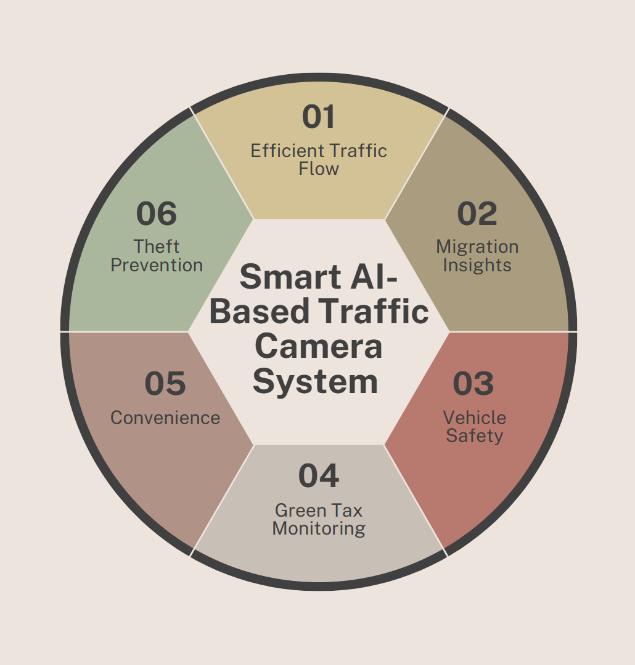
The proposed system illustrated in Figure 1 provides a fundamental understanding of our enhanced AI-based cameras utilized for intelligent traffic management systems.
AI-based cameras can be employed to detect vehicle density and vehicle number plates, from which multiple datapoints,asenumeratedinFigure1,canbeextracted.
An advanced AI-driven system can be developed that leverages computer vision, machine learning, and IoT to addresstheaforementionedchallenges,ensuring:
1. Efficient Traffic Flow: AI-powered traffic density detectiontodynamicallyadjustsignaltimings.
2. Migration Insights: Number plate scanning to monitor inter-statevehiclemovement.
3. Vehicle Safety: Real-time MOT status checks to ensure roadsafetyandemissionscompliance.
4.GreenTaxMonitoring:PromoteatransitiontowardEVs andhydrogen-poweredvehiclesthroughtargetedinsights.
5. Convenience: Seamless integration with navigation systems to guide users to proximate fuel or charging stations.
6.TheftPrevention:Automaticdetectionofstolenvehicles attrafficsignals.
This system will transform traffic management into an intelligent, environmentally conscious, and user-oriented framework, facilitating the development of smarter cities andsustainabletransportationsystems.
This research paper has examined the limitations of current existing smart traffic management systems, primarily their high installation costs and limited operational capabilities. To address these challenges, we have proposed a Smart AI-based traffic management system that can perform multiple tasks, ranging from efficient traffic management to vehicle safety, migration
International Research Journal of Engineering and Technology (IRJET) e-ISSN:2395-0056
tracking, green tax monitoring, theft prevention, and enhanced user convenience. This system presents a costeffective solution in comparison to existing Smart Traffic managementsystems.
[1] Poonam Musmade , Sachin Rajas, S.M. Khairnar, “ArtificialIntelligence(AI)inTrafficManagement:Toward aFuturewithoutTrafficPolice”,AjeenkyaDYPatilJournal Of Innovation in Engineering & Technology, September 2024, pp. 17-23 , https://adypsoe.in/adypjiet/cbe7b2d6f2a3-4fb8-8dea-684dfaf655cd.pdf
[2] Vishal Mandal , Abdul Rashid Mussah , Peng Jin and Yaw Adu-Gyamfi , “Artificial Intelligence-Enabled Traffic Monitoring System” , Sustainability , 4 November 2020 , https://www.mdpi.com/2071-1050/12/21/9177
[3] Abdul Muthalib Bin Nizar, Dr. Thiruvenkadam, ” Advancing Traffic Management: Exploring AI Camera Systems in Kerala”, International Journal of Research PublicationandReviews,Vol5,no3,pp2782-2789March 2024 , https://ijrpr.com/uploads/V5ISSUE3/IJRPR23673.pdf
[4] C. Heltin Genitha, S. Abishek Danny, A.S.Hepsi Ajibah, S.Aravint, A.Angeline Valentina Sweety, “ AI based RealTime Traffic Signal Control System using Machine Learning”, IEEE , 06-08 July 2023, https://ieeexplore.ieee.org/document/10193319/authors #authors
[5] Aryan Khare , “Assessing the Impact of Artificial Intelligence on Resolving Traffic Issues in India”, International Journal of Engineering, Management and Humanities (IJEMH), Volume 4, Issue 5, Sep.-Oct., 2023, https://ijemh.com/issue_dcp/Assessing%20the%20Impa ct%20of%20Artificial%20Intelligence%20on%20Resolvin g%20Traffic%20Issues%20in%20India.pdf
[6] Abhishek Patil , Diya Raut, Roshani Prasad, and Charudatta Shimpi , “Integrating Artificial Intelligence with Camera Systems for Automated Surveillance and Analysis”, International Journal of Innovative Research in EngineeringandManagement(IJIREM),Volume-11,Issue2, April 2024 , https://www.ijirem.org/DOC/5integrating-artificial-intelligence-with-camera-systemsfor-automated-surveillance-and-analysis%20(2).pdf
[7] Bhakti Dighe , Aakash Nikam , ” Intelligent Traffic Management Systems: A Comprehensive Review” , International Journal of Creative Research Thoughts (IJCRT) , Volume 12, Issue 4 April 2024 , https://www.ijcrt.org/papers/IJCRT2404906.pdf
[8] Aniket Phand, Shweta Bagade, Nikhil Bandgar, Prof. Ganesh Wayal , “Real-Time Traffic Light Optimization
Volume: 12 Issue: 04 | Apr 2025 www.irjet.net p-ISSN:2395-0072 © 2025, IRJET | Impact Factor value: 8.315 | ISO 9001:2008
Using AI and IOT”,IJRASET Journal For Research in Applied Science and Engineering Technology, 2024-04-20 ,https://doi.org/10.22214/ijraset.2024.60686
[9] Aravind Sasidharan Pillai,” TRAFFIC MANAGEMENT: IMPLEMENTING AI TO OPTIMIZE TRAFFIC FLOW AND REDUCECONGESTION”,JournalofEmergingTechnologies and Innovative Research (JETIR) , 2024 JETIR July 2024, Volume 11, Issue 7, https://papers.ssrn.com/sol3/Delivery.cfm/4916398.pdf? abstractid=4916398&mirid=1
[10] Olushola Adegoke, ”Implementation of Artificial Intelligence in Traffic Management in the United States”, InternationalJournalofComputer(IJC), Volume49,No 1, pp 192-228, 2023-12-10, https://ijcjournal.org/index.php/InternationalJournalOfC omputer/article/view/2123/795
[11] Patan Rizwan, K Suresh, Dr. M. Rajasekhara Babu, “Real-Time Smart Traffic Management System for Smart Cities by Using Internet of Things and Big Data”, 2016 International Conference on Emerging Technological Trends [ICETT], 21-22 October 2016, https://ieeexplore.ieee.org/document/7873660
[12] Abida Sharif, Jianping Li, Mudassir Khalil, Rajesh Kumar, Muhammad Irfan Sharif, Atiqa Sharif, “Internet Of Things - Smart Traffic Management System For Smart Cities Using Big Data Analytics”, 2017 IEEE, https://ieeexplore.ieee.org/document/8301496
[13] Sabeen Javaid, Ali Sufian, Saima Pervaiz, Mehak Tanveer, “Smart Traffic Management System Using InternetofThings”,InternationalConferenceonAdvanced Communications Technology(ICACT), February 11 - 14, 2018,https://ieeexplore.ieee.org/document/8323770