
International Research Journal of Engineering and Technology (IRJET) e-ISSN:2395-0056
Volume: 12 Issue: 04 | Apr 2025 www.irjet.net p-ISSN:2395-0072
International Research Journal of Engineering and Technology (IRJET) e-ISSN:2395-0056
Volume: 12 Issue: 04 | Apr 2025 www.irjet.net p-ISSN:2395-0072
Maaz khan
1 ,
Jyoti Maurya
2
, Pushpa Kumavat3 , Dr. Nita Patil4
1,2,,3-Student, Department of Computer Engineering, K. C. College of Engineering, Thane, India
4-Professor, Department of Computer Engineering, K. C. College of Engineering, Thane, India
Abstract - This study presents a smart traffic management system that utilizes computer vision and artificial intelligence to address urban traffic congestion. The proposed system integrates the You Only Look Once (YOLO) object detection algorithm to detect and track vehicles in real-time using live camera feeds from traffic intersections. By analyzing traffic density, vehicle count, and movement patterns, the system dynamically adjusts traffic signals to optimize flow, reduce delays, and minimize fuel consumption and emissions. An intelligentalgorithm determines the optimal signal timing based on real-time traffic conditions, ensuring adaptive and efficient traffic control. The system's scalability and compatibility allow seamless integration into various urban infrastructures while requiring lower implementation and maintenance costs than conventional traffic management systems. To evaluate its effectiveness, experiments were conducted using real-world traffic data, demonstrating high accuracy in vehicle detection, reliable traffic density calculations, and significant congestion reduction. The results indicate that this approach enhances traffic efficiency, reduces environmental impact, and improves commuter experiences. By leveraging advanced AI- driven techniques, the proposed system provides a cost- effective and adaptable solution for modernizing urban traffic management andpavingthewayforsmart,sustainablecities.
Key Words: Smart traffic management, YOLO, AI, congestion optimization, real-time monitoring, webcam, computer vision, roboflow, IoT, 74HC595
Urbanizationhasledtoexponentialgrowthinvehiculartraffic, exacerbating congestion and increasing the risk of road accidents. Traditional traffic management systems, reliant on static signal timing, fail to address the dynamic and unpredictable nature of traffic flows. The inefficiencies inherent in these systems contribute to prolonged wait times, increased fuel consumption, and higher greenhouse gas emissions,intensifyingurbanmobilitychallenges.
The Smart Traffic Management System with Real-Time Monitoring seeks to address these challenges by leveraging advanced technologies. It integrates artificial intelligence (AI), machinelearning,andcomputervisiontooptimizetrafficflow
dynamically. At the core of the system lies YOLOv8, a state-of-the-art object detection model capable of analyzing real-timetrafficdatafromcamerasandsensors.
Thesystem’sfeaturesincludedynamicsignalcontrolbased on traffic density and comprehensive data logging for future analysis. It offers significant advantages over conventional systems by adapting to real-time traffic conditions, enabling moreefficientandsustainabletrafficmanagementpractices.
With its cost-effective implementation and scalability, the
system is well-suited for deployment across various urban environments,rangingfromsmalltownstolargemetropolitan areas. By addressing inefficiencies in traditional traffic systems, this projectaims toenhanceurban mobility,improve roadsafety,andreduceenvironmentalimpact.
Todeterminetheviabilityofourproposalandexplorevarious execution methods, we reviewed numerous research articles. Thesestudiesprovidedvaluableinsights,helpingusdefineour project’s vision and scheme of action. Implementing an intelligent traffic management system requires expertise in multiple domains, including Python, image processing, computervision,andmachinelearning.Manyblogsexplainthe workings of YOLO and its application in real-time traffic systems. Several studies have explored automated vehicle detection and traffic signal control, demonstrating the advantages of deep learning-based approaches in optimizing urbanmobility.
Recentresearchhasfocusedonadaptivetrafficsignalsystems that dynamically adjust signal timings based on real-time vehicle density.One such study presents a machine learning model that leverages YOLO for vehicle detection, allowing for efficient traffic regulation and improved congestion management [1].Another study introduces an approach that integrates deep learning with real-time image processing to optimize urban intersections, showcasing significant improvementsinvehiclethroughputandreduceddelays[2].
Various traffic monitoring systems have also been developed using computer vision and deep learning models. Researchers have demonstrated how integrating YOLO with OpenCV enhances vehicleclassificationandcounting,providingprecise
International Research Journal of Engineering and Technology (IRJET) e-ISSN:2395-0056
Volume: 12 Issue: 04 | Apr 2025 www.irjet.net p-ISSN:2395-0072
real-time monitoring for better traffic analysis and law enforcement applications [3]. A different study combines reinforcement learning with object detection to simulate and optimize signal control, leveraging simulation environments likeSUMOtoimproveintersectionperformance[4].
Some studies specifically address challenges related to signal detection and prioritization in diverse traffic conditions. A system utilizing YOLOv8 has shown effectiveness in detecting traffic signals and adapting to varying lighting and environmental conditions [5]. Similarly, a real-time traffic control system integrates deep learning with predictive modeling to dynamically allocate green signal time, reducing congestionanddelays[6].
Emergency vehicle prioritization is another critical aspect of intelligent traffic management. Research in this area has explored reinforcement learning-based solutions that adjust traffic lights dynamically, ensuring seamless passage for emergency responders [7]. Another study implements a deep learning-driven scheduling system that reduces overall wait times while improving emergency vehicle movement efficiency[8].
To enhance monitoring capabilities, computer vision has been used to analyze traffic patterns and optimize light durations based on real-time vehicle flow. One study employs AIpowered monitoring techniques to assess congestion levels and suggest adaptive changes in traffic control mechanisms [9]. Another approach integrates convolutional fuzzy neural networks with YOLO for improved vehicle tracking and classification, achieving high accuracy in real-time traffic monitoring[10].
ThereviewedstudieshighlightthetransformativeimpactofAI and deep learning on traffic management systems. By integrating YOLO, reinforcement learning, and neural networks, researchers have demonstrated significant advancementsinadaptivesignalcontrol,congestionreduction, and emergency vehicle prioritization. However, challenges such as computational overhead, scalability, and real-world deployment constraints remain areas for future research. Continued innovation in AI-driven traffic systems will play a pivotal role in creating safer, more efficient, and sustainable urbantransportationnetworks.
TheSmartTrafficManagementSystemisdesignedtooptimize traffic flow dynamically by integrating YOLOv8- basedvehicle detection, a webcam for traffic signal control. The system continuously monitors traffic conditions, detects vehicle types, and dynamically adjusts signal timings to reduce congestion.
A.Vehicle Detection and Classification Module: The system beginswithreal-timevideostreamingfromawebcammodule, which transmits traffic footage to the backend. The YOLOv8 deep learning model is employed to detect and classify vehicles based on type (cars, motorcycles, buses, trucks, etc.) andtocountthemperlane.
1.Data Collection and Preprocessing Dataset Preparation – A dataset consisting of various vehicle types is collected. Annotation–Vehiclesinthedatasetarelabeledwithbounding boxes for object detection. Dataset Splitting – The dataset is divided into training and validation subsets. Pre- processing Steps: Images are resized for uniform input dimensions. Pixel values are normalized for deep learning processing. Data augmentation techniques like random cropping and flipping areapplied.
2.Model Training and Optimization YOLOv8 Model Initialization–
A pre-trained YOLOv8 model is fine-tuned on the vehicle dataset.TrainingProcess:Themodelistrainedusingacustom loss function to optimize detection accuracy. Precision, recall, and F1-score are monitored to evaluate performance. Postprocessing Techniques: Confidence Thresholding –Eliminates low-confidencedetections.Non-MaximumSuppression (NMS) –Removesoverlappingboundingboxes.
Real-time Vehicle Detection and Classification The webcam continuously streams video data. The YOLOv8 model detects and classifies vehicles inreal time. Thetotal vehicle count per lane is computed. Heavy vehicles (buses/trucks) are given priorityduetolongermovementtimes.
B. DynamicTrafficSignalControlAlgorithm:Thetrafficsignal control algorithm dynamically adjusts green signal durations basedonreal-timevehicledensityandtype.
TrafficDensityCalculationThedensityofvehiclesineachlane iscalculatedas:
Density= Number of vehicle (1) Lane Width
Density= Lane Width Number of Vehicles where heavy vehicles are assigned a higher weight in traffic flow calculations.
Dynamic Green Signal Time Calculation The green signal time (GST)foreachlaneisdeterminedby
GST= ∑N (No of Vehicles ×Avg Time) [12,eq.(1)](2) No of Lanes+1
Signal Switching Mechanism The system initializes with default signal durations. The YOLOv8 model continuously monitorsreal-timetrafficconditions.Whenthecurrentgreen lightreaches5seconds,asnapshotofvehicledensityis taken. The system allocates more time to lanes withhigher traffic density. If a heavy vehicle is detected, additional time is assignedtoensuresmoothmovement.
C. LSTMbasedTrafficPrediction:TheLSTMmodeltakesseven inputs five vehicle types, the hour, and the day to analyze how traffic patterns evolve over time. It uses two LSTMlayers with 64 units each to capture these time-based trends effectively. By processing both real- time and historical traffic data, the model learns how traffic behaves under different conditions.Thishelpsitpredictthemostsuitabletrafficsignal duration. The final output is an optimized signal timing that adaptstocurrentvehicledensityandtime-of-dayvariations.
D. Hardware Implementation: The system integrates both hardware and software components to execute real-time trafficmanagement.
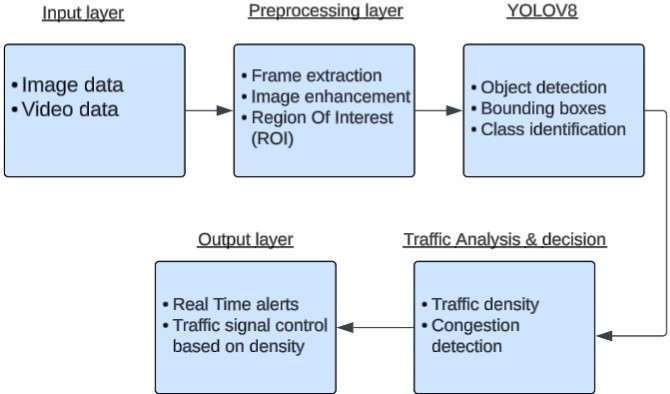
- 3.1: Methodologydiagramoftraffic signalcontrol system
1) KeyComponents:Thewebcam-modulecaptureslivetraffic footage. The YOLOv8 Model processes the video stream for vehicle detection. Traffic Signal Modules adjust signal durationsbasedonreal-timeconditions.
2) System Operation: The webcam continuously streams video to the backend. The YOLOv8 model detects vehicles and computes traffic density. The traffic control algorithm dynamicallyadjustssignalduration.
3. IMPLEMENTATION
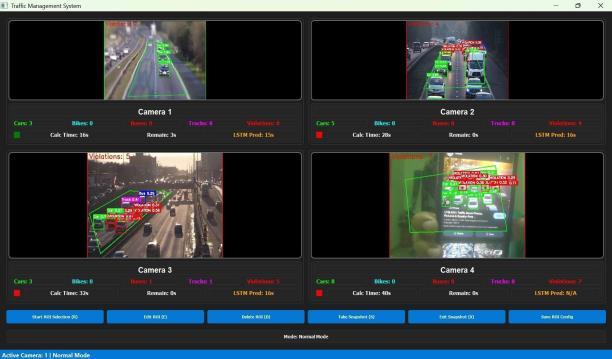
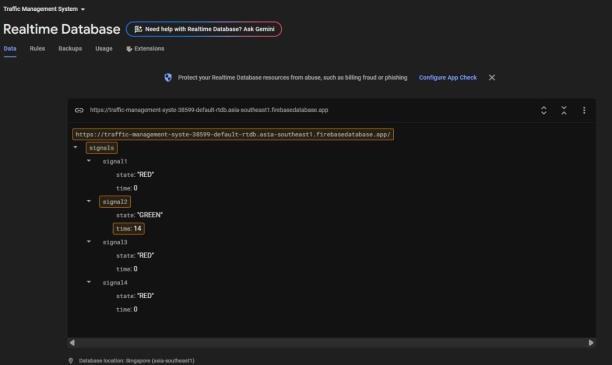
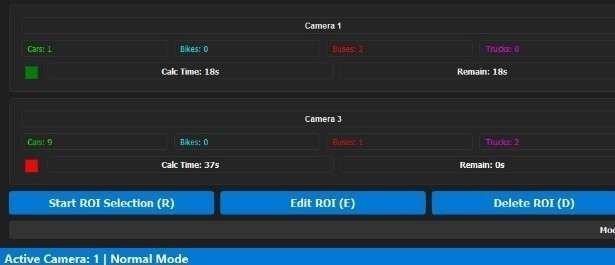
International Research Journal of Engineering and Technology (IRJET) e-ISSN:2395-0056
Volume: 12 Issue: 04 | Apr 2025 www.irjet.net p-ISSN:2395-0072
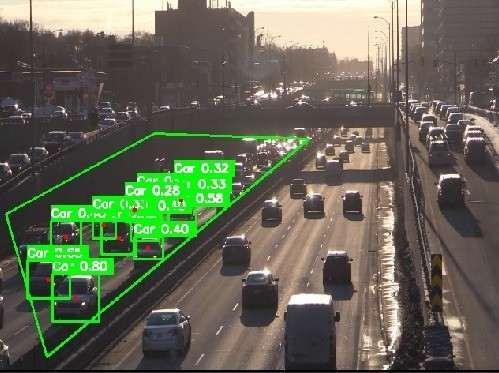
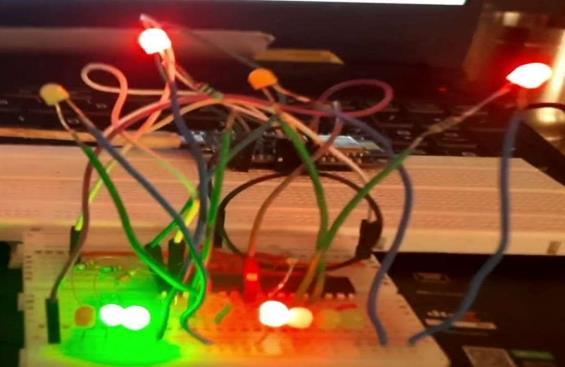
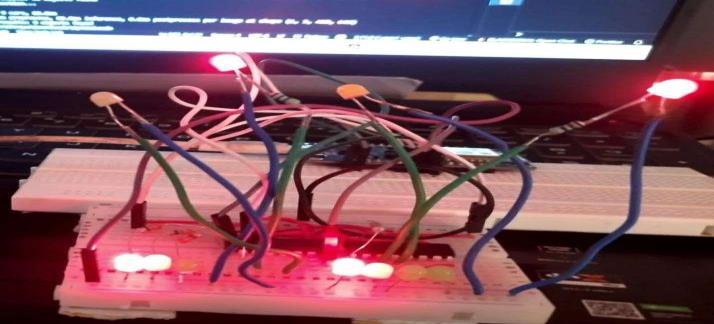
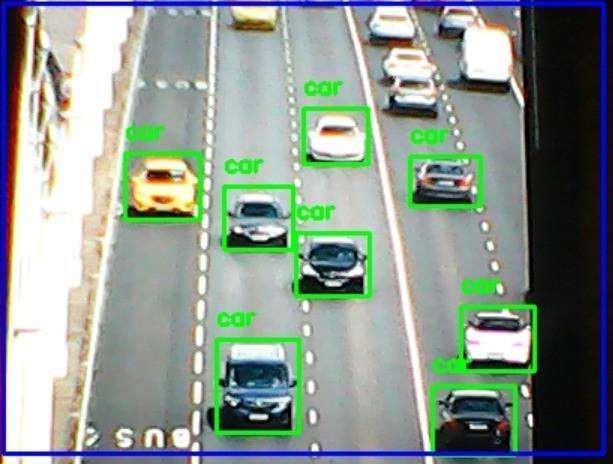
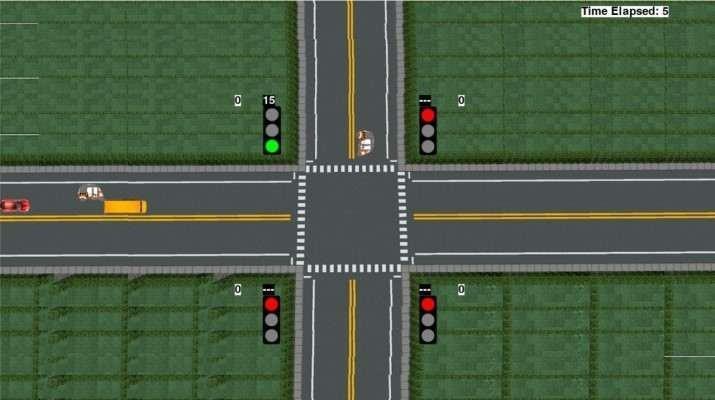
- 4.3: ResultsofVehicleDetection,UserInterface&Hardware
Thesystemwasputtothetestinvarioustrafficsituations,and itsperformancewasevaluatedusingkeymetricssuchas:
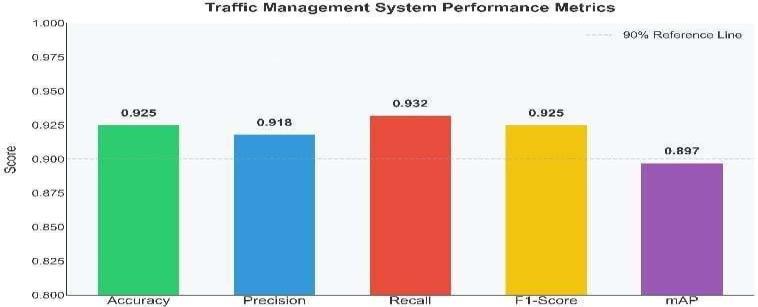
Detection Precision: With over 90% precision and recall, YOLOv8'svehicledetectionaccuracywasremarkable.
TrafficOptimization:Whencomparedtopresetsignaltimings, the proposed approach showed significant reductions in wait timesandcongestion.
ScalabilityandEfficiency:Withlowhardwaredemands,thelight designmakesitsimpletodeployatmultiplejunctions.
In comparison to traditional traffic management systems, the efficiency of the system in minimizing idle time, increasing traffic throughput, and optimizing emergency vehicle priority wasemphasized.
The performance of the Smart AI-Based Traffic Management Systemwas evaluated using key metrics such as accuracy, efficiency, processing time, and classification performance fordifferentvehicletypes.
Recall= correctly classified actual positives all actual positives = TP (3) TP+FN
Precision= correctly classified predicted positives (4) all predicted positives = TP TP+FP
Where, F1Score= 2TP 2TP+FP+FN (5)
TP (True Positives): The number of correctly classifiedpositive instances.
FN (False Negatives): The number of actual positive instances thatwereincorrectlyclassifiedasnegative.
FP (False Positives): Instances incorrectly predicted aspositive butactuallynegative.
Table – 6.1: PerformanceMetricsTable
(Basedonrelevant researchsources)
Vehicles Detected 45
(s)
International Research Journal of Engineering and Technology (IRJET) e-ISSN:2395-0056
Volume: 12 Issue: 04 | Apr 2025 www.irjet.net p-ISSN:2395-0072
Table – 6.2: Classification Performance by Vehicle Type

The results indicate that while the system effectively detects buses (F1 Score = 1.0), cars and trucks have lower precision,andmotorcyclesarenotdetectedeffectively.This suggests the need for further optimization, particularly in handling motorcycles and improving precision for cars and trucks
AI-driven traffic management is a game-changer in optimizing urban mobility. By leveraging YOLO-based deep learning models for real-time vehicle detection and adaptive signal control, our system significantly reduces congestion, enhances traffic efficiency, and ensures seamless emergency vehicle prioritization. The integration of computer vision, reinforcement learning enables dynamic, data-driven decision-making, making traffic control smarter and more responsive.
Our approach demonstrates high accuracy, scalability, and real-worldapplicability,positioningitasarobustsolutionfor intelligent traffic systems. While challenges like computational efficiency and adverse weather adaptability remain, future advancements in multi-agent reinforcement learning,V2X (vehicle-to-everything) communication, and edge computing will further enhance performance and reliability.
Thisresearchlaysthefoundationforthenextgenerationof AIpowered traffic management, transforming urban transportation into a safer, smarter, and more sustainable system. With continued innovation and strategic implementation, intelligent traffic control will become an integral part of modern smart cities, driving efficiency and sustainabilityonaglobalscale.
Future research can focus on enhancing the scalability and computational efficiency of AI-driven traffic management systems for diverse urban environments. Optimizing deep learning models for low-power edge devices can enable realtime deployment in resource-constrained settings. Integrating multi-modaldatasourcessuchasIoTsensors,Li-DAR,andGPS can improve traffic prediction accuracy and adaptive signal control. Reinforcement learning can be extended to multiagent systems, optimizing traffic flow across multiple intersections. Addressing real-world challenges like poor weather, occlusions, and nighttime traffic through selfsupervised learning and synthetic data augmentation can improvemodelrobustness.
Additionally, future research should explore the economic feasibility of large-scale deployment and integration with intelligenttransportsystems(ITS).Cost-effectivestrategiesfor deploying AI-driven traffic control should be analyzed to ensure practical implementation. As autonomous vehicles evolve, AI-driven traffic control can be integrated with V2X (vehicle-to-everything) communication, enabling seamless interaction with connected autonomous vehicles (CAVs). These advancements will drive safer, smarter, and more efficienturbanmobility.
[1]F. Darwish, M. Ayman, and A. Mohammed, “Framework for adaptive traffic light system,” in 2024 IEEE Intelligent Methods, Systems, and Applications (IMSA), pp. 76–81, IEEE, 2024.
[2]D. Gnanakumar, J. Ponrabi, R. N. Ahmed, and G. Kannan, “Advanced traffic violation detection with Tesseract OCR and computervision,” in2024InternationalConference on Circuit, SystemsandCommunication(ICCSC),2024.
[3]H. Tabassum, M. Ameer, M. M. Alam, M. Y. Sharieff, N. Ahamed, and A. Anjum, “Density-based traffic control system using IoT and machine learning,” in 2024 IEEE International Conference on Knowledge Engineering and Communication System(ICKECS),2024.
International Research Journal of Engineering and Technology (IRJET) e-ISSN:2395-0056
Volume: 12 Issue: 04 | Apr 2025 www.irjet.net p-ISSN:2395-0072
[4]S. Kayalvizhi, J. Jayanth, K. Karthikeyan, and N. Kumar, “Intelligent traffic management system: Helmet compliance, trafficsignalviolationdetection,andproximity-based alerts,” in 2024 2nd International Conference on Computer, CommunicationandControl(IC4),2024.
[5]D. S. G., G. A., and L. D., “Next-generation traffic control: Adaptive timer and emergency vehicle priority,” 2024 IEEE International Conference on E-mobility, Power Control and SmartSystems(ICEMPS),2024.
[6]M.Ravichandran,K.Laxmikant,andA.Muthu,“Smarttraffic control: Adaptive signal managementbasedon real- time lane detection using YOLOv8,”in 2024 International Conference on AutomationandComputation(AUTOCOM),pp. 174–178,2024.
[7]J. Clement, M. James, and J. Anne, “Smart traffic management using convolutional neural networks,”in 2024 7th International Conference on Information and Computer Technologies (ICICT), IEEE Access, pp. 504-508, 2024. [8]S. Biswas, S. Acharjee, A. Ali, and S. S. Chaudhari, “YOLOv8 Based Traffic Signal Detection in Indian Road,”Proc. 7th Int. Conf. Electron., Mater. Eng. Nano-Technol. (IEMENTech), 2023.
[9]A. R. Kalva,J.S. Chelluboina,andB. Bharathi, “SmartTraffic Monitoring System using YOLO and Deep Learning Techniques,” Proc. 7th Int. Conf. Trends Electron. Inform. (ICOEI),pp.831–837,2023.
[10]N. Jain, R. Parwanda, and A. Chauhan, “Real-Time Smart Traffic Control and Simulation: An Approach for Urban Congestion Management,” Proceedings of the IEEE IAS Global ConferenceonEmergingTechnologies(GlobConET),2023.
[11]A.K.M., D.S. S.,M. J.Mohan, R.G.,D. D.T., S.M. S.,and R. V., “ComputerVisionAssistedArtificialIntelligenceEnabled Smart Traffic Control System for Urban Transportation Management,”Proc.Annu.Int.Conf.Emerg. Res.Areas: Int. Conf. Intell.Syst.(AICERA/ICIS),2023.
[12]C.H.Genitha,S.A.Danny,A.S.H.Ajibah,S.Aravint,andA. A. V. Sweety, “AI based Real-Time Traffic Signal Control System using Machine Learning,” Proc. 4th Int. Conf. Electron. Sustain. Commun.Syst.(ICESC),pp.1613–1618,2023.
[13]D. Singh, “Deep Reinforcement Learning (DRL) for RealTime Traffic Management in Smart Cities,” Proc. Int. Conf. Commun.,Secur.Artif.Intell.(ICCSAI),pp.1001–1004,2023.
[14]A. Patil, A. Raorane, and J. Kundale, “Enhancing Traffic Management withDeep Learning Based VehicleDetection and Scheduling Systems,” Proc. Int. Conf. Model. Simul. Intell. Comput.(MoSICom),2023.
[15]S. Shankaran and L. Rajendran, “Real-time adaptive traffic control system for smart cities,” in 2021 International ConferenceonComputerCommunicationand Informatics(ICCCI -2021),2021.