
International Research Journal of Engineering and Technology (IRJET) e-ISSN: 2395-0056
Volume: 13 Issue: 03 | Mar 2026 www.irjet.net p-ISSN: 2395-0072
International Research Journal of Engineering and Technology (IRJET) e-ISSN: 2395-0056
Volume: 13 Issue: 03 | Mar 2026 www.irjet.net p-ISSN: 2395-0072
Dr.B.Narsimha1 , A .Varsha Reddy2 , B.Bhuvaneshwari3 , Anil Kumar Malik4
1 Associate Professor, Department of Computer Science and Engineering 2,3,4 B.Tech Students, Department of Computer Science and Engineering
Teegala Krishna Reddy Engineering College , Telangana, India ***
Abstract - Traffic congestion and delayed emergency response are significant challenges in modern urban transportation systems. Conventional traffic signal systems operate on fixed-time intervals and fail to adapt to dynamic trafficconditions, leadingto inefficient trafficflow, increased waitingtime,fuelconsumption,andenvironmentalpollution. This research proposes a Smart Traffic Management System that uses deep learning and computer vision techniques to dynamically control traffic signals based on real-time traffic density.ThesystemutilizestheYOLOv8objectdetectionmodel to detect and classify vehicles such as cars, buses, trucks, and motorcyclesfromtrafficvideoinputs.Vehiclecountsare used to estimate traffic density and adjust signal timing accordingly. In addition, the system incorporates an emergency vehicle detection mechanism using Optical Character Recognition (OCR) combined with visual colorbasedanalysistoidentifyambulancesandfirevehicles.When an emergency vehicle is detected, the system prioritizes that lane by allocating extended green signal duration to ensure faster passage. Furthermore, the system estimates CO₂ emissions based on detected vehicle types to analyze environmentalimpact.Allprocessedresults,includingvehicle counts,signalstatus,emergencydetection,andemissionlevels, are stored in a database for monitoring and analysis. The proposed system improves traffic efficiency, reduces congestion, enhances emergency response time, and contributes to sustainable urban traffic management.
Key Words: Smart Traffic Management, YOLOv8, Computer Vision, Deep Learning, Emergency Vehicle Detection, Optical Character Recognition (OCR), Traffic Density Estimation, CO₂ Emission Monitoring, Intelligent Transportation Systems.
Traffic congestion has become one of the most critical problemsinmodernurbantransportationsystems.Withthe continuous growth in the number of vehicles, traditional traffic control mechanisms struggle to manage traffic efficiently.Conventionaltrafficsignalsgenerallyoperateon fixed-time intervals that do not consider real-time traffic density.Asaresult,roadswithfewervehiclesmayreceive unnecessary signal time while heavily congested roads experiencelongerwaitingperiods.Thisimbalanceleadsto inefficient traffic flow, increased fuel consumption, and environmentalpollution.
Advancementsinartificialintelligenceandcomputervision have enabled the development of intelligent traffic managementsolutions.Byanalyzingvideofeedsusingdeep learning models, modern systems can detect vehicles, estimate traffic density, and dynamically adjust signal timings.Suchintelligentsystemscansignificantlyimprove trafficefficiencyandreducecongestioninurbanareas.
TheproposedSmartTrafficManagementSystemutilizesthe YOLOv8deeplearningmodeltodetectandclassifyvehicles fromtrafficvideos.Thesystemcountsdifferentvehicletypes such as cars, buses, trucks, and motorcycles to determine trafficdensity.Inaddition,anemergencyvehicledetection module is integrated using Optical Character Recognition (OCR)andcolor-basedanalysistoidentifyambulancesand firevehicles.
When an emergency vehicle is detected, the system automaticallyprioritizes the corresponding traffic lane by extending the green signal duration. If no emergency is detected, the signal duration is dynamically adjusted accordingtotrafficdensitylevels.Furthermore,thesystem estimates CO₂ emissions based on detected vehicles to evaluate environmental impact. By integrating artificial intelligence with traffic monitoring, the proposed system aimstoimprovetrafficflow,reducewaitingtime,enhance emergencyresponse,andsupportsmartcitytransportation infrastructure.
Urbanizationandrapidpopulationgrowthhavesignificantly increased the number of vehicles on roads, resulting in frequenttrafficcongestion.Traditionaltrafficmanagement systems rely on fixed-time signals or basic sensor technologies that often fail to adapt to real-time traffic conditions.Thesesystemscannotefficientlymanagevarying trafficdensitiesacrossdifferentlanes.
Recentdevelopmentsincomputervisionanddeeplearning providenewopportunitiesforintelligenttrafficmonitoring. Technologiessuchasobjectdetectionandimageprocessing allowautomatedanalysisoftrafficvideostoidentifyvehicles andevaluatetrafficconditions.Byusingsuchtechnologies, trafficsignalscanbedynamicallyadjustedtoimprovetraffic flowandreducedelays.
Volume: 13 Issue: 03 | Mar 2026 www.irjet.net p-ISSN: 2395-0072
The increasing level of traffic congestion and delays in emergencyresponsehighlighttheneedforsmartertraffic management solutions. Fixed-time traffic signals do not provideprioritytoemergencyvehiclessuchasambulances orfiretrucks,whichcanleadtolife-threateningdelays.The motivationbehindthisresearchistodevelopanintelligent systemthatcanautomaticallymonitortrafficdensity,detect emergencyvehicles,andadjustsignaltimingaccordingly.By integratingdeeplearningmodelssuchasYOLOv8andOCR techniques, the system aims to provide a more efficient, automated, and scalable solution for modern traffic management.
The primary objective of this research is to develop an intelligent traffic monitoring system using deep learning techniques.Thesystemaimstodetectandclassifydifferent typesofvehiclesfromtrafficvideosusingtheYOLOv8object detection model. By analyzing the number of detected vehicles, the system estimates traffic density and dynamicallyadjuststrafficsignaltimingtoimprovetraffic flowandreducecongestion.Anotherimportantobjectiveis todetect emergencyvehiclessuchasambulancesand fire trucksusingOpticalCharacterRecognition(OCR)andvisual analysismethods.Whenanemergencyvehicleisidentified, thesystemprioritizesthatlanebyextendingthegreensignal durationtoensurefasterpassage.Additionally,thesystem estimatestheCO₂emissionsgeneratedbydifferentvehicle types to analyze environmental impact and support more sustainabletrafficmanagement.
TheproposedSmartTrafficManagementSystemfocuseson improvingtrafficsignalefficiencyusingvideo-basedvehicle detectionandanalysis.Thesystemprocessestrafficvideos to detect vehicles and determine traffic density using the YOLOv8deeplearningmodel.Basedonthedetectedtraffic conditions,thesystemdynamicallyadjustssignalduration. The system also includes an emergency vehicle detection module that identifies ambulances and fire vehicles using OCR andcolor-basedheuristics.Thisallowsthe system to prioritizeemergencyvehiclesatintersections.Additionally, thesystemestimatesCO₂emissionsbasedonvehiclecounts toanalyzeenvironmentalimpact.Theproposedsolutionis suitable for integration with smart city infrastructure and can be extended to real-time traffic monitoring using live camerafeedsinfutureimplementations.
The proposed Smart Traffic Management System uses artificial intelligence and computer vision techniques to improve traffic signal control based on real-time traffic conditions. Unlike traditional traffic systems that rely on
fixedtimers,theproposedsystemanalysestrafficvideosto detect and count vehicles and dynamically adjust signal duration according to traffic density. The system employs theYOLOv8deeplearningmodeltoidentifydifferenttypes ofvehiclesincludingcars,buses,trucks,andmotorcycles.
In addition to traffic density estimation, the system incorporatesanemergencyvehicledetectionmoduleusing OpticalCharacterRecognition(OCR)andvisualcolor-based analysis.Thismoduleidentifiesemergencyvehiclessuchas ambulancesandfiretrucksbydetectingspecifickeywordsor colourpatternsonvehicles.Whenanemergencyvehicleis detected,thesystemprioritizesthatlanebyallocatinglonger greensignaldurationtoallowfastermovement.
The system also estimates CO₂ emissions based on the numberandtypeofdetectedvehicles.Allresultsincluding vehiclecountssignaltiming,emergencydetectionstatus,and emissionlevelsarestoredinadatabaseformonitoringand analysis. This intelligent approach helps improve traffic efficiency, reduce waiting time, and support sustainable urbantransportation.
The system architecture consists of several modules that worktogethertoanalysetrafficvideosandmanagetraffic signalsdynamically.Theinputtothesystemistrafficvideo capturedfromsurveillancecamerasoruploadedbyusers. The video frames are processed using the YOLOv8 object detection model to identify and classify vehicles. After vehicledetection;thesystemcalculatestrafficdensitybased on the number of vehicles detected in each lane. The emergency detection module then analyses the vehicles using OCR and colour detection techniques to identify ambulances or fire trucks. Based on these results, the decisionmoduledeterminestheappropriatesignaltiming. Finally,theresultsarestoredinthedatabaseanddisplayed onthedashboardforanalysis.
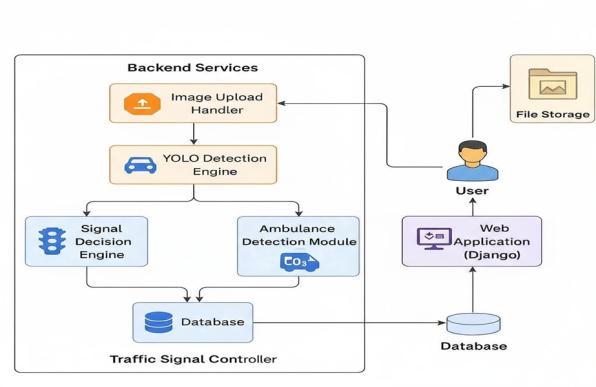
: System Architecture of the Smart Traffic Management System
International Research Journal of Engineering and Technology (IRJET) e-ISSN: 2395-0056
Volume: 13 Issue: 03 | Mar 2026 www.irjet.net p-ISSN: 2395-0072
TheproposedsystemusestheYOLOv8deeplearningmodel foraccuratevehicledetectionandclassification.YOLOv8isa real-timeobjectdetectionalgorithmcapableofidentifying multiple objects within a video frame. In this system, YOLOv8 detects vehicles such as cars, buses, trucks, and motorcyclesfromtrafficvideoframes.Themodelprocesses videoframesandreturnsboundingboxesarounddetected vehicles along with their class labels. By counting these detectedvehicles,thesystemdeterminesthetrafficdensity foreachlane.Thisinformationisthenusedtodynamically adjusttrafficsignaltiming.
Emergencyvehicledetectionisacriticalcomponentofthe proposedsystem.Thesystemidentifiesemergencyvehicles suchasambulancesandfiretrucksusingacombinationof OCRandvisualcolouranalysistechniques.TheOCRmodule extractstextfromdetectedvehicleregionsandsearchesfor keywords such as “AMBULANCE”, “EMS”, “RESCUE”, and “FIRE”. In addition, the system analyses colour patterns typicallyassociatedwithemergencyvehicles,suchaswhite bodycolorwithredmarkings.Ifthesepatternsorkeywords are detected, the system identifies the vehicle as an emergencyvehicle.Oncedetected,thesystemautomatically prioritizes the corresponding traffic lane by assigning extendedgreensignaltime.
The signal control module dynamically determines the duration of the green signal based on traffic density and emergency detection. If an emergency vehicle is detected, the system immediately assigns the highest priority and extendsthegreensignalduration.Ifnoemergencyvehicleis present,thesystemadjuststhesignaltimingbasedonthe number of vehicles detected. Lanes with higher traffic densityreceivelongergreensignals,whilelaneswithfewer vehiclesreceiveshorterdurations.Thisadaptivemechanism helpsreducecongestionandimprovetrafficflow.
The system also estimates CO₂ emissions generated by vehicles waiting at traffic signals. Each vehicle type is assignedapredefinedemissionfactor,andthetotalemission iscalculatedbasedonthenumberofdetectedvehicles.This analysishelpsevaluatetheenvironmentalimpactoftraffic congestion and provides insights into sustainable traffic managementstrategies.
The implementation of the Smart Traffic Management Systemintegratesdeeplearning,computervision,andwebbased technologies to analyze traffic conditions and dynamicallycontroltrafficsignals.Thesystemisdeveloped
usingtheDjangowebframeworkandPythonprogramming language. Various libraries such as OpenCV, Ultralytics YOLOv8, and Tesseract OCR are used to process traffic videos,detectvehicles,andidentifyemergencyvehicles.The system consists of multiple modules including user registration and authentication, video upload and processing,vehicledetection,emergencyvehiclerecognition, traffic signal decision-making, and result analysis. Each module works together to provide an intelligent and automatedtrafficmanagementsolution.
Theusermanagementmoduleallowsuserstoregister,login, and access the system features. During registration, users provide basic information such as name, email, mobile number, password, and profile image. The registration request is stored in the database and requires admin approvalbeforeactivation.Onceapproved,userscanlogin to the system and access the dashboard where they can uploadtrafficvideosandviewanalysisresults.Theadmin moduleallowsadministratorstomanageusersbyactivating, deactivating,ordeletinguseraccounts.
The video upload module enables users to upload traffic videos through the web interface. Uploaded videos are storedintheserverusingDjango'sfilestoragesystem.Each videoisprocessedframebyframeusingOpenCV.
Toimproveefficiency,thesystemanalyzesselectedframes insteadofprocessingeveryframeofthevideo.Theseframes arethenpassedtotheYOLOv8modelforvehicledetection and classification. The processed results are stored in the databaseforfurtheranalysisandvisualization.
ThevehicledetectionmoduleusestheYOLOv8deeplearning modeltodetectandclassifyvehiclespresentintrafficvideos. The model identifies different vehicle categories such as cars,buses, trucks,and motorcyclesby drawing bounding boxesaroundthem.
Each detected vehicle is counted to determine the total numberofvehiclespresentinthetrafficscene.Thevehicle countsareusedtoestimatetrafficdensity,whichplaysan importantroleindeterminingtrafficsignaltiming.
Theemergencyvehicledetectionmoduleidentifiesvehicles suchasambulancesandfiretrucksusingOpticalCharacter Recognition (OCR) and color-based image analysis. The system extracts text from vehicle regions using Tesseract OCR and searches for keywords such as “AMBULANCE”, “EMS”,“RESCUE”,and“FIRE”.
Volume: 13 Issue: 03 | Mar 2026 www.irjet.net
In addition to text recognition, the system analyzes color patterns commonly found on emergency vehicles, such as white bodies with red markings. If these patterns or keywordsaredetected,thesystemidentifiesthevehicleas anemergencyvehicleandtriggersprioritysignalcontrol.
The signal control module determines the duration of the greensignalbasedontrafficdensityandemergencyvehicle detection results. If an emergency vehicle is detected, the system assigns a longer green signal duration to ensure immediatepassage.Ifnoemergencyvehicleispresent,the systemdynamicallyadjuststhesignaltimingbasedonthe numberofdetectedvehicles.Highertrafficdensityresultsin longergreensignalduration,whilelowerdensityresultsin shortersignaltime.
Allprocessedresultsincludingvehiclecounts,signalstatus, emergencydetectionstatus,andCO₂emissionestimatesare storedinthesystemdatabase.Thisdataisusedtogenerate reports and visualize traffic analysis through the system dashboard.
Theanalysisdashboarddisplaystrafficdensitylevels,smart signaltimings,andcomparisonswithtraditionalfixed-timer trafficsystems.Thishelpsinevaluatingtheeffectivenessof theproposedsmarttrafficmanagementapproach.
The proposed Smart Traffic Management System was implementedusing Python, Django, YOLOv8, OpenCV,and Tesseract OCR. The system was evaluated using multiple traffic videos containing different vehicle densities and emergencyvehiclescenarios.Theresultsdemonstratethe abilityofthesystemtoaccuratelydetectvehicles,estimate trafficdensity,identifyemergencyvehicles,anddynamically adjusttrafficsignalduration.
Thesystemprocessesuploadedtrafficvideosandanalyzes video frames using the YOLOv8 deep learning model. Detectedvehiclesareclassifiedintocategoriessuchascars, buses,trucks,andmotorcycles.Thetotalnumberofvehicles is then used to determine traffic density and assign an appropriate signal duration. The system also detects emergency vehicles such as ambulances using OCR-based text recognition and visual color analysis. When an emergency vehicle is detected, the system prioritizes that lanebyextendingthegreensignalduration.
The system provides a user-friendly interface that allows users to upload multiple traffic videos for analysis. These videosareprocessed bythe systemtodetectvehiclesand analyzetrafficconditions.
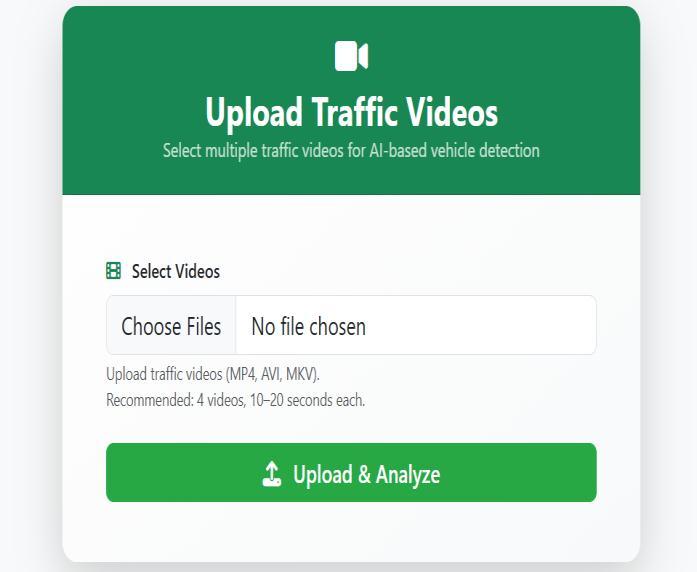
The uploaded traffic videos are stored in the server and processed frame by frame. The YOLOv8 model identifies differentvehicletypesandcalculatestrafficdensitybasedon the number of detected vehicles. This information is then used by the system to determine the appropriate signal timingforeachtrafficlane.
Afterprocessingtheuploadedvideos,thesystemgeneratesa live traffic dashboard that displays traffic conditions for multiple lanes. The dashboard shows vehicle density, CO₂ emissionestimates,emergencyvehicledetectionstatus,and theassignedtrafficsignalduration.
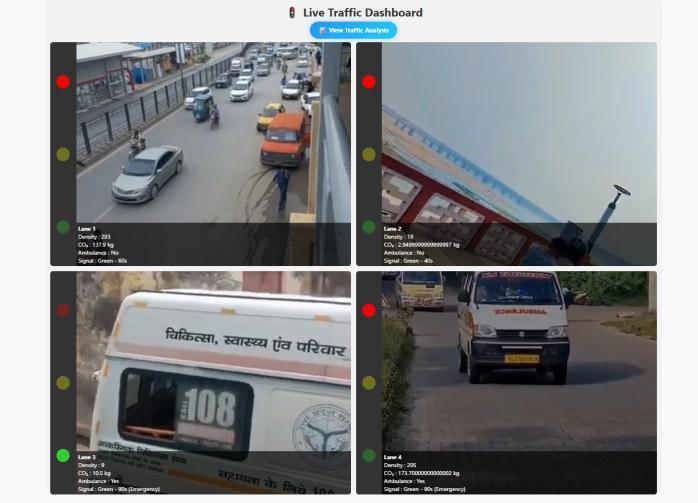
Eachlaneisanalyzedseparatelyandthesystemdynamically determinesthesignaldurationbasedonthetrafficdensity.If anemergencyvehiclesuchasanambulanceisdetected,the systemautomaticallyassignsalongergreensignalduration to allow the vehicle to pass quickly. Otherwise, the signal timing is adjusted according to the number of vehicles detectedineachlane.
Volume: 13 Issue: 03 | Mar 2026 www.irjet.net p-ISSN: 2395-0072
Theperformanceoftheproposedsystemwasevaluatedby comparingdynamicsignaltimingwithtraditionalfixed-time trafficsignalsystems.Theexperimentalresultsindicatethat theintelligentsystemsignificantlyimprovestrafficflowby allocating signal duration based on real-time traffic conditions.
The system also demonstrates accurate detection of emergency vehicles using OCR and visual analysis techniques.Byprioritizingemergencyvehicles,thesystem helps reduce response time in critical situations. Additionally,theCO₂emissionestimationmoduleprovides insights into environmental impact caused by traffic congestion.Overall, the proposed system improves traffic efficiency,reduceswaitingtime,enhancesemergencyvehicle response,andsupportsenvironmentallysustainabletraffic management.
ThisresearchpresentedaSmartTrafficManagementSystem thatutilizesdeeplearningandcomputervisiontechniques toimprovetrafficsignalcontrolandtrafficmonitoring.The systememploystheYOLOv8objectdetectionmodeltodetect andclassifyvehiclesfromtrafficvideosandestimatetraffic density. Based on the detected vehicle counts, the system dynamicallyadjuststrafficsignaldurationtooptimizetraffic flowandreducecongestion.
In addition to traffic density analysis, the system incorporates an emergency vehicle detection mechanism usingOpticalCharacterRecognition(OCR)andvisualcolor analysis techniques. This enables the system to identify emergencyvehiclessuchasambulancesandfiretrucksand provideprioritysignal control toensurefastermovement duringcriticalsituations.
The system also estimates CO₂ emissions based on the numberandtypeofdetectedvehicles,providinginsightsinto the environmental impact of traffic congestion. The experimental results demonstrate that the proposed intelligent system improves traffic efficiency compared to traditional fixed-time traffic signal systems. Overall, the proposedsolutionoffersanautomated,scalable,andcosteffective approach for smart city traffic management by reducingwaitingtime,improvingemergencyresponse,and supportingsustainabletransportationsystems.
Although theproposedSmartTrafficManagementSystem demonstrateseffectivetrafficmonitoringanddynamicsignal control,severalimprovementscanbemadeinfuturework to enhance the system’s performance and real-world applicability.Onepossibleextensionistheintegrationoflive traffic camera feeds instead of relying only on uploaded
videos.Thiswouldallowthesystemtooperateinrealtime andautomaticallymanagetrafficsignalsatintersections.
Another improvement could involve the use of more advanced deep learning models and larger datasets to further increase the accuracy of vehicle detection and emergencyvehiclerecognition.IntegrationwithInternetof Things(IoT)devicesandsmarttrafficlightscanalsoenable automaticsignalcontroldirectlyatroadintersections.
Additionally,thesystemcanbeexpandedtoincludefeatures suchasvehiclespeeddetection,trafficviolationmonitoring, andlicenseplaterecognitionforbettertrafficmanagement. Future research may also explore the use of cloud-based processingandedgecomputingtohandlelarge-scaletraffic data from multiple intersections in smart cities. These enhancements would make the system more efficient, scalable, and suitable for real-world intelligent transportationsystems.
[1]J.Redmon, S.Divvala,R.Girshick,andA.Farhadi,“You Only Look Once: Unified, Real-Time Object Detection,” ProceedingsoftheIEEEConferenceonComputerVisionand PatternRecognition(CVPR),pp.779–788,2016.
[2]G.Jocher,A.Chaurasia,andJ.Qiu,“YOLOv8:Ultralytics ObjectDetectionModel,”Ultralytics,2023.
[3] R. Szeliski, Computer Vision: Algorithms and Applications,Springer,2011.
[4]A.Rosebrock,“DeepLearningforComputerVisionwith Python,”PyImageSearch,2019.
[5]N.DalalandB.Triggs,“HistogramsofOrientedGradients forHumanDetection,”IEEEComputerSocietyConferenceon Computer Vision and Pattern Recognition, pp. 886–893, 2005.
[6] R. Smith, “An Overview of the Tesseract OCR Engine,” Proceedings of the Ninth International Conference on DocumentAnalysisandRecognition,IEEE,2007.
[7]S.SivaramanandM.Trivedi,“LookingatVehiclesonthe Road:ASurveyofVision-BasedVehicleDetection,Tracking, and Behavior Analysis,” IEEE Transactions on Intelligent TransportationSystems,vol.14,no.4,pp.1773–1795,2013.
[8] M. Teja, P. Reddy, and K. Srinivas, “Smart Traffic ManagementSystemUsingImageProcessing,”International JournalofEngineeringResearchandTechnology(IJERT),vol. 8,no.6,pp.245–250,2019.
[9]Y.Chen,H.Liu,andZ.Wang,“TrafficFlowDetectionand Analysis Using Deep Learning,” IEEE Access, vol. 8, pp. 123456–123467,2020.
International Research Journal of Engineering and Technology (IRJET) e-ISSN: 2395-0056
Volume: 13 Issue: 03 | Mar 2026 www.irjet.net p-ISSN: 2395-0072
[10] S. Bhandari and R. Gupta, “Vehicle Detection and CountingUsingComputerVisionTechniques,”International JournalofComputerApplications,vol.179,no.21,pp.12–18, 2018.
[11] L. Li, Y. Lv, and F. Wang, “Traffic Signal Timing OptimizationBasedonIntelligentTransportationSystems,” IEEE Transactions on Intelligent Transportation Systems, vol.15,no.3,pp.123–132,2014.
[12]P.ViolaandM.Jones,“RapidObjectDetectionUsinga Boosted Cascade of Simple Features,” IEEE Conference on Computer Vision and Pattern Recognition, pp. 511–518, 2001.
[13] S. S. Raut and R. K. Patil, “Smart Traffic Light Control System Using Image Processing,” International Journal of AdvancedResearchinComputerEngineering&Technology, vol.5,no.3,pp.682–686,2016.
[14] A. Krizhevsky, I. Sutskever, and G. Hinton, “ImageNet Classification with Deep Convolutional Neural Networks,” AdvancesinNeuralInformationProcessingSystems(NIPS), 2012.
[15] M. A. Jabbar, B. L. Deekshatulu, and P. Chandra, “IntelligentTransportationSystemUsingMachineLearning and Image Processing,” International Journal of Computer ScienceandInformationTechnologies,vol.8,no.5,pp.706–710,2017.