
International Research Journal of Engineering and Technology (IRJET) e-ISSN: 2395-0056
Volume: 13 Issue: 03 | Mar 2026 www.irjet.net p-ISSN: 2395-0072
International Research Journal of Engineering and Technology (IRJET) e-ISSN: 2395-0056
Volume: 13 Issue: 03 | Mar 2026 www.irjet.net p-ISSN: 2395-0072
Mrs P. Swetha1 , B. Prathyusha2 , A. Ravali3 , B. Poojitha4
1 Assistant Professor, Department of Computer Science and Engineering 2,3,4 B.Tech Students, Department of Computer Science and Engineering
Teegala Krishna Reddy Engineering College , Telangana, India
Abstract - Campus recruitment is an essential process in educationalinstitutionsthatconnectsstudentswithpotential employment opportunities. However, inmanyinstitutions the eligibility screening process is still carried out manually by Training and Placement Officers (TPOs), which requires significant time and effort. Manual verification of student recordsagainstjobrequirementsoftenleadstodelays,errors, and inefficient communication with eligible candidates. To address these challenges, this research proposes a Smart PlacementEligibilityandNotificationSystemthatautomates the process of matching student profiles with job requirements.Thesystemstoresstudentacademicinformation such as branch, CGPA, backlog status, and technical skills, along withjobcriteria providedbycompanies. Anautomated eligibility engine evaluates student profiles dynamically and identifies candidates who meet the required conditions. Once the eligibility check is completed, the system automatically sends email notifications to shortlisted students, ensuring timelycommunication.Theapplicationisdevelopedusingthe Django web framework and follows a modular architecture that includes student management, job management, eligibility matching, notification services, and eligibility history tracking. The proposed system improves accuracy, reducesadministrativeworkload,andenhancestransparency in the recruitment process. By automating the shortlisting mechanism and maintaining centralized data records, the system provides a scalable and efficient platform for managing campus placements and can be extended in the future with advanced features such as resume parsing and intelligent recommendation systems.
Key Words: Campus Placement System, Eligibility Matching, Recruitment Automation, Student Information System, Django Web Application, Email Notification System, Skill-Based Matching, Placement Management System
Campus placement is a critical process in educational institutions as it provides students with opportunities to transitionfromacademiclearningtoprofessional careers. TrainingandPlacementOfficers(TPOs)areresponsiblefor coordinatingrecruitmentactivities,managingstudentdata, and ensuring that eligible candidates are shortlisted for variousjobopportunities.However,manyinstitutionsstill rely on manual processes for verifying eligibility criteria, which often leads to inefficiencies, delays, and
inconsistencies in the recruitment process. With the increasingnumberofstudentsandrecruitmentdrives,ithas become essential to develop automated systems that can efficientlymanageplacement-relatedactivities.
Traditionalcampusrecruitmentsystemsinvolvecollecting student data and manually comparing it with companyspecific eligibility criteria such as minimum academic performance, technical skills, and departmental requirements. According to Sharma and Gupta [2], webbased placement management systems have significantly improved data accessibility and communication between students and placement officers. Similarly, Patel et al. [3] highlighted the importance of automated job recommendation mechanisms that can match candidate profileswithemployerrequirements.Thesesystemsaimto simplify the process of candidate screening and improve efficiencyinrecruitmentmanagement.
Despitetheavailabilityofdigitaltools,manyplacementcells stillfacechallengesrelatedtodatahandlingandeligibility verification. Manual filtering of student records based on multiple criteria such as CGPA, backlog status, branch eligibility,andskillsetscanbetime-consumingandproneto human errors. Verma and Jain [6] emphasized that automated resume and profile screening techniques are necessary to handle large volumes of candidate data efficiently.Furthermore,GuptaandArora[9]discussedthat traditional recruitment methods often lack scalability and transparency,especiallywhendealingwithalargenumber ofapplicants.
Another major challenge is the delay in communicating eligibilityresultstostudents.Inmanyinstitutions,eligible candidatesareinformedthroughnoticeboardsormanual emails,whichmayresultindelayednotifications.Singhand Sharma[10]suggestedthatautomatednotificationsystems integrated with recruitment platforms can significantly enhancecommunicationefficiency.
Volume: 13 Issue: 03 | Mar 2026 www.irjet.net p-ISSN: 2395-0072
Theincreasingcomplexityofrecruitmentcriteriarequires intelligent systems capable of automatically evaluating candidate profiles against job requirements. Research by Joshi and Kulkarni [11] indicates that data-driven approaches can significantly improve the accuracy of candidateselectionprocesses.Automatedeligibilitysystems help reduce administrative workload while ensuring consistentandunbiasedevaluationofstudentprofiles.
An automated placement eligibility system integrates student information management, job management, eligibility verification, and notification services within a unifiedplatform.Suchsystemsenablereal-timeprocessing ofrecruitmentdataandimprovetransparencyincandidate shortlisting.
To address the limitations of traditional placement management processes, this research proposes a Smart Placement Eligibility and Notification System. The system automatestheprocessofverifyingstudenteligibilitybased on parameters such as branch eligibility, academic performance,backlogconstraints,andskillmatching.Once theeligibilitycriteriaaresatisfied,thesystemautomatically notifieseligiblestudentsthroughemailnotifications.
The proposed system is developed using the Django web frameworkandfollowsamodulararchitectureconsistingof studentmanagement,jobmanagement,eligibilitymatching, and notification modules. The system also maintains an eligibilityhistorydatabasetopreventduplicatenotifications andprovidetransparenttrackingofcandidateshortlisting.
TheproposedSmartPlacementEligibilityandNotification Systemisdesignedtoautomateandstreamlinethecampus recruitment process within educational institutions. The system integrates student information management, job postingmanagement,automatedeligibilityverification,and real-time communication through email notifications. It eliminates the need for manual screening by allowing the systemtodynamicallyevaluatestudentprofilesagainstjob eligibility criteria specified by companies. The system operatesonaweb-basedarchitecturebuiltusingtheDjango framework. Students register and provide their academic detailssuchasbranch,CGPA,backlogstatus,andtechnical skills.Theserecordsarestoredinacentralizeddatabaseand remaininactiveuntilverifiedbytheTrainingandPlacement Officer (TPO). The TPO reviews and approves student profiles to ensure data authenticity before they are consideredforrecruitmentprocesses.
Similarly, job postings are entered by the TPO along with eligibilityconditionsincludingeligiblebranches,minimum CGPA,allowedbacklogcount,andrequiredtechnicalskills. Once a job posting is approved, the system automatically triggerstheeligibilitymatchingengine.Theenginecompares jobcriteriawithstudentrecordsandidentifiescandidates whomeettherequiredconditions.Theeligibilityprocessis designed to be flexible and dynamic. A student becomes eligibleiftheiracademicandskillattributessatisfythejob requirements. The system also maintains an eligibility historydatabasetoensurethateachstudentreceivesonly onenotificationperjob.Thispreventsduplicatenotifications andprovidestransparencyincandidateselection.
After the eligibility verification process is completed, the systemautomaticallysendsemailnotificationstoalleligible students, informing them about the job opportunity. By automating candidate screening and communication, the proposed system significantly reduces administrative workload, improves accuracy, and enhances the overall efficiencyofplacementmanagement.
The student management component allows students to register and maintain their academic profiles within the system.Studentsprovideinformationsuchasbranch,CGPA, backlogcount,andtechnicalskills.Theserecordsarestored inacentralizeddatabaseforfurtherprocessing.Thesystem ensuresthatstudentdataremainssecureandconsistentby allowing the TPO to verify and approve student records beforetheyparticipateintheeligibilityevaluationprocess.
ThejobmanagementcomponentallowstheTPOtoaddand managerecruitmentopportunitiesprovidedbycompanies Eachjobpostingcontainsimportantdetailssuchascompany name, job role, eligible branches, minimum academic requirements, and required technical skills. The system supports multiple branch selection and flexible skill requirements to accommodate real-world recruitment criteria.Onceverified,jobpostingsareactivatedandused foreligibilityverification.
The eligibility matching engine is the core component responsible for automatically evaluating student records against job requirements. The engine compares student profiles with job eligibility criteria based on multiple parameters including branch eligibility, academic performance, backlog limits, and skill compatibility. Only those students who satisfy all required conditions are shortlisted. This automated evaluation process eliminates manualscreeningerrorsandensuresconsistentcandidate selection.
Volume: 13 Issue: 03 | Mar 2026 www.irjet.net p-ISSN: 2395-0072
Thenotificationsystemisresponsibleforinformingeligible students about recruitment opportunities. Once the eligibilityengineidentifiessuitablecandidates,automated email notifications are sent through an integrated email service.Thisensuresthatstudentsreceivetimelyupdates about job opportunities without requiring manual communicationfromtheplacementoffice.
Thesystemalsomaintainsarecordofeligibilityresultsfor each job posting. This eligibility history module prevents duplicate notifications and allows the TPO to track which studentswereshortlistedforspecificjobs.Maintainingthis historical data improves transparency and enables better monitoringofrecruitmentactivities.
2.6 System Architecture
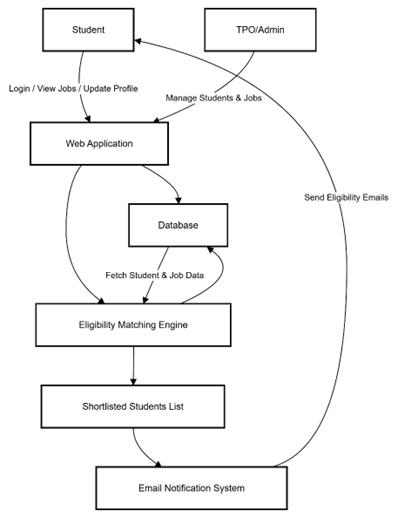
including modules for student management, job management,eligibilitymatching,andnotificationservices. Thedatalayermanagesthecentralizeddatabasethatstores student profiles, job information, and eligibility history records. Finally, the service layer handles external communication through email services that notify eligible studentsaboutrecruitmentopportunities.
TheimplementationoftheSmartPlacementEligibilityand Notification System focuses on developing a web-based platform that automates the process of managing student information, job postings, eligibility verification, and notificationservices.Thesystemisimplementedusingthe Django web framework, which follows the Model–View–Template (MVT) architectural pattern. This architecture helpsinseparatingtheapplicationlogic,userinterface,and database operations, ensuring better maintainability and scalability. The system is divided into several functional modules that work together to automate the placement eligibilityverificationprocess.Theimplementationincludes backendlogicforeligibilitymatching,databasemanagement forstoringstudentandjobrecords,andanautomatedemail notificationsystemtoinformeligiblecandidates.
Thedevelopmentoftheproposedsystemiscarriedoutusing PythonandtheDjangowebframework.Djangoprovidesa robustenvironmentfordevelopingsecureandscalableweb applications.Thebackendofthesystemisimplementedin Python, while the frontend interface is developed using HTMLandCSSforuserinteraction.ThesystemusesSQLite astheprimarydatabaseforstoringapplicationdataduring development, although it can be easily migrated to other databasesystemssuchasMySQLorPostgreSQLforlarger deployments.
The application is executed on a web server environment thatprocessesuserrequests,retrievesrelevantinformation fromthedatabase,andreturnsappropriateresponsestothe user interface. The integrated email service uses SMTP protocoltosendautomatednotificationstostudents.
The system architecture consists of four main layers: the clientlayer,applicationlayer,datalayer,andservicelayer. TheclientlayerincludestheStudentandTPOinterfacesthat interact with the system through a web browser. The application layer contains the core logic of the system,
Thedatabaseplaysanessentialroleinstoringandmanaging studentrecords,jobdetails,andeligibilityinformation.The systemmaintainsstructuredtablesthatstoreinformation suchasstudentprofiles,jobpostings,andeligibilityhistory. Thestudenttablestoresacademicdetailsincludingbranch, CGPA, backlog count, and technical skills. The job table stores information about recruitment opportunities including company name, job role, required skills, eligible branches,andminimumacademicrequirements.
Volume: 13 Issue: 03 | Mar 2026 www.irjet.net p-ISSN: 2395-0072
The eligibility history table records which students are eligible for specific job postings. This database structure ensures efficient retrieval and prevents duplication of notifications.TheuseofDjango'sObjectRelationalMapping (ORM)simplifiesdatabaseoperationsandenablesseamless communicationbetweentheapplicationandthedatabase.
Theeligibilitymatchingprocessisthecorefunctionalityof thesystem.OnceajobpostingisapprovedbytheTPO,the systemautomaticallyretrievesallapprovedstudentrecords fromthedatabase.Theeligibilityenginethencomparesthe studentprofileswiththejobrequirementsusingpredefined conditions.
The matching algorithm checks whether the student's branchisincludedinthelistofeligiblebranchesspecifiedin the job posting. It then verifies that the student's CGPA satisfiestheminimumacademicrequirementandthatthe numberofbacklogsdoesnotexceedtheallowedlimit.The algorithm also performs skill matching by comparing the student'slistedskillswiththerequiredjobskills.Ifatleast oneskillmatchesandallacademicconditionsaresatisfied, the student is considered eligible for that job. This automated evaluation process ensures accurate candidate shortlistingandeliminatestheneedformanualverification bytheplacementofficer.
The user interface of the system is designed to provide a simpleandintuitiveinteractionexperienceforbothstudents andtheTPO.Studentscanregisterandupdatetheirprofiles throughthestudentinterface,whiletheTPOcanmanagejob postings, approve student records, and view eligibility resultsthroughtheadministrativedashboard.
The interface allows users to navigate easily between differentmodulesofthesystem.Studentscansubmittheir academic details and view notifications about job opportunities, while the TPO can monitor recruitment activitiesandmanageplacementrecordsefficiently.
The system integrates an automated email notification service to inform eligible students about recruitment opportunities.Oncetheeligibilityengineidentifiessuitable candidates, the notification module generates email messages containing job details and sends them to the correspondingstudentsusinganSMTP-basedemailservice.
Thesystemalsomaintainsa notificationstatus withinthe eligibilityhistorytabletoensurethatduplicateemailsare not sent for the same job posting. This automated communication mechanism significantly improves the efficiencyoftheplacementprocessandensuresthateligible
students receive timely updates about available opportunities.
All modules of the system work together to provide a completeautomatedplacementmanagementsolution.The workflowbeginswhenstudentssubmittheirprofilesandthe TPOapprovesthem.TheTPOthenaddsjob postingswith specific eligibility criteria. Once a job is approved, the eligibility engine processes student records and identifies eligible candidates. Finally, the system sends automated emailnotificationsandstorestheeligibilityresultsforfuture reference. Through this integrated workflow, the system ensures efficient coordination between students and the placement office while minimizing manual effort and improvingtheaccuracyoftherecruitmentprocess.
This section presents the results obtained after implementing the Smart Placement Eligibility and NotificationSystem.Thesystemwastestedtoevaluateits functionality, efficiency, and reliability in automating the campus recruitment eligibility process. The evaluation focuses on key functionalities such as student profile registration,jobpostingmanagement,eligibilityverification, andautomatedemailnotification.Thesystemdemonstrates improved efficiency in handling recruitment data and reduces the manual effort required for candidate shortlisting.
The student registration module allows students to enter their academic and technical details into the system. The interface collects essential information such as student name,emailaddress,branch,CGPA,backlogcount,andskill set.Thesedetailsarestoredinthedatabaseandlaterused foreligibilityverificationduringrecruitmentdrives.
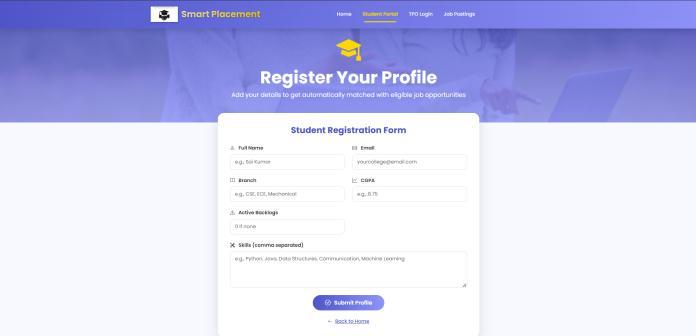
AsshowninFig.2,theinterfaceprovidesastructuredform forenteringstudentinformation.Thedesignensureseaseof useandallowsstudentstoinputtheirdataaccurately.Once the form is submitted, the information is stored in the
International Research Journal of Engineering and Technology (IRJET) e-ISSN: 2395-0056
Volume: 13 Issue: 03 | Mar 2026 www.irjet.net p-ISSN: 2395-0072
database and awaits approval from the Training and PlacementOfficer(TPO).Thisapprovalmechanismensures thatonlyverifiedstudentprofilesareusedintheeligibility evaluationprocess.
The job management module allows the TPO to add and managejobpostingsprovidedbyvariouscompanies.Each jobrecordincludesinformationsuchascompanyname,job role, minimum CGPA requirement, allowed backlog limit, required technical skills, and eligible branches. These parametersareusedbytheeligibilityenginetodetermine suitablecandidates.
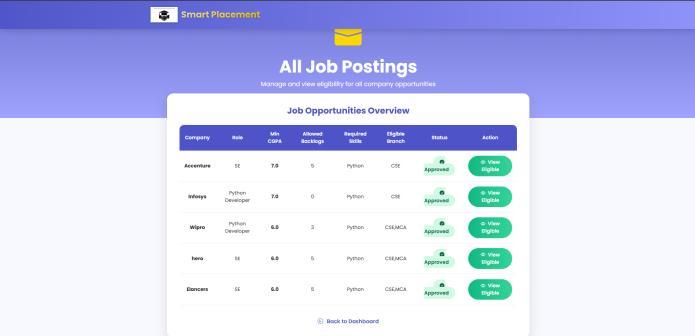
Figure3illustratesthejobopportunitiesdashboardwhere multiplejobpostingsaredisplayedinatabularformat.The interface provides a clear overview of company requirementsandapprovalstatus.Onceajobisapprovedby the TPO, the eligibility engine automatically processes studentrecordstoidentifysuitablecandidates.
The administrative dashboard provides the TPO with centralizedcontrolovertheplacementmanagementprocess. Through thisinterface,the TPO canview student records, approve student registrations, approve job postings, and monitorrecruitmentactivities.
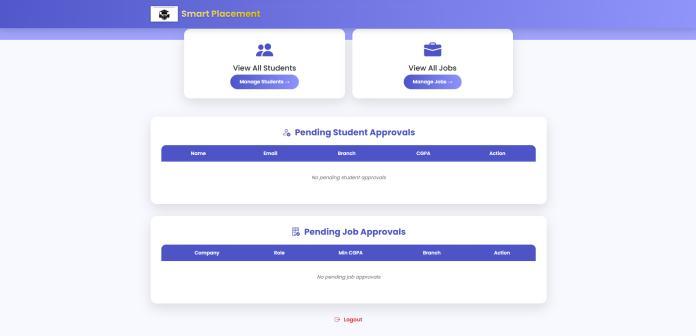
As illustrated in Fig. 4, the dashboard displays pending studentapprovalsandjobapprovals.ThisallowstheTPOto verify and approve data before it becomes active in the system.Theinterfacealsoprovidesquicknavigationoptions to view all students and job postings, enabling efficient monitoringofplacementactivities.
One of the key features of the system is the automated eligibilitymatchingprocess.Afterajobpostingisapproved, the eligibility engine compares job requirements with studentrecordsstoredinthedatabase.Thesystemevaluates multipleparametersincludingbrancheligibility,academic performance,backloglimits,andtechnicalskillmatching.
The automated verification process ensures that eligible candidates are identified quickly and accurately. This eliminates manual filtering of student records and significantlyreducesadministrativeworkload.
Once eligible students are identified, the system automatically sends email notifications through an integratedSMTP-basedemailservice.Eacheligiblestudent receives a notification containing details of the job opportunity. The eligibility history module ensures that duplicatenotificationsarenotsentforthesamejobposting.
The automated notification process improves communicationefficiencyandensuresthatstudentsreceive timelyinformationaboutrecruitmentopportunities.
Thesystemdemonstratesstrongperformanceinmanaging placement-related activities. By automating the eligibility verificationprocess,thesystemreducesthetimerequired forcandidateshortlisting.Themodulararchitectureallows the system to handle multiple student records and job postingsefficiently.
The results indicate that the proposed system provides a reliable and scalable solution for managing campus placements.Itimprovesaccuracyineligibilityverification, enhances transparency in the recruitment process, and significantlyreducesmanualeffortforplacementofficers.
The Smart Placement Eligibility and Notification System providesaneffectiveandautomatedsolutionformanaging campus recruitment activities in educational institutions. The system addresses the limitations of traditional placement management processes by introducing an automated platform that integrates student profile management, job posting management, eligibility verification,andnotificationservices.Byeliminatingmanual
Volume: 13 Issue: 03 | Mar 2026 www.irjet.net p-ISSN: 2395-0072
screeningprocedures,thesystemsignificantlyreducesthe workloadofTrainingandPlacementOfficerswhileensuring accurateandconsistentcandidateshortlisting.
Theproposedsystemutilizesacentralizeddatabasetostore studentinformationandjobdetails,allowingtheeligibility enginetoautomaticallyevaluatecandidateprofilesagainst jobrequirements.Thematchingprocessconsidersmultiple parameters such as academic performance, branch eligibility,backlogconstraints,andtechnicalskills,ensuring that only qualified students are identified for recruitment opportunities. This automated evaluation mechanism improvestransparencyandminimizeshumanerrorsduring theshortlistingprocess.Anothersignificantadvantageofthe systemisitsautomatednotificationfeature,whichensures that eligible students receive timely updates about job opportunities. By integrating email services into the platform,thesystemenhancescommunicationefficiencyand allowsstudentstostayinformedaboutrecruitmentdrives withoutdelays.Additionally,theeligibilityhistorymodule helpsmaintainrecordsofshortlistedcandidates,preventing duplicatenotificationsandprovidingbettertraceability.
Overall,thedevelopedsystemdemonstratesascalableand reliable framework for managing campus placement processes.Themodulararchitectureimplementedusingthe Django framework ensures flexibility for future improvementsandintegrationwithadvancedtechnologies. Thesystemcontributestoimprovingtheefficiency,accuracy, andtransparencyofrecruitmentmanagementandprovides a strong foundation for developing intelligent placement managementplatformsineducationalinstitutions.
Although the proposed Smart Placement Eligibility and Notification System effectively automates the process of managing campus recruitment activities, several enhancements can be incorporated in future versions to furtherimprovethesystem’sfunctionality,scalability,and intelligence.Theseimprovementswill allowthesystemto supportmoreadvancedrecruitmentprocessesandprovide better user experience for both students and placement administrators.Onepossibleenhancementistheintegration ofaresumeuploadandautomatedskillextractionfeature. By incorporating Natural Language Processing (NLP) techniques,thesystemcanautomaticallyanalyzeresumes andextractrelevantskills,educationaldetails,andtechnical experience. This would reduce the need for students to manuallyentertheirskillsandensuremoreaccurateprofile information.
Another important improvement involves implementing machine learning-based recommendation systems. Such systemscananalyzehistoricalplacementdataandsuggest suitable job opportunities to students based on their academicbackground,skillsets,andcareerinterests.This featurewouldmaketheplacementsystemmoreintelligent
and personalized. The system can also be enhanced by addingastudentdashboardwherestudentscantracktheir eligibilitystatus,viewappliedjobs,andreceivenotifications regardingrecruitmentevents.Similarly,theTPOdashboard can be extended to include analytical reports such as placement statistics, student skill distribution, and recruitmenttrends.
Additionally, future versions of the system can integrate multiple communication channels, including SMS notifications and mobile application support, to improve accessibility and ensure that students receive timely updates. Security enhancements such as role-based authentication and secure login mechanisms can also be implemented to protect sensitive student data. Finally, deploying the system on cloud-based platforms would enable better scalability and allow institutions to manage large volumes of student data and recruitment activities efficiently. These enhancements would transform the proposedsystemintoacomprehensiveintelligentplacement management platform capable of supporting modern recruitmentprocesses.
[1]S. Kumar and R. Singh, “Automated Placement Management System for Educational Institutions,” InternationalJournalofComputerApplications,vol.182,no. 34,pp.15–21,2021.
[2]A. Sharma and P. Gupta, “Web-Based Placement Management System,” International Journal of Advanced Research in Computer Science, vol. 11, no. 3, pp. 45–50, 2020.
[3]M. Patel, J. Shah, and K. Mehta, “Smart Job Recommendation System Using Machine Learning Techniques,”InternationalJournalofComputerScienceand InformationTechnologies,vol.12,no.2,pp.102–108,2021.
[4]R.Alonso,M.Fernández,andL.García,“ANovelApproach forJobMatchingandSkillIdentification,”ProcediaComputer Science,vol.230,pp.150–158,2024.
[5]A.MusaleandS.Nagpure,“JobRecommendationSystem UsingProfileMatching,”inProceedingsoftheInternational ConferenceonEmergingTechnologies,2022,pp.134–139.
[6] N. Verma and P. Jain, “Automated Resume Screening UsingNaturalLanguageProcessing,”InternationalJournalof DataScienceandAnalytics,vol.9,no.4,pp.221–229,2022.
[7] J. Park, C. Lee, and J. Kim, “Course Recommendation System for Company Job Matching,” in Proceedings of the InternationalConferenceonInformationSystems,2024,pp. 210–215.
International Research Journal of Engineering and Technology (IRJET) e-ISSN: 2395-0056
Volume: 13 Issue: 03 | Mar 2026 www.irjet.net p-ISSN: 2395-0072
[8] S. K. Patel and R. Patel, “Web Portal for Training and Placement Cell,” International Journal of Engineering ResearchandTechnology,vol.9,no.5,pp.341–346,2020.
[9]D.GuptaandR.Arora,“Skill-BasedJobRecommendation SystemUsingDataMiningTechniques,”InternationalJournal ofComputerApplications,vol.177,no.10,pp.10–15,2019.
[10] P. Singh and V. Sharma, “Online Recruitment System UsingWebTechnologies,”InternationalJournalofComputer Science and Mobile Computing, vol. 8, no. 7, pp. 180–186, 2019.
[11]A.JoshiandK.Kulkarni,“PredictingStudentPlacement UsingMachineLearningAlgorithms,”InternationalJournal ofAdvancedComputerScienceandApplications,vol.11,no. 6,pp.540–546,2020.
[12] S. Bansal and M. Chawla, “Automated Job Matching SystemBasedonCandidateSkills,”InternationalJournalof InformationTechnology,vol.13,no.2,pp.611–618,2021.
[13]R.MehtaandD.Patel,“DesignandImplementationofan OnlinePlacementPortal,”InternationalJournalofScientific ResearchinComputerScience,vol.6,no.4,pp.88–94,2018.
[14] K. Reddy and S. Rao, “Campus Placement Prediction Using Data Mining Techniques,” IEEE International Conference on Computational Intelligence, pp. 123–128, 2019.
[15]M.S.AhmedandH.Khan,“AI-BasedResumeScreening System for Automated Hiring,” International Journal of ComputerApplications,vol.183,no.6,pp.24–30,2023.
[16]P.Kumar,R.Sharma,andS.Mishra,“AnIntelligentSkillBased Matching Framework for Job Recommendation Systems,”InternationalJournalofEngineeringResearchand Applications,vol.14,no.1,pp.120–125,2024.