
International Research Journal of Engineering and Technology (IRJET) e-ISSN: 2395-0056
Volume: 13 Issue: 03 | Mar 2026 www.irjet.net p-ISSN: 2395-0072
International Research Journal of Engineering and Technology (IRJET) e-ISSN: 2395-0056
Volume: 13 Issue: 03 | Mar 2026 www.irjet.net p-ISSN: 2395-0072
Mrs.B.Priyanka1 , Bhargavi Guggilla2 , Sindhuja Gummula3 , Shiva Gilla4
1 Associate Professor, Department of Computer Science and Engineering
2,3,4 B.Tech Students, Department of Computer Science and Engineering
Teegala Krishna Reddy Engineering College , Telangana, India
Abstract - Early identification of diseases based on symptoms plays a significant role in improving healthcare outcomes and preventing severe complications. However, traditional diagnosis methods often require medical consultation and may take time for accurate evaluation. To address this challenge, this research proposes a Smart Symptom-Driven Disease Diagnosis and Prevention RecommendationSystemusingMachineLearningtechniques. The system allows users to input symptoms through an interactive interface and predicts the most probable disease using trained machine learning algorithms such as Naive Bayes and Random Forest. The dataset used for training containsmultiplesymptomsandassociateddiseases,enabling the model to learn relationships between symptoms and medical conditions. In addition to predicting the disease, the system also provides preventive recommendations to guide users in managing their health condition at an early stage. Furthermore, an AI-powered chatbot is integrated into the system to assist users by providing medical information and guidance based on their queries. The experimental results demonstrate that the proposed system achieves reliable prediction accuracy and provides useful preventive suggestions.Thedevelopedsolutioncanserveasapreliminary decision-support tool for users by offering quick insights into possiblehealthconditionsandrecommendedprecautions.This approachcontributestowardimprovingaccessibilitytobasic healthcare information through intelligent technologies.
Key Words: Disease Prediction, Machine Learning, Naive Bayes, Random Forest, Healthcare AI, Symptom Analysis, Prevention Recommendation System
Healthcare systems around the world are increasingly adoptingintelligenttechnologiestoimprovetheefficiency andaccuracyofdiseasediagnosis.Earlydetectionofdiseases based on symptoms can significantly reduce the risk of complicationsandimprovetreatmentoutcomes.However, traditional diagnostic procedures often require direct consultation with medical professionals, which may not always be immediately accessible to individuals. With the rapid advancement of machine learning and artificial intelligencetechnologies,ithasbecomepossibletodevelop intelligentsystemsthatassistusersinidentifyingpotential diseasesbasedontheirsymptoms.
Machinelearningtechniqueshavedemonstratedsignificant potentialinthemedicaldomainforanalyzingcomplexhealth data and predicting diseases with improved accuracy. AccordingtoKononenko[2],machinelearningmodelscan assistmedical practitioners byidentifying patterns within healthcare datasets and providing reliable diagnostic predictions. Algorithms such as Naive Bayes and Random Forestarewidelyusedforclassificationproblems,including medical diagnosis, due to their efficiency and ability to handle structured datasets [5][6]. These algorithms can learn relationships between symptoms and diseases by analyzinghistoricalmedicaldatasets.
Recentstudieshavehighlightedthegrowingroleofartificial intelligence in healthcare applications. Rajkomar et al. [8] emphasize that machine learning can help improve diagnosticaccuracybyanalyzingpatientdataandproviding predictive insights. Similarly, Deo [9] discusses how intelligentsystemscanassistinidentifyingdiseasesearlyby processing large amounts of medical data and generating meaningful predictions. By utilizing machine learning algorithms, automated diagnostic systems can support healthcare decision-making and enhance accessibility to medicalinformation.
Despite these advancements, many existing healthcare systemsstillrelyonmanualsymptomevaluation,whichcan betime-consumingandmaynotalwaysprovideimmediate feedbacktopatients.Toaddressthislimitation,asymptomdriven disease prediction system can be developed to analyze user-reported symptoms and predict possible diseases using trained machine learning models. Such systemscanactaspreliminarydiagnostic toolsthatassist users in understanding their health conditions before seekingprofessionalmedicalconsultation.
In addition to disease prediction, providing preventive recommendations is equally important for improving healthcareawareness.Preventiveguidanceallowsusersto takeearlyprecautionsandadopthealthierhabitstoreduce the risk of disease progression. Therefore, integrating disease prediction with prevention recommendations can significantly enhance the usability and practical value of intelligenthealthcaresystems.
Theproposedsystem,titled“SmartSymptom-DrivenDisease Diagnosis and Prevention Recommendation System Using
International Research Journal of Engineering and Technology (IRJET) e-ISSN: 2395-0056
Volume: 13 Issue: 03 | Mar 2026 www.irjet.net p-ISSN: 2395-0072
MachineLearning,”aimstopredictdiseasesbasedonuserenteredsymptomsusingmachinelearningalgorithms.The system utilizes medical datasets containing symptom–disease relationships and applies classification algorithms such as Naive Bayes and Random Forest to generate predictions. Furthermore, the system includes an AIpowered chatbot assistant that provides users with additionalhealth-relatedinformationandguidance.
Thedevelopedweb-basedplatformprovidesaninteractive interfacewhereuserscaninputsymptoms,obtaindisease predictions, and receive preventive suggestions. By combiningmachinelearningalgorithms,symptomanalysis, and AI-based assistance, the proposed system aims to improveearlydiseaseawarenessandsupportpreliminary healthcaredecision-making.
Machinelearninghasbecomeanimportanttoolinmodern healthcare systems for analyzing medical data and predicting diseases. By learning patterns from historical datasets,machinelearningmodelscanassistinidentifying relationships between symptoms and medical conditions. Algorithms such as Naive Bayes and Random Forest are commonly used in disease prediction systems because of theirhighclassificationaccuracyandefficiencyinhandling largedatasets.
Symptom-based disease prediction systems analyze the symptomsenteredbyusersandcomparethemwithtrained medicaldatasetstoidentifypossiblediseases.Thesesystems act as decision-support tools that provide preliminary diagnostic information. By utilizing machine learning techniques, symptom-driven systems can quickly process multiplesymptomsandgeneratepredictionsthathelpusers understandpotentialhealthrisks.
Preventive healthcare plays a critical role in reducing diseaserisksandimprovingoverallpublichealth.Providing preventionrecommendationsalongwithdiseaseprediction helps users take appropriate precautions and adopt healthier lifestyles. Integrating preventive guidance into intelligent healthcare systems ensures that users not only receivediagnosticsuggestionsbutalsolearnaboutmeasures tomanageandpreventdiseaseseffectively.
The proposed system aims to develop an intelligent healthcaresupportplatformcapableofpredictingpossible diseasesbasedonuser-providedsymptomsandproviding preventiverecommendations.Thesystemutilizesmachine learning techniques to analyze symptom patterns and identifypotential diseasesfroma trainedmedical dataset.
The overall framework integrates data preprocessing, machine learning model training, symptom-based prediction,andpreventivehealthcareguidance.
Theproposedsystemisdesignedasaweb-basedapplication that allows users to interact with the system through a simpleinterface.Userscanentersymptoms,afterwhichthe system processes the information using trained machine learning models to generate disease predictions. Additionally, the system provides preventive recommendationsandintegratesanAI-poweredchatbotto assist users with health-related queries. The architecture ensures efficient data processing and accurate disease predictionwhilemaintainingauser-friendlyinterface.
Theproposedsystemutilizesamedicaldatasetcontaininga large number of symptoms and their corresponding diseases. The dataset serves as the primary source for training and testing the machine learning models. Each recordinthedatasetconsistsofmultiplesymptomattributes and the associated disease label. This structured dataset enablesthemachinelearningalgorithmstolearnpatterns betweensymptomsanddiseases.
The dataset is divided into two parts: training data and testing data. The training dataset is used to build the machinelearningmodel,whilethetestingdatasetisusedto evaluatethemodel’sperformanceandpredictionaccuracy.
Data preprocessing plays a crucial role in preparing the dataset for machine learning analysis. The raw medical dataset often contains redundant or inconsistent information that must be processed before training the model.Thepreprocessingstageincludesdatacleaningand datatransformationprocesses.
Duringdatacleaning,missingvaluesandinconsistenciesin thedatasetarehandled to ensurethatthe model receives accurate and consistent information. Data transformation converts symptom information into a structured feature format that can be used by machine learning algorithms. Thisstephelpsimprovetheperformanceandreliabilityof thepredictionmodel.
In the proposed system, symptoms entered by users are converted into a feature vector representation. Each symptom corresponds to a specific feature in the dataset. Whena user selects symptoms,the systemconvertsthem into a binary feature vector where the presence of a symptomisrepresentedby1andtheabsenceofasymptom isrepresentedby0.
International Research Journal of Engineering and Technology (IRJET) e-ISSN: 2395-0056
Volume: 13 Issue: 03 | Mar 2026 www.irjet.net p-ISSN: 2395-0072
Thisfeaturevectoristhenprovidedasinputtothetrained machinelearningmodel.Thefeaturerepresentationallows the model to analyze symptom patterns efficiently and generateaccuratediseasepredictions.
The proposed system implements machine learning algorithms such as Naive Bayes and Random Forest Classifierfordiseaseprediction.Thesealgorithmsarewidely used for classification tasks due to their ability to handle structureddatasetsandprovidereliablepredictionresults.
The Naive Bayes algorithm is used as a probabilistic classification model that calculates the probability of diseasesbasedonthesymptomsprovided.RandomForest, an ensemble learning algorithm, improves prediction performance by combining multiple decision trees to generateamorerobustclassificationresult.
Both models are trained using the preprocessed medical dataset and evaluated using performance metrics such as accuracy,precision,recall,andF1-score.
Once the machine learning model is trained, it is used to predictdiseasesbasedonsymptomsenteredbyusers.The system processes the symptom input, converts it into a feature vector, and provides it to the trained prediction model.Themodelthenidentifiesthemostprobabledisease associatedwiththegivensymptoms.
Inadditiontodiseaseprediction,thesystemalsoprovides preventive recommendations to help users manage their healthcondition.Theserecommendationsareretrievedfrom a predefined prevention knowledge base that contains preventivemeasuresassociatedwitheachdisease.
To further enhance the usability of the system, an AIpowered chatbot assistant is integrated into the platform. Thechatbotallowsuserstoaskhealth-relatedquestionsand receiveinformativeresponses.Thechatbotusesgenerative AI technology to provide explanations about diseases, symptoms, and general healthcare guidance. This feature improves user interaction with the system and provides additionalsupportbeyonddiseaseprediction.
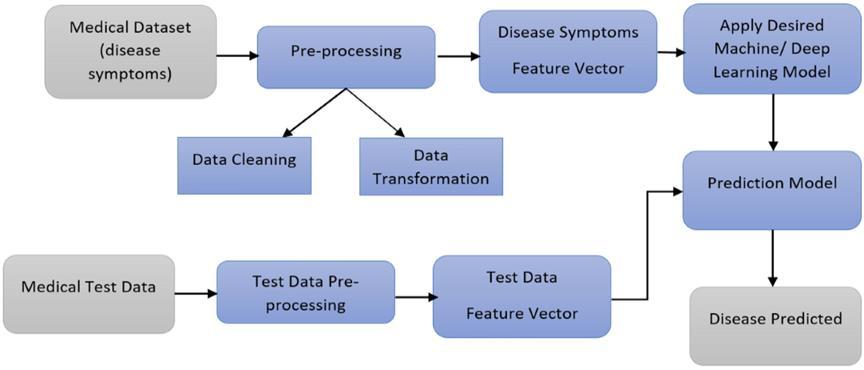
Fig. 1 illustrates the overall architecture of the proposed diseasepredictionsystem.Thearchitecturebeginswiththe medicaldatasetcontainingdisease–symptomrelationships. Thedatasetundergoespreprocessingstepsincludingdata cleaningandtransformation.Afterpreprocessing,symptom featuresareextractedandconvertedintofeaturevectors.
The machine learning models are trained using the processed training dataset to build the prediction model. Whennewsymptomdataisprovidedbyusers,itundergoes preprocessing and feature vector conversion before being passedtothetrainedpredictionmodel.Finally,thesystem outputs the predicted disease along with preventive recommendations.
Thissectiondescribesthepracticalimplementationofthe proposed Smart Symptom-Driven Disease Diagnosis and Prevention Recommendation System. The system is developed as a web-based application using the Django framework, integrated with machine learning models for disease prediction. The implementation includes data preprocessing,modeltraining,symptom-basedprediction, preventionrecommendation,andAIchatbotintegration.
TheproposedsystemisimplementedusingPythonandthe Djangowebframework.Pythonprovidespowerfullibraries for machine learning and data processing, while Django enablesthedevelopmentofadynamicweb-basedinterface for user interaction. The system utilizes libraries such as NumPy and Pandas for data manipulation and preprocessing. Machinelearning modelsareimplemented usingtheScikit-learnlibrary,whichprovidesefficienttools forclassificationandevaluation.
TheuserinterfaceofthesystemisdevelopedusingHTML, CSS,andBootstraptoensurearesponsiveanduser-friendly design.ThebackendlogicishandledthroughDjangoviews andmodels,whichmanageuserauthentication,prediction processing,andinteractionwithmachinelearningmodules.
The medical dataset used in the system contains multiple symptoms associated with different diseases. Each row in thedatasetrepresentsacombinationofsymptomsandthe corresponding disease label. Before training the machine learningmodel,thedatasetundergoespreprocessingsteps toensuredataconsistencyandquality.
International Research Journal of Engineering and Technology (IRJET) e-ISSN: 2395-0056
Volume: 13 Issue: 03 | Mar 2026 www.irjet.net p-ISSN: 2395-0072
Duringpreprocessing,thediseaselabelsareconvertedinto numerical form using label encoding. This transformation allowsmachinelearningalgorithmstoprocesscategorical disease names efficiently. The dataset is then divided into feature variables representing symptoms and a target variable representing the disease class. The dataset is further split into training and testing subsets to evaluate modelperformance.
The system employs two machinelearning algorithms for disease classification: Naive Bayes and Random Forest Classifier. These algorithms are trained using the preprocessed training dataset to learn the relationship betweensymptomsanddiseases.
TheNaiveBayesalgorithmcalculatestheprobabilityofeach disease based on the symptoms provided by the user. It assumesindependenceamongfeaturesandisefficientfor high-dimensionalclassificationtasks.RandomForest,onthe otherhand,isanensemblelearningtechniquethatcombines multipledecisiontreestoimprovepredictionaccuracyand reduce overfitting. Both models are trained using the trainingdatasetandevaluatedusingthetestingdatasetto measuretheirperformance.
The prediction module allows users to select symptoms through the web interface. The selected symptoms are convertedintoafeaturevectorrepresentationthatmatches the structure of the training dataset. Each symptom is represented as a binary value indicating whether the symptomispresentorabsent.
The generated feature vector is provided as input to the trained machine learning model. The model analyzes the symptom pattern and predicts the most probable disease associatedwiththegivensymptoms.Thepredicteddisease isthendisplayedtotheuserthroughthewebinterface.
To enhance the usefulness of the system, a prevention recommendation module is integrated with the disease predictionsystem.Afterpredictingthedisease,thesystem retrievesrelevantpreventivemeasuresfroma predefined knowledgebase.Thisknowledgebaseisimplementedusing a dictionary that maps diseases to their corresponding preventiverecommendations.
These preventive suggestions help users understand precautionary measures and encourage early healthcare awareness. Providing preventive guidance along with predictionimprovesthepracticalvalueofthesystem.
An AI-powered chatbot assistant is incorporated into the system to provide additional healthcare guidance. The chatbot uses generative AI technology to respond to user queriesrelatedtosymptoms,diseases,andgeneralmedical information.Userscaninteractwiththechatbotthroughthe webinterfacebyenteringtheirhealth-relatedquestions.
The chatbot analyzes the user's input and generates informative responses, helping users understand their health conditions better. This feature complements the machinelearningpredictionsystembyofferingadditional explanationsandrecommendations.
Theentiresystemisintegratedintoaweb-basedplatform withauser-friendlyinterface.Theinterfaceallowsusersto register,login,accesspredictionmodules,viewalgorithm performancecomparisons,andinteractwiththeAIchatbot assistant.TheDjangoframeworkmanagescommunication between the frontend interface and backend processing modules.
The integrated architecture ensures smooth interaction betweendatapreprocessing,machinelearningmodels,and userinput.Thefinaloutputpresentedtotheuserincludes the predicted disease along with relevant preventive recommendations.
TheproposedSmartSymptom-DrivenDiseaseDiagnosisand PreventionRecommendationSystemwasdevelopedusing Python, Django, and machine learning algorithms. The system was evaluated using a medical symptom dataset containing multiple disease classes and associated symptoms.Theprimaryobjectiveoftheevaluationwasto measuretheeffectivenessofthemachinelearningmodelsin predicting diseases accurately based on user-provided symptomsandtoanalyzetheusabilityofthedevelopedwebbasedinterface.
The system provides an interactive web interface where userscanaccessdifferentfunctionalitiessuchassymptombased disease prediction, machine learning model performance comparison, and an AI-powered chatbot assistantforhealth-relatedqueries.Thepredictionmodule allows users to select symptoms from a predefined list, whicharethenprocessedbythetrainedmachinelearning modeltopredictthemostprobabledisease.
The developed system integrates two machine learning algorithms, namely Naive Bayes and Random Forest Classifier,toanalyzeandcomparepredictionperformance. Both models were trained using the training dataset and evaluated using a testing dataset to measure accuracy, precision, recall, and F1-score. The experimental results
International Research Journal of Engineering and Technology (IRJET) e-ISSN: 2395-0056
Volume: 13 Issue: 03 | Mar 2026 www.irjet.net p-ISSN: 2395-0072
demonstrate that both algorithmsachievehighprediction accuracy due to the structured nature of the symptom–diseasedataset.
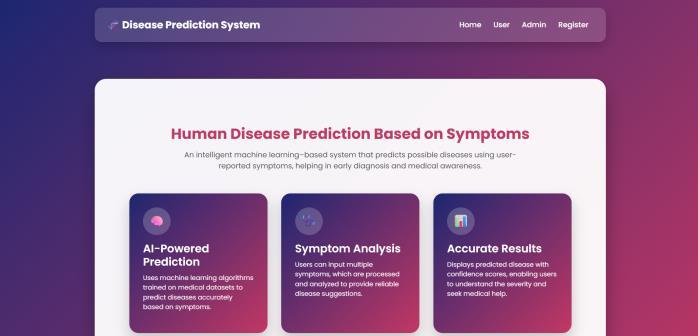
The home page of the developed system provides a clear overviewofthediseasepredictionplatform,highlightingthe main features such as AI-powered prediction, symptom analysis, and accurate result generation. The interface is designedtobeuser-friendlyandaccessible,enablingusers tounderstandthesystemfunctionalityeasily.
Fig.2illustratesthemaininterfaceofthedevelopeddisease prediction system. The page highlights the system’s capability to analyze symptoms using machine learning algorithmsandgenerateaccuratediseasepredictions.
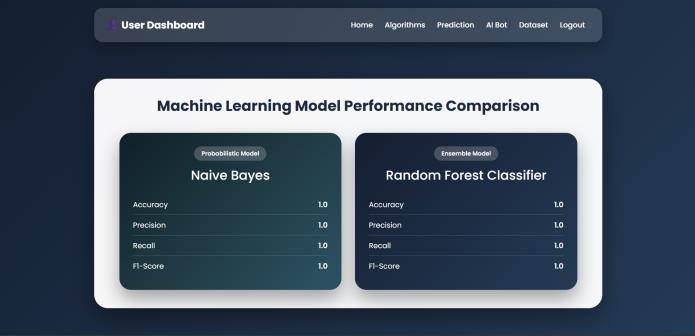
The machine learning performance comparison module displays the evaluation metrics for the implemented algorithms. The comparison includes accuracy, precision, recall, and F1-score values obtained during the model evaluationprocess.Thesemetricsprovideinsightsintohow wellthealgorithmsclassifydiseasesbasedonsymptomdata.
Fig. 3 presents the performance comparison between the Naive Bayes and Random Forest Classifier models. The resultsindicatethatbothalgorithmsachievedhighaccuracy scores,demonstratingthereliabilityoftheproposedsystem inpredictingdiseasesbasedonsymptoms.
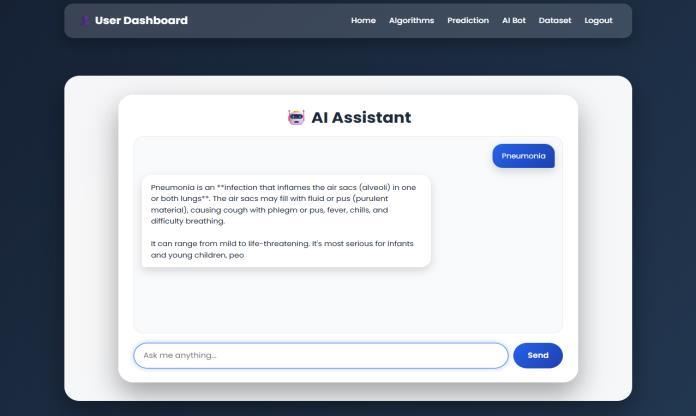
additional medical informationandguidance. Thechatbot uses generative AI technology to respond to user queries related to symptoms, diseases, and general healthcare information.Thisfeatureenhancestheoverall usabilityof the system by providing quick medical insights and improvinguserinteraction.
Fig. 4 shows the AI chatbot interface where users can ask health-relatedquestionsandreceiveintelligentresponses. This component complements the machine learning prediction system by offering additional explanations and recommendations.
Overall, the experimental results demonstrate that the proposed system effectively predicts diseases based on symptoms while also providing preventive recommendations and interactive medical assistance. The integrationofmachinelearningalgorithmswithanAI-based chatbot improves the system’s capability to support early diseaseidentificationandhealthcareawareness.
Inadditiontodiseaseprediction,thesystemintegratesan AI-powered chatbot assistant that helps users obtain
In this research work, a Smart Symptom-Driven Disease DiagnosisandPreventionRecommendationSystemhasbeen developedusingmachinelearningtechniquestoassistusers in identifying possible diseases based on their symptoms. The proposed system utilizes medical datasets containing symptom–disease relationships and applies classification algorithms such as Naive Bayes and Random Forest to predict diseases accurately. By analyzing user-provided symptoms, the system is capable of generating reliable diseasepredictionsthatcanhelpusersunderstandpotential healthconditionsatanearlystage.Theexperimentalresults demonstratethattheimplementedmachinelearningmodels achieve high performance in terms of accuracy, precision, recall, and F1-score, indicating the effectiveness of the systeminpredictingdiseasesbasedonsymptomdata.The comparison of machine learning models further confirms thatensemblemethodssuchasRandomForestcanprovide robust prediction results when trained on structured medicaldatasets.
International Research Journal of Engineering and Technology (IRJET) e-ISSN: 2395-0056
Volume: 13 Issue: 03 | Mar 2026 www.irjet.net p-ISSN: 2395-0072
Inadditiontodiseaseprediction,thesystemalsoprovides preventiverecommendationsassociatedwiththepredicted diseases.Thisfeatureenhancesthepracticalusefulnessof thesystembyhelpinguserstakenecessaryprecautionsand improve their health awareness. Furthermore, the integrationofanAI-poweredchatbotassistantallowsusers toobtainadditionalmedicalguidanceandinteractwiththe system in a more intuitive manner. Overall, the proposed system demonstrates the potential of combining machine learningalgorithms,web-basedinterfaces,andAIassistance tocreateintelligenthealthcaresupporttools.Thesystemcan serve as a preliminary diagnostic support platform that promotesearlydiseaseawarenessandencouragesusersto seekprofessionalmedicalconsultationwhennecessary.
Althoughtheproposedsystemsuccessfullypredictsdiseases based on symptoms and provides preventive recommendations,severalimprovementscanbemadeinthe future to enhance its functionality and accuracy. One possibleenhancementistheintegrationoflargerandmore diversemedicaldatasets.Incorporatingadditionaldatasets containing a wider variety of symptoms and diseases can helpimprovetheperformanceandreliabilityofthemachine learningmodels.Anotherimportantimprovementwouldbe the use of advanced deep learning techniques for disease prediction. Algorithms such as neural networks and deep learning models can analyze more complex relationships between symptoms and diseases, potentially increasing prediction accuracy. Additionally, incorporating real-time health data from wearable devices and health monitoring systems could further improve the system’s predictive capabilities.
Thesystemcanalsobeextendedbyintegratingahospitalor doctor recommendation module that suggests nearby healthcare facilities based on the predicted disease. This featurewouldhelpusersquicklyfindappropriatemedical assistancewhenrequired.Furthermore,amobileapplication version of the system can be developed to increase accessibilityandallowuserstoperformsymptomanalysis directly from their smartphones.Future versions of the system may also include multilingual support and personalized healthcare recommendations based on user history and medical records. By integrating these enhancements,theproposedsystemcanevolveintoamore comprehensiveintelligenthealthcareassistantthatsupports earlydiseasedetection,prevention,andimprovedhealthcare accessibility.
[1]D.DuaandC.Graff,“UCIMachineLearningRepository,” University of California, Irvine, School of Information and ComputerSciences,2019.Available: https://archive.ics.uci.edu
[2]I.Kononenko,“Machinelearningformedicaldiagnosis: history, state of the art and perspective,” Artificial IntelligenceinMedicine,vol.23,no.1,pp.89–109,2001.
[3]T.Mitchell,MachineLearning.NewYork,USA:McGrawHillEducation,1997.
[4] S. Kotsiantis, I. Zaharakis, and P. Pintelas, “Machine learning: A review of classification and combining techniques,”ArtificialIntelligenceReview,vol.26,no.3,pp. 159–190,2006.
[5] P. Domingos and M. Pazzani, “On the optimality of the simple Bayesian classifier under zero-one loss,” Machine Learning,vol.29,pp.103–130,1997.
[6]L.Breiman,“Randomforests,”MachineLearning,vol.45, no.1,pp.5–32,2001.
[7]S.Ramesh,C.Yaashuwanth,andR.Rajesh,“Predictionof diseasesusingmachinelearningalgorithms,”International Journal of Computer Applications, vol. 181, no. 6, pp. 1–5, 2018.
[8]A.Rajkomar,J.Dean,andI.Kohane,“Machinelearningin medicine,”TheNewEnglandJournalofMedicine,vol.380, pp.1347–1358,2019.
[9]S.Deo,“Machinelearninginmedicine,”Circulation,vol. 132,no.20,pp.1920–1930,2015.
[10]J.Han,M.Kamber,andJ.Pei,DataMining:Conceptsand Techniques,3rded.SanFrancisco,USA:MorganKaufmann, 2012.
[11] F. Pedregosa et al., “Scikit-learn: Machine learning in Python,”JournalofMachineLearningResearch,vol.12,pp. 2825–2830,2011.
[12] W. W. Cohen, “Fast effective rule induction,” in Proceedings of the 12th International Conference on MachineLearning,1995,pp.115–123.
[13] J. Brownlee, Machine Learning Mastery with Python. Melbourne,Australia:MachineLearningMastery,2016.
[14]S.RussellandP.Norvig,ArtificialIntelligence:AModern Approach, 3rd ed. Upper Saddle River, NJ, USA: Pearson Education,2010.
[15] K. H. Zou, A. J. O’Malley, and L. Mauri, “Receiveroperating characteristic analysis for evaluating diagnostic testsandpredictivemodels,”Circulation,vol.115,pp.654–657,2007.