
International Research Journal of Engineering and Technology (IRJET) e-ISSN: 2395-0056
Volume: 13 Issue: 02 | Feb 2026 www.irjet.net p-ISSN: 2395-0072
International Research Journal of Engineering and Technology (IRJET) e-ISSN: 2395-0056
Volume: 13 Issue: 02 | Feb 2026 www.irjet.net p-ISSN: 2395-0072
Mrs.Y.Uma1 , Jaidi Rishwika2 , Kanugula Maneesh Kumar3 , Gopagoni Shanmukha4 , Adapa Aravind5
1Assistant Professor, Department of IT, TKR College of Engineering and Technology, Telangana, India 2,3,4,5B.Tech Students, Department of IT, TKR College of Engineering and Technology, Telangana, India ***
Abstract - Helmet non-compliance among two-wheeler riders remains a major cause ofsevereinjuriesandfatalitiesin roadaccidents. Manual monitoringandchallangenerationby traffic authorities is time-consuming, inconsistent, and prone to humanerror, especiallyinhigh-trafficareas.Toaddressthis issue, this paper presents an AI-Based Helmet Violation Detection and E-Challan Generation System using deep learningandcomputervisiontechniques.Theproposedsystem allows users to upload an image of a two-wheeler rider through a web interface. A YOLO-basedobjectdetectionmodel is used to verify the presence of a rider and detect helmet usage. If a helmet violation is identified, the system automatically detects the vehicle number plate using a dedicated YOLO model and extracts the registration number through OCR using EasyOCR. Based on the extracted details, the system generates an electronic challan with a fixed fine amount of ₹235. All challan records, evidence images, timestamps, and generated PDFs are stored in a database for future reference. The system provides a user-friendlyinterface for result visualization, challandownload, andchallanhistory tracking. The proposed solution improves enforcement efficiency, reduces manual workload, and supports scalable integration into smart traffic surveillance systems.
Key words : Helmet Detection, E-Challan Generation, YOLO, Number Plate Recognition, EasyOCR, Computer Vision, Deep Learning, Django, Traffic Rule Enforcement.
Two-wheeler vehicles are one of the most widely used modes of transportation due to their affordability and convenience. However, the rise in two-wheeler usage has also led to an increase in road accidents, many of which result in severe head injuries and fatalities. Wearing a helmet is one of the most effective safety measures for reducing the impact of accidents. Despite strict traffic regulations, helmet non-compliance is still commonly observed, especially in densely populated urban areas. Manual monitoring by traffic police is often limited by manpower, traffic volume, and environmental conditions, whichreducestheefficiencyofenforcement.
With the advancement of Artificial Intelligence (AI) and Computer Vision, automated systems have become more effectivefortrafficsurveillanceandsafetyruleenforcement.
Deep learning-based object detection algorithms such as YOLO(YouOnlyLookOnce)providereal-timedetectionwith highaccuracyandcanbedeployedinpracticalapplications such as helmet detection and number plate recognition. Integrating such technologies into a digital enforcement systemcansignificantlyreducemanualeffortandimprove transparencyinchallangeneration.
This project proposes an AI-Based Helmet Violation DetectionandE-ChallanGenerationSystemthatautomates the process of detecting helmet violations and generating electronicchallans.Thesystemacceptsanuploadedimageof atwo-wheelerrider,detectswhethertherideriswearinga helmet,andifnot,identifiesthevehicle’snumberplateand extractstheregistrationnumberusingOCR.Achallanisthen generated with a predefined fine amount and stored in a database along with evidence and timestamp. The system alsoprovidesdownloadablePDFchallansandchallanhistory formonitoringandrecordmaintenance.
Helmetusageplaysavitalroleinreducingheadinjuries,yet many riders ignore safety regulations. The motivation behind this work is to create an automated and reliable enforcementsystemthatencourageshelmetcomplianceand enhancesroadsafety.
Existingtrafficenforcementmethodsrelyheavilyonmanual monitoring,whichisinefficientandpronetoerrors.Thereis a need for an automated system that can detect helmet violationsandgeneratechallansaccuratelywithsupporting evidence.
Themainobjectivesoftheproposedsystemaretodetectthe presence of a rider, verify helmet usage, recognize the vehiclenumberplate,generateane-challanwithfinedetails, and store all challan records in a database for future reference.
International Research Journal of Engineering and Technology (IRJET) e-ISSN: 2395-0056
Volume: 13 Issue: 02 | Feb 2026 www.irjet.net p-ISSN: 2395-0072
Thescopeofthisprojectincludeshelmetdetection,number plate detection, OCR-based vehicle number extraction, automaticchallangeneration,PDFgeneration,andchallan history tracking through a Django-based web application. The system can be further extended for real-time CCTVbased monitoring and integration into smart city traffic managementsystems.
The proposed system is an AI-Based Helmet Violation Detection and E-Challan Generation System designed to automate the process of detecting helmet violations and generating electronic challans with evidence. The system takes a two-wheeler rider image as input through a web interface, verifies helmet compliance using deep learning, and automatically generates a challan when a violation is detected.Thecompleteworkflowintegratesobjectdetection, OCR, database storage, and PDF generation in a single platform.
The system begins by allowing the user to upload a twowheeler rider image through a Django-based web application. After upload, the image is processed using a YOLO-baseddeeplearningmodeltodetectthepresenceofa riderandidentifyhelmetusage.Thesystemisdesignedwith properdecisionlogictoavoidfalsechallans.Ifnopersonis detected, the system directly returns the result as “No Person Detected”. If a rider is detected and a helmet is present, the result is shown as “No Violation”. If a rider is detectedwithoutahelmet,thesystemproceedstonumber platedetectionandchallangeneration.
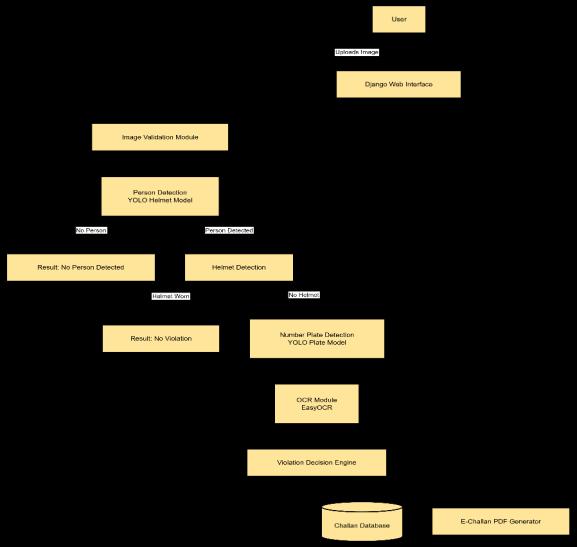
Fig- 1: System Architecture of AI-Based Helmet Violation Detection and E-Challan Generation System
HelmetdetectionisperformedusingatrainedYOLOobject detectionmodel(Helmate_detector.pt).Themodelanalyses theuploadedimageandidentifiestwokeyclasses:person and helmet. The system ensures helmet verification is performedonlyafterconfirmingthatariderispresentinthe image.Ifa riderisdetected andthehelmetismissing,the systemclassifiesitasavalidhelmetviolation.Thismoduleis the core component of the proposed system and plays a crucial role in improving road safety through automated compliancechecking.
Whenahelmetviolationisdetected,thesystemactivatesthe number plate detection pipeline. A second YOLO model (license_plate_detector.pt)isusedtolocatethenumberplate regionfromthesameimage.Oncethenumberplateareais detected, it is cropped and passed to the OCR engine (EasyOCR)forextractingthevehicleregistrationnumber.If theextractedtextisemptyorunclear,thesystemreturnsthe vehiclenumberas“NumberPlateNotClear”,ensuringthat incorrectchallansarenotgeneratedduetoOCRerrors.
After extracting the vehicle number, the system automatically generates an electronic challan with a predefinedfineamountof ₹235.Aprofessionallyformatted PDF challan is generated using the ReportLab library, containingchallandetailssuchaschallanID,vehiclenumber, violationtype,fineamount,timestamp,andevidenceimage. All challan records, including uploaded images, processed images, PDF files, and violation status, are stored in a centralized database. The system also provides a challan historypagewhereuserscanviewallpreviouschallansand downloadPDFreceipts.
The implementation of the proposed AI-Based Helmet Violation Detection and E-Challan Generation System is carriedoutusingamodularapproach.Thesystemintegrates deeplearningmodelsforobjectdetection,OCRfornumber plate recognition, and Django for web deployment. The complete workflow includes image acquisition, helmet violation detection, number plate recognition, challan generation,anddatabasestorage.
ThesystemisimplementedasaDjangowebapplication thatprovidesauserinterfaceforuploadingimages.Whenan imageisuploaded,Djangostoresitinthemediadirectory andthefilepathispassedtotheprocessingmodule.OpenCV isusedtoreadtheimageandverifyitsvalidity.Iftheimage
International
Volume: 13 Issue: 02 | Feb 2026 www.irjet.net p-ISSN: 2395-0072
cannot be read, the system returns the status as “Invalid Image”.Theuploadedimageistreatedastheinputevidence andissavedforfuturereferenceinthechallandatabase.
After successful upload, the system performs detection using the YOLO-based helmet detection model (Helmate_detector.pt). The model is executed using the UltralyticsYOLOframework.Thedetectionprocessfocuses on identifying two major classes: person and helmet. The system first checks whether a person is detected in the image.Ifnopersonisfound,theoutputisdirectlylabeledas “No Person Detected”. If a person is detected, the system verifieshelmetpresence.Ifthehelmetisdetected,thestatus ismarkedas“NoViolation”.Ifahelmetisnotdetected,the systemidentifiesitasahelmetviolationandproceedstothe nextstage.
Forhelmet violationcases,thesystemappliesa second YOLOmodel(license_plate_detector.pt)todetectthenumber plate.Oncethenumberplateboundingregionisobtained, OpenCVisusedtocropthedetectedplatearea.Thecropped plate image is then passed to the EasyOCR engine for extracting the alphanumeric registration number. The extractedtextisnormalizedbyremovingextraspacesand convertingitintouppercaseformat.IfOCRfailsduetoblur, lowresolution,orocclusion,thesystemassignsthevehicle number as “Number Plate Not Clear” to avoid incorrect challangeneration.
Afterconfirmingavalidhelmetviolationandextracting thevehiclenumber,thesystemgeneratesane-challanwitha fixedfineamountof₹235.APDFchallanisgeneratedusing theReportLablibrary.ThePDFincludeschallandetailssuch aschallanID,vehiclenumber,violationtype,fineamount, timestamp (localized to IST), and the uploaded image as evidence.Allchallanrecordsarestoredinadatabaseusing Django ORM, including the uploaded image, processed image,extractedvehiclenumber,challanstatus,fineamount, andgeneratedPDFpath.Thesystemalsoprovidesachallan history page where all stored challans can be viewed and downloadedforrecordmaintenance.
TheproposedAI-BasedHelmetViolationDetectionandEChallan Generation System was evaluated using multiple two-wheelerriderimagestovalidatetheaccuracyofhelmet detection,numberplateextraction,challangeneration,and database storage. The system was tested under different scenariossuchasriderwith helmet,riderwithouthelmet, andimageswithoutanyrider.Theobtainedresultsconfirm
thatthesystemeffectivelyautomatestheprocessofhelmet violation identification and e-challan generation with evidence.
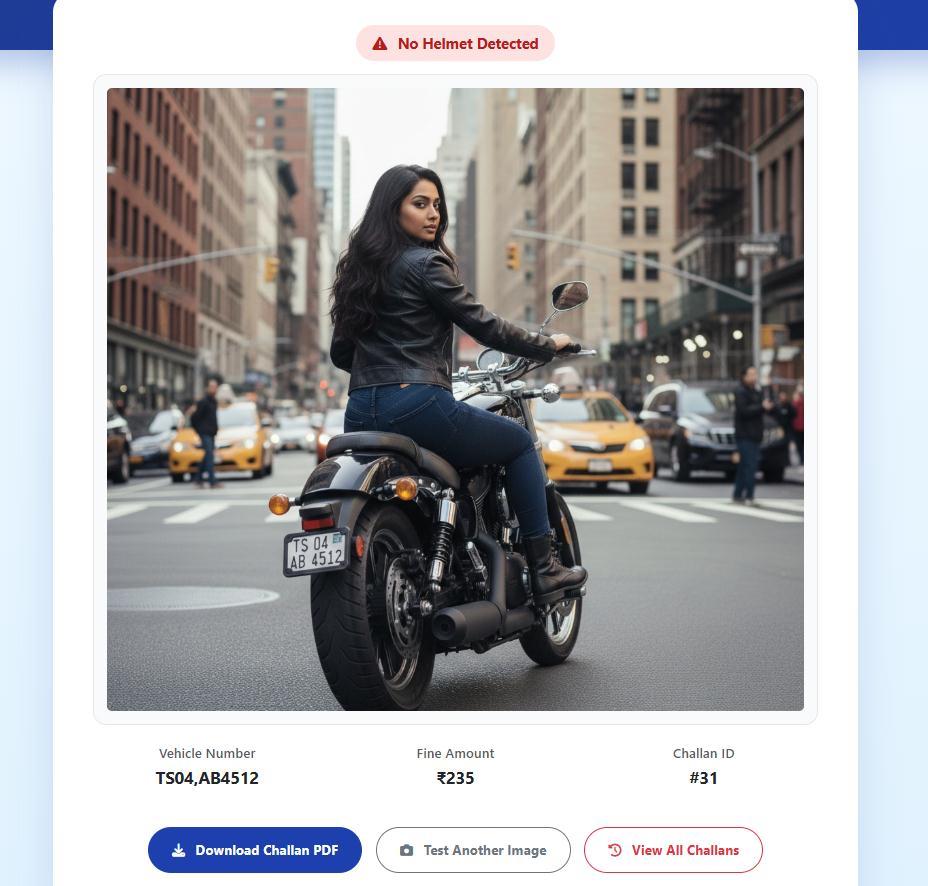
The system successfully detects whether a rider is wearingahelmetbyusingaYOLO-basedhelmetdetection model.Whenariderisdetectedwithoutahelmet,thesystem classifiesthecaseasavalidviolationanddisplaysthestatus as“NoHelmetDetected”.Alongwiththeviolationstatus,the systemalsodisplaysthedetectedvehiclenumber,challanID, and fine amount. The result page provides a clear visualizationoftheuploadedevidenceimageandincludes options for downloading the generated challan PDF. The output result interface for helmet violation detection is showninFig.2.
Afterconfirmingahelmetviolation,thesystemgeneratesan electronic challan with a fixed fine amount of 235. The challanisautomaticallyconvertedintoaprofessionalPDF usingtheReportLablibrary.Thegeneratedchallanincludes essentialdetailssuchaschallanID,vehiclenumber,violation type,fineamount,localizedtimestamp,andevidenceimage. The PDF generation ensures transparency and acts as an officialrecordforenforcement.Thesuccessfulgenerationof challandetailsandthedownloadablechallanPDFconfirm thereliabilityofthesystem.
Volume: 13 Issue: 02 | Feb 2026 www.irjet.net p-ISSN: 2395-0072

All challans generated by the system are stored in a centralized database using Django ORM. The system provides a challan history page that displays all previous challans in a structured format. Each record includes the challan ID, extracted vehicle number, fine amount, timestamp, and a download button for the corresponding challanPDF.Thismodulevalidatesthatthedatabasestorage andretrievalprocessesarefunctioningcorrectly.Thechallan historyoutputisshowninFig.3,whichdemonstratesthat thesystemmaintainssystematicdigitalrecordsandsupports futureanalysissuchasrepeatoffenderidentification.
This paper presented an AI-Based Helmet Violation DetectionandE-ChallanGenerationSystemthatautomates the process of identifying helmet violations and issuing electronicchallans.ThesystemintegratesYOLO-baseddeep learningmodelsforriderandhelmetdetection,followedby number plate detection and OCR-based vehicle number extraction using EasyOCR . When a valid violation is detected, the system automatically generates an e-challan withafixedfineamountof₹235,storesthecompleterecord inadatabase,andproducesaprofessionallyformattedPDF challanwithevidenceandlocalizedtimestamp.Experimental results confirm that the system accurately differentiates between no-person cases, compliant riders, and helmet violators while maintaining proper challan history and download functionality. The proposed solution reduces manual enforcement effort, improves accuracy, ensures transparency through evidence storage, and provides a scalable framework that can be extended to real-time surveillanceandsmarttrafficmonitoringapplications.
TheAlthoughtheproposedsystemsuccessfullyautomates helmetviolationdetectionande-challangeneration,several improvements can be incorporated to enhance its performanceandreal-worldapplicability.Inthefuture,the systemcanbeextendedtosupportreal-timeCCTVandvideo streamprocessing;enablingautomaticmonitoringwithout manualimageuploads.Additionaltrafficviolationssuchas triple riding, mobile phone usage while riding, signal jumping,andspeedingcanalsobedetectedbyintegrating moretraineddeeplearningmodels.TheOCRmodulecanbe improved by using advanced recognition techniques and
supportingmultipleregionalnumberplateformatsforbetter accuracy under low-light or blurred conditions. Furthermore,thesystemcanbeintegratedwithSMS/email notificationservicesandonlinepaymentgatewaystonotify vehicleownersandallowdigitalfinepayment.Integration withofficialtransportauthoritydatabasescanalsoenable automaticownerverificationandrepeatoffenderanalysis, makingthesystemsuitableforsmartcitytrafficenforcement applications.
[1]J.Redmon, S.Divvala,R.Girshick,andA.Farhadi,“You Only Look Once: Unified, Real-Time Object Detection,” in Proc.IEEEConf.ComputerVisionandPatternRecognition (CVPR),LasVegas,NV,USA,2016,pp.779–788.
[2] J. Redmon and A. Farhadi, “YOLOv3: An Incremental Improvement,”arXivpreprintarXiv:1804.02767,2018.
[3]G.Jocheretal.,“UltralyticsYOLOv5,”GitHubRepository, 2020.[Online].Available: https://github.com/ultralytics/yolov5(Accessed:Jan.2026).
[4]J.Baek,G.Kim,J.Lee,S.Park,D.Han,S.Yun,S.Lee,andH. Lee, “What Is Wrong With Scene Text Recognition Model Comparisons?DatasetandModelAnalysis,”inProc.IEEEInt. Conf.ComputerVision(ICCV),2019,pp.4715–4723.
[5]DjangoSoftwareFoundation,“DjangoDocumentation,” [Online]. Available: https://docs.djangoproject.com/ (Accessed:Jan.2026).
[6] A. Rosebrock, Practical Python and OpenCV: An Introductory,ExampleDrivenGuidetoImageProcessingand ComputerVision,PyImageSearch,2018.
[7] M. A. Khan and Y. Kim, “Vision-Based Vehicle Number Plate Recognition Using Deep Neural Networks,” IEEE Access,vol.7,pp.77115–77128,2019.
[8] S. M. Kamruzzaman, M. T. Rahman, and M. H. Islam, “AutomaticHelmetDetectionforTrafficSafetyUsingDeep Learning,” International Journal of Advanced Computer ScienceandApplications,vol.11,no.5,pp.123–129,2020.
[9]MinistryofRoadTransportandHighways,Government ofIndia,“RoadSafetyandTrafficRules,”[Online].Available: https://morth.nic.in/(Accessed:Jan.2026).
[10] R. Szeliski, Computer Vision: Algorithms and Applications,2nded.,Springer,2022.