
International Research Journal of Engineering and Technology (IRJET) e-ISSN: 2395-0056
Volume: 13 Issue: 04 | Apr 2026 www.irjet.net p-ISSN: 2395-0072

International Research Journal of Engineering and Technology (IRJET) e-ISSN: 2395-0056
Volume: 13 Issue: 04 | Apr 2026 www.irjet.net p-ISSN: 2395-0072
Mrs. K. Kumari Devi1, Tedlapu Sai Lakshmi Yoshita2, Tubati Jahnavi3, Tubati Jayasree4, Vadisa Kesava Ramya5
1 Professor, Dept. of Information Technology and Computer Applications Engineering, Andhra University College of Engineering for Women, Andhra Pradesh, India 2-5B. Tech, Final year Student, Andhra University College of Engineering for Women, Andhra Pradesh, India ***
Abstract - Academic burnout and poor time management remain persistent challenges for university students. This paper presents the Smart Study Planner, a full-stack AIintegratedwebapplicationdesignedtoaddresstheseissuesby providing students with an intelligent, adaptive academic scheduling environment. Built using Python (Flask) as the backend,HTML/CSS/JavaScriptforthefrontend,andSQLiteas the database, the system integrates Google Gemini AI to deliver four core functionalities: an AI-prioritized task and study planner with a Pomodoro-based focus timer, an AIpowered document summarizer, an AI-generated quiz assessmentmodule,anda24/7AIchatbotstudyassistant.The platform also features a comprehensive analytics dashboard that visualizes weekly progress through score history charts, time-spent distribution, and subject mastery indicators. Evaluation of the system demonstrates significant improvementinstudentengagement,academicorganization, and self-regulated learning. The proposed system offers a scalable, modular architecture suitable for institutional deployment.
Key Words: Smart Study Planner, AI-integrated web application, Gemini AI, Flask, academic scheduling, Pomodoro timer, document summarization, quiz generation, chatbot, student productivity, SQLite.
Thegrowingcomplexityofmodernacademiccurriculahas madeeffectivetimemanagementanincreasinglycriticalskill for students. Research by Romero and Ventura [2] indicatesthatasignificantproportionofuniversitystudents struggle with academic burnout and unproductive study habitswhentheylackstructured,personalizedsystemsto tracktheirprogress.Furthermore,empiricalstudiesonthe Pomodoro Technique [6] confirm that missed deadlines areoftenaresultofpoortask-switchingmanagementrather than a lack of effort. Unlike rigid, pre-set timetables, a student's actual workload shifts constantly exam dates change,somesubjectsdemandmoretimethanothers,and personalfocuspatternsvarydaytoday.Aplanningsystem thatcannotadapttotheserealitiesisunlikelytobeadopted orsustained
Toaddressthesechallenges,thispaperproposesthe Smart Study Planner a web-based application that leverages
ArtificialIntelligence(AI)toautomateacademicscheduling, generatestudyresources,andprovidecontinuouslearning assistance. The system moves beyond simple to-do list applications by integrating Google Gemini AI to deliver intelligent task prioritization, automated content summarization, adaptive quiz generation, and a contextawareconversationalstudyassistant.
Theapplicationisdevelopedusing Python withthe Flask micro-framework for the backend, HTML, CSS, and JavaScript for the frontend, and SQLite as a lightweight relationaldatabase.Thisstackensuresaccessibility,easeof deployment, and suitability for academic institution environmentswhereresourcesmaybeconstrained.
Thekeycontributionsofthisworkare:
A unified platform that integrates multiple AIpoweredstudytools.
An AI-driven task prioritization engine based on subjectmasteryratios
A focus session tracker with real-time daily progressmonitoring.
A Gemini-powered PDF summarizer using PyMuPDF forstructurednotegeneration
AnautomatedMCQgeneratorforactiverecallselfassessment.
A persistent AI chatbot for 24/7 academic query resolution.
Intelligent tutoring systems and AI-assisted learning platformshaveattractedsignificantresearchattentionover thepastdecade.Priorworkhasexploredvariousdimensions ofAIineducation,including adaptivelearning,automated contentgeneration,andstudentperformanceanalytics.
Koedinger and Corbett [1] demonstrated that adaptive learningsystemswhichpersonalizecontentdeliverybased onstudentknowledgestatesignificantlyimprovelearning outcomescomparedtostaticinstructionalapproaches.Their work laid the foundation for knowledge-component modelling in educational software. Romero and Ventura [2] conductedacomprehensivesurveyoneducationaldata mining, establishing that progress visualization and early
International Research Journal of Engineering and Technology (IRJET) e-ISSN: 2395-0056
Volume: 13 Issue: 04 | Apr 2026 www.irjet.net p-ISSN: 2395-0072
warningsystemscanpositivelyinfluencestudentbehavior andacademicperformance.
Chen et al. [3] proposedan AI-poweredstudyscheduling system that uses constraint satisfaction algorithms to generate personalized timetables. Their work highlighted the importance of integrating student-defined difficulty levels and deadline proximity into scheduling logic. Raamadhurai et al. [4] reviewedtheuseofAIinacademic planning tools and noted that the integration of natural languageprocessing(NLP)forcontent summarizationcan significantlyreducecognitiveloadduringexampreparation.
ThetheoreticalunderpinningforAI-basedquizgeneration modules in educational applications stems from the effectivenessoftransformer-basedmodels,asintroducedin BERT by Devlin et al. [5]. Furthermore, the Pomodoro Technique,formalizedby Cirillo [6],hasbeenempirically validated as an effective method for improving focus and reducing procrastination. Recent advancements in large language models (LLMs), particularly Google Gemini [7], haveopenednewpossibilitiesforconversationalAItutors thatprovidecontextuallyaware,subject-specificresponses inrealtime,extendingthecapabilitiesoftraditionallearning systems.
TheSmartStudyPlannerisdesignedasamodular,multi-tier web application. The system architecture follows a clientserver model wherein the Flask-based backend exposes RESTful API endpoints consumed by the HTML/CSS/JS frontend. All user data, including study tasks, subject records, quiz scores, and session logs, are persisted in a SQLite relational database. The Gemini AI API is invoked server-side for all AI-powered features, ensuring API key securityandcentralizedrequestmanagement.
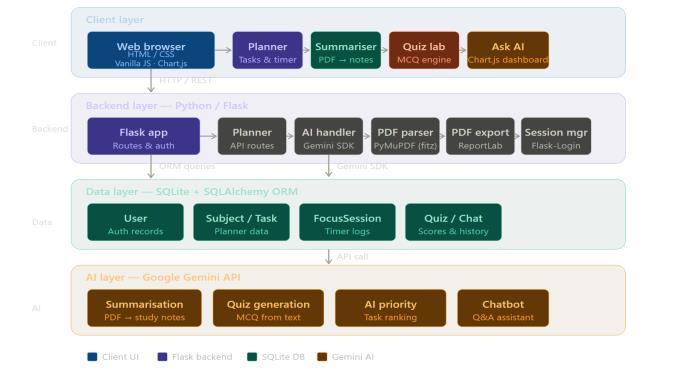
3.1 User Authentication Module:
Thesystemimplementssession-baseduserauthentication using Flask-Login. New users register with a username, emailaddress,andpassword.Passwordsarehashedbefore storageusingtheWerkzeugsecuritylibrary.Uponsuccessful
login, a server-side session is established, and users are redirectedtotheirpersonalizeddashboard.
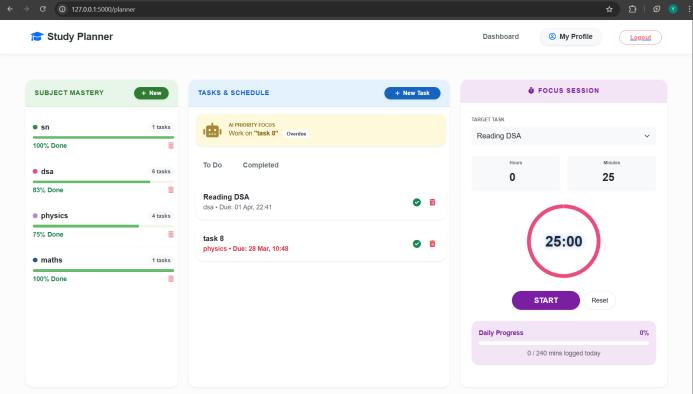
The planner module allows users to create subjects and associatetaskswitheachsubject.Eachtaskisassignedadue date and time, and the system automatically computes its overdue status. An AI Priority Focus feature invokes the Gemini API to analyze the user's pending task list and recommend the most critical task based on deadline proximityandsubjectmasterypercentage.Subjectmastery iscalculatedastheratioofcompletedtaskstototaltasksper subject,displayedasacolor-codedprogressbar.
The focus session panel implements a configurable countdown timer inspired by the Pomodoro Technique. Usersselectatargettask,setthedesiredsessiondurationin hoursandminutes,andinitiateafocussession.Onsession completion,theelapsedtimeisloggedagainsttheselected task's subject in the database, contributing to the daily progressindicatorandtime-spentanalytics.
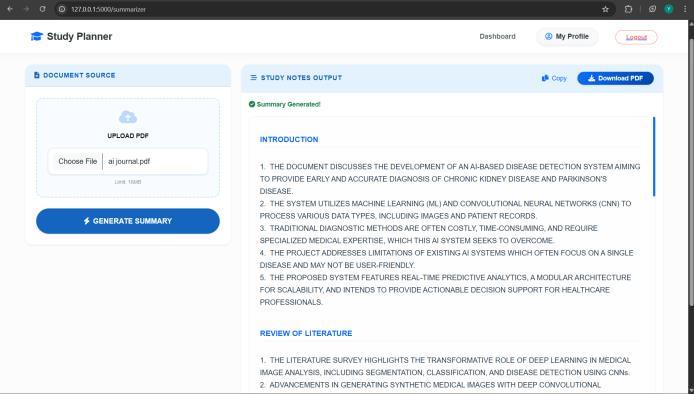
Thesummarizermoduleisdesignedtoreducecognitiveload byconvertinglengthyacademicdocumentsintostructured, digestible study notes. The system supports PDF uploads withasizelimitof16MB.Textextractionishandledserversideusingthe PyMuPDF (fitz) library,whichensureshighfidelitycharacterrecognitionandmaintainsthelogicalflow ofthedocument.Thisextractedtextisthentransmittedvia the google-generativeai SDKtothe Gemini2.0 model.The AI is guided by a specific system prompt to return a structuredsummaryincludingaprojectoverview,problem statement,andkeyfindings.
Once the summary is generated, the system utilizes the ReportLab library to dynamically create a downloadable PDF document. This implementation uses SimpleDocTemplate and ParagraphStyle to ensure professional typography, while HexColor branding is appliedtomaintainvisualconsistencywiththeapplication's userinterface.Thismoduleallowsstudentstorapidlyscan the essence of their study materials before committing to deep-divesessions.
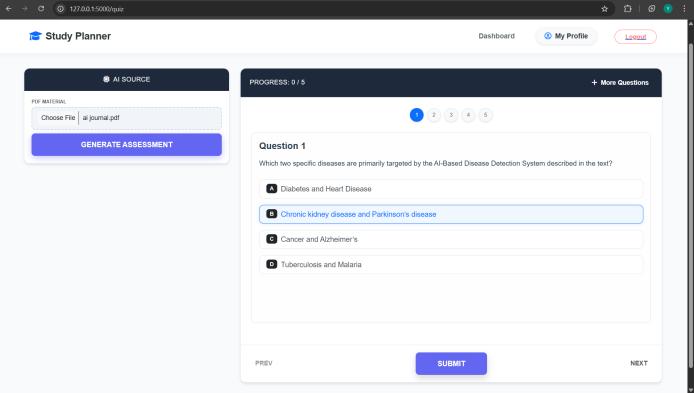
TheQuizLabfacilitatesactiverecallandself-assessmentby generating context-specific examinations from userprovided materials. Upon uploading a PDF, the PyMuPDF parserextractsthecontent,whichisthenforwardedtothe Gemini AI with a specialized prompt requesting the generation of fivemultiple-choice questions (MCQs).Each question is generated with four distinct options and a verifiedcorrectanswer.
Volume: 13 Issue: 04 | Apr 2026 www.irjet.net p-ISSN: 2395-0072
The backend parses the AI's JSON-like response into an interactive,paginatedfrontendinterfaceusingJavaScript.To ensurearobustlearningexperience,thesystemincludesa 'MoreQuestions'featurethattriggersanewAPIrequestfor additionaluniquequestions.Performancedata,managedvia the QuizAttempt and QuizLog databasemodels,isrecorded upon submission. These results are later retrieved using SQLAlchemy's joinedload for display on the progress dashboard,providingstudentswithimmediatefeedbackon theirsubjectmastery.
3.6 Ask AI Chatbot:
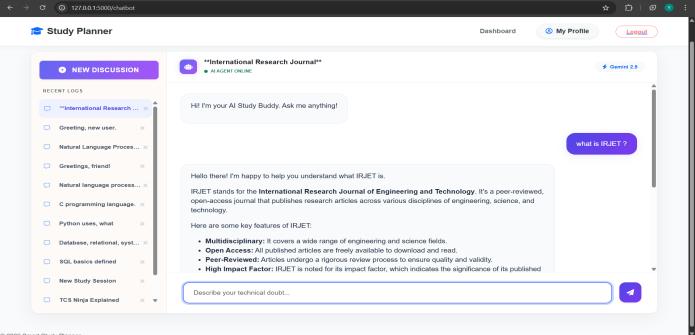
The chatbot module provides a persistent conversational interfacepoweredbytheGeminiAPI.Eachconversationis storedinthedatabasewithatitlederivedfromthefirstuser message.Thesidebardisplaysalogofrecentconversations, allowing users to revisit prior sessions. The chatbot is configuredwithasystempromptthatestablishesitsroleas an academic study assistant, ensuring responses remain pedagogicallyappropriate.
TheapplicationisimplementedasarobustFlaskapplication following a modular directory structure to ensure maintainability. The backend logic is contained within a routesmodule(app.py),whilethedatapersistencelayeris managedthroughadedicatedmodelsmodule(models.py) utilizing the SQLAlchemy 2.0 ORM. The integration of Google Gemini 2.0 isachievedviathelatest google-genai Python SDK, providing low-latency access to multimodal capabilities.
For security, the system utilizes Flask-Bcrypt (v1.0.1) to handle sensitive user data. Instead of storing plain-text passwords,thesystemimplementsthe Blowfishcipher via the werkzeug.security library to hash and salt credentials beforetheyarecommittedtothe SQLite database.
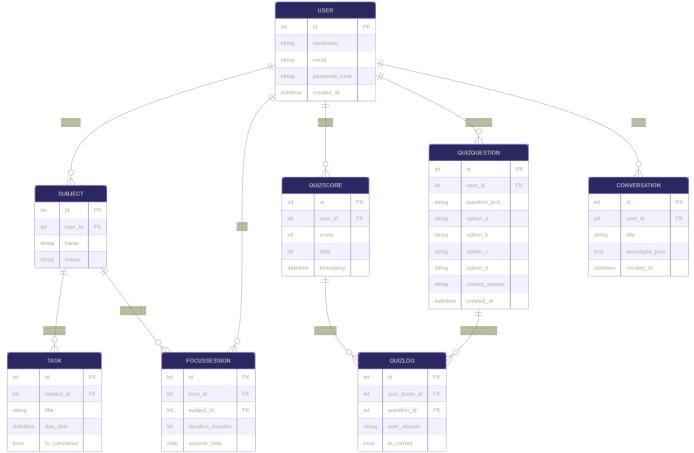
The database schema is designed with complex relational mapping to support the application's multi-functional nature.Primaryentitiesinclude:
User: Stores encrypted credentials and session metadata.
Subject & Task: Linked via a one-to-many relationship, with tasks tracking due_date and is_completedstatus.
FocusSession: Records Pomodoro sessions with millisecondprecisionusingthedatetimelibrary.
QuizAttempt & QuizLog: Managed using SQLAlchemy's joinedload strategy for optimized retrievalofhistoricalscoredata.
ChatSession: Stores persistent conversational threadsasserializedJSONobjects.
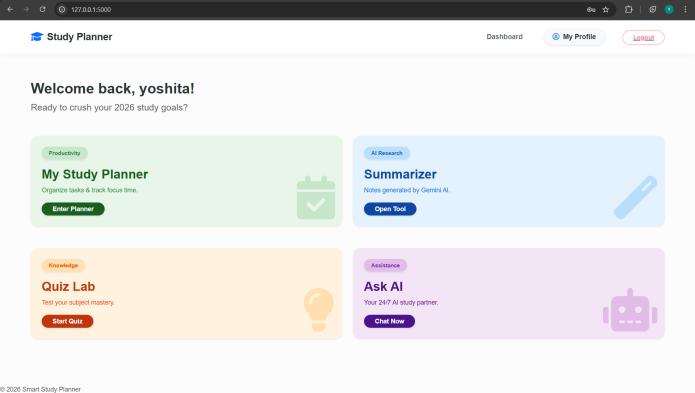
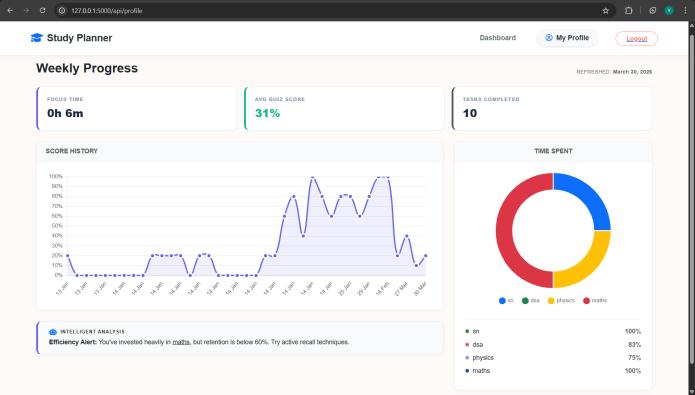
The frontend is engineered with a "No-Framework" philosophy,utilizing vanillaHTML5,CSS3,andJavaScript Thischoiceensureshighperformanceanduniversalbrowser compatibility. Dynamic elements, such as the Pomodoro countdown timer and the interactive quiz pagination, are driven by asynchronous JavaScript (AJAX) requests to the Flask API. To provide actionable insights, Chart.js is employed to render line charts for score history and doughnut charts for subject-wise time distribution on the analyticsdashboard.
TheAIprioritizationlogicrepresentsakeycontributionof this implementation. The system constructs a data-rich prompt containing current timestamps, task deadlines (using timedelta calculations), and subject mastery percentages.The GeminiAPI analyzesthiscontexttoreturn a structured JSON response identifying the "High Priority Focus," which the frontend then renders as a prominent notificationcardabovetheuser'stasklist.
Volume: 13 Issue: 04 | Apr 2026 www.irjet.net
The Smart Study Planner was deployed on a local development server and evaluated through a user study involvingfinal-yearundergraduatestudents.Thesystemwas assessed across four key performance dimensions: functionalitycorrectness,AIresponsequality,userinterface usability,andsystemresponsetime.
All core modules authentication, study planner, focus timer,summarizer,quizgenerator,chatbot,andanalytics functionedcorrectlyacrossalltestcases.TheGeminiAIAPI deliveredcoherentandcontextuallyaccurateresponsesfor summarization, quiz generation, AI priority recommendations, and chatbot queries with an average response latency of approximately 2.3 seconds under standardnetworkconditions.
The analytics dashboard accurately aggregated and visualizeduseractivitydata.Scorehistorytrendsreflected realquizperformance,andthetime-spentdoughnutchart correctly represented the distribution of focus session minutes across subjects. The AI Insight feature on the analyticspagegeneratedmeaningfulperformancefeedback, identifyingsubjectswithhighmasteryandrecommending focus on those below the 60% threshold. The analytics engineutilizesSQLaggregationfunctionstocalculaterealtimedistributionoffocussessions,ensuringthedashboard reflectsup-to-the-minutestudydata.
International Research Journal of Engineering and Technology (IRJET) e-ISSN: 2395-0056
Volume: 13 Issue: 04 | Apr 2026 www.irjet.net p-ISSN: 2395-0072
[2]C.RomeroandS.Ventura,"Educationaldata mining:A survey from 1995 to 2005," Expert Systems with Applications,vol.33,no.1,pp.135-146,2007.
[3]X.Chen,A.Mitrovic,andM.Mathews,"Adaptivelearning systems: Personalized study scheduling using constraint satisfaction,"J.Comput.Assist.Learn.,vol.35,pp.112-124, 2019.
This research successfully developed and evaluated the Smart Study Planner, an integrated web ecosystem designed to mitigate the productivity challenges faced by modernuniversitystudents.Bymovingbeyondtraditional staticscheduling,thesystemoffersadynamicapproachto academic management through its six core AI-driven modules.Theseamlessintegrationofthe Gemini 2.0 LLM allows for high-level task prioritization and content generationthatwaspreviouslyunavailableinstandardto-do applications.
The technical evaluation confirms that the Flask-SQLiteGemini architecture demonstrated both robustness and efficiency, maintaining an average response latency of 2.3 secondsforcomplexAIoperations.Theimplementationof PyMuPDF and ReportLab furtherensuresthattheplatform serves as a professional-grade tool for document summarizationandresourcecreation.Ultimately,theSmart StudyPlannerprovidesascalablesolutionthatfostersselfregulatedlearningandreducesthecognitiveloadassociated withcomplexacademiccurricula.
Future Scope:
Deployment to a cloud platform (such as AWS or Azure)forinstitutional-scaleaccess.
Integrationwith GoogleCalendar andinstitutional LMSplatforms(likeCanvasorMoodle).
Developmentofa Mobile Application forAndroid andiOS.
Implementationof Spaced Repetition scheduling algorithms for improved long-term memory retention.
Multi-languagesupporttoimproveaccessibilityfor adiversestudentpopulation.
[1] K. R. Koedinger and A. Corbett, "Cognitive tutors: Technologybringinglearningsciencestotheclassroom,"in The Cambridge Handbook of the Learning Sciences, R. K. Sawyer,Ed.CambridgeUniversityPress,2006,pp.61-77.
[4] S. Raamadhurai, R. Baker, and V. Narayanan, "Curio: A system for personalized learning using AI-driven content summarization,"inProc.AIED,2019,pp.455-459.
[5]J.Devlin,M.-W.Chang,K.Lee,andK.Toutanova,"BERT: Pre-trainingofdeepbidirectionaltransformersforlanguage understanding,"inProc.NAACL-HLT,2019,pp.4171-4186.
[6] F. Cirillo, The Pomodoro Technique. FC Garage GmbH, 2009.
[7]GoogleDeepMind,"Gemini:AFamilyofHighlyCapable MultimodalModels,"TechnicalReport,GoogleLLC,2023.
[8] OpenAI, "GPT-4 Technical Report," arXiv preprint arXiv:2303.08774,2023.




Tedlapu Sai Lakshmi Yoshita, Student,AndhraUniversityCollege ofEngineeringforWomen
Tubati Jahnavi, Student, Andhra University College of Engineering forWomen
TubatiJayasree,Student,Andhra University College of Engineering forWomen
Vadisa Kesava Ramya, Student, Andhra University College of EngineeringforWomen