Smart Street Light
R. Seshendra Krishna
CSE-IoT
ChandigharUniversity Mohali, Punjab
Dr. Sonal Rattan
Professor(AIT)
ChandigarhUniversity Mohali, Punjab
Abstract This study introduces a novel method for urban lighting systems by leveraging Internet of Things (IoT) technology to create a smarter, energy-efficient, and adaptable street lighting solution. The suggested system uses Light Dependent Resistors (LDRs) and Infrared (IR) sensors to automatically modify the brightness of street lights according to current environmental factors like surrounding lightintensity andthemovementof peopleor cars. A NodeMCU microcontroller acts as the main processing unit, facilitating smooth wireless communication and system management via the Blynk app. The incorporation of sensors and IoT communication guarantees that the street lights turn on only when needed, thus greatly decreasing energy usage and lessening light pollution in urban regions. The solution is createdtobescalableandeconomical,makingitfittingfor contemporary cities looking to improve public safety and lessen environmental effects. The system is built with the Arduino Integrated Development Environment (IDE), and remotecontrol and monitoring aremade possible through the Blynk app, allowing for effortless management and deployment from anywhere. By tackling the simultaneous issues of energy efficiency and sustainability, the suggested intelligent street lighting system aids in the advancement of more intelligent and environmentally friendlyurbaninfrastructure.
Keywords—Smart Street Light, Energy Efficiency, IoT (Internet of Things), Node MCU, Blynk App, LDR (Light Dependent Resistor), IR Sensor, Arduino IDE, Smart City, SustainableUrbanInfrastructure.
I. INTRODUCTION
Conventional street lighting systems function on predetermined schedules and manual management, frequentlyleadingtoconsiderableenergywastebecausethey
2395-0072
Y. Aravind Kumar
CSE-IoT
ChandigarhUniversity Mohali, Punjab
cannot adapt lighting according to real-time circumstances. These systems generally light up streets at maximum brightnesswithoutconsideringtherealnecessity,likeduring times of low traffic or when there is enough natural light, resulting in higher energy usage and costs for local governments. Moreover, traditional street lights are not flexible enough to adjust to environmental shifts and human presence,whichdiminishestheireffectivenessinmaintaining publicsafety.TheSmartStreetLightinitiativeseekstotackle these issues by introducing anadvanced lightingsystemthat automaticallymodifiesstreetlightsaccordingtosurrounding light conditions and the detection of pedestrians or vehicles. By incorporating sensors, wireless communication, and IoT technology, the system can autonomously optimize lighting, minimize energy waste, decrease operational costs, and improvepublicsafety.Thiscreativemethodcorrespondswith the increasing need for sustainable and intelligent urban infrastructure.
HardwareSpecification
Node MCU (ESP32): Microcontroller unit for handling theIoTcommunicationandprocessing.
LDR (Light Dependent Resistor): Sensor to detect ambientlightlevelsandadjustthestreetlightbrightness accordingly.
IR Sensor: Infrared sensor to detect the presence of vehiclesorpedestriansfortriggeringthestreetlights.
LEDStreetLight:LEDlightsourcetobecontrolledbythe system.
Relay Module: Electronic switch that allows the microcontrollertocontrolthehigh-powerstreetlight.
International Research Journal of Engineering and Technology (IRJET) e-ISSN: 2395-0056
Volume: 12 Issue: 03 | Mar 2025 www.irjet.net p-ISSN: 2395-0072
SoftwareSpecification
Arduino IDE: Integrated Development Environment for writinganduploadingthemicrocontrollercode.
Blynk App: Mobile application for remote monitoring andcontrolofthestreetlightsystemviaasmartphone.
ESP8266/ESP32 Board Drivers: Necessary drivers to ensure compatibility between the Node MCU and the ArduinoIDE.
II. LITERATURE REVIEW
Recent developments in intelligent street lighting systems, fueled by the incorporation of Internet of Things (IoT) technologies, have been widely examined in the literature. Smith et al. (2024) utilized Arduino and Wi-Fi modules for sensor-based control, highlighting energy efficiency and economical advantages in street illumination. Johnson & Davis (2024) created machine learning algorithms for predictive maintenance leveraging Raspberry Pi and LoRaWAN, with the goal of lowering maintenance expenses and enhancing system dependability. Patel et al. (2023) examined data analytics related to usage trends in smart cities by leveraging Zigbee and cloud technologies, improving user satisfaction and reducing environmental effects.Totacklesecurityissues,Lee&Kim(2023)suggested encryption protocols and secure boot processes to reduce cybersecurity risks, highlighting the importance of strong security and data privacy in IoT-enabled street lighting systems.
In the realm of sustainability, Gupta & Sharma (2022) combined solar panels with LED technology to enhance energy usage, encouraging the use of renewable energy and increasing system sustainability. Wang et al. (2022) employed IoT sensors and AI techniques for monitoring the environment, aiding in the enhancement of air quality and the reduction of waste in urban areas. Moreover, Chen & Zhang(2021)concentratedonscalability,utilizingtheMQTT protocol and edge computing to create scalable IoT frameworks, tackling system scalability and network performance in expanding urban infrastructures. These studies together emphasize the promise of IoT technologies in improving the energy efficiency, security, sustainability, and scalability of intelligent street lighting systems, which alignswiththelargergoalsofsmartcitydevelopment.
The analyzed literature shows considerable progress in smart street lighting systems by incorporating IoT technologies. Major contributions encompass energy efficiency through sensors, maintenance predictions, usage
pattern data analytics, and improved security measures. Furthermore, sustainability is enhanced by incorporating renewable energy, whereas scalability is attained through sophisticated IoT frameworks. Together, these studies emphasizethecapabilityofintelligentstreetlightingtoboost energy efficiency,lowerexpenses,increasesafety,andaidin theadvancementofsmarturbaninfrastructure.
III. PROBLEM STATEMENT
Thechallengeistodevelop asmartsystemthatdynamically adjusts street lighting based on real-time data, optimizing energy use, reducing operational costs, enhancing public safety,andprovidingremotemanagementcapabilitiesviaan IoT platform.The Smart Street Light initiative targets the ineffectivenessandelevatedexpenseslinkedtoconventional streetlightingsystems.
These traditional systems function on a set timetable, resultinginvarioussignificantdifficulties:
Elevated Operational Expenses: Constantfulllightingleads tohigheroperationalcostsforlocalgovernments.
Energy Waste: Lights stay completely on during times of low traffic or daylight, leading to excess energy use and raisingenvironmentalissues.
Absence of Immediate Flexibility: Conventional street lamps cannot modify their settings according to current conditions, like changes in ambient light or the presence of carsandpeople.
Public Safety Hazards: Thelackofabilitytomodifylighting dynamically may result in inadequate lighting in busy areas and overly bright conditions in less frequented zones, adverselyaffectingpublicsafety.
Light Pollution: Excessive lighting in specific regions leads to light pollution, impacting the environment as well as humanhealth.
Thetaskistocreateanintelligentsystemthatautomatically modifies street lighting according to real-time information, maximizing energy efficiency, lowering operating expenses, improving public safety, and enabling remote management throughanIoTplatform.
IV. EXISTING SYSTEM
Conventional street lighting systems mainly function on set schedules,usingmanualcontrolsorsimpletimerstoactivate and deactivate the lights. This approach leads to multiple majorproblems:
International
Constant Maximum Brightness: Street lights remain at maximum brightness all night long, irrespective of real conditions,resultinginexcessiveenergyuse.
respond to immediate environmental conditions, like fluctuatingambientlight or the presence of pedestrians and vehicles,potentiallyleading toinsufficientlighting incrucial momentsoroverlybrightconditionsinlow-trafficzones.
Ineffective Oversight: Traditionalstreetlightingsystemsdo not possess advanced monitoring features, complicating the identificationofmalfunctionsormaintenanceconcernsuntil theyescalateintomajorproblems.
Restrictions of Manual Control: The lack of remote management capabilities limits the system's efficiency in responding to real-time situations, leading to decreased operationaleffectiveness.
Consequently, current street lighting systems frequently display ineffective energy consumption and higher operational expenses, leading to various economic and environmentalissues.
V.PROPOSED SYSTEM
T
HE SMART STREET LIGHT INITIATIVE SUGGESTS AN ADVANCED STREET LIGHTING SOLUTION AIMED AT MAXIMIZING ENERGY EFFICIENCY AND IMPROVING PUBLIC SAFETY BY MAKING REAL-TIME MODIFICATIONS DEPENDING ON ENVIRONMENTAL FACTORS AND HUMANPRESENCE.CONVERSELY,THESUGGESTEDSYSTEMINTEGRATES CUTTING-EDGETECHNOLOGIESANDAPPROACHESTOOVERCOMETHESE DRAWBACKS:
Sensor Integration: The system will employ Light Dependent Resistors (LDRs) and Infrared (IR) sensors to constantly assess surrounding light conditions and identify thepresenceofpedestriansandvehicles,enablingautomatic modulationoflightbrightness.
Dynamic Lighting Management: By assessing live data from the sensors, the system will adjust the brightness of street lights in real-time, providing ideal lighting conditions whileminimizingenergyconsumption.
Wireless Communication: TheuseofaNodeMCUsupports wireless communication, allowing the lighting system to connectwitharemotemanagementplatform.
Remote Monitoring through Blynk App: Utilizing the Blynk application facilitates remote observation and management, offering adaptability and quick responses in overseeingstreetlightingsystems.
Public Safety Improvement: The system seeks to provide sufficient lighting in busy areas while reducing light pollutioninquieterregions,therebyenhancingpublicsafety.
Sustainable Development: By integrating with smart city projects, the suggested solution advocates for sustainable urban growth, minimizing the ecological effects linked to conventionalstreetlightingsystems.
This groundbreaking method seeks to develop a dynamic and energy-saving street lighting system that improves urbaninfrastructureandpromotessustainability.
VI. METHODOLOGY
THE APPROACH FOR THE SMART STREET LIGHT INITIATIVE ADOPTS A STRUCTURED METHOD TO CREATE, EXECUTE, AND EVALUATE AN ADVANCED STREET LIGHTING SYSTEM CONVENTIONAL SYSTEMS RUN ON RIGID TIMETABLES, RESULTING IN INEFFICIENCIES IN ENERGY CONSUMPTION.CONVERSELY,THISPROJECTUTILIZESAMOREFLEXIBLE ANDADAPTIVEAPPROACH:
i. System Design and Planning:
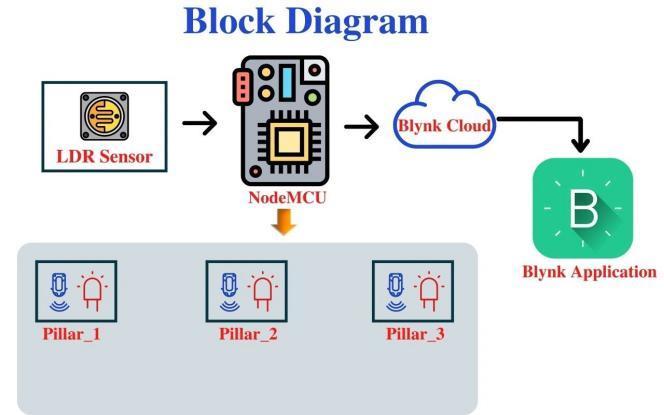
The project team defines technical requirements, choosing suitablehardwarepartsincludingLightDependentResistors (LDRs), Infrared (IR) sensors, a Node MCU for micro controller tasks, and relay modules for controlling street lights.
ii. Hardware Assembly and Integration:
Component Readiness: Collect and confirm the operationofallhardwareelements.
Fig - 01: Block Diagram of Smart Street Light
Insufficient Real-Time Adaptation: Thesesystemsfailto
Circuit Design: Develop a schematic illustration to outline the connections among LDRs, IR sensors, Node MCU,relaymodules,andLEDlights.
Circuit Assembly: Connect components on a breadboardorPCBphysically,followingtheschematic.
iii. Integration of Sensors and Relays:
Connect LDRs to analog input pins for measuring light andattachIR sensors todigital input pinsfordetecting motion.
ConnectrelaymodulestotheNodeMCUforcontrolling theLEDstreetlights,makingsuretoobservethecorrect voltageandcurrentspecifications.
iv. Software Creation:
Developcontrol algorithms utilizingtheArduinoIDEto interpret data from the sensors and regulate light intensity.
Transfer the code to the Node MCU, making sure it functionsproperly.
v.Blynk Application Integration:
Establish a project in the Blynk application for remote supervisionandmanagement.
Integrate the Blynk app with the Node MCU, including essentiallibrariesandsetup.
vi. Testing and Calibration:
Perform preliminary tests to confirm sensor measurementsandlightingmodifications.
Verify the remote control features using the Blynk app toguaranteesmoothfunctionality.
This comprehensive methodology ensures that the Smart StreetLightsystemeffectivelymeetsitsobjectivesofenergy efficiency,adaptability,andenhancedpublicsafety.
VII. RESULTS
The Smart Street Light initiative effectively showcases an adaptable and energy-saving lighting solution that responds in real time to changing environmental factors. The system underwent testing in diverse situations to assess its capabilities related to energy efficiency, reaction to vehicle
and pedestrian activity, and convenience of remote administration via the Blynk app. The findings show a significantdecreaseinenergyusagerelativetoconventional street lighting setups, as the lights function at maximum brightness only when necessary, greatly reducing operating expenses.
Moreover, the system improves public safety by offering sufficient lighting in busy areas while minimizing light pollution in quieter regions. The capabilities for remote monitoring and control were effective, enabling users to modify lighting settings as required. In general, the Smart Street Light system achieves its aims of energy efficiency, flexibility, and sustainability, closely aligning with the objectivesofsmartcityinfrastructure.
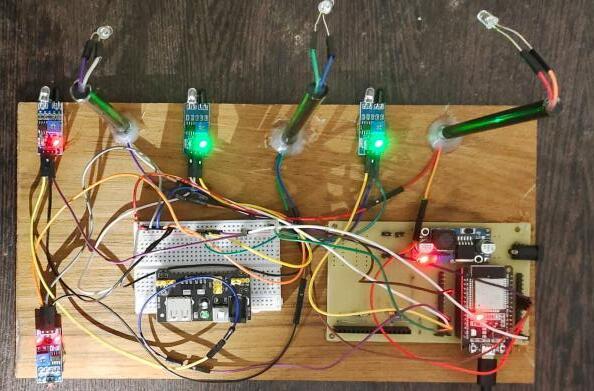
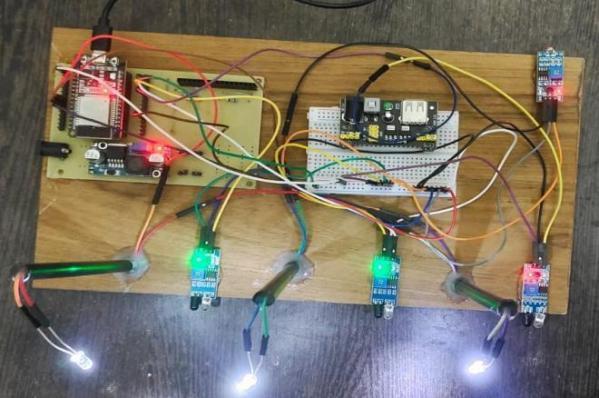
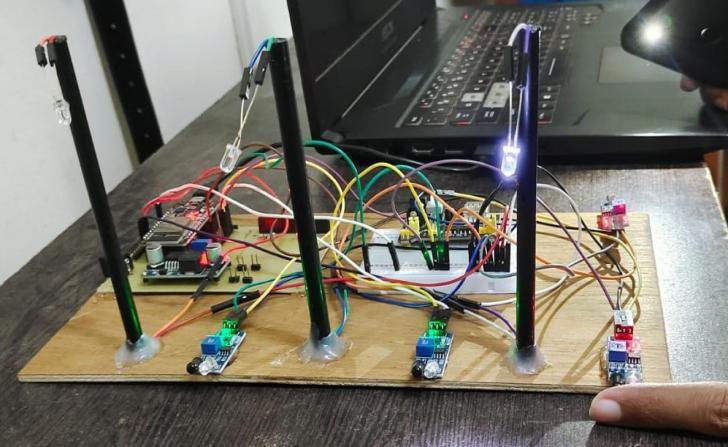
Fig - 02: Experiment Setup
Fig - 03: Circuit Connection
International Research Journal of Engineering and Technology (IRJET) e-ISSN: 2395-0056
Volume: 12 Issue: 03 | Mar 2025
www.irjet.net p-ISSN: 2395-0072
TheSmartStreetLightinitiativeoffersnotableprospectsfor growth and improvement to meet the changing demands of urban settings. Upcoming advancements may involve expanding the system to support more extensive urban regions and incorporating it with current city frameworks, enabling wider application and enhanced resource managementamongmunicipalities.
Moreover, adding sophisticated sensors, like those for monitoringweatherorairquality,canimprovethesystem's flexibilityandeffectiveness.Utilizingdataanalyticsmethods, such as machine learning algorithms, will enable the examination of lighting patterns and enhancement of performance via predictive modifications. Additionally, enhancing interoperability with other smart city systems, includingtrafficmanagementandenvironmentalmonitoring, will establish a more integrated urban infrastructure, supporting sustainability and a better quality of life for city inhabitants.
REFERENCES
[1] Chiradeja, Pathomthat, and Suntiti Yoomak. "Development of public lighting system with smart lighting control systems and internet of thing (IoT) technologies for smartcity."EnergyReports10(2023):3355-3372.
[2] Babu,CV Suresh, etal. "Smart Street Lighting System for Smart Cities Using IoT (LoRa)."Effective AI, Blockchain, and E-Governance Applications for Knowledge Discovery and Management.IGIGlobal,2023.78-96.
[3] Khemakhem,Siwar,andLotfiKrichen."Acomprehensive survey on an IoT-based smart public street lighting system applicationforsmartcities."FranklinOpen(2024):100142
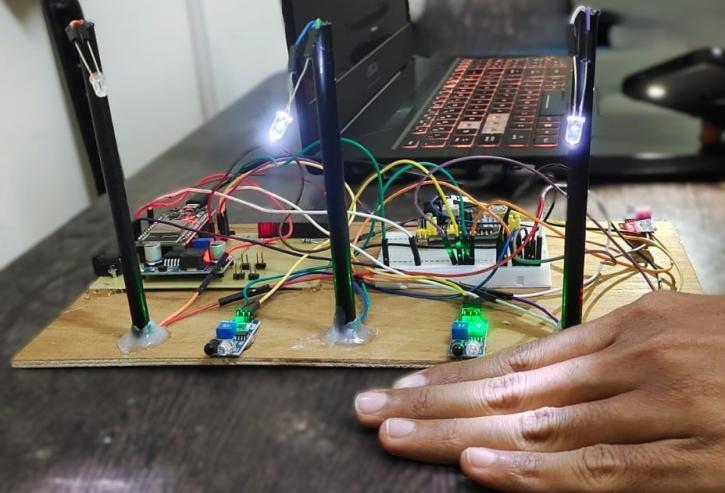
Fig - 4.1: Results
Fig - 4.2: Results
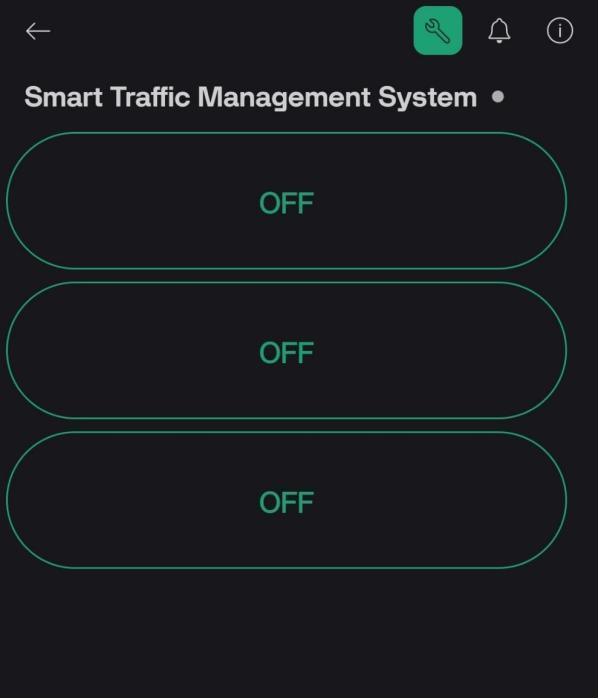
Fig - 05 : Blynk Dashboard
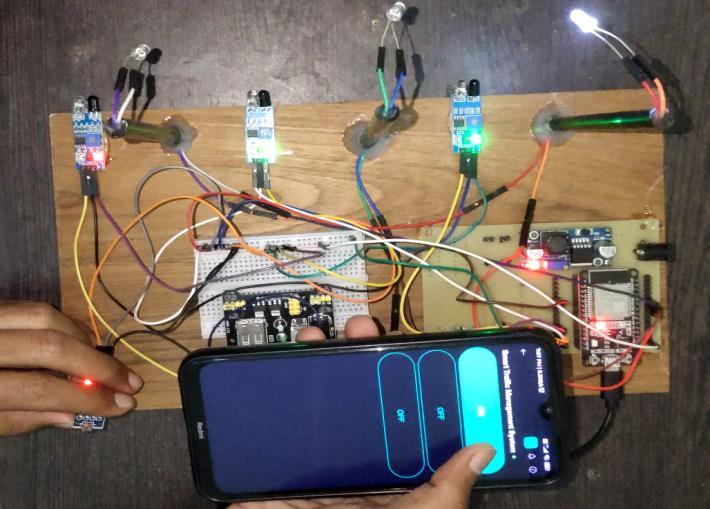
Fig - 06 : Working of Smart Street Light
VIII. FUTURE SCOPE
International Research Journal of Engineering and Technology (IRJET) e-ISSN: 2395-0056 Volume: 12 Issue: 03 | Mar 2025 www.irjet.net p-ISSN: 2395-0072
[4] Masri, Mahrizal, et al. "Smart Energy Public Street Lighting System."IOP Conference Series: Earth and Environmental Science. Vol. 1301. No. 1. IOP Publishing, 2024.
[5] Gowda, V. Dankan, et al. "IoT enabled smart lighting system for smart cities."Journal of Physics: Conference Series.Vol.2089.No.1.IOPPublishing,2021.
[6] Kabir, Md Humayun, et al. "Design and Implement IoTBased Intelligent Manageable Smart Street Lighting Systems forFutureSmartCity."EngineeringProceedings56.1(2023): 147.
[7] Ahmed, Saadaldeen Rashid, et al. "Solar Street Lighting Revolution: A Sustainable Approach Enabled by AIoT and Smart Systems."International Conference on Forthcoming NetworksandSustainabilityintheAIoTEra.Cham:Springer NatureSwitzerland,2024.
[8] Saxena, Arushi, and Abhishek Singh. "Smart Street Light."International Conference On Innovative Computing And Communication. Singapore: Springer Nature Singapore, 2024.
[9] Mohanty, Prajnyajit, et al. "bSlight 2.0: Battery-free Sustainable Smart Street Light Management System."IEEE TransactionsonSustainableComputing(2024)
[10] Srivastava, Atul, Ahana Roy, and Amrita Singh. "Deployment of IoT-Based Smart Street Lighting System."International Conference on Trends in Computational and Cognitive Engineering. Singapore: SpringerNatureSingapore,2023.