
International Research Journal of Engineering and Technology (IRJET) e-ISSN: 2395-0056
Volume: 13 Issue: 03 | Mar 2026 www.irjet.net p-ISSN: 2395-0072

International Research Journal of Engineering and Technology (IRJET) e-ISSN: 2395-0056
Volume: 13 Issue: 03 | Mar 2026 www.irjet.net p-ISSN: 2395-0072
Mrudini Vishe 1 , Diya Rajpurohit2 , Diya Parmar 3 , Gauri Rawool4 , Mr. Dhrupesh Savadia5
1Final Year Student, Department of Computer Engineering, ZAGDUSING CHARITABLE TRUST\'S THAKUR POLYTECHNIC, Kandivali, Maharashtra, India
2Final Year Student, Department of Computer Engineering, ZAGDUSING CHARITABLE TRUST\'S THAKUR POLYTECHNIC, Kandivali, Maharashtra, India
3Final Year Student, Department of Computer Engineering, ZAGDUSING CHARITABLE TRUST\'S THAKUR POLYTECHNIC, Kandivali, Maharashtra, India
4Final Year Student, Department of Computer Engineering, ZAGDUSING CHARITABLE TRUST\'S THAKUR POLYTECHNIC, Kandivali, Maharashtra, India
5Lecturer, Department of Computer Engineering, ZAGDUSING CHARITABLE TRUST\'S THAKUR POLYTECHNIC, Kandivali, Maharashtra, India
Abstract - The AI-powered accessibility application presented is designed to assist visually impaired individuals in understanding and navigating their surroundings more independently.Thesystemcombinesmoderntechnologies such asartificialintelligence,computervision,andvoiceinteraction to create a simple and accessible platform. By integrating multiple assistive features in a single application, the project aimstomakedailyactivitieseasierandsaferforuserswhorely onauditoryguidanceinsteadofvisualinformation.
The application includes a Smart Camera module that detects objectsanddescribesthesurroundingenvironmentinrealtime usingAI-basedimagerecognition.Itprovidesvoicefeedbackso that users can understand what is around them. In addition, a Voice Navigation module allows users to search for destinations andreceivestep-by-stepnavigationthrough voice commands.AnintegratedAIAssistanthelpsusersinteractwith the system, ask questions, and access different features of the applicationeasily.
Overall, the system focuses on improving accessibility and independence for visually impaired individuals by providing intelligent guidance and assistance. By combining AI technologies with a user-friendly interface and voice-based interaction, the application helps users navigate environments more confidently. This project demonstrates how modern technology can be used to create practical solutions that enhancemobility,awareness,andqualityoflifeforpeoplewith visualimpairments.
Key Words: artificial intelligence, accessibility, object detection, voice navigation, assistive technology
Introducing an intelligent solution designed to improve accessibility and independence for visually impaired individuals, our AI-powered application combines modern technologies to create a smart and supportive digital
companion. The system is developed to help users better understand their surroundings, navigate unfamiliar environments, and interact with technology more easily. By integrating artificial intelligence, computer vision, and voice interaction, the application aims to simplify everyday activities and reduce the challenges faced by people with visual impairments. Designed with accessibility and usability in mind, the system focuses on creating a seamless and userfriendly experience. It also incorporates safety-focused features such as an SOS emergency option that can provide quickassistanceincriticalsituations.Bycombiningintelligent technologies with anaccessibleinterface,thisprojectaimsto empower visually impaired users to move more confidently, stayawareoftheirsurroundings,andinteractwiththedigital worldinamoreindependentandsecureway.
The research in this paper explores the growing role of artificial intelligence–based assistive technologies in improving accessibility and independence for visually impaired individuals. Existing studies highlight how advancements in computer vision, speech recognition, and mobiletechnologieshavesignificantlyimprovedtheabilityof assistivesystemsto support people withvisual disabilitiesin their daily lives. Researchers emphasize that tools such as object detection, voice navigation, and intelligent assistants canhelpusersbetterunderstandtheirsurroundings,navigate unfamiliar environments, and access information more efficiently. These technologies aim to reduce dependence on others and promote greater confidence and mobility among visuallyimpairedusers.
Many studies focus on the effectiveness of computer vision systems in recognizing objects, obstacles, and environmental elements in real time. By converting visual information into audio descriptions, these systems allow users to receive immediate feedback about their surroundings. Research has shownthatintegratingvoice-
International Research Journal of Engineering and Technology (IRJET) e-ISSN: 2395-0056
Volume: 13 Issue: 03 | Mar 2026 www.irjet.net p-ISSN: 2395-0072
based interaction into assistive applications enhances usability and accessibility, as visually impaired users can control the system through simple voice commands instead of relying on touch-based interfaces. In addition, the inclusion of AI-driven assistants has been found to improve user interaction with digital systems by enabling natural communication and providing guidance when accessing applicationfeatures.
Furthermore,severalresearchershighlighttheimportanceof user-centered design in the development of assistive technologies. A well-designed interface with clear voice feedback, simple navigation, and minimal visual complexity significantly improves user engagement and satisfaction. Studies also discuss the importance of safety-focused features,suchasemergencyassistancesystems,whichallow users to quickly contact support during critical situations. Thesefeaturesincreasethereliabilityandtrustworthinessof accessibilityapplications,especiallywhenusedinreal-world environments.
Recentresearchalsoemphasizesthepotentialofintegrating multiple assistive functionalities within a single platform. Instead of relying on separate applications for navigation, object recognition, and assistance, modern solutions aim to provide a unified system that simplifies user interaction. By combining technologies such as artificial intelligence, computer vision, and speech processing, these systems can deliver a more seamless and efficient user experience. This integration helps visually impaired individuals perform everydaytaskssuchasidentifyingobjects,navigatingstreets, orinteractingwithdigitalservicesmoreindependently.
Additionally,accessibilityresearchhighlightstheimportance of making assistive technologies widely available through smartphones and web-based platforms. Mobile devices provide a convenient and cost-effective solution for deploying AI-powered accessibility tools, allowing users to access assistance anytime and anywhere. Studies suggest that applications designed for smartphones have higher adoption rates due to their portability, familiarity, and ease ofuse. Asa result,many modernaccessibility systemsfocus on developing mobile-friendly solutions that integrate intelligentfeatureswithoutrequiringspecializedhardware.
Overall, the literature indicates that AI-powered assistive applications have the potential to significantly improve the quality of life for visually impaired individuals. By enabling real-time environmental awareness, voice-based navigation, and intelligent assistance, these technologies promote greaterindependenceandsafety. However, researchersalso suggest that further improvements are needed to enhance accuracy, reliability, and usability in diverse environments. Continuedresearchanddevelopmentinartificialintelligence and accessibility design will play a crucial role in creating more effective assistive systems for visually impaired users inthefuture.
Overview:
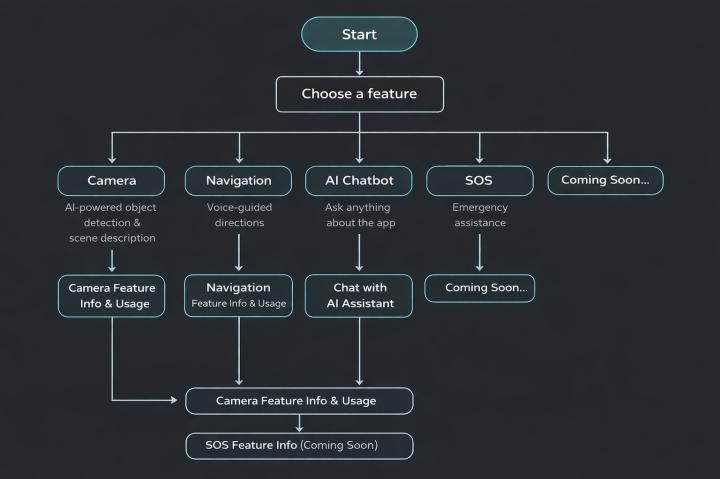
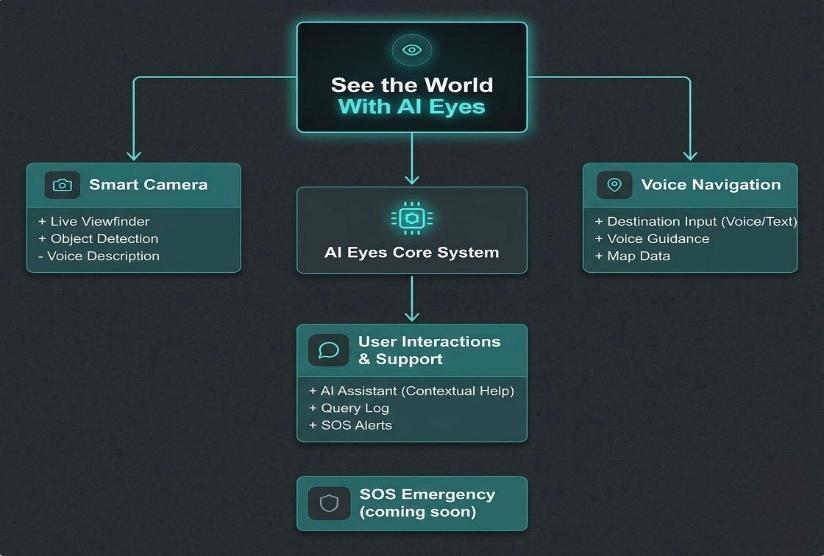
The system design for the AI-powered accessibility application focuses on creating a reliable and user-friendly platform that assists visually impaired individuals in understanding their surroundings and navigating environments more independently. The application is built with multiple integrated modules that work together to provide intelligent assistance through artificial intelligence, computer vision, and voice interaction. These modules include the Smart Camera module for object detection, Voice Navigation for route guidance, an AI Assistant for user interaction,andanSOSemergencyfeatureforsafetysupport. All these components operate within a unified system to provide real-time assistance and improve the accessibility experienceforusers.
At the core of the system is the AI-based image recognition module,whichprocessesvisualinputfromthedevicecamera to detect objects and analyze the surrounding environment. The system uses computer vision techniques to identify objects and convert this information into audio feedback, allowing users to understand what is present around them without relying on visual cues. The Voice Navigation module allows users to search for locations and receive step-by-step directionsusingvoicecommands,makingiteasierforvisually impaired individuals to move safely and confidently in different environments. The integrated AI Assistant further enhancesusabilitybyallowinguserstocommunicatewiththe system naturally and access different features through voice interaction.
Thesystemisdesignedwithaccessibilityandsimplicityaskey priorities, ensuring that users can easily interact with the applicationwithoutcomplexnavigationorvisualdependency. Safetyisalsoanimportantpartofthedesign,whichiswhythe application includes an SOS emergency feature that allows users to quickly request help during critical situations. The interfaceiskeptminimalandintuitivesothatuserscaneasily accessimportantfeatureswhenneeded.
To ensure smooth performance and reliability, the system is developed using a modular architecture, allowing different components to operate independently while still working together within the application. This approach makes the system easier to maintain, update, and expand in the future. Security and data privacy are also considered during development, ensuring that user interactions and location dataarehandledresponsibly.
International Research Journal of Engineering and Technology (IRJET) e-ISSN: 2395-0056
Volume: 13 Issue: 03 | Mar 2026 www.irjet.net p-ISSN: 2395-0072
Overall, the system is designed to provide a practical and scalable assistive solution that improves independence and situational awareness for visually impaired individuals. By combining artificial intelligence, voicebased interaction, and real-time environmental recognition, the application demonstrates how modern technology can be used to build inclusive solutions that enhance accessibility and support individuals with visual impairmentsintheireverydaylives.
The AI-powered accessibility application is designed to assist visually impaired individuals by providing intelligent features that help them understand their surroundings, navigate environments, and interact with technology more easily. The system integrates multiple functionalities that work together to deliver real-time assistanceandimproveaccessibility.
One of the primary functions of the system is object detection through the Smart Camera module. Using computer vision and artificial intelligence, the application analyzes images captured from the device camera and identifies objects present in the surroundings. Once an object is detected, the system converts the information intoaudiofeedback,allowingtheusertounderstandwhat isaroundthemwithout needing visual input. This feature helps users identify obstacles, everyday objects, and environmentalelementsinrealtime.
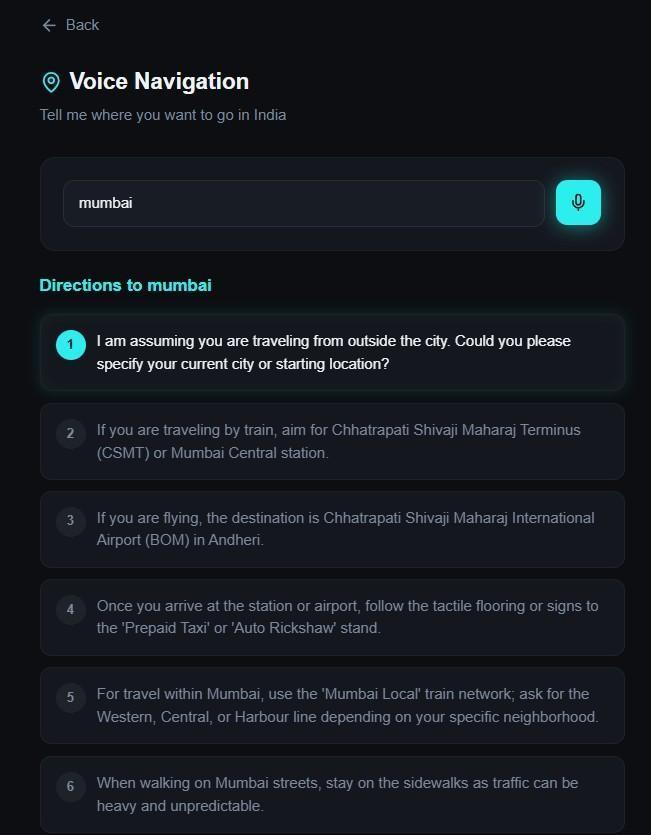
Anotherimportantfunctionalityisvoice-basednavigation. The system allows users to search for destinations and receive step-by-step directions using voice commands. By integrating navigation services with voice interaction, the application provides clear audio instructions that help users travel safely and reach their desired locations more easily. This feature reduces the challenges visually impaired individuals often face when moving through unfamiliarenvironments.
ThesystemalsoincludesanAIAssistantthatenablesusers to interact with the application through natural voice communication. Users can ask questions, request assistance, or access different features of the application using simple voice commands. This functionality makes the system more accessible and eliminates the need for complexvisualinterfaces.
In addition, the application provides an SOS emergency feature designed to improve user safety. In emergency situations, users can activate the SOS function to quickly send alerts or request assistance. This ensures that help can be reached when the user is in a critical situation, increasingconfidenceandsecuritywhileusingthesystem.
Overall, the system combines object recognition, voice navigation, intelligent assistance, and emergency support to create a comprehensive accessibility solution. By integratingthesefunctionalitiesintoasingleplatform,the application helps visually impaired individuals perform daily tasks more independently while improving their awareness,mobility,andsafety.
The database design for the AI-powered accessibility system is structured to efficiently store and manage the datarequiredfortheapplicationtofunctionsmoothly.The systemusesa relational databaseto organize information relatedtousers,detectedobjects,navigationrequests,and emergency contacts. This structured approach ensures that the application can process and retrieve information quicklywhilemaintainingdataaccuracyandreliability.
Volume: 13 Issue: 03 | Mar 2026 www.irjet.net p-ISSN: 2395-0072
Atthecore of the database is theUser table, which stores basicinformationaboutusersoftheapplication.Thistable includesfieldssuchasuser_id,username,email,password, and profile details. The user_id acts as the primary key anduniquelyidentifieseachuserinthesystem.Passwords are stored using encryption techniques to maintain user security and privacy. This table allows the system to manage user authentication, login, and profile managementefficiently.
The system also includes a Detected Objects table, which records information about objects identified through the Smart Camera module. This table contains fields such as object_id, object_name, detection_time, and user_id. The object_idservesastheprimarykey,whiletheuser_idactsas a foreign key that links detected objects to the user who initiatedthedetectionprocess.Thishelpsmaintaina record of detected items and improves system functionality when analyzinguserinteractions.
Another important table is the Navigation History table, whichstoresdetailsofnavigationrequestsmadebyusers.It includes fields such as navigation_id, destination, start_location,date,anduser_id.Thenavigation_idactsasthe primarykey,whiletheuser_idlinksthenavigationrequestto aspecificuser.Thistablehelpstracknavigationactivitiesand supports better analysis of user movement patterns within theapplication.
For safety purposes, the database also contains an Emergency Contacts table. This table stores information about emergency contacts that can be used when the SOS feature is activated. It includes fields such as contact_id, contact_name, phone_number, anduser_id.Thecontact_id is the primary key, and user_id acts as a foreign key linking contactstotherespectiveuser.Thisensuresthatthesystem can quickly access the correct contact details during emergency situations. To maintain efficient performance, indexing techniques are applied to frequently used fields such as user_id, detection_time, and destination. This improves query speed when retrieving or processing data. The database is also designed to be flexible and scalable, allowing new tables or attributes to be added easily if additionalfeaturesareintroducedinthefuture.
In conclusion, the database design for the AI-powered accessibility system provides a structured and reliable foundation for storing and managing application data. By organizing information related to users, object detection, navigation activities, and emergency contacts, the database supports the smooth functioning of the system while ensuringdatasecurity,efficiency,andfuturescalability.
The problem addressed in this project focuses on the difficulties faced by visually impaired individuals when performing everyday tasks such as recognizing objects, navigating unfamiliar environments, and accessing important information independently. Traditional navigation and assistancemethods often relyonhumansupport,guide dogs, or basic tools like walking sticks, which may not always provide sufficient information about the surrounding environment.Asaresult,visuallyimpairedindividualsoften face challenges in understanding obstacles, identifying objects, and moving safely in public or unfamiliar spaces. Althoughsomeassistivetechnologies exist,many ofthemare either expensive, limited in functionality, or require specializedhardwarethatisnoteasilyaccessibletoeveryone. In many cases, available solutions focus only on a single feature, such as navigation or object recognition, without providing a comprehensive system that supports multiple aspects of daily life. Additionally, some systems lack intuitive interfaces and voice-based interaction, making them difficult forvisuallyimpaireduserstooperateeffectively.
Another major challenge is the lack of real-time environmental awareness and emergency support within manyexistingassistivesystems.Withoutimmediatefeedback about surrounding objects or obstacles, visually impaired individuals may face safety risks when moving through crowded or unfamiliar areas. Similarly, the absence of quick emergency communication features can make it difficult for userstoseekhelpduringcriticalsituations.
Furthermore, many existing solutions do not fully utilize the capabilities of modern technologies such as artificial intelligence, computer vision, and voice recognition to provide an integrated accessibility experience. The lack of a unified platform that combines object detection, voice navigation, intelligent assistance, and safety features limits theeffectivenessofassistiveapplicationsdesignedforvisually impairedindividuals.
Therefore, there is a clear need for a smart and accessible system that can provide real-time assistance, improve environmental awareness, and support safe navigation. The proposed AI-powered accessibility application aims to addressthesechallengesbyintegratingobjectdetection,voice navigation, AI-based assistance, and emergency support within a single platform. By leveraging modern AI technologies and designing the system with accessibility in mind,theprojectseekstoenhanceindependence,safety, and qualityoflifeforvisuallyimpairedusers.
International Research Journal of Engineering and Technology (IRJET) e-ISSN: 2395-0056
Volume: 13 Issue: 03 | Mar 2026 www.irjet.net p-ISSN: 2395-0072
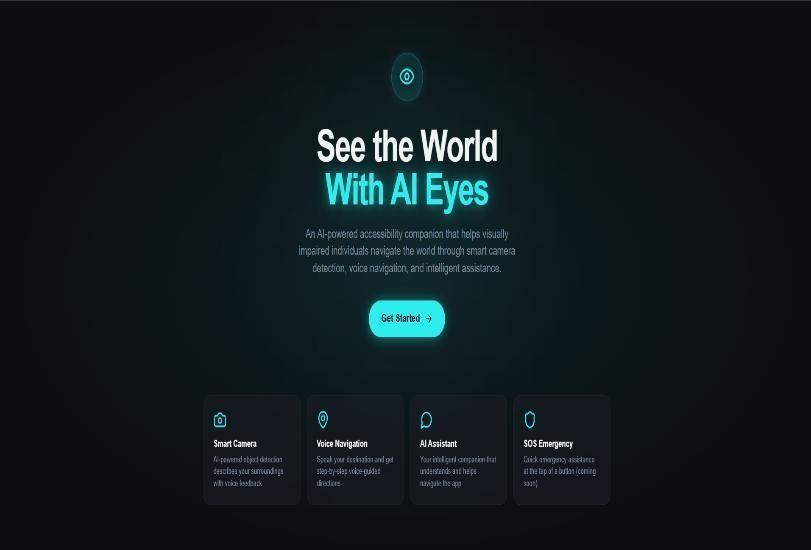
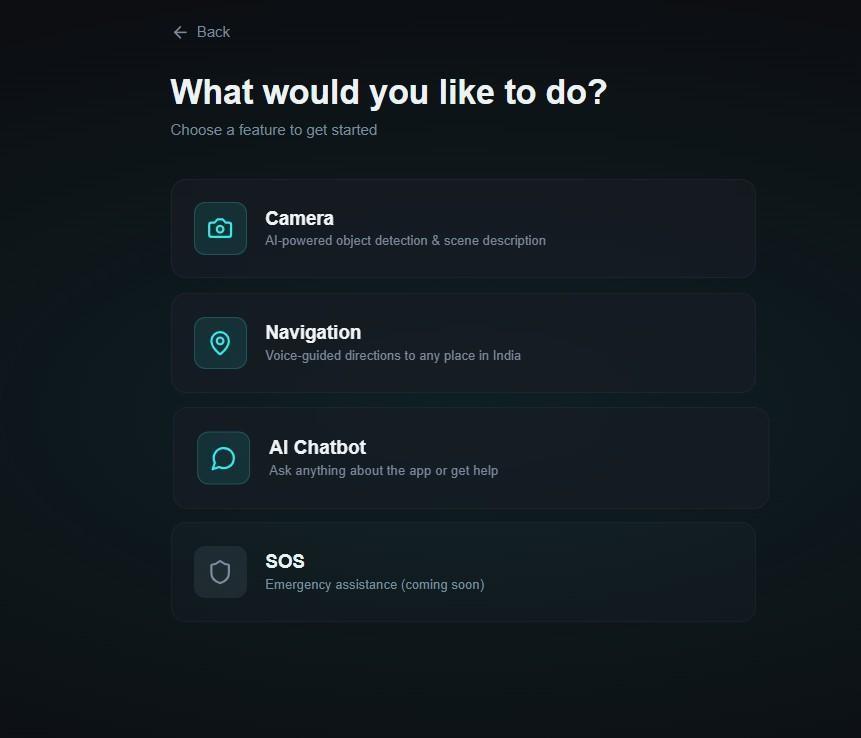
The AI-powered accessibility system offers several advantages for visually impaired individuals by providing intelligent assistance that improves independence, safety, anddailymobility.Oneofthemajorbenefitsofthesystemis its real-time object detection capability through the Smart Cameramodule.Byusingartificialintelligenceandcomputer vision, the system can identify objects and obstacles in the surrounding environment and convert this information into audiofeedback.Thisallowsvisuallyimpaireduserstobetter understand their surroundings without relying on visual input, making everyday activities safer and more manageable. Another significant advantage of the system is the voice-based navigation feature, which enables users to search for destinations and receive step-by-step directions usingsimplevoicecommands.Thisfunctionalityreducesthe difficulty that visually impaired individuals often face when traveling in unfamiliar areas. By providing clear audio instructions, the system helps users move more confidently andreachtheirdesiredlocationswithoutrequiringconstant assistancefromothers.
International Research Journal of Engineering and Technology (IRJET) e-ISSN: 2395-0056
Volume: 13 Issue: 03 | Mar 2026 www.irjet.net p-ISSN: 2395-0072
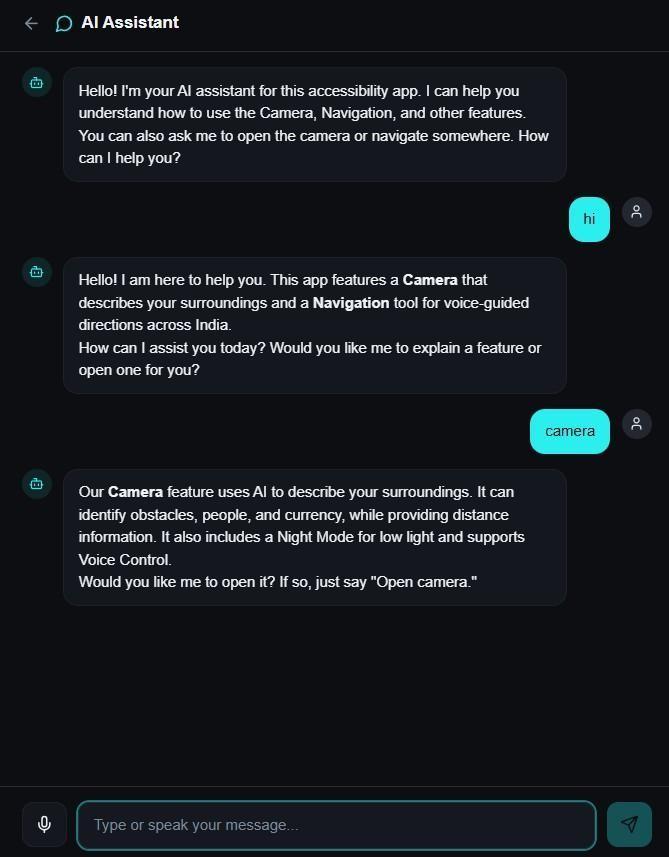
In conclusion, the AI-powered accessibility system provides a practical and innovative solution to support visually impaired individuals in their daily lives. By integrating technologies such as artificial intelligence, computer vision, and voice interaction, the system helps users better understand their surroundings and navigate environments more independently. Features like the Smart Camera for object detection, Voice Navigation for route guidance, AI Assistantfor interaction,andthe SOS emergency featurefor safety work together to create a comprehensive and accessibleplatform.
The system enables users to receive real-time audio feedback about their surroundings, helping them identify objects and obstacles more easily. Voice-based interaction simplifies the way users communicate with the application, allowingthemtoaccessdifferentfeatureswithoutrelyingon visual interfaces. Additionally, the navigation feature assists usersinreachingtheirdestinationssafelybyprovidingclear step-by-step directions. These functionalities significantly reducethechallengesfaced byvisuallyimpairedindividuals whileperformingeverydayactivities.
Overall, the AI-powered accessibility system demonstrates howmoderntechnologiescanbeusedtocreateinclusiveand assistive solutions that improve independence and quality of life. By providing intelligent assistance, environmental awareness,andsafetysupport,thesystemempowersvisually impairedindividualstointeractwiththeirsurroundingsmore confidently. With further development and integration of advanced AI capabilities, this solution has the potential to become an even more effective tool for improving accessibilityinthefuture.
[1] Stuart Russell and Peter Norvig, Artificial Intelligence: A ModernApproach,4thed.,PearsonEducation,2020.
[2] Richard Szeliski, Computer Vision: Algorithms and Applications,Springer,2011.
[3] Ian Goodfellow, Yoshua Bengio, and Aaron Courville, DeepLearning,MITPress,2016.
[4] Gary Bradski and Adrian Kaehler, Learning OpenCV: Computer Vision with the OpenCV Library, O’Reilly Media,2008.
[5] World Health Organization, World Report on Vision, Geneva:WHOPress,2019.
[6] International Telecommunication Union, ICT Accessibility for Persons with Disabilities, ITU Publications,2020.
[7] Thad Starner, “Wearable Computing and Context Awareness for Assistive Technologies,” IEEE Pervasive Computing,vol.1,no.2,pp.24–31,2002.
[8] IEEE, “Computer Vision and Pattern Recognition for Assistive Technology Applications,” IEEE Conference Proceedings,2021.
[9] Association for Computing Machinery, “Assistive Technology and Accessibility Research,” ACM Digital Library,2020.
[10] Cristian Sminchisescu and Trevor Darrell, “Advances in Computer Vision for Assistive Applications,” InternationalJournalofComputerVision,2019.
[11] Google, “Accessibility Features and AI-Based Vision Technologies,”GoogleResearchPublications,2021.
[12] Microsoft,“AIforAccessibility:EmpoweringPeoplewith VisualImpairments,”MicrosoftResearch,2020.