
International Research Journal of Engineering and Technology (IRJET) e-ISSN: 2395-0056
Volume: 13 Issue: 03 | Mar 2026 www.irjet.net p-ISSN: 2395-0072

International Research Journal of Engineering and Technology (IRJET) e-ISSN: 2395-0056
Volume: 13 Issue: 03 | Mar 2026 www.irjet.net p-ISSN: 2395-0072
Prof. S.S. Panchal1 , Mr Pratik Deshmukh2 , Miss. Ayodhya Wankhede3
1Asst. Prof. Department of CSE, Gramin Technical & Management Campus, Vishnupuri, Nanded (MH), India
2UG Student Department of CSE Gramin Technical & Management Campus Vishnupuri, Nanded (MH), India
3UG Student Department of CSE Gramin Technical & Management Campus Vishnupuri, Nanded (MH) India
ABSTRACT - The Smart Solar Micro-Grid Monitoring System is an advanced solution developed to improve the efficiency, reliability, and sustainability of solar power systems. This system uses Internet of Things (IoT) technology to continuously monitor important parameters such as voltage, current, power generation, battery condition, temperature, and dust accumulation on solar panels.
Dust sensors help detect dirt on panels, which can reduce efficiency, while temperature sensors monitor overheating conditions that may damage components. The system collects real-time data and uses machine learning techniques to identify unusual patterns and predict possible faults.
A centralised dashboard displays live data, alerts, and historical records, allowing users to monitor and control the system remotely. This solution is especially useful in rural and remote areas, as it ensures a stable power supply, reduces maintenance costs, and increases system lifespan.
Intoday’sworld,energyplaysaveryimportantroleinourdailylives.Withtheincreasingdemandforelectricityandtherapid depletionofconventionalenergyresourcessuchascoalandpetroleum,thereisastrongneedtoshifttowardsrenewableand sustainable energy sources. Among all renewable energy options, solar energy is one of the most widely used and environmentallyfriendlysources.Itisclean,abundant,andfreelyavailable,makingitanidealsolutionformeetingfuture energyneeds.
Solarpowersystems,especiallysolarmicro-grids,arebecomingincreasinglypopularinruralandremoteareaswhereaccessto traditional electricity grids is limited or unavailable. A solar microgrid is a small-scale power system that generates and distributeselectricitylocallyusingsolarpanels,batteries,andothercomponents.Thesesystemsprovideanefficientandcosteffectivewaytosupplyelectricitytooff-gridlocationssuchasvillages,farms,campuses,andisolatedindustrialareas.
However,despitetheiradvantages,solarmicro-gridsystemsfaceseveralchallenges.Oneofthemajorproblemsisthelackof proper monitoring and maintenance. Factors such as dust accumulation on solar panels, overheating, battery issues, and electricalfaultscansignificantlyreducesystemefficiencyandperformance.Intraditionalsystems,monitoringisoftendone manually,whichistime-consumingandinefficient.Problemsareusuallydetectedonlyaftertheycauseseriousdamage,leading toincreasedmaintenancecosts,reducedsystemlife,andunreliablepowersupply.
Toovercomethesechallenges,theconceptofaSmartSolarMicro-GridMonitoringSystemusingInternetofThings(IoT)has beenintroduced.Thissystemaimstoprovideamodern,automated,andintelligentsolutionformonitoringandmanagingsolar powersystems.Ituses IoT sensors tocontinuouslytrackimportantparameterssuchasvoltage,current,powergeneration, batterystatus,temperature,anddustlevelsonsolarpanels.
Thecollecteddataisprocessedusingamicrocontrollerandtransmittedtoacloud-basedplatformthroughtheinternet.A centralizeddashboarddisplaysreal-timeinformation,graphicalanalysis,andsystemalerts,allowinguserstomonitorthe systemfromanywhere.Thisnotonlyimprovesconveniencebutalsohelpsinmakingquickandinformeddecisions.
Oneofthekeyfeaturesofthissystemisitsabilitytodetectproblemsatanearlystage.Forexample,dustsensorscanidentify dirt accumulation on solar panels, which reduces their efficiency. Similarly, temperature sensors can detect overheating conditionsthatmaydamagesystemcomponents.Byprovidingtimelyalerts,thesystemenablespreventivemaintenance, reducingdowntimeandimprovingoverallperformance.
International Research Journal of Engineering and Technology (IRJET) e-ISSN: 2395-0056
Volume: 13 Issue: 03 | Mar 2026 www.irjet.net p-ISSN: 2395-0072
Inaddition,theintegrationofmachinelearningtechniquesmakesthesystemevenmorepowerful.Byanalysinghistoricaldata andidentifyingpatterns,thesystemcan predict potential failuresandsuggestcorrective actions. Thisapproachnot only enhancessystemreliabilitybutalsoextendsthelifespanofcomponentssuchasbatteriesandsolarpanels.
Overall,theSmartSolarMicro-GridMonitoringSystemisasmartandefficientsolutionformodernenergymanagement.It combinesrenewableenergywithadvancedtechnologieslikeIoTandmachinelearningtocreateasustainableandreliable powersystem.Thisproject isespeciallybeneficial for rural electrification,smartcities,and remoteapplications,where a continuousandefficientenergysupplyisessential.
TheSmartSolarMicro-GridMonitoringSystemusingIoTisnotjustabasicsolarmonitoringsystem;itintroducesseveral innovativeanduniquefeaturesthatmakeitdifferentfromtraditionalsolutions.
Oneofthemainnovelaspectsofthisprojectistheintegrationof dust sensing technology alongwithsolarmonitoring.In manyexistingsystems,onlyelectricalparameterslikevoltageandcurrentaremonitored.However,thisprojectfocusesona real-world problem dust accumulation on solar panels which directly reduces efficiency. By detecting dust levels and generatingalertsforcleaning,thesystemhelpsmaintainmaximumenergyoutput.
Another important innovation is the combination of temperature monitoring with predictive analysis. Instead of just displayingtemperaturevalues,thesystemanalysesabnormalincreasesintemperatureandprovidesearlywarnings.This preventsoverheatingandprotectsthecomponentsfromdamage,whichincreasestheoveralllifespanofthesystem.
Theprojectalsostandsoutduetoitsuseof IoT-based real-time monitoring with remote accessibility.Userscanmonitor theentiresystemfromanywherethroughadashboard,makingithighlyconvenientandpractical,especiallyforremoteorrural areaswherephysicalmonitoringisdifficult.
Akeynoveltyistheimplementationof basic machine learning techniques for fault prediction.Unliketraditionalsystems thatreactonlyafterafaultoccurs,thissystemcanidentifypatternsindataandpredictpossiblefailuresinadvance.This approachenablespredictivemaintenance,reducesdowntime,andlowersrepaircosts.
Additionally,thesystemprovidesa centralised dashboard that combines multiple parameters suchasvoltage,current, batterystatus,temperature,anddustlevelsinoneplace.Thisintegratedviewhelpsusersmakebetterdecisionsandmanage energymoreefficiently.
The project is also designed with a focus on scalability and real-world application. It can be extended for use in rural electrification,smarthomes,agriculturalsystems,andsmallindustries.Itslow-costcomponentsandsimpledesignmakeit affordableandeasytoimplement.
Insummary,thenoveltyofthisprojectliesin:
Integrationofdustandtemperaturemonitoringwithsolarsystems
Real-timeIoT-basedremotemonitoring
Useofmachinelearningforearlyfaultprediction
Smartalertsystemforpreventivemaintenance
User-friendlyandcentraliseddashboard
Practicalandcost-effectivedesignforreal-worlduse
3. LITERATURE SURVEY
3.1 Our Survey:
BeforestartingthedevelopmentoftheSmartSolarMicro-GridMonitoringSystemusingIoT,weconductedadetailedsurveyto understandtheexistingsystems,real-worldproblems,andpossibleimprovementsinsolarenergymonitoring.
International Research Journal of Engineering and Technology (IRJET) e-ISSN: 2395-0056
Volume: 13 Issue: 03 | Mar 2026 www.irjet.net p-ISSN: 2395-0072
Duringoursurvey,weobservedthatsolarenergyiswidelyusedinruralandremoteareasduetothelackofreliablegrid electricity.Manyhouseholds,farms,andsmallindustriesdependonsolarpowerfortheirdailyneeds.However,mostofthese systemsdonothavepropermonitoringfacilities.Inmanycases,usersarenotawareoftheactualperformanceoftheirsolar panelsandbatteries.
Wealsofoundthattraditionalsolarsystemsmainlyrelyonmanualchecking.Usershavetophysicallyinspectthesystemto identifyfaultsorissues.Thisprocessistime-consumingandoftenleadstodelayedproblemdetection.Commonissuessuchas dust accumulation on solar panels, overheating, and battery problems are usually ignored until they cause significant performanceloss.
Throughonlineresearchandstudyofexistingprojects,wecametoknowthatsomeadvancedsystemsuseIoTformonitoring parameterslikevoltage,current,andbatterystatus.Thesesystemsprovidereal-timedatathroughdashboards.However,most ofthemdonotincludeimportantenvironmentalfactorslikedustandtemperature,whichdirectlyaffecttheefficiencyofsolar panels.
Anotherimportantobservationfromoursurveywasthelackofpredictiveanalysisinmanysystems.Mostexistingsolutions only provide monitoring but do not predict future problems. As a result, users can only react after a fault occurs, which increasesmaintenancecostsandsystemdowntime.
Wealsostudiedresearchpapers,journals,andcasestudiesrelatedtoIoT-basedsolarmonitoringsystems.Thesestudies highlightedtheimportanceofreal-timedatacollection,cloudstorage,andremoteaccess.Somesystemsalsousedmachine learningtechniques,buttheywerecomplexandcostly,makingthemlesssuitableforsmall-scaleorruralapplications.
Basedonoursurvey,weidentifiedtheneedforasystemthatis:
Easytouse
Cost-effective
Capableofreal-timemonitoring
Abletodetectdustandtemperatureissues
Supportsearlyfaultdetectionandprediction
Toaddressthesegaps,wedesignedourprojectbycombiningIoTtechnologywithsmartsensorsandbasicmachinelearning techniques. Our system not only monitors electrical parameters but also focuses on environmental factors like dust and temperature.Itprovidesreal-timealertsandallowsuserstomonitorthesystemremotelythroughadashboard.
Inconclusion,oursurveyhelpedusunderstandthelimitationsofexistingsystemsandguidedusindevelopingamoreefficient, smart,andpracticalsolution.Theproposedsystemaimstoovercomethedrawbacksoftraditionalmonitoringmethodsand provideareliablesolarenergymanagementsystemsuitableforreal-worldapplications.
Basedonthefieldsurveysandobservations,thefollowingproblemswereidentified:
1. Noreal-timemonitoringofsystemparameters
2. Dependenceonmanualinspection
3. Dustaccumulationreducespanelefficiency
4. Overheatingissuesnotdetectedearly
5. Delayinfaultdetection
6. Noremotemonitoringcapability
7. Poorenergymanagement
8. Lackofpredictivemaintenance
9. Highcostofadvancedsystems
International Research Journal of Engineering and Technology (IRJET) e-ISSN: 2395-0056
Volume: 13 Issue: 03 | Mar 2026 www.irjet.net p-ISSN: 2395-0072
Toaddresstheaboveproblems,aSmartSolarMicro-gridMonitoringandFaultPredictionsystemisbeingdeveloped.
Real-timemonitoringusingIoT
Dustandtemperaturedetection
Smartalertandnotificationsystem
Machinelearning-basedfaultprediction
Remoteaccessthroughclouddashboard
Improvedenergymanagement
Cost-effectiveandpracticalimplementation.
Thesystemalsosupports energy optimisation and load management.Byanalysingreal-timeandpastdata,users canmakebetterdecisionsregardingenergyusage,reducewastage,andimproveoverallefficiency.
Finally,theproposedsolutionisdesignedtobe low-cost, scalable, and easy to implement. Itcanbeusedinvariousapplicationssuchasruralelectrification,agriculture,smarthomes,andsmallindustries.
3. DESIGN AND IMPLEMENTATION
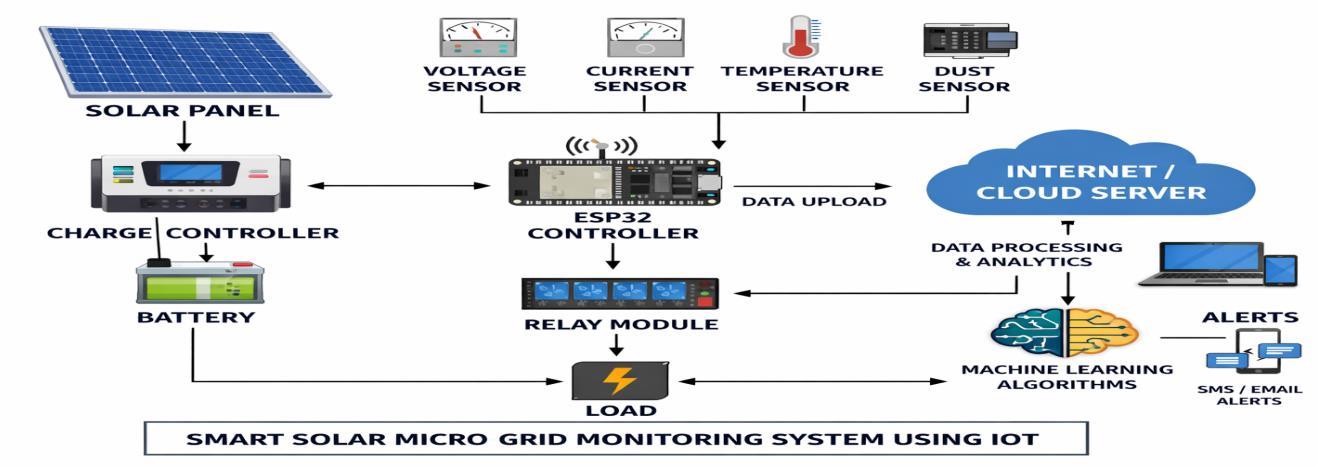
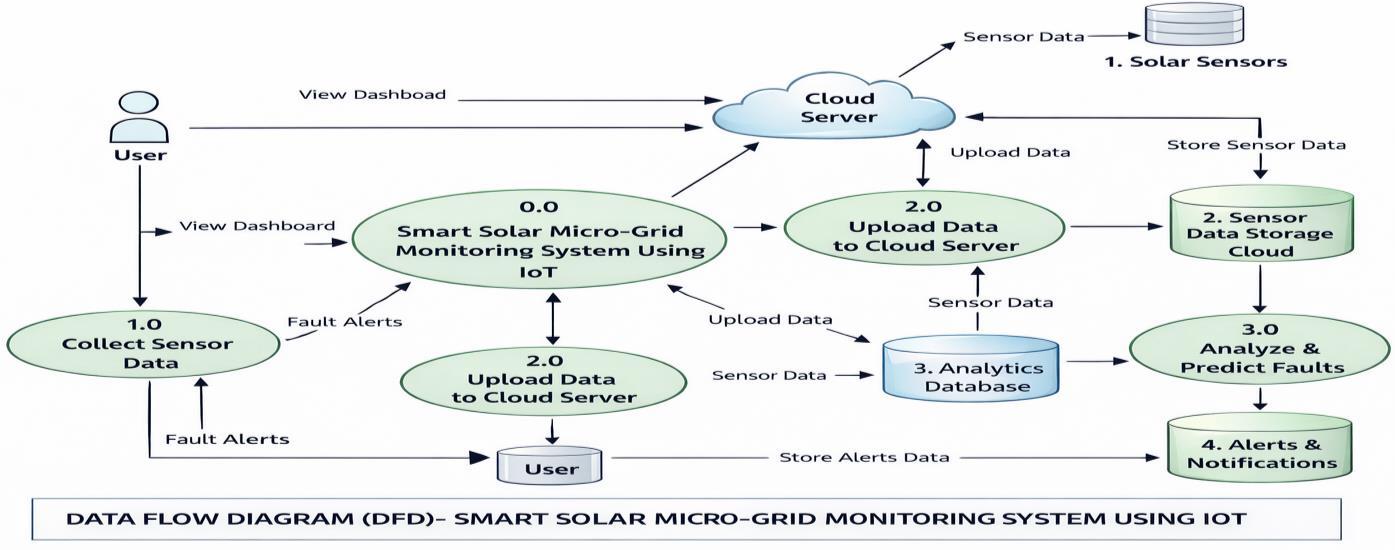
1.Block Diagram
International Research Journal of Engineering and Technology (IRJET) e-ISSN: 2395-0056
Volume: 13 Issue: 03 | Mar 2026 www.irjet.net p-ISSN: 2395-0072
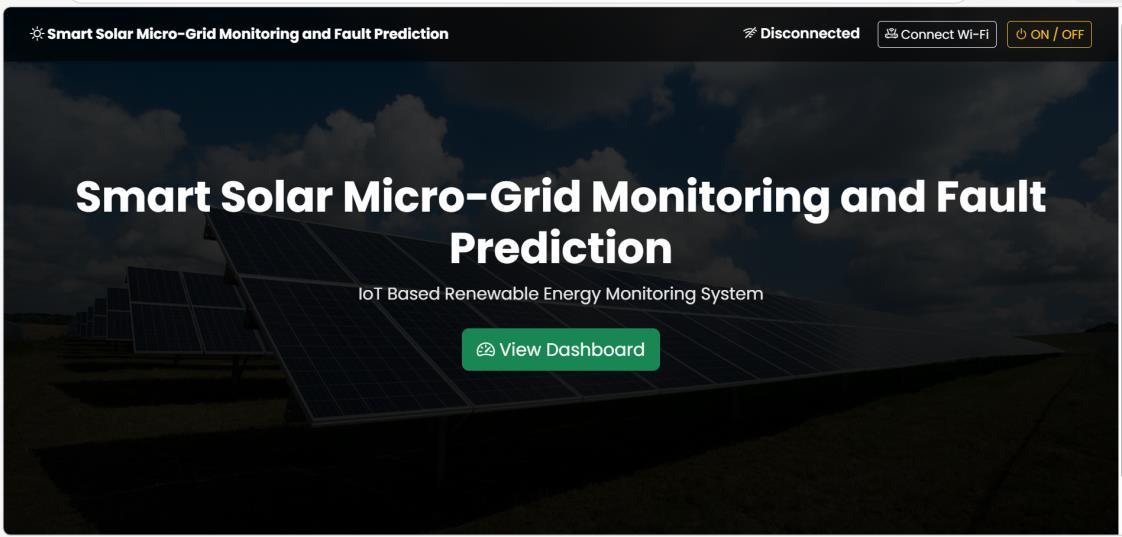
3. Home Page Design
Homepagedesignofthesolarmicro-gridmonitoringsystemshowingnavigation,systemoverview,anduser interfacelayout:
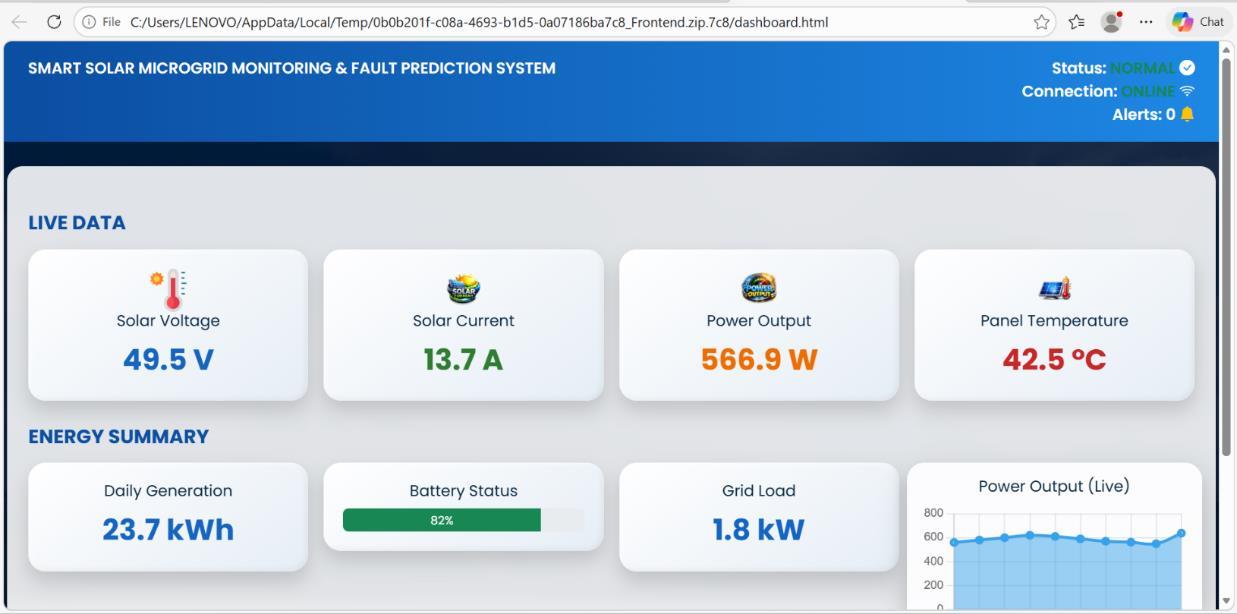
4 User Dashboard Design
Userdashboardforvisualisingreal-timevoltage,current,temperature,andbatterystatus:
4. Graphs of Monitoring.
Livemonitoringgraphsshowingreal-timeperformanceofthesolarmicro-gridsystem:
International Research Journal of Engineering and Technology (IRJET) e-ISSN: 2395-0056
Volume: 13 Issue: 03 | Mar 2026 www.irjet.net p-ISSN: 2395-0072
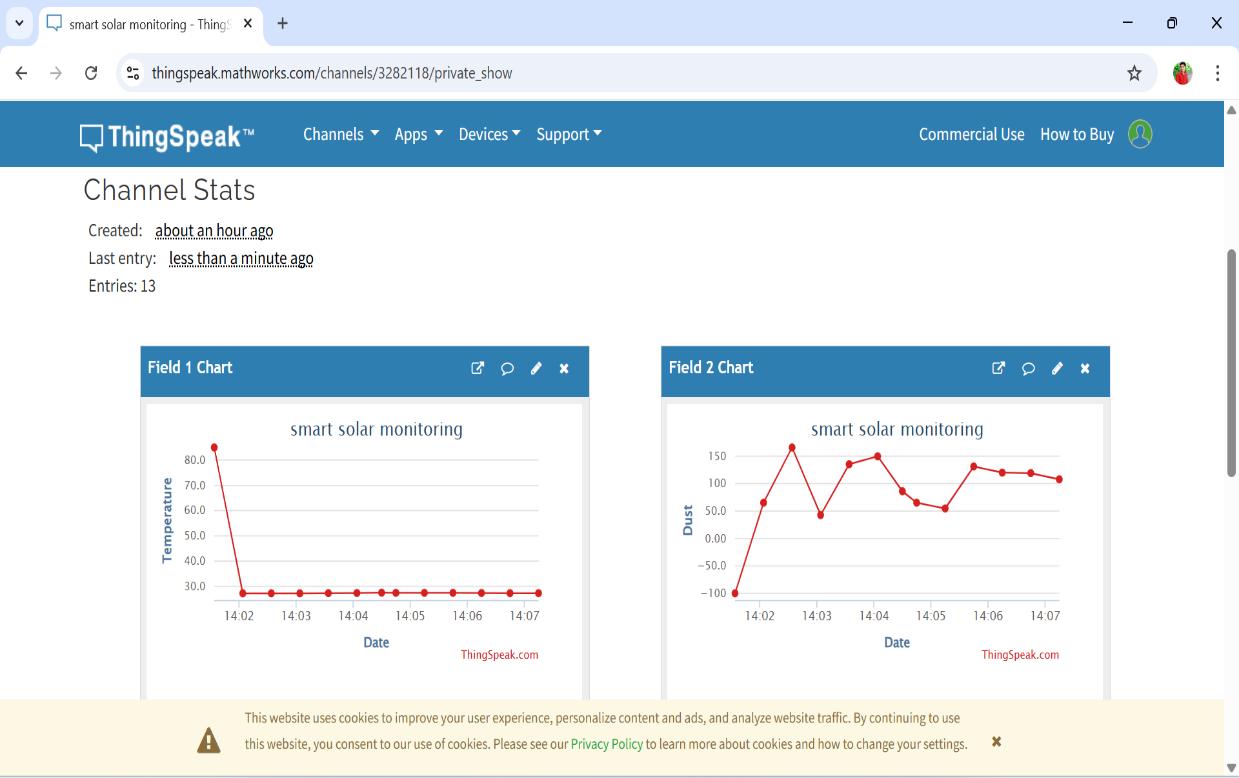
Real time Monitoring Graphs Analysis
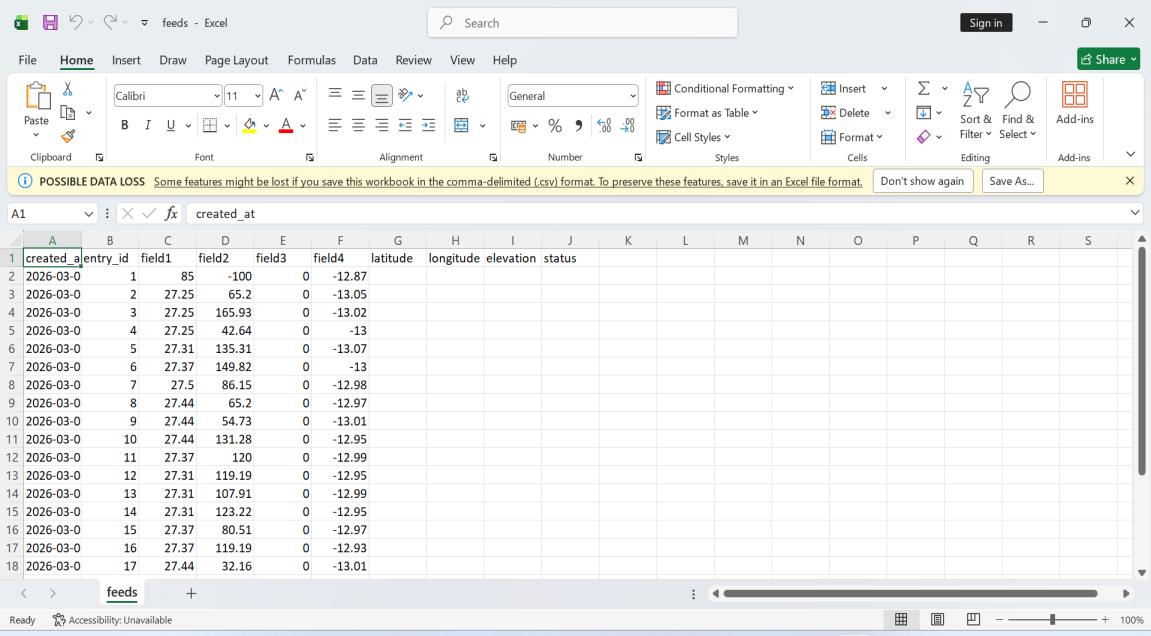
5. Stored Data of Solar Panel
Recordedsolarpaneldata,includingelectricalandenvironmentalparameters:
International Research Journal of Engineering and Technology (IRJET) e-ISSN: 2395-0056
Volume: 13 Issue: 03 | Mar 2026 www.irjet.net p-ISSN: 2395-0072
Physicalsetupofsolarmicro-gridsystemwithIoT-basedhardwarecomponents:
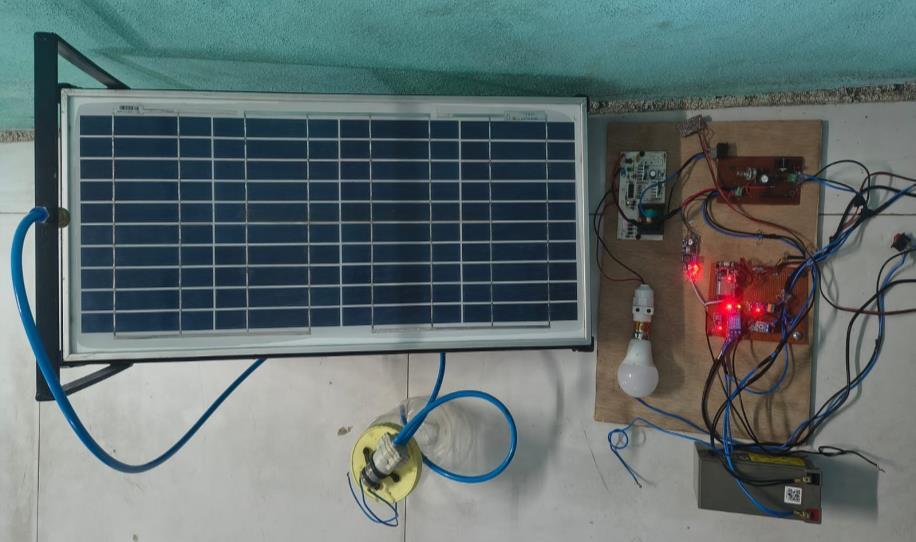
Integration meansconnectingallthepartsoftheprojectsotheyworkasonesystem.Inthisproject,weconnectedsensors,an ESP32,asolarpanel,abattery,andaclouddashboardsothatdatacanflowproperlyandthesystemcanmonitoreverythingin realtime.
Testing meanscheckingwhetherthesystemisworkingcorrectlyornot.Wetestedeachcomponent,likesensorsandESP32, andthentestedthefullsystemtomakesureitshowscorrectdata,sendsalerts,andworkssmoothlywithouterrors.
In this project, proper safety measures are followed to ensure safe operation of the solar micro-grid system. Electrical componentslikesolarpanels,batteries,andwiringarehandledcarefullytoavoidshortcircuits,overheating,andelectric shocks.Protectivedevicessuchaschargecontrollersandproperinsulationareusedtomaintainsystemsafety.
Thesystemisdesignedtooperatewithinsafevoltageandcurrentlimitstopreventdamagetocomponentsandensureuser safety.Regularmonitoringthroughsensorsalsohelpsindetecting abnormal conditionslikehightemperature orvoltage fluctuations.
Fromalegalpointofview,theprojectfollowsbasicstandardsrelatedtorenewableenergysystemsandelectronicdevices.It usesapprovedcomponentsandfollowsgeneralguidelinesforsafeinstallationandoperation.Datacollectedfromthesystemis usedonlyformonitoringpurposes,ensuringuserprivacyandsecurity.
TheSmartSolarMicro-GridMonitoringSystemusingIoTisaneffectiveandpracticalsolutionforimprovingtheperformance ofsolarpowersystems.Ithelpsinreal-timemonitoringofimportantparameterslikevoltage,current,temperature,battery status,anddustlevels.
Thesystemcandetectproblemsearlyandsendalerts,whichreducesmaintenanceeffortsandpreventsmajorfailures.Italso allowsremotemonitoring,makingitusefulforruralandremoteareas. Overall,thisprojectincreasesefficiency,improves reliability,andsupportstheuseofcleanandsustainableenergy
[1] Dipali E. Bhatkar, “A Study of IoT-Based Real-Time Monitoring Multiple Solar Power Remote Monitoring,” InternationalJournalofScientificResearchinEngineeringandManagement(IJSREM)Volume:09Issue:05|May2025SJIFRating:8.586ISSN:2582-3930,2019
[2]V.Surendra,S.RadhaKrishna,P.Prasad,Sk.GalibShareef,DrN.Karthik,“SOLARPANELMONITORINGUSINGIOT ANDAITECHNIQUES,”InternationalJournalofCreativeResearchThoughts(IJCRT):2024IJCRT|Volume12,Issue4 April2024|ISSN:2320-2882
[3] Rajarajeswari K, Adshaya S S, Balamurugan R, Madhumitha P, Manisha K, “Solar Panel Defect Detection and Monitoring”InternationalJournalofScientificResearchinEngineeringandManagement(IJSREM)Volume:09Issue: 05|May-2025SJIFRating:8.586ISSN:2582-3930
[4]PunithaKumaresaPillai1,D.DevarajandSaravananSelvam,“SmartdiagnosticsofAI-poweredIoTsolutionsfor solargridreliability”,Pillaietal.DiscoverElectronics(2025)2:72https://doi.org/10.1007/s44291-025-00113-7.
[5]CharityM.Nkinyam,PeterA.Olubambi,ChikaOliverUja,ChristianO.Asadu,BonifaceAnyaka,“Developmentofa low-costmonitoringdeviceforsolarelectric(PV)systemusinginternetofthings(IoT)”,ResultsinEngineering28 (2025)107324,journalhomepage:www.sciencedirect.com/journal/results-in-engineering
[6] Pannee Suanpang, Pitchaya Jamjuntr, “Machine Learning Models for Solar Power Generation Forecasting in MicrogridApplicationImplicationsforSmartCities”,2024bytheauthors.LicenseeMDPI,Basel,Switzerland.This articleisanopen-accessarticledistributedunderthetermsandconditionsoftheCreativeCommonsAttribution(CC BY)license(https://creativecommons.org/licenses/by/4.0/).
[7] Monika P. Tellawar, Nilesh Chamat, “An IoT-based Smart Solar Photovoltaic Remote Monitoring System”, InternationalJournalofEngineeringResearch&Technology(IJERT)Publishedby:http://www.ijert.orgISSN:22780181Vol.8Issue09,September2019.
[8]VijayMP,“IntelligentSolarPowerMonitoringSystemUsingIoTandTrackingMechanism”,InternationalJournal forMultidisciplinaryResearch(IJFMR)E-ISSN:2582-2160 Website:www.ijfmr.com
International Research Journal of Engineering and Technology (IRJET) e-ISSN: 2395-0056 Volume: 13 Issue: 03 | Mar 2026 www.irjet.net p-ISSN: 2395-0072 © 2026, IRJET | Impact Factor value: 8.315 | ISO 9001:2008 Certified Journal | Page1519