
International Research Journal of Engineering and Technology (IRJET) e-ISSN: 2395-0056
Volume: 13 Issue: 03 | Mar 2026 www.irjet.net p-ISSN: 2395-0072

International Research Journal of Engineering and Technology (IRJET) e-ISSN: 2395-0056
Volume: 13 Issue: 03 | Mar 2026 www.irjet.net p-ISSN: 2395-0072
Aamir Ashfaque Khalife1, Sharique Shah2
1Aamir Ashfaque Khalife. (Lead Full-Stack Developer)
2 Sharique Shah, Dept. of Computer Engineering, Anjuman Islam Abdul Razzak Kalsekar Polytechnic, Maharashtra, India
Abstract - The rapid growth of digital technology has significantly transformed traditional service industries, particularly the restaurant sector, where efficiency, accuracy, and customer experience are critical. Smart Serve X is a comprehensive restaurant automationsystem designedto digitize and streamline the entire dining process through the use of QR-based technology.ByscanningaQRcodeplacedonthetable, customerscanaccessaninteractivedigitalmenu,place orders in real time, and monitor their billing directly from their smartphones without requiring continuous staff assistance. The system ensures seamless communication by instantly transmitting orders to a centralizedkitchendashboard,therebyreducingdelays and minimizing manual errors. It supports multiple payment methods, including cash, card, and UPI QR, with automated bill generation and pre-filled payment details to enhance transaction speed and convenience. A key innovation of the system is its secure waiterbasedpaymentverificationmechanism,whichconfirms payment completion before generating a unique, timelimited exit PIN to prevent unauthorized exits. This paper presents the design, architecture, implementation, and evaluation of Smart Serve X, highlighting its effectiveness in improving operational efficiency, reducing service time, enhancing user satisfaction, and ensuring secure transaction validation. The proposed system demonstrates scalability and adaptability for modern restaurant environments.
Key Words: Smart Restaurant, QR Code System, Digital Menu, Restaurant Automation, UPI Payment, Secure Payment Verification, Real-Time Systems, Web Technology
The restaurant industry has traditionally relied on manual processes for order taking, food preparation coordination,billing,andpaymentverification.While these conventional methods have been effective in thepast,theyareincreasinglybecominginefficientin today’s fast-paced, technology-driven environment. Commonchallengessuchaslongwaitingtimes,order miscommunication, billing errors, and dependency on staff availability often lead to reduced customer satisfactionandoperationalinefficiencies.
With the rapid advancement of smartphones, internet connectivity, and web-based technologies, therehasbeenasignificantshifttowardsdigitaland contactless solutions in the hospitality sector. Customers today expect faster service, transparency in billing, and minimal physical interaction, especially after the global push towards contactless systems. This has created a strong need for smart, automatedsolutionsthatcanenhancebothcustomer experienceandbusinessperformance.
Smart Serve X is proposed as a next-generation restaurant automation system that leverages QR codetechnologytodigitizethediningexperience.By simply scanning a QR code placed on the table, customers can access a dynamic digital menu, place orders, and track their bills in real time without waiting for a waiter. This not only reduces service delays but also minimizes human errors associated withmanualordertaking.
In addition to improving ordering efficiency, Smart ServeX introduces asecure andinnovative payment verification mechanism. Unlike traditional systems where payment confirmation may be prone to oversight,thissystemensuresthateverytransaction is verified by authorized staff before allowing customer exit through a unique, time-bound PIN.
International Research Journal of Engineering and Technology (IRJET) e-ISSN: 2395-0056
Volume: 13 Issue: 03 | Mar 2026 www.irjet.net p-ISSN: 2395-0072
This feature significantly enhances security and preventsrevenueleakage.
Furthermore, the system integrates real-time communication between the customer interface, kitchen dashboard, and admin panel, ensuring smoothcoordinationandfasterservicedelivery.The use of modern web technologies makes the system scalable, cost-effective, and easy to deploy across different types of restaurants, from small cafes to largediningestablishments.
This paper aims to present the design, implementation, and evaluation of Smart Serve X, demonstrating how digital transformation can address existing challenges in the restaurant industry and create a more efficient, secure, and user-friendlyecosystem.
The Smart Serve X system is designed with the goaloftransformingtraditionalrestaurantoperations intoafullydigitalandefficientecosystem.Themajor objectivesofthisstudyareasfollows:
• To design and develop a user-friendly QR-based orderingsystemthateliminatestheneedforphysical menus.
•Toreducecustomerwaitingtimebyenablingdirect orderplacementthroughmobiledevices.
• To ensure real-time communication between customers,kitchenstaff,andrestaurantmanagement.
• To minimize human errors in order taking, billing, andcommunication.
• To implement a secure and reliable payment verificationmechanismtopreventfraudulentexits.
• To enhance customer satisfaction through a seamlessandinteractivediningexperience.
•Todevelopascalableandcost-effectivesystemthat canbeadoptedbyvarioustypesofrestaurants.
• To integrate multiple payment options including cash,card,anddigitalpaymentssuchasUPI.
ThescopeofSmartServeXextendsacrossdifferent typesandscalesofrestaurantbusinesses.Thesystem is designed to be flexible and adaptable, making it suitablefor:
• Small cafes and quick-service restaurants where speedandefficiencyarecritical.
• Medium-sized restaurants aiming to improve servicequalityandreduceoperationalcosts.
• Large restaurant chains that require centralized controlandreal-timemonitoringofmultipleoutlets.
The system can be deployed as a web-based application, eliminating the need for additional hardware installations.Itcanalso be integrated with existing restaurant management systems such as billingsoftwareandinventorymanagementtools.
Additionally, the system has the potential to be expanded with advanced features such as customer analytics, personalized recommendations, loyalty programs, and AI-based demand forecasting. However,itseffectivenessdependsonstableinternet connectivityanduserfamiliaritywithsmartphones.
The concept of restaurant automation has gained significant attention in recent years due to advancements in digital technology and changing consumer behavior. Various systems have been developed to improve efficiency and customer experienceinthehospitalityindustry.
Mobile-based ordering systems allow customers to place orders through dedicated applications. While these systems improve convenience, they often require installation and user registration, which can act as barriers for first-time users. Tablet-based ordering systems installed on tables provide an interactive experience but involve high installation andmaintenancecosts.
QR code-based systems have emerged as a costeffective alternative, enabling customers to access menus and services instantly without installing additionalapplications.StudieshaveshownthatQRbasedsolutionssignificantlyreduceoperationalcosts andimproveorderaccuracy.
Digital payment systems, especially UPI in countries like India, have revolutionized transaction methods
International Research Journal of Engineering and Technology (IRJET) e-ISSN: 2395-0056
Volume: 13 Issue: 03 | Mar 2026 www.irjet.net p-ISSN: 2395-0072
by providing fast and secure payment options. However, many existing systems lack proper verification mechanisms, leading to potential revenueloss.
Smart Serve X differentiates itself by combining QRbased ordering, real-time kitchen integration, and a secure payment verification system. The introduction of a time-limited exit PIN adds an additional layer of security that is not commonly foundinexistingsolutions.
The Smart Serve X system is built on a modular and scalable architecture that ensures smooth communication between different components. The architecture consists of three primary modules: Customer Interface, Kitchen Dashboard, and Admin/Waiter Panel, all connected through a centralizedserveranddatabase.
The system follows a client-server model where the frontend interface communicates with the backend server using APIs. The backend processes requests, manages data, and ensures real-time synchronization acrossallmodules.
The CustomerInterface isthe primaryinteraction point for users. It is designed to be simple, responsive, and accessible through any smartphone browser.Keyfeaturesinclude:
• QR Code Access: Customers scan a QR code placedonthetabletoaccessthesysteminstantly.
• Digital Menu: Displays categorized food items withimages,descriptions,andprices.
• Order Placement: Allows customers to select items,customizeorders,andplacethemdirectly.
• Real-Time Updates: Customers can track order statussuchaspreparing,ready,orserved.
•BillingSystem:Automaticallycalculatesthetotal bill,includingtaxesandadditionalcharges.
• Payment Options: Provides multiple payment methodsincludingUPIQR,card,andcash.
The interface is designed with user experience in mind, ensuring minimal navigation complexity and fastloadingtimes.
The Kitchen Dashboard is responsible for managing incoming orders efficiently. It provides a centralizedviewofallactiveordersandhelpskitchen staffprioritizetasks.Keyfeaturesinclude:
• Real-Time Order Display: Orders are displayed instantlyassoonastheyareplaced.
• OrderCategorization:Orderscanbecategorized basedonpreparationtimeortypeofdish.
• StatusUpdates:Kitchenstaffcanupdateorder status(e.g.,preparing,ready),whichisreflectedon thecustomerinterface.
•QueueManagement:Helpsinorganizingmultiple ordersandavoidingconfusionduringpeakhours.
This module significantly improves coordination within the kitchen and reduces delays in food preparation.
TheAdmin/WaiterPanelactsasthecontrolcenter ofthesystem.Itisusedbyrestaurantstafftomanage operations and ensure smooth workflow. Key functionalitiesinclude:
•OrderMonitoring:Staffcanviewallongoingand completedorders.
•PaymentVerification:Waitersverifywhetherthe customerhascompletedthepayment.
•ExitPINGeneration:Aftersuccessfulverification, aunique4-digitPINisgeneratedforsecureexit.
• Menu Management: Admins can add, update, or removemenuitemsdynamically.
International Research Journal of Engineering and Technology (IRJET) e-ISSN: 2395-0056
Volume: 13 Issue: 03 | Mar 2026 www.irjet.net p-ISSN: 2395-0072
• Reports and Analytics: Provides insights into sales,popularitems,andcustomerbehavior.
Thismoduleensuresoperationalcontrol,security, andflexibilityinmanagingrestaurantactivities.
TheSmartServeXsystemoperatesthrougha well-definedandsystematicworkflowthat ensuresefficiency,accuracy,andsecurityat everystageofthediningprocess.The methodologyintegratesuserinteraction, backendprocessing,andreal-time communication.
Step 1: QR Code Scanning Each table is assigned a uniqueQRcode.
The customer scans the code using a smartphone camera, which redirects them to the web-based application.
Step 2: DigitalMenuInteraction
The system loads a dynamic digital menu that includes categories, item descriptions, images, and prices.Customerscanbrowse,filter,andselectitems easily.
Step 3: OrderPlacement
Selecteditemsareaddedtoavirtualcart.Customers can modify quantities and confirm the order. The requestissenttothebackendserver.
Step 4: Real-TimeOrderTransmission
The backend processes the request and instantly forwards itto the kitchendashboardusingreal-time communication technologies such as WebSockets or Firebase.
Step 5: OrderProcessinginKitchen Kitchenstaffviewincomingorders,prioritizethem, andupdatetheirstatus(preparing,ready,served).
Step 6: LiveOrderTracking
Customersreceivereal-timeupdatesabouttheir orderstatus,improvingtransparencyandreducing uncertainty.
Step 7: AutomatedBilling
Thesystemautomaticallycalculatesthetotalbill, includingtaxesandadditionalcharges,ensuring accuracy.
Step 8: PaymentExecution
Customerschoosetheirpreferredpaymentmethod. ForUPIpayments,aQRcodewithapre-filled amountisgenerated.
Step 9: PaymentVerification
Thewaiterverifiesthepaymentthroughtheadmin panel.Thisstepensuresthatnotransactionisleft unconfirmed.
Step 10: ExitAuthorization
Aftersuccessfulverification,thesystemgeneratesa unique,time-limited4-digitPIN,whichisrequired forcustomerexit.
Thisstructuredworkflowensuresminimalhuman interventionwhilemaintainingcontrolandsecurity.
TheSmartServeXsystemisbuiltusingmodernweb technologies that ensure scalability, reliability, and performance.Themajortechnologiesinvolvedare:
• Frontend Technologies: HTML, CSS, and JavaScript are used to create a responsive and user-friendly interface. Frameworks like React or Angular can be usedforenhancedperformance.
•Backend Technologies: Node.js or Python(Django/Flask) is used to handle server-side logic,APImanagement,anddataprocessing.
•DatabaseManagement:MySQLorMongoDBisused for storing user data, orders, menu items, and transactionrecords.
International Research Journal of Engineering and Technology (IRJET) e-ISSN: 2395-0056
Volume: 13 Issue: 03 | Mar 2026 www.irjet.net p-ISSN: 2395-0072
• QR Code Integration: QR codes are generated and linkedtospecifictablesforseamlessaccess.
• Payment Integration: UPI APIs, payment gateways, and QR-based payment systems are integrated for securetransactions.
•Real-Time Communication: Technologies like WebSockets or Firebase are used to enable instant dataupdatesbetweenmodules.
•Cloud Deployment: The system can be hosted on cloudplatformssuchasAWSorFirebaseHostingfor betterscalability.
Smart Serve X provides numerous advantages to bothcustomersandrestaurantowners:
•ReducesWaitingTime:Customerscanplaceorders instantlywithoutwaitingforstaff.
•Improves Accuracy: Eliminates errors caused by manualordertaking.
•EnhancesCustomerExperience:Providesamodern, interactive,andcontactlessdiningexperience.
•Secure Payment System: Ensures payment verificationbeforeexit,reducingfraud.
•OperationalEfficiency:Streamlinescommunication betweencustomer,kitchen,andstaff.
•Cost Reduction: Minimizes the need for excessive staffandprintedmenus.
•Real-TimeMonitoring:Enablesbettermanagement andtrackingoforders.
Despiteitsadvantages,theSmartServeXsystemhas certainlimitations:
•InternetDependency:Requiresstableinternet connectivityforproperfunctioning.
•SmartphoneRequirement:Customersmusthavea smartphonetoaccessthesystem.
•InitialSetupCost:Restaurantsmayneedtoinvest insystemsetupandtraining.
•TechnicalIssues:Systemdowntimeorbugsmay affectoperations.
•UserAdaptability:Someusersmayfinditdifficult toadapttodigitalsystemsinitially.
The implementation of Smart Serve X was evaluated based on performance, usability, and efficiency. The results indicate a significant improvement in order processing timeandservicequality.
Order Accuracy increased due to direct customerinput.
Waiting time reduced as orders are sent instantlytothekitchen.
Customer satisfaction improved due to transparencyandeaseofuse.
Payment security enhanced through verificationandexitPINmechanism.
The discussion highlights that integrating digital technologies in restaurant operations notonlyimprovesefficiencybutalsoprovides acompetitiveadvantageinthemarket.
TheSmartServeXsystemhasvastpotentialfor futureenhancements:
AI-BasedRecommendations:Suggestfood itemsbasedoncustomerpreferences.
VoiceOrderingSystem:Enablehands-free orderingusingvoicecommands.
Multi-LanguageSupport:Catertodiverse customerbases.
IntegrationwithDeliveryPlatforms:Expand functionalitybeyonddine-inservices.
AdvancedAnalytics:Provideinsightsinto customerbehaviorandsalestrends.
FacialRecognition:Identifycustomersfor personalizedexperiences.
International Research Journal of Engineering and Technology (IRJET) e-ISSN: 2395-0056
Volume: 13 Issue: 03 | Mar 2026 www.irjet.net p-ISSN: 2395-0072
Smart Serve X represents a significant step towards digital transformation in the restaurant industry. By integrating QR-based ordering, real-time communication,andsecurepaymentverification,the systemaddresseskeychallengesfacedbytraditional restaurantoperations.
The system enhances efficiency, reduces errors, improves customer satisfaction, and ensures secure transactions.Itsscalableandadaptabledesignmakes it suitable for a wide range of restaurant environments.
With continuous advancements and future enhancements, Smart Serve X has the potential to become a standard solution for smart dining experiencesinthemodernera.
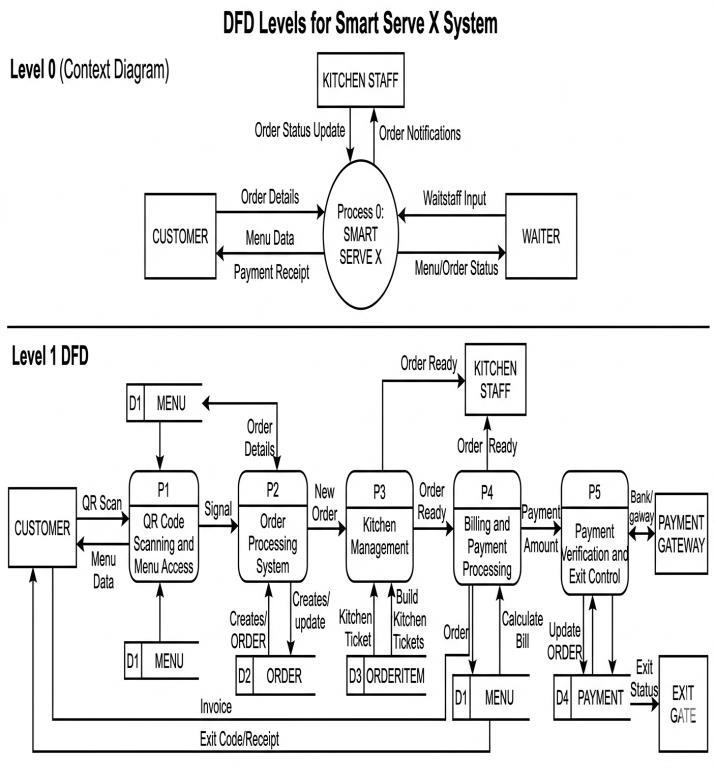
The Data Flow Diagram (DFD) represents how data movesthroughtheSmartServeXsystem.
Level 0 (Context Diagram):
ExternalEntities:Customer,Waiter,KitchenStaff
System:SmartServeX
DataFlow:Orderdetails,paymentstatus,menudata
Level 1 DFD:
Process1:QRCodeScanningandMenuAccess
Process2:OrderProcessingSystem
Process3:KitchenManagement
Process4:BillingandPaymentProcessing
Process5:PaymentVerificationandExitControl
This layered structure ensures clarity in system functionalityanddatahandling.
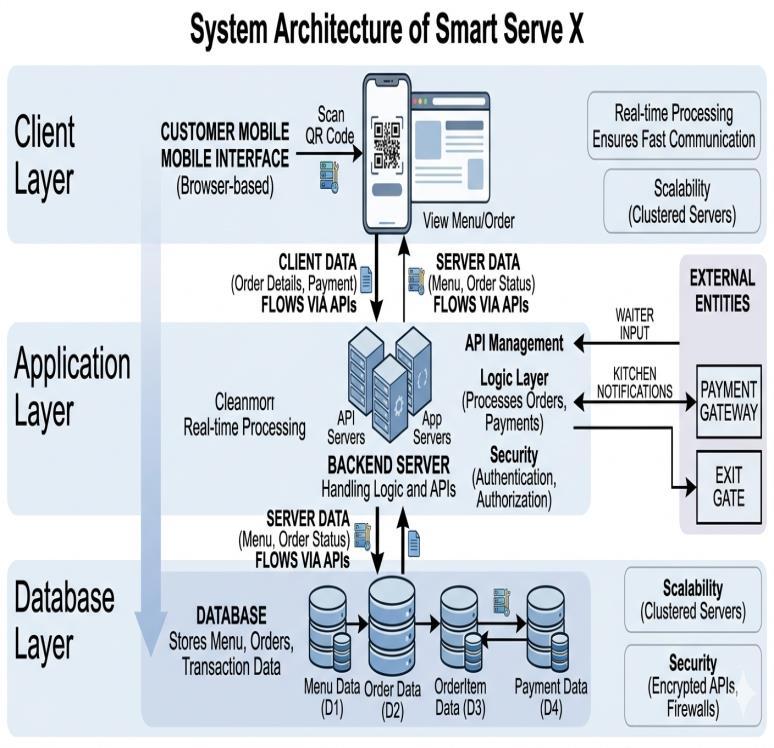
Thesystemfollowsaclient-serverarchitecture:
• Client Layer: Customer mobile interface (browserbased)
• Application Layer: Backend server handling logic andAPIs
• Database Layer: Stores menu, orders, and transactiondata
Data flows from the client to the server via APIs, processed in real-time, and stored in the database. The architecture ensures scalability, security, and fastcommunication.
International Research Journal of Engineering and Technology (IRJET) e-ISSN: 2395-0056
Volume: 13 Issue: 03 | Mar 2026 www.irjet.net p-ISSN: 2395-0072
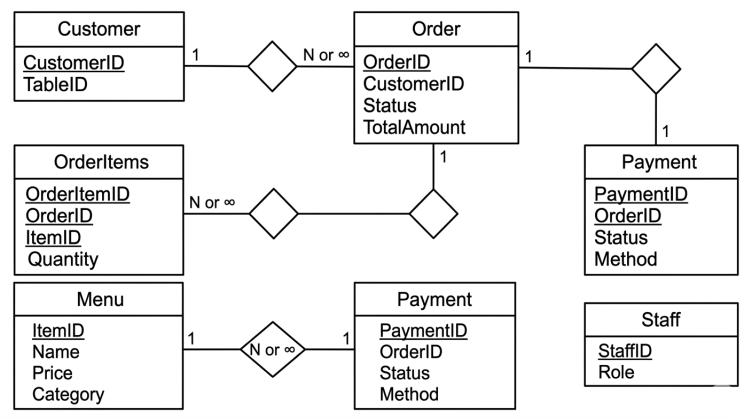
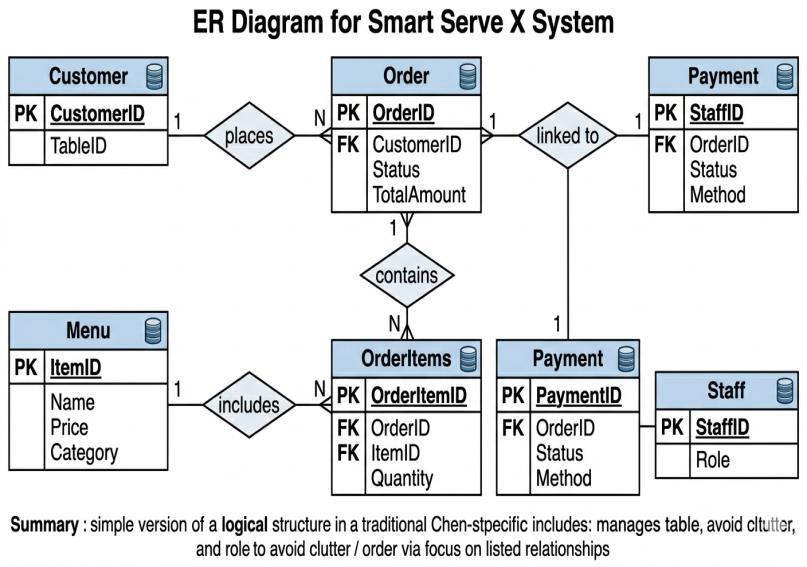
1 Entity Relationship (ER) Diagram
The system database consists of the following entities:
•Customer(CustomerID,TableID)
•Order(OrderID,CustomerID,Status,TotalAmount)
• OrderItems (OrderItemID, OrderID, ItemID, Quantity)•Menu(ItemID,Name,Price,Category)
•Payment(PaymentID,OrderID,Status,Method)
Staff (StaffID, Role) Relationships:
•OneCustomercanplacemultipleOrders
•OneOrdercontainsmultipleOrderItems
•EachOrderislinkedtoonePayment
2 Database Schema (Sample Tables)
Table:CustomersCustomerID(PK),TableNumber
Table:OrdersOrderID(PK),CustomerID(FK),Status, TotalAmount
Table:MenuItemID(PK),Name,Price,Category
Table: Payments PaymentID (PK), OrderID (FK), Method,Status
This structured schema ensures efficient data storageandretrieval.
Feature Traditional System Existing Digital Systems Smart Serve X
Order Method Manual App/Tablet Based QR-Based Instant
Waiting Time High Medium Low
Order Accuracy Low Medium High
Payment System Manual Digital Verified + Secure PIN
Cost Low High Moderate
Security Low Medium High
Theauthorwouldliketoexpresssinceregratitudeto Mr. Abdul Haadi Muqri for his invaluable guidance and continuous support throughout the project. Special thanks are also extended to Ms. Shariyam Sayyed Ma’am and Ms. Hafsah Siddique Ma’am for theirencouragementandassistance.
The author is deeply thankful to their family members for their constant support and motivation. A special mention goes to the author’s pet hamster, Hamood Habibi, for providing emotional comfort duringthecourseofthiswork.
The author also acknowledges the faculty and institution for their support and guidance in successfullycompletingthisresearchwork.
1. D. Smith, “Digital Transformation in Restaurants,” Journal of Hospitality Technology,2022.
2. R. Kumar, “QR Code Applications in Smart Systems,” International Journal of Computer Science,2023.
3. A. Sharma, “Secure Payment Systems in Retail,”IEEETransactions,2021.
4. P. Gupta, “Real-Time Data Processing in Web Applications,”Springer,2020.
5. M. Patel, “Restaurant Automation Systems,” InternationalJournalofEngineeringResearch &Technology(IJERT),2022.
6. S. Verma, “Web-Based Ordering Systems,” IEEEConferenceProceedings,2023.
7. K. Lee, “Cloud-Based Food Services,” Elsevier, 2021.
International Research Journal of Engineering and Technology (IRJET) e-ISSN: 2395-0056
Volume: 13 Issue: 03 | Mar 2026 www.irjet.net p-ISSN: 2395-0072
8. T. Brown, “User Experience in Digital Platforms,”ACMDigitalLibrary,2020.
9. N. Singh, “UPI Payment Systems in India,” JournalofFinancialTechnology,2022.
10. A. Khan, “Smart Hospitality Solutions,” Springer,2023.
11. S. K. Sharma and M. Gupta, “Automation in Restaurant Industry Using QR Code Technology,” International Journal of Engineering Research & Technology (IJERT), vol.11,no.5,2022.
12. A. Patel andR. Shah, “Smart OrderingSystem for Restaurants Using Mobile and Web Applications,” IEEE International Conference onSmartComputing,2021.
13. J. W. Lee and H. Kim, “Design of Real-Time Food Ordering System Using Web Technologies,”JournalofComputerNetworks, vol.45,no.3,2020.
14. P. Singh, “Impact of Digital Payment Systems on Indian Economy,” Journal of Financial Technology,vol.8,no.2,2023.
15. R. Mehta and S. Jain, “Secure Payment Gateway Integration in Web Applications,” International Journal of Computer Applications,2021.
16. T. Nguyen, “Cloud-Based Restaurant ManagementSystems,”IEEECloudComputing Journal,2022.
17. K. Zhao, “Improving Customer Experience ThroughDigitalTransformation,”ACMDigital Library,2020.
18. V. Kumar and A. Singh, “Real-Time Data Processing Using WebSockets,” Springer, AdvancesinComputing,2021.
19. M. Brown, “User Interface Design for MobileBasedApplications,”Elsevier,2020.
20. N. Gupta, “UPI-Based Payment Systems and Their Security Challenges,” Journal of Cybersecurity,2023.
BIOGRAPHIES
AAMIR KHAIFE is a student of Computer Engineering with interests in web development and automation systems. His work focuses on developing practical solutionsforreal-worldproblems.