
International Research Journal of Engineering and Technology (IRJET) e-ISSN: 2395-0056
Volume: 12 Issue: 04 | Apr 2025 www.irjet.net p-ISSN: 2395-0072
International Research Journal of Engineering and Technology (IRJET) e-ISSN: 2395-0056
Volume: 12 Issue: 04 | Apr 2025 www.irjet.net p-ISSN: 2395-0072
A.Jeevana
Jyothi1 , G.Latha2 , G .V.S.N.Jahnavi3 , K.Narendra kumar4 O.Raghavendra5
1Student & AMRITASAIINSTITUTEOFSCIENCEANDTECHNOLOGY
2Assistant Professor & AMRITASAIINSTITUTEOFSCIENCEANDTECHNOLOGY
3Student & AMRITASAIINSTITUTEOFSCIENCEANDTECHNOLOGY
4Student & AMRITASAIINSTITUTEOFSCIENCEANDTECHNOLOGY
5Student & AMRITASAIINSTITUTEOFSCIENCEANDTECHNOLOGY ***
Abstract -
The rapid advancements in microcontroller technologies have significantly contributed to the developmentofembeddedsystemscapableofperforming intelligent tasks in real-time. Among these applications, the display and monitoring of environmental parameters such as time and temperature in a synchronized, reliable, and user-friendly manner has gained considerable attention, especially in public spaces, educational institutions, industries, and smart home systems. The project titled “Smart Real-Time Clock and Temperature Display Using Arduino” aims to design and implement a cost-effective and efficient embedded system that continuously tracks and displays real-time clock (RTC) data along with temperature readings on an LED matrix display module, ensuring high visibility and accurate data dissemination.
This system is built around the widely-used Arduino microcontroller, specifically integrating the DS1307 RTC module, the DHT11 digital temperature and humidity sensor, and a P10 LED display panel. The DS1307 is a low-power, battery-backed real-time clock chip that maintains the current time (hour, minute, second) and calendar data (day, date, month, year) with precision. Its integration ensures that the system continues to function accurately even during power outages or resets. The DHT11 sensor is used to measure ambient temperature and humidity, enabling environmental monitoring in real-time. The P10 LED display panel is responsible for visually presenting the acquired data, offering a bright and readable interface suitableforindoorenvironments.
The system architecture involves a wellstructured interaction between hardware and software components. The Arduino microcontroller acts as the central processing unit, interfacing with the DS1307 via the I²C communication protocol and receiving temperature data from the DHT11 sensor via a digital GPIO pin. It processes the time and environmental data andtransmitstheinformationtotheP10displayusingthe SPIprotocolwiththehelpoftheDMD(DotMatrixDisplay) libraryandTimerOneinterruptserviceroutinestorefresh the display consistently without flickering. The display
alternates between showing the current time (in hours andminutes)andtheambienttemperature,alongwiththe dateanddayoftheweek,usingascrollingtextformatfor betterreadabilityonasingleP10module.
The code implementation focuses on precise timing using the millis() function instead of delay-based execution to maintain non-blocking and real-time performance. The software periodically updates time and temperature readings every second and dynamically scrolls text messages on the bottom row of the display to show the date, day, and temperature in a cyclic manner. Thetimeisdisplayedina 24-hourformat,witha blinking colonseparatorthatmimics thebehaviorofdigitalclocks. Furthermore, the day of the week is calculated using the RTCdataandconvertedintohuman-readableformatusing predefinedarrays.
One of the key highlights of this project is its simplicity and effectiveness. The Arduino platform ensures flexibility, scalability, and ease of programming, making the system ideal for educational demonstrations and real-world deployment. The RTC module eliminates the need for continuous manual updates, while the temperature readings offer additional environmental context to users. The display interface through the P10 module ensures excellent visibility and makes it easy to convey information clearly and attractively, even from a distance.
Fromanapplicationstandpoint,thisprojecthasa broad scope. It can be installed in classrooms to help students and teachers track time and monitor room temperature. It can be deployed in factories and workshops to assist in maintaining optimal working conditions.Insmarthomes,itcanbeintegratedintowallmounted systems for indoor environmental awareness. Moreover,byextendingthesystemwithnetworkmodules suchasESP8266orESP32,thedesign canbeupgradedto a cloud-connected IoT-based solution that can log data remotely or trigger alerts based on threshold temperatures.
This project also promotes the idea of combining multiple sensors and modules to build smarter, multifunctional embedded systems. The inclusion of real-
International Research Journal of Engineering and Technology (IRJET) e-ISSN: 2395-0056
Volume: 12 Issue: 04 | Apr 2025 www.irjet.net p-ISSN: 2395-0072
time features allows it to function as a clock with timekeeping capabilities independent of external synchronization.Additionally,thetemperaturemonitoring provides valuable insight into environmental conditions, which is increasingly important in the context of smart climatecontrolandhealth-consciousenvironments.
In terms of future enhancement, this system can be scaled by adding features like automatic brightness adjustment based on ambient light, touch-based interface to change display settings, or mobile app connectivity for remotemonitoring.Theaccuracyoftemperaturedata can beimprovedbyswitchingtohigherprecisionsensorslike the DHT22 or using multiple sensors for distributed sensing. Another potential enhancement is incorporating battery backup for the Arduino itself to ensure that the entiresystemremainsoperationalduringpowerfailures.
Keywords: Arduino, Real-Time Clock (RTC) ,DS1307, DHT11 Sensor ,Temperature Monitoring ,P10 LED Display, Embedded Systems ,Digital Clock ,Environmental Sensing, Microcontroller ,Time and Date Display ,IoT Applications, ScrollingDisplay,SmartDisplaySystem,SensorIntegration
1.INTRODUCTION
In the modern era of digitization, technology continues to revolutionize every aspect of life, including the education sector. Educational institutions are increasingly integrating automation and communication technologies to streamline administrative processes, enhance student engagement, and improve academic performance reporting. Among various administrative responsibilities, the process of recording, managing, and disseminating students’ academic marks remains one of the most critical. Traditionally, marks are communicated through printed report cards, verbal announcements, or manual record-keeping systems, all of which are susceptible to inefficiencies such as delays, miscommunication, loss of records, and human error. In this context, the development of an Automatic Marks Sending System to Students Through SMS emerges as an innovative and efficient solution aimed at enhancing the accuracyandspeedofacademicinformationdelivery.
This system is particularly significant in educational environments where direct communication between schools and parents is limited, either due to geographical challenges or infrastructural constraints. In many rural and semi-urban areas, parents often lack timelyaccesstotheirchild’sacademicperformancedueto the absence of regular reporting mechanisms or digital infrastructure.Whileinternet-basedplatformsandmobile appsareincreasinglypopularinurbanareas,theyarenot always feasible in remote regions with limited connectivity or low smartphone penetration. On the contrary, SMS (Short Message Service) is a ubiquitous communication medium that is accessible on even the
mostbasicmobilephonesanddoesnotrequireaninternet connection.Leveragingthismediumcanbridgethedigital divide and ensure inclusive access to academic information.
The Automatic Marks Sending System introduced in this project combines RFID (Radio Frequency Identification) and GSM (Global System for Mobile Communication) technologies to automate the process of identifying students and sending their marks via SMS to registered mobile numbers. The system is implemented using a microcontroller-based platform specifically the Arduino UNO which serves as the core controller for RFID data acquisition and GSM communication. Upon scanning an RFID card that uniquely identifies a student, the system sends a pre-defined SMS containing the student’s subject-wise marks to the assigned mobile numberusingtheSIM900GSMmodule.
TheRFIDtechnologyisemployedforitsabilityto rapidly and reliably identify individual users through unique identification codes embedded in RFID tags. Each student is provided with a unique RFID card, and the system maps the card's UID (Unique Identifier) to the student'sacademicdatastoredinthecontroller'smemory. WhenthecardisbroughtneartheRFIDreader,thesystem reads the UID, matches it with stored data, and initiates theprocessofsendinganSMS.
The GSM communication, facilitated through the SIM900 module, is handled via AT commands sent over a software serial connection. Once a valid RFID tag is detectedandmatched,thesystemsetstheGSMmoduleto textmodeandconstructsanSMSwiththestudent’smarks in various subjects like Telugu, English, Hindi, and Mathematics. This message is then sent to the parent’s mobilenumber,ensuringthatacademicperformancedata iscommunicatedinstantlyanddirectly.
The system is further enhanced with LED indicators that provide immediate visual feedback upon successful scanning of RFID tags. This not only improves the user interface but also serves as a simple debugging mechanism during implementation. The LEDs indicate whether a valid tag has been detected and whether the systemisprocessingthecorrectstudentdata.
From a development perspective, the use of Arduino makes the system accessible and easy to implement. Arduino's open-source nature, extensive library support, and user-friendly programming environment make it a preferred choice for rapid prototypingandeducationaltechnologydevelopment.The integration of MFRC522 RFID reader and SIM900 GSM module into the Arduino ecosystem ensures a smooth interaction between identification and communication components.
International Research Journal of Engineering and Technology (IRJET) e-ISSN: 2395-0056
Volume: 12 Issue: 04 | Apr 2025 www.irjet.net p-ISSN: 2395-0072
One of the primary motivations behind this system is the growing demand for transparency and parent involvement in a child’s education. When parents are informed regularly and promptly about their child’s academic performance, it fosters a culture of accountability and motivation. Moreover, it encourages timelyinterventionincaseofpooracademicperformance, allowing parents and educators to work collaboratively towardthestudent’sacademicimprovement.
This project also aligns with broader goals of Digital India and smart education initiatives that aim to infuse technology into school management systems, especially in government-run and low-budget private schools. While larger institutions might rely on Learning Management Systems (LMS) and mobile applications, smaller schools with limited resources can benefit from this lightweight yet powerful solution. By simply issuing RFID cards to students and configuring a GSM module with valid parent contact numbers, a school can implement a system that significantly improves communicationefficiencywithoutheavyinvestments.
Furthermore, the design is highly modular and scalable. Additional student profiles can be added to the code base with minimal effort, and the system can be upgraded in the future to dynamically fetch marks from a database or cloud server. For institutions aiming for enhanced security and features, the system can be expanded to include biometric verification, encrypted messaging, or multi-language SMS delivery, depending on regionalneeds.
In summary, this project introduces a practical and innovative approach to solving a persistent challenge in the education system. The Automatic Marks Sending System to Students Through SMS ensures that academic marks are accurately and swiftly delivered to students or their guardians using cost-effective and widely available technologies. The system is not only technically feasible but also socially impactful, especially for schools in underdeveloped areas seeking low-cost solutions for efficientparent-student-schoolcommunication.
This introduction sets the stage for the subsequent sections of the paper, which will detail the system design, implementation methodology, hardware and software components, and performance evaluation. Through real-time testing and validation, the paper will demonstrate the effectiveness of the proposed system in improving academic communication and fostering a smarter,moreresponsiveeducationalenvironment.
The implementation of the "Smart Real-Time Clock and Temperature Display Using Arduino" project requires a combinationofessential hardwarecomponentsthatwork
together to achieve real-time data collection, processing, and display. At the heart of the system lies the Arduino UNO microcontroller board, which is based on the ATmega328P chip. This open-source platform serves as thebrainoftheentiresetup,orchestratingcommunication between the various input and output devices. It reads data from the connected DHT11 temperature sensor and the DS1307 real-time clock (RTC) module, processes the data, and then sends it to the P10 LED display for visualization. The Arduino UNO provides 14 digital I/O pins, 6 analog input pins, and is programmable through the Arduino IDE, making it highly suitable for embedded systemprojectslikethis.
To keep track of accurate time and date, the systememploystheDS1307RTCmodule.Thislow-power, battery-backed device ensures that the timekeeping continuesevenwhenthesystemisturnedoff,thankstoits onboard CR2032 coin cell battery. It communicates with theArduinousingtheI2Cinterfaceandprovidestimedata intheformatofseconds,minutes,hours,day,date,month, and year. Its precision and reliability make it ideal for applicationsrequiringreal-timemonitoring.
The DHT11 temperature sensor is another integral component used in the project. It is a digital sensorthatprovidestemperaturereadingsinasimpleand easily interpretable format. With a temperature range of 0–50°C and an accuracy of ±2°C, the DHT11 transmits real-time environmental data to the Arduino, which then displays the current temperature on the LED panel. The sensor is energy-efficient and operates with minimal delay,makingitperfectforcontinuousmonitoring.
For visual output, the project uses a P10 LED display module, which is a 32×16 red LED matrix. This module is commonly used for public displays and is ideal forscrollingtextorfixeddatapresentation.Itoperateson a5VsupplyandcanbeeasilyinterfacedwiththeArduino usinglibrarieslike“DMD”or“PxMatrix.”In thisproject, it displays both the current time and temperature in a readable format, updating in real-time as the Arduino receivesnewdata.
A 5V 2A power supply adapter is necessary to provide stable and sufficient power to all components, especially the Arduino and the P10 LED display module. TheLEDdisplay,inparticular,requiresmorecurrent,and a regulated 5V adapter ensures that the system functions reliablywithoutvoltagedropsorresets.
To facilitate connections between the components,jumperwires(male-to-male)areused.These wires make it easy to interconnect sensors, modules, and the microcontroller in a flexible and modular way. They are especially useful during prototyping and testing. Additionally, a breadboard may be used during development to avoid soldering and allow quick modificationstothecircuit.
International Research Journal of Engineering and Technology (IRJET) e-ISSN: 2395-0056
Volume: 12 Issue: 04 | Apr 2025 www.irjet.net p-ISSN: 2395-0072
For timekeeping continuity, a CR2032 coin cell battery is included with the RTC module. This small, 3V lithiumbatterypowerstheDS1307whenthemainsystem isoff,ensuringuninterruptedreal-timeoperation.Ithasa longlifeandiseasilyreplaceable.
Lastly, to secure and stabilize the connections between modules, female Berg strips and DC barrel jack connectors are used. The female headers provide a neat and reliable interface between jumper wires and module pins, while the DC jack allows for a clean power connectionfromtheadaptertotheArduinoboard.
Together, these components form a cohesive and robust hardware foundation for the project. They enable the Arduino to effectively gather temperature and time data,processit,andpresentitvisuallyontheLEDdisplay, fulfilling the goal of creating a smart and interactive realtimemonitoringsystem.
Theimplementationofthe"SmartReal-TimeClock and Temperature Display Using Arduino" project involves the integration of several hardware components namely the Arduino UNO, DS1307 RTC module, DHT11 temperature sensor, and the P10 LED display panel. Each component is carefully interfaced to enable real-time acquisitionand displayof bothtemperatureandtime. The implementationprocessincludeshardwaresetup,software development,circuitconnection,andtesting.
To begin with, the Arduino UNO acts as the main controlunitofthesystem.Itisresponsibleforreadingtime data from the DS1307 RTC module and temperature data fromtheDHT11sensor.Thisinformationisthenformatted and sent to the P10 LED display for real-time output. The Arduino is programmed using the Arduino IDE, and necessarylibrarieslikeWire.h,RTClib.h,DHT.h,andDMD.h or PxMatrix (for P10 display) are included to simplify communicationwithperipheralmodules.
The DS1307 RTC module is connected to the Arduino using the I2C protocol. The SDA (data line) and SCL (clock line) oftheRTCare connected totheArduino’s A4andA5pinsrespectively.Themodulekeepstrackofthe currenttimeanddatewiththehelpofanonboardCR2032 coin cell battery, which allows it to continue operation even when the Arduino is powered off. The time data (hour, minute, second, day, date, month, and year) is accessed and displayed through the code using the RTClib library.
For environmental sensing, the DHT11 temperaturesensorisused.Itisconnectedtoa digital pin on the Arduino, typically pin 2 or 3. The sensor provides temperature data in degrees Celsius with decent accuracy andisreadusingtheDHTlibrary.IntheArduinoprogram,
theDHTobjectisinitialized,andtemperaturereadingsare periodically taken, usually at intervals of 1 second to balanceaccuracyandperformance.
The P10 LED display panel is connected to the Arduino using multiple digital pins, depending on the library used (e.g., DMD or PxMatrix). For the DMD library, pinslike6,7,8,9,and10arecommonlyused.Thedisplay isinitializedandconfiguredtoupdatethescreenregularly. Thecurrenttimeandtemperatureareformattedasstrings and printed on the LED matrix using built-in display functions.Thetextcanbesettoscrollordisplayinafixed position,dependingontheapplicationrequirement.
A regulated 5V power supply (2A) is used to power the P10 display, as it consumes more current than the Arduinocan provide. The Arduinocan be poweredvia USB during programming and testing or through a DC barreljackwhendeployed.Allconnectionsaremadeusing jumper wires and female headers, and a breadboard is used during the prototyping phase to keep the layout organizedandmodifiable.
The Arduino code initializes all sensors and modulesinthesetup()function.Intheloop()function,the Arduinocontinuouslyfetchestimeandtemperaturevalues, updates them on the serial monitor (for debugging purposes),andsendsthedata totheP10display.TheRTC is updated only when needed, while the temperature is readmorefrequentlytoreflectreal-timechanges.
After assembling the components and uploading the code to the Arduino UNO, the system is tested for accuracyandperformance.TheRTCmoduleisvalidatedby comparing displayed time with a known accurate clock, and the DHT11 is cross-checked using another thermometer. The display is monitored to ensure that updatesaresmoothandlegible.
Overall, the implementation demonstrates an efficient and reliable system for real-time environmental and temporal monitoring using affordable, open-source hardware. It serves as an ideal solution for educational institutions, public spaces, or personal projects requiring constantdisplayoftimeandtemperatureinformation.
The hardware integration of the “Smart Real-Time Clock andTemperatureDisplayUsingArduino”projectinvolvesa seamless connection between the Arduino UNO, DS1307 Real-Time Clock (RTC) module, DHT11 temperature sensor, and the P10 LED display panel. Each component plays a vital role in the system’s functionality and is interfaced in a structured manner to ensure accurate data collectionandreal-timedisplay.
International Research Journal of Engineering and Technology (IRJET) e-ISSN: 2395-0056
Volume: 12 Issue: 04 | Apr 2025 www.irjet.net p-ISSN: 2395-0072
At the heart of the system is the Arduino UNO, which serves as the central processing unit. It communicates with all peripheral devices to gather data andcontroloutputoperations.TheDS1307RTCmoduleis interfaced with the Arduino using the I2C communication protocol, which utilizes only two pins SDA (A4) and SCL (A5) on the Arduino. This module is responsible for providingaccurate andconsistent timeand date data. The DS1307 includes a coin-cell battery backup, allowing it to retainthetimeevenduringpowerinterruptions.
For environmental monitoring, the DHT11 temperature sensor is connected to a digital pin on the Arduino, typically D2 or D3. The sensor provides temperaturedata in degrees Celsius andis readat regular intervals. It operates on a single-wire digital communication interface, which makes it easy to interface with the microcontroller without requiring complex protocols.
The visual output is managed using a P10 LED display panel, which is connected to the Arduino via multiple digital pins. Depending on the library used (such asDMDorPxMatrix),pinslikeD6toD13maybeusedfor data,clock,latch,andenablesignals.Thedisplayrequiresa separate 5V, 2A power supply due to its higher current consumption, which is connected through the VCC and GND terminals of the P10 board. Care is taken to ensure that the ground of the P10 display is common with the Arduino’sgroundtomaintainsignalintegrity.
All components are powered through appropriate voltage levels. The Arduino is powered via USB during development and can be powered using a 9V DC adapter during deployment. The DHT11 and RTC modules are powered directly through the Arduino’s 5V pin, while the P10 display is connected to an external 5V power adapter toensurestableoperation.
In summary, the hardware components are carefully integrated with the Arduino UNO to form a cohesive system. The I2C-based RTC, single-wire DHT11 sensor,andparallel-interfacedP10displayworkintandem toprovidecontinuoustimeandtemperatureupdates.This integration ensures the system functions accurately and reliablyinreal time,displayingessential datatousersina clearandefficientmanner.
The software development process for the “Smart RealTime Clock and Temperature Display Using Arduino” projectiscenteredaroundprogrammingtheArduinoUNO to control and coordinate the connected hardware components namely, the DS1307 RTC module, DHT11 temperature sensor, and P10 LED display panel. The development is carried out using the Arduino Integrated Development Environment (IDE), which provides a user-
friendly platform for writing, compiling, and uploading codetothemicrocontroller.
The program begins with the inclusion of necessary libraries. The Wire.h library is used to communicate with the DS1307 RTC module over the I2C protocol,whiletheRTClib.hlibrarysimplifiesthehandling of time and date values. For temperature sensing, the DHT.h library is included to read data from the DHT11 sensor.Additionally,theDMD2orPxMatrixand TimerOne librariesmaybeincludedtodrivetheP10LEDdisplayand manageitsrefreshtiming.Theselibrariesenableeasytext renderingandreal-timedisplaycontrol.
In the setup() function, serial communication is initialized using Serial.begin() to allow for debugging and data monitoring during development. The RTC is then initializedandcheckedforvalidity.Ifitisnotrunning,itis set to the current compile time to begin timekeeping. The DHT11 sensor is initialized, and the display buffer for the P10moduleisconfigured,ensuringthatthepanelisready toreceiveandshowdata.
The loop() function continuously retrieves and updates sensor data and the real-time clock. The current time and date are fetched from the RTC using functions providedbytheRTClib.Simultaneously,theDHT11sensor ispolledtogettheambienttemperature.Thesevaluesare converted into human-readable strings, such as “Time: 12:45” or “Temp: 28°C”. The final strings are then displayed on the P10 LED panel using scrolling or static textfunctions,dependingonthedesignpreference.
To enhance system responsiveness and display quality, non-blocking programming techniques are used. This prevents delay-based functions from halting sensor readings or display updates. Timer interrupts are also implemented using the TimerOne library to manage display refresh rates independently of the main loop, providing a flicker-free and smooth user interface on the LEDpanel.
In case of power loss, the RTC continues to keep time thanks to its onboard battery, while the Arduino reinitializes and continues functioning upon power restoration. The software is modular, with each function such as readTemperature(), getTime(), and displayData() clearlydefinedforeaseofdebuggingandscalability.
Overall, the software development of this system ensures that real-time data acquisition, processing, and display are handled efficiently. The code architecture promotesclarity,modularity,andreliability,makingiteasy to upgrade or integrate additional sensors or features in futureiterationsoftheproject.
International
Volume: 12 Issue: 04 | Apr 2025 www.irjet.net p-ISSN: 2395-0072
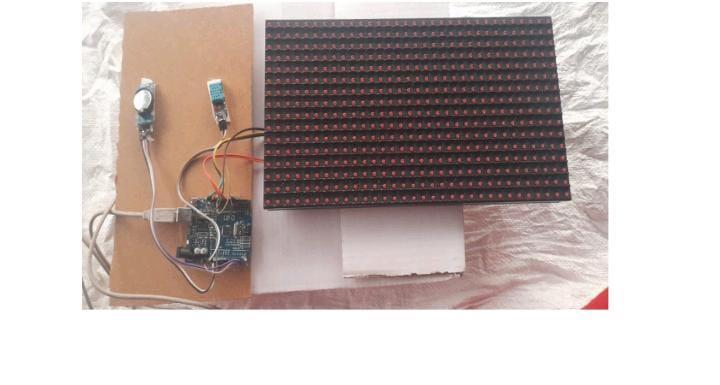
The real-time implementation of the “Smart Real-Time Clock and Temperature Display Using Arduino” project demonstrates a seamless integration of timekeeping and environmental monitoring in a compact and efficient system. The prototype is assembled by interfacing the DS1307 Real-Time Clock (RTC) module, the DHT11 temperaturesensor,andaP10LEDdisplaypanelwiththe Arduino UNO microcontroller. Once the hardware is connectedandthesoftwareisuploaded,thesystembegins operating autonomously, continuously retrieving and displayingaccuratetimeandtemperaturedata.
In a live environment, the DS1307 RTC module maintains precise real-time tracking of hours, minutes, and seconds, even in the absence of external power, thanks to its internal battery backup. This ensures the system does not lose track of time during power outages. The Arduino reads the current time at regular intervals and formats it for human readability. Simultaneously, the DHT11sensormonitorsthesurroundingtemperatureand sends the data to the Arduino, which processes it and preparesitfordisplay
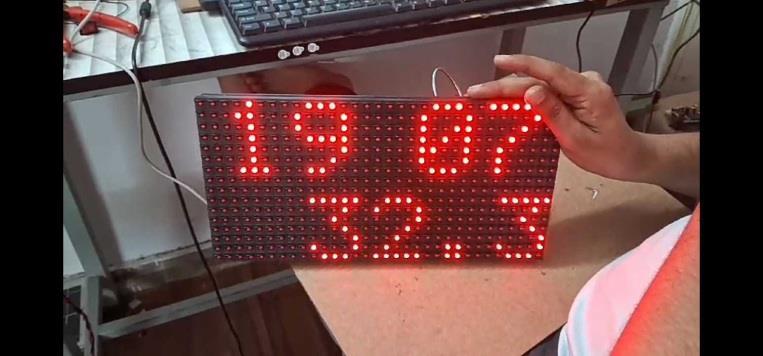
The collected data is presented on the P10 LED display panel in a scrolling or static format. For instance, the time might appear as “Time: 14:35” followed by “Temp:30°C”,repeatinginalooptoensureclearvisibility totheusers.Thedisplayisbrightandreadableevenfrom a distance, making it suitable for deployment in schools, offices, railway stations, hospitals, and public information centers. This real-time visualization provides instant access to essential data without any need for manual interactionorupdates.Duringoperation,theArduinoruns a continuous loop that checks for updates from the RTC and DHT11 sensor without delays, thanks to the use of efficientprogrammingtechniquessuchastimerinterrupts and non-blocking code execution. This ensures that the display remains responsive and up-to-date at all times. Moreover, the modularity of the system allows for easy calibrationorreplacementofcomponentswithoutaltering the core functionality.The success of the real-time implementationisevidentinitsaccuracy,consistency,and
clarity of displayed information. It serves as a practical example of how embedded systems can be utilized for real-time data monitoring and display. Furthermore, the system is scalable; additional features such as humidity display, Wi-Fi data logging, or alert mechanisms can be incorporated to enhance functionality for different use cases.
5. Simulations
6. ADVANTAGES
1.Accurate Timekeeping:
UtilizestheDS1307RTCmodulewhichmaintains precisetimeevenduringpowerfailuresduetoits built-inbatterybackup.
2.Real-Time Temperature Monitoring:
Constantly displays the ambient temperature using the DHT11 sensor, making it suitable for environments where temperature awareness is important.
3.Clear Visual Display:
The P10 LED display provides bright, large, and easily readable text visible from a distance, ensuringeffectiveinformationdelivery.
4.Energy Efficient:
The system consumes minimal power, making it suitableforcontinuous24/7operation.
5.Low Cost and High Efficiency:
Built with inexpensive, easily available components, the system is cost-effective while offeringessentialfunctionality.
6.Simplicity and Modularity:
Designed using modular components and opensource software, allowing for easy replication, troubleshooting,andupgrades.
International Research Journal of Engineering and Technology (IRJET) e-ISSN: 2395-0056
Volume: 12 Issue: 04 | Apr 2025 www.irjet.net p-ISSN: 2395-0072
7.Standalone Operation:
Operates independently using the Arduino UNO without the need for a computer or external processingunit.
8.Scalability and Customization:
Can be enhanced with additional sensors (e.g., humidity, air quality) or integrated with IoT platformsforremotemonitoring.
9.Educational Value:
Serves as an excellent learning project for students and hobbyists interested in embedded systems,electronics,andprogramming.
10.Reliable Performance:
Offers consistent and stable operation in various conditions, thanks to the reliable hardware and softwareintegration.
largeandluminous, enhancesvisibility, makingitsuitable forpublicareasorlong-distanceviewing.
The Arduino UNO acts as the central controller, orchestrating the entire system by collecting real-time clock data from the DS1307, fetching temperature readingsfromtheDHT11,andformattingthisinformation for display on the P10 panel. The software developed for this project plays a key role in system coordination. Written in Arduino IDE using C/C++ language, it ensures that the display is continuously updated and the information is correctly formatted. It also allows for easy customization, enabling users to add additional functionalities like humidity monitoring, remote updates, or even internet-based synchronization through Wi-Fi modules.
8.
In today’s fast-paced world, the need for efficient and real-time display systems is more critical than ever, particularlyineducationalinstitutions,industrialfacilities, publicvenues,andsmarthomeenvironments.Thisproject titled “Smart Real-Time Clock and Temperature Display Using Arduino” addresses this necessity by integrating fundamental electronic components DS1307 RTC, DHT11 temperature sensor, and P10 LED display panel withtheArduinoUNOmicrocontrollertodeliverarobust, scalable, and low-cost solution for displaying real-time clockandtemperaturedata.
Thesystem providesa user-friendlyandaccurate way to display time and ambient temperature on a large, visible interface. Through this project, we successfully demonstratedhowareal-timeembeddedsystemcouldbe constructed using easily accessible components, opensource platforms, and basic programming skills. The inclusion of a Real-Time Clock (RTC) ensures that timekeepingremainsaccurateevenwhenthemainpower supply is turned off, thanks to the onboard battery. This feature is vital for applications that require continuous time monitoring, such as schools, hospitals, factories, and offices. The DHT11 sensor used for temperature monitoring gives a simple and efficient method for tracking ambient environmental conditions. Although the sensor has its limitations in terms of precision and range, it serves the purpose effectively in environments where extremely precise temperature measurements are not critical. The sensor constantly measures the temperature and sends the data to the Arduino UNO, which processes andrelaysittotheP10display.TheP10LEDmatrix,being
Oneofthesignificantachievementsofthisproject is its cost-effectiveness. The components used are affordable, widely available, and compatible with opensource platforms, making the system accessible to a wide range of users. Furthermore, the system is designed with simplicity and modularity in mind, allowing for easy maintenance, upgrades, and scalability. For instance, additionalP10panelscanbeaddedtoincreasethedisplay area, or wireless modules like ESP8266 or ESP32 can be introducedforIoT-basedapplications.
This project also holds educational value as it combines both hardware and software aspects of embedded systems. Students and hobbyists working on this project can gain practical experience in sensor integration, microcontroller programming, real-time systems, and display technology. It provides a hands-on learning opportunity for understanding how real-time data acquisition and display systems work, fostering innovationandencouragingfurtherexperimentation.
In terms of real-world implementation, this system can be installed in school corridors to display the current time and room temperature, which are essential for scheduling and comfort. In industrial zones, it can assist workers in monitoring environmental conditions to ensure safety and compliance. Similarly, in smart homes, the setup can contribute to better control and monitoring of internal climate conditions. The modular architecture ensuresthatitcanbecustomizedforvariousdomainsand specificrequirements.
Despite its many advantages, the project does have scope for future enhancements. For instance, the DHT11 sensor can be replaced with a more accurate sensorlikeDHT22orBMP280toimprovetheprecisionof temperature readings. The current setup can also be extended with wireless connectivity to enable remote monitoringanddatalogging,enhancingitsfunctionalityin smartIoT ecosystems.Integration withsolar powercould
International Research Journal of Engineering and Technology (IRJET) e-ISSN: 2395-0056
Volume: 12 Issue: 04 | Apr 2025 www.irjet.net p-ISSN: 2395-0072
alsobe exploredto make thesystem energy-independent, especiallyinoutdoororremotelocations.
In conclusion, the Smart Real-Time Clock and Temperature Display System using Arduino is an innovative, reliable, and practical solution that successfully meets the goals of real-time environmental data display. By combining fundamental electronic components with efficient software and a user-centric design, this system serves as a model for future smart display technologies. Its affordability, ease of use, and adaptability make it an ideal project for educational, industrial, and home automation purposes. The project not only fulfills its technical objectives but also promotes the broader goal of making technology accessible and usefulfordailylife.
[1] Arduino. (n.d.). Arduino Uno Rev3. Retrieved from https://store.arduino.cc/products/arduino-uno-rev3
[2] Adafruit. (n.d.). DHT11 Temperature and Humidity Sensor Datasheet. Retrieved from https://cdnshop.adafruit.com/datasheets/DHT11.pdf
[3] Microchip Technology. (2008). DS1307 Real-Time Clock (RTC) with I²C Interface. Retrieved from https://datasheets.maximintegrated.com/en/ds/DS1307. pdf
[4] Electropeak.(n.d.). HowtoUseP10LEDDisplayModule with Arduino. Retrieved from https://electropeak.com/learn/interfacing-p10-leddisplay-module-with-arduino/
[5] Arduino Project Hub. (n.d.). Arduino Real Time Clock with DS1307. Retrieved from https://create.arduino.cc/projecthub/projects
[6] Tutorials Point. (n.d.). Interfacing DHT11 Sensor with Arduino. Retrieved from https://www.tutorialspoint.com/arduino/arduino_tempe rature_sensor.htm
[7] Circuit Digest. (n.d.) Displaying Real Time Clock and TemperatureonLEDDisplayUsingArduino.Retrievedfrom https://circuitdigest.com/microcontroller-projects/realtime-clock-ds1307-and-temperature-on-p10-led-displayusing-arduino
[8] Instructables.(n.d.). Real Time Clock and Temperature on LED Matrix Using Arduino. Retrieved from https://www.instructables.com
[9] Open Source Hardware and Software. (n.d.). P10 LED Display Technical Specifications. Retrieved from manufacturer datasheets or resellers like https://www.electronicscomp.com
[10] Banzi, M., & Shiloh, M. (2014). Getting Started with Arduino: The Open Source Electronics Prototyping Platform (3rded.).MakerMedia,Inc.