
International Research Journal of Engineering and Technology (IRJET) e-ISSN: 2395-0056
Volume: 13 Issue: 05 | May 2026 www.irjet.net p-ISSN: 2395-0072
International Research Journal of Engineering and Technology (IRJET) e-ISSN: 2395-0056
Volume: 13 Issue: 05 | May 2026 www.irjet.net p-ISSN: 2395-0072
Koushik R1, Dr Kavitha A S2, Jayanth Gowda H M3, Prashanth L R4, Shreekanth K5
Department of Artificial Intelligence and Machine Learning, East West Institute of Technology, Bengaluru, India ***
Abstract- Skipping meds causes big problems, especially for older adults or those with memory issues. A new gadget helps by tracking pills through timing cues plus real-time checks. Alarms sound when it is time, repeating if nobody reacts. Instead of guessing, the device notices change in weight to confirm a dose was taken. Cameras add another layer, watching actions to back up the data. A camera setup might be added later to double-check medicine use by watching with smart image tools. When pills get skipped, alerts go out to helpers - those people can log taken doses themselves on a screen too. Testing happens online in a mock version that checks if reminders fire right, spotting when meds are taken, plus how it reacts after. This method works well now - it handles live tracking without big costs while staying flexible for growth
Key Words: Smart pill box, load cell, HX711, ESP32, RTC, medication adherence, cognitive impairment, IoT healthcare, em-bedded systems, weight-based detection., computer vision, AIML, caregiver monitoring, simulation-based validation
Sticking to a medicine routine really matters when handling long-term health conditions [7], [8]. Getting the correct pill at the exact time and amount doctors say keeps things on track. Still, older people - particularly if they have trouble thinking clearly because of illnesses like Alzheimer’s or dementia - can find it hard to keep up. Problems remembering might cause them to skip a dose, take onelate,orevengrabtwobymistake.Thatkindofmix-up couldtriggerdangerouseffectsontheirbody.
Halfofthoseonlong-termtreatmentsinwealthiernations do not follow their prescribed plans, reports the World Health Organization [1]. Worse still - people struggling withmemoryorthinkingfaceevengreaterchallenges.Labelled pill boxes show up a lot, so do notes and family watching over them; yet these tools too frequently fall shortwhenitcomestosteady,trustworthyuse[9],[11].
Thanks to progress in Internet-connected devices, tools now help people handle their medicine schedules more easily[10].Usually,thesesetupsdependondetectors andwirelesspartstotrackwhenpillsaretaken.Still,many currentoptionsleanonclueslikeacontainerbeingopened or someone saying they took it - neither proves the dose wastrulyswallowed.
So it happens that a smarter way is needed - something steadyenoughtonudgepeopleattherighttimewhilequietlymakingsurepillsareactuallytaken.
Back then,medicinealerts reliedonbasicbeepsorclock signals. As IoT grew, so did the tools - now using sensors, live signal transfers, and stored records to shape smarter healthsupport.
From Khan et al. [2], a smart pillbox links to the cloud via Arduino and ESP8266, sending updates on medicine intake. Real-time monitoring works well - yet pressing buttonsisrequiredeachtime.Forthosestrugglingtorememberthings,suchstepscouldbecomeaproblem.Interaction stayshands-on,limitingeaseforcertainusers.
Out in the field, Vimal and team [3] built a clever pill box thatsendssignalsfarawayusingLoRatech.Eventhoughit workswellwherenetworksareweak,itsmethodwaitsfor user actions before recording - meaning missed doses mightgounnoticed.
Haqueandteam[4]builtapilltrackerusingIoT,linkedto phones for alerts and logs. Still, every dose needs manual check-in,whichtripsupifsomeoneoverlookstheprompt.
Camera footage helps spot pill-taking by watching hands move,sayPhanandteam[5].Thoughspottinggetssharper this way, the system demands more computing muscle. Costsclimbalongsidepowerneeds.Everydayuseathome becomestougherundertheseconditions.
International Research Journal of Engineering and Technology (IRJET) e-ISSN: 2395-0056
Volume: 13 Issue: 05 | May 2026 www.irjet.net p-ISSN: 2395-0072
A setup shown by Maria [6] uses weight sensors along withrulesorsmartmethodstospotthingsmoreaccurately. Even if it works better, linking several sensors and complexcomputingmakesthewholethinghardertomanagepluspriciertobuild.
Looking at those studies, you see a pattern - boxes get opened, people click confirmations, sensors pile up. Most setups depend on signs like these instead of proof someone swallowed the pill. Some fixes miss real verification entirely. Others bring steep prices along with tangled designs.
Built right, such a setup must catch threats without constant oversight. Yet it should run smoothly where people actually work. Not too heavy on steps. Still sharp when neededmost.
Some smart pillboxes use tiny computers inside them, alongwithsensorsthattrack whena compartmentopens. Yetevenwithalarmsbuiltin,theydonotalwaysworkwell forpeoplewhostruggletorememberthingsclearly.Wireless signals let them connect elsewhere, sending data automatically.Thoughbetterthanpaperlogs,gapsremainin how they support those with thinking difficulties. Their designoftenmissesrealdailychallengesfacedathome.
Most people rely on sensors attached to pill bottle lids to track when the container opens. Even so, just because the cap moves don’t mean a dose was taken. Sometimes individualsliftthelidbutskipswallowingthepill.Othertimes theypulloutpillstouseatanothermoment.
Pressingabuttonorreplyingviaanappoftenservesasthe way people log meds. Still, remembering to do it every time can slip, especially when thinking gets harder. Dependence on routine fades when minds struggle to keep pace.
Mostpeoplerelyonalertsystemslikephonepingsorloud beeps.Thoughtiminggetseasierwithsuchcues,there'sno real proof a pill was swallowed. Skipping sounds happens often, putting off meds slips by unnoticed, sometimes checkmarks appear even when nothing went into the mouth - so records lie flat. These signals organize momentsbutfailattruthkeeping.
Camera setups paired with smart algorithms now check if patients take pills correctly. Even though accuracy gets a boost, expenses climb alongside energy needs. Privacy
questionspopupalongwithtangledsetupdemands.These factorsslowdownhowoftenpeopleadoptthemathome.
Most current setups depend on clues that aren’t direct, demand constant input from users, yet they still lean on pricey,complicatedtech.Thegapshowsclearlywhensimpler, dependable options are missing despite clear demand.
The proposed system is a smart medication monitoring solution that helps patients with cognitive impairment keep track of their medication schedules. It combines scheduled reminders, weight-based detection, visionassisted verification (for future improvement), and caregiverinteractiontomakesurepatientstaketheirmedicine reliably.
At scheduled medication times, the system triggers an alert using a buzzer and visual signals. If the patient does not respond, the system sends repeated notifications at intervals until someone responds or a set time limit is reached.
When the patient takes their medication, the system detects tablet removal by measuring weight changes inside the pill container. This method is more dependable than traditionalapproacheslikeliddetectionormanualchecks. The system figures out if a tablet has been taken by comparingtheweightbeforeandafterthescheduledtime.
To further improve reliability, a vision-based verification moduleissuggestedforfutureuse.Inthismethod,a cameraactivatesonlyduringmedicationeventsafterdetecting tablet removal. The recorded data can be checked with computervisiontechniquestoconfirmwhetherthepatient hasactuallyconsumedthemedication,whichhelpstellthe difference between taking the tablet and simply removing it.
If there is no response within the set time frame, the system marks the event as a missed dose and notifies the caregiver.Thecaregivercanmanuallyconfirmifthemedication was taken using a user interface, especially if the patientisnotnearthedevice.
All medication events, including the time, status (taken, not taken, or missed), and type of verification, are logged andstoredformonitoringandreview.Thesystem'sworkflow is tested using a web-based simulation environment, which shows reminder activation, intake detection, verificationlogic,andcaregiverinteraction.
International Research Journal of Engineering and Technology (IRJET) e-ISSN: 2395-0056
Volume: 13 Issue: 05 | May 2026 www.irjet.net p-ISSN: 2395-0072
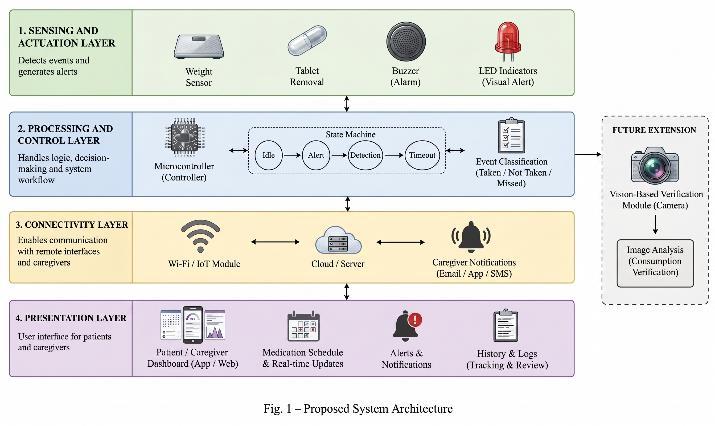
The proposed system has a layered structure with four main components: the sensing and actuation layer, the processing and control layer, the connectivity layer, and thepresentationlayer.Thismodulardesignallowsforflexibility, scalability, and easy future implementation since eachlayerworksindependently.
This layer detects system events and generates alerts. It uses weight-based sensing to identify when a tablet is removedandincludesanalertmechanismwithabuzzerand visual indicators. The system continuously checks weight changesduringscheduledmedicationtimestoseeifatablethasbeenaccessed.Alertsgooffatsetintervalsandrepeatifnoresponseisreceived.
5.2
The processing layer handles the overall system logic and decision-making. It controls the workflow, including activatingreminders,managingrepeatedalerts,detectingtablet removal, and classifying events (taken, not taken, or missed). The system runs through defined states like idle, alert, detection, and timeout, ensuring orderly and dependableexecution.
5.3 Connectivity Layer
This layer allows communication between the system and outside interfaces. Medication events, including timestampsandstatuses,aresenttoaremoteinterfacefor monitoring.Itsupportsreal-timeupdatesandsendsnotifications to caregivers if doses are missed or if there are unusualconditions.
5.4 Presentation Layer
The presentation layer offers a user interface for patients and caregivers. It shows medication schedules, real-time updates, and alerts. Caregivers can monitor patient activities from afar and manually confirm when medication is taken if needed. The interface also keeps a record of past eventsfortrackingandreview.
5.5
In the future, a camera-based verification module can be addedtothesystem.Thismoduleactivatesduringmedicationeventsandusesimageanalysistoconfirmactualconsumption.Thisadditionwillimprovethesystem'sreliability by clearly distinguishing between tablet removal and intake.
Theproposedsystemcanbesetupusingavarietyoflowcost and common hardware components. The design supports weight detection, alert generation, and connectivity for real-time monitoring. The hardware setup might be developedinthefutureasanextensionofthecurrentsimulation-basedsystem.
A load cell measures the weight of the pill container. The analogsignalfromtheloadcellisamplifiedandconverted intodigitalformusinganHX711analog-to-digitalconverter. This allows for precise measurement of small changes inweightwhentabletsareremoved.
6.2
A real-time clock (RTC) module, like the DS3231, can be added to keep accurate timing for medication schedules. This ensures that alerts trigger at set intervals, even after systemrestartsorpoweroutages.
6.3
Amicrocontroller,suchastheESP32orsomethingsimilar, canmanagesystem tasks.Thisincludesprocessingsensor data, controlling alerts, and handling communication. The controller runs the logic for medication detection and overallsystemfunction.
6.4
ThesystemcanhaveabuzzerandLEDindicatorstonotify usersatscheduledtimes.Thevisualandaudioalertsmake suretheuserreceivesmedicationreminders.
Wirelesscommunication,suchasWi-Fi,cantransmitmedication data to a remote interface. This enables caregivers tomonitorpatientactivitiesinrealtime.
International Research Journal of Engineering and Technology (IRJET) e-ISSN: 2395-0056
Volume: 13 Issue: 05 | May 2026 www.irjet.net p-ISSN: 2395-0072
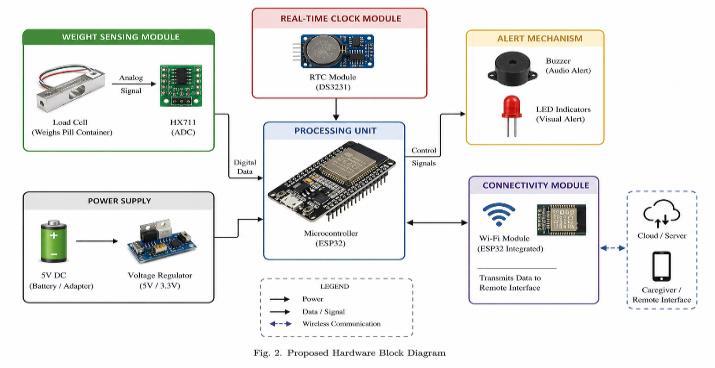
Fig-2: ProposedHardwareBlockDiagram
TABLE -1: ProposedComponentsandSpecifications
Component Model/Type KeySpecifications
LoadCell StrainGauge LoadCell
ADCModule HX711
Real-Time Clock(RTC) DS3231
Capacity:1–5 kg;Sensitivity:~1.0–2.0 mV/V;Accuracy:±0.03% FS
24-bitADC; Gain: 32/64/128; Supply:2.6–5.5V
Accuracy: ±2ppm; Battery backup;I2C interface
Microcontroller ESP32
Buzzer ActiveBuzzer
LEDIndicator Standard LED
Connectivity Module Wi-Fi (ESP32)
PurposeinSystem
Measurespill container weight
Convertsanalog loadcellsignal todigital
Maintainsprecisemedication timing
Dual-core, 240MHz; Wi-Fi+ Bluetooth; 3.3Vlogic Controlssystemlogicand communication
Voltage:3–5 V;Sound level:~85 dB Providesaudio alerts
Voltage:2–3 V;Current: 10–20mA
IEEE802.11 b/g/n; Range:~50–100m
Providesvisual alerts
Enablesdata transmissionto remoteinterface
For a validation and system implementation purpose, a software-based simulation approach is adopted. The implementationisdividedintotwomainparts,includingsystemlogicsimulationanda web-basedinterfacefortheusers.
TheprimarylogicisembodiedinaComplextypeworkflow that emulates reminder generation, tablet detection, and response handling. The overall setting for this system is the medications schedules. Finally, at the scheduled moment, the system triggers an alerting mechanism (buzzer simulation). In the absence of a response, the alert is repeated at set intervals for a predetermined period. The repeatednotificationcanalsoguaranteethatmisseddoses arekepttoaminimum.Thelogicbehindthisweightvariation is supposed to emulate the removal of tablets. The weight values before and after the scheduled event are comparedtofindoutifthetablethasbeenaccessedornot. Ifthechangeisabovesetthresholds,thesystemdeemsthe event a tablet removal event. The system then enters the verificationstage,whichisachievedbydetectingwhenthe tabletisremoved.Finally,upondetectionoftabletremoval, the system switches into a verification stage; a visionbased verification module, where the camera is triggered in an attempt to verify the actual consumption, is considered as a future enhancement. This is done currently through predefined scenarios or by providing sample inputs. If there is no indication of tablet removal within the defined window of time, the system registers the missed doseandfiresthecaregivernotification.Thecaregivercan manually confirm the removal of medication through the user interface if the need arises. All events are recorded with timestamps and categorized as taken, not taken, and missedforfurtherprocessing.
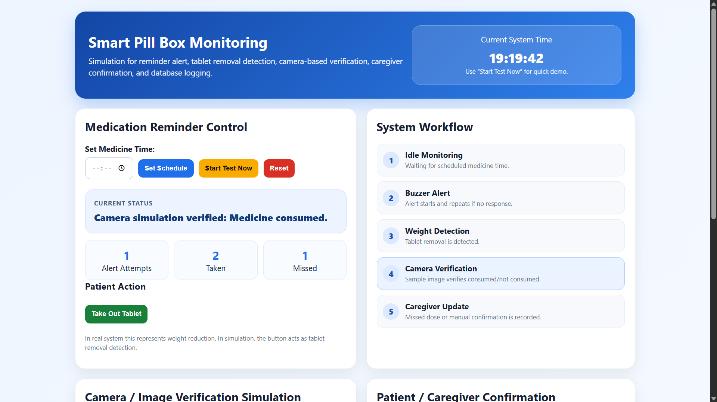
Tovisualizethesystembehaviourandsimulationresults,a web-based dashboard is developed using standard web technologies like HTML, CSS, and JavaScript. Other data representedincludesschedulesfortakingmedications,ontime alerts, and current system statuses. The dashboard providesdifferentvisualindicatorsfordifferentresults:
Green: Medication is Taken
Red: Missed dose
Yellow:Yettobeorverificationphase
Caregiverscanalsocheckonthepatient’sactivityremotely andmanuallyupdatethestatusofmedicationifnecessary. ForensicEvidenceTheories
International Research Journal of Engineering and Technology (IRJET) e-ISSN: 2395-0056
Volume: 13 Issue: 05 | May 2026 www.irjet.net p-ISSN: 2395-0072
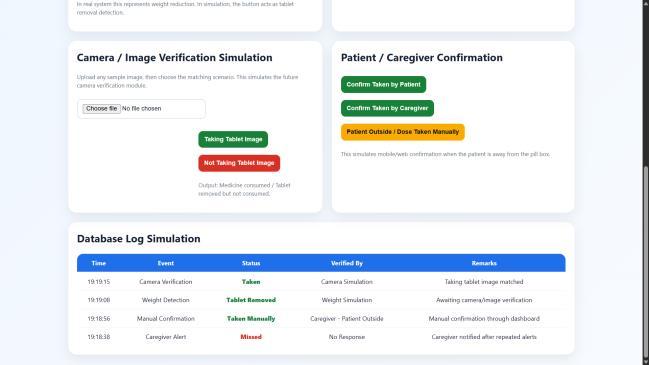
The methodology for the proposed system includes its weight-based detection capabilities, managing alerts, and decision-making based on various workflows. For this purpose, the system uses a structured approach so that propermedicationmonitoringcanbeensured.
For detection of removal of tablets, the system uses the weight-based approach. First, calibration is done in two stages. First, the variation in the baseline weight of the emptypill containerisrecordedtoeradicateoffset errors. Then, a special reference value is taken into account concerning the expected variations in the tablet weight. This calibration process ensures that the changes in weight, however small they may be, can be accurately detected anddifferentiatedfromnoise.
Threshold-based detection mechanisms determine tablet removal. The tablet-removal process is determined by using a threshold-based detection system, and at the scheduled medication time, the initial weight is noted as; This
givestheinitialweightatthetimeofscheduledmedication as:
If the weight difference calculated is more than a predefinedthreshold (the minimum expectedtablet weight), thetabletisdeemedremoved.
If, ,thenTabletremoved ,thenNotabletisremoved.
The threshold value is selected in a way that sensitivity and stability are balanced so that actual tablet removal is sure to be detected while any false detection due to noise isminimized.
Onthepredefinedtimesformedication,analertisactivated using a buzzer and visual indicators. Thereafter, the alertisrepeatedatpredefinedintervalsforacertainduration,iftheuserisinactive.Ifthereisnointeractionduring the specified window of time, the alert is temporarily stoppedandthenrestartedafterashortdelay.Thesystem operates this way until a user responds, or the event becomesrecognizedasamissed-doseincident.
The overall operation of the system is as follows in sequence;Systemisinitializedandthenentersidlemonitoring mode. Constantly monitors time and system conditions; At scheduled time, it takes initial weight , Starts buzzer and indicator as alert signals. Also, records changes in weight over a period of time. If , it is confirmed that the tablet has been removed. Starts verificationstage(vision-basedmodule–future).Itsvalueisset to 1, and the pill is marked as a missed dose if a weight change is not detected within the specified time. Sends notification tothecaregiver if necessary. Writestologfile (timestamp, status). The last step is to go back to the idle stateuntilthenextcyclestarts.
To improve on system reliability, a vision-based verificationmoduleisproposed.AfterTabletremoval isdetected, a Camera can be turned on to analyze users’ actions
International Research Journal of Engineering and Technology (IRJET) e-ISSN: 2395-0056
Volume: 13 Issue: 05 | May 2026 www.irjet.net p-ISSN: 2395-0072
through computer vision methods. This source also helps to distinguish between removing a tablet and its real consumption.
To that end, a web-based simulation was performed to validate the system’s workflow regarding whether reminders are set, the course of action following repeated alert reminder signals, the recognition of tablet removal, and the caregivers’ behaviour in interacting with the system. The scenarios differed in the time taken for a responseandthemannerinwhichthetabletswereremoved.
Differenttestscenarioswerefactoredin,andtheyincluded normal tablet intake, delayed response, and missing the tablets.Thesystembehaviourwhenusingweightvariation to confirm a tablet removal and when considering alert mechanismswasanalyzed.
To identify tablet removal, the threshold-based detection approach was used based on weight values before and after the scheduled event. The threshold was chosen based on the expected variations in the tablet weight to ensure the detection was reliable and that noise and a smallvariationinthetabletweightshaveminimumimpact onthedetectionprocedure.
Results demonstrate the system’s capacity to differentiate between tablet removal and missed doses in simulated environmentssuccessfully.Therepeatedalertprovestobe a goodmechanismtonotify theusersmorethanonce(4), ensuring that a case of missed medication is unlikely (ibid).Besides,thecaregiversarealsonotifiedtoaddmore reliability in situations where the patient is not responding.
Theproposedworkflowpresentsasolutiontothisbyeliminating the need for manual input and by creating a framework for monitoring medication. Compared to conventionalmethodsoflid-basedorbuttonconfirmation,the weight-based approach can provide more reliable confirmationoftabletaccess.
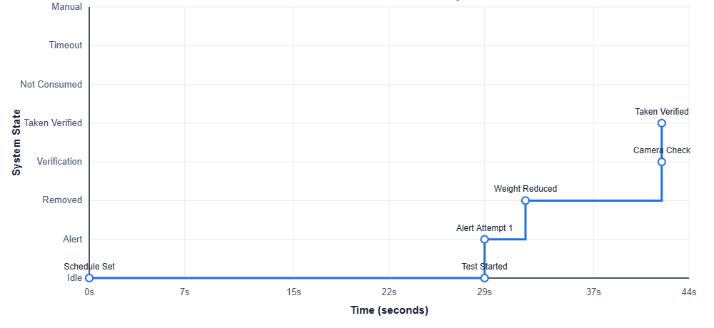
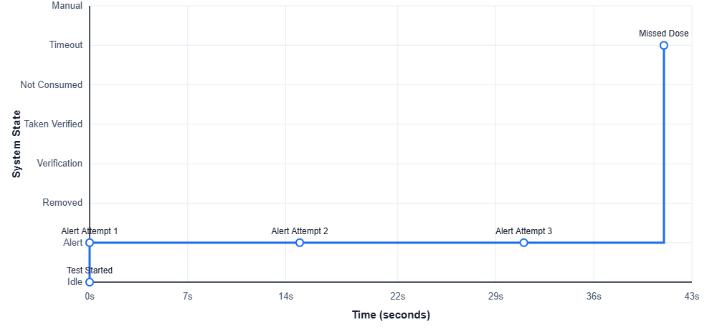
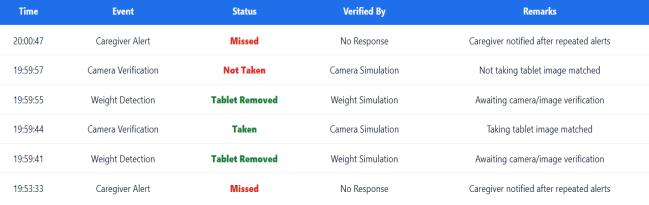
Fig-4: SimulationResults(web-based)
The comparative analysis suggests that direct indicators areeitherabsentorthereisaneedforsignificantcomplexity and costs. The proposed system is meant to offer a compromisesolutionthatbenefitsfromsimplicity,reliability, and scalability. The system can be enhanced with the introduction of the vision-based verification module (futurework),whichimprovesthereliabilityofthesystemby eliminating the ambiguity between tablet removal and actualconsumption.
Table2showsacomparisonbetweentheproposedsystem andthe existing onesbased onthedetection method, reliability,andcomplexityofthesystem.
TABLE 2: ComparativeAnalysis
System Method User Input Intake Verification Cost Limitation
Khanet al.[2] Lid/clou d Required No Medium Indirect detection
Vimalet al.[3] Pull sensor Low No
Medium Removalonly
Haque etal.[4] Button/app Required No Low Depends onuser
International
Volume: 13 Issue: 05 | May 2026 www.irjet.net p-ISSN: 2395-0072
Proposed Weight +vision simulation
The simulation results are a proof of concept for the proposedsystem’sabilitytoworkwithreal-worldmedication scenarios.Therefore,theidentifiedremindermechanisms, detection logic, and caregiver interaction form a comprehensivemonitoringsolution.
However, for now, the evaluation is limited to simulationbased validation. Real-world performance would differ whenitcomestohardwareaccuracy,environmentalsetup, anduserperformance.
Thispaperpresentedthe architectural designofa Smart Pill Box Monitoring System that aims to enhance medicationadherenceforpatientswithmemory-relatedcognitive disabilities. The entire scheme will work on planned reminders,weightdetection,andawell-definedworkflowto ensurereliablemonitoringofmedicationintake.
With this, a threshold-based detection approach is established to recognize the variations in weight to identify if the tablets were removed and is defined as: To detect the removaloftablets,athreshold-basedapproachisinitiated onthevariationofweightsandisformulatedasfollows.
Validation of the system is done through a simulationbasedapproach,showingthesystem’scapabilitiesonactivatingreminders,amechanismforrepeatedalerts,detecting intakes, and its interaction with caregivers. The proposed workflow offers a more reliable alternative to the existing workflow, which depends mainly on manual user inputs.
On the whole, the system can serve as a practical and cheaper alternative of medication monitoring, which can be deployed for the real-world scenarios, after hardware implementation.
Further work will be based on extending the system toward the real-world implementation and considering the enhancement of the reliability under the practical conditions. The hardware prototype will be constructed from the most appropriate sensing components to validate the performanceofthesysteminrealenvironments.
Enhancements in detection accuracy can be achieved through better signal processing techniques including noise filtering and adaptive thresholding. Finally, integration of a mobile or web-based application with real-time notificationsand remotemanagementoftheschedulewill enhance the usability of the system by patients and caregivers.
A vision-based verification module will subsequently be introducedtoverifythatthetabletshaveindeedbeentaken and not just removed through computer vision techniques.Thiswillhelpfurtherverifythesystem’sreliability.
Furtherimprovementsmayincludecloud-baseddatastorageandanalyticsforlong-termmonitoring,aswellasmulti-sensor integration to reduce false dictions. Lastly, the systems will also be subjected to real-world validation withusers,mostspecificallyamongtheelderlypatients,to assess its general usability and performance in practical healthcarecontexts.
[1] World Health Organization, Adherence to Long-Term Therapies: Evidence for Action. Geneva, Switzerland: WHO,2003.
[2] A. Khan et al., "A Smart Medical Box for Medical Professionals and Patients for Helping Them to Avail TimelyMedication," inProc. IEEEInt.WomeninEngineering (WIE) Conf. on Electrical and Computer Engineering (WIECON-ECE), Chennai, India, Dec. 2024, pp.321-325, doi:10.1109/WIECONECE64149.2024.10914895.
[3] S. Vimal et al., "A Smart Pill Dispenser with Real Time Alerts, Remote Access, and Enhanced Safety," in Proc. Int. Conf. on Computing and Intelligent Reality Technologies (ICCIRT), 2024, pp. 39–43, doi: 10.1109/ICCIRT59484.2024.10921885.
[4] Md. S. S. Haque et al., "Design and Implementation of an IoT-based Smart Pillbox for Improving Medical Adherence," in Proc. 17th Int. Conf. on Electronics Computer and Computation (ICECCO), Kaskelen, Kazakhstan, Jun. 2023, doi: 10.1109/ICECCO58239.2023.10147144.
[5] H. T. T. Phan et al., "IoT and AI-Enabled Smart Pillbox forMedicationReminderandIntakeMonitoringinthe Elderly," inProc.10thInt.Conf.onResearchinIntelligent Computing in Engineering (RICE), 2025, doi: 10.1109/RICE67503.2025.11439972.
International Research Journal of Engineering and Technology (IRJET) e-ISSN: 2395-0056
Volume: 13 Issue: 05 | May 2026 www.irjet.net p-ISSN: 2395-0072
[6] A. Maria, "AI Medication Adherence System Using an IoTSmartPillBox,"TechnicalReport,ImmaculateCollegeforWomen,Cuddalore,India,2024.
[7] L. Osterberg and T. Blaschke, "Adherence to medication,"NewEnglandJournalofMedicine,vol.353,no.5, pp.487–497,Aug.2005.
[8] B. Vrijens et al., "A new taxonomy for describing and defining adherence to medications," British Journal of ClinicalPharmacology,vol.73,no.5,pp.691–705,May 2012.
[9] D. S. Abdul Minaam and M. Abdelfattah, “Smart drugs: Improvinghealthcareusingsmartpillboxformedicine reminder and monitoring system, Future Computing andInformaticsJournal,vol.3,no.1,pp.1–5,2018.
[10] A. Al-Fuqaha et al., "Internet of Things: A survey on enabling technologies, protocols, and applications," IEEE Communications Surveys and Tutorials, vol. 17, no.4,pp.2347–2376,2015.
[11] R. Turjamaa, S. Kapanen, and M. Kangasniemi, "How smart medication systems are used to support older people's drug regimens: A systematic literature review," Geriatric Nursing, vol. 41, no. 6, pp. 677–684, 2020.
[12] T.Pateletal.,"Anin-homemedicationdispensingsystemtosupportmedicationadherenceforpatientswith chronic conditions in the community setting," JMIR FormativeResearch,vol.6,no.5,p.e34906,2022.
[13] S. K. Saha et al., "An IoT based smart medicine dispenser model for healthcare," in Proc. Int. Conf. on Computer, Communication, Chemical, Materials and ElectronicEngineering(IC4ME2),2021,pp.1-5.
[14] EspressifSystems,ESP32TechnicalReferenceManual, v5.1,2023.[Online].Available:https://www.espressif.co m/documentationAccessed:Apr.2026.
© 2026, IRJET | Impact Factor value: 8.315 | ISO 9001:2008 Certified Journal | Page261