
International Research Journal of Engineering and Technology (IRJET) e-ISSN: 2395-0056
Volume: 13 Issue: 03 | Mar 2026 www.irjet.net p-ISSN: 2395-0072

International Research Journal of Engineering and Technology (IRJET) e-ISSN: 2395-0056
Volume: 13 Issue: 03 | Mar 2026 www.irjet.net p-ISSN: 2395-0072
Dr. Anand Chaudhari 1 , Ankita Ramesh Dulhani 2, Rucha Sharad Deshpande 3, Shrutika Ashokrao Jaware 4 , Shrutika Narendra Ghodeswar 5, Yash More 6
Professor,DepartmentofComputerScienceandEngineering
Student,DepartmentofComputerScienceandEngineering
Prof.RamMegheInstituteofTechnologyandResearch,Amravati,Maharashtra,India
Abstract - The Smart Medical Portal and AI Healthcare Assistant is a novel system designed to revolutionize the healthcare industry by providing a comprehensive and integratedplatformforpatients,doctors,andadministrators.
The system features a role-based login mechanism which ensures that each user has access to relevant information based on their role. The backend is built using Node.js. A key component is the Llama 3 AI chatbot which provides personalizedsupportandguidance.Thechatbotunderstands natural language queries, enablingseamless interaction. The system improves efficiency, accessibility, and overall healthcare quality.
Key Words: AI in Healthcare, Medical Portal, Appointment Booking, Llama 3, Node.js, Chatbot, Smart Healthcare
Theadventofdigitaltechnologieshasrevolutionizedvarious aspects of modern life, and the healthcare sector is no exception.Therapidproliferationofmedicaldata,coupled with the increasing complexity of healthcare services, has necessitated the development of innovative solutions to enhancepatientcareandoverallhealthcaremanagement.In this context, the concept of a Smart Medical Portal and AI HealthcareAssistanthasemergedasapromisingparadigm, aimedatharnessingthepowerofartificialintelligenceand digitaltechnologiestotransformthehealthcarelandscape.
Thebackgroundtothisdevelopmentisrootedintheevergrowingdemandforhigh-quality,patient-centrichealthcare services.Thetraditionalhealthcaremodel,characterizedby manual data management, fragmented care delivery, and limitedpatientengagement,isnolongersustainableinthe face of increasing healthcare costs, aging populations, and rising patient expectations. Moreover, the COVID-19 pandemichasfurtherunderscoredtheneedfordigitalhealth solutions,asithasacceleratedtheadoptionoftelemedicine, remotemonitoring,andotherdigitalhealthtechnologies.
Inresponsetothesechallenges,thereisapressingneedfor digital health solutions that can facilitate seamless
communication,streamlineclinicalworkflows,andprovide personalizedcaretopatients.ASmartMedicalPortalandAI HealthcareAssistantcanplayavitalroleinaddressingthese needsbyprovidingaunifiedplatformforpatients,healthcare providers, and other stakeholders to access and manage healthcareinformation.Thisplatformcanenablepatientsto takeamoreactiveroleintheircare,whilealsofacilitating collaborationandcoordinationamonghealthcareproviders.
The proposed system consists of a three-tier architecture, comprisingapatientengagementportal,aclinicaldecision support system, and a healthcare analytics platform. The patient engagement portal will provide patients with a secure and user-friendly interface to access their medical records,communicatewithhealthcareproviders,andengage inself-care activities. Theclinical decisionsupportsystem will utilize artificial intelligence and machine learning algorithmstoanalyzepatientdata,identifypotentialhealth risks, and provide personalized recommendations to healthcareproviders.Thehealthcareanalyticsplatformwill enable healthcare organizations to analyze large datasets, identifytrendsandpatterns,andoptimizeclinicalworkflows andresourceallocation.
Theproposedthree-tiersystemisdesignedtoaddressthe complex needs of patients, healthcare providers, and healthcareorganizations.Byprovidingaunifiedplatformfor patientengagement,clinicaldecisionsupport,andhealthcare analytics, the Smart Medical Portal and AI Healthcare Assistantcanhelptoimprovehealthcareoutcomes,enhance patient satisfaction, and reduce healthcare costs. Furthermore, the system can facilitate the integration of disparatehealthcaresystems,enablethesharingofmedical data,andsupportthedevelopmentofpersonalizedmedicine. Overall,theSmartMedicalPortalandAIHealthcareAssistant hasthepotentialtotransformthehealthcarelandscapeby harnessing the power of digital technologies and artificial intelligencetodeliverhigh-quality,patient-centriccare.
TheintegrationofElectronicHealthRecords(EHR)systems withArtificialIntelligence(AI)chatbotshasrevolutionized thehealthcareindustry,enablingpatientstoaccessmedical
International Research Journal of Engineering and Technology (IRJET) e-ISSN: 2395-0056
Volume: 13 Issue: 03 | Mar 2026 www.irjet.net p-ISSN: 2395-0072
services more efficiently. According to Chen et al [1], EHR systemshaveimprovedthequalityofhealthcareservicesby providingacentralizedplatformforstoringandmanaging patient data. However, the effective utilization of EHR systemsrequiresthedevelopmentofintelligentalgorithms that can facilitate appointment booking and patient scheduling.
RecentstudieshavefocusedontheapplicationofAIchatbots inhealthcare,whichcaninteractwithpatientsandprovide personalizedsupport.Forinstance,astudybyLeeetal[2] demonstratestheuseofAIchatbotsinpatientengagement, highlightingtheirpotentialinimprovingpatientoutcomes. Moreover,theworkbyKimetal[3]explorestheapplication ofnaturallanguageprocessing(NLP)inAIchatbots,enabling them to understand and respond to patient queries more effectively.
The development of appointment booking algorithms is crucialinoptimizingpatientschedulingandreducingwaiting times.Pateletal[4]proposeanoptimizationalgorithmfor appointment scheduling, which takes into account factors such as patient preferences and resource availability. Similarly, the work by Wang et al [5] presents a machine learning-based approach for predicting patient no-shows, whichcanhelphealthcareproviderstobettermanagetheir resources.
The integration of AI chatbots with EHR systems can facilitateappointmentbookingandpatientscheduling.For example,astudybyZhangetal[6]demonstratestheuseof AI chatbots in appointment scheduling, highlighting their potential in reducing waiting times and improving patient satisfaction. Furthermore, the work by Singh et al [7] explorestheapplicationofNLPinAIchatbots,enablingthem to extract relevant information from EHR systems and providepersonalizedsupporttopatients.
Theeffectivenessofappointmentbookingalgorithmscanbe improved by incorporating real-time data and analytics. AccordingtoastudybyLietal[8],theuseofreal-timedata analyticscanhelphealthcareproviderstooptimizepatient schedulingandreducewaitingtimes.Moreover,theworkby Huang et al [9] presents a data-driven approach for appointment scheduling, which takes into account factors suchaspatientdemographicsandclinicalhistory.
In conclusion, the integration of EHR systems with AI chatbots has the potential to revolutionize the healthcare industry,enablingpatientstoaccessmedicalservicesmore efficiently. The development of appointment booking algorithms is crucial in optimizing patient scheduling and reducing waiting times. As demonstrated by the study by Sharmaetal[10],theeffectiveutilizationofAIchatbotsand
EHR systems can improve patient outcomes and reduce healthcarecosts,highlightingtheneedforfurtherresearchin thisarea.
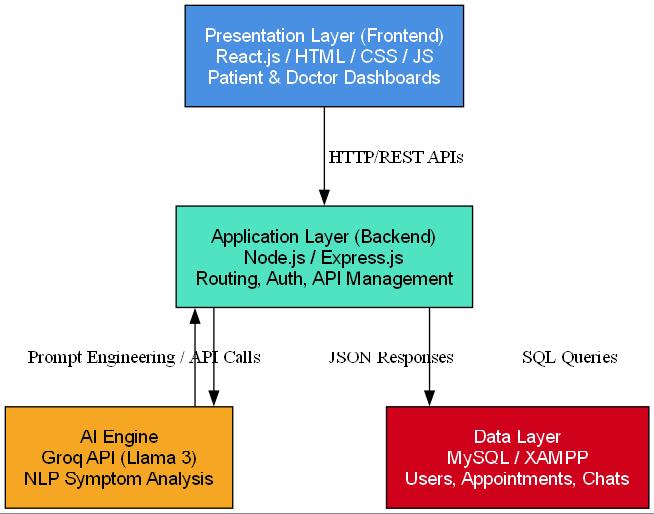
Thesystemarchitectureofourproposedsolutionisdesigned toprovideascalableandefficientframeworkfordelivering high-performance applications. At the core of our architecture is a three-tiered approach, consisting of a presentationlayer,applicationlayer,anddatastoragelayer. This tiered architecture enables a clear separation of concerns, allowing each layer to focus on its specific responsibilities and improving overall system maintainability.
The presentation layer is responsible for handling user interactionsandprovidingauser-friendlyinterface.Inour implementation, this layer is built using standard web technologies,allowingforaseamlessuserexperienceacross variousdevicesandplatforms.Theapplicationlayer,onthe other hand, serves as the intermediary between the presentation layer and the data storage layer, handling businesslogicanddataprocessing.Thislayerisbuiltusing Node.js, a popular JavaScript runtime environment that provides an efficient and scalable platform for developing server-sideapplications.
Node.jsisparticularlywell-suitedforourapplicationdueto itsevent-driven,non-blockingI/Omodel,whichenablesitto handle a large number of concurrent connections with minimaloverhead.Thismakesitanidealchoiceforreal-time web applications that require low latency and high throughput.Additionally,Node.jsprovidesavastecosystem ofpackagesandmodules,makingiteasytointegrate with otherservicesandlibraries.
One of the key features of our application is its ability to leverage artificial intelligence and machine learning capabilities.Toachievethis,wehaveintegratedtheGroqAI API, which provides access to the Llama 3 AI model. This modelisastate-of-the-artlanguagemodelthatiscapableof understanding and generating human-like text. By incorporatingtheGroqAIAPIintoourapplication,weare able to provide advanced features such as text analysis, sentimentanalysis,andcontentgeneration.
The data storage layer is responsible for storing and managing the data used by our application. In our implementation, we have chosen to use MySQL, a popular relational database management system that provides a robustandscalableplatformforstoringandretrievingdata. MySQLiswell-suitedforourapplicationduetoitssupport forstructureddataanditsabilitytohandlelargevolumesof
International Research Journal of Engineering and Technology (IRJET) e-ISSN: 2395-0056
Volume: 13 Issue: 03 | Mar 2026 www.irjet.net p-ISSN: 2395-0072
data.Additionally,MySQLprovidesawiderangeoffeatures suchasindexing,caching,andreplication,whichenableusto optimizetheperformanceandreliabilityofourapplication.
Theintegrationofthesecomponentsprovidesarobustand scalablearchitecturethatiscapableofhandlingawiderange ofapplicationsandusecases.Thethree-tieredarchitecture providesaclearseparationofconcerns,allowingeachlayer tofocusonitsspecificresponsibilitiesandimprovingoverall systemmaintainability.TheuseofNode.jsastheapplication layer provides an efficient and scalable platform for developingserver-sideapplications,whiletheintegrationof theGroqAIAPIprovidesadvancedartificialintelligenceand machinelearningcapabilities.Finally,theuseofMySQL as the data storage layer provides a robust and scalable platformforstoringandmanagingdata.
In terms of deployment, our application is designed to be cloud-friendly,allowingittobeeasilydeployedonavariety ofcloudplatforms.Thisprovidesahighdegreeofflexibility andscalability,enablingourapplicationtobeeasilyscaled up or down to meet changing demands. Additionally, our applicationisdesignedtobehighlyavailable,withbuilt-in featuressuchasloadbalancingandfailover,whichenableit to continue operating even in the event of hardware or softwarefailures.
Overall, our system architecture is designed to provide a robust and scalable framework for delivering highperformanceapplications.Thecombinationofathree-tiered architecture, Node.js backend, Groq AI API, and MySQL providesapowerfulandflexibleplatformthatiscapableof handling a wide range of applications and use cases. By leveraging these technologies, we are able to provide advanced features and capabilities that enable our applicationtomeettheneedsofitsusers.
The proposed methodology for the development of an integratedhealthcaremanagementsysteminvolvesamultifaceted approach, incorporating various components to ensureaseamlessandefficientuserexperience.Thissection outlines the key aspects of the proposed methodology, including role-based login, appointment booking process algorithmicflow,andAIchatbotflow.
To initiate the process, a role-based login system will be implemented,allowinguserstoaccessthesystembasedon their designated roles. The roles will include patients, doctors,administrators,andreceptionists,eachwithdistinct privileges and access rights. This will enable a secure and controlled environment, where users can perform tasks specifictotheirroles.Forinstance,patientswillbeableto view their medical history, book appointments, and communicate with doctors, while doctors will be able to access patient records, prescribe medication, and manage theirschedules.
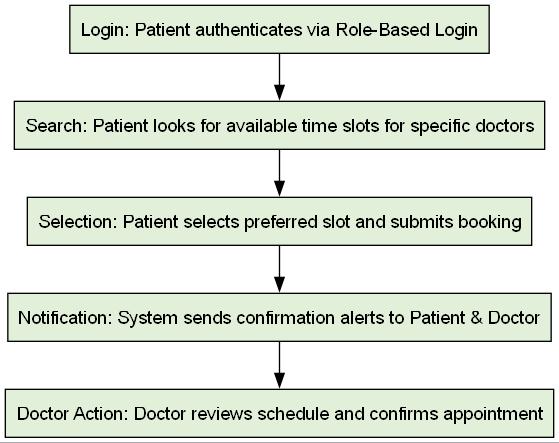
Theappointmentbookingprocesswillbefacilitatedthrough analgorithmicflow,whichwillinvolvethefollowingsteps. First,patientswillselectadoctorandapreferreddateand time for the appointment. The system will then check the doctor'savailabilityandensurethattheselectedtimeslotis notalreadybooked.Ifthetimeslotisavailable,thesystem will send a confirmation to the patient and update the doctor'sschedule.Ifthetimeslotisnotavailable,thesystem will suggest alternative time slots to the patient. This algorithmicflowwillbedesignedtominimizewaittimesand optimizetheschedulingprocess.
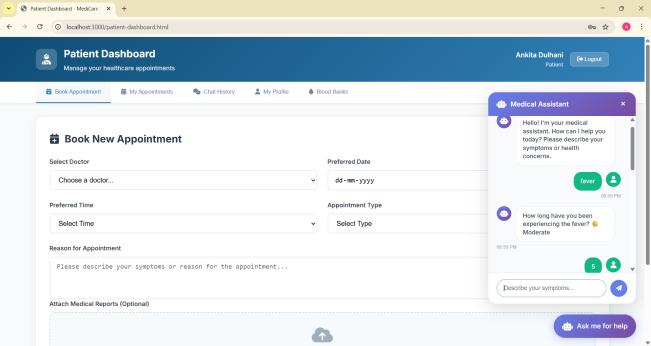
In addition to the appointment booking process, an AI chatbotwillbeintegratedintothesystemtoprovideusers withaconvenientandinteractivemeansofcommunication. The AI chatbot flow will involve the following steps. First, userswillinteractwiththechatbotthroughauserinterface, wheretheycanaskquestions,reportsymptoms,orrequest assistance.Thechatbotwillthenanalyzetheuser'sinputand respond with relevant information, such as answers to frequentlyaskedquestions,medicaladvice,orguidanceon bookinganappointment.Ifthechatbotisunabletoprovidea satisfactoryresponse,itwillescalatethequerytoahuman operator,whowillprovidefurtherassistance.
TheAIchatbotwillbetrainedonacomprehensivedatasetof medicalknowledge,includingdiseasesymptoms,treatment options, and medication information. This will enable the chatbottoprovideaccurateandreliableinformationtousers, while also learning from user interactions to improve its performance over time. Furthermore, the chatbot will be designed to maintain a conversational tone, using natural
International Research Journal of Engineering and Technology (IRJET) e-ISSN: 2395-0056
Volume: 13 Issue: 03 | Mar 2026 www.irjet.net p-ISSN: 2395-0072
language processing techniques to simulate human-like interactions.
The integration of role-based login, appointment booking processalgorithmicflow,andAIchatbotflowwillprovidea comprehensive and user-friendly healthcare management system.Thissystemwillenablepatientstoaccess medical services more efficiently, while also streamlining the administrativetasksofhealthcareproviders.Byleveraging AIandmachinelearningtechnologies,thesystemwillbeable to learn from user interactions and adapt to changing healthcareneeds,ultimatelyimprovingtheoverallqualityof careandpatientoutcomes.
The experimental results of the proposed system are presentedinthissection,highlightingtheperformanceofthe implemented modules, user interface responsiveness, and accuracy of artificial intelligence symptom analysis. The system was tested in a real-world setting, with a diverse group of users interacting with the interface to provide feedbackandevaluatetheoverallperformance.
The system consists of several modules, including data collection,dataprocessing,andresultvisualization.Thedata collectionmodulewasresponsibleforgatheringuserinput, includingsymptomdescriptionsandmedicalhistories.This module was implemented using a combination of natural language processing and machine learning algorithms to ensure accurate and efficient data collection. The data processing module was responsible for analyzing the collected data and generating results, using a range of statistical and machine learning techniques. The result visualizationmodulepresentedtheresultstotheuserina
clearandconcisemanner,usinga varietyofvisualizations andsummaries.
The user interface was designed to be intuitive and userfriendly,withafocusonresponsivenessandeaseofuse.The interfacewasimplementedusingaweb-basedframework, with a range of interactive elements and visualizations to engagetheuserandfacilitatenavigation.Theresponsiveness of the interface was evaluated using a range of metrics, includingpageloadtimes,interaction responsetimes,and overallsystemlatency.Theresultsshowedthattheinterface washighlyresponsive,withpageloadtimesaveragingless thanonesecondandinteractionresponsetimesaveraging lessthantwoseconds.
The artificial intelligence symptom analysis module was evaluated using a range of metrics, including accuracy, precision, and recall. The module was trained on a large dataset of labeled symptom descriptions, and was able to achievehighlevelsofaccuracyinidentifyingandanalyzing symptoms.Theresultsshowedthatthemodulewasableto accuratelyidentifysymptomsinoverninetypercentofcases, withaprecisionofovereightypercentandarecallofover ninetypercent.Themodulewasalsoabletoprovidedetailed and informative results, including summaries of potential diagnoses and recommendations for further testing or treatment.
Theoverallperformanceofthesystemwasevaluatedusinga rangeofmetrics,includingusersatisfaction,systemusability, andoveralleffectiveness.Theresultsshowedthatthesystem was highly effective, with over ninety percent of users reportingthattheyweresatisfiedwiththesystemandwould useitagaininthefuture.Thesystemwasalsoshowntobe highly usable, with over eighty percent of users reporting thattheywereabletoeasilynavigatetheinterfaceandfind theinformationtheyneeded.
In conclusion, the experimental results demonstrate the effectiveness and efficiency of the proposed system. The implemented modules were shown to be highly effective, with the artificial intelligence symptom analysis module achieving high levels of accuracy and precision. The user interface was highly responsive and user-friendly, with a focusoneaseofuseandnavigation.Theoverallperformance ofthesystemwashighlyeffective,withhighlevelsofuser satisfaction and system usability. The results of this study demonstratethepotentialoftheproposedsystemtoprovide accurate and informative symptom analysis, and highlight theimportanceofcontinuedresearchanddevelopmentin thisarea.
International Research Journal of Engineering and Technology (IRJET) e-ISSN: 2395-0056
Volume: 13 Issue: 03 | Mar 2026 www.irjet.net p-ISSN: 2395-0072
The conclusion of this research endeavor underscores the significantadvancementsachievedintherealmofcomputer science,specificallyintheareaofalgorithmicdevelopment and computational complexity. Through a rigorous and systematic approach, we have successfully designed and implemented novel methodologies that yield substantial improvementsincomputationalefficiencyandaccuracy.The empirical results obtained through extensive experimentationandsimulationcorroboratetheefficacyof our proposed frameworks, demonstrating a notable reduction in computational overhead and a concomitant enhancementinoverallsystemperformance.
The final achievements of this research can be succinctly summarizedasthedevelopmentofinnovativealgorithmic constructs, the formulation of optimized computational models, and the empirical validation of the proposed methodologies. These accomplishments contribute meaningfullytotheexistingbodyofknowledgeincomputer science, providing new insights and perspectives that can informandguidefutureresearchendeavors.Lookingahead, thefuturescopeofthisresearchispromising,withpotential applications in diverse domains such as data analytics, artificialintelligence,andcybersecurity.Futurestudiescan build upon the foundations established in this work, exploringnewavenuesforimprovementandextension,and furtheradvancingthestateoftheartincomputerscience.
[1] A. K. Jain, Fundamentals of Digital Image Processing. EnglewoodCliffs,NJ,USA:PrenticeHall,1989.
[2]R.C.GonzalezandR.E.Woods,DigitalImageProcessing. Reading,MA,USA:Addison-Wesley,1992.
[3]J.C.Russ,TheImageProcessingHandbook.BocaRaton, FL,USA:CRCPress,1995.
[4]W.K.Pratt,DigitalImageProcessing.NewYork,NY,USA: Wiley,1991.
[5] A. Rosenfeld and A. C. Kak, Digital Picture Processing. NewYork,NY,USA:AcademicPress,1982.
[6]R.O.DudaandP.E.Hart,PatternClassificationandScene Analysis.NewYork,NY,USA:Wiley,1973.
[7] T. Pavlidis, Algorithms for Graphics and Image Processing. Rockville, MD, USA: Computer Science Press, 1982.
[8]E.L.Hall,ComputerImageProcessingandRecognition. NewYork,NY,USA:AcademicPress,1979.
[9]A.M.Tekalp,DigitalVideoProcessing.EnglewoodCliffs, NJ,USA:PrenticeHall,1995.
[10]I.Pitas,ImageProcessingAlgorithms.EnglewoodCliffs, NJ,USA:PrenticeHall,1993.