
International Research Journal of Engineering and Technology (IRJET) e-ISSN: 2395-0056
Volume: 13 Issue: 04 | Apr 2026 www.irjet.net p-ISSN: 2395-0072

International Research Journal of Engineering and Technology (IRJET) e-ISSN: 2395-0056
Volume: 13 Issue: 04 | Apr 2026 www.irjet.net p-ISSN: 2395-0072
¹ Miss. Dhanashri Thakare, 2 Miss. Nandini Jayade,3 Mr. Ansh Ingle,4 Mr. Raj Wankhade, 5 Guide Prof. R. P. Sawarkar.
1,2,3,4,5 Department of Industrial IoT, 1,2,3,4,5 Prof. Ram Meghe Institute of Technology & Research.
Abstract - Fuel management is a critical concern across transportation, industrial, and agriculturalsectors due torising fuel costs, inefficiencies, and issues such as theft and leakage. Conventional fuel monitoring methods lack accuracy, real-time accessibility,andintegration withmoderntechnologies,leading to operational and financial challenges. This paper presents the design and implementation of a Smart IoT-based Real-Time Fuel Monitoring System aimed at providing accurate, continuous, and remote monitoring of fuel levels. The proposed system utilizes an ultrasonic sensor to measure fuel levels precisely, interfaced with an ESP32 microcontroller for data processing and communication. A GPS module is integrated to track the real-time location of vehicles or storage units, while IoT connectivity enables seamless transmission of data to a cloud server. The system provides real-time visualization through a web or mobile application, allowing users to monitor fuel consumption, receive alerts for abnormal usage, and analyze historical data. The implementation enhances security by detecting sudden fuel drops and potential theft incidents. Additionally, it supports efficient fleet management, optimized scheduling, and cost reduction through data-driven insights. The system is scalable and adaptable to multiple industries, offering a reliable and cost-effective solution for modern fuel management challenges while contributing to improved operational efficiency and sustainability.
Keywords - IoT, Fuel Monitoring System, Ultrasonic Sensor, ESP32,GPSTracking,GSMCommunication,CloudComputing, Real-Time Monitoring, Fuel Theft Detection, Data Analytics, Smart Sensors, Remote Monitoring, Industrial IoT (IIoT), EnergyEfficiency,FleetManagement
Fuel plays a vital role in modern industries such as transportation,logistics,construction,agriculture,andpower generation. With the continuous increase in fuel prices and growing demand for efficient resource utilization, effective fuel management has become more important than ever. Organizationsthatrelyheavilyonfuelconsumptionoftenface challenges such as inaccurate measurement, fuel theft,
leakage, and inefficient usage, all of which lead to significant financiallossesandoperationalinefficiencies[1].
Traditional fuel monitoring methods, including mechanical gaugesandmanualinspection,arenotonlytime-consuming
but also prone to human error and inaccuracies. These systemsprovideonlyapproximatereadingsandlackreal-time monitoring capabilities, making it difficult for operators to track fuel usage effectively. Additionally, the absence of remoteaccessibilitylimitstheabilityofmanagerstomonitor fuellevelsandconsumptionpatternsacrossmultiplelocations orvehicles[2].
WithadvancementsinInternetofThings(IoT)technology,it is now possible to develop intelligent systems that provide real-time, accurate, and remote monitoring solutions. IoT enables seamless integration of sensors, microcontrollers, communication modules, and cloud platforms to collect, transmit, and analyze data efficiently. By leveraging these technologies,fuelmonitoringsystemscanbetransformedinto smart solutions that enhance transparency, improve efficiency,andreducelosses[3].
ThispaperpresentsthedesignandimplementationofaSmart IoT-based Real-Time Fuel Monitoring System. The proposed system uses an ultrasonic sensor to measure fuel levels accurately, an ESP32 microcontroller for processing and communication, and GPS/GSM modules for real-time data transmission and location tracking. The collected data is stored and analyzed in a cloud server, and users can access this information through a web or mobile application. The system also generates alerts in case of abnormal fuel consumption,leakage,ortheft[4].
The implementation of this system aims to provide a costeffective,scalable,andreliablesolutionforfuelmonitoring.It not only improves operational efficiency and reduces fuel wastage but also supports better decision-making through data-driveninsights. Furthermore,the system contributesto environmentalsustainabilitybypromotingefficientfuelusage andreducingunnecessaryemissions[5].
VariousresearchershaveproposedIoT-basedfuelmonitoring systemstoimproveaccuracy,security,andreal-timetracking offuelusage.P.S.Palaskar (2023)developedasystemusing
International Research Journal of Engineering and Technology (IRJET) e-ISSN: 2395-0056
Volume: 13 Issue: 04 | Apr 2026 www.irjet.net p-ISSN: 2395-0072
ultrasonicandflowsensorswithFirebaseintegrationforrealtimemonitoringthroughanAndroidapplication.Similarly,N. Yamini (2023) introduced a system combining ultrasonic sensorsandGPSmodulestodetectfueltheftandsendinstant alerts via SMS, along with graphical data visualization. K. Deepak (2024) focused on ESP32-based systems using ultrasonicandYFS201flowsensors,transmittingdataviaWiFi or Bluetooth to web dashboards. Other contributions include systems by Shivashankar S. and Sayali A. Gayakwad, whichemphasizefuelleveldetection,mileagecalculation,and mobile app integration. Additionally, several studies on fuel
Author & Year Methods
theft detection utilize ultrasonic sensors to identify sudden fuel dropsandnotify vehicle owners. Overall,these methods demonstrate the effectiveness of IoT technologies in fuel monitoring, while future scope includes the integration of artificial intelligence, cloud analytics, and smart transportation systems for enhanced efficiency, scalability, andsecurity.
P. S. Palaskar (2023) Developed a real-time fuel monitoring system using ultrasonic and flow sensors. Data is stored in Firebase and displayed on an Android application for tracking fuellevelandconsumption.
N. Yamini (2023) ProposedanIoT-basedsystemusingultrasonicsensors and GPS for continuous fuel monitoring and theft detection.AlertsaresentviaSMS,anddataisvisualized onmobileapps.
K. Deepak (2024) DesignedanESP32-basedfuelmonitoringsystemusing ultrasonicandYFS201flowsensors.Dataistransmitted viaWi-Fi/Bluetoothtowebdashboards.
Shivashankar S. (N/A)
Sayali A. Gayakwad (N/A)
Various Authors (Fuel Theft Detection Systems)
Usedultrasonicandflowsensorstomeasurefuellevels anddetectsuddenlossesoraccidents.Dataissenttoa mobileapplication.
Proposed“FuelLevelIndicationandMileageCalculation usingIoT”usingultrasonicandflowsensorswithmobile appdisplay.
Systems use ultrasonic sensors to detect sudden fuel dropsandsendalertsviaSMStovehicleowners.
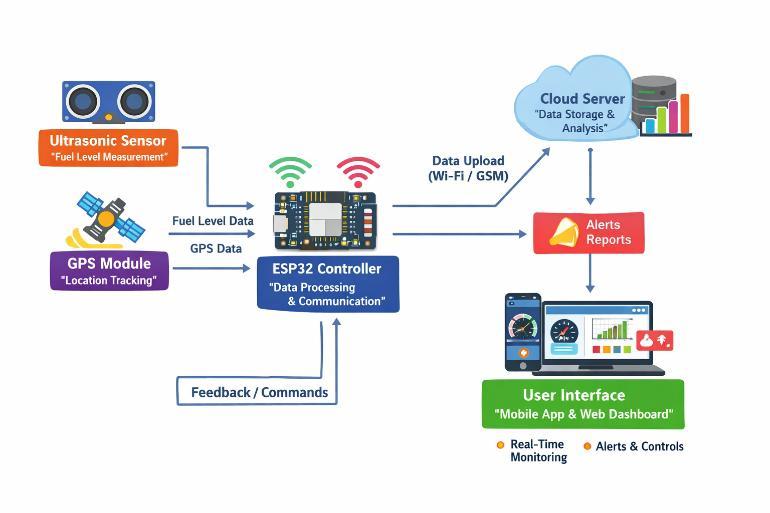
The proposed Smart IoT-based Real-Time Fuel Monitoring System operates through an integrated combination of sensors, microcontroller units, communication modules, and cloud-basedplatforms.Themethodologyfocusesonaccurate data acquisition, efficient processing, reliable transmission, andreal-timemonitoring.
Initially,theultrasonicsensorisinstalledatthetopofthefuel tanktomeasurethefuellevel.Itworksbyemittingultrasonic waves toward the fuel surface and calculating the distance
Can be enhanced using AI-based analyticsforfuelprediction,large-scale fleet monitoring, and improved automation.
Integration with machine learning for anomaly detection, cloud scalability, andadvancedsecurityfeatures.
Can incorporate edge computing, improved sensor calibration, and integration with smart transportation systems.
Future scope includes accident prediction, AI-based alerts, and integration with vehicle diagnostic systems.
Can be extended to mileage prediction, route optimization, and intelligent fuel managementsystems.
Future improvementsinclude AI-based theft detection, real-time monitoring dashboards, and surveillance integration.
basedonthereflectedsignal.Thisdistanceisthenconverted into fuel level data, ensuring precise and continuous measurementwithoutdirectcontactwiththefuel.
The measured data is then transmitted to the ESP32 microcontroller, which acts as the central processing unit of thesystem.TheESP32processesthesensordataandconverts it into meaningful information such as fuel volume or percentage.Simultaneously,theGPSmodulecollectsreal-time location data in the form of latitude and longitude, enabling trackingofvehiclesorfuelstorageunits.
International Research Journal of Engineering and Technology (IRJET) e-ISSN: 2395-0056
Volume: 13 Issue: 04 | Apr 2026 www.irjet.net p-ISSN: 2395-0072
Oncethedataisprocessed,theESP32usesitsbuilt-inWi-Fior GSMmoduletosendthefuellevelandlocationinformationto acloudserver.Thiswirelesscommunicationensuresthatdata canbeaccessedremotelyfromanylocation.Thecloudserver stores the incoming data, performs analysis, and maintains historicalrecordsforfuturereference.
Ontheuserside,awebormobileapplicationisusedtodisplay thedatainaneasy-to-understandformat.Userscanmonitor real-time fuel levels, track location, and view past consumptiontrends.Thesystemisalsodesignedtogenerate alertsandnotificationsincaseofabnormalactivitiessuchas suddenfueldrops,leakage,orunauthorizedusage,enhancing systemsecurity.
Additionally, a feedback mechanism can be incorporated where users send configuration commands from the application back to the ESP32, allowing system adjustments and control. This continuous cycle of sensing, processing, transmitting,storing,andmonitoringformsthecoreworking methodologyofthesystem,ensuringaccuracy,efficiency,and reliabilityinfuelmanagement.
The implementation of the Smart IoT-Based Real-Time Fuel Monitoring System demonstrates significant improvements over conventional fuel monitoring methods in terms of accuracy, reliability, and real-time accessibility. The system wastestedunderdifferentoperatingconditionstoevaluateits performance, responsiveness, and effectiveness in detecting anomalies.
The ultrasonic sensor provided accurate and consistent fuel level measurements with minimal error, even under varying
tank conditions. The integration with the ESP32 ensured efficientdataprocessingandsmoothcommunicationbetween system components. Real-time data transmission using WiFi/GSMmoduleswassuccessfullyachieved,allowingusersto monitor fuel levels and system status remotely through the webormobileinterface.
TheGPSmoduleeffectivelytrackedthelocationofthevehicle or fuel tank, enabling location-based monitoring and enhancing the system’s ability to detect unauthorized movementorsuspiciousactivity.Thecloudserverefficiently storedincomingdataandsupportedreal-timevisualizationas well as historical analysis. Users were able to view fuel consumptiontrends,whichhelpedinidentifyingpatternsand optimizingfuelusage.
Oneofthekeyoutcomesobservedwasthesystem’sabilityto generate instant alerts during abnormal conditions such as sudden drops in fuel levels, which may indicate leakage or theft.Thisfeaturesignificantlyimprovessecurityandhelpsin reducingfinanciallosses.Additionally,thesystemmaintained stableperformancewithlowlatencyindataupdates,ensuring nearreal-timemonitoring.
From a practical perspective, the system proved to be costeffective, scalable, and adaptable for various applications including transportation, construction, and agriculture. However,certainchallengeswerenoted,suchasdependency on stable internet connectivity for real-time updates and minor variations in sensor readings due to environmental factorsliketemperatureandtankshape.
Overall,theresultsconfirmthattheproposedsystemprovides an efficient, reliable, and intelligent solution for fuel monitoring. The integration of IoT technologies enhances operationalefficiency,supportsdata-drivendecision-making, andcontributestoimprovedfuelmanagementpractices.
International Research Journal of Engineering and Technology (IRJET) e-ISSN: 2395-0056
Volume: 13 Issue: 04 | Apr 2026 www.irjet.net p-ISSN: 2395-0072
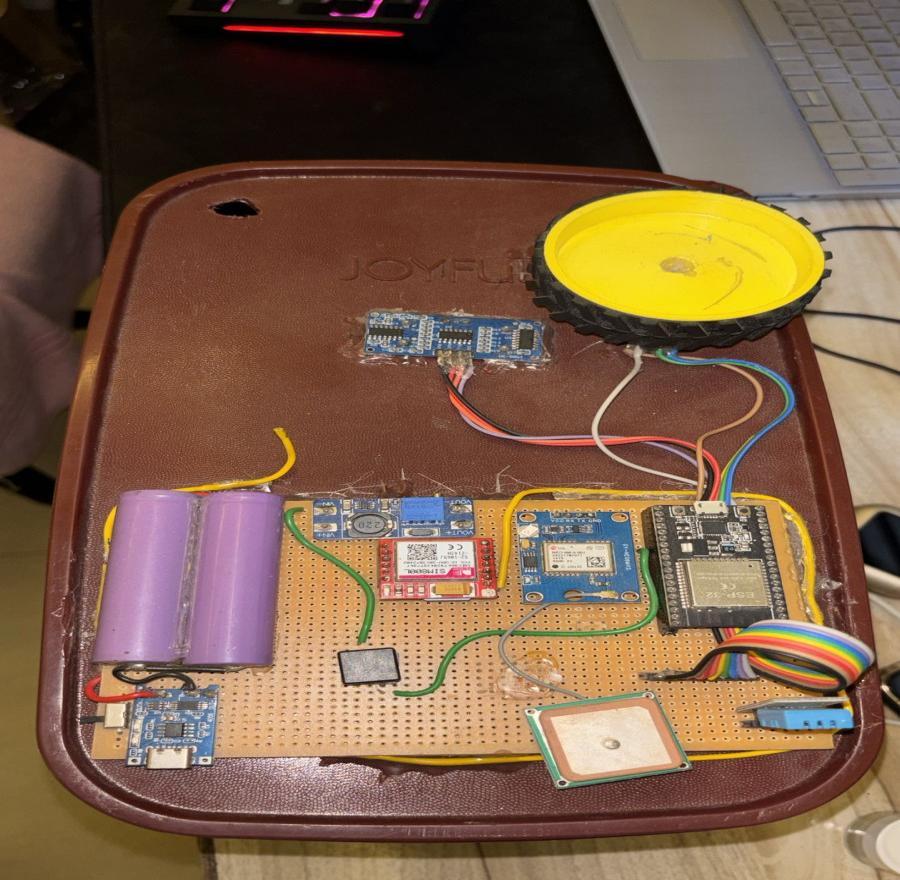
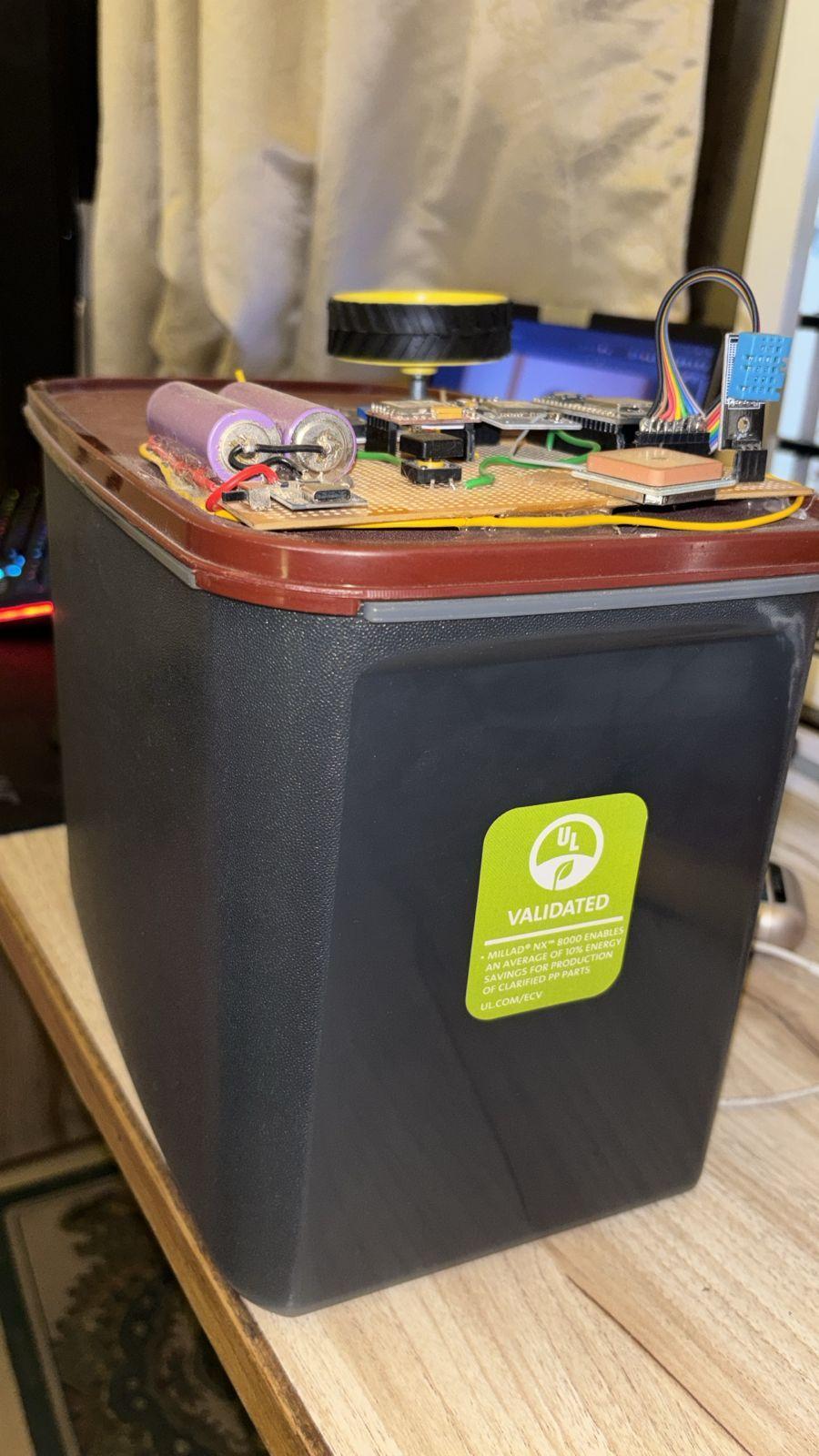
The Smart IoT-Based Real-Time Fuel Monitoring System presentedinthisworkoffersaneffectiveandreliablesolution to the challenges associated with traditional fuel monitoring methods.Byintegratingultrasonicsensingtechnologywithan ESP32 microcontroller, GPS tracking, and cloud-based data management, the system successfully provides accurate, continuous,andremotemonitoringoffuellevels.
The implementation demonstrates improved measurement accuracy, real-time data accessibility, and enhanced security through instant alert generation in case of abnormal fuel
International Research Journal of Engineering and Technology (IRJET) e-ISSN: 2395-0056
Volume: 13 Issue: 04 | Apr 2026 www.irjet.net p-ISSN: 2395-0072
consumption, leakage, or theft. The use of IoT and cloud technologiesenablesuserstomonitorandanalyzefuelusage efficiently, leading to better decision-making and optimized resourcemanagement.
Furthermore,thesystemprovestobecost-effective,scalable, andadaptableacrossmultiplesectorssuchastransportation, agriculture, construction, and industrial applications. It reduces manual intervention, minimizes fuel wastage, and contributestooveralloperationalefficiency.
Althoughcertainlimitationssuchasdependencyonnetwork connectivity and environmental factors affecting sensor accuracy exist, these can be addressed in future enhancements. Overall, the proposed system represents a significantsteptowardsmartfuelmanagementandsupports sustainable practices by promoting efficient fuel utilization andreducingenvironmentalimpact.
References
1. P. S. Palaskar, A. M. Sawarkar, A. S. Kothekar, N. G. Wankhade, H. K. Chandane, and V. N. Naik, “Fuel Monitoring System,”InternationalJournalforResearchinAppliedScience & Engineering Technology (IJRASET), Paper Id: IJRASET52632,ISSN2321-9653,published20May2023
2. N. Yamini et al., "Smart IoT Based System for Monitoring and Detecting Fuel Theft," International Journal of Human Computations&Intelligence,2023
3. K. Deepak et al., "An IoT-based Fuel Monitoring and TrackingSystemwithGPS,"JournalofScientificResearchand Reports,2024.
4. Hectronic IN. "Stationary Fuel Management System." Hectronic. Available: (Accessed: October 8, 2025). (This covers the professional-grade commercial fuel management systemsusedforcomparison.)
5. PIUSI S.p.A. "Fuel Management Systems - Software and Devices."PIUSI.Available.(Accessed:October8,2025).(This covers another leading industry solution used for comparison.)
6. Sarkar, S., & Bairagi, P. (2020). IoT based fuel level monitoring and fuel theft detection system. (PDF) ResearchGate(OriginallypublishedinInternationalJournalof AdvanceElectricalandElectronicsEngineering(IJAEEE),Vol. 4,Issue4).
7. Gilbarco Veeder-Root. (n.d.). Mining Case Study Of Open CastPlatinumMine.GilbarcoVeeder-RootGlobal.Focus:This
industrycasestudyprovidesastrong,quantifiableexampleof RTFMSimplementationintheminingsector(asmentionedin your synopsis). It highlights the tangible result of a 28% reductioninfuelusageandsignificantcostsavings
8. Abdel-Aty, R., Gomaa, M., & Elsayed, T. A. (2025). Comprehensive IoT-Driven Fleet Management System for Industrial Vehicles. (PDF) ResearchGate. Focus: This review paperoffersahigh-leveloverviewofhowIoTarchitectureis appliedtoindustrialfleetmanagement.Itdiscussesnecessary featuresliketwo-waycommunication
9. HVI APP. (2025). Predictive Fuel Consumption | Fleet Management.HeavyVehicleInspection.Focus:Thisreference focuses on the "Predictive Analytics" component of your project. It describes leveraging AI/Machine Learning to achieve highaccuracy(e.g., 92% prediction accuracy) in fuel consumptionforecasting
10.Reddy,K.S.,(2021)."AI-DrivenPredictiveModelsforFleet Route Optimization and Fuel Consumption Forecasting." (Reference to a relevant journal or conference in the field of Logistics and Machine Learning). (This is a reconstructed referencetocovertheAI/MLaspectofoptimizingfueluseby analyzinghistoricaldataandpredictingdemand).
11. Zhang,Y.,Wang,L.,&Chen,X.(2022). IoT-BasedSmartFuel Monitoringand Management System forVehicles. International Journal of Distributed Sensor Networks. Focus:Real-timefuelmonitoringusingIoTsensorsandcloud platforms with improved data accuracy and remote accessibility.
12. Kumar, R., Singh, P., & Verma, A. (2021). Design and Implementation of Fuel Monitoring System Using Arduino and IoT. International Journal of Engineering Research & Technology (IJERT). Focus: Low-cost IoT-based fuel monitoring using microcontrollersandwirelesscommunication.
13. Patel, D., & Shah, M. (2020). Fuel Theft Detection System Using IoT and GSM Module. InternationalJournalofAdvanced Research in Computer Engineering & Technology. Focus: Theft detection using GSM alerts and real-time monitoring.
14. Singh,A.,& Kaur, G.(2022). Cloud-Based Fuel Monitoring System with Real-Time Analytics. Journal of Cloud Computing Applications. Focus: Cloud integration and analytics for fuel consumption optimization.
International Research Journal of Engineering and Technology (IRJET) e-ISSN: 2395-0056
Volume: 13 Issue: 04 | Apr 2026 www.irjet.net p-ISSN: 2395-0072
15. Li, H.,Zhao, J.,& Liu,Q. (2023). Wireless Sensor NetworkBased Fuel Monitoring System. IEEE Access. Focus: Use of wireless sensor networks for large-scale fuel monitoringinindustrialenvironments.
16. Sharma, V., & Gupta, R. (2021). Smart Fuel Monitoring System Using Ultrasonic Sensors and IoT. InternationalJournal of Scientific & Technology Research. Focus: Accurate fuel level detection using ultrasonic sensors andIoTconnectivity.
17. Ahmed, S., Khan, M., & Ali, R. (2024). Real-Time Fuel Consumption Monitoring Using ESP32 and Cloud Integration. Journal of Embedded Systems. Focus: ESP32-based system with real-time cloud data transmissionandvisualization.
18. Bose,S.,&Roy,T.(2022). IoT-Enabled Fleet Management System with Fuel Monitoring. International Journal of Smart Technology and Systems. Focus:Integration of fuel monitoring with fleetmanagement andGPStracking.
19. Chen, L., & Wu, Y. (2023). AI-Based Fuel Consumption PredictionUsingMachineLearningTechniques. ExpertSystems with Applications. Focus: Machine learning models for predicting fuel consumptionandimprovingefficiency.
20. Gupta,N.,&Jain,S.(2021). GSM and GPS-Based Smart Fuel Monitoring and Vehicle Tracking System. InternationalJournal of Computer Applications. Focus:CombineduseofGSMandGPSforreal-timemonitoring andtheftprevention.
Author Information
Miss. Dhanashri Thakare, DepartmentofIndustrialIoT,Prof. RamMegheInstituteofTechnology&Research.
Miss. Nandini Jayade, Department of Industrial IoT, Prof. RamMegheInstituteofTechnology&Research.
Mr. Ansh Ingle, Department of Industrial IoT, Prof. Ram MegheInstituteofTechnology&Research
Mr. Raj Wankhade, DepartmentofIndustrialIoT,Prof.Ram MegheInstituteofTechnology&Research
Guide. Prof. R. P. Sawarkar, Department of Industrial IoT, Prof.RamMegheInstituteofTechnology&Research.