
International Research Journal of Engineering and Technology (IRJET) e-ISSN: 2395-0056
Volume: 13 Issue: 04 | Apr 2026 www.irjet.net p-ISSN: 2395-0072

International Research Journal of Engineering and Technology (IRJET) e-ISSN: 2395-0056
Volume: 13 Issue: 04 | Apr 2026 www.irjet.net p-ISSN: 2395-0072
Nikhil Singh1 , P Rajeev Kumar 2, K Shilpa3
1,2 B Tech final year students ,ECE department, JB Institute of Engineering and Technology,Hyderabad, Telangana 3 Assistant professor, ECE Department ,JB Institute of Engineering and Technology,Hyderabad, Telangana
Abstract - The current project aims to rectify some problems associated with the conventional attendance system such as low efficiency, proxy attendance, and reliability issues. While the face recognition-based approach automates the process of attendance tracking, it is prone to spoofing attacks and does not require physical verification. Therefore, the current paper proposes the use of a Smart Hybrid Attendance System that incorporates deep learning face recognition and hardware-based physical verification using an ESP32 board. In our approach, the Mobile Face-net (TensorFlow Lite) is utilized to obtain 128D face embedding using the cosine similarity function for verification purposes. A two-phase verification strategy was adopted by which any detected face generates a pending record of attendance, which should be validated using physical hardware within a specified time frame. The proposed solution integrates the edge AI approach by employing the Raspberry Pi device for temporal validation and hybrid verification purposes. The experiment showed an accuracy rate of up to 92%
Keywords: Face Recognition, Attendance System, Edge AI, ESP32, Hybrid Verification, IoT
Attendance tracking represents one of the core administrative processes in various organizations and institutions. Conventional systems for collecting attendance data involve laborious processes and pose significant security threats. Hence, automatic attendance systems utilizing biometric have been gaining increased attentioninrecenttimes.
Facialrecognitionhasbeencommonlyusedsinceit is relatively easy to implement and involves minimal privacy concerns. Yet, most attendance processes depend solely on facial recognition without any further considerations, which makes them vulnerable to infiltrationviaphotosorvideotoaccessthesystem.
In the current system, facial recognition technology will be combined with hardware components. The application of the ESP32 micro-controller will allow for accurate attendance registration only upon confirmationoftheperson’sidentityandpresence.
Present day methods of tracking attendance face several obstacles such as proxy attendances through images or impersonators, inadequate means of proving physical presence, detection problems caused by lighting differences or body postures, duplication of records because of frame-by-frame processing, and unreliability when implemented in the actual world scenario. Our project is aimed at developing an attendance marking system based on the application of computer vision technologiesalongwiththeuseofembeddedsystems.
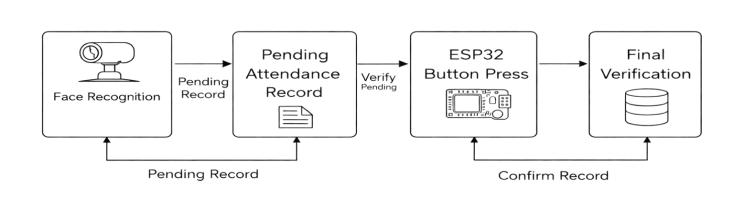
1: Outline Diagram of Proposed Smart Hybrid AttendanceSystem
Figure 1: Figure walks you through the whole hybrid attendance process. It starts by scanning someone’s face andcheckingifitmatchesanyexistingrecords.Ifitfindsa match, the system creates a pending attendance entry. Now,thepersonhastopressabuttonontheESP32device to prove they’re actually present. When the system gets that confirmation, it saves the attendance for good in the database.
The solution makes use of a two-step authentication process:
Facial recognition software authenticates students based onembeddinggeneratedviadeeplearning.
AnESP32boarddemandsforanactivebuttonclick bythestudentwithinagivenwindowoftime. Unlike the traditional approach, attendance is not immediately logged after facial recognition is completed. Instead,apending-to-authenticationprocessisemployed.
Volume: 13 Issue: 04 | Apr 2026 www.irjet.net
Thesystemiscomposedofseveralintegratedcomponents thatworktogethertoensureefficientoperation.TheFace Monitoring Module captures frames from a video camera andperformsfacedetectionandrecognitiontasks.ABack end Server built using Fast API handles all API requests, managesusersessions,andperformsnecessaryvalidation processes. The ESP32 module is responsible for sending HTTP requests during the authentication process. An SQLite database is used to store students’ facial embeddingandmaintainattendancerecords.Additionally, a Web Dashboard provides a user-friendly interface for managingsessionsandmonitoringthesystem.Overall,the system is intentionally designed to be highly efficient and well-suited for deployment on edge devices such as RaspberryPi.
5.1
Face detection is performed using an Open CV Haar Cascade classifier, which efficiently identifies faces in captured frames. Once a face is detected, it is processed using the Mobile Face-net model implemented with TensorFlow Lite to extract a 128-dimensional feature vector representing unique facial characteristics. Identificationisthencarriedoutbycomparingthisfeature vectorwithstoredembeddingusingcosinesimilarity.Ifthe similarity score is greater than or equal to 0.62, it is consideredavalididentification;otherwise,itistreatedas invalid.Thethresholdvalueof0.62isdeterminedthrough empirical testing to achieve an optimal balance between falsepositivesandfalsenegatives.
An additional 10 seconds time limit is set in order to ensure that more than one face detection takes place during the period in question, in order to decrease the probability of a false positive because of an erroneous identification.
-The system operates in a structured sequence to ensure accurate attendance recording. Initially, face detection is performed, followed by face recognition to identify the individual. Once a successful identification is achieved,a pendingrecord iscreatedinthesystem.When the button on the ESP32 module is pressed, it triggers the transmission of an HTTP POST request to the back end server.Thebackendthencarriesoutseveralidentification processes, including session validation, verification of the pendingrecord,andfinallyrecordingtheattendance.
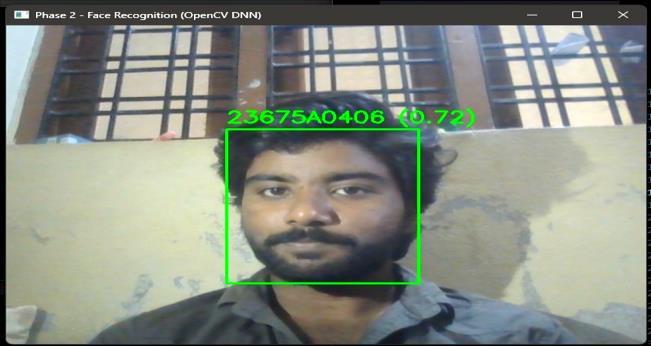
Figure 5: Real-TimeFaceDetectionandRecognition OutputwithCosineSimilarityScore
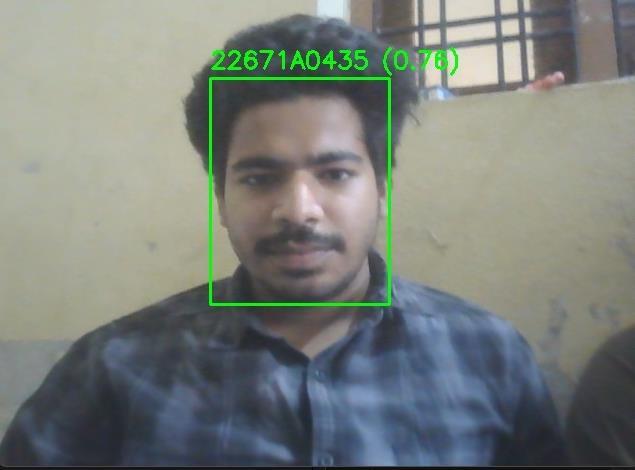
5.1: Real-TimeFaceDetectionandRecognition OutputwithCosineSimilarityScore
Figure 5: Figure shows what the face recognition module sees in real time. You can spot the detected face inside a bounding box,and right next to it, you’ll see the predicted student ID and similarity score. The system checks this scoreagainstitssetthresholdtodecideifthefacematches aregisteredstudent.
Thesystemisbuiltusingacombinationofsoftwareand hardware components to ensure efficiency and reliability. Theback-endisdevelopedinPythonusingFast-API,which handles API requests and system logic. Image processing tasks,includingfacedetection,arecarriedoutusing OpenCV, while TensorFlow Lite is utilized for efficient model inference,enablingfasterexecutiononedgedevices.SQLite is used as the database to store facial embedding and attendance records. For hardware communication, the ESP32 module is employed to send HTTP requests and interactwiththesystem.Oneofthekeydesigndecisionsin this system is the separation of the face recognition component from the back-end functionality. This separation helps prevent performance issues that may ariseduetothelongruntimeofrecognitiontasks,ensuring smootherandmorereliableoperation.
International Research Journal of Engineering and Technology (IRJET) e-ISSN: 2395-0056
Volume: 13 Issue: 04 | Apr 2026 www.irjet.net p-ISSN: 2395-0072
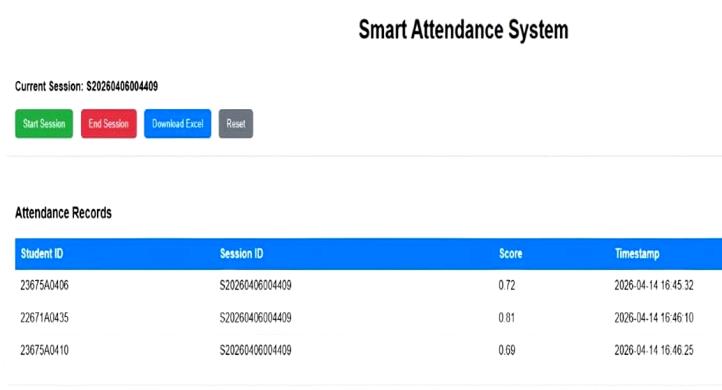
Figure 6:WebDashboardShowingSessionControland Real-TimeAttendanceRecords
Figure 6: Figure 5 shows the dashboard for managing attendance online. Here, you can start or end a session, reset the system, or export the attendance data when you need it. The dashboard also shows real-time attendance details,likestudentIDs,sessionIDs,confidencescores,and timestamps.
7. Result and discussions
Here's how the system comes together: The backend uses Python with Fast-API. Image processing? That’s all handled by Open-CV.Forquick model inference,it taps intoTensorFlowLite.AllthedatalivesinSQLite.Andwhen it comes to hardware, everything connects through the ESP32. One of the main design choices was to keep face recognition separate from the back-end. By splitting them up, the back-end stays snappy and doesn’t get bogged down with long-running tasks. It just works better this way.
8.Advantage and Limitation
Advantages
The system offers several key advantages that enhance its practicality and reliability. It significantly reduces instancesofproxyattendancebyincorporatingaccurate face recognition and validation mechanisms. Designed with efficiency in mind, it runs smoothly even on lowcost hardware such as edge devices. The setup process is simple, making it easy to deploy and use without requiring complex configurations. Additionally, by integrating multiple validation steps, the system outperforms traditional face-only systems in terms of overallreliabilityandaccuracy.
Limitations
The system has a few limitations that need to be addressed for improved performance and security. Currently, it lacks liveness detection, which means it may not be able to distinguish between a real person and a spoof attempt such as a photo or video. There is also a possibilityofmisuse,asindividualscouldpressthebutton ontheESP32withoutpropersupervision.Additionally,the system requires adequate lighting conditions to function effectively, as poor lighting can impact face detection and
recognition accuracy. Lastly, the system is limited to operationwithasinglecamera,whichrestrictsitscoverage andscalability .
The system can be further enhanced through several improvementsaimedatincreasingsecurity,scalability,and usability. One key upgrade is the addition of liveness detection techniques, such as blink or facial movement detection, to prevent spoofing attempts using photos or videos.Expandingthesystemtosupportmultiplecameras would make it more suitable for larger classrooms by improving coverage and accuracy. Developing a mobile application interface can provide users with greater accessibility and ease of interaction with the system. Additionally, migrating the database from SQLite to a cloud-based solution would improve scalability, allowing the system to handle larger amounts of data and support multipleusersorlocationsefficiently
This project brings together face recognition and a simple physical check to track attendance. It’s not just all about AI there’s a hardware step in there to make everything more dependable.The system deals with daily use pretty smoothly and solves some of the problems you seeinothersetups.
1. Solanki K., Pittalia P., “Review of face recognition techniques”, International Journal of Computer Applications,2016,133(12),20–24.
2. Deng W., Hu J., Guo J., “Face recognition via collaborative representation”, IEEE Transactions on PatternAnalysisandMachineIntelligence,2017,40 (10).
3. Pei T., Zhang L., Wang B., Li F., Zhang Z., “Decision pyramid classifier for face recognition”, Pattern Recognition,2016,64,305–313.
4. Shi H., Wang X., Yi D., Lei Z., Zhu X., Li S., “Crossmodality face recognition”, IEEE Signal Processing Letters,2017,24(1),81–85.
5. Ding C., Tao D., “Ensemble convolutional neural networks for face recognition”, IEEE Transactions onPatternAnalysis,2016.
6. Wu D., Tang Y., Lin G., Hu H., “Robust face recognition using deep learning”, Journal of OptoelectronicsLaser,2016,27(6),655–661.
7. Sun Y., Zhao J., Hu Y., “Supervised sparsity preservingprojections”,ProceedingsofSPIE,2017.
International Research Journal of Engineering and Technology (IRJET) e-ISSN: 2395-0056
Volume: 13 Issue: 04 | Apr 2026 www.irjet.net p-ISSN: 2395-0072
8. Best-Rowden L., Jain A.K., “Longitudinal study of face recognition”, IEEE Transactions on Pattern Analysis,2018.
9. DuanY.,LuJ.,FengJ.,ZhouJ.,“Context-awarefeature learningforfacerecognition”,IEEETransactionson PatternAnalysis,2017.
10. Mudunuri S., Biswas S., “Low resolution face recognitionundervariations”,IEEETransactionson PatternAnalysis,2016,38(5),1034–1040.
11. Li Y., Song W., Cheng C., “Face recognition-based attendance system using Raspberry Pi”, MicrocontrollersandEmbeddedSystems,2016.
12. Chakraborty S., Singh S., Chakraborty P., “Local gradient patterns for face recognition”, IEEE TransactionsonCircuitsandSystems,2016.
13. Zhu X., Liu H., Lei Z., Shi H., Yang F., Yi D., “Largescale face recognition learning”, International JournalofComputerVision,2019.
14. Nguyen H., Yang W., Sheng B., “Dictionary learning forfacerecognition”,Neurocomputing,2016.
15. Ji H., Sun Q., Yuan Y., Zhang G., “Collaborative probabilistic labels for recognition”, Pattern Recognition,2017.
16. WangL.,ChenS.,“Jointrepresentationclassification forfacerecognition”,PatternRecognition,2017.
17. Schroff F., Kalenichenko D., Philbin J., “FaceNet: A unified embedding for face recognition”, IEEE Conference on Computer Vision and Pattern Recognition(CVPR),2015.
18. Howard A.G., et al., “MobileNets: Efficient convolutional neural networks for mobile vision applications”,2017.
19. SandlerM.,HowardA.,Zhu M.,ZhmoginovA., Chen L., “MobileNetV2: Inverted residuals and linear bottlenecks”,CVPR,2018.
20. Viola P., Jones M., “Rapid object detection using a boosted cascade of simple features”, IEEE CVPR, 2001.