
International Research Journal of Engineering and Technology (IRJET) e-ISSN: 2395-0056
Volume: 13 Issue: 03 | Mar 2026 www.irjet.net p-ISSN: 2395-0072

International Research Journal of Engineering and Technology (IRJET) e-ISSN: 2395-0056
Volume: 13 Issue: 03 | Mar 2026 www.irjet.net p-ISSN: 2395-0072
Mrs T. Priyanka1 , V.Himabindu2 , T.Abhinav3, V.Srikanth4
1 Associate Professor, Department of CSE, Teegala Krishna Reddy Engineering College, Telangana, India 2,3,4 B.Tech Students, Department of Computer Science and Engineering, Teegala Krishna Reddy Engineering College, Telangana, India
Abstract - This paper presents a hybrid deep learning approachforpredictingresidentialelectricityconsumptionto supportefficientenergymanagementandsustainablepower utilization. Withtheincreasingdemandforelectricitydueto rapid urbanization and widespread use of household appliances, accurate forecasting of energy consumption has become essential for ensuring grid stability and optimizing power generation. The proposed model integrates Convolutional Neural Networks (CNN) for effective feature extraction,BidirectionalLongShort-TermMemory(BiLSTM) for capturing long-term temporal dependencies, and a SelfAttention (SA) mechanism to focus on the most relevant features in the dataset. Additionally, to enhance computational efficiency, BiLSTM is replaced with Bidirectional Gated Recurrent Units (BiGRU), reducing complexity while maintaining high prediction accuracy. The model is trained and evaluated using the UCI household electricity consumption dataset, and its performance is assessed using metrics such as R² score, Root Mean Square Error(RMSE),andMeanAbsoluteError(MAE).Experimental results demonstrate that the proposed hybrid model outperforms traditional and existing machine learning approaches by effectively capturing complex spatial and temporal patterns in electricity usage. The system also includesaFlask-basedwebinterfaceforuserinteractionand visualization of predictions. This approach contributes to improved energy planning, reduced power wastage, and the developmentofintelligentenergymanagementsystems.
Key Words: Residential Electricity Consumption, Deep Learning, CNN, BiLSTM, BiGRU, Self-Attention, Energy Forecasting, Time Series Prediction, Smart Energy Management, UCI Dataset, RMSE, MAE, R² Score.
1.INTRODUCTION
Therapidgrowthinurbanizationandtheincreasingreliance onelectricalapplianceshavesignificantlyraisedresidential electricity consumption, making efficient energy managementacriticalchallengeinmodernpowersystems. Accurate forecasting of electricity usage is essential for maintaininggridstability,optimizingpowergeneration,and reducingenergywastage.Traditionalstatisticalmodelssuch asSARIMAandconventionalmachinelearningtechniques often fail to capture the complex, non-linear, and timedependentpatternspresentinelectricityconsumptiondata, leading to less reliable predictions [3], [4]. Recent advancements in deep learning, including Convolutional
Neural Networks (CNN) and Recurrent Neural Networks (RNN), have shown promising results in modeling such complex patterns due to their ability to learn spatial and temporal features effectively [7], [10]. In particular, Long Short-TermMemory(LSTM)networksandtheirvariantsare widelyusedfortime-seriesforecasting,astheycancapture long-termdependenciesinsequentialdata[7].Furthermore, attention mechanisms have been introduced to enhance model performance by focusing on the most relevant features,improvingpredictionaccuracy[9].However,these models often involve high computational complexity and maynotefficientlyadapttolarge-scaledatasets.Toaddress theselimitations,thispaperproposesahybridCNN-BiLSTMSA model, further optimized using BiGRU, to improve predictionaccuracywhilereducingcomputationaloverhead. TheproposedapproachutilizestheUCIhouseholdelectricity consumptiondataset[6]andevaluatesperformanceusing metricssuchasR²score,RMSE,andMAE,aimingtoprovide a robust and scalable solution for intelligent energy managementsystems[1],[2].
Electricityconsumptionforecastinghasbeenwidelystudied using statistical, machine learning, and deep learning techniques to improve energy management and demand prediction.Earlyapproachesprimarilyreliedonstatistical models such as the Seasonal Auto-Regressive Integrated MovingAverage(SARIMA),whicheffectivelycapturelinear patterns and seasonality in time-series data. For instance, Andoh et al. [3] utilized the SARIMA model for electricity demand forecasting and achieved reasonable accuracy; however,themodelstruggledtoincorporateexternalfactors and complex non-linear relationships, limiting its performanceindynamicenvironments.
Toovercometheselimitations,machinelearningtechniques suchasRandomForest(RF)andArtificialNeuralNetworks (ANN)havebeenintroduced.KesornsitandSirisathitkul[2] proposed a hybrid model combining RF and ANN, which improvedpredictionaccuracythroughfeatureselectionand dimensionalityreduction.Similarly,Geetha etal. [4]applied supervisedmachinelearningusingsmartmeterdatasetsand demonstratedenhancedperformanceinpredictingdomestic electricity consumption. Despite these improvements, traditionalmachinelearningmodelsoftenfailtoeffectively capture long-term temporal dependencies and complex sequentialpatternsinenergyconsumptiondata.
International Research Journal of Engineering and Technology (IRJET) e-ISSN: 2395-0056
Volume: 13 Issue: 03 | Mar 2026 www.irjet.net p-ISSN: 2395-0072
Recent advancements in deep learning have significantly improved forecasting performance. Recurrent Neural Networks (RNN) and Long Short-Term Memory (LSTM) networksarewidelyusedfortime-seriespredictiondueto theirabilitytomodelsequentialdependencies[7].However, LSTM-basedmodelscanbecomputationallyexpensiveand may suffer from inefficiencies when handling large-scale datasets. To address these issues, Gated Recurrent Units (GRU)wereintroducedasasimplifiedalternativewithfewer parameters and faster training while maintaining comparableperformance[8].
Furthermore, attention mechanisms have emerged as a powerfulenhancementtodeeplearningmodelsbyenabling thesystemtofocusonthemostrelevantfeatureswithinthe inputdata.Vaswani etal. [9]demonstratedtheeffectiveness ofattention-basedmodelsinimprovingpredictionaccuracy across various domains. In the context of electricity consumptionforecasting,combiningattentionmechanisms with deep learning architectures has shown significant improvements in capturing both spatial and temporal dependencies.
Additionally, Akyol et al. [1] highlighted the issue of overconfidence in residential energy demand predictions andproposedmethodstoimproveforecastingrobustnessby addressingdatairregularities.Spiliotis et al. [5]compared statistical andmachinelearningapproachesforelectricity forecasting and concluded that hybrid and deep learningbased models generally outperform traditional methods, especially when handling complex and high-dimensional datasets.
Despite these advancements, existing models still face challengessuchashighcomputationalcomplexity,limited feature selection efficiency, and difficulty in adapting to evolvingconsumptionpatterns.Toaddresstheseresearch gaps,theproposedworkintroducesahybridCNN-BiLSTMSAmodelwithBiGRUoptimization,whichcombinesfeature extraction,temporallearning,andattentionmechanismsto achieve improved accuracy and efficiency in residential electricityconsumptionforecasting.
The proposed system introduces a hybrid deep learning modeldesignedtoaccuratelypredictresidentialelectricity consumption by effectively capturing both spatial and temporal patterns in energy usage data. The system integratesConvolutionalNeuralNetworks(CNN)forfeature extraction,BidirectionalLongShort-TermMemory(BiLSTM) for learning long-term dependencies, and a Self-Attention (SA)mechanismtofocusonthemostrelevantfeatures.To further enhance efficiency, the BiLSTM component is replacedwithBidirectionalGatedRecurrentUnits(BiGRU), whichreducescomputationalcomplexitywhilemaintaining highpredictiveperformance.
The overall workflow of the system begins with data acquisitionfromtheUCIhouseholdelectricityconsumption dataset. The collected data is then preprocessed through cleaning, handling missing values, and normalization to ensure quality input for the model. Feature engineering techniques,includingsequencegenerationandtime-window creation,areappliedtopreparethedatasetfortraining.The processed data is then fed into the hybrid CNN-BiGRU-SA model, where CNN extracts meaningful patterns, BiGRU captures temporal dependencies, and the attention mechanism highlights significant features for improved forecasting accuracy. Finally, the model generates predictions,whicharevisualizedthroughaFlask-basedweb interface,enablinguserstoanalyzeelectricityconsumption trendsefficiently.
Architecture F
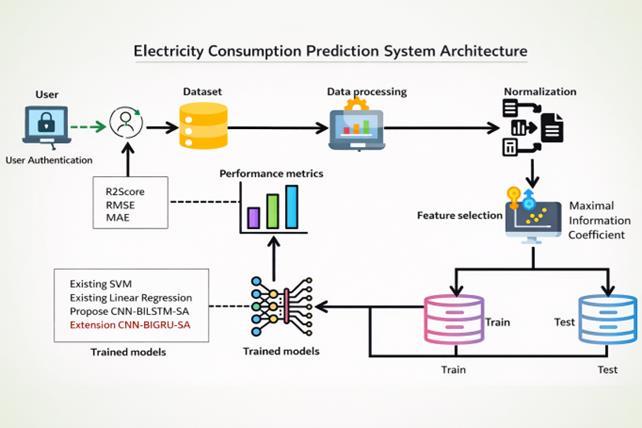
Thesystemarchitectureillustratesthecompleteworkflowof the proposed electricity consumption prediction system, startingfromuserinteractiontofinalmodelevaluationand prediction. It consists of multiple interconnected modules that ensure accurate forecasting using a hybrid deep learning approach. Initially, the process begins with user authentication,whereauthorizedusersaccessthesystem. Once authenticated, the user interacts with the system by providingorselectingtheelectricityconsumptiondataset, whichservesastheprimaryinputforthemodel.Thedataset is then passed to the data processing module, where raw data is cleaned, structured, and prepared for further analysis.
After preprocessing, the data undergoes normalization, which scales the values into a uniform range to improve modelperformanceandconvergence.Thisstepisessential fordeeplearningmodels,asitensuresstableandefficient training.Followingnormalization,thesystemappliesfeature selectionusingtheMaximal InformationCoefficient(MIC) technique.Thisstepidentifiesthemostrelevantfeaturesand removesredundantorhighlycorrelatedattributes,thereby
2395-0056
Volume: 13 Issue: 03 | Mar 2026 www.irjet.net p-ISSN: 2395-0072
improvingpredictionaccuracyandreducingcomputational complexity.Therefineddatasetisthendividedintotraining andtestingsets.Thetrainingdataisusedtobuildandtrain multiple models, including traditional approaches such as SupportVectorMachine(SVM)andLinearRegression,along with the proposed deep learning models CNN-BiLSTM-SA anditsoptimizedversionCNN-BiGRU-SA.Thehybridmodel combines CNN for feature extraction, BiGRU for temporal learning, and Self-Attention for focusing on important features.Once the models are trained, they generate predictions,whichareevaluatedusingperformancemetrics suchasR²Score,RootMeanSquareError(RMSE),andMean AbsoluteError(MAE).Thesemetricshelpincomparingthe effectiveness of different models and validating the superiority of the proposed approach. Finally, the trained model provides accurate electricity consumption predictions,whichcanbeusedforenergyplanning,demand management,andvisualizationthroughthesysteminterface.
Theimplementationoftheproposedelectricityconsumption predictionsystemiscarriedoutusingacombinationofdeep learningtechniquesandweb-basedtechnologiestoensure accurate forecasting and user interaction. The system is developed using Python in the Anaconda environment, leveraging libraries such as NumPy, Pandas, Scikit-learn, TensorFlow, and Keras for data processing and model development.Initially,theelectricityconsumptiondataset obtainedfromtheUCIrepositoryisloadedandpreprocessed byhandlingmissingvalues,removinginconsistencies,and normalizing the data to improve model performance. Feature engineering is performed by converting the timeseriesdataintosequentialinputwindowssuitablefordeep learningmodels.TheMaximalInformationCoefficient(MIC) methodisappliedtoselectthemostrelevantfeaturesand eliminateredundantattributes.Theprocesseddataisthen dividedintotrainingandtestingsets.Thehybridmodel is constructedbyintegratingCNNlayersforfeatureextraction, BiGRU layers for capturing temporal dependencies, and a Self-Attention mechanism to enhance important feature representation. The model is trained using appropriate optimization techniques and loss functions to minimize predictionerror.Aftertraining,themodelisevaluatedusing performance metrics such as R² score, RMSE, and MAE to ensureaccuracyandreliability.Inadditiontotheprediction model, a Flask-based web interface is developed to allow users to upload datasets, view predictions, and visualize electricity consumption trends. The entire system is implemented on a machine with minimum hardware requirements of an Intel i5 processor, 8 GB RAM, and sufficientstorage,ensuringsmoothexecutionandscalability.
Component Specification
Programming
Language Python
DevelopmentTool Anaconda,JupyterNotebook
Framework Flask
LibrariesUsed NumPy, Pandas, Scikit-learn, TensorFlow,Keras
Database SQLite3
Frontend HTML,CSS,JavaScript,Bootstrap
OperatingSystem Windows
Hardware Inteli5,8GBRAM,25GBStorage
The performance of the proposed electricity consumption prediction system is evaluated using the UCI household electricity consumption dataset to assess its accuracy, efficiency,andreliability.Thedatasetisdividedintotraining and testing sets, where the model is trained on historical consumptiondataandtestedonunseendatatovalidateits predictive capability. The proposed hybrid deep learning model,CNN-BiGRU-SA,iscomparedwithtraditionalmodels such as Linear Regression and Support Vector Machine (SVM), as well as the baseline CNN-BiLSTM-SA model to demonstrateitseffectiveness.
Theevaluationofthemodelsiscarriedoutusingstandard performancemetrics,includingR²Score,RootMeanSquare Error(RMSE),andMeanAbsoluteError(MAE).TheR²score measureshowwellthepredictedvaluesfittheactualdata, while RMSE and MAE quantify the prediction error. The experimentalresultsindicatethattheproposedCNN-BiGRUSAmodel achievesa higherR²scoreandlowerRMSEand MAEvaluescomparedtotheexistingmodels,demonstrating superior prediction accuracy and robustness. The integrationofCNNenableseffectivefeatureextraction,while BiGRU captures temporal dependencies with reduced computational complexity. Additionally, the Self-Attention mechanism enhances the model’s ability to focus on important features, further improving forecasting performance.
TheresultsalsoshowthattraditionalmodelssuchasLinear RegressionandSVMarelesseffectiveincapturingcomplex non-linearrelationshipsandtemporalpatternsinelectricity consumptiondata,leadingtohigherpredictionerrors.The
International Research Journal of Engineering and Technology (IRJET) e-ISSN: 2395-0056
Volume: 13 Issue: 03 | Mar 2026 www.irjet.net p-ISSN: 2395-0072
CNN-BiLSTM-SA model performs better than traditional approachesbutrequireshighercomputationalresources.In contrast, the proposed CNN-BiGRU-SA model achieves comparable or improved accuracy with reduced training timeandmemoryusage,makingitmoresuitableforrealtimeandlarge-scaleapplications.
Furthermore,thesystemprovidesvisualrepresentationsof predictedversusactualelectricityconsumptionthroughthe Flask-basedinterface,allowinguserstoeasilyinterpretthe results. The overall analysis confirms that the proposed hybrid model significantly enhances prediction accuracy, reduces computational overhead, and supports efficient energy management by providing reliable consumption forecasts.
This paper presents a hybrid deep learning approach for predictingresidentialelectricityconsumptionusingaCNNBiGRU-SAmodel.Theproposedsystemeffectivelyintegrates Convolutional Neural Networks for feature extraction, BidirectionalGatedRecurrentUnitsforcapturingtemporal dependencies,andaSelf-Attentionmechanismtoemphasize themostrelevantfeaturesinthedataset.Byleveragingthese techniques,themodelsuccessfullyovercomesthelimitations oftraditionalstatisticalandmachinelearningapproaches, which often fail to capture complex non-linear and timedependentpatternsinelectricityconsumptiondata.
The experimental results demonstrate that the proposed modelachievessuperiorperformanceintermsofprediction accuracy,asindicatedbyhigherR²scoresandlowerRMSE andMAEvaluescomparedtoexistingmodelssuchasLinear Regression, SVM, and CNN-BiLSTM-SA. Additionally, replacing BiLSTM with BiGRU significantly reduces computationalcomplexity,trainingtime,andmemoryusage withoutcompromisingaccuracy,makingthesystemmore efficientandscalableforreal-worldapplications.
Furthermore,theintegrationoffeatureselectionusingthe MaximalInformationCoefficient(MIC)enhancesdataquality by eliminating redundant features, while the Flask-based web interface improves usability by enabling users to visualize and analyze predictions ة لوهس ب. Overall, the proposedsystemprovidesareliableandefficientsolution for electricity consumption forecasting, contributing to betterenergymanagement,reducedpowerwastage,andthe developmentofintelligentandsustainableenergysystems.
Theproposedelectricityconsumptionpredictionsystemcan be further enhanced in several directions to improve its accuracy, scalability, and real-world applicability. One important extension is the incorporation of additional external factors such as weather conditions, electricity pricing,seasonalvariations,andsocio-economicparameters,
which can significantly influence household energy consumptionpatternsandimproveforecastingperformance. Themodelcanalsobetrainedandvalidatedonlargerand morediversedatasetscollectedfromdifferentgeographical regions to enhance its generalization capability and robustnessacrossvaryingconsumptionbehaviors.
Another potential improvement is the deployment of the model asa cloud-basedor webAPI service, enabling realtimeelectricityconsumptionpredictionandintegrationwith smart grid systems. The system can also be extended by integratingInternetofThings(IoT)devicesinsmarthomes, allowingautomaticdatacollectionandintelligentcontrolof appliancesbasedonpredictedenergyusage.Furthermore, advanceddeeplearningarchitecturessuchasTransformers orhybridattention-basedmodelscanbeexploredtofurther enhancepredictionaccuracy.
In addition, the system can be upgraded to provide personalizedenergy-savingrecommendationsforusersby analyzing their consumption patterns and suggesting optimal usage strategies. Improving model explainability usingtechniquessuchasSHAPorLIMEcanalsohelpusers and stakeholders better understand prediction outcomes. Overall,theseenhancementswouldmakethesystemmore intelligent,adaptive,andsuitableforlarge-scaledeployment inmodernsmartenergymanagementenvironments.
[1] H. B. Akyol, C. Preist, and D. Schien, “Avoiding overconfidenceinpredictionsofresidentialenergydemand through identification of the persistence forecast effect,” IEEETransactionsonSmartGrid,vol.14,no.1,pp.228–238, Jan.2023.
[2] W. Kesornsit and Y. Sirisathitkul, “Hybrid machine learningmodelforelectricityconsumptionpredictionusing random forest and artificial neural networks,” Applied ComputationalIntelligenceandSoftComputing,vol.2022,pp. 1–11,Apr.2022.
[3]P.Y.A.Andoh,C.K.K.Sekyere,L.D.Mensah,andD.E.K. Dzebre,“ForecastingelectricitydemandinGhanawiththe SARIMA model,” Journal of Applied Engineering and TechnologicalScience,vol.3,no.1,pp.1–9,Dec.2021.
[4] R. Geetha, K. Ramyadevi, and M. Balasubramanian, “Prediction of domestic power peak demand and consumptionusingsupervisedmachinelearningwithsmart meterdataset,” Multimedia Tools and Applications,vol. 80, no.13,pp.19675–19693,May2021.
[5] E. Spiliotis, H. Doukas, V. Assimakopoulos, and F. Petropoulos, “Forecasting week-ahead hourly electricity prices in Belgium with statistical and machine learning methods,” in Mathematical Modelling of Contemporary
International Research Journal of Engineering and Technology (IRJET) e-ISSN: 2395-0056
Volume: 13 Issue: 03 | Mar 2026 www.irjet.net p-ISSN: 2395-0072
Electricity Markets. New York, NY, USA: Academic Press, 2021,pp.59–74.
[6]UCIMachineLearningRepository,“Individualhousehold electric power consumption dataset.” [Online]. Available: https://archive.ics.uci.edu/dataset/235/individual+househo ld+electric+power+consumption
[7] S. Hochreiter and J. Schmidhuber, “Long short-term memory,” NeuralComputation,vol.9,no.8,pp.1735–1780, 1997.
[8]K.Choetal.,“LearningphraserepresentationsusingRNN encoder–decoderforstatisticalmachinetranslation,”in Proc. EMNLP,2014,pp.1724–1734.(GRUconcept)
[9] A. Vaswani et al., “Attention is all you need,” in Proc. Advances in Neural Information Processing Systems (NeurIPS),2017.
[10] Y. LeCun, Y. Bengio, and G. Hinton, “Deep learning,” Nature,vol.521,no.7553,pp.436–444,2015
2026, IRJET | Impact Factor value: 8.315 | ISO 9001:2008