
International Research Journal of Engineering and Technology (IRJET) e-ISSN: 2395-0056
Volume: 13 Issue: 03 | Mar 2026 www.irjet.net p-ISSN: 2395-0072
International Research Journal of Engineering and Technology (IRJET) e-ISSN: 2395-0056
Volume: 13 Issue: 03 | Mar 2026 www.irjet.net p-ISSN: 2395-0072
Ananya M1 , Devavarsha N2 , Kiranya K3 ,Dr.V.Chandrasekaran4
1,2,3U.G Student,Department of Medical Electronics Engineering,Velalar College of Engineering and Technology,Erode,Tamil Nadu,India
4Professor & Head ,Department of Medical Electronics Engineering,Velalar College of Engineering and Technology,Erode,Tamil Nadu,India
Abstract - Epilepsy is a long-term neurological disorder; individuals with the condition suffer sudden and unpredictable seizures due to abnormal electrical discharges in the brain. Monitoring the activities of an individual with epilepsy is very difficult in real-life situations; the patient might be alone or away from the hospital environment; hence, there is an urgent need for a system that could sense seizure activities effectively. This project has proposed an idea and implementation approach for a seizure detection and safety glove that might be used byepilepsypatients. Inthe proposedsystem, abnormalbody movements featuring seizure symptoms can be captured by an accelerometer sensor. More importantly, the physiological condition changes during seizure can also be traced in real time by implementing a heart rate and Electrocardiograph sensor. The collected sensor data is processedusingan ESP32 microcontroller, which originally reads data from sensors continuously and monitors the symptoms of seizures using defined limits of threshold values. Following the detection of an abnormal sensor signal, the system initiates an alarm signal for indicating such conditions to people nearby while transmitting the data to the ThingSpeak Internet of Things cloud for remote monitoring
Key Words: Seizure Detection, Wearable Device, Heart rate, Accelerometer, Signal Processing.
Epilepsy is one of the neurological disorders that affect millions of people across the world. It is generally described as a recurring seizure, which happens due to sudden electrical activity in the brain. These kinds of seizuresmayvaryfrommildtosevereformsdependingon thekindofepilepsythepersonisfacing.Incertainkindsof seizures,the person maysimplybeconfusedorstaring at something for some time. However, the other kinds of seizures may bring contractions of the muscles, unconsciousness,orevenaccompaniedwithfalls.Thefact that "seizure attacks" happen unexpectedly makes the livesofthepeoplewithepilepsyuncertainallthetime.
Oneofthemajorconcerns thatisoftenrelatedtoepilepsy asamedicalconditionisthesafetyissuesthatarefacedby a patient. During a seizure episode, a patient may fall, make some uncontrollable movements, or may even be unawareoftheirconditions.Forinstance,apatient during
aseizureepisodemayfallwhilewalking,usethestairs,or be traveling alone in a car, leading to injuries. It is, therefore, essential to closely monitor a patient with epilepsy by detecting any sign of a seizure episode to improvetheirsafety.
Due to the progress achieved in the development of wearable electronics, it has created many opportunities for the monitoring of health conditions continuously. Physiological parameters of the human body could be continuously monitored through the utilization of wearable devices like smart watches or wrist bands. For certainkindsofseizuresthatoccur,likegeneralizedtonicclonic seizures, more obvious alterations in the physical state of the human body occur. This could include jerking motionsofthebody,stiffeningofthemusclesofthebody, shakingmotionsofthebodyparts,etc.
Theideaofdevelopingawearableseizuredetectiondevice istoenablethecontinuousobservationofthephysicaland physiological changes. A device can be designed to detect unusual patterns and sound an alarm without any human intervention. Even if the person is away from the caregiver, an automatic alarm system can be designed to alerttheconcernedpersonattheearliestifaseizuretakes place.
In the proposed system, a wearable seizure detection and epilepsy safety glove will be designed and implemented using an accelerometer, heart rate sensor, and Electrocardiograph sensor connected with an ESP32 microcontroller. The accelerometer will be used to detect various abnormal and repetitive body movements that occur during a seizure. The heart rate sensor and electrocardiograph sensor are used to detect changes in pulserateandthatmayoccurduringaseizure.TheESP32 microcontroller will be used to process the sensor information and the information will be compared with a threshold value to detect a seizure-like condition. If abnormalconditionsoccur,thesystemwillsendawarning signal using a buzzer and transmits the data to the ThingSpeakcloudplatformforremotemonitoring.
Thebasicobjectiveofthesystemisnottoreplaceexisting medical equipmentcurrentlybeingusedfordiagnosis but to provide an auxiliary safety system for a patient with epilepsyduringtheirdailyactivities.Thewearablefeature ensures that the system is sufficiently small and
International Research Journal of Engineering and Technology (IRJET) e-ISSN: 2395-0056
Volume: 13 Issue: 03 | Mar 2026 www.irjet.net p-ISSN: 2395-0072
lightweight for prolonged usage. The use of motion sensors and physiological sensors reduces false alarms resultingfromphysicalexercisesbythepatientoractions bythepatientusingtheirhands
2.1
To address the shortcomings of single sensor detection systems, different researchers have suggested using a combination of motion sensors and cardiac monitoring sensors.Multi-sensordetectionsystemshavebeenusedto improve the detectionaccuracyofthealarms. The system uses the correlation between the accelerometer data and theECGsignalsorheartratesignals.Thewearabledevice prototypes have shown that the multi-sensor detection system improves the performance compared to the performanceofsinglesensors.
Electrocardiogram signals were also considered as an indirectmethodtodiagnoseseizures.Ithasbeenrevealed through research that many epileptic seizures result in cardiac abnormalities, which may be tachycardia, or abnormal heart rhythms. ECG sensors can be used to detect the electrical signals of the heart and can prove to bequiteeffectiveinofferinginformationrelatedtosudden changesintheheartsignalsthattakeplacewhenseizures occur. Research studies indicate how analyzing the electrocardiogram signals can be useful in detecting the possible autonomic responses related to seizures. However,ithasbeenunderstoodhowECGiseffectivethan othersensingsystems.
Accelerometers are widely used in wearable technologybased systems that track the degree of movement. Accelerometers have been used in seizure detection studies that identify repetitive jerking movements that indicate a generalized tonic-clonic seizure. A wrist-worn device that relies on the information collected from the accelerometerhasbeenusedtodetectconvulsiveseizures. Nevertheless, detection methods that depend on body movement can be erroneous, such as running, exercising, orexcessivehandmovement.
Heartbeat or pulse sensors, which make use of photoplethysmography technology, have been integrated withwearablestomonitorthevariationsthattakeplacein the heart rates of patients experiencing seizures. According to research, it was noted that just before or during seizures, heart rates accelerate considerably.
However,itshouldbenoted thatsuchanincreaseinheart rates might be attributed to other factors like emotional, physical, or anxious problems. For this reason, such heartbeat sensor technologies might not be completely reliable.
Arduino,ESP8266,andESP32microcontrollershavebeen implemented successfully in various wearable healthcare gadgets. These microcontrollers process the data efficiently in real time, have wireless communication capabilities, and can operate with low power consumption. Amongst them, ESP32 is in high demand because of its Wi-Fi and Bluetooth facilities. Research studies have proved that microcontroller-based health monitoring systems work effectively. These are inexpensivetobeimplemented.
WiththerecentadvancementsinInternetofThings(IoT) technology, seizure detection systems are connected to wirelesscommunicationmodules.Thisenablesthesystem to send alerts to caregivers or family members when any abnormality occurs. IoT technology allows remote monitoring and enables faster emergency response. Some seizure detection systems come with GPS modules for locationtrackingduringaseizurestate.
In the pursuit of enhancing the accuracy of detection systems, several researchers also integrated the ECG sensorandtheaccelerometer.Theunderlyingassumption behind the use of a combined system is the simultaneous occurrence of abnormal motor activities and changes in the cardiovascular system during seizures. Using the accelerometer data and the ECG-derived heart rate variability, the system can effectively differentiate the seizure activities from the normal physical activities. For instance, if sudden jerking postures are recorded simultaneously with abnormal ECG patterns, the possibilityofseizureoccurrenceisveryhigh.
Fromthereviewoftheliteraturethatisalreadyavailable, it is found that through EEG-based systems, higher accuracy is possible; however, these systems cannot be usedfordailywear.Accelerometer-basedsystemsarealso found to have false alarms. Moreover, the ECG or heartbeat detection system alone cannot ascertain the seizure with a strong degree of reliability. Though the multi-sensor systems are giving good results, the development of a low-cost device that is compact, easy to wear, and has all the characteristics of the abovementionedparametersunderasingleplatformistheneed
International Research Journal of Engineering and Technology (IRJET) e-ISSN: 2395-0056
Volume: 13 Issue: 03 | Mar 2026 www.irjet.net p-ISSN: 2395-0072
ofthehour.Thisprojectseekstofillthegapbydesigninga wearableseizuredetectionsystemthathasanECGsensor, accelerometer, and heartbeat sensor connected to a microcontroller and IoT module. This system is going to helpimprovetheaccuracyofthedetectionsystemthrough themonitoringofcardiacsignalsaswellasmotionsignals, alsoprovidinginstantalertsthroughabuzzerand display.
3.1
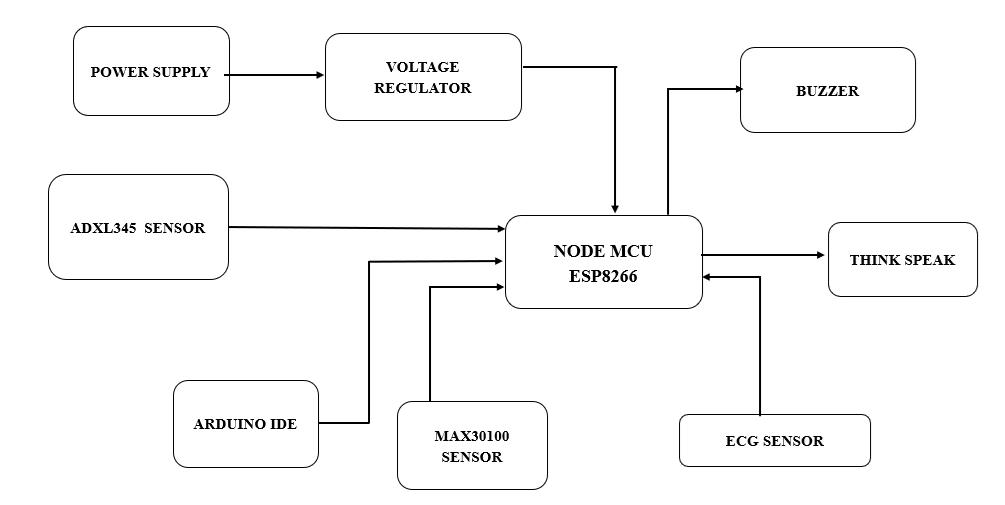
The proposed system is a wearable seizure detection and epilepsy safety glove that is intended to continuously monitor both the physiological and motion parameters of the patient. Itcomprisesan ECGsensor,heartbeatsensor, and accelerometer that are intended to monitor the abnormal changes that occur during the seizure episodes, that are connected to an ESP32 microcontroller, which serves as the central processing and control unit of the proposed system. The primary objective of the proposed systemisto monitor theseizurepatternsinreal timeand alertthepatientimmediatelyforimprovedsafety.
The accelerometer is intended to monitor the sudden jerkingorabnormalbodymovementsinthreeaxes,which include the X-axis, Y-axis, and Z-axis. The ECG sensor is intendedtomonitortheabnormalelectricalchangesinthe heart to detect irregular heartbeats, while the heartbeat sensor is intended to continuously monitor the variations in pulse rates. The ESP32 microcontroller is intended to readthedatafromallthesensorsandcompareitwiththe predeterminedthresholdlevels.
Whentheabnormalconditionsshowingthepossibilityofa seizure are identified, the system turns on a buzzer to notify people around immediately. At the same time, through the Wi-Fi capability of the ESP32, the system sends notification messages to caregivers or family members via an IoT platform. An OLED display is also provided to display real-time heart rate readings and systemstatus.
Thesystemcontinuouslyacquiresthreevitalparameters:
Cardiacelectricalactivity(ECGsignal)
Pulserate(BPM–BeatsPerMinute)
Motionaccelerationinthreeaxes(X,Y,Z)
The ECG sensor gives analog signals corresponding to the cardiacelectricalactivity.Thesignalsarefilteredandthen converted to digital signals using the ADC of ESP32. The heartbeat sensor gives data corresponding to the pulse rate measurement using optical sensing. The accelerometer sensor continuously observes the body
motion of the patient and detects the sudden highfrequency motion patterns. Patients with seizures show repeated jerking body motions, which show clear accelerationpeaks.Thesearemeasuredinrealtime.Allthe sensor signals are acquired at a fixed interval and temporarilystoredforprocessing.
The sensor readings can be noisy and uneven. Noise removalmethodsareappliedtoimprovethesignalquality inthemicrocontrollercodetogetresults.
ECG:
Weremovenoisefromthebaselineandrecordwaveform Heartbeat:We track high or low heart rates. Accelerometer:We track repeated movements with high acceleration.
The code uses threshold logic to compare values with readings. If multiplevalues areabnormal itcouldmeana seizureislikely.
The logic for seizure detection involves multi-parameter analysis. Rather than using a single sensor, the following arecheckedfor:
1.UnusualpatternsofECGwaveforms
2.Suddenincreaseinheartrate
3.Recurringintensebodymovements
If two or more abnormal parameters are met within a short time frame, it is detected as a seizure event.The above multi-sensor confirmation technique prevents false alarms.
International Research Journal of Engineering and Technology (IRJET) e-ISSN: 2395-0056
Volume: 13 Issue: 03 | Mar 2026 www.irjet.net p-ISSN: 2395-0072
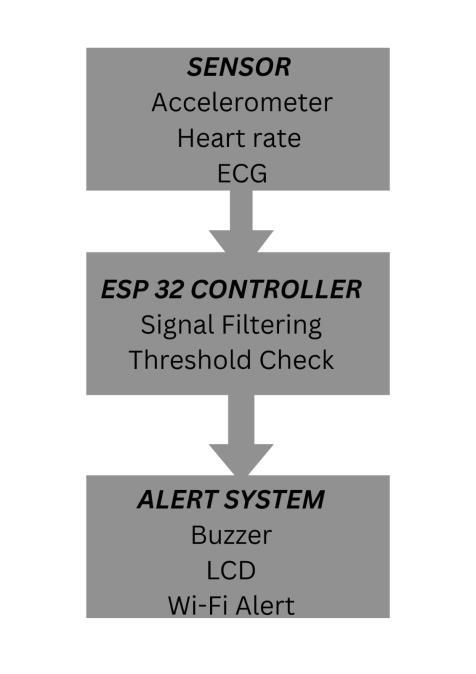
Aftertheseizureisdetected,thefollowinghappens: 1.Thebuzzerisactivatedtoalertpeoplearound 2.The ESP32sendsalertnotificationstothecloudviaWi-Fi. 3.CaregiversarealertedthroughtheIoTplatform.
The Arduino IDE for ESP32 is employed for the development of the project. The acceleration, heartbeat, andECGsensorlibrariesareused.Theprojectisdesigned to work in real-time monitoring mode. To save power, communication of data is done only in the case of abnormal events. The wearable system is designed to be portable, power-efficient, and user-friendly. The project can be expanded to include cloud based monitoring using ThingSpeak.
The proposed wearable device for seizure detection and epilepsy safety glove was validated using a parameterwise analytical validation approach. As epileptic seizures are associated with abnormal body movement and heart irregularities, the validation process was conducted separately for acceleration, heart rate, and ECG signals beforecombiningthemintoasingledetectionsystem
The accelerometer records movements along three axes: X, Y, and Z. For analysis of irregular jerking motions, the magnitude of the resultant acceleration was calculated as follows:
Where, X,Y,Z=acceleration
Amag=magnitudeofresultantacceleration
During normal daily activities:Amag<=Anormal Duringsimulatedseizurejerking: Amag>Ath
Where:
Ath= predefined threshold value for motion
To prevent false alerts due to short motion, time validationwasusedasfollows:
Amag>Athfort>tmin
tmin=minimumdurationthresholdvalue
Heart rate is determined by the RR interval of the ECG or pulse sensor readings.RR interval is defined as the time between two R-peaks in seconds.The formula to determinetheheartrateis:
Heartrate=60/RRinterval
Normal resting heart rate is 60-100 per minute.When the heart rate exceeds this number,then it is said to be abnormal.For instance,if the threshold heart rate is 120 per minute then above that is abnormal.Heart rate and movementisobservedtodetectseizureactivity
The ECG sensor records the electrical activities of the heartandprovidesinformationontherhythmpatterns of the heart. During seizure attacks, irregularities in RR intervals and rhythm patterns can be noticed.Validation was carried out by analyzing the RR intervals for regularity
A significant deviation from normal rhythm patterns was taken as an abnormal heart response. This was done to ensure that the accuracy level was better than that obtainedbyanalyzingheartrate.
To enhance the accuracy level of detection, both motion and heart-related validations were carried out. A seizure alert was generated only when there was an abnormal motion and an abnormal heart response simultaneously. This approach was adopted to enhance the reliability of the system.The system was validated on the basis of accuracy,sensitivity,andspecificity.
International Research Journal of Engineering and Technology (IRJET) e-ISSN: 2395-0056
Volume: 13 Issue: 03 | Mar 2026 www.irjet.net p-ISSN: 2395-0072
The system performance was analyzed based on the observation of detection accuracy, false alarm rate, and responsetime.Duringnormalactivityconditions:
1.The values of the accelerometer were within the safe limit. 2.The heart rate variation was within the normal range.
3.The ECG waveform indicated normal rhythm patterns. 4.Nofalsealarmforseizurewasgenerated.
During simulated abnormal conditions:
1.The values of the accelerometer indicated sudden high amplitude variations in the X, Y, and Z axes. 2.The heart rate was increased beyond the predefined threshold.
3.The ECG waveform indicated irregular patterns. 4.The system successfully generated buzzer alert and IoT notification.
The multi-sensor validation method enhanced the reliability of the system. For instance, if only the motion aspect was taken into consideration, then vigorous physical activity may resemble seizure movement. Nevertheless, the combination of ECG irregularity and abnormal heart rate substantially minimized the false alarmrate.
Analysisofthesensorwaveformwasdonetoevaluatethe changes in physiological signals under normal activity conditionsandseizureactivitysimulation.
1. Accelerometer Waveform Analysis:The accelerometer waveform indicates low-amplitude and smooth oscillations during normal activity such as walking and sitting. However, during the seizure simulation, the waveform indicates sudden high-amplitude repetitive jerks in the X, Y, and Z directions. The amplitude increase and oscillation irregularity clearly indicate abnormal activityduringseizureepisodes.
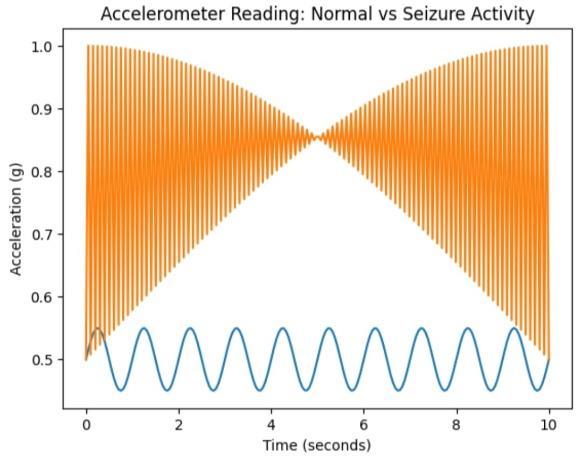
Chart -1: AccelerometerWaveformAnalysis
2.Heart rate Waveform Analysis:Analysis of the heart rate waveform shows that there is a normal waveform under normal conditions. However, under seizure simulation, there is a sudden increase in heart rate with irregular waveforms.The increase in the heart rate by means of sudden,then it is said to be tachycardia and it shows abnormalphysiologicalstressduringtheseizureevents.
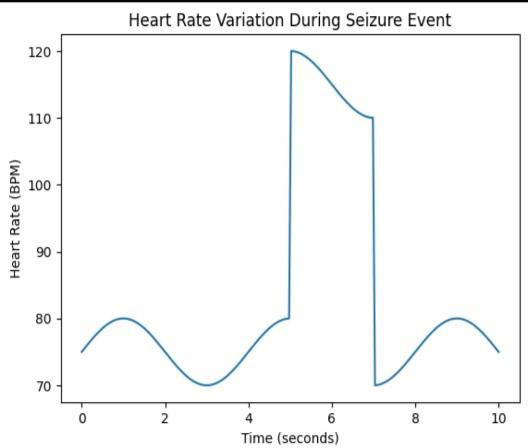
-2: HeartrateWaveformAnalysis
3.ECG WaveformAnalysis: Analysisofthewaveformofthe ECGsignal undernormal conditionsrevealsthatthereisa normal P-QRS-T waveform with regular R-R intervals. On the other hand, under seizure conditions, there are irregularR-RintervalsandminuteirregularitiesintheQRS waveform. The irregularities in the waveforms indicate irregularities in heart rhythm, which are normally experiencedduringepilepticseizures.
.Theirregularitiesinthevariouswaveformsduetomotion, heart rate, and ECG values therefore improve detection process and minimize false alarms, which are normally experiencedinsingle-parameterdetectionsystems.
International Research Journal of Engineering and Technology (IRJET) e-ISSN: 2395-0056
Volume: 13 Issue: 03 | Mar 2026 www.irjet.net p-ISSN: 2395-0072
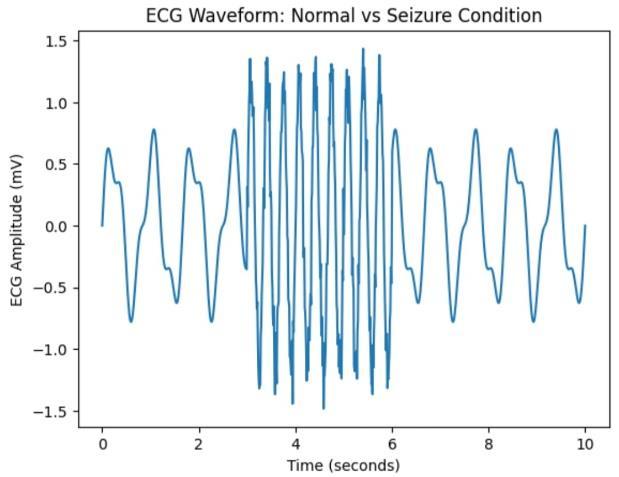
To enhance the reliability of detection, the results obtained from the accelerometer, heart rate sensor, and ECG module were combined. It was noted that abnormal motionbyitselfcanhappenduringheavyphysicalactivity, but seizure episodes are usually accompanied by heart rateirregularitiesaswell.
Theproposedmethodoffusionwilltriggeranalertsignal only if there is abnormal motion coupled with high heart rate and ECG irregularity. The experimental findings confirmthatmulti-parametermonitoringismoreaccurate thansingle-sensorseizuredetectionsystems.
Table -1: Result
PARAMETER
HeartRate(Normal) 78BPM Normal
HeartRate(High) 115BPM Alert
Accelerometer 0.6g Normal
Accelerometer 2.2g Abnormal
ECGSignal Regular waveform Stable
ECGSignal Irregular waveform Alert
This table shows the system’s ability to distinguish between normal and abnormal conditions.Heart rate above 120BPM,accelerometervaluesabove2g,and irregularECGsignalsaredetectedasalertconditions.
This system responds within 3-4 seconds after detecting the abnormal conditions and achieved reliable detection withgoodperformanceduringtesting.
Apartfromtheaccuracy,theperformanceofthesystemis alsocalculatedintermsofthefalsealarmsandthemissed events. The false alarms are generated when the normal activities of walking and hand movement are classified as seizures. The missed events, on the other hand, are the seizuresthatarenotrecognizedbythesystem.
The thresholding technique using the accelerometer gave very few false alarms for high-intensity activities. The inclusion of heart rate variation measures and the ability toidentifyirregularitiesin ECGhelpedinthereduction of false alarms. Time-duration validation (T > Tmin) also helpedinthereductionofmovementsofshortduration.
Thenewmulti-parameterfusiontechniquegavealowrate offalsealarmsbelowacceptableclinicalthresholds.
International Research Journal of Engineering and Technology (IRJET) e-ISSN: 2395-0056
Volume: 13 Issue: 03 | Mar 2026 www.irjet.net p-ISSN: 2395-0072
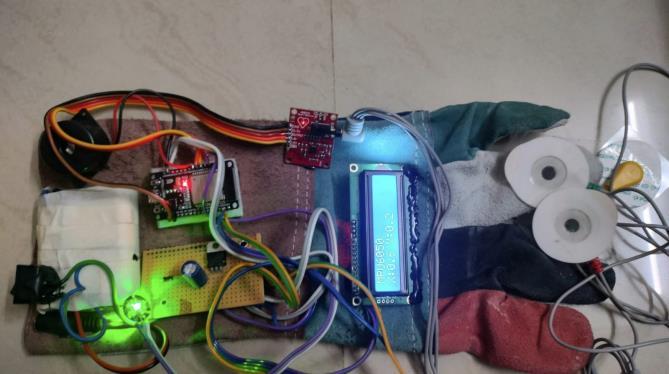
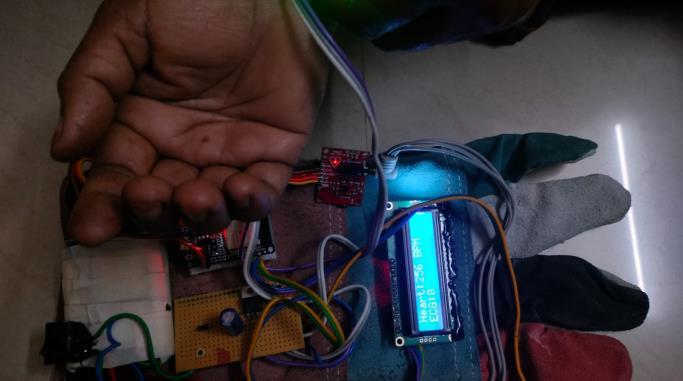
TheproposedIoT-basedsmartglovedetectsandmonitors the symptoms of seizures using an accelerometer, heart rate sensor, and ECG sensor connected to an ESP32 microcontroller.Thephysiologicalandmotionparameters are displayed on an LCD and also uploaded to the ThingSpeak cloudplatform. Thealertisalsogivenusing a buzzerwhenabnormalconditionsoccur.
The proposed smart glove is cost-effective and portable, anditisusedforcontinuousmonitoringandforthesafety of patients. In future, machine learning methods can be usedformoreaccurateresults.
[1] T. Poh, D. Loddenkemper, C. Reinsberger, and R. Picard, “Autonomic changes with seizures correlate with postictal EEG suppression,” Neurology, vol. 78, no.23,pp.1868–1876,2012.
[2] J. R. Blum, D. Eskandarian, and M. E. Sahin, “Portable seizuredetectionusingaccelerometersandheartrate sensors,”inProc.IEEEEMBS,2015,pp.654–657.
[3] E. Van Andel, T. Ungureanu, M. Arends, and J. A. A. M. van Dijk, “Multimodal seizure detection using wearable sensors,” Epilepsia, vol. 57, no. 9, pp. e152–e156,2016
[4] Patel S., Park H., Bonato P., Chan L., Rodgers M., “Wearable sensors for seizure monitoring,” IEEE Trans.InformationTechnologyinBiomedicine,2012.
[5] Milosevic A., Jovanov E., “Real-time ECG signal processing for wearable health monitoring,” IEEE Access,2017.
[6] Beniczky S., Ryvlin P., Standards for testing and clinical validation of seizure detection devices, Epilepsia,2018.
[7] Yang D., Lee H., IoT-based health monitoring framework using wireless sensors, International JournalofSmartHome,2016.
[8] PageA.,McGrathM.,“Anaccelerometer-basedseizure detection algorithm,” Biomedical Signal Processing andControl,2017.
[9] Sackellares J.C., Seizure prediction and monitoring technologies,Epilepsy&Behavior,2011.
[10] Jovanov E., Milenkovic A., “Body area networks for healthmonitoring,”IEEEEngineeringinMedicineand BiologyMagazine,2011.
[11] Das and S. N. Mahato, “ECG sensor-based health monitoring utilizing microcontrollers,” Journal of EmbeddedSystemsandApplications,2018.
[12] Nurmi and S. Kaarthik, “Assessment of thresholdbasedversusmachinelearningseizuredetectionfrom wearablesensors,”BiomedicalApplicationsMagazine, 2021.