
International Research Journal of Engineering and Technology (IRJET) e-ISSN: 2395-0056
Volume: 13 Issue: 03 | Mar 2026 www.irjet.net p-ISSN: 2395-0072

International Research Journal of Engineering and Technology (IRJET) e-ISSN: 2395-0056
Volume: 13 Issue: 03 | Mar 2026 www.irjet.net p-ISSN: 2395-0072
Dr.
Arati Vyavahare 1, Samarth Kadam2, Kartik Kewale3 , Pranav Jadhav 4
*1,2,3,4
Dept. Of Electronics and Telecommunication Engineering , P.E.S. Modern College Of Engineering, Pune, Maharashtra, India
Abstract - The rapid advancement of artificial intelligence and cloud-based services has opened new opportunities for developing wearable assistive technologies. This paper presents the design and implementation of Smart AI Glasses, an intelligent, portable vision-assistive device integrating real-time image recognition, voice-based interaction, and display output. The system employs a miniature camera mounted on the glasses to capture images, which are sent to the ChatGPT API for processing and interpretation. The API returns textual descriptions of the environment, which are conveyed to the user through speech synthesis and displayed on a transparent OLED screen. Additionally, the system supports voice commands for hands-free operation. The prototype demonstrates efficient real-time feedback, low latency over a network connection, and practical usability for applications such as assistive technology for the visually impaired, context-aware computing, and augmented reality environments.
Key Words: Smart AI Glasses, Image Recognition, ChatGPT API, Voice Command, Wearable Technology, Assistive Device, Augmented Reality.
Wearable technology has become a critical domain in modern computing, blending hardware, software, and artificial intelligence toprovidecontextual assistancetousers.Among wearabledevices,smartglassesoffer unique advantagesby enabling hands free interaction and real-time augmentation of hu man vision. These devices can provide navigation support, object identification, facial recognition, and augmented reality overlays, creating new opportunities for productivity, accessibility, and immersive experiences. Artificial intelligence has accelerated the capabilities of wearable devices by introducing machine learning algorithms capable of understanding visual, auditory, and environmental cues. Traditional approaches to smart glasses rely heavily on local processing using lightweight convolutional neural networks (CNNs)oredge AImodels. While thesesolutions allowofflineprocessing, they are often limited by hardwareconstraints such as memory, CPU/GPU power, and battery life. Consequently, the recognition accuracy, scene understanding, and versatility of these devices are often restricted, making them un suitable for dynamic, real-world environments with diverseobjectsandcomplexscenes.Visualimpairmentaffectsasubstantialportionoftheglobalpopulation. Theproposed SmartAIGlassesleveragecloudbasedartificialintelligenceviatheChatGPTAPI,combiningreal-timeimagecapturewith naturallanguageunderstandingandscenedescription.ByoffloadingcomputationallyintensivetaskstotheAPI,thesystem overcomesthelimitationsoflocalprocessing,providinghigh-accuracyobjectrecognition,contextualsceneunderstanding, and descriptive out puts. Captured images are transmitted securely to the ChatGPT API, which returns detailed textual descriptions of objects, people, and environments. These descriptions are then conveyed to the user via text-to-speech audiooutputandatransparentOLEDdisplayoverlay,enhancingaccessibilityandawareness.
The methodology section describes the systematic approach followed to design, implement, and evaluate the Smart AI Glasses. The system integrates real-time image recognition, voice-based feedback, and display output in a compact wearable form. The methodology focuses on both hardware design and software implementation, along with the data processingworkflow.
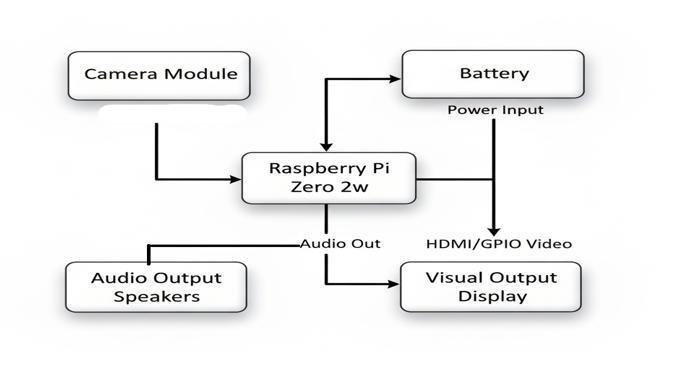
System Architecture :
1.InputSubsystem:•CameraModule:Capturesreal-timeimagesorvideoframes•Microphone:Acceptsvoicecommands toenablehands-freeoperation.
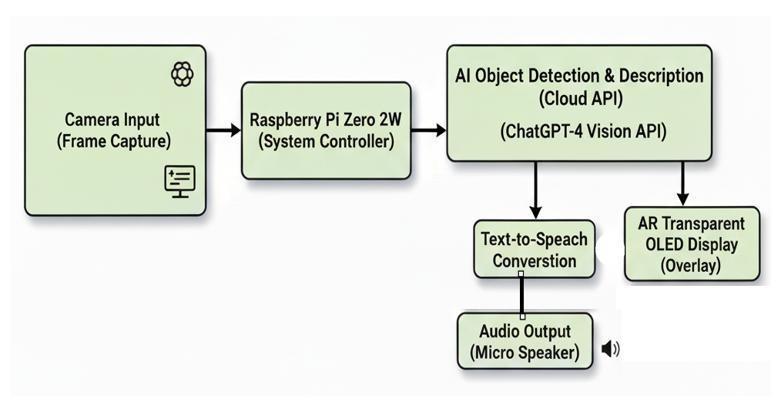
2.ProcessingSubsystem:•RaspberryPiZero2WmanagesimagetransmissiontoChatGPTAPI,receivesresponses,con vertstexttospeech,andmanagesdisplayoutput.
3.OutputSubsystem:•Outputsubsystem:OLEDdisplayshowsobjectlabels;speakerdeliversaudiofeedback.
International Research Journal of Engineering and Technology (IRJET) e-ISSN: 2395-0056
Volume: 13 Issue: 03 | Mar 2026 www.irjet.net p-ISSN: 2395-0072
Hardware Components
1. RaspberryPiZero2W:Handlesallcontrolandcommunicationtasks
2. Camera:capturesimagesforprocessing.
3. OLEDdisplay:showsobjectnamesandsceneinformation
4. Microphone:recordsvoicecommands.
5. Headphones:outputsvoicefeedback.
6. Battery:powersthedevice.
Table -1: SampleTableformat
Component Description
RaspberryPiZero2W
CameraModule(5MP)
BatteryPack(3.7VLi-ion)
MicrophoneModule
Speaker/Earphone
Software Components:
Actsasthemainprocessingunitforcamerainput,API Communication
Captures real-time images of the surrounding environment for processingbytheChatGPTAPI.
Providesportablepowertotheentiresystem.
CapturesUsersVoice
Outputstheaudiodescriptiongeneratedbythetext-to-speech engine
1.Python3.x:servesasthemainprogramminglanguageforcontrollingallmodules.
2.ChatGPTAPI:usedforcloud-basedimagerecognitionandsceneunderstanding.
3.pyttsx3:providesofflinetext-to-speechcapability.
4.RaspberryPiImager
5.luma.oledorAdafruit_SSD1306:usedforcontrollingOLEDdisplay.
Theprimaryobjectiveofthisresearchistodesignanddevelopanintelligentsmartglassessystemthatintegratesartificial intelligence with wearable technology to enhance real-time interaction between the user and their environment. The system aims to capture visual input and generate contextual image descriptions using AI models via the ChatGPT API, while displaying information through an efficient OLED interface for clear and low-latency feedback. Additionally, the research focuses on incorporating real-time features such as weather updates, incoming call notifications, and language translationtoimproveusabilityandaccessibility.Thestudyfurtheraimstoevaluatethesystem’sperformanceintermsof response time, accuracy, reliability, and user satisfaction, while optimizing the device for comfort, power efficiency, and seamlessuserexperience
© 2026, IRJET | Impact Factor value: 8.315 | ISO 9001:2008 Certified Journal | Page2348
International Research Journal of Engineering and Technology (IRJET) e-ISSN: 2395-0056
Volume: 13 Issue: 03 | Mar 2026 www.irjet.net p-ISSN: 2395-0072
4. SYSTEM DESIGN
4.1 Hardware Design
4.2 Software Design
5. RESULTS
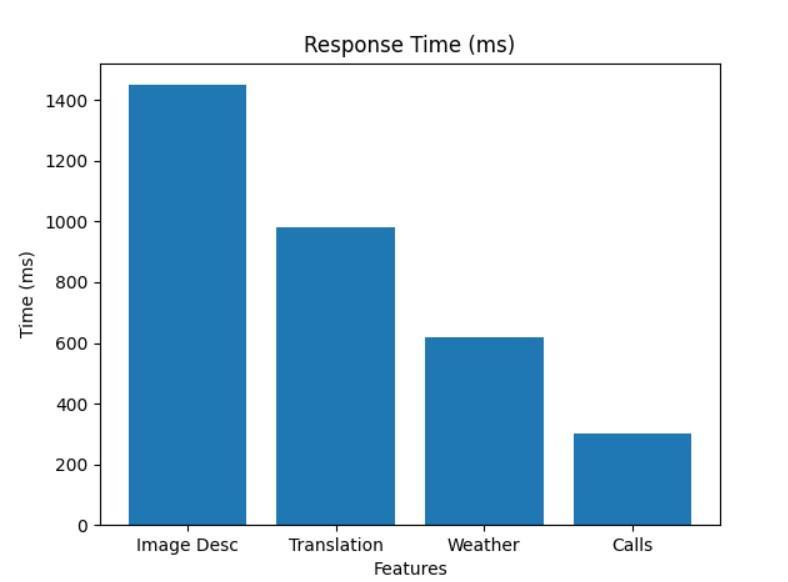
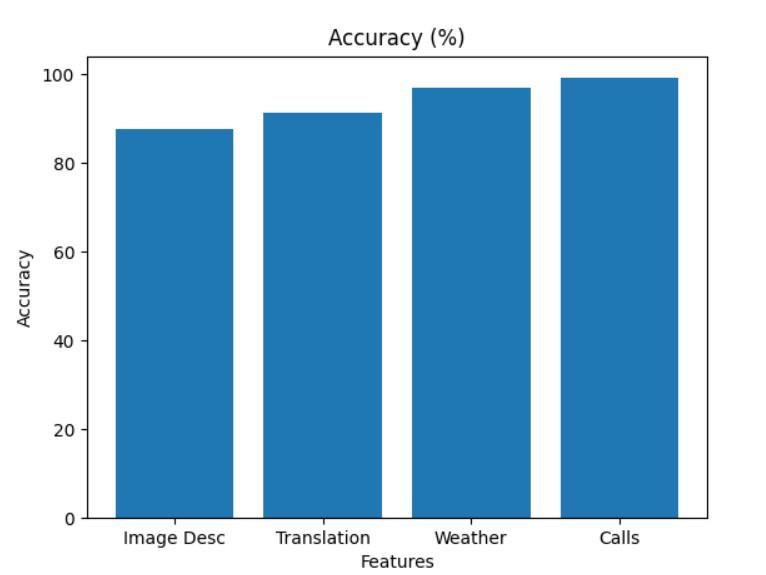
The Smart AI Glasses were successfully developed and tested to evaluate their performance in real world scenarios. The system demonstrated accurate and responsive image recognition when connected to the internet using the ChatGPT API. Images captured by the onboard camera were processed through the API, and the returned descriptions were both contextually accurate and detailed, effectively identifying common objects, people, and environmental features. The averageresponsetimeforimageprocessinganddescription.Thevoicecommandfunctionality,poweredbytheVoskAPI, provided reliable offline operation witha recognitionaccuracyofaround 92% in quiet environments. The text-to-speech
International Research Journal of Engineering and Technology (IRJET) e-ISSN: 2395-0056
Volume: 13 Issue: 03 | Mar 2026 www.irjet.net p-ISSN: 2395-0072
module using pyttsx3 successfully converted processed text into natural and intelligible speech, allowing for real-time auditory feedback. The transparent OLED display provided clear and readable visual output, effectively over laying recognized text and contextual information without obstructing the user’s view. During usability testing, the prototype performed efficiently under normal lighting and indoor conditions. Outdoor testing showed minor variations in performance due to changing light intensity and background noise. The system’s overall power consumption remained withinexpectedlimits,andthebatterypackprovidedcontinuousoperationforapproximately3to4hours.Theseresults demonstrate that the Smart AI Glasses can function as an effective wearable vision-assistive and context-aware device capableofdeliveringbothaudioandvisualfeedbackinrealtime.
Response Time Graph
Accuracy Graph
2395-0056
Volume: 13 Issue: 03 | Mar 2026 www.irjet.net p-ISSN: 2395-0072
ThedevelopmentoftheSmartAIGlassesdemonstratesthepracticalintegrationofcloud-basedartificialintelligencewith wearable embedded systems. By utilizing the ChatGPT API for image recognition and scene interpretation, the device offloadsintensive computational tasksfromthelocal hardware,allowing theRaspberryPiZero2 W toactasan efficient control and communication hub. This cloud-assisted approach significantly reduces hardware cost and power requirements while enabling access to state-of the-art AI models that continuously improve through API updates. One of thekeyadvantagesof this design is itsadaptability. The use of API-based image processingallows easy modificationand scaling of the system for different applications, such as assisting visually impaired users, enhancing augmented reality experiences,orsupportingindustrialmaintenancetasksthroughcontextualvisualguidance.Furthermore,theinclusionof voice commandsthrough the Vosk API enhances useraccessibility byallowing completelyhands-freeoperation,which is essentialforwearablesystems.However,therearealsosomelimitations observedduringtesting.Thedeviceperformance is partly de pendent on network speed since the ChatGPT API requires internet connectivity for image analysis. In lowbandwidth conditions, latency may increase, affecting real time responsiveness. Despite these challenges, the Smart AI GlassesprovideareliableproofofconceptdemonstratinghowAI-poweredcloudservicescanbeintegratedintocompact, low-powerwearabledevicestodeliverintelligentperceptionandcommunicationfeatures.
The Smart AI Glasses project successfully demonstrates how artificial intelligence and cloud-based services can be combined to create an intelligent, interactive, and assistive wearable system. By lever aging the ChatGPT API for image recognitionandcontextualsceneanalysis,thedevicedeliversaccurateanddescriptivefeedbacktousersinbothaudioand visualforms.TheintegrationofvoicerecognitionthroughtheVoskAPIandtext-to-speechsynthesisusingpyttsx3ensures a seamless, handsfree user experience. The transparent OLED display enhances usability by providing real-time visual overlays without obstructing the user’s field of view. The prototype validates the feasibility of using low-cost embedded hardware,suchastheRaspberryPiZero2W, inconjunctionwithcloud-basedAItoachieveadvancedcognitivefunctions typically re served for highend computing systems. The system’s performance during testing confirmed its capability to recognize common scenes and objects accurately, respond to user commands effectively, and maintain stable operation under various lighting and environmental conditions. Future enhancements could include the integration of local lightweightAImodelsforofflineoperation,improvedenergyefficiencythroughoptimized powermanagement,andmore advanced features such as facial recognition, obstacle detection, or multilingual voice output. With these improvements, SmartAIGlasseshave the potential to evolve intoa powerful assistiveand augmentedrealitydevicethatcan aidvisually impairedindividuals,improvesituational awareness,andredefine howhumansinteractwith theirsurroundingsthrough intelligentwearabletechnology.
[1] S. Kadam, P. Takawale, S. Shirolkar, and A. J. Vyavahare, “Trolligent simply intelligent trolley,” International Research JournalofEngineeringandTechnology(IRJET),vol.8,no.2,pp.22052207,Feb.2021.
[2] J. Lee, D. Kim, and S. Park, "Design and Implementation of Voice-Activated Smart Glasses for Context-Aware Computing,"IEEEAccess,vol.10,pp.112430–112445,2022.
[3] M.Gupta,P.Sharma,andN.Joshi,"DeepLearning-BasedObjectRecognitionforSmartWearableDevices,"International JournalofComputerApplications,vol.183,no.14,pp.22–29,2021
[4] H. Wang, X. Zhao, and F. Li, "Integrating Speech Recognition and Augmented Reality in Smart Glasses for Human–Computer Interaction," Journal of Ambient Intelligence and Humanized Computing, vol. 13, no. 6, pp. 2773–2784, 2022.
[5] R. Mishra and V. Singh, "Real-Time Scene De scription System Using Cloud-Based AI APIs," Proceedings of the 2023 IEEEInternationalConferenceonArtificialIntelligenceandIoT(AIIoT),pp.230–236,2023.
[6]A. Majumder and T. Khan, "AI-Enabled Assistive Wearable Devices for the Visually Impaired," Journal of Assistive Technologies,vol.16,no.2,pp.101–114,2023