
International Research Journal of Engineering and Technology (IRJET) e-ISSN: 2395-0056
Volume: 13 Issue: 02 | Feb 2026 www.irjet.net p-ISSN: 2395-0072
International Research Journal of Engineering and Technology (IRJET) e-ISSN: 2395-0056
Volume: 13 Issue: 02 | Feb 2026 www.irjet.net p-ISSN: 2395-0072
Swayam Thakre1, Samir Chahande2, Lokesh Daheriya3, Pranay Jaiswal4 , rof.Avinash.R.Mankar5 , Prof.Satish Markad6
1234Dept.of ME, Guru Nanak Institute of Technology, Nagpur, Maharashtra, India
5Professor, Dept.of ME, Guru Nanak Institute of Technology, Nagpur, Maharashtra, India
6 Professor and HOD, Dept of ME, Guru Nanak Institute of Technology, Nagpur, Maharashtra, India
Abstract - Gas leakage is one of the most common and dangerous accidents that occur in domestic, industrial, and commercial environments. Leaks of combustible gases such as LPG, methane, or propane can lead to explosions, fires, and severe health hazards if not detected and controlled in time. To address this issue, this project presents the design and development of a ‘Smart Gas Leak Detector with an Automatic Shut-Off System’ using ‘Arduino technology’.
The proposed system employs an ‘MQ-2 gas sensor’ to continuously monitor gas concentration in the surrounding atmosphere. When the gas concentration exceeds a predefined safety threshold, the ‘Arduino Uno microcontroller’ immediately activates an alarm system, which includes a buzzer and LED indicators, to alert the occupants.
Key Words: Smart gas leak detector, IoT gas leakage detection,Automatic gas Shutoff,LPG gas leak sensor, Lenoid valve cutoff.
1.
In modern homes, industries, and laboratories, the risk of gas leakage poses a serious threat to life and property. Gases suchasLPG,methane,andpropanearehighlyflammableandcancauseexplosionsifnotdetectedintime.Traditionalgas leak detection systems rely heavily on manual supervision and often fail to respond promptly during emergencies. To address these challenges, this project proposes a ‘Smart Gas Leak Detector with an Automatic Shut-Off System’ using ‘Arduino’. The system integrates gas sensors, an Arduino microcontroller, a solenoid valve, and communication modules (like GSM or Wi-Fi) to ensure early detection and preventive action. When gas leakage is detected, the system not only alertsusersvia buzzerandmessagebutalsoautomaticallycutsoffthegassupply,thusminimizingthe riskofexplosionor fire.Shouldmatchwiththelistofreferencesattheendofthepaper.
Early Systems-TraditionalgasdetectorsreliedonbasicsensorslikeMQ-2forLPGdetection,pairedwithmicrocontrollers such as Arduino or PIC to trigger alarms and simple relays for shutoff valves. These addressed limitations of manual monitoringbutoftenlackedremoteaccessorAIanalysis.
IoT Integration-RecentstudiesemphasizeESP32orNode MCUmodulesforWi-Fi connectivity, enablingreal timealerts via SMS, apps, or cloud platforms. Systems now include GPS for leak location and GSM for notifications, improving responseinhomesandindustries.
AI and Advanced Features-AI-enhanced detectors, like those using machine learning on sensor data, predict leaks and automate exhaust fans or solenoid valves. Prototypes test detection under one minute, integrating flame sensors for comprehensivesafety.
Gaps and Trends-Literature highlights scalability for industrial use and low false alarms, though challenges remain in low-level detection and power efficiency. Future work points to wireless networks and edge computing for broader adoption.
The methodology for a smart gas leak detector with automatic shutoff follows a structured engineering approach, combining hardware prototyping, software development, and iterative testing. It draws from established IoT-based researchpractices
International Research Journal of Engineering and Technology (IRJET) e-ISSN: 2395-0056
Volume: 13 Issue: 02 | Feb 2026 www.irjet.net p-ISSN: 2395-0072
Select core components like MQ-2/MQ-5 gas sensors for detecting LPG/propane leaks, ESP32 or Node MCU for IoT connectivity,asolenoidvalveforautomaticshutoff,buzzer/LEDforalarms,andoptionalflame/temperaturesensors.Use amicrocontroller(e.g.,Arduino/PIC)asthecentralprocessortoreadanalogsensordata,applythresholds(e.g.,>500ppm triggersalert),andcontroloutputsviarelays.ImplementationSteps
1 Hardware Assembly:Wiresensorstomicrocontrolleranaloguepins,connectrelaytodigitalpinsforvalve/fancontrol, andintegrateGSM/Wi-FimoduleforSMS/appalerts.
2.Firmware Development:CodeinArduinoIDEorMicroPythontosamplesensordataevery1-5seconds,filternoisewith averagingalgorithms,andactivateshutoffiflevelsexceedsafelimits(<1minuteresponse).
3. IoT Integration: Upload data to cloud platforms (e.g, Blynk/Thing Speak) for remote monitoring; implement ML anomalydetectionifadvanced.
4. Testing and Validation: Conduct lab tests with controlled gas releases to measure sensitivity (91% detection rate target),falsepositives,andshutofflatency.Field-testinsimulatedhome/industrialsetups,refinebasedonfeedback,then deploywithpoweroptimizationforreliability.
2. Working Principle
Detection Phase: A gas sensor (typically MQ-2 or MQ-5) continuously monitors air for LPG, methane, or propane by measuring changes in electrical resistance when target gases interact with its tin dioxide surface resistance drops sharplyabovesafethresholds(e.g.,500-1000ppm).Themicrocontroller(e.g.,ArduinoorESP32)samplesthisanalogdata everyfewseconds,appliescalibrationcurves,andfiltersnoiseviaaveragingtoconfirmaleak.
Irjet Template sample paragraph .Define abbreviations and acronyms the first time they are used in the text, even after theyhavebeendefinedintheabstract.AbbreviationssuchasIEEE,SI,MKS,CGS,sc,dc,andrmsdonothavetobedefined. Donotuseabbreviationsinthetitleorheadsunlesstheyareunavoidable.
Alert and Shutoff-Upondetection,thecontrolleractivatesoutputs:abuzzer/LEDforlocalalarms,optionalGSM/WiFifor SMS/appnotifications,andarelaytotriggerasolenoidvalveorservomotorthatphysicallyclosesthegaslineinundera second,haltingflow.Additionallogicmayengageexhaustfansorcutpowertoappliancesviarelays,enteringasafemode untillevelsnormalize.
Recovery-Sensorsrecheck airqualitypost-shutoff;ifconcentrationsfallbelowsafelimits,thesystemcanresetmanually orviaapp,withlogsstoredforanalysis.Thisclosed-loopprincipleensuresrapidmitigation,reducingexplosionrisks.
Table -1: SampleTableformat
Preparation of Manuscript Step Condition Action Outcome”
1 Normalgas level Monitoronly Gasflows normally
2 Gas>threshold Triggerrelay+ alerts Valvecloses, gassupply cutsoff
3 Flamedetected (optional sensor) Enhancealerts Prevents ignitionrisks
4 Gasdrops< threshold Auto-reset valve + silencealerts System resumes monitoring
International Research Journal of Engineering and Technology (IRJET) e-ISSN: 2395-0056
Volume: 13 Issue: 02 | Feb 2026 www.irjet.net p-ISSN: 2395-0072
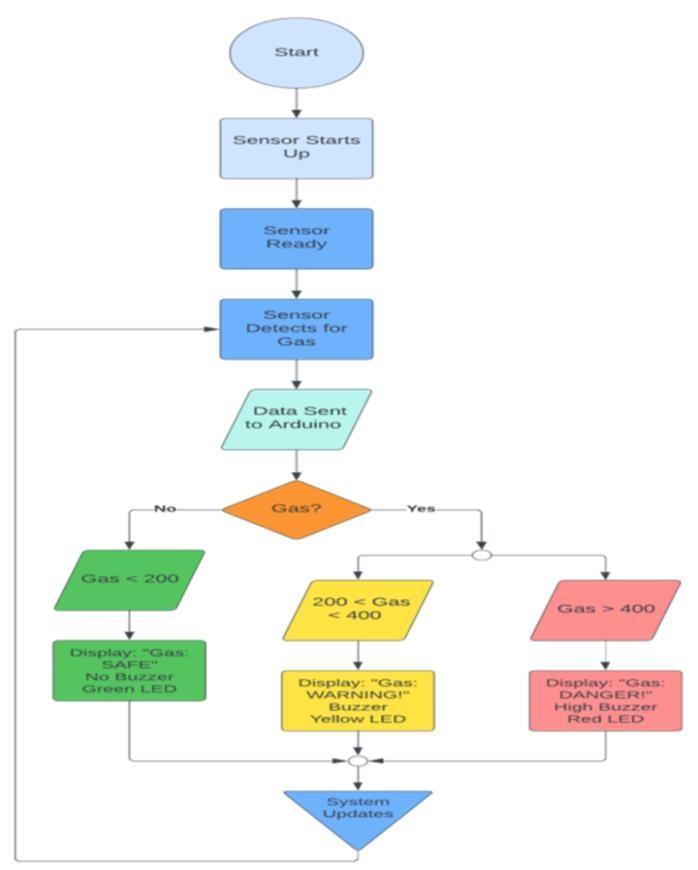
The sample table outlines the sequential operation of a smart gas leak detector with automatic shut-off. In normal conditions, the system simply monitors gas levels without interference, allowing normal flow. When gas concentration exceeds a safe threshold, it triggers the relay to close the solenoid valve while activating alerts like buzzers or LEDs, immediately cutting off the supply to prevent hazards. An optional flame detection step heightens warnings if fire risks emerge. Finally, once levels drop below the threshold, the system auto-resets the valve and silences alerts, returning to continuousmonitoring system initialization and continuous gas level monitoring via an MQ-2 sensor. If levels remain below the thres hold
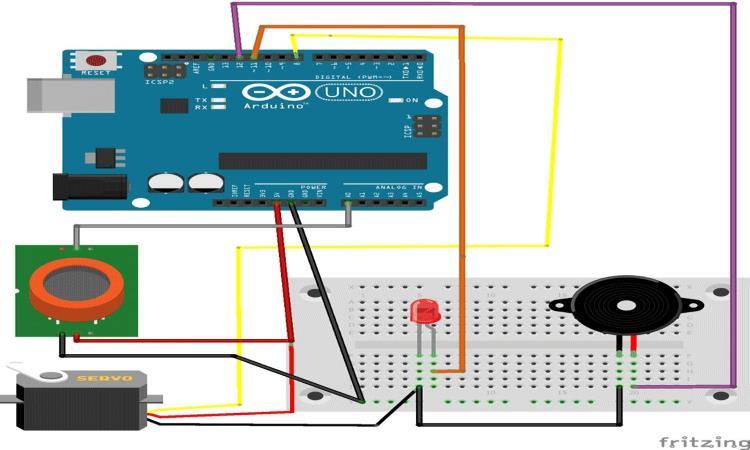






A typical smart gas leak detector project connects an MQ gas senor to a microcontroller like ESP8266 or Arduino, which monitors air for LPG leaks. Upon detection above a threshold, it triggers a relay to close a solenoid valve on the gas line, sounds a the gas checks a flame sensor for extra alerts. Power comes from a V supply, with wires linking components as follows:sensoroutputtomicrocontrolleranalogpin,relayinputtodigitalpin,buzzer/LEDtoGPIOpins,andvalviarelay
Theflowchartillustratestheoperationallogicofasmartgasleakdetectorwithautomaticshut-off.Itstartswith
monitoring loops indefinitely; exceeding it triggers alerts like buzzers or LEDs, activates the relay to close the solenoid valve,andcutsoffgassupply,withanoptionalflamesensorcheckforescalatedwarnings.Oncelevelsnormalize,thevalve resets,alertssilence,andthesystemreturnstomonitoring,formingasafety-focusedcycle.
Components Used:
Core Components
1.Gas Sensor (MQ-2 or MQ-5):DetectsLPG,methane,orotherleaksbysensingconcentrationchangesintheair.
2.Microcontroller (Arduino Uno or ESP8266/ESP32):Processessensordata,runslogic,andcontrolsoutputs.
Actuators and Controls
1. Relay Module:Switchesthesolenoidvalveon/offtocutgassupplyautomatically.
International Research Journal of Engineering and Technology (IRJET) e-ISSN: 2395-0056
Volume: 13 Issue: 02 | Feb 2026 www.irjet.net p-ISSN: 2395-0072
2. Solenoid Valve:Physicallyblocksgaslinewhenactivatedbyrelay.
Alert and Displays
1. Buzzer:Emitsaudiblealarmduringdetection.
2. LED (or RGB LED):Providesvisualindicationofstatusorleak.
Power and Connectivity
1. Power Supply (12V adapter or 9V battery):Powerstheentiresetup.
2. Optional Add-ons:GSMmoduleforSMSalerts,Wi-Fiforappnotifications,flamesensor,orDCfanforventilation.
3. LCD Display (optional):Showsreal-timegaslevels
3. CONCLUSIONS
Thesmartgasleakdetectorwithautomaticshut-offeffectivelyenhanceshomesafetybycontinuouslymonitoringforleaks using an MQ-2 sensor and promptly cutting off supply via a solenoid valve upon detection. This project demonstrates a cost-effective,Arduino/ESP-basedsolutionwithalertsandoptionalIoTfeatures,reducingfire/explosionrisksinkitchens or industrial settings. Overall, it provides reliable, real-time protection that's easy to assemble and scalable for broader applications.
[1] Prof. S. N. Kumar et al., “IoT-Based Gas Leakage Detection and Alert System,” International Journal of Engineering Research,2020.
[2] Prof.R.K.Sharma,“LPGLeakageDetectionandControlSystemUsingArduino,”InternationalJournalofInnovationsin EngineeringandTechnology,2019
[3] Dr. M. N. Singh, “Development of a Smart Domestic Safety System,” IEEE Transactions on Smart Home Automation, 2021
[4] Prof.P.L.Joshietal.,“AutomatedGasControlandAlertSystemUsingArduinoUno,”JournalofAppliedElectronicsand InstrumentationEngineering,2022
[5] M. Sunandini et al., "Smart Industrial Level Gas Leakage Detection System Using AI & IoT," IJERT (2024) – AI algorithmsanalyzesensordataforreal-timeleaklocation,integratedwithIoTforremotemonitoring.
[6] Smart Gas Leakage Detector IJRPR (2024) – Arduino Uno-based system with MQ sensor, GSM alerts, relay fan activation,andbuzzerforresidentialsafety
[7] "Development of Smart Gas Leakage Detection System," JETIR (2024) – Uses gas sensors, microcontroller, GSM, and machinelearningforSMSnotificationsandleakanalysis.
[8] Smart Gas Leakage Detector Using IoT Sensors," IJISAE – Integrates Arduino, Wi-Fi, GPS, DC fan, and LCD for comprehensiveleakdetectionwithremoteappcontrol.
[9] "An Intelligent LPG Leakage Detection and Control System," IJETT (2024) – Focuses on automated control with solenoidvalvesandwirelessalerts.
[10]EnhancingGasLeakDetectionwithIoTTechnology,"ScienceDirect(2024) –SurveysIoTsensornetworksforprecise industrialleakprevention