
International Research Journal of Engineering and Technology (IRJET) e-ISSN: 2395-0056
Volume: 13 Issue: 03 | Mar 2026 www.irjet.net p-ISSN: 2395-0072

International Research Journal of Engineering and Technology (IRJET) e-ISSN: 2395-0056
Volume: 13 Issue: 03 | Mar 2026 www.irjet.net p-ISSN: 2395-0072
Rubigha
M, Gokulraj R, Arun Prasanna TJ, Dhanushraja R, Abishake C
1 Rubigha M: Assistant Professor, Dept. of Information Technology, Knowledge Institute of Technology, Tamil Nadu, India
2 Gokulraj R: Student, Dept. of Information Technology, Knowledge Institute of Technology, Tamil Nadu, India
3 Arun Prasanna TJ: Student, Dept. of Information Technology, Knowledge Institute of Technology, Tamil Nadu, India
4 Dhanushraja R: Student, Dept. of Information Technology, Knowledge Institute of Technology, Tamil Nadu, India
5 Abishake C: Student, Dept. of Information Technology, Knowledge Institute of Technology, Tamil Nadu, India
Abstract - Managing day-to-day activities in colleges can become complicated when different tasks such as student records, fee payments,exams,andcommunicationarehandled separately. In many institutions, these processes are still done manually or using disconnected systems, whichleadstodelays and confusion.
To solve this problem, this project introduces a Smart College Management System (SCMS), which is a web-based platform designed to bring all institutional activitiesintooneplace.The system is developed using PHP with the CodeIgniter framework and uses MySQL for storing data.
SCMS combines multiple features such as student information management, fee handling with online payment options, attendance monitoring, examination processing, and communication tools. It also supports different user roles, allowing administrators, staff, students, and parents toaccess only the features they need.
By using this system, institutions can reduce manual work, improve accuracy, and make information easily accessible at any time. The solution is designed to support growing institutions and can handle large numbers of users efficiently.
Key Words: School Management System, College ERP, CodeIgniter, MVC Architecture, Role-Based Access Control, PHP, MySQL, Online Fee Payment, Student Information System, Web Application.
In today’s digital world, it is becoming increasingly important for educational institutionstomove awayfrom manualmethodsofmanagement.Manycollegesstilldepend on paperwork and separate systems to handle their operations,whichoftenresultsinwastedtimeanderrors. Handlingstudentdata,feecollection,attendance,andexam records manually can become difficult as the number of studentsincreases.Italsobecomeschallengingtomaintain proper communication between the institution and stakeholderssuchasstudentsandparents. Althoughsomemanagementsystemsarealreadyavailable, they do not always meet all requirements. Some lack
importantfeatures,whileothersareexpensiveordifficultto use.
This project focuses on developing a Smart College Management System (SCMS) that brings all essential functionstogetherinasingleplatform.Thesystemisbuilt usingCodeIgniter,whichfollowstheMVCapproach,making theapplicationorganizedandeasiertomaintain.
Themainaimistocreateasystemthatissimple,efficient, and capable of handling different institutional activities withoutcomplexity.
Different types of software have been created to support schoolandcollegemanagement.Someofthecommonlyused systemsincludeFedena,OpenSIS,SchoolTool,andGibbon. Whiletheseplatformsprovideusefulfeatures,theyalsohave certaindrawbacks.
Forexample,somesystemsaredifficulttoinstallorrequire technical expertise to manage. Others do not support modernrequirementssuchasonlinepaymentsoradvanced communicationmethods
.TheSCMSisdesignedtomeetthisrequirementbyoffering multiplefunctionalitieswithinasingle,easy-to-useplatform
Table -1: Comparison of Existing School Management Systems
Volume: 13 Issue: 03 | Mar 2026 www.irjet.net
As shown in Table 1, the proposed SCMS significantly surpassesexistingsolutionsinpaymentgatewayintegration (28 vs. 0-5), SMS provider support (15+ vs. 0), and multibranchcapability.
3.1 Layered Architecture
TheSmartCollegeManagementSystemisdesignedusinga five-layerarchitecturalmodel,asshowninFig.1,toensure better organization and system efficiency. The first layer, knownastheclientlayer,allowsuserstointeractwiththe systemthrough a web browser thatdisplays a responsive interface built using Bootstrap. The presentation layer is responsibleformanagingtheuserinterface,includinglayout designandinteractiveelements,usingfrontendtechnologies suchasBootstrapandJavaScript.
The web server layer processes incoming requests and manages navigation within the application, using server configurationstomaintaincleanandstructuredURLs.The application layer contains the main functional logic of the systemandisdevelopedusingtheCodeIgniterframework basedontheMVCpattern.Itincludesmultiplecontrollers, models, and supporting libraries that work together to handlesystemoperations.
Finally,thedatalayerisusedforstoringandmanagingall applicationdata.ItreliesonaMySQLdatabaseandsupports multiplebranchesbyallowingdynamicswitchingbetween different databases. In addition, it handles file storage for user-uploadedcontent.
Fig. 1: System Architecture Five-Layer MVC Architecture of SCMS
3.2 Controller Class Hierarchy
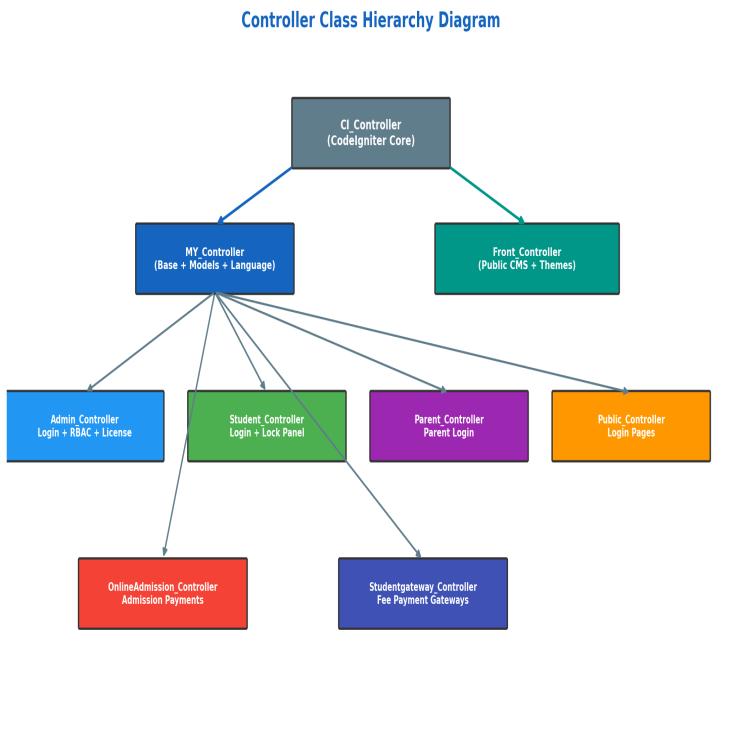
Animportantdesignchoiceinthesystemistheuseofseven basecontrollerclasses,whicharederivedfromacommon parent controller (MY_Controller) that extends the core CI_Controller.Eachofthesebasecontrollersisresponsible forhandlinguser-specificaccesscontrol,includingverifying user identity, managing permissions, and maintaining sessiondatabasedontheassignedrole.
Table -2: Controller Class Hierarchy and Authentication
Admin_Controller
Student_Controller
Parent_Controller
Front_Controller
OnlineAdmission_Controller
Adminpanel access
login+license +RBAC
portal Studentlogin+lock panel
CMS website
payments
(maintenance check)
Studentgateway_Controller Feepayment gateways Studentlogin
3.3 Data Flow Diagrams
Thesystemdataflowismodelledusingstructuredanalysis.
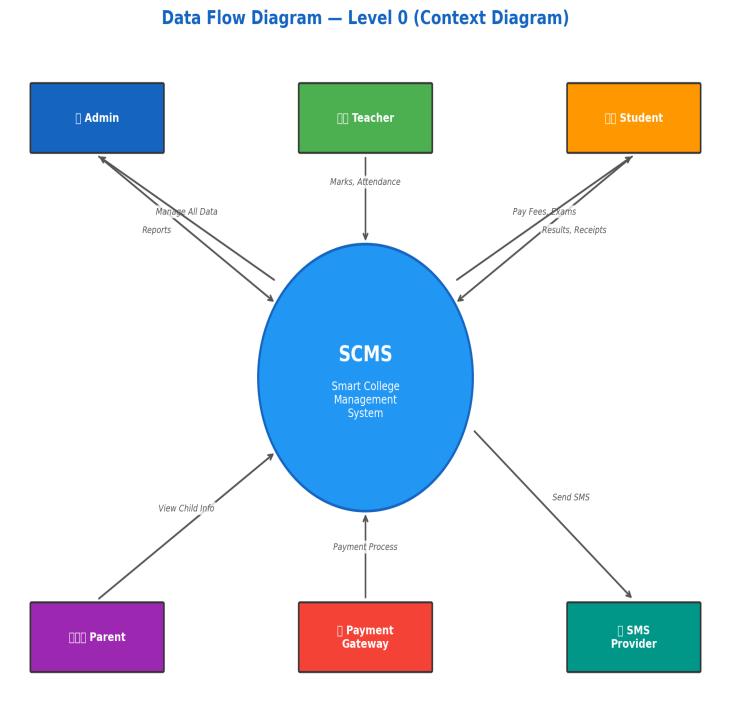
Level 0 (Context Diagram): Fig. 3 shows six external entities(Admin,Teacher,Student,Parent,PaymentGateway, SMSProvider)interactingwithSCMSasacentralprocess.
International Research Journal of Engineering and Technology (IRJET) e-ISSN: 2395-0056
Volume: 13 Issue: 03 | Mar 2026 www.irjet.net p-ISSN: 2395-0072
Context Diagram
Level1(Sub-processes):Fig.4decomposesthecentral process into eight major sub-processes: Authentication, Student Management, Fee Management, Academic Management, HR Management, Communication, Report Generation,andFrontCMS&Admission.
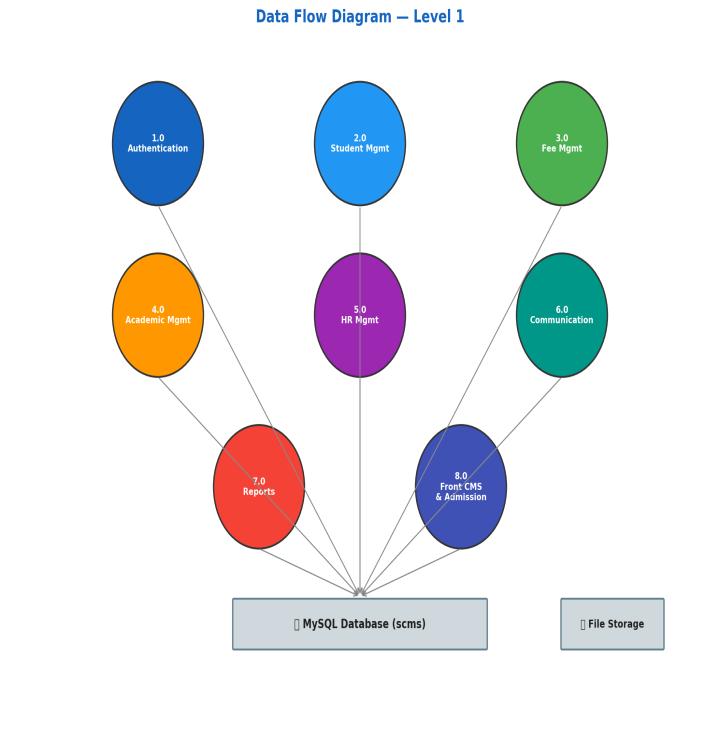
Fig. 4: DFD Level 1 Major Sub-processes
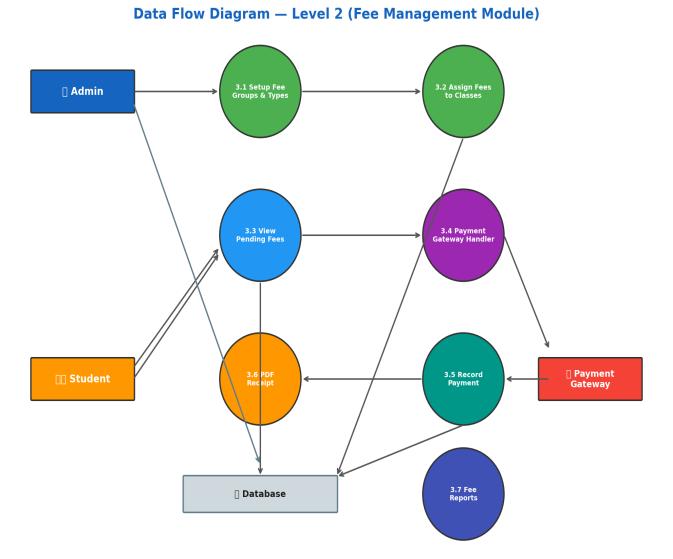
Level 2 (Fee Management): Fig. 5 provides a granular decompositionoftheFeeManagement processintoseven
sub-processes, including fee setup, assignment, viewing, gateway handling, payment recording, receipt generation, andreporting.
3.4 Use Case Diagram
Fig.6presentstheusecasediagramidentifying18primary use cases across 5 actor types: Admin, Teacher, Student, Parent,andPublicUser.
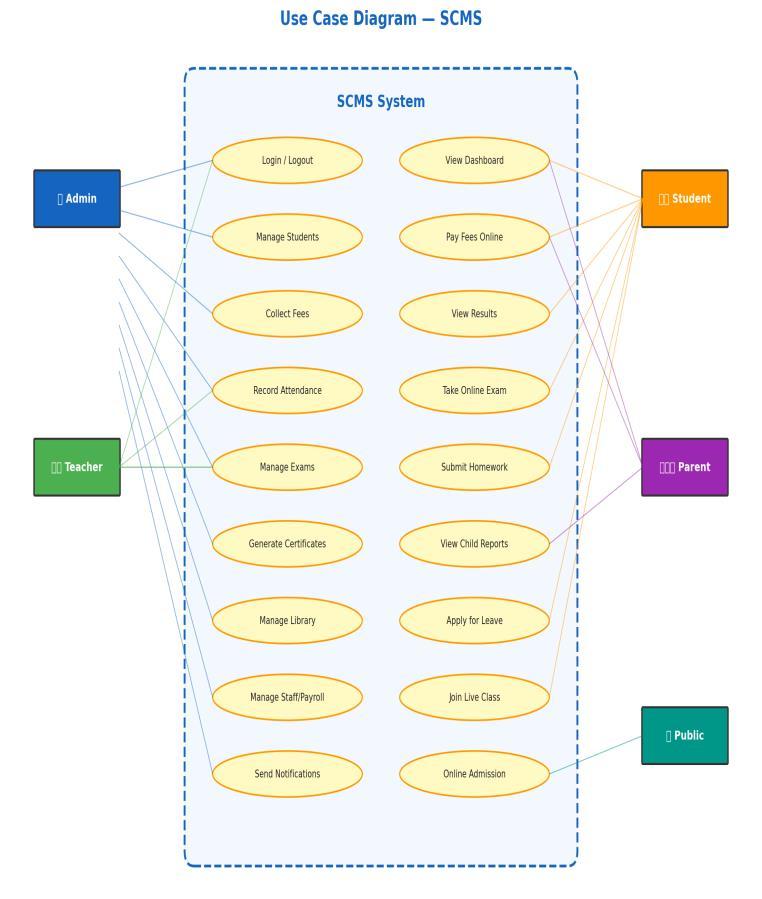
6: Use Case Diagram 5 Actors and 18 Use Cases
International Research Journal of Engineering and Technology (IRJET) e-ISSN: 2395-0056
Volume: 13 Issue: 03 | Mar 2026 www.irjet.net p-ISSN: 2395-0072
3.5 Sequence Diagrams
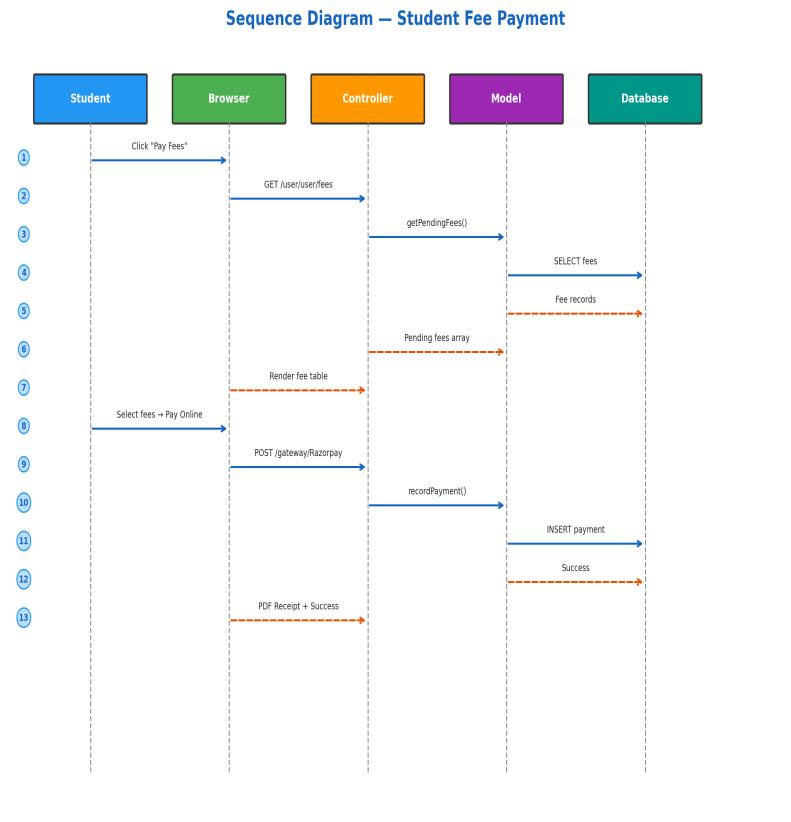
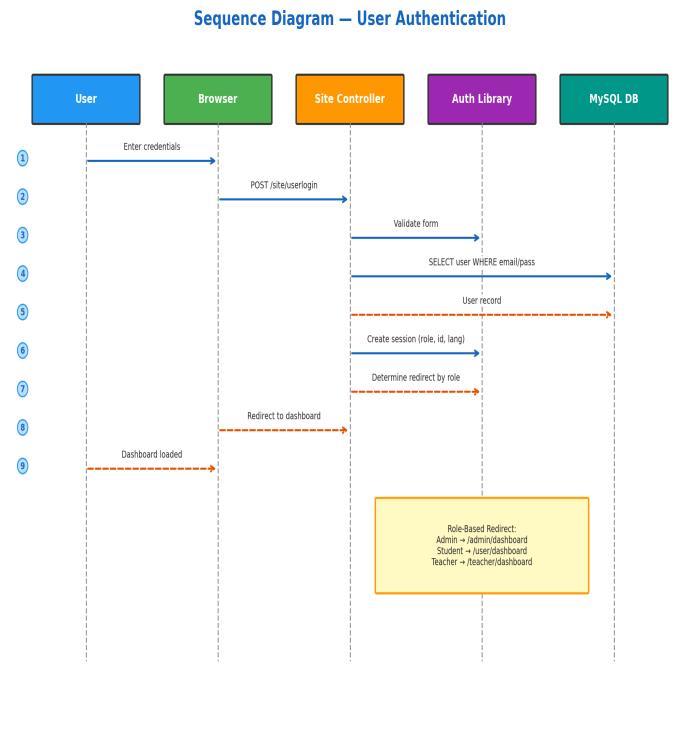
Fig. 7 illustrates the Student Fee Payment sequence involving 13 steps across 5 system components with externalPaymentGatewayinteraction.Figure8showsthe Authenticationsequencewithrole-basedredirection.
3.6 Entity Relationship Diagram
Figure 9 shows key entities and their relationships in the SCMSdatabaseschema.
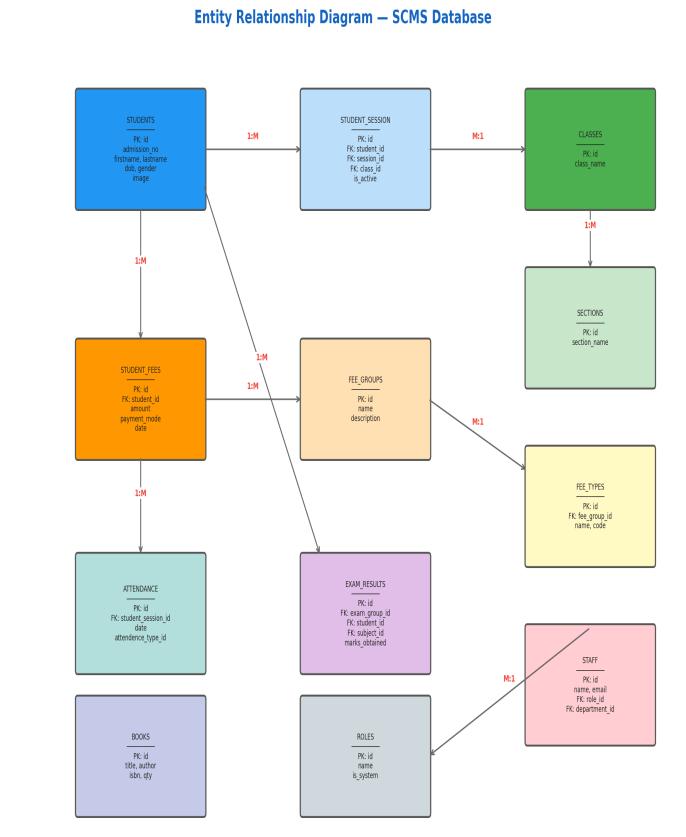
9: Entity Relationship Diagram SCMS Database 4. MODULE IMPLEMENTATION
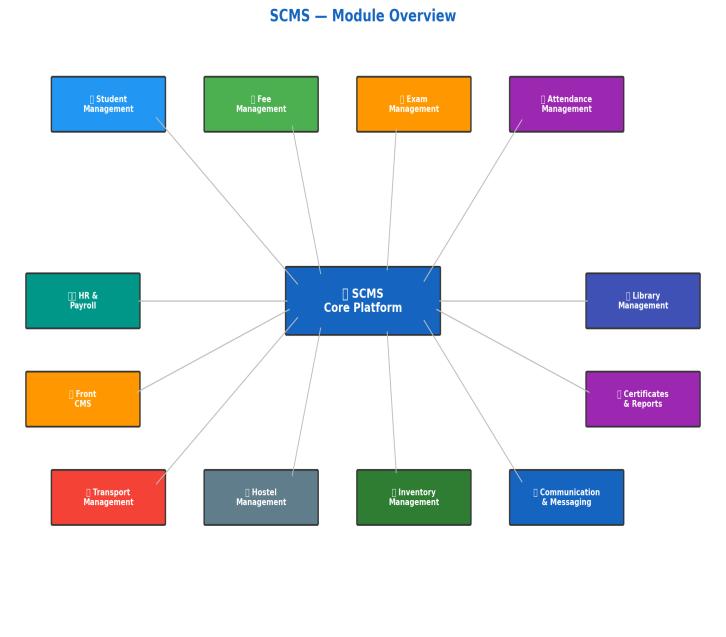
SCMScomprises20+integratedmodulesasdepictedinFig. 10
Volume: 13 Issue: 03 | Mar 2026 www.irjet.net p-ISSN: 2395-0072
TheStudentManagementmoduleisresponsibleforhandling all activities related to student records throughout their academic journey. It stores detailed information such as personaldetails,parentorguardiandata,contactaddress, bankinginformation,andothercustomfieldsrequiredbythe institution.
This module provides several useful features to simplify administration.ItsupportsbulkdataoperationsthroughCSV import and export, allowing large numbers of student recordstobemanagedefficiently.Italsoincludesoptionsfor organizingstudentsintodifferentcategories,generatingID cards with customizable formats, and managing transfers betweenclassesorbranches.
TheFeeManagementmoduleisdesignedusingastructured approachthatincludesmultiplelevelssuchasfeegroups,fee categories,masterfeedefinitions,andassignmentoffeesto individual students. This layered structure helps in organizingandmanagingdifferenttypesoffeesefficiently.
Thesystemsupportsawiderangeofonlinepaymentoptions by integrating multiple payment gateways from different regions.Theseincludeinternationallyrecognizedplatforms as well as region-specific services from countries such as India,Africa,andSoutheastAsia.Thiswidecoverageensures that users can make payments conveniently using their preferredmethods.
Eachpaymentgatewayisimplementedasanindependent controller within the system, which makes it easier to manage, update, or add new gateways in the future. This modulardesignimprovesflexibilityandscalability.
Inadditiontopaymentprocessing,themodulealsoprovides features such as fee concession management, automated notifications through SMS and email, and generation of digital receipts in PDF format. These features help streamlinefinancialoperationsandimprovecommunication withusers.
The Examination module is designed to handle both traditionalanddigitalexamprocesseswithintheinstitution. Forofflineexaminations,itallowsadministratorstoorganize examsbasedontermsorsemesters,createschedules,record studentmarks,anddefinegradingcriteria.Italsosupports classificationofresultsintodivisionsbasedonperformance.
TheCommunicationmoduleallowstheinstitutiontosend messagesthroughmultiplechannelssuchasSMS,email,and notifications. It supports various service providers for reliablemessagedelivery.Thesystemalsoincludesfeatures likein-appchatandonlinemeetingintegrationforreal-time communication.
The system also includes additional modules to support overallmanagement.Thesecoverattendancetracking,staff andpayrollmanagement,libraryoperations,transportand hostelmanagement,andinventorycontrol.Italsoprovides features for generating certificates and documents, managing website content, and creating various reports relatedtoacademics,finance,andattendance.
The system uses a database to store all information in an organizedmanner.Datarelatedtostudents,staff,fees,and examsisstoredinseparatetables,makingiteasytomanage andretrieve..
Table -3: Key Database Tables and Attributes
Table Purpose Key Attributes
students
student_session
staff
student_fees
student_attendances
exam_results
online_exams
Studentmaster data id,admission_no,name, dob,gender,image
Classenrollment student_id,session_id, class_id,section_id
Staff/Admin records id,name,email, password,role_id
Feetransactions id,student_id,amount, payment_mode,date
Attendance records id,student_session_id, date,type_id
Exammark entries id,exam_group_id, student_id,marks
Onlineexam config id,name,duration, passing_pct
books Librarycatalog id,title,author,isbn, qty
roles
sidebar_menus
Foronlineexaminations,thesystemprovidesaflexiblesetup thatincludesdifferenttypesofquestionssuchasmultiplechoice, multiple-select, and true/false. A question bank is maintained for easy exam creation, and exams can be conducted within a specified time limit. The system automatically evaluates responses and generates results, reducingmanualeffort.
Roledefinitions id,name,is_system
RBAC/menu config id,short_code,url, permissions
Volume: 13 Issue: 03 | Mar 2026 www.irjet.net
SCMSimplementsadefence-in-depthsecurityapproach: Table -4: Security Implementation Summary Security Layer Mechanism Implementation
Authentication Passwordhashing+ sessions SHA-1hash,2hrexpiry, filedriver
Authorization RBAC Per-page,per-action permissionchecks
InputSecurity Validation+XSS clean
SQLSecurity
CSRF
queries
check
FormValidation library
ActiveRecord/ QueryBuilder
library whitelist
Audit Logintracking user_logstablewithIP, timestamp
Each controller checks user permissions using the hasPrivilege() function before executing any action. The sidebarmenuisalsogenerateddynamically,showingonly theoptionsthatthelogged-inuserisallowedtoaccessbased ontheirrole.
7.1 Testing Methodology
The system was tested using four levels of testing. Unit testing was used to verify individual components, integration testing checked the interaction between modules,systemtestingensuredoverallfunctionality,and useracceptancetesting wascarriedoutwith real users to validateperformance.
Twenty test cases were executed across 10 functional modules.AlltestcasesachievedPASSstatus,demonstrating functionalcorrectness.
-5: Test Case
International Research Journal of Engineering and Technology (IRJET) e-ISSN: 2395-0056
Volume: 13 Issue: 03 | Mar 2026 www.irjet.net p-ISSN: 2395-0072
[3]OpenSIS, "Open Source Student Information System," [Online].Available:https://www.opensis.com/.
Database queries/page <50 15-40queries/page
PDFgenerationtime <5seconds 2-4seconds
Studentcapacity 10,000+/branch Validated
Cross-browsertestingconfirmedcompatibilitywithGoogle Chrome90+,MozillaFirefox85+,MicrosoftEdge90+,Safari 14+, and mobile browsers (Chrome and Safari) with a responsivelayout.
This paper presented SCMS, a comprehensive web-based ERP system for educational institutions built on the PHP CodeIgniter 3 MVC framework. The system successfully integrates 20+ functional modules, 28 payment gateway integrations, multi-channel communication (15+ SMS providers),andRBACfor7+userroles.
Keyachievementsinclude:layeredMVCarchitecturewith 7 base controller classes, dynamic multi-branch database switching,comprehensiveRBACwithpageandaction-level granularity, and modular payment gateway integration across6continents.
Testingacross20testcasesconfirmed100%passrate. Performancemetricsdemonstratedsub-3-secondpageloads andsupportfor150+concurrentsessions.
Inthefuture,thesystemcanbeimprovedbyaddingmobile applications,cloud-basedservices,andadvancedanalytics. Features such as AI-based predictions and biometric attendancecanalsobeincludedtoenhancefunctionality.
The authors would like to thank Rubigha M for their guidanceandtheDepartmentofInformationTechnologyat Knowledge Institute of Technology for providing the necessaryinfrastructureforthisresearch.
[1]M. A. Khan, S. K. Sharma, "Role of ICT in Education: A Review,"InternationalJournalofComputerScienceand Information Technologies, vol. 7, no. 2, pp. 800-803, 2016.
[2]Fedena, "Open Source School Management Software," [Online].Available:https://fedena.com/.
[4]Gibbon, "Flexible, Open Source School Management Platform,"[Online].Available:https://gibbonedu.org/
[5]BritishColumbiaInstituteofTechnology,"CodeIgniter3 UserGuide,"[Online]. Available:https://codeigniter.com/userguide3/
[6]Oracle Corporation, "MySQL 8.0 Reference Manual," [Online]. Available:https://dev.mysql.com/doc/refman/8.0/en/.
[7]Shuttleworth Foundation, "SchoolTool School AdministrationSoftware,"[Online]. Available:https://schooltool.org/
[8]I.Back,"mPDF PHPLibraryforGeneratingPDFFiles," [Online].Available:https://mpdf.github.io/
[9]Google, "Firebase Cloud Messaging Documentation," [Online].Available:https://firebase.google.com/docs/clo ud-messaging.
[10]Zoom Video Communications, "Zoom API Documentation,"[Online].Available:https://marketplace. zoom.us/docs/api-reference/
[11]E. Gamma, R. Helm, R. Johnson, J. Vlissides,Design Patterns:ElementsofReusableObject-OrientedSoftware, Addison-Wesley,1994.
[12]OWASP Foundation, "OWASP Web Security Testing Guide," [Online]. Available:https://owasp.org/wwwproject-web-security-testing-guide/.
[13]Stripe, "Stripe API Reference," [Online]. Available:https://stripe.com/docs/api
[14]Twilio, "Twilio SMS API Documentation," [Online]. Available:https://www.twilio.com/docs/sms
[15]Bootstrap, "Bootstrap Documentation," [Online]. Available:https://getbootstrap.com/docs/.