
International Research Journal of Engineering and Technology (IRJET) e-ISSN: 2395-0056
Volume: 13 Issue: 04 | Apr 2026 www.irjet.net p-ISSN: 2395-0072

International Research Journal of Engineering and Technology (IRJET) e-ISSN: 2395-0056
Volume: 13 Issue: 04 | Apr 2026 www.irjet.net p-ISSN: 2395-0072
Rupali¹, Prachi Sharma², Akansha Pandey³, Mahesh Bahadur Singh´
¹Student, Dept. of Computer Science and Engineering, SRMCEM, Lucknow, India
²Student, Dept. of Computer Science and Engineering, SRMCEM, Lucknow, India
³Assistant Professor, Dept. of Computer Science and Engineering, SRMCEM, Lucknow, India
´Assistant Professor, Dept. of Computer Science and Engineering, SRMCEM, Lucknow, India
Abstract - Selecting an appropriate career path has becomeincreasinglychallengingforstudentsduetorapid technological advancements and continuously evolving industryrequirements.Manystudentslackpropercareer guidance and often make career decisions without fully understanding their skills, interests, or the available opportunities in the job market. Traditional career counseling methods primarily rely on academic performance and static assessments, which often fail to consider important factors such as personality traits, learningstyles,andchanginglabor-markettrends. To address these limitations, this study proposes a Smart Career Path Recommender System that utilizes Artificial Intelligence(AI)andMachineLearning(ML)techniquesto provide personalized and data-driven career recommendations. The proposed system analyzes multiple aspects of user data, including academic performance,skills,interests,andpsychometricattributes to identify suitable career paths. Machine learning algorithms such as Decision Trees, are combined with recommendation techniques including Collaborative Filtering and Content-Based Filtering to improve recommendation accuracy. Furthermore, Natural LanguageProcessing(NLP)isintegratedtointerpretuser career goals provided in textual form. In this study, a system was developed to help students choose suitable careerpathsbyanalyzingtheirabilitiesandinterestsand relating them to current and future industry opportunities.
Key Words: Career Recommendation System, Artificial Intelligence, Machine Learning, Recommender System, SkillGapAnalysis,PredictiveModeling,CareerGuidance.
Selectingacareerpathisoneofthemostimportantdecisions in a student’s life, as it influences their professional growth, job satisfaction, and future success. Despite this, many students struggle to identify suitable career options because
oflimitedawarenessofnewjobopportunitiesandinsufficient career guidance. Traditional career counseling methods mainly rely on academic performance or standardized assessments, which do not provide a comprehensive evaluation of students’ abilities, interests, personality traits, and learning styles. As a result, these conventional approaches often fail to deliver accurate and personalized careerrecommendationsinarapidlychangingjobmarket.
Most existing career recommendation systems still depend heavily on fixed questionnaires and outdated occupational data[1,3].Thesesystemsoftenlacktheflexibilityrequiredto adapt to individual preferences and evolving industry demands [18,20]. Consequently, the generated recommendations are often generic and may not accurately represent a user’s actual potential. Furthermore, many traditional systems overlook important factors, such as personality traits and emotional intelligence, which play a significant role in career success [2,11]. The absence of automation and real-time feedback further reduces the effectiveness of these systems, making them less suitable for today’sdynamicemploymentenvironments[7,20].
To overcome these limitations, the proposed Smart Career Path Recommender System integrates advanced machine learning techniques with a personalized recommendation approach [4,5,12,13]. The system analyzes various aspects of a student’s profile, including academic performance, skills, interests, and psychometric data, to generate more accurate andrelevantcareerrecommendations[15].Theintegrationof Natural Language Processing (NLP) allows the system to understand user queries and provide context-based suggestions through an interactive interface [9,10]. Additionally, the system is designed to continuously learn from new data and user interactions, ensuring that recommendations remain up to date and aligned with future industry trends [17,19]. The primary objective of this system istomakecareerguidancemoreaccessible,reliable,anduser-
International Research Journal of Engineering and Technology (IRJET) e-ISSN: 2395-0056
Volume: 13 Issue: 04 | Apr 2026 www.irjet.net p-ISSN: 2395-0072
friendly, thereby helping students make informed and confidentcareerdecisions[14].
2.1
The early development of automated career guidance systemswasprimarily basedonrule-basedapproaches and theoretical frameworks, such as the Holland Occupational Themes (RIASEC), which classified careers into various categories according to personality characteristics [1]. Althoughthesemodelsofferasystematicapproachtocareer guidance, they lack flexibility and are not capable of adaptingtoindividualdifferencesorevolvingcareertrends. Subsequently, web-based career guidance systems began integrating statistical methods, such as linear regression and decision tree algorithms, to enhance prediction accuracy [2,3]. While these techniques are relatively simple to implement and interpret, they remain largely static and are unable to adapt to changing job market conditions. Moreover, these systems mainly focus on quantifiable factors such as academic performance and often overlook important aspects such as soft skills, personality traits, and behavioral characteristics, which are crucial for long-term careergrowthandsatisfaction[4].
With the rapid advancement of Artificial Intelligence and MachineLearning,moderncareerrecommendationsystems have become more advanced, intelligent, and data-driven. Recent research has focused on integrating of explainable artificialintelligencetechniques,suchasSHAPandLIME,to make recommendation results more transparent and easier for users to understand [11]. These techniques help users understand the rationale behind specific career recommendations.
Researchers have also begun incorporating psychometric analysis and behavioral profiling to improve the level of personalization in career recommendation systems [12]. Furthermore,theintegrationof real-timelabormarket data fromjobportalsandprofessionalnetworkingplatformshas improved the relevance of recommendations by aligning them with current industry requirements and employment trends [13]. For instance, Kumar et al. (2022) proposed a system that compares students’ skills with current job market demands to identify skill gaps and improve career readiness[14].
Despite these advancements, several challenges remain in theexistingsystems.Manycareerrecommendationsystems still face difficulties in effectively integrating multiple types of user data, adapting based on continuous user feedback, and ensuring accessibility for users from diverse
educationalandsocioeconomicbackgrounds[15].
Table-1:ComparativeAnalysisofExistingCareer RecommendationSystems
Re f. No . Autho r / Year Method Used Key Contribution
[1] Hollan d, 1997
Psychomet ricCareer Theory (RIASEC Model)
[2] Brown & Lent, 2002 Career Developme ntTheory
Classified careersbased on personality typesand vocational interests
Provided theoretical framework forcareer counseling anddecision making
Limitations
Staticmodel, lacks adaptability andmodern jobmarket integration
Theoretical model,not automated orAI-based
[3] Goyal & Vohra, 2011 Rule-Based Expert System Developed expertsystem forcareer selection using psychometric testing Limited scalability and personalizat ion
[4] Chen &Ngu, 2015
MultiCriteria Evaluation
[5] Nguye net al., 2020 Machine Learning Prediction
Proposed user-centric career recommendat ionsystem usingmulticriteria decision making
Didnotuse machine learning models
Usedmachine learningto predict student careerpaths basedon academicdata Focused mainlyon academic performance
[6] Patel etal., 2021 Decision Tree/ Random Forest Applied classification algorithmsfor career prediction Limited datasetand feature diversity
International Research Journal of Engineering and Technology (IRJET) e-ISSN: 2395-0056
Volume: 13 Issue: 04 | Apr 2026 www.irjet.net p-ISSN: 2395-0072
A review of existing studies identified several significant limitations in current career recommendation systems. Most existing approaches focus on a single aspect of user data, such as academic performance or psychometric assessment, rather than performing a comprehensive evaluation of multiple factors. This type of limited analysis often leads to incomplete and, at times, less reliable career recommendations
Anotherimportantlimitationofmanyexistingsystemsisthe lack of adaptive learning capability. Many systems do not update or improve their recommendations based on user feedbackornewlyavailabledata,makingthemstaticandless effective over time. In addition, only a few systems use realtime labor market information, which reduces the relevance of their recommendations in a continuously changing job environment. Accessibility is also an important issue, since some advanced career recommendation systems require technical knowledge or institutional support, making them difficult for general users to accessand use efficiently. These limitations highlight the need for a more integrated and intelligent career recommendation system that can combine multiple data sources, adapt continuously through learning, and provide personalized as well as user-friendly career guidance.
Selecting an appropriate career path continues to be difficult for many students because of limited exposure to different career opportunities and the rapidly changing job market. In many cases, students are not fully aware of the variety of career options available and therefore rely on traditional career counseling methods that often provide only general guidanceratherthanpersonalizedrecommendations.
Existing career recommendation systems are largely static and primarily depend on fixed questionnaires and outdated occupational information. Consequently, these systems often generate generalized recommendations that may not accuratelyrepresentanindividual’sabilities,interests,ortrue potential.
Another major issue is the fragmented analysis of the user data. Most current systems focus on only one factor, such as academicperformanceorpsychometricevaluation,insteadof analyzing a comprehensive user profile. This limited evaluation leads to incomplete and less reliable career recommendation.
Furthermore,manyexistingsystemslackadaptabilitybecause theydonotincorporateuserfeedbackorcontinuouslyupdate their models based on changing industry trends and job marketrequirements.Thisresultsinagapbetweenthecareer
recommendations provided and the actual job market demands.
Problem Statement:
Basedonthelimitationsofexistingsystems,itisimportantto developanintelligentandintegratedcareerrecommendation system that considers multiple factors, such as academic performance, skills, interests, and personality traits. The system should also be able to update and improve its recommendations based on user feedback and changing industry requirements. In this study, a Smart Career Path Recommender System was developed to address these challenges by providing personalized and accurate career guidancethatcanadapttofutureindustrytrends.
Themainobjectiveofthisstudywastodevelopanintelligent andeasy-to-usecareerrecommendationsystemthatcanhelp students make better career decisions. The system evaluates different aspects of a student’s profile, such as academic performance, skills, and interests, to provide personalized andaccuratecareerguidance.
Thespecificobjectivesofthisstudyareasfollows.
Integrate Multidimensional Student Data: To Combine academic performance, psychometric evaluation results, and personal interests into a unified student profile, allowing a morecomprehensiveandaccurateassessmentofeachuser.
Apply Machine Learning Algorithms: To implement supervised learning algorithms such as decision trees, random forest, and naïve Bayes for analyzing user data and predictingsuitablecareerpaths.
Incorporate Natural Language Processing (NLP): To enable the system to interpret user inputs expressed in natural language, making the interaction process more intuitive and accessible.
Develop Adaptive Feedback Mechanism: A feedback system that allows the model to learn continuously from user input andupdaterecommendationsaccordingtochangingindustry trendsanduserpreferencesshouldbedesigned
Design a User-Centric Interface: To develop an easy-to-use platform that clearly displays career recommendations, identifies skill gaps, and provides suggestions for improvement.
International Research Journal of Engineering and Technology (IRJET) e-ISSN: 2395-0056
Volume: 13 Issue: 04 | Apr 2026 www.irjet.net p-ISSN: 2395-0072
Objective Statement:
The overall goal of this study is to develop a scalable, adaptive, and explainable career recommendation system that assists students in aligning their skills, interests, and abilitieswithappropriatecareeropportunitieswhilekeeping pacewithevolvingindustryrequirements.
5.1 Architectural Framework
The proposed system is designed using a modular and scalable architecture that can adapt to evolving job market trends and changing user preferences. In contrast to traditional rule-based career guidance systems, the proposedmodelemploysanintegratedArtificialIntelligence framework to generate dynamic and personalized career recommendations.
1. UserProfileandDataAcquisition
The initial stage involves collecting various types of data to constructacomprehensiveuserprofile.
StructuredData:Thisincludesacademicinformation,suchas grades,GPA,andexaminationscores.
Semi-Structured Data: This consists of psychometric test results,aptitudeevaluations,andself-declaredskills.
Unstructured Data: This includes textual inputs such as personal statements and career goals, which are processed usingNaturalLanguageProcessing(NLP)techniques.
Theintegrationofthesemultipledatatypeshelpsindevelop a more complete and accurate representation of the user profile.
2. DataPreprocessingandFeatureEngineering
The collected data were preprocessed to ensure accuracy, consistency,andsuitabilityformachinelearningmodels.
Data Cleaning: In this step, missing values and inconsistent data entries are identified and handled using suitable preprocessingmethodstoimprovedataquality.
Normalization and Encoding: Numerical features were normalized to maintain a uniform scale, and categorical variableswereconvertedintomachine-readableformsusing encodingtechniques.
NLP Processing: Textual data are processed using Natural Language Processing techniques, such as tokenization, stopword removal, and lemmatization, to extract meaningful informationfromtextinputs.
Once preprocessing is completed, all processed features are combinedtoformasinglefeaturevectorthatrepresentsthe overalluserprofile
5.2 The Analytical Core
The system adopts a hybrid analytical approach that combines multiple machine learning techniques to enhance predictionaccuracyandreliability.
In this stage, different supervised learning algorithms are usedtoclassifyusersintosuitablecareer domainsbasedon theirprofile.
Base Models: Decision trees and random forests are used because they are easy to interpret and provide efficient classificationresults.
Advanced Models: Support Vector Machines and Gradient Boosting were also applied to identify the complex patterns inthedataset
EnsembleMethod:Multiplemodelsarecombinedtoimprove the overall prediction accuracyand reduce theclassification errors.
Afteridentifyingpotentialcareeroptions,thesystemrefines andprioritizestherecommendationsusingrecommendation algorithms.
Collaborative Filtering: Recommends career options based onsimilaritieswiththeprofilesofotherusers.
Content-Based Filtering: Matches user skills, interests, and profileattributeswithcareerrequirements.
Ranking Mechanism: Final career recommendations are rankedaccordingtopredictionconfidenceandrelevance.
To improve transparency and system performance, the model incorporates an explainability and continuous learningmechanism.
ExplainableAI(XAI):TechniquessuchasSHAPandLIMEare used to explain the reasoning behind the career recommendations.
FeedbackMechanism:Userfeedbackiscollectedandusedto refinetherecommendations.
Reinforcement Learning: The system continuously updates itsrecommendationsbasedonuserinteractionandchanging industrytrends.
Thesystemwasdeployedasaweb-basedapplicationusinga microservicesarchitecture.
International Research Journal of Engineering and Technology (IRJET) e-ISSN: 2395-0056
Volume: 13 Issue: 04 | Apr 2026 www.irjet.net p-ISSN: 2395-0072
User Interface: A dashboard interface was provided to display career recommendations, skill gaps, and improvement suggestions in a clear and user-friendly format. Security Measures: User data privacy and security are maintained through secure storage, authentication mechanismsandethicalAIpractices.
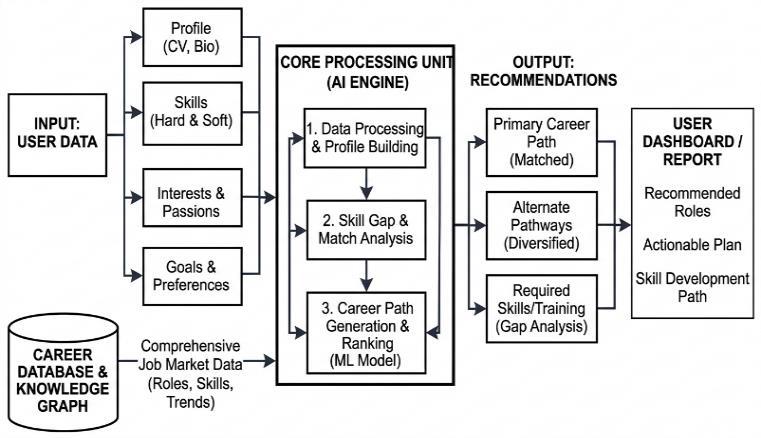
TheSmartCareerPathRecommenderSystemusesa machine learning–based approach to generate personalized career recommendations for users. The algorithm analyzes different user attributes such as academic performance, skills, interests, and aptitude to determine the most suitable career domain. By analyzing these factors together, the system can provide more accurate and personalized recommendations comparedtotraditionalcareerguidancemethods.
Thesystemusesmultipleinputparameterstobuildadetailed user profile. These include academic performance (such as percentageorCGPA),technicalandnon-technicalskills,areas of interest (such as Artificial Intelligence, Management, or Design), and aptitude-related indicators. These inputs are combinedtoformafeaturevectorthatrepresentstheuserin themachinelearningmodel.
Beforeapplyingthemachinelearningmodel,theinputdatais preprocessed to ensure consistency and accuracy. This step involves handling missing data values, converting categorical variables into numerical form using label encoding, and normalizing numerical features to maintain a uniform scale. These preprocessing steps help improve the overall performanceandaccuracyofthesystem
A suitable machine learning classification algorithm, such as Random Forest, is used for career prediction. This algorithm is selected because it can handle multiple input features efficiently, reduce overfitting, and provide reliable classificationresultsforcareerdomainprediction.
Theworkingprocedureofthesystemcanbedescribed inthe followingsteps.
1. Theuserenterstherequiredinformationthroughthe systeminterface.
2. Theinputdataispreprocessedandthentransformed intoastructuredformat.
3. The processed data is given as input to the trained machinelearningmodel.
4. The system predicts the most accurate career domain.
5. A skill gap analysis is performed to identify missing orrequiredskills.
6. The system displays the recommended career path alongwithsuggestionsforskillimprovement.
Input: User data (academic performance, skills, interests, aptitude)
Output: Recommended career path and skill improvement suggestions Begin
Collectuserinput
Preprocessdata(clean,encode,normalize)
Loadtrainedmachinelearningmodel
Predictcareerpathusingmodel
Performskillgapanalysis
Displayresultstotheuser
End
Thealgorithmisdesignedtoprovideefficientprocessingand reliable prediction results. By applying proper data preprocessing and using a suitable classification model, the system can achieve good prediction accuracy and scalability. Thesystemperformancecanbefurtherimprovedbytraining the model on larger datasets and using more advanced machinelearningalgorithmsinfuturework.
International Research Journal of Engineering and Technology (IRJET) e-ISSN: 2395-0056
Volume: 13 Issue: 04 | Apr 2026 www.irjet.net p-ISSN: 2395-0072
7.1
The Smart Career Path Recommender System was successfully developed and evaluated using a structured dataset that included student-related attributes such as academic performance, skills, interests, and aptitude. The machine learning model was trained and tested using the collected dataset to generate accurate and personalized careerrecommendationsbasedontheinputfeatures. The system provides career predictions based on the information entered by the users through a web-based interface. During the testing phase, the model was observed to recommend career domains that matched well with user profiles. In addition, the Skill Gap Analysis module enhances the system by identifying missing or required skills for the recommended career path and suggesting ways to improve skills
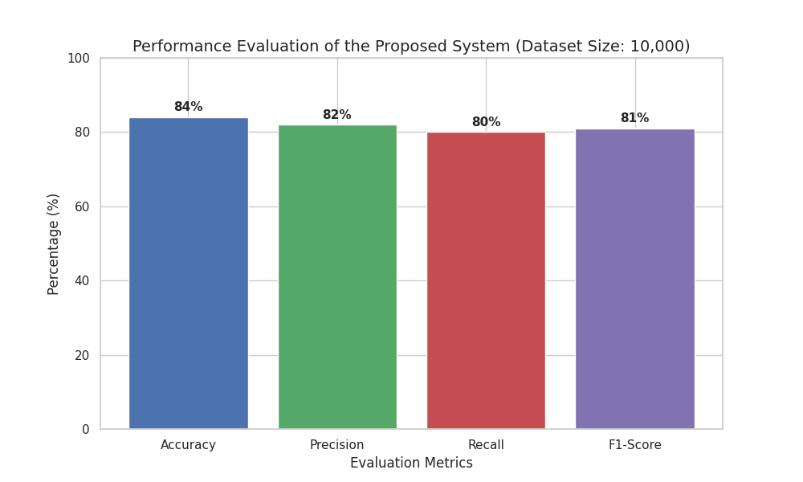
The model performance was evaluated using standard evaluation metrics, such as accuracy. The model achieved satisfactory 84% accuracy, which indicating that the model has a reliable prediction capability and can be effectively usedforcareerrecommendationpurposes.
Theproposedsystemwasevaluatedusingadatasetof10,000 records, and its performance was measured using standard evaluationmetrics,suchasaccuracy,precision,recall,andF1score.
Table-2:EvaluationMetricsforSmartCareerPath RecommenderSystem
Metric Value Dataset Size Remarks
Accuracy 84% 10,000 Good prediction performance
Precision 82% 10,000 Lowfalsepositiverate
Recall 80% 10,000
F1-Score 81% 10,000
Effective detection of relevantcareers
Balancedperformance
Theresultsdemonstratethatthesystemachievessatisfactory performance across all evaluation metrics, indicating its effectiveness in providing reliable and personalized career recommendations.
7.2 Conclusion
The Smart Career Path Recommender System demonstrates theeffectiveapplicationofArtificialIntelligenceandMachine Learning techniques in delivering personalized career guidance. The system analyzes important user parameters, suchasacademicperformance,skills,interests,andaptitude, to recommend suitable career paths through an interactive web-based platform. By combining multiple user attributes, the system provides more informed and personalized recommendations than traditional career counseling methods. The use of a machine learning model in the proposed system helps make efficient and data-based decisions, whereas the Skill Gap Analysis module improves the system by identifying areas where users need improvementandsuggestingrelevantskillsfordevelopment. The system demonstrated satisfactory performance in terms of prediction accuracy and usability, indicating that it can be used as a reliable tool for career recommendation and guidance.Theoverallperformanceofthesystemdependson thequalityandsizeofthedatasetusedfortrainingthemodel. Inthefuture,thesystemcanbeimprovedbyusinglargerand more diverse datasets, applying advanced machine learning algorithms to improve prediction accuracy, and developing a mobileapplicationtomakethesystemmoreaccessibletothe users. Overall, the proposed system provides a practical and scalable solution that can help students make informed careerdecisionsandhighlightsthegrowingimportanceofAIbasedsystemsineducationandincareerguidance.
The Smart Career Path Recommender System can be improved in several ways to enhance its performance, accuracy, and usability. One possible improvement is the integration of real-time job market data from online employment platforms so that the system can generate recommendations based on current industry requirements
International Research Journal of Engineering and Technology (IRJET) e-ISSN: 2395-0056
Volume: 13 Issue: 04 | Apr 2026 www.irjet.net p-ISSN: 2395-0072
and emerging career trends, instead of relying only on static datasets.
The use of advanced machine learning and deep learning models can also be explored to improve prediction accuracy, especially when working with complex and unstructured data,suchasuseressays,resumes,orpersonalstatements.In addition, incorporating a reinforcement learning mechanism would allow the system to continuously improve its recommendations based on user feedback and interactions overtime.Futuredevelopmentmayalsoincludethecreation ofamobileapplication with multilingual support, which would make the system accessible to users from different regions and backgrounds. The addition of career-path visualization features could also help users better understand the required skills, career progression,andstepsneededtoachievetheircareergoals.
Furthermore, integrating soft skill assessments and personalityanalyseswouldallowthesystemtoprovidemore comprehensive and well-rounded career recommendations Ensuring data privacy, system transparency, and ethical AI practicesareessentialforbuildingusertrustandmaintaining system reliability. Overall, the proposed system has significant potential to evolve into a comprehensive, intelligent,anduser-centeredcareerguidanceplatform.
[1] J. L. Holland, Making Vocational Choices: A Theory of Vocational Personalities and Work Environments, 3rd ed. Odessa,FL:PsychologicalAssessmentResources,1997.
[2] M. Brown and R. Lent, “Career development and counselling: Putting theory and research to work,” J. Career Dev.,vol.29,no.3,pp.193–205,2002.
[3] S. Goyal and S. Vohra, “A rule-based expert system for careerselectionusingpsychometrictesting,”in Proc. IEEE Int. Conf. on Advanced Computing,2011,pp.1–6.
[4] L. Chen and A. Ngu, “A user-centric approach for career recommendation based on multi-criteria evaluation,” Expert Syst. Appl.,vol.42,no.7,pp.3668–3676,2015.
[5] T.Nguyen, S. Zaman,and R. Mahmud,“Machine learningbased student career path prediction system,” IEEE Access,vol.8,pp.137013–137024,2020.
[6] K. Patel, M. Shah, and R. Chandra, “Applying decision tree andrandomforestalgorithmsforcareerprediction,” Int. J. Comput. Appl.,vol.182,no.24,pp.34–40,2021.
[7] R.PatilandP.Jadhav,“Hybridrecommendationapproach using collaborative and content-based filtering for elearning,” in Proc. IEEE Int. Conf. on Data Mining Workshops,2021,pp.189–194.
[8] P. Sharma and A. Jain, “Deep learning framework for career guidance using student essays,” Int. J. Intell. Syst. Appl.,vol.14,no.3,pp.47–56,2022.
[9] H. Singh and R. Kaur, “NLP-based adaptive recommendation model for educational career mapping,” IEEE Trans. Learn. Technol., vol. 15, no. 2, pp. 120–129, 2022.
[10] A. M. Rahman, M. Hossain, and N. Ahamed, “Text-based emotion recognition using deep neural networks for career recommendation,” Comput. Intell. Neurosci., vol. 2021,pp.1–10,2021.
[11] S. Batra and D. Kumar, “A fuzzy logic approach for multicriteria career recommendation,” J. Comput. Sci., vol. 18, no.4,pp.229–239,2020.
[12] Y. Zhao and T. Wang, “Genetic algorithm-based optimization for personalized education recommendation,” IEEE Access, vol. 7, pp. 112495–112506,2019.
[13] F. Li, J. Qian, and Y. Liu, “Reinforcement learning-based adaptive recommendation framework for personalized learning,” IEEE Trans. Neural Netw. Learn. Syst.,vol.33,no. 4,pp.1558–1570,2022.
[14] L. Lundberg et al., “Explainable AI for education: Using SHAPtointerpretmodelpredictions,” Proc. IEEE Frontiers in Education Conf.,2021,pp.1–7.
[15] A. Thomas and P. Gupta, “Psychometric profiling and data-drivencareerpredictionusingmachineintelligence,” Int. J. Inf. Technol. Educ.,vol.17,no.2,pp.89–98,2022.
[16] N. Kapoor and D. Mehta, “AI-based assessment of employability using behavioural and academic features,” Int. J. Eng. Res. Technol.,vol.11,no.6,pp.985–990,2023.
[17] P.Kumar,R.Bansal,andV.Sharma,“IntegrationofrealtimelabormarketdataforAI-basedcareer recommendation,” IEEE Trans. Comput. Soc. Syst.,vol.9, no.3,pp.431–440,2022.
[18] A.BanerjeeandS.Ghosh,“Bigdataanalyticsfordynamic career guidance using labor market intelligence,” Proc. IEEE Int. Conf. on Smart Data,2021,pp.144–151.
[19] C. Rao and T. Deshmukh, “Design of adaptive e-learning systems using collaborative AI,” Int. J. Educ. Technol. High. Educ.,vol.19,no.1,pp.1–18,2022.
[20] R. Mishra and V. Jain, “AI-driven educational recommender systems: A review of emerging trends and challenges,” IEEE Access,vol.10,pp.74233–74245,2022.