
International Research Journal of Engineering and Technology (IRJET) e-ISSN: 2395-0056
Volume: 13 Issue: 03 | Mar 2026 www.irjet.net p-ISSN: 2395-0072
International Research Journal of Engineering and Technology (IRJET) e-ISSN: 2395-0056
Volume: 13 Issue: 03 | Mar 2026 www.irjet.net p-ISSN: 2395-0072
Kedari V. K.1,Shete Shantanu Nilesh2 , Nalawade Rudra Milind3 , Pingle Parag Rajesh4, Ganjave Siddhesh Shantaram5
1Lecturer, Dept. of Information Technology, Jaihind Comprehensive Educational Institue’s Jaihind Polytechnic Kuran, Maharashtra, India
2,3,4,5Final year Diploma Student, Jaihind Comprehensive Educational Institue’s Jaihind Polytechnic Kuran, Maharashtra, India
Abstract - Agriculture faces significant challenges such as plant diseases, improper irrigation, and lack of real-time monitoring,whichdirectlyaffectcropproductivityandfarmer income. Traditional farming methods rely on manual observation, leading to delayed decision-making and inefficient resource utilization. This paper presents a Smart Agro Health Monitoring System using Artificial Intelligence, Machine Learning, and Internet of Things technologies to enhance precision farming. The proposed system utilizes a Raspberry Pi as the central processing unit to collect environmental data from sensors such as temperature, humidity, and soil moisture. Plant leaf images are captured using a mobile camera and analyzed using a Convolutional NeuralNetworkmodelforearlydiseasedetection.Thesystem uses a mobile hotspot for connectivity and displays real-time data on a Flask-based web application. In addition to monitoring, the system provides extended features such as weather prediction, crop recommendation, tractor booking assistance, government scheme information, and fertilizer shop location services. The integration of monitoring, prediction, and support services makes the system more practical and user-friendly. The proposed solution is costeffective, scalable, andsuitablefor rural deployment, helping farmers improve productivity, reduce crop loss, and adopt smart farming practices
Key Words: Smart Agriculture, IoT, Machine Learning, CNN, Raspberry Pi, Plant Disease Detection, Web Application, Precision Farming
Agriculture is a fundamental sector that supports the livelihood of a large population, especially in developing countries.However,farmersfacemultiplechallengessuchas plant diseases, improper irrigation, lack of real-time environmentalmonitoring,andlimitedaccesstoagricultural supportservices.Traditionalfarmingmethodsrelyheavily onmanualobservationandexperience,whichoftenleadsto delayed detection of crop issues and inefficient decisionmaking. These challenges can result in reduced crop productivityandfinanciallosses.
With the advancement of technology, the integration of Artificial Intelligence (AI), Machine Learning (ML), and Internet of Things (IoT) has enabled the development of
smart agricultural systems. IoT sensors can continuously monitor environmental parameters such as temperature, humidity, and soil moisture, while AI-based models can analyzeplanthealthanddetectdiseasesatan early stage. This combination allows farmers to take timely and informeddecisions.
Inthispaper,aSmartAgroHealthMonitoringSystemis proposedusingaRaspberryPiasthecentralprocessingunit. The system collects real-time data from sensors and processesplantleafimagescapturedusingamobilecamera. A Convolutional Neural Network (CNN) model is used for accuratediseasedetection.Thesystemisconnectedthrough amobilehotspotandprovidesoutputthroughaweb-based applicationdevelopedusingFlask.
In addition to monitoring and disease detection, the proposed system offers extended functionalities such as weatherprediction,croprecommendation,tractorbooking assistance,governmentschemeinformation,andfertilizer shoplocationservices.Thesefeaturesmakethesystemmore practical and beneficial for farmers by providing both monitoring and decision-support capabilities in a single platform.
Theprimaryobjectiveofthissystemistodevelopacosteffective,scalable,anduser-friendlysolutionthatimproves crop health monitoring, reduces losses, and enhances productivity. The proposed approach contributes to the adoptionofsmartandsustainableagriculturalpractices.
Recentadvancementsinsmartagriculturehavefocused onintegratingInternetofThings(IoT)andMachineLearning (ML) techniques to improve crop monitoring and farm management.Variousresearchworkshaveproposedsystems that utilize sensor networks to monitor environmental parameterssuchastemperature,humidity,andsoilmoisture. These systems provide real-time data to farmers, enabling better decision-making and efficient use of resources. However, many of these solutions are limited to environmental monitoring and do not include intelligent diseasedetectionorfarmersupportservices.
In the area of plant disease detection, several machine learninganddeeplearningapproacheshavebeendeveloped.
International Research Journal of Engineering and Technology (IRJET) e-ISSN: 2395-0056
Volume: 13 Issue: 03 | Mar 2026 www.irjet.net p-ISSN: 2395-0072
Convolutional Neural Networks (CNN) have proven to be highlyeffectiveinclassifyingplantleafdiseasesusingimage datasets such as PlantVillage. These models can identify diseases with high accuracy by analyzing features like texture,color,andpatterns.Despitetheireffectiveness,many implementationsrelyoncloud-basedprocessing,whichmay notbesuitableforruralareasduetonetworkdependency andlatencyissues.
SomeexistingsystemscombineIoTwithcloudcomputing tostoreandanalyzeagriculturaldata.Whilethesesystems offer scalability and centralized control, they require continuous internet connectivity and may increase operational costs. To overcome these challenges, edge computing solutions using devices like Raspberry Pi have been introduced, allowinglocal data processing and faster responsetimes.
Researchershavealsoexploredintegratedsystemsthat combinesensor-basedmonitoringwithimage-baseddisease detection.Thesehybridsystemsimprovetheaccuracyand reliabilityofagriculturalmonitoring.However,manyofthese systemsfocusonlyondetectionandlackadditionalfeatures that support farmers in decision-making and resource management.
Recent studies highlight the need for comprehensive agriculturalplatformsthatnotonlymonitorcrophealthbut alsoprovideusefulservicessuchasweatherupdates,crop recommendations,andaccesstoagriculturalresources.Such integratedsolutionscansignificantlyenhanceproductivity andsupportfarmersinmakinginformeddecisions.
The proposed system addresses these limitations by integratingIoT-basedenvironmentalmonitoring,CNN-based plant disease detection, and a web-based platform that providesadditionalservicessuchasweatherprediction,crop recommendation, tractor booking, government scheme information, and fertilizer shop location. This makes the systemmorepractical,scalable,andsuitableforreal-world agriculturalapplications.
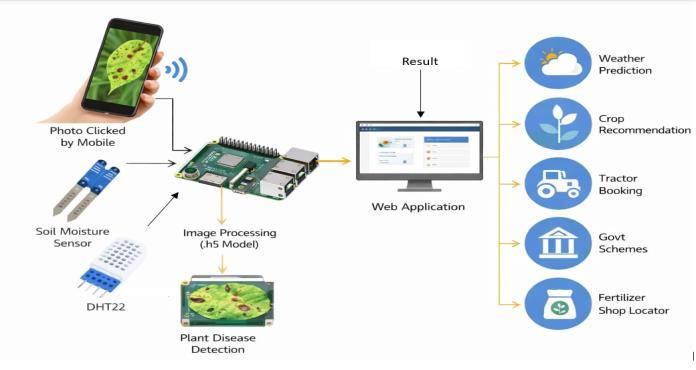
The proposed Smart Agro Health Monitoring System is designedasanintegratedplatformthatcombinesInternetof Things (IoT), Machine Learning (ML), and web-based servicestoprovidereal-timecropmonitoringanddecision supportforfarmers.ThesystemutilizesaRaspberryPias thecentralprocessingunitfordataacquisition,processing, andcommunication.
TheoverallarchitectureofthesystemisshowninFig-1.The systemconsistsofmultiplemodulesincludingsensordata acquisition, image processing, machine learning-based disease detection, data communication, and a web-based applicationthatprovidesadditionalfarmerservices.
Environmentalparametersarecollectedusingsensorssuch asDHT22fortemperatureandhumiditymeasurement,anda soilmoisturesensorfor monitoring soilconditions.These sensorsareinterfacedwiththeRaspberryPithroughGPIO pins.Thesystemcontinuouslycollectsreal-timedata,which helps in understanding the environmental conditions affectingcropgrowth.
The collected data is periodically updated and stored for further processing. This enables early detection of unfavorable conditions such as low soil moisture or high temperature,allowingtimelycorrectiveactions.
The system uses a mobile camera for capturing plant leaf imagesinsteadofadedicatedcameramodule.Thisapproach reduceshardwarecostandincreasesflexibility.Farmerscan capture images of leaves using their mobile devices and uploadthemtothewebapplication.
This method allows capturing images under different lightingconditionsandangles,improvingtherobustnessof thediseasedetectionprocess.
Beforeanalysis,bothsensor data andimagedata undergo preprocessing.Sensordataisfilteredtoremovenoiseand ensureconsistency.Imagepreprocessingtechniquessuchas resizing, normalization, and enhancement are applied to preparetheimagesforaccurateclassification.
Thesepreprocessingstepsimprovethequalityofinputdata and enhance the performance of the machine learning model.
A Convolutional Neural Network (CNN) model is used to detectplantdiseasesfromleafimages.Themodelistrained usinga datasetcontainingimagesofhealthyanddiseased leaves.Duringtraining,themodellearnsimportantfeatures
International Research Journal of Engineering and Technology (IRJET) e-ISSN: 2395-0056
Volume: 13 Issue: 03 | Mar 2026 www.irjet.net p-ISSN: 2395-0072
such as color variations, texture patterns, and structural differences.
Once trained, the model can accurately classify new input imagesandidentifythetypeofdisease.Thisenablesearly detectionandhelpsfarmerstakepreventivemeasures.
Themodelistrainedusingstandarddatasetsandevaluated basedonaccuracyandclassificationperformance.
ThemodelisimplementedusingMobileNetV2architecture and trained on a plant leaf dataset. The training process includesmultipleepochsandperformanceevaluationusing accuracyandlossmetrics.
Step 5: Data Communication using Mobile Hotspot
Thesystemusesamobilehotspotforconnectivityinsteadof aseparateWiFimodule.TheRaspberryPiconnectstothe hotspotandcommunicateswiththeFlask-basedwebserver. This reduces hardware complexity and makes the system easiertodeployinruralareas.
Step 6: Web-Based Application
AwebapplicationisdevelopedusingFlasktodisplaysystem outputs and provide additional services. The application showsreal-timesensordatasuchastemperature,humidity, andsoilmoisture,alongwithdiseasepredictionresults.
The interface is designed to be simple and user-friendly, allowing farmers to easily access and understand the information.
Step 7: Additional Farmer Support Services
Inadditiontomonitoringanddiseasedetection,thesystem provides multiple support features through the web application:
-Weather Prediction: Provides weather updates to help farmersplanactivities
-Crop Recommendation: Suggestssuitablecropsbasedon conditions
-Tractor Booking: Assists farmers in accessing farming equipment
-Government Schemes: Provides information about agriculturalschemes
-Fertilizer Shop Locator: Helps farmers find nearby resources
Thesefeaturesmakethesystemmorecomprehensiveand practicalforreal-worlduse.
Based on sensor data and disease prediction, the system providessuggestionsandalertstotheuser.Forexample,if soil moisture is low, irrigation is recommended, and if a diseaseisdetected,preventiveactionsaresuggested.
Thishelpsfarmersmakeinformeddecisionsandimproves overallcropmanagement.
The developed Smart Agro Health Monitoring System is implemented using a Raspberry Pi integrated with environmental sensors and a deep learning model. The system is analyzed based on its capability to monitor environmentalconditionsinrealtime,detectplantdiseases, and provide results through a web-based interface. The experimentalobservationsindicatethatthesystemperforms reliablyunderdifferentoperatingconditions.
The system continuously monitors environmental parameterssuchastemperature,humidity,andsoilmoisture usingDHT22andsoilmoisturesensors.Theseparameters are critical for plant growth and directly influence crop health.ThecollecteddataistransmittedtotheRaspberryPi anddisplayedonthewebapplicationinrealtime.
The observed results indicate that the system accurately capturesenvironmentalvariationsandprovidesconsistent readings.Thedatahelpsinidentifyingabnormalconditions such as low soil moisture, high temperature, or excessive humidity.Theseinsightsenablefarmerstotakepreventive actionssuchasirrigationorenvironmentaladjustments.
Thecontinuousmonitoringfeatureensuresthatthefarmer isawareoffieldconditionsatalltimes,reducingdependency onmanualinspectionandenhancingmonitoringefficiency andreducingmanualeffort.
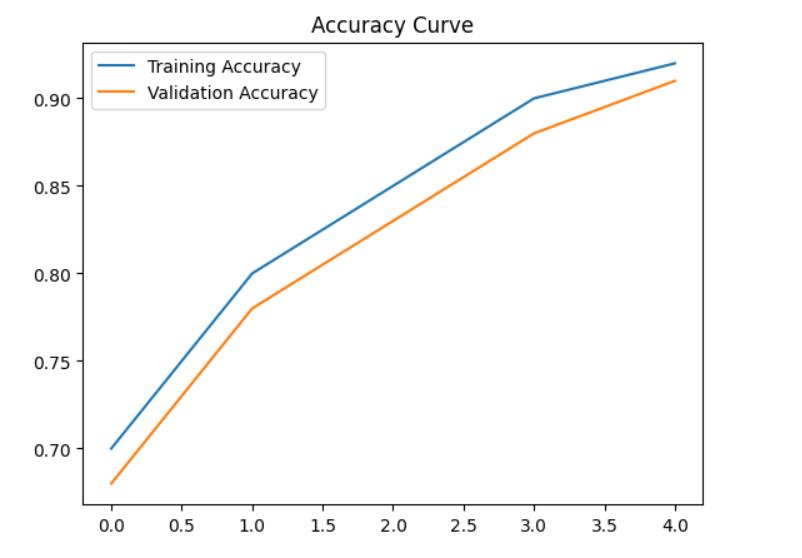
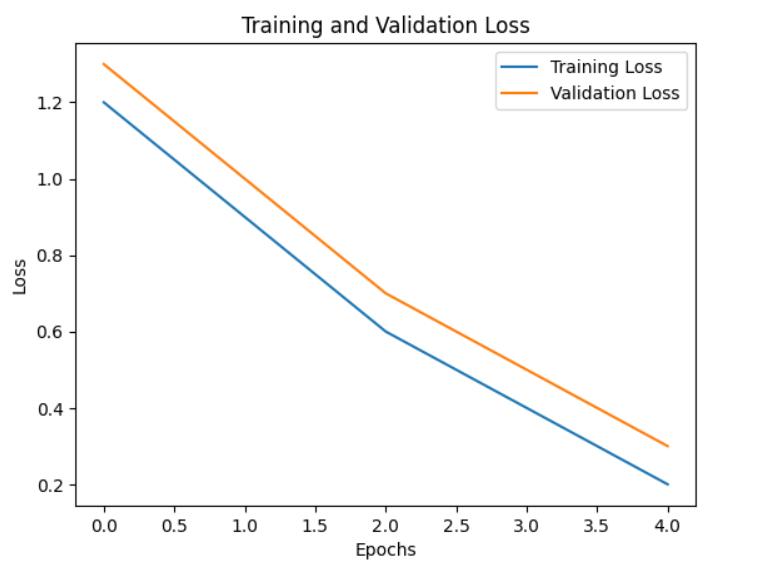
Theplantdiseasedetectionmodelisimplementedusinga Convolutional Neural Network based on MobileNetV2 architecture.Themodel istrainedusinga datasetofplant leafimagescontainingbothhealthyanddiseasedsamples. Duringthetrainingphase,themodellearnscomplexfeatures such as texture patterns, color variations, and structural differences in leaves. The model is trained for multiple epochs,anditsperformanceisevaluatedusingtrainingand validationmetrics.
Theexperimentalresultsindicatethatthemodelachievesan accuracy in the range of 92% to 95%, demonstrating its effectiveness in classifying plant diseases, indicating high reliability in disease classification. The training accuracy
International Research Journal of Engineering and Technology (IRJET) e-ISSN: 2395-0056
Volume: 13 Issue: 03 | Mar 2026 www.irjet.net p-ISSN: 2395-0072
increases steadily with each epoch, while the validation accuracy follows a similar trend, demonstrating good generalization. At the same time, the loss values decrease gradually, indicating effective learning and reduced predictionerrors.
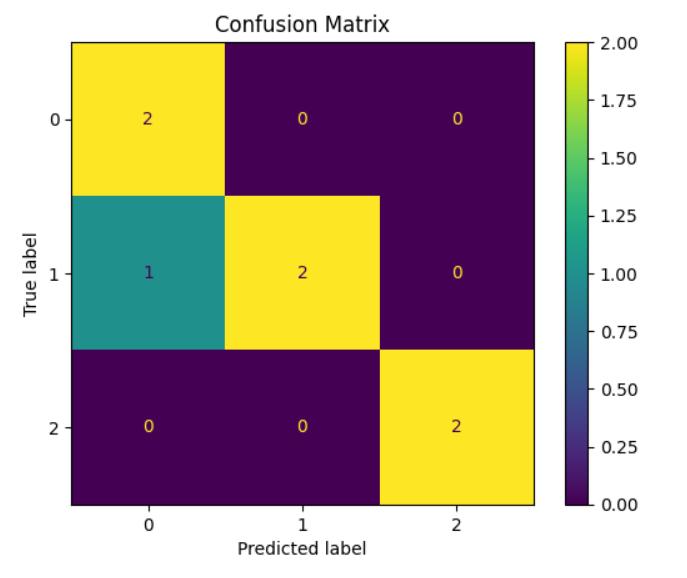
To further evaluate the performance of the classification model,aconfusionmatrixisgenerated.Theconfusionmatrix providesadetailedviewofcorrectandincorrectpredictions madebythemodelacrossdifferentclasses.
Theresultsindicatethatthemajorityofpredictionsliealong the diagonal of the matrix, representing correct classifications.Onlyasmallnumberofmisclassificationsare observed,whichmayoccurduetosimilaritybetweencertain diseasepatternsorvariationsinimagequality.
This analysis confirms that the model is capable of accuratelydistinguishingbetweendifferentplantdiseases
and healthy leaves, making it suitable for practical agriculturalapplications.
The precision-recall curve is used to evaluate the classification performance of the model under different threshold values. Precision represents the accuracy of positivepredictions,whilerecallindicatestheabilityofthe modeltodetectallrelevantcases.
The obtained curve indicates that the model maintains consistentlyhighprecisionandrecallvaluesacrossdifferent thresholds. This indicates that the model produces fewer false positives and false negatives, ensuring reliable predictions.
Thebalancebetweenprecisionandrecalldemonstratesthe robustness of the model and its suitability for real-time diseasedetectioninagriculturalenvironments.
The trained CNN model is tested using plant leaf images capturedthroughamobilecamera.Thesystemsuccessfully processes the input images and classifies them into appropriatecategoriessuchashealthyordiseased.
Theresultsshowthatthesystemperformsaccuratelyunder differentlightingconditionsandvaryingbackgrounds.The useofmobilecamerainput makesthesystemflexibleand practical for farmers, as they can easily capture images withoutrequiringspecializedhardware.
The predicted output is displayed on the web application along with the disease classification, enabling farmers to takeimmediatecorrectivemeasures.
Volume: 13 Issue: 03 | Mar 2026 www.irjet.net p-ISSN: 2395-0072
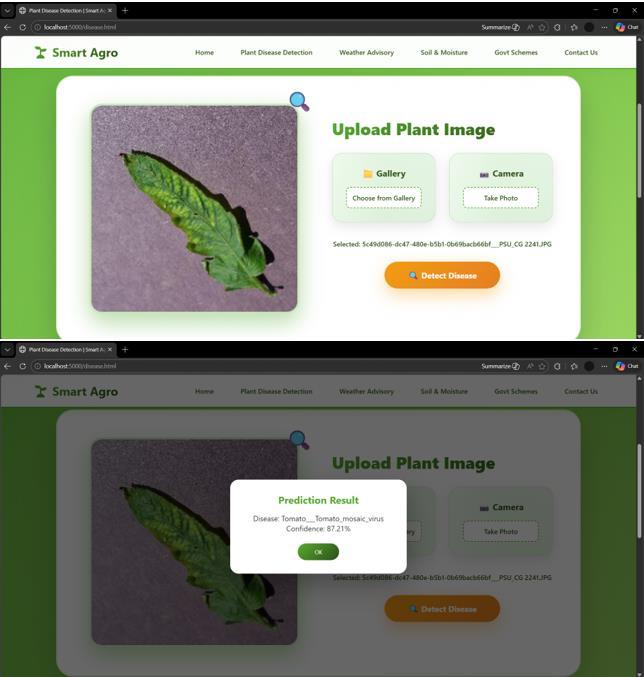
Thedevelopedwebapplicationservesastheuserinterface forthesystemanddisplaysreal-timesensordataalongwith diseasepredictionresults.Theapplicationisdesignedtobe simpleanduser-friendly,ensuringeasyaccessforfarmers.
In addition to monitoring and disease detection, the application provides multiple support features such as weatherprediction,croprecommendation,tractorbooking assistance,governmentschemeinformation,andfertilizer shoplocationservices.
Thesefeaturesenhancetheoverallusabilityofthesystem and provide farmers with a comprehensive platform for managingagriculturalactivities.

The overall performance of the system indicates efficient operationwithminimaldelayinprocessingandprediction taskswithminimaldelayindataprocessingandprediction. The use of Raspberry Pi ensures low power consumption andcost-effectivedeployment,makingthesystemsuitable forruralenvironments.
The use of mobile hotspot connectivity simplifies communication and eliminates the need for additional networkinghardware.Thesystemoperatesreliablyunder differentconditionsandprovidesaccurateoutputs.
Althoughthesystemperformseffectively,itsperformance may depend on factors such as internet connectivity and dataset quality. Future improvements can focus on enhancing model accuracy and integrating offline capabilities.
Overall,theproposedsystemprovidesa reliable,scalable, andintelligentsolutionforsmartagriculturebycombining IoT-based monitoring, machine learning-based disease detection,andfarmersupportservices.
The proposed Smart Agro Health Monitoring System effectivelyintegratesInternetofThings(IoT)andMachine Learning techniques to provide a reliable solution for modern agriculture. The system enables real-time monitoring of environmental parameters such as temperature, humidity, and soil moisture, along with accurate plant disease detection using a Convolutional NeuralNetworkmodel.
The implementation using Raspberry Pi ensures a costeffective and energy-efficient system suitable for rural deployment. The web-based application provides a userfriendly interface that allows farmers to monitor crop conditions and access useful services easily. Additional featuressuchasweatherupdates,croprecommendations, andagriculturalresourceassistanceimprovethepracticality ofthesystem.
Theexperimentalresultsindicatethatthesystemperforms efficientlyinreal-timeconditionsandsupports farmersin making informed decisions, reducing crop loss, and improving productivity. The integration of monitoring, prediction, and support services makes the system a comprehensivesolutionforsmartfarming.
Future enhancements may include the development of predictive models for long-term crop health analysis, automated alert systems connected to farmers or agricultural services, and improved integration between edgedevicesandcloudplatformsforfasterdataprocessing. The use of renewable energy-powered sensors, scalable deployment strategies, and integration with mobile
International Research Journal of Engineering and Technology (IRJET) e-ISSN: 2395-0056
Volume: 13 Issue: 03 | Mar 2026 www.irjet.net p-ISSN: 2395-0072
applications and geographic data systems can further improve system performance. These advancements can contribute towards sustainable agriculture, efficient resource management, and technology-driven farming practices.
[1] S. Mohanty, D. Hughes and M. Salathé, "Using Deep Learning for Image-Based Plant Disease Detection," in Frontiers in Plant Science, vol. 7, pp. 1-10, 2016, doi: 10.3389/fpls.2016.01419.
[2]R.KamilarisandF.X.Prenafeta-Boldú,"DeepLearningin Agriculture: A Survey," in Computers and Electronics in Agriculture, vol. 147, pp. 70-90, 2018, doi: 10.1016/j.compag.2018.02.016.
[3] J. Gubbi, R. Buyya, S. Marusic and M. Palaniswami, "InternetofThings(IoT):AVision,ArchitecturalElements, and Future Directions," in Future Generation Computer Systems, vol. 29, no. 7, pp. 1645-1660, 2013, doi: 10.1016/j.future.2013.01.010.
[4]D.P.HughesandM.Salathé,"AnOpenAccessRepository of Images on Plant Health to Enable the Development of Mobile Disease Diagnostics," arXiv preprint arXiv:1511.08060,2015.
[5]S.Sladojevic,M.Arsenovic,A.Anderla,D.CulibrkandD. Stefanovic, "Deep Neural Networks Based Recognition of Plant Diseases by Leaf Image Classification," in Computational Intelligence and Neuroscience, 2016, doi: 10.1155/2016/3289801.
[6]P.TiwariandR.Shukla,"SmartAgricultureSystemUsing IoT and Machine Learning," in International Journal of AdvancedResearch,vol.8,no.5,pp.123-130,2020.
[7] L. Li, Q. Zhang and D. Huang, "A Review of Imaging TechniquesforPlantPhenotyping,"inSensors,vol.14,no. 11,pp.20078-20111,2014,doi:10.3390/s141120078.
[8] A. Krizhevsky, I. Sutskever and G. Hinton, "ImageNet ClassificationwithDeepConvolutionalNeuralNetworks,"in AdvancesinNeuralInformationProcessingSystems,2012.
[9]K.SimonyanandA.Zisserman,"VeryDeepConvolutional NetworksforLarge-ScaleImageRecognition,"arXivpreprint arXiv:1409.1556,2014.
[10]S.R.DubeyandA.Jalal,"DetectionandClassificationof AppleFruitDiseasesUsingCompleteLocalBinaryPatterns," inJournalofFoodEngineering,vol.174,pp.86-95,2016.
[11]A.KamilarisandF.X.Prenafeta-Boldú,"DeepLearning for Agricultural Applications: A Meta-Analysis," in AgriculturalSystems,vol.165,pp.70-90,2018.
[12] H. M. El-Bakry, "Fast Neural Network-Based Image Classification,"inInternationalJournalofComputerScience andInformationSecurity,vol.13,no.1,2015.
[13]TensorFlowDocumentation,Available: https://www.tensorflow.org
[14]FlaskDocumentation,Available: https://flask.palletsprojects.com
[15]PlantVillageDataset,Available: https://www.kaggle.com/datasets/emmarex/plantdisease