
International Research Journal of Engineering and Technology (IRJET) e-ISSN:2395-0056

International Research Journal of Engineering and Technology (IRJET) e-ISSN:2395-0056
Mr. Dhrupesh Savadia (Mentor) 1 , Mr.Bhavesh Laxman Mali 2 , Mr.Ameet Ganesh Maurya 3 , Mr.Vyom Rajendra Maurya 4 , Mr.Sarvesh Mithilesh Mishra 5
ComputerEngineering ThakurPolyTechnicKandivali,Mumbai,India
Abstract - Students living away from home frequently struggle to access affordable, hygienic, and authentic homecooked meals, often relying on expensive or unhealthy commercial food delivery options. To address this gap, this paper presents Smart Tiffin, a comprehensive three-panel software platform designed to connect students directly with local home cooks. Developed using modernframeworks such as SpringBoot, the system architecture is divided into threedistinctmodules.
The Student Panel facilitates location-based discovery, allowing users to manage both one-time meal orders and ongoingmonthlytiffinsubscriptions.
The Cook Panel empowers local vendors to efficiently manage daily menus, track inventory, and handle automated subscription rosters without requiring extensive technical expertise. Finally, the Delivery Panel optimizes logistics through real-time route navigation and secure delivery verification. By integrating live order tracking and automated dispatching, the platform ensures seamless endto-endoperations.
The implementation of Smart Tiffin not only promotes healthier and more accessible dining options for the student demographic but also provides local culinary entrepreneurs with a streamlined digital infrastructure to scale their micro-businesseseffectively.
Key Words: Tiffin Service, Three-Panel Architecture, Subscription Management , Real-Time Tracking, Automated Dispatching, Spring Boot
Students migrating to educational hubs frequently struggle to access affordable, hygienic, and authentic home-cooked meals [1]. While commercial food delivery applications dominate the market, they primarily cater to expensive, one-time restaurant orders rather than sustainabledailysubscriptions[2].Conversely,traditional unorganized tiffin services often suffer from poor communication, inflexible menus, and a lack of real-time tracking. To resolve these operational inefficiencies, this projectintroduces"SmartTiffin,"adigitizedplatformthat connects students directly with local home cooks through astructured,three-panelecosystem[3].
Developed utilizing dynamic Backend frameworks like SpringBoot , Smart Tiffin provides tailored interfaces for
each stakeholder. The Student Panel enables users to seamlessly discover nearby kitchens, customize preferences, and manage monthly meal subscriptions. Simultaneously, the Cook Panel equips local culinary entrepreneurs with intuitive tools for daily roster and inventory management. Finally, the Delivery Panel optimizes the logistics network through automated dispatching,locationrouting,andsecuredeliveryhandoffs [4]. Ultimately, this project aims to foster a healthier dining lifestyle for students while providing a scalable digitalinfrastructureforlocalhome-basedkitchens.
The evolution of food delivery systems has significantly transformed urban dining; however, existing solutions rarely cater to the specific daily nutritional and financial requirements of the student demographic. A review of current literature and existing market models reveals three primary approaches to food delivery, each with notable limitations that the Smart Tiffin platform aims to resolve.
Modern on-demand food delivery platforms have established robust technological frameworks featuring real-time tracking, algorithmic dispatching, and seamless digital payments [5]. While highly efficient, these platforms are predominantly restaurant-centric. Research indicates that frequent reliance on restaurant-prepared meals contributes to increased monthly expenses and poor dietary habits among students [6]. Furthermore, these applications are designed for sporadic, one-time ordersratherthanrecurring,localizedmealsubscriptions, making them unsustainable for daily student consumption.
Conversely,traditionallocaltiffinservicesandhostelmess facilities offer the affordability and home-cooked quality that students require [7]. However, these conventional modelssufferfromsevereoperational inefficiencies.They largely operate offline, relying on manual bookkeeping, cash transactions, and informal communication channels likephonecallsormessagingapps[8].Studiesoninformal food distribution networks highlight that this lack of digitalinfrastructureleadstoinflexiblemenus,aninability to pause or manage subscriptions dynamically, and a
Volume: 13 Issue: 03 | Mar 2026 www.irjet.net p-ISSN:2395-0072 © 2026, IRJET | Impact Factor value: 8.315 | ISO 9001:2008 Certified Journal | Page 1260
International Research Journal of Engineering and Technology (IRJET) e-ISSN:2395-0056
Volume: 13 Issue: 03 | Mar 2026 www.irjet.net p-ISSN:2395-0072
complete absence of transit transparency or delivery trackingfortheenduser[9].
Recent academic proposals have explored the digitization of tiffin services; yet, many of these systems are structurally incomplete. Most proposed architectures focus solely on a two-node relationship (Customer and Vendor), frequently neglecting the logistics layer [10]. Without a dedicated, integrated delivery panel, cooks are forcedtomanagetheirownlogistics,whichseverelylimits theiroperationalradiusandscalability.
The proposed "Smart Tiffin" platform operates on a robust, multi-tier client-server architecture designed to handle real-time data synchronization across multiple user types. The system is structurally divided into a dynamic frontend interface, a centralized backend server, andacloud-baseddatabasetoensurehighavailabilityand seamlesscommunication.
The user interface is developed utilizing ReactJS, a component-based JavaScript library that ensures a highly responsive and scalable single-page application (SPA) experience. The frontend is segmented into three distinct operationalpanels:
● Student Panel: Focused on discovery and transaction management. It features locationbased filtering, allowing users to query local cooks within a specific radius. The interface integrates state management to handle shopping cart logic, separating logic for one-time meal processing and 30-day recurring subscription plans.
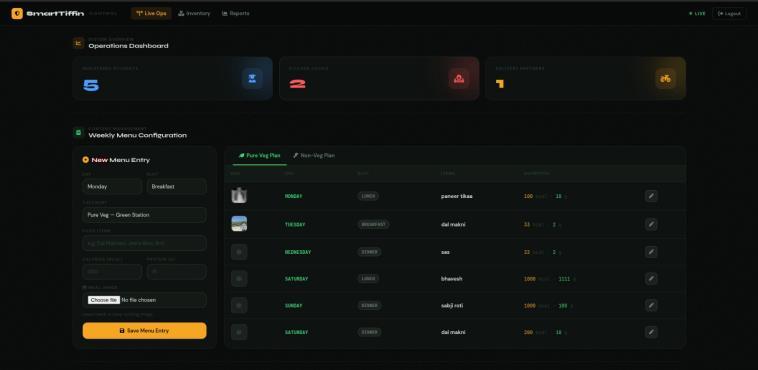
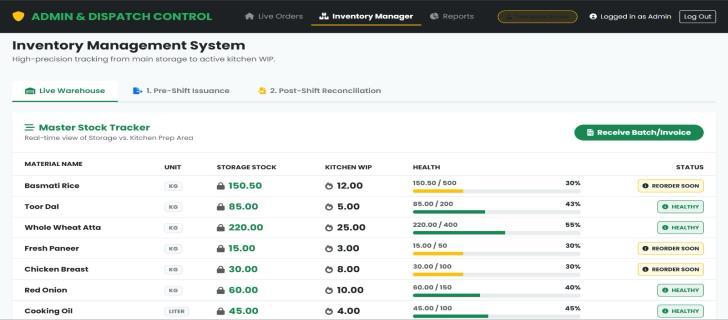
● Cook Panel: Functioning as a vendor dashboard, thisinterfaceisoptimizedfororderandinventory management. It utilizes real-time data fetching to update the "Active Orders" and "Daily Subscription Roster" screens dynamically. Cooks can toggle item availability, which immediately updates the database and reflects on the Student Panel.
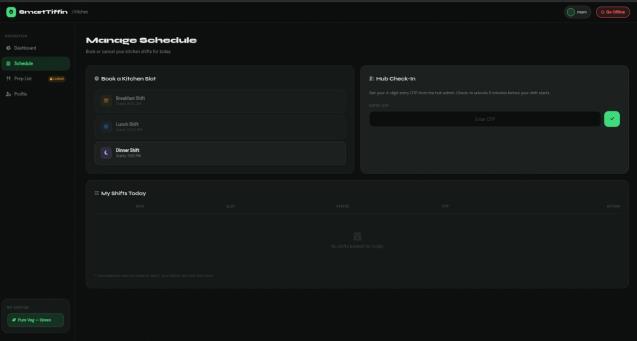
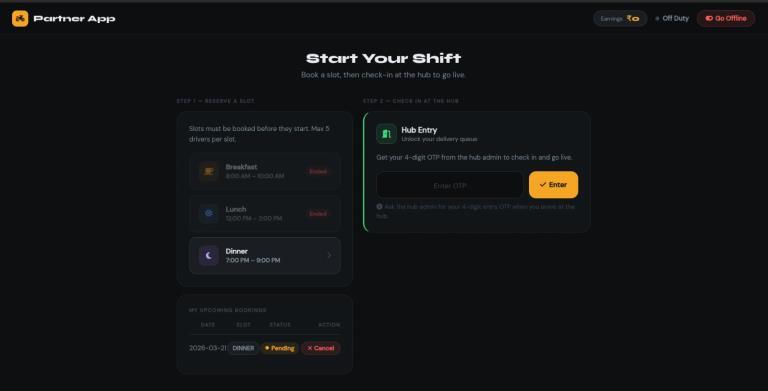
● Delivery Panel: Designedforlogisticalefficiency, this mobile-responsive interface relies on geolocation APIs. It features an online/offline availability toggle, a task acceptance board, and integratedmaproutingtoguidetheriderfromthe cook'skitchentothestudent'sdrop-offlocation.
The core engine of the platform acts as the intermediary between the database and the three frontend panels via RESTful APIs. Itis responsible for authentication,session management, and algorithmic dispatching. The database uses a relational or document-based structure to map complex relationships, such as linking a specific Order ID toaStudentID,aCookID,andaDeliveryIDsimultaneously.
Acritical component of the systemdesignis the real-time order state machine, which dictates the flow of information:
1. Initiation: A student places an order, updating thedatabasestatusto Pending
2. Preparation: Thecookacceptstheorderviatheir panel, triggering a state change to Accepted/Preparing, which reflects instantly on thestudent'slivetrackingscreen.
3. Dispatch Algorithm: Once the cook marks the food as Ready, the backend algorithm queries the database for the nearest available rider and pushesanotificationtotheirDeliveryPanel.
4. Verification and Handoff: To ensure security, the system employs a two-step verification process. The rider verifies the order ID with the cook upon pickup and must enter a unique OneTime Password (OTP) provided by the student uponfinaldeliverytomarkthetaskas Completed
The Smart Tiffin platform integrates multiple interconnectedfeaturesacrossitsthreepanelstoensurea frictionless food delivery ecosystem. The functional requirementsarecategorizedbasedontherespectiveuser modules.
● Location-Based Discovery: Uponauthentication, the system utilizes the student’s geographical coordinates to populate a list of nearby home kitchens.
● Dynamic Ordering System: Studentscanbrowse daily menus (for example, standard meals like ladyfingerswithroti)andchoosebetweenplacing an immediate, one-time order or subscribing to a recurring30-daytiffinplan.
International Research Journal of Engineering and Technology (IRJET) e-ISSN:2395-0056
Volume: 13 Issue: 03 | Mar 2026 www.irjet.net p-ISSN:2395-0072
● Subscription Management: Users have the flexibility to pause, resume, or cancel their monthly meal plans, accommodating sudden schedulechangesorweekendtravel.
● Real-Time Tracking: The interface provides live updates on the order state, tracking the progression from kitchen preparation to active transit,culminatinginfinaldelivery.
4.2 Cook Module Functionalities
● Digital Menu and Inventory Control: Home cookscanseamlesslyupdatetheirdaily offerings, adjust pricing, and toggle the availability of specific items to reflect real-time kitchen inventory.
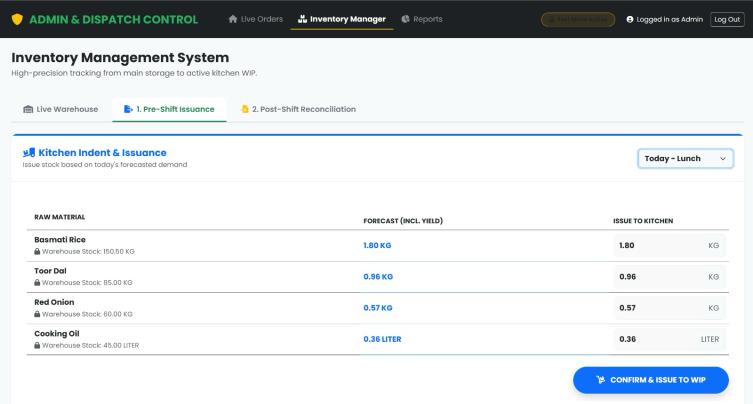
● Unified Order Queue: Thedashboardsegregates incoming requests into distinct categories: New Orders,ActivePreparation, andReadyforPickup, streamliningkitchenoperations.
● Automated Subscription Roster: The system automaticallyaggregatesthenumberofrecurring subscription meals required for the day, allowing cooks to prepare bulk quantities efficiently withoutmanualbookkeeping.
4.3 Delivery Module Functionalities
● Algorithmic Task Assignment: Delivery personnel can toggle their active status to "Online." The system automatically pushes deliverytaskstothenearestavailablerideroncea cookmarksanorderasready.
● Integrated Navigation: The application provides turn-by-turn GPS routing, directing the rider first to the kitchen's location and subsequently to the student’s registered address (such as a specific collegegateorhostelblock).
● Secure Delivery Verification: To prevent order misplacement, the system enforces a mandatory One-Time Password (OTP) verification. The rider must input the code provided by the student to successfullyclosetheactivetask.
4.4 Administrative and Core Functionalities
● Automated Dispatching Engine: Thecentralized backend continuously monitors order states and driver proximities to minimize delivery wait times.
● Payment Routing: The system securely processes digital transactions at checkout and
tracks the proportional revenue splits for the cook’searningsandtherider’sdeliveryfee.
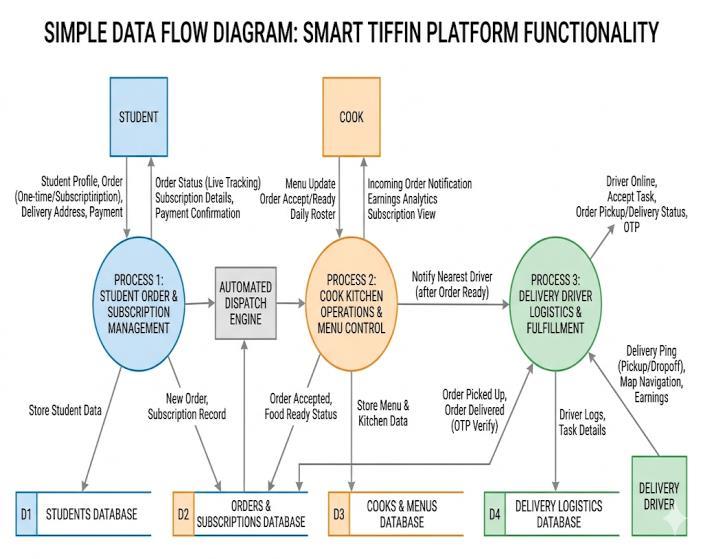
The database architecture of the Smart Tiffin platform is designed to handle highly relational, real-time data efficiently. To ensure data integrity across the three distinct user modules (Student, Cook, and Delivery), the system employs a Relational Database Management System (RDBMS) approach. This structure maps the complex, multi-layered associations required for order tracking, subscription management, and automated dispatchingwithoutdataredundancy.
The database schema categorizes user data into three primary entities to manage profile information. The Student Entity is uniquely identified by a primary key (StudentID) and stores essential customer details, including full name, contact information for authentication, precise GPS coordinates for delivery routing,andspecificdietarypreferences.The Cook Entity, identified by a CookID, stores vendor information, including the kitchen's display name, operational status, and exact location coordinates for driver pickup routing. Finally, the Delivery Entity utilizes a unique RiderID to track logistics personnel, logging their registered vehicle numbers and real-time operational status, such as whethertheyarecurrentlyonline,offline,oronadelivery trip.
To manage the dynamic, day-to-day functions of the platform,thedatabaseemploysspecificoperationaltables. The Menu Items Entity utilizes an ItemID to manage kitchen inventory, acting as a foreign key linked to a specificCookID.Ittrackstheitem'snameanditsreal-time availability status, allowing cooks to seamlessly toggle items between in-stock and sold-out. For long-term user engagement,the Subscriptions Entity managesrecurring
International Research Journal of Engineering and Technology (IRJET) e-ISSN:2395-0056
Volume: 13 Issue: 03 | Mar 2026 www.irjet.net p-ISSN:2395-0072
30-day meal plans through a unique SubID. It links a subscribed student to a specific providing kitchen and tracks the plan's initiation date along with its current status(active,paused,cancelled,orexpired).
5.3 Core Relationships and Order Management The functional core of the database is the Orders Entity, identified by a unique OrderID, which acts as the central hubconnectingallthreeplatforms.Itcontainsforeignkeys linking to the specific StudentID placing the request and theCookIDpreparingthemeal.Crucially,theRiderIDfield withinthisentityinitiallyremainsnulluntiltheautomated dispatch engine successfully assigns an available delivery partner, at which point the logistical tracking begins. The entity also tracks the real-time order progression from pendingto delivered and stores a secure four-digit OneTime Password (OTP) required for the final delivery handoff. This structure establishes a robust one-to-many relationship, where a single student or cook can be associated with multiple unique orders over time, ensuring complete transactional transparency across the entireecosystem.
With the increasing migration of students to urban educational centers, securing daily, nutritious, and affordable meals has emerged as a significant logistical and financial challenge. Currently, the student demographic is forced to navigate a polarized food deliverymarket.Ononeendarecommercialfooddelivery aggregators; while technologically advanced, these platforms primarily cater to expensive, one-time restaurant orders, making them financially unsustainable andnutritionallyinadequatefordailyconsumption.Onthe other end are traditional local tiffin services, which offer the necessary home-cooked quality but operate almost entirelyoffline.
Thisrelianceoninformal,unorganizedoperationalmodels createssevereinefficienciesforboththeconsumerandthe provider. For students, the lack of digital infrastructure results in highly inflexible monthly subscriptions, manual cash tracking, and a complete absence of real-time transit transparency, leading to frequent miscommunications regarding food delivery. From the vendor's perspective, local home cooks struggle to scale their micro-businesses due to the overwhelming administrative overhead of manually managing daily rosters, tracking inventory, and coordinatingindependentdeliverylogistics.
Therefore, the core problem is the absence of a unified, technology-driven ecosystem tailored specifically to the localizedmealsubscriptionmodel.Thereisacriticalneed for a comprehensive digital platform that seamlessly bridgesthegapbetweenstudentsseekingaffordabledaily meals and local culinary entrepreneurs needing an
accessible, structured infrastructure to manage their operationsandautomatedlogistics.
The implementation of the Smart Tiffin platform offers significant operational, economic, and lifestyle benefits, strategically distributed across its three primary stakeholder groups: the consumers, the vendors, and the logistics personnel. By digitizing an inherently unorganized sector, the system introduces enterpriselevelefficiencytolocalmicro-businesses.
Theprimaryadvantageforstudentsisconsistentaccessto hygienic, authentic, and affordable home-cooked meals, whichdirectlycombats the nutritional andfinancial drain of relying on commercial restaurant aggregators. The digital interface eliminates the friction of traditional tiffin services by providing a transparent, flexible subscription management system. Students can seamlessly pause or modify their 30-day meal plans in real-time, completely bypassing the need for manual tracking or uncomfortable offline communication. Furthermore, the integration of liveGPS tracking and OTP-basedsecure delivery handoffs providesunprecedentedreliabilityandpeaceofmind.
For local home chefs, the platform serves as a powerful digital infrastructurethatdrasticallylowersthebarrier to entry for establishing a scalable culinary micro-business. The major advantage is the complete automation of administrative overhead. By utilizing the automated daily rosterandinventorytoggles,cooksarefreedfrommanual bookkeeping and can focus entirely on food quality and preparation. Additionally, the system eliminates the vendor'sburdenofmanagingindependentlogistics,asthe automated dispatch engine seamlessly connects their kitchentoanon-demandfleetofdeliveryriders.
From a systemic perspective, the three-panel architecture ensures that data remains synchronized and accurate across all nodes in real-time. Delivery personnel benefit from algorithmic dispatching and integrated turn-by-turn navigation, which optimizes their travel routes and maximizes their earning potential by reducing idle wait times. Overall, the platform effectively bridges the gap between the affordability of the informal tiffin sector and the technological convenience of modern food delivery applications,creatingasustainable,scalableecosystem.
International Research Journal of Engineering and Technology (IRJET) e-ISSN:2395-0056
Volume: 13 Issue: 03 | Mar 2026 www.irjet.net p-ISSN:2395-0072
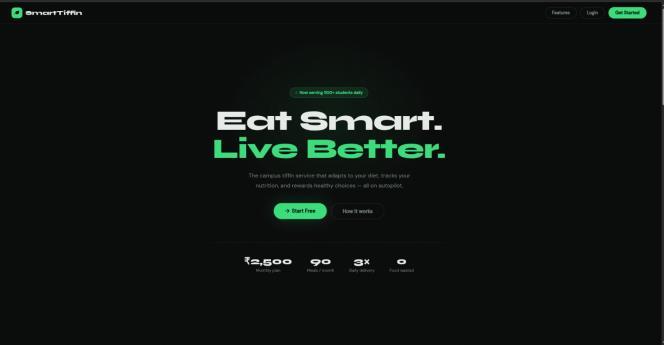
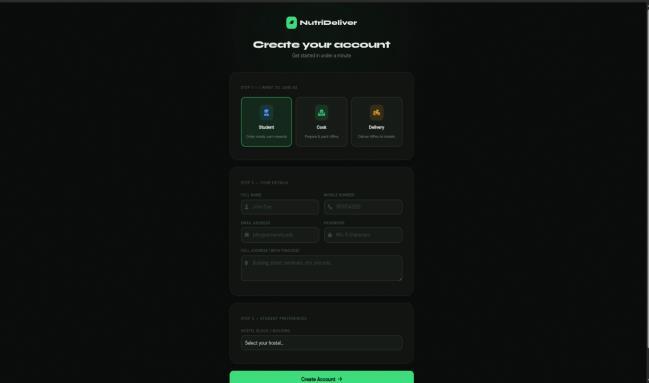
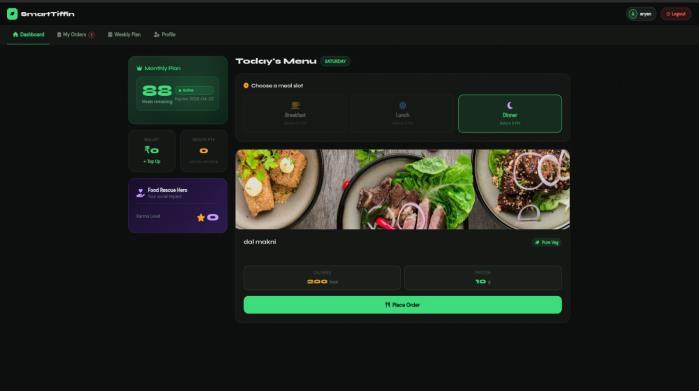
International Research Journal of Engineering and Technology (IRJET) e-ISSN:2395-0056
Volume: 13 Issue: 03 | Mar 2026 www.irjet.net p-ISSN:2395-0072
The "Smart Tiffin" platform successfully addresses a critical gap in the localized food delivery ecosystem by providing a highly structured, technology-driven solution tailored to the daily nutritional needs of the student demographic.Bytransitioningthetraditional,unorganized tiffin service model into a digitized, three-panel architecture, the system eliminates inherent operational inefficiencies.TheReactJS-drivenfrontend,coupledwitha centralized relational database, ensures seamless realtime synchronization across the Student, Cook, and Delivery modules. The implementation of enterprise-level features such as automated logistical dispatching, dynamicsubscriptionmanagement,andsecureOTP-based delivery handoffs democratizes advanced food-tech capabilitiesforlocalculinarymicro-businesses.Ultimately, SmartTiffinnotonlyfostersahealthierandmorereliable dininglifestyleforstudentsbutalsoestablishesascalable, transparent,andeconomicallyviabledigitalinfrastructure forhomecooks.
[1] A. Sharma and R. Gupta, "Nutritional Challenges and Dietary Habits of Migrant Students in Indian Educational Hubs,"JournalofStudentHealthandNutrition,vol.12,no. 3,pp.45-52,2023.
[2] M. Kumar, "The Rise of Food Delivery Aggregators: Market Dynamics and Consumer Behavior," International Journal of E-Commerce Studies, vol. 8, no. 2, pp. 112-125, 2022.
[3] S. Choudhury, Platform Ecosystems: Designing MultiSided Architectures for Service Industries. New Delhi: TechPressAcademic,2021.
[4] Meta Platforms, Inc., "React - A JavaScript library for building user interfaces," React Official Documentation, 2024.[Online].Available:https://react.dev/
[5] P. Deshmukh and K. Singh, "Algorithmic Dispatching and Real-Time Tracking in Modern On-Demand Delivery Applications," IEEE Transactions on Intelligent Transportation Systems, vol. 24, no. 5, pp. 1024-1031, 2023.
[6] V. Patel, "Economic and Health Impacts of App-Based Restaurant Food Consumption Among University Students,"AsianJournalofPublicHealth,vol.15,no.1,pp. 77-89,2022.
[7]R.ThomkeandM.Sinha,"TheMumbaiDabbawalas:An Efficient Informal Food Supply Chain and Its Lessons for Modern Logistics," International Journal of Operations Management,vol.29,no.4,pp.310-325,2020.
[8]N.Verma,"DigitalDivideinMicro-Enterprises:AStudy ofUnorganizedCateringandLocalTiffinServices,"Journal ofSmallBusinessandEnterpriseDevelopment,vol.31,no. 4,pp.210-225,2023.
[9] L. Chen and H. Wang, "The Role of Transit Transparency and GPS Tracking in Last-Mile Delivery Customer Satisfaction," International Journal of Logistics Research,vol.30,no.2,pp.340-355,2021.
[10] A. Jadhav, S. Patil, and R. Kadam, "Design and Implementation ofa Campus-BasedOnlineFoodOrdering System,"inProceedingsoftheInternationalConferenceon ComputingandWebTechnologies,2022,pp.150-155.