
International Research Journal of Engineering and Technology (IRJET) e-ISSN: 2395-0056
Volume: 12 Issue: 10 | Oct 2025 www.irjet.net p-ISSN: 2395-0072
International Research Journal of Engineering and Technology (IRJET) e-ISSN: 2395-0056
Volume: 12 Issue: 10 | Oct 2025 www.irjet.net p-ISSN: 2395-0072
R Savitha, K S Udhayarani, R Sindhiya
R Savitha Dept. of CSE, K.L.N College of Engineering, Tamil Nadu, India
K S Udhayarani Dept. of CSE, K.L.N College of Engineering, Tamil Nadu, India
R Sindhiya Assistant Professor Dept. of CSE, K.L.N College of Engineering, Tamil Nadu, India
Abstract - The advancement of Artificial Intelligence and Computer Vision has enabled intelligent systems to assist users in personalized product selection. This paper presents a Skin Tone Based Product (Dress) Recommendation System using Deep Learning and Content-Based Filtering techniques. The proposed system automatically detects a user’s skin tone (classified as light, mid-light, mid-dark, or dark) using Convolutional Neural Networks (CNN). Based on the identified skin tone, the system recommends suitable dress colors for both men and women SareesandChudidharfor women, and Shirts and Pants for men. The deep learning model is trained with diverse datasets of human faces to ensure accurate tone detection, while content-based filtering utilizes pre-defined color–tone relationships to generate recommendations. This approach helps users choose outfits that complement their natural skin tone, enhancing both appearance and confidence. The system is implemented using Python, TensorFlow, and Flask, providing a user-friendly web interface that captures an image, predicts tone, and displays the recommended product set. The project demonstrates the integration of machine learning and recommendation systems to create intelligent, personalized fashion assistance tools.
Key Words: Skin tone detection, Deep learning, CNN, Content-based filtering, Dress recommendation, Personalizedfashion,Computervision,Python.
Withtheincreasinginfluenceofartificialintelligenceinthe fashion industry, personalized product recommendations have become highly desirable. Many users face difficulty choosingoutfitsthatcomplementtheiruniqueskintone.The Skin Tone Based Product (Dress) Recommendation System aimstosolvethischallengebyanalysingaperson’s facial image to detect their skin tone and suggest suitable dress colours accordingly. The system employs Deep Learning (CNN) for accurate skin tone classification and Content-BasedFiltering forgeneratingrecommendations.
Theproposedmodelenhancestheshoppingexperienceby providingintelligentandpersonalizedsuggestions,thereby bridgingthegapbetweentechnologyandfashion.
In today’s fashion and online shopping environment, customersoftenfacedifficultyinchoosingdresscolorsthat complement their unique skin tones. Many individuals, especiallythoseshoppingonline,endupselectingcolorsthat maynotsuittheircomplexion,leadingtodissatisfactionand reducedconfidenceinappearance.Traditionale-commerce platformsrecommendproductsbasedonpopularityoruser ratings, without considering the user’s physical attributes such as skin tone. This gap highlights the need for an intelligentrecommendationsystemthatcananalyzeauser’s skin tone and suggest the most suitable dress colors. Therefore, there is a strong demand for a personalized system that enhances user satisfaction by recommending color-appropriatedressessuchassarees,chudidhar,shirts, and pants based on the detected skin tone categories like light,mid-light,mid-dark,anddark.:
Themainobjectiveofthisstudyistodesignanddevelop anintelligentdressrecommendationsystemthatsuggests suitableoutfitcoloursbasedonauser’sskintoneusingDeep Learning and Content-Based Filtering techniques. The system automatically detects the user’s skin tone from an uploadedorreal-timecapturedimageandclassifiesitinto one of the predefined tone categories such as dark, light, mid-dark, mid-light
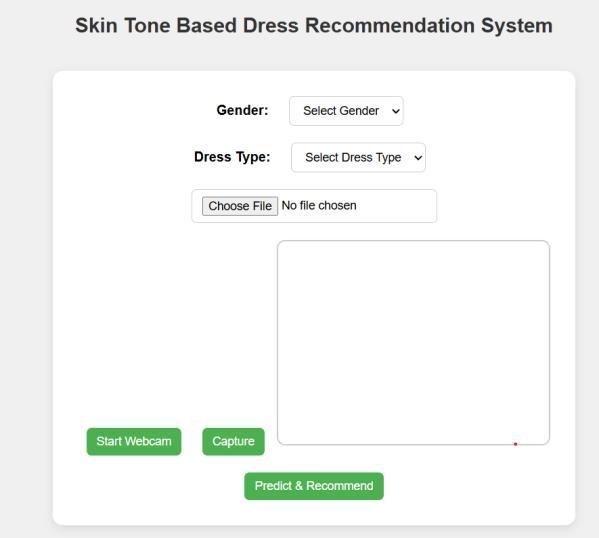
Basedonthedetectedskintone,thesystemrecommends colour-appropriate dresses sarees and chudidhars for women, and shirts and pants for men that best complementtheuser’scomplexion.Theplatformalsoallows usersto either capture their image in real time using a webcamoruploadanexistingphoto,givingflexibilityand controloverhowtheyinteractwiththesystem.
The literature review provides insights into the existing researchandtechnologicaldevelopmentsrelatedtoproduct recommendation systems, deep learning models, and content-based filtering techniques. Several studies have focused on personalized recommendation systems that analyse user preferences, purchase history, or behaviour
International Research Journal of Engineering and Technology (IRJET) e-ISSN: 2395-0056
Volume: 12 Issue: 10 | Oct 2025 www.irjet.net p-ISSN: 2395-0072
patternstosuggestproducts.However,onlyalimitednumber ofworkshaveexploredrecommendationsbasedonphysical attributes such as skin tone.
Earlier systems primarily used collaborative filtering or rule-based models, which rely on user feedback or demographicdata.Althoughthesemethodsareeffectiveto some extent, they fail to capture the personalized visual featuresofusers.Withtherapidadvancementsin computer visionanddeeplearning,particularlyusingConvolutional NeuralNetworks(CNNs),image-basedanalysishasbecome more accurate for applications like face recognition, tone detection,andaestheticanalysis.
Recentstudieshavealsoapplied content-based filtering to recommendproductsbasedonitemsimilarity,colour,and visual features extracted from datasets. However, these systemsstilllacktheintegrationofdeeplearning-drivenskin tone analysis for personalized fashion recommendations. Therefore, the proposed work aims to bridge this gap by combiningCNN-basedskintoneclassificationwithacontentbased recommendation engine to provide personalized dress suggestions tailoredtoeachuser’scomplexion.
Parameter
ProjectTitle Skin Tone Based Product Recommendation System using Deep Learning and ContentBasedFiltering
ProjectDomain ArtificialIntelligence/DeepLearning/Web Application
Objective Torecommendsuitabledresscoloursbased on the user'sskin tone detected using realtimecaptureorimageupload.
Problem Statement Many people struggle to select clothing colours that complement their natural skin tone,resultinginmismatchedstylechoices.
Proposed Solution Adeeplearning-basedsystemthatdetectsa user’s skin tone from an image and recommends matching dress colours using content-basedfiltering.
Tools & Technologies Used Python, TensorFlow/Keras, OpenCV, Flask, HTML, CSS, Deep Learning (CNN), ContentBasedFiltering
Dataset Custom-collectedskintonedatasetoropensourceskinimagedatasets
EndUsers Fashionindustry,e-commerceplatforms,and individualusers
Output Recommended dress colour suggestions displayedonthewebinterface
UniqueFeature Real-timeimagecaptureanduploadfeature allowing users to decide on the website directly
Table -1: SampleTableformat
Provides an overview of the proposed system, highlightingthekeyaspectsoftheproject“SkinToneBased ProductRecommendationSystemUsingDeepLearningand Content-Based Filtering.” It summarizes the project title, domain, objectives, problemstatement, proposedsolution, tools and technologies used, dataset, end users, expected output,anduniquefeatures.Thistablegivesreadersaclear andconciseunderstandingofthesystem’spurpose,scope, and functionality ata glance, making it easier to grasp the overall project framework before delving into detailed sections.
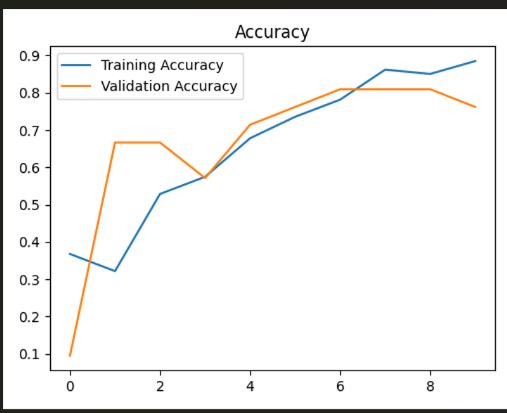
Chart -1:Model(CNN)training
The training graph illustrates the performance of the Convolutional Neural Network (CNN) model used for skin tone classification. During the training phase, the model learnstoidentifypatternsintheinputimagesandcorrectly classifythemintooneofthefourskintonecategories: light, mid-light, mid-dark, and dark.Theaccuracycurveinthe graph shows a gradual increase as the number of epochs progresses,indicatingthatthemodeliseffectivelylearning fromthetrainingdata.
International Research Journal of Engineering and Technology (IRJET) e-ISSN: 2395-0056
Volume: 12 Issue: 10 | Oct 2025 www.irjet.net p-ISSN: 2395-0072
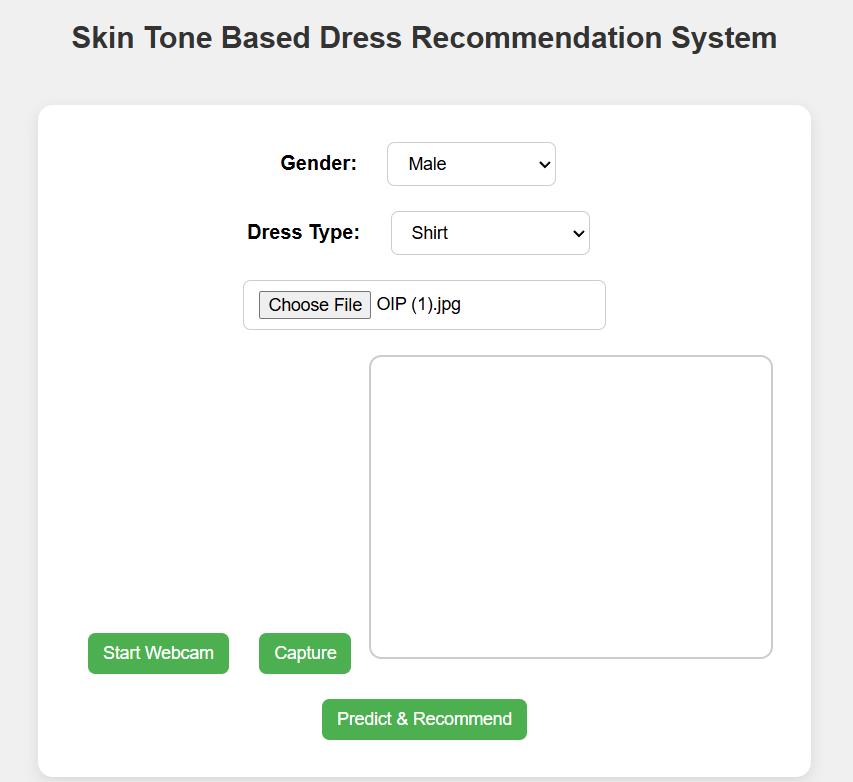
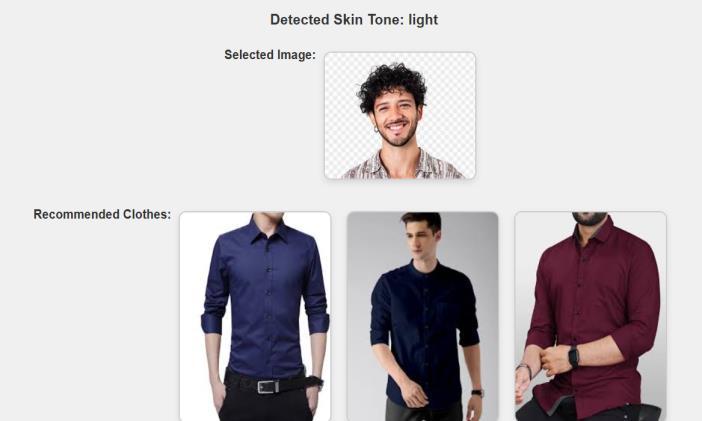
recommended clothes
Inthisproject,severalabbreviationsandtechnicaltermsare used for clarity and conciseness. The term CNN (Convolutional Neural Network) referstoadeeplearning model used for image recognition and classification. DL (Deep Learning) represents the branch of artificial intelligencethattrainsmodelstolearnpatternsfromlarge datasets. CBF (Content-Based Filtering) is the recommendationtechniqueusedtosuggestproductsbased onfeaturessuchascolorandsimilarity. GUI(GraphicalUser Interface) denotes the web interface that allows users to capture or upload images and view personalized dress recommendations.
The Skin Tone Based Product Recommendation System using Deep Learning and Content-Based Filtering successfully demonstrates an intelligent approach to personalized fashion recommendations. By leveraging a ConvolutionalNeuralNetwork(CNN)foraccurateskintone
detection and combining it with content-based filtering techniques, the system is able to recommend colourappropriatedresses sareesand chudidharsforwomen, shirts and pants for men that complement the user’s complexion.
Thesystemprovidesflexibilitybyallowingusersto either capture their image in real-time or upload an existing photo, making the platform highly user-friendly and interactive.Thetrainingresults,includingaccuracyandloss analysis,indicatethatthemodelisbothrobustandreliable, achievinghighaccuracyinskintoneclassification.
Overall, this project enhances the online shopping experiencebyoffering personalized, visually compatible dressrecommendations,reducesthedifficultyofselecting suitablecolours,andbridgesthegapbetween AItechnology and the fashion industry. The implementation confirms thatintegratingdeeplearningwithcontent-basedfiltering can significantly improve user satisfaction, fashion compatibility,anddecision-makingforcustomers.
1. Gupta and R. Sharma, “CNN-Based Skin Tone Classification for Image-Based Applications,”IEEEAccess,vol.8,pp.112345–112352020.
2. S.PatelandM.Desai,“AutomatedSkinToneDetection UsingTransferLearningModels,”InternationalJournal ofComputerVisionandApplications,vol.14,no.3,pp. 210–219,2021.
3. L. Zhang et al., “Clustering-Based Skin Tone Categorization for Personalized Cosmetic Recommendation,” Procedia Computer Science, vol. 187,pp.421–428,2021.
4. Kim and E. Park, “Content-Based Product RecommendationUsingVisualandTextualFeatures,” ExpertSystemswithApplications,vol.166,p.114082, 2020.
5. Wangetal.,“HybridFashionRecommendationSystem UsingDeepLearningandCollaborativeFiltering,”IEEE Transactions onMultimedia,vol.23,no.5,pp.1378–1388,2021.
6. Singh and A. Kaur, “Deep Learning-Based Product Recommendation Framework for Beauty Products,” International Journal of Advanced Computer Science andApplications,vol.12,no.4,pp.230–236,2021.
7. Lee et al., “CNN-Based Outfit Recommendation Using Facial Attribute Recognition,” Computers inIndustry,vol.135,p.103552,2022