
International Research Journal of Engineering and Technology (IRJET) e-ISSN: 2395-0056
Volume: 12 Issue: 04 | Apr 2025 www.irjet.net p-ISSN: 2395-0072
International Research Journal of Engineering and Technology (IRJET) e-ISSN: 2395-0056
Volume: 12 Issue: 04 | Apr 2025 www.irjet.net p-ISSN: 2395-0072
C.Rakshitha1 , E. Swathi2 , K. Maheshwari3, B. Pallavi4
1B.Tech Student, Electrical and Electronic Engineering, Stanley of College of Engineering and Technology for Women, Telangana, India
2B.Tech Student, Electrical and Electronic Engineering Stanley of College of Engineering and Technology for Women, Telangana, India
3B.Tech Student, Electrical and Electronic Engineering Stanley of College of Engineering and Technology for Women, Telangana, India
4Assisstant Professor, Electrical and Electronic Engineering Stanley of College of Engineering and Technology for Women, Telangana, India ***
Abstract - In electric vehicles, the battery management system (BMS) is used to track and regulate battery charging and discharging. Additionally, it keeps an eye on metrics like state of charge (SOC) and offers the services required to guarantee the battery operates safely. Battery management systemsimprovebatteryefficiencyandmakeoperationssafer, more dependable, and more cost-effective. Thus, BMS is essential to guaranteeing the best possible battery performance. The suggested BMS enhances vehicle range by prolonging battery life and streamlining charging cycles. Various monitoring systems are employed to maintain the battery's status as well as the ambient temperature, voltage, and current. Various analog and digital sensors with microcontrollers are utilized for monitoring. This essay discusses a battery's maximum capacity as well as its charge, health, and life states. It is feasible to identify potential future problems and their solutions by going over all of these approaches. Because BMS is a crucial component of any electriccar, there isconstant researchbeing done inthisarea to create more advanced battery management systems. The simulation is conducted using software tool like MATLAB Simulink providing a various BMS functionalities.
Keywords: charging state, discharging state, Battery performance and Charging Cycle
World’spopulationgrowth,economicexpansion,expanding car usage, and urbanization are all contributing to an increasedvehicleandE-motorvehicle(1).EVshaveseveral benefits,suchasbeingmoreeconomicaltorunandmaintain andbeinghealthierforboththeenvironmentandpeople(2) Thestudy'sobjectiveistodeterminethebestapproachto use batteries, DC-DC converters, and motors from the standpointofanEVapplicationbysurveyingactualelectric vehicles(3).Becauseofitssubstantialadvantagesoverother energystoragetechnologies suchastheirhighenergyand power density, extended lifespan, and low self discharge performance factors under improper temperatures
batteries are used in many everyday applications (4). Because of the aforementioned benefits, batteries have drawnalotofattentionlatelyandhaveshownpotentialas anenergystoragesourceinelectricvehicles(EVs)(5) PHEV batteriescanbeused efficientlyto supplyservicestoISO workers,theautomotivesector,andmicrogridsystems(6). Theoverallhardwareandsoftwaresystemusedtoincrease thesafetyandefficiencyofbatteriesisknownasthebattery management system (BMS) (7). By monitoring crucial parametersincludingthebatterycells'temperature,voltage, and current, the system controls the charging and discharging operations (8). Consequently, there are applications in the literature-based research that may be applied in real-time and theoretical research that aims to increaseefficiency(9).Inordertomonitorbatteriesmore effectivelyandsafely,BMSs arefrequentlyemployedwith battery-operatedindustrial,commercialdevicesandsystems (10).Theyputoutanovelapproachtocreatingadependable anduniversalBMSthatexplainscurrentBMSmethodologies (11).
Forelectricandhybridcars,batteriesserveastheprimary energy source, and how well they work has an impact on how well the cars function. Numerous factors need to be takenintoaccountwhenchoosingabattery,includinglow internal resistance, no memory effect, fast charging, high level safety,highenergydensity,highpower density,long life, high charge-discharge efficiency, high reliability in cyclicaluse,lowcost,andthecapacitytoundergorecycling procedures (12). outlined a few viable strategies for EV viability improvement to increase its acceptability over a larger range. Thisincludestheuse of EVcomponentsthat aren'tusedfrequently,suchusedloadbatteries.Similarly, the stationary energy storage capacity of these batteries must also be taken into account in order to increase the overalleconomicefficiencyofvehicles(13).Severalstudies haveprovidedanoverviewoftheanalysisofrestoringand reusingexpiredEVbatteriesforreducedenergy-demanding
International Research Journal of Engineering and Technology (IRJET) e-ISSN: 2395-0056
Volume: 12 Issue: 04 | Apr 2025 www.irjet.net p-ISSN: 2395-0072
applications(14).NRELprovidesreportsontheeconomic and technological feasibility of reusing electric vehicle batteries(15).Creadyaswellasotherssuggestedutilising usedEVbatteriesforstaticpurposesinordertolowerthe costofelectricityregulation(16).IfanoldEVbatterycannot provide80%ofthemaximumpowerneededforthevehicle's acceleration,itisnolongerusefulforelectricalmobilityin comparison to a new battery (17). Non-rechargeable batterieswereusedinsequenceinthisinstance,anditwas discovered that their discharge was irregular. Here, a "weakest-link" phenomena was noted. An integrated building block system has been proposed for the management of retired battery packs consisting of many batterycellsfromtransportationapplications.Additionally,a control method for managing spent batteries is suggested (18).Here,eachcellismonitored,controlled,andprotected byaseparatemodularconverter.Eachcellcanbearranged separately using this way of integrating various building pieces. No extra equalizers or centralized converters are requiredforthemanagementofoldbatteries.Additionally,it offers a more robust protection system, simplicity of reconfiguration,andcustomization.Inaddition,itprovides powerreduction,temperatureregulation,andtheabilityto lessen voltage strain on power electronics components. A two-levelcontrolstrategywassuggestedforusedbatteries tooperateattheirbest.Severalequalizationmethodsbased onparallel,series,orseries-parallelarchitectureshavebeen discussed(19).AccordingtoautomakersthatemployLi-ion batteries, typical old EV batteries are retired after around fivecalendaryears,or1500lifecycles(20).
When using a BLDC motor in an electric vehicle (EV), the battery management system (BMS) should prioritize effective energy harvesting, optimal battery performance, and increased safety through real-time monitoring and control. Regenerative braking and sophisticated control algorithmsmayalsobeincluded.
2.1.1
The efficiencyof thesystem canbeincreasedby precisely controlling the BLDC motor's speed using field-oriented control or other sophisticated control techniques. BLDC motorshavebeencontrolledusingawidevarietyofcontrol methods. A power transistor acting as a linear voltage regulator regulates the motor voltage. When operating motorswithmorepower,thisisnotfeasible.PWMcontrolis necessaryforhigh-powermotors,andamicrocontrolleris neededforstartingandcontrolling
2.1.2
A BLDC motor's speed can be managed using a technique called pulse width modulation, or PWM. To regulate the
BLDC motor's speed and torque, it modifies the voltage appliedtothemotor'swinding.Becauseitenablesprecise speedcontrolofBLDCmotorswithminimalpowerloss,itis a useful technique. A brushless DC motor's speed can be adjustedbyadjustingtheinputDCvoltageandcurrent.The speedincreasesasthevoltageincreases.BLDCmotorshave beencontrolledusingawidevarietyofcontrolmethods.
2.1.3
Soc is a crucial factor in battery system management, especially for electric cars (EVs). It serves as a digital fuel gaugebydisplayingtheamountofenergyleftinabatteryas a proportion of its overall useful capacity. For the battery pack tooperatewell,besafe,andlastalongtime,theSoC mustbeaccuratelydetermined.Aninaccurateestimatemay resultindeepdischarge,overcharging,orunplannedvehicle shutdowns,allofwhichcouldendangersafetyordeteriorate battery health. SoC must be approximated using mathematicalanddata-drivenmodelsbecauseitcannotbe measureddirectlyliketemperatureorvoltagecan
2.1.4 Voltage
:
Playsakeypartinperformanceoptimization,safety,control, andmonitoringinelectricvehicles(EVs).Eachbatterycellin an EV pack can function safely and effectively within a certainvoltagerange.TheBMScanassessthebattery'sstate and charge level in real time by measuring the voltage of eachindividualcellaswellasthepackvoltageasawhole.In additiontoregulatingpowerdelivery,cellbalance,thermal behavior,andchargingtechniques,precisevoltagereadings arecrucialforcalculatingtheStateofCharge(SoC)andState ofHealth(SoH).
2.1.5 Inverters:
Anessentialpartofanelectricvehicle(EV)istheinverter, whichtransformsthedirectcurrent(DC)fromthebattery into the alternating current (AC) required to power the electricmotor.SincebatteriesstoreenergyinDCformand the majority of high-performance electric motors, like AC induction or permanent magnet synchronous motors (PMSM), run on AC, this power conversion is crucial. The inverternotonlyhandlesthisconversionbutalsocontrols thefrequencyandamplitudeoftheACvoltage,whichinturn regulates the motor’s speed and torque output Therefore, thevehicle'sacceleration,efficiency,regenerativebraking, andgeneraldrivingdynamicsarealldirectlyimpactedbythe inverter.
2.1.6 Capacitor:
Capacitors improve performance, efficiency, and dependabilityinanelectricvehicle(EV)bysupportingthe BatteryManagementSystem(BMS)andtheoverallpower electronics architecture. Although an EV's battery pack servesasitsmainenergysource,capacitorsareincorporated
International Research Journal of Engineering and Technology (IRJET) e-ISSN: 2395-0056
Volume: 12 Issue: 04 | Apr 2025 www.irjet.net p-ISSN: 2395-0072
into the BMS and powertrain circuits in a number of locations, particularly in DC-DC converters, inverters, and protection modules, to offer high-speed energy buffering, voltagestabilization,andtransientsuppression
3.Methodology
In this project, a Battery Management System (BMS) is simulated in Simulink to compare the performance of differentbatterychemistries i.e.,Lead-Acid,Lithium-Ion, Nickel-Cadmium,andNickel-MetalHydride whenutilized to drive a BLDC motor. The simulation starts with the implementation of a BLDC motor, driven through a sixswitchinvertertopology.Theswitchingsignals(s1tos6)are createdtopowertheinverter,allowingDCpowerfromthe batteriestobeconvertedintothree-phaseACpowerneeded bythemotor.Everybatterytypeisrepresentedwithitsown electrical characteristics such as state of charge (SOC), terminalvoltage,andcurrent.Theparametersareconstantly monitoredanddisplayedusingindividualscopes.
3.1.1bldc
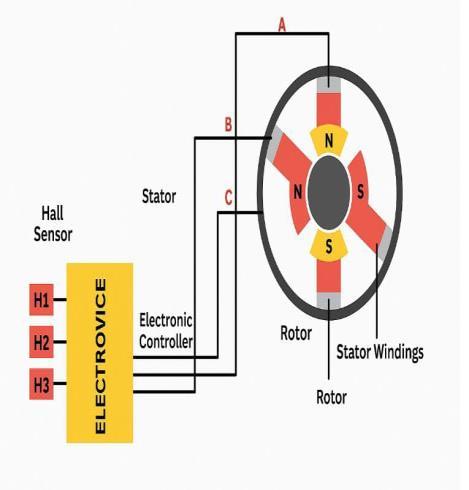
ABLDCmotorwassimulatedwiththree-phaseconnections for real-world operation. Inputs like stator current, electromagnetictorque,andbackEMFweresettomeasure motorperformance.Arotorpositionfeedbacksystemwas
Motor
implemented to guarantee correct commutation, which is importantforefficientandsmoothmotorcontrol.
3.1.2
Topowerthemotor,asix-switchinverterconfigurationwas utilized with IGBT switches S1 to S6. These switches transformtheDCvoltageofthebatteriestothethree-phase ACsignalsusedbytheBLDCmotor.Theswitchingsignalsof the inverter were synchronized with the position of the rotor,ensuringproperandefficientswitchingduringmotor operation.Themaintaskoftheinverteristotransformthe constant DC voltage into a three-phase AC supply, with regulatedamplitudeandfrequency,appropriatefordriving the motor effectively. The IGBT switching is controlled by gatesignalsderivedfromrotorpositionfeedback.
3.1.3
Fourdistinct batterychemistries Lead-Acid,Lithium-Ion (Li-ion),Nickel-Cadmium(Ni-Cd),andNickel-MetalHydride (Ni-MH) were simulated separately. Each battery was modeled to approximate its real electrical properties, e.g., internal resistance, nominal voltage, capacity, and SOC behavior.Thesemodelsenabledrealisticsimulationofhow eachbatterybehavesunderloadcondition.
Eachbatterywastestedindividuallybyattachingitto theinverter-motorsystemunderthesameconditions. Thisensuredafairandequalcomparison.Throughthe analysis of parameters like voltage stability, current output, and SOC depletion, the performance of each battery type was analyzed to ascertain its efficiency and viability for BLDC motor applications. The SOC depletion rate reflected the energy delivery capacity and life of each battery type. Voltage stability was tested by monitoring voltage sag or recovery during currentspikes,especiallyduringmotorstartupwhen currentdemandismaximum.Currentoutputpatterns were also studied to determine anyinconsistencyor limitationinthebattery'scapacityto deliverenough power.
4.Block Diagram
4.1 Battery
ThesystemispoweredbyDCfromthebatteryservesasa mechanismforenergystorage,providingthatthemotorwill always have power. frequently found in home appliances, industrial equipment, and electric cars. offers a steady DC voltage. Motor power rating (Voltage & Ah rating) determinescapacity.Itmustbeabletomanageheavypower demands.
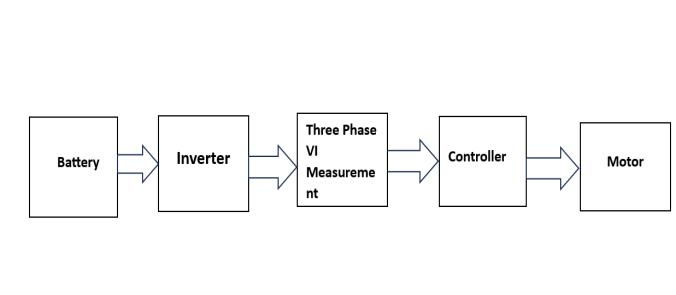
Fig- 2 BlockDiagram
4.1.1 Inverter
Transforms the battery's DC (direct current) into AC (alternatingcurrent)fortheBLDCmotor.producesathreephase voltage source with the appropriate amplitude and
International Research Journal of Engineering and Technology (IRJET) e-ISSN: 2395-0056
Volume: 12 Issue: 04 | Apr 2025 www.irjet.net p-ISSN: 2395-0072
frequency.modifiesthevoltageandfrequencyofMOSFETs andIGBTs,whichareswitchesthatregulatepowerflow,to controlthemotor'sspeedandtorque.
4.1.2
Determineseachphase'svoltage(V)andcurrent(I).gives thecontrollerfeedbackinrealtime.ensuresthatthemotor receivestherightamountofelectricity.detectsissueswith undervoltageorovercurrent.aidsinfield-orientedcontrol, or vector control (FOC). use current transformers, shunt resistors,orHallsensorsformeasurement.makessurethe right voltage and current are reaching the motor. guards againstpowersupplyimbalanceoverload,andshortcircuits.
4.1.3
Regulatesthemotor'sefficiency,torque,andspeed.accepts data from encoders, Hall sensors, or current sensors. modifies the PWM signals that are transmitted to the inverter in order tocontrol motor operation. includes safeguards against overvoltage, overcurrent, and overheating.
4.1.4
produces mechanical energy (rotational motion) from electrical energy. uses three-phase windings on the stator and permanent magnets on the rotor. needs electronic commutation,whichisnotthecasewithbrushedmotors.
5.Results
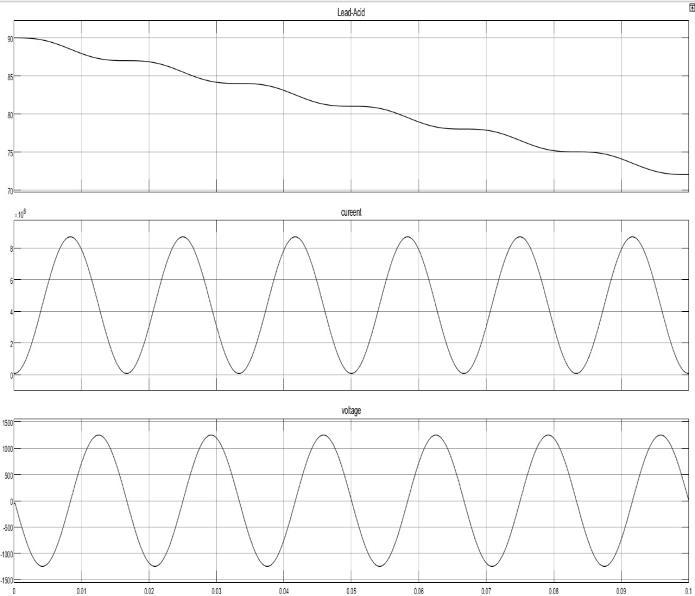
Fig-3
Lead-Acidbatterychargedwithalternatingcurrent(AC)for a briefperiod.Theinitial subplotatthetoptraceswhat is probably the efficiency or state of charge (SOC) of the battery,whichtrackssteadilyfromaround90%to70%.This tells us that the battery is slowly discharging or losing efficiencyasitdeliverspower.
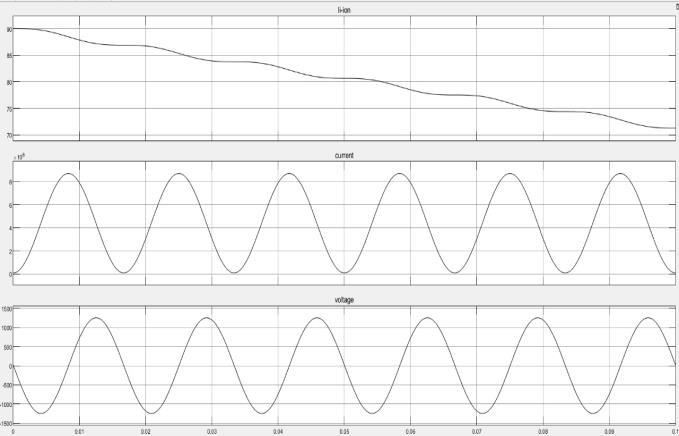
Li-Ion (Lithium-Ion) battery under an alternating current (AC) load for a short period of time. It consists of three subplots.the state of charge (SOC) or maybe battery efficiency,whichbeginsatabout90%anddecreasesslowly to about 70%. This means the battery is draining slowly sincepowerisbeingsuppliedtotheload.
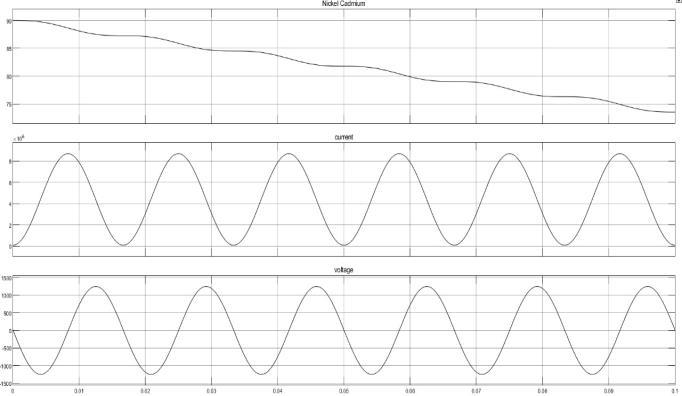
The Nickel-Cadmium (NiCd) battery under an alternating current (AC) load for a brief duration. The upper subplot withthetitle"NickelCadmium"probablyreflectsthestateof chargeorterminalvoltageofthebattery,whichexhibitsa gradualreductionfromaround90to74unitswithinthe0.1second duration This indicates that the battery is discharging steadily, perhaps owing to continuous power supplytoa loadconnected. The waveformis periodicand steady,whichsuggeststhattheloadissignificantlyresistive orslightlyreactive,consumingcurrentatasteadyfrequency. Thelowersubplotshowstheassociatedvoltagewaveform, also sinusoidal, but with amplitudes varying from ±1500 units.ThisisindicativeofasteadyACvoltagesupply,either createdorsustainedbythebatterysystem,perhapsthrough aninverter
International Research Journal of Engineering and Technology (IRJET) e-ISSN: 2395-0056
Volume: 12 Issue: 04 | Apr 2025 www.irjet.net p-ISSN: 2395-0072
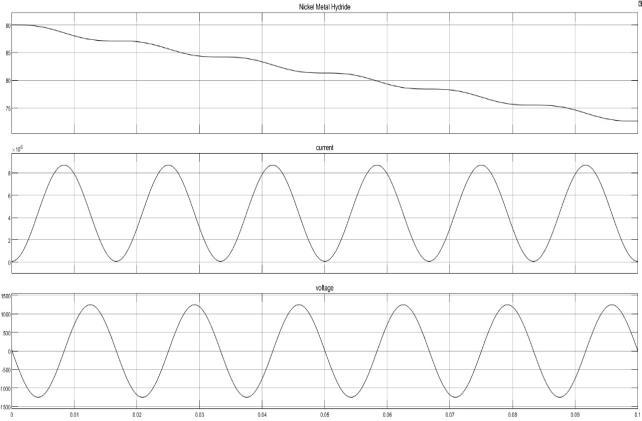
NickelMetalHydride(NiMH)batteryunderloadforabrief timeintervalof0.1seconds,plottedinthreesubplots.The upperplot,titled"NickelMetalHydride,"probablyplotsthe stateofcharge(SoC)orvoltagelevelofthebattery,which dropssteadilyfromapproximately90toabout75units.
In conclusion,The Battery Management System (BMS) is essentialformaximizingefficiency,safety,andperformance, particularly when combined with Brushless DC (BLDC) motors.Tomakesurethebatteryrunswithinsafeandideal bounds, the BMS continuously monitors and controls important battery characteristicslikevoltage,currentand StateofCharge(SoC).Thismakesitpossibleforthecarto operatedependablyandconsistentlyinavarietyofdriving situations. Acceleration, torque control, regenerative braking,andoveralldrivetrainefficiencyareallimprovedby the BMS's precise energy delivery to the BLDC motor through real-time data sent to the motor controller and inverter.Intheend,awell-designedBMSandBLDCmotor system work together to protect the battery from deterioration,ensurevehiclesafety,andallowEVstorunas efficientlyandeffectivelyaspossible.ImprovementsinBMS design,suchasAI-basedSoCestimate,activebalancing,and predictivefaultdiagnostics,willreinforceitspositionasthe foundationofintelligentelectricpropulsionsystemsasEV technologydevelops.hebasicfunctionofBMSistoregulate thetemperatureincaseofoverheating.Thisworkshowcases that lithium batteries are more significant as they carry a longer period as compared to lead-acid batteries. The simulationresultsoftheLithiumbatterycell–1RCnetwork, and 2RC network parameters have been analysed. These batteriesarelighterandallowthechemicalreactiontoemit less heat thus minimizing the chain of chemical reaction problems.
7.Comparsion of Batteries Table
Table-1 ComparsionofBatteries
8.REFERENCES
1. K. M. Rahman and M. Ehsani, ‘‘Performance analysis of electricmotordrivesforelectricandhybridelectricvehicle application,’’inProc.PowerElectron.Transp.,1996,pp.49–56
2.D. Mohanraj, J. Gopalakrishnan, B. Chokkalingam, and L. Mihet-Popa, ‘‘Critical aspects of electric motor drive controllersandmitigationoftorqueripple Review,’’IEEE Access,vol.10,pp.73635–73674,2022Jun.20203
3.ElectricCarUsebyCountry.Accessed:Jun.2020.[Online]. Available: https://en.wikipedia.org/wiki/Electric_car_use_by_countr
4.Wu, C.; Zhu, C.; Ge, Y.; Zhao, Y. A Review on Fault MechanismandDiagnosisApproachforLi-IonBatteries. J. Nanomater. 2015,2015,1–9[CrossRef]
5.Liu,Z.;Ahmed,Q.;Zhang,J.;Rizzoni,G.;He,H. Structural analysis-based sensor’s fault detection and isolation of cylindricallithium-ionbatteriesinautomotiveapplications ControlEng.Pract.2016,52,46–58.[CrossRef
6.S. Beer, T. Gomez, D. Dallinger, and I. Momber, “An economic analysis of used electric vehicle batteries integrated into commercial building microgrids,” IEEE TransactionsonSmartGrid,vol.3,no.1,pp.517-525,2012.
7.J. V. Barreras, M. J. Swierczynski, E. Schaltz, S. J. Andreasen,C. Fleischer,D. U.Sauer,andA. E.Christensen, “FunctionalAnalysisofBatteryManagementSystems using Multi-Cell HIL,” 2015 Tenth InternationalConference on Ecological Vehicles and RenewableEnergies(EVER),pp.110,2015.
International Research Journal of Engineering and Technology (IRJET) e-ISSN: 2395-0056
8.D.Andrea,BatteryManagementSystemsforLargeLithium IonBatteryPacks,1sted.;ArtechHouse:London,UK,2010; pp.22–110.
9.O. Satilmis, and E. Mese, “Elektrikli ve Hibrid Elektrikli Araçlar İçin Batarya Şarj Cihazları,” Elektrik-Elektronik ve Bilgisayar Sempozyumu, pp. 137-142, 5-7 October 2011, Elazığ,Turkey.
10.J. Chatzakis, K. Kalaitzakis, N. C. Voulgaris, and S. N. Manias, “Designing a New Generalized Battery Management System,” IEEE Transactions on Industrial Electronics,vol. 50,no. 5, pp.990-999,2003.
11.Y. Xing, E. W. M. Ma, K. L. Tsui, and M. Pecht, “Battery Management Systems in Electric and Hybrid Vehicles,”Energies,vol.4,pp.1840-1857,2011.
12.A.Affanni,A.Bellini,G.Franceschini,P.Guglielmi,andC. Tassoni, “Battery choice and management for newgenerationelectricvehicles,”IEEETransactionsonIndustrial Electronics, vol.52,no.5,pp.13431349,2005
Severalstudieshaveprovidedanoverviewoftheanalysisof restoring and reusing expired EV batteries for reduced energy-demandingapplications.
13.B. D. Williams and T. E. Lipman, “Strategies for transportation electric fuel implementation in California: overcoming battery first-cost hurdles,” PIER final project report,Feb.2010.
14.E.Cready,J.Lippert,J.Pihl,I.Weinstock,P.Symons,andR. G.Jungst, “Technical andEconomicFeasibilityofApplying UsedEVBatteriesinStationaryApplications,”DOEEnergy StorageSystemsProgram,SAND2002-4084,Mar.2003
15.J.Neubauer,“SecondaryUseofEVandPHEVBatteriesOpportunitiesandChallenges,”Orlando:NREL,May2010.
16.E.Cready,J.Lippert,J.Pihl,I.Weinstock,andP.Symons, “Technical and economic feasibility of applying used EV batteriesin stationaryapplications,”No. SAND2002-4084. Sandia National Labs., Albuquerque, NM (US); Sandia NationalLabs.,Livermore,CA(US),2003
17. A. F. Burke, “Performance, Charging, and Second-use Considerations for Lithium Batteries for Plug-in Electric Vehicles,”InstituteofTransportationStudies,Universityof California, Davis, Research Rep.UCD-ITS-RR-09-17, 2009 [Online]. Available: http://www.its.ucdavis. edu/?page_id=10063&pub_id=1306A.Burke,“Performance, chargingandsecond-useconsiderationsforlithiumbatteries for plug-in electric vehicles,” in Proc. Electricity Storage Assoc.Meeting,May2009
16.E.Cready,J.Lippert,J.Pihl,I.Weinstock,andP.Symons, “Technical and economic feasibility of applying used EV batteriesinstationaryapplications,”No.SAND2002-4084.
Sandia National Labs., Albuquerque, NM (US); Sandia NationalLabs.,Livermore,CA(US),2003
17. A. F. Burke, “Performance, Charging, and Second-use Considerations for Lithium Batteries for Plug-in Electric Vehicles,”InstituteofTransportationStudies,Universityof California, Davis, Research Rep.UCD-ITS-RR-09-17, 2009 [Online].
Available:http://www.its.ucdavis.edu/?page_id=10063&pub _id=1306A.Burke,“Performance, charging and second-use considerations for lithium batteries for plug-in electric vehicles,” in Proc. Electricity Storage Assoc. Meeting, May 2009.
18. Y. Li, and Y. Han, “Used-battery management with integratedbattery building block system,”IEEE,pp.31773182,2015.
19.C.Pascual,andP.T.Krein,“Switchedcapacitorsystemfor automatic series battery equalization,” in Twelfty annual IEEEAppliedPowerElectronicsConferenceandExposition (APEC),pp.848-854,1997.
20. Nissan Leaf forum [Online]. Available: http://www.nissanleafforum.com
Volume: 12 Issue: 04 | Apr 2025 www.irjet.net p-ISSN: 2395-0072 © 2025, IRJET | Impact Factor value: 8.315 | ISO 9001:2008