
International Research Journal of Engineering and Technology (IRJET) e-ISSN: 2395-0056
Volume: 12 Issue: 04 | Apr 2025 www.irjet.net p-ISSN: 2395-0072
International Research Journal of Engineering and Technology (IRJET) e-ISSN: 2395-0056
Volume: 12 Issue: 04 | Apr 2025 www.irjet.net p-ISSN: 2395-0072
Vinayak Suryavanshi1, Ritika Parab2, Abhijeet Yadav3, Nishek Sharma4, Prof.Vrushali Thakur5
1,2,3,4Student, Dept of Computer Engineering, MGM’s College of Engineering and Technology, Kamothe, Navi Mumbai, India
5Prof.VrushaliThakur:Professor, Department of Computer Engineering, MGM’s College of Engineering and Technology, Kamothe, Navi Mumbai, India
Abstract - For deaf and hard-of-hearing people, sign languageisanessentialmediumofcommunication.However, since sign language is not universally understood, it poses a range of problems in social as well as professional contexts. A vision-based deep learning approach using sign language gestures to provide text translation is proposed in this paper, providing better access and more people. In this system Convolutional Neural Networks (CNNs) are used for gesture recognition; and Long Short-Term Memory (LSTM) networks are employed in the temporal sequence learning process. For improved recognition accuracy, the model incorporates attention mechanisms and uses a hybrid feature extraction method.
A wide variety of sign languages are used to create the dataset, which covers enough general conditions and a range of scenarios. One must observe that using a variety of representations significantly improves the likelihood of effective generalization. The suggested approach is tested using both standard datasets and custom-collected sign motions. By displaying mistake rates, it produces promising accuracy results. Data augmentation and subs are two adaptive learning strategies that address issues including handocclusions,signervariability,andvarioussignlanguage patterns.
Key Words: Sign Language Recognition, Deep Learning, CNN, LSTM, Computer Vision, Gesture Translation, RealTime Processing, Accessibility, Sequence Learning, Human-Computer Interaction.
Sign language is a rich, expressive visual language that is utilized by millions of deaf and hard-of-hearing people across the globe. Sign languages differ from spoken or writtenlanguagesinthattheyaredependentontheaccurate combinationofhandmovement,facialexpression,andbody movementtocommunicatemeaning.Eachnationorregion mightuseitsowntypeofsignlanguage,e.g.,AmericanSign Language (ASL), British Sign Language (BSL), and Indian Sign Language (ISL), each with different grammar and vocabulary[2].
Traditionalmethodsforsignlanguagerecognitionhaveused sensor-based gloves, accelerometers, or depth sensors, which are good but sometimes costly, invasive, and impracticalforbroaduse.Someofthepioneeringworkby Starner and Pentland [2] proved real-time sign language recognition withHiddenMarkovModels(HMMs)feasible, settingthestageforcurrentrecognitionsystems.Oursystem utilizes CNNs to extract visual features and LSTM and Transformermodelsforrecognitionoftemporalsequences. ThesolutionalsoexploitstheuseofMediaPipetoachieve real-timelandmarkdetectionaswellastheuseofOpenCV for preprocessing images and image segmentation. Our objectiveistodesignalow-cost,easy-to-use,high-accuracy system that works within real environments that have unpredictable lighting conditions and backgrounds. This research advances the area of assistive technologies by offering a scalable and versatile system which can be instantiated for various sign languages, is deployable on multipledevices,andcanultimatelyaccommodatefeatures suchassentencerecognitionandvoicesynthesis.
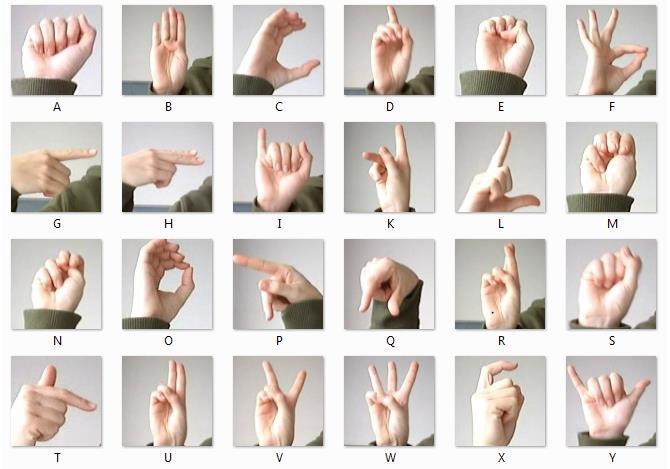
Fig 1 Sign Gestures
Theprimaryobjectiveofthisstudyistocreateareal-time, vision-basedsignlanguagetotexttranslationsystembased ondeeplearning.Thespecificobjectivesareasfollows–
International Research Journal of Engineering and Technology (IRJET) e-ISSN: 2395-0056
Volume: 12 Issue: 04 | Apr 2025 www.irjet.net p-ISSN: 2395-0072
1.Real-TimeTranslation:
To create a system that can recognize and translate sign language gestures into text in real time with the use of standardcamerainputwithoutrequiringanyextrasensors orgloves,hencemakingitscalableandcost-effective[2].
2. User-Friendly Interface:
ToincorporateasimpleandinteractiveGUIwiththehelpof tools such as Python Tkinter, so that end users nontechnicalusersaswell caninteractwiththesysteminan intuitivemanner.
3. RobustnesstoEnvironmentalVariations:
Tomakethesystemworkreliablyunderdifferentlighting conditions and complex backgrounds, employing data augmentationandpreprocessingtechniques[4].
4. Support for Continuous Gesture Recognition: Inordertomovebeyondstand-alonesignidentificationand processcontinuousstringsofsignstocreatecompletewords orsentences,morenaturalpatternsofcommunication[1].
5. AdaptabilityAcrossLanguages and Users:
In order to make the model transferrable to a variety of users and sign languages through transfer learning and multi-language data sets so that in the future it can be extendedtoASL,ISL,BSL,etc.[5].
6. AssistiveApplicationDevelopment:
Withafocusonbeingplacedonthemobileandembedded marketsasa helptooltoaidthedeafandhard-of-hearing user community in private and public modes of communication.
The Main motive of these project is to help the disabled peoplewhichhasproblemtointeractwithotherpeople.Our aimistoprovidereal-timesignlanguage-to-texttranslation through a camera and deep learning algorithms without dependence on any additional sensors or wearable technologies. This is not only more affordable, but also providesgreatercomforttotheuserandscalabilitytothe system[2].
Thissystemspecializesindetectingstaticanddynamichand movementsofIndianSignLanguage(ISL)butismeanttobe generalizabletoothersignlanguageslikeASLandBSLusing transferlearningandmultilingualtrainingdatasets[5].The systemcomprisespre-processing,featureextraction,gesture classification,andtextgenerationmodulesthatarecapable ofexecutionontypicaldesktoporembeddedplatforms,e.g., laptops, Raspberry Pi, or Android-based phones. The GUI enables users to view real-time translation and provides suggestionsforthepredictedwords,makingitmoreuseful ineducational,personal,andpublicenvironments.
1.3.1.DataAcquisition
1.3.2.Datapre-processingandFeatureextraction
1.3.3.GestureClassification
1.3.4TextandSpeechTranslation
1.3.5FeatureExtractionModule
1.3.6TextGenerationandLanguageProcessingModule
2. Problem Statement
Although a common and very expressive means of communicationforthedeafandhard-of-hearingpopulation, sign language is still not easily accessible to the general public. This leaves a communication gap between signers andnon-signersinschools,publicservices,healthcare,and daily life. The absence of technology which may affect to thosewhousesignlanguage,frequentlyfaceprobleminlack ofcommunicationwiththesociety[2].
Conventional methods of sign language recognition use wearablesensors,gloves,ordepthcameras,whichareeither too costly, invasive, or not very mobile. Although these systems have shown high accuracy, their practical use is limited by hardware dependencies and environmental sensitivity[3].
Latestdevelopmentsincomputervisionanddeeplearning hold promising alternatives in the form of camera-based, non-invasive approaches. But issues still remain for capturing real-time performance, processing ongoing gestures, conformity to different sign languages, and sustaining accuracy in diverse surroundings and illumination conditions [1][4]. Thus, a vision-based, low-cost, real-time sign language recognition system with the ability to work effectively on commonlyavailabledeviceslikewebcamsormobilephone camerasiscertainlytheneedofthehour.Thesystemshould beabletorecognizebothstaticanddynamichandsignsand transcribethemintocorrecttextualoutputandbeauseful communication aid for the deaf and hard-of-hearing community[5].
Despitemajorbreakthroughsinsignlanguagerecognition technology,currentsystemsstillpresentmanylimitations that limit their applicability in real-world settings. A key limitationistheneedforspecializedhardwarelikesensorbasedgloves,accelerometers,ordepthcameras,whichare typicallycostly,intrusive,andnotfeasibleforeverydayuse by the masses (Starner & Pentland, 1997). Though such systemscanbepreciseinacontrolledsetting,theyarenot scalableforgeneraluse.Additionally,mostpreviousmodels
International Research Journal of Engineering and Technology (IRJET) e-ISSN: 2395-0056
Volume: 12 Issue: 04 | Apr 2025 www.irjet.net p-ISSN: 2395-0072
onlyconcernthemselveswithstaticgesturerecognitionand cannot accurately translate dynamic, continuous sign sequences,whichareneededtoexpresscompletesentences andthoughts(Puetal.,2019;Huangetal.,2015).
Anotherrelevantconstraintislimitedgeneralizabilityacross signlanguagesandsigners.Modelslearnedononecorpusor language, e.g., ASL, tend to perform suboptimally when subjectedtootherregionaldialectslikeISLorBSL.Thisis worsened by the inability of previous systems to have powerful transfer learning methods (Koller et al., 2020). Furthermore,vision-based recognitionsystemstendto be extremely sensitive to environmental conditions like low lighting,clutteredbackgrounds,orpartialocclusions,allof whichleadtodecreasedaccuracyinreal-worldapplications (Pigouetal.,2014).Furthermore,mostofthesesystemslack Natural Language Processing (NLP) modules, leading to grammatically incorrect or contextually unnatural translations when translating gestures into text (Pu et al., 2019).
Finally,certaindeeplearning-basedsystems,whileprecise, arecomputationallyintensiveandhencenotdeployableon mobileorembeddedsystemswithoutextensiveoptimization (Huang et al., 2015). These constraints as a whole point towardsthenecessityofareal-time,low-cost,andhardwareindependent sign language recognition system that is flexible, scalable, and user-friendly for static and dynamic gestures.
Signlanguagerecognitionhasbeenamostcommonlanguage whichhasbeentalkforaboutdecades,andthesystemsare tended to emphasize hardware solutions and rule-based algorithms.Oneoftheearliestseminalcontributionsinthis area was presented by Starner and Pentland (1997), who presentedareal-timerecognitionsystemforAmericanSign Language(ASL)basedonHiddenMarkovModels(HMMs) and wearable computing. Although effective, their model utilizedhead-mountedcamerasandwasconfinedtoisolated sign recognition (Starner & Pentland, 1997). With the emergence of deep learning, researchers started discoveringvision-basedsolutionsbasedonConvolutional Neural Networks (CNNs) and Recurrent Neural Networks (RNNs).Pigouetal.(2014)showedhowCNNsareusedto recognize video-based sign gestures in a non-intrusive manner,makingCNNsastrongmeansofextractingspatial featuresfromvisualinputs.Thesesystems,however,tended toberestrictedtostaticorshorttemporalgestures.
MorerecentdevelopmentscamewithPuetal.(2019),who introducedtheIterativeAlignmentNetwork(IAN),amodel intendedtoaligninputvideoframesandgesturesequences better. Their method has achieved the state of the art on continuoussignlanguagebenchmarkslikeRWTH-PHOENIXWeather. More recently, investigators have tackled the limitations of language dependency and signer variation.
Kolleretal.(2020)suggestedemployingtransferlearningto allowmodelslearnedonasinglesignlanguagetogeneralize acrossothers.Thestudyisindicativeoftheworkincreating scalableandmultilingualrecognitionsystemsthataremore universalintheirgeneralizabilityoverusersandscenarios.
Along with high advancements in the neural field, capabilities such as Media Pipe have been developed to advance the pre-processing phaseand extraction phase. MediaPipefacilitateseffective,real-timedetectionofhand landmarks, which can be utilized as direct input to deep learningmodels,alleviatingcomputationalrequirementsand enhancinginferencerates.Ingeneral,theliteraturereportsa distinctshifttowardslightweight,vision-oriented,anddeep learning-based methods moving away from hardware limitations and towards scalable real-time sign language recognitionsolutions.
5.1 System Architecture
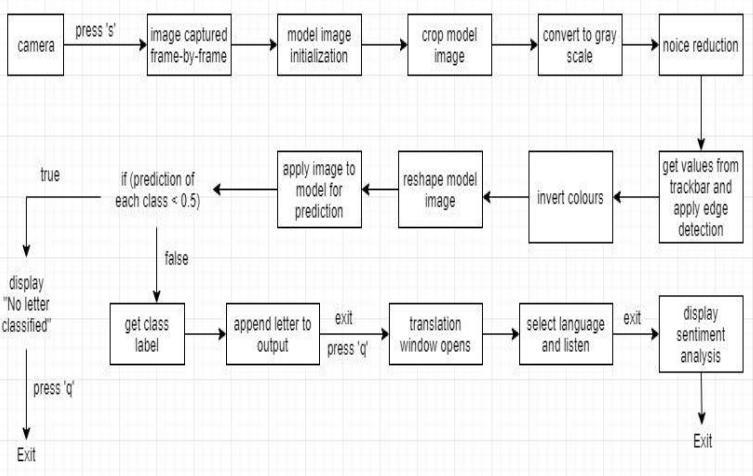
Thearchitectureofsuchsystemforsignlanguagevision-totexttranslationwithdeeplearningconsistsofdifferentparts that communicate with different technology for accurate recognition and real-time processing. The system architecturehasastructuredpipelinethatbeginswithdata acquisitionandendswithproducingtextoutput.
The first phase is Data Acquisition in which input sign languageintheformofvideoorimagesisrecordedusinga camera. This is achieved either through pre-recorded datasets or live video streams. The raw input is then processedwithinthePre-processingModule,whereseveral imageenhancementoperationslikegrayscale,background subtraction, noise removal, and resizing of images are undertaken.Thesepre-processesstandardizetheinputand improve the model to recognize gestures irrespective of
International Research Journal of Engineering and Technology (IRJET) e-ISSN: 2395-0056
Volume: 12 Issue: 04 | Apr 2025 www.irjet.net p-ISSN: 2395-0072
different problems in settings, as well as hand shape variations.
After pre-processing step is done, the system goes to the FeatureExtractionpartthatderivesvariousfeaturesfrom images or video frames by using Convolutional Neural Networks (CNNs). CNNs is used to help identify the hand shape, finger location, and motion paths upon which sign languagegesturesarebasedthroughcameraassistance.For better tracking of motion, pose estimation models can be incorporatedforidentifyingimportantjointmovements.
ThefeaturesarethenpassedtotheGestureRecognitionand Sequence Learning Module, where Recurrent Neural Networks (RNNs), Long Short-Term Memory (LSTM) networks,orTransformer-basedmodelsareusedtoidentify thetemporalpatternsofsignlanguage.Themoduleissuch thatthesystemnotonlydetectsisolatedgesturesbutalso comprehendssequencesofgestures,allowingdetectionof wholewordsandsentences
Aftergesturerecognition,theTextGenerationandLanguage Processing Module converts the identified gestures into sensibletext.Lastly,theprocessedtextispresentedtothe userviatheUserInterfaceModule.Theinterfacemaybea desktop application, mobile application, or web platform, makingitaccessibleonvariousdevices.Thesystemcanalso incorporatetext-to-speech(TTS)functionalitytofacilitate spokenoutput,thusimprovingcommunicationbetweensign languageusersandnon-signers.
Thissystemarchitectureisscalable,real-time,andadaptable for various sign languages. Future enhancement can be orientedtowardsmulti-modallearning,dataexpansion,and low-power device optimization to facilitate wider accessibilityandusability.
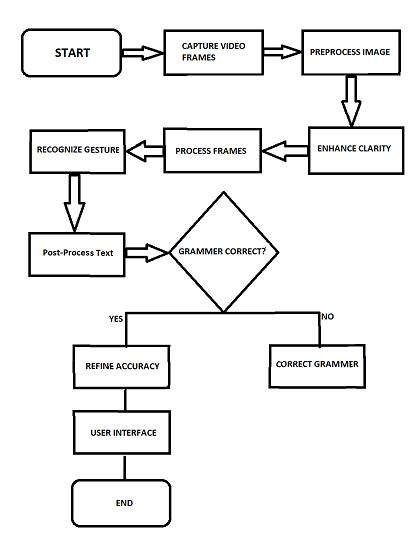
In the next stage, we have depicted the step-by-step workflow of the envisioned vision-to-text sign language recognition system. This workflow consists of various interrelatedprocessesthataltogetherconvertrawgesture inputs into useful textual output. The system starts with dataset identification, where appropriate sign language datasets are chosen or established depending upon the intended language and application domain.
After capturing the gestures, the system proceeds to the preprocessingstage,involvingframeextraction,background subtraction, resizing, normalization, and potentially hand segmentation.BelowisthementionedDataFlowDiagram.
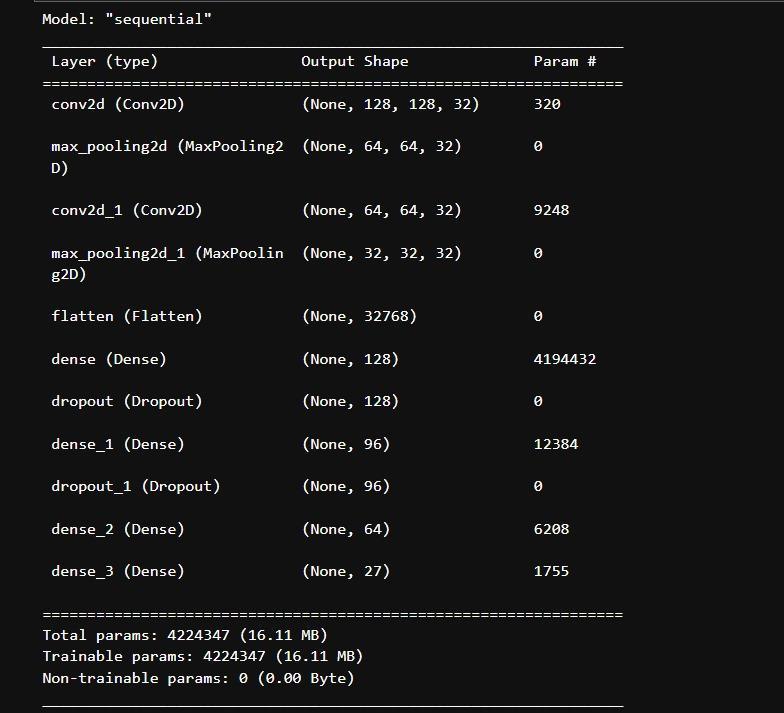
Convolutional Neural Network (CNN) is a special kind of deeplearningmodelengineeredtohandleandanalyzevisual data, thus excelling in performing image recognition activities.CNN'sworkexactlythesamewayahumanbrain receives and processes information visually by reading meaningful patterns within images via multi-layer extraction.CNNsstructuresincludeconvolutional,pooling, and fully connected layers, and these all contribute significantlytofeaturerecognitionandclassification.
Convolutional layers employ filters to identify edges, textures, and shapes and progressively more intricate patterns.Poolinglayersdownsamplefeaturemaps,making it more efficient and reducing computation time for the network.Thefullyconnectedlayersfinallymakesenseofthe extractedfeaturesandclassifytheinputintermsoflearned representations. CNNs have many applications in image classification, object detection, facial recognition, and medicalimaging.Theircapabilitytolearnautomaticallyand recognize patterns without feature extraction by hand rendersthemabasictoolincurrentdeeplearningforvisionrelatedtasks.
International Research Journal of Engineering and Technology (IRJET) e-ISSN: 2395-0056
Volume: 12 Issue: 04 | Apr 2025 www.irjet.net p-ISSN: 2395-0072
5.3 Detailed Module description
5.3.1
Thereareseveralmethodstoobtaindataonhandgestures forsignlanguagerecognition.Onesuchmethodisthrough theuseofelectromechanicaldevices,e.g.,sensorgloves,that can precisely capture hand movement and position. Even though these devices yield accurate data, they tend to be expensive and may not be user-friendly, thus not being practicalforlarge-scaleimplementation.
Anothermethodisvision-basedgesturerecognition,whereby an ordinary camera like a computer webcam records the motion of hands and fingers. It does away with the use of extrahardwareandallowsanaturalinteractionbetweenthe usersandthesystemwithdrasticallylowercosts.
Thevision-basedhanddetectionmaycausesomechallenges, such on the extensive variability in hand shape and movement, skin color, and the effect of parameters like camera orientation, and motion velocity. These challenges must be overcome in order to enhance the accuracy and reliability of sign language recognition systems for the people.
5.3.2
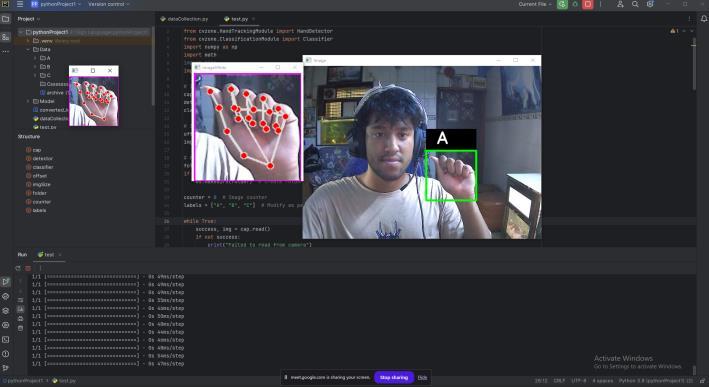
Inhanddetection,theinitialstepistolocatethehandfrom thewebcamimage.Forthispurpose,theMediaPipelibraryis used since it is a dedicated library for image processing operations.Afterthehanddetection,RegionofInterest(ROI) isfound,andtheimageiscroppedaccordingly.Thecropped imageisfurthertransformedintoagrayscaleimagewiththe helpoftheOpenCVlibrary,andaGaussianblurisappliedto ittofilteroutnoiseandimprovetheclarityoffeatures.
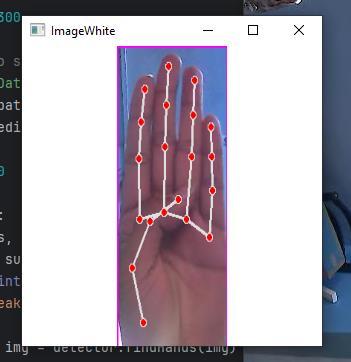
FIG 5.3.2
Oncethehandisidentified,thesystemretrieveslandmark points describing the fingers' and palm's structure and motion. The points are then projected onto a blank white surface via the OpenCV library to provide an even presentationofgesturesandremovebackgroundnoiseand variationsoflight.
International Research Journal of Engineering and Technology (IRJET) e-ISSN: 2395-0056
Volume: 12 Issue: 04 | Apr 2025 www.irjet.net p-ISSN: 2395-0072
TheMedia-Pipelibraryistheimportantfactortothisprocess since these identifies hand landmarks regardless of the backgroundandlightingintheenvironment,therebymaking the system more versatile and reliable. For training, a collectionof180skeletalimageshasbeenprepared,ranging fromalphabetsignsAtoZ.
Theseimagesgiveasimplifiedbutefficientrepresentationof handgestures,improvingtheaccuracyandperformanceof thedeeplearningmodel.
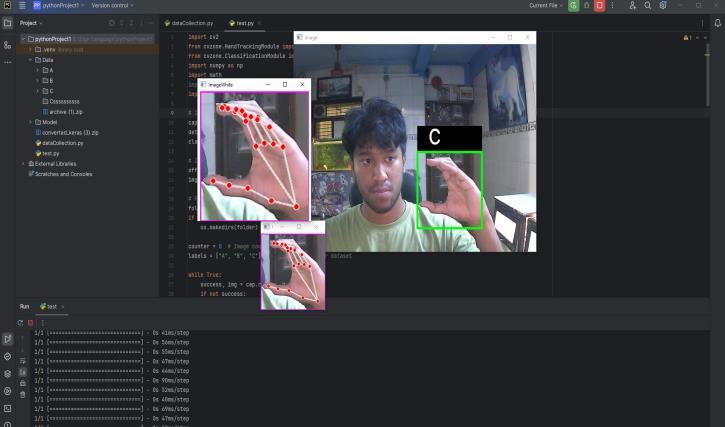
Here are some Screenshots when user shows some hand gesturesinmostoptimalbackgroundaswellasindifferent lightning conditions and system is giving corresponding prediction.
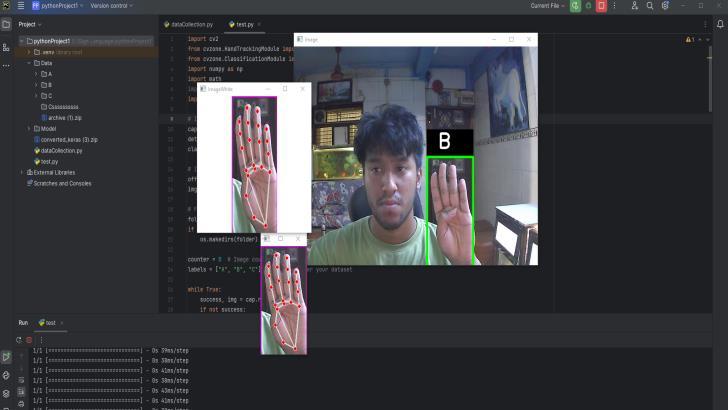
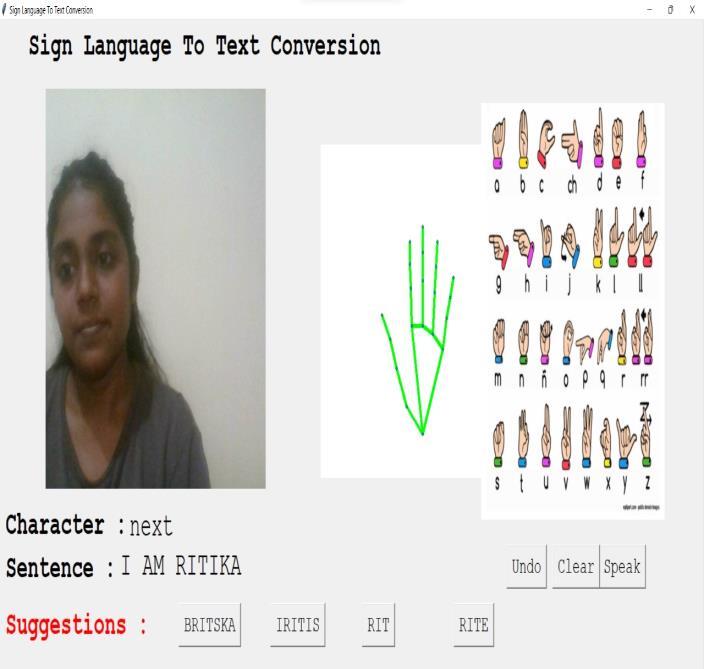
After Implementing the CNN algorithm, we did GUI using python Tkinter and added Suggestions also to make the process smooth for user. We can directly input the suggestionsword.
The future of vision-based sign language translation with deep learning is very promising for enhancing communicationbetweenthedeafandhearingpopulations. With improved deep learning architectures, real-time processing, and multimodal learning, the accuracy and efficiency of sign language recognition systems can be greatly improved. The natural language processing (NLP) canalsoimprovethetranslatedtext,andthedialoguecanbe mademoresmoothandpreciseforinterpretingwithother people. Future developments can be in the form of edge computingandAI-poweredwearabledevices,enablingsign languagerecognitiononmobilephoneswithoutrelyingon cloudservers
Further, increasing the dataset to cover different regional sign languages and gestures will make the system more adaptableacrossdifferentlinguisticcommunities.Advances in gesture tracking through virtual reality (VR) and augmentedreality(AR)canfurtherclosethedividebetween sign language users and non-signers and make communication even smoother and more convenient in everyday life. As research and technology advance, sign languagerecognitionsystemscanbecomeregulartoolsfor useinschools,workplaces,andpublicservicestopromote greater inclusivity and access for the deaf community globally.
Last but not least, we can forecast any alphabet[a-z] with 97% Accuracy (clean background and suitable lightning conditions and without clean background and suitable lightningconditions)byourapproach.Andifbackgroundis clearandlightningconditionisgoodthenweachievedeven 99%accurateresults.
International Research Journal of Engineering and Technology (IRJET) e-ISSN: 2395-0056
Volume: 12 Issue: 04 | Apr 2025 www.irjet.net p-ISSN: 2395-0072
Though deep learning has evolved, issues such as limited trainingsets,heterogeneityofsignlanguage,anddifficulties indeployingthesysteminreal-worldapplicationsstillexist. Butduetotheadvancementsinresearchanddevelopment, the system's accuracy as well as usability will continue to evolve.Futureenhancementsthroughmultimodallearning, edge computing, and real-time gesture recognition will continuetoincreasethesystem'sefficiencyandaccessibility. Astechnologyadvances,AI-basedsolutionssuchasthiswill beinstrumentalinpromotingaccessibility,education,and social integration for the deaf and hard-of-hearing populations.
InFutureweareconsideringanandroidapporIOTgadget in which we apply this algorithm for gesture prediction whichcanassistlotsofindividualsworldwide.
[1]Pu,J.,Zhou,W.,Li,H.,&Li,W.(2019).IterativeAlignment Network for Continuous Sign Language Recognition. IEEE CVPR,4165–4174.
[2]Starner,T.,&Pentland,A.(1997).Real-TimeAmerican SignLanguageRecognitionUsingHMMs.IEEEPAMI.
[3]Pigou,L.,Dieleman,S.,Kindermans,P.J.,&Schrauwen,B. (2014).SignLanguageRecognitionusingCNNs.
[4] Huang, J., Zhou, W., & Li, H. (2015). Continuous Sign LanguageRecognitionwithCNN-LSTM.ECCV.
[5]Koller,O.,Ney,H.,&Bowden,R.(2020).SignLanguage RecognitionwithTransferLearningAcrossLanguages.