
International Research Journal of Engineering and Technology (IRJET) e-ISSN: 2395-0056
Volume: 13 Issue: 03 | Mar 2026 www.irjet.net p-ISSN: 2395-0072
International Research Journal of Engineering and Technology (IRJET) e-ISSN: 2395-0056
Volume: 13 Issue: 03 | Mar 2026 www.irjet.net p-ISSN: 2395-0072
Riya Sanjay Kalake1, Siddhi Shankar Patil2, Pranav Dattatray Raut 3 , Pranav Suresh Rajigare4
1(Computer Engineering, Dr. D. Y. Patil Polytechnic, Kolhapur, Maharashtra
2(Computer Engineering, Dr. D. Y. Patil Polytechnic, Kolhapur, Maharashtra
3(Computer Engineering, Dr. D. Y. Patil Polytechnic, Kolhapur, Maharashtra
4 (Computer Engineering, Dr. D. Y. Patil Polytechnic, Kolhapur, Maharashtra
Abstract - Food wastage has emerged as a serious global challenge that affects food security, environmental sustainability, and economic stability. According to reports from the Food and Agriculture Organization (FAO), nearly one-third of the food produced globally is wasted every year. At the same time, millions of people across the world suffer from hunger and malnutrition. In developing countries such as India, the problem is more severe due to improper food management, lack of awareness, and absence of an efficient system to redistribute surplus food. A large amount of food is wasted during social events, restaurants, hotels, hostels, and households where excess food is often discarded instead ofbeing utilizedtohelp those inneed.
This review paper focuses on the concept of a Food Waste Management System and analyzes various existing approaches and technologies used to reduce food wastage through digital platforms. The study reviews different webbased and mobile-based systems that connect food donors with receivers such as NGOs, shelters, and orphanages. These systems help in identifying surplus food sources and enable timely redistribution to underprivileged communities. The paper also discusses key features such as real-time communication, location-based services, user registration, donation tracking, and systemtransparency.
Furthermore, this review highlights the benefits and limitations of current food waste management solutions and identifies potential improvements that can enhance efficiency and scalability. The study concludes that implementing a technology-driven food redistribution platform can significantly reduce food wastage, improve coordination among stakeholders, and contribute to social welfare and environmental sustainability. Such systems can play an important role in addressing hunger and supporting the global goal ofsustainable development.
Keywords: Food Waste Management, ShareBite, Surplus Food Redistribution, Sustainable Food System, Hunger Reduction, Digital Food Sharing Platform, Smart Waste Management.
Food wastage has become one of the major global challenges in recent years, affecting food security,
environmental sustainability, and economic development. Despite the increase in global food production, a significant portion of the population still suffers from hunger and malnutrition. According to reports from the FoodandAgricultureOrganization(FAO),nearlyone-third of the food produced worldwide, which is approximately 1.3billiontons,iswastedeveryyear.Thismassivewastage occurswhilemillionsofpeoplearoundtheworldstruggle to obtain sufficient and nutritious food for daily consumption.
Food waste occurs at different stages of the food supply chain such as production, transportation, storage, processing, distribution, and consumption. In developing countries, the major causes of food wastage include inadequateinfrastructure,lackofproperstoragefacilities, poor transportation systems, and inefficient supply chain management.Indevelopedcountries,foodwastagemainly results from consumer behavior, overproduction, strict food quality standards, and improper consumption patterns.
Urban areas contribute significantly to food wastage due to large-scale food preparation in restaurants, hotels, hostels, canteens, and various social events such as weddings and parties. In many cases, food is prepared in excess to ensure availability for all guests, but a large portion of the prepared food remains unused and is eventually discarded. Much of this food is still safe and suitable for consumption, but due to the lack of an organized system to redistribute surplus food, it goes to waste.
Atthesametime,manyNGOs,orphanages,old-agehomes, and shelters constantly struggle to obtain adequate food resources for the people they support. The absence of a centralized platform that connects food donors with food receivers creates a gap between surplus food availability and the communities that need it most. This imbalance highlights the necessity for an efficient system that can facilitatetheredistributionofsurplusfoodinatimelyand organizedmanner.
Withtherapidgrowthofdigitaltechnologyandweb-based platforms, it has become possible to develop systems that can effectively address the issue of food wastage. Food
International Research Journal of Engineering and Technology (IRJET) e-ISSN: 2395-0056
Volume: 13 Issue: 03 | Mar 2026 www.irjet.net p-ISSN: 2395-0072
Waste Management Systems use web and mobile technologies to connect food donors such as restaurants, hotels, and event organizers with receivers such as NGOs and charitable organizations. These platforms enable users to register, list surplus food, and allow receivers to requestandcollectfoodbeforeitgetsspoiled.
This review paper focuses on analysing various existing food waste management solutions and technologies that aim to reduce food wastage through digital platforms. It examines different research studies, system architectures, and approaches used in food redistribution systems. The paper also discusses the advantages, challenges, and potentialimprovementsinimplementingsuchsystems.
The main objective of this review is to understand how technology can be used effectively to minimize food wastage, improve food redistribution, and contribute to social welfare and environmental sustainability. By studying existing systems and research work, this paper aims to highlight the importance of developing efficient food waste management solutions that can support the global effort to reduce hunger and promote sustainable development
Food waste management has attracted significant attention from researchers, governments, and social organizations due to its increasing impact on society and the environment. Various studies and systems have been developed to reduce food wastage and improve the redistribution of surplus food. These systems range from traditional manual donation practices to modern digital platformsandmobileapplications.
One of the earliest and most common methods of food redistributionismanualfooddonation,whereindividuals, restaurants, or event organizers directly contact nearby NGOs or charitable organizations to donate surplus food. In this approach, the donor identifies a local organization and communicates with them through phone calls or emailstoarrangefoodcollection.Although thismethod is simpleanddoesnotrequireanytechnicalinfrastructure,it is often inefficient and time-consuming. The absence of propercoordinationmayleadtodelays infoodcollection, increasing the chances of food spoilage. Additionally, manual systems lack proper record-keeping and transparency, making it difficult to track the distribution process.
Another commonly used approach is the food bank system, where organizations collect surplus food from various sources such as hotels, supermarkets, and households and distribute it to underprivileged communities. Several well-known food bank initiatives exist worldwide. For example, the Akshaya Patra Foundation in India and Feeding America in the United
States operate large-scale food distribution programs. These organizations provide centralized collection and distribution systems capable of handling large volumes of fooddonations.However,foodbanksystemsoftenrequire high operational costs and extensive logistics support. In manycases,theprocessstillreliesonmanualcoordination and lacks real-time interaction between donors and receivers.
With the advancement of technology, several mobilebased applications have been introduced to address the issue of food wastage. Applications such as Too Good To Go, OLIO, and Food Rescue US allow users to list surplus food and notify nearby users or organizations who can collectit.Theseapplicationsprovidefeaturessuchasrealtime notifications, location-based services, and direct communication between donors and receivers. Despite theseadvantages,manyoftheseapplicationsareprimarily designedforspecificregionsandmaynotbefullylocalized for countries like India. Furthermore, adoption in smaller cities and semi-urban areas remains limited. Some applications also lack proper integration with NGOs and structuredtrackingmechanisms.
Governments have also introduced several food distribution programs aimed at reducing hunger and supporting vulnerable populations. These initiatives includeschoolmealprogramsandpublicfooddistribution schemes that provide food assistance to low-income families.Althoughsuchprogramshavewidecoverageand can reach large populations, they are generally designed forplanneddistributionratherthanreal-timesurplusfood management.Asaresult,theymaynoteffectivelyaddress theissueoffoodwastageoccurringinrestaurants,events, andhouseholds.
Fromtheanalysisofexistingsystems,severalgapscanbe identified. Many current solutions lack a centralized platform that efficiently connects food donors with receivers. Real-time tracking and transparency in food donation processes are also limited. In addition, several systems fail to provide proper integration with NGOs and shelters, which play a crucial role in food redistribution. Another important limitation is the lack of scalable solutions that can effectively serve urban as well as semiurbanregions.
To address these limitations, the proposed Food Waste Management System introduces a technology-driven approachusingamobileapplicationdevelopedinAndroid Studio using Java. The system provides a centralized platform where food donors such as restaurants, event organizers, and households can list surplus food, while receivers such as NGOs and shelters can request and collect the food efficiently. The application supports realtime notifications, location-based services, and structured record-keeping to improve transparency and coordination. By integrating donors, receivers, and
International Research Journal of Engineering and Technology (IRJET) e-ISSN: 2395-0056
Volume: 13 Issue: 03 | Mar 2026 www.irjet.net p-ISSN: 2395-0072
administratorswithinasingledigitalplatform,thesystem aims to reduce food wastage and improve food redistributionefficiency.
Overall, the study of existing systems highlights the importance of developing a structured, scalable, and technology-based solution for managing food waste. The proposedmobile-basedplatformcanplayasignificantrole in bridging the gap between surplus food availability and thecommunitiesthatrequireit.
Theprimaryobjectiveofthisstudyistoanalyzetheroleof technology in reducing food wastage and improving food redistributionthroughdigitalplatforms.Thestudyfocuses on understanding existing food waste management approaches and identifying how a technology-based systemcanaddressthelimitationsofcurrentsolutions.
Themajorobjectivesofthisstudyareasfollows:
Toanalyzetheproblemoffoodwastageanditsimpacton society,theeconomy,andtheenvironment.
Toexamineexistingfoodwastemanagementsystemsand digitalplatformsusedforsurplusfoodredistribution.
To identify the limitations and challenges present in currentfooddonationandredistributionmethods.
To expore the use of technology for connecting food donorssuchasrestaurants,households,hostels,andevent organizers with receivers such as NGOs, shelters, and orphanages.
To understand how centralized platforms can help improve coordination and efficiency in food donation processes.
To study the role of real-time communication, notifications, and location-based services in improving foodcollectionanddistribution.
To analyze how proper record management and tracking systems can improve transparency and accountability in fooddonationactivities.
To highlight the importance of scalable and user-friendly digitalsystemsthatcansupportlargenumbersofusers.
Inadditiontotheseobjectives,thestudyalsoexploresthe implementation of a mobile-based Food Waste Management System developed using Android Studio and Java, which can facilitate efficient interaction between food donors and receivers. The system aims to provide a structured platform for listing surplus food, enabling nearbyorganizationstocollectitbeforeitgetswasted.By integrating database management, mobile application
development, and real-time communication technologies, the proposed system demonstrates how computer engineeringsolutionscancontributetosolvingreal-world socialproblems
The scope of this study focuses on analyzing the problem offoodwastageandexploringtechnologicalsolutionsthat can improve the redistribution of surplus food. The study mainly examines digital platforms and systems that connectfooddonorswithreceiversthroughorganizedand efficient communication mechanisms. By reviewing existing systems and approaches, the research aims to understandhowtechnologycanhelpreducefoodwastage and improve food distribution to underprivileged communities.
The study considers the interaction between different stakeholders involved in the food donation ecosystem. These stakeholders include food donors such as restaurants, hotels, hostels, households, and event organizers,aswellasreceiverssuchasnon-governmental organizations(NGOs),shelters,orphanages,andcharitable institutions. The analysis also includes the role of centralized digital platforms that allow donors to list surplus food and enable receivers to identify and collect availablefoodinatimelymanner.
In terms of technological implementation, the study focuses on a mobile-based Food Waste Management System developed using Android Studio and Java. The system is designed to provide features such as user registration and authentication, food listing with details such as quantity and location, and a structured record of food donations. These features aim to improve coordination between donors and receivers and ensure transparencyinthefooddonationprocess.
The scope of the study primarily targets urban and semiurban regions where food wastage from restaurants, hostels, canteens, and social events is relatively high. By analyzing these environments, the study aims to identify effectivemethodsforredistributingsurplus food before it getswasted.
However, certain aspects are beyond the scope of the currentstudy.Thesystemdoesnotincludetransportation or logistics management for food delivery, and the responsibility for collecting food remains with NGOs or receivers. Similarly, the system does not incorporate automatedfoodqualitytestingorcoldstoragefacilitiesfor food preservation. Financial transactions between donors andreceiversarealsonotconsideredwithinthesystem.
Despite these limitations, the study highlights the potential for future enhancements such as advanced location-based services, artificial intelligence for predicting food surplus, integration with Internet of
International Research Journal of Engineering and Technology (IRJET) e-ISSN: 2395-0056
Volume: 13 Issue: 03 | Mar 2026 www.irjet.net p-ISSN: 2395-0072
Things (IoT) technologies for monitoring food storage conditions,andpossiblecollaborationwithgovernmentor municipalauthoritiesforlarge-scaleimplementation.
Overall, the scope of this study is to understand how a technology-driven food waste management platform can contribute to reducing food wastage, improving food redistribution,andsupportingsocialwelfareinitiatives.
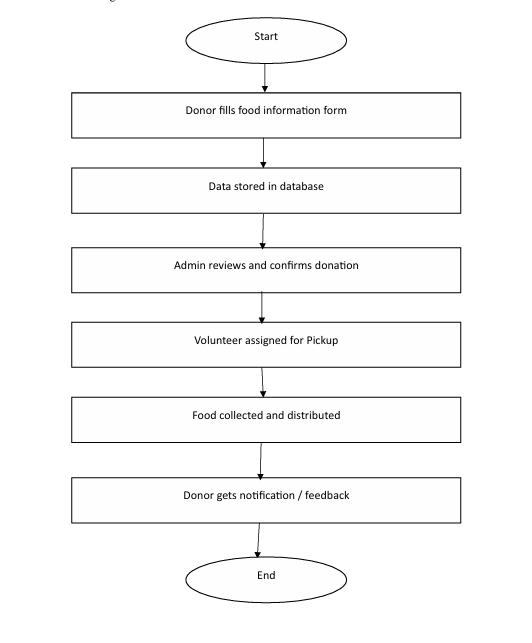
5. Existing System Working Flow:
To overcome the limitations identified in existing food waste management approaches, a centralized technologybased Food Waste Management System is proposed. The system aims to create an organized digital platform that connects food donors with receivers in order to redistribute surplus food efficiently. By utilizing modern mobile technologies, the system facilitates real-time communication, improves coordination between stakeholders, and ensures transparency in the food donationprocess.
The proposed system is implemented as a mobile application developed using Android Studio with Java The platform allows food donors such as restaurants, hotels, hostels, event organizers, and households to registerandlistsurplusfoodalongwithimportantdetails includingfoodtype,quantity,expirytime,andlocation.At the same time, receivers such as NGOs, shelters, orphanages, and charitable organizations can access the
platform to view available food listings and request food thatissuitablefortheirneeds.
The system is designed with multiple modules to ensure efficientfunctionality. The donor module enables donors to register, log in, and upload information about surplus food. Donors can also track their donation history and receivenotificationswhenreceiversrequestorcollectthe listed food. The receiver module allows registered NGOs or organizations to browse available food listings in real time and request food for collection. Receivers can also maintain records of previously collected donations throughtheirdashboard.
An optional admin module can be incorporated to manage users, monitor system activities, and generate reports on food donations and beneficiaries. This module helps ensure system security and smooth workflow management.
Akeyfeatureof the proposedsystemistheintegration of real-time notification mechanisms, which alert receivers whenever new food is listed and notify donors when their food has been requested or collected. Additionally,thesystemutilizes location-based services, allowing receivers to identify the nearest donors and collect food before it gets wasted. These features significantlyimprovetheefficiencyoffoodredistribution
The system architecture follows a multi-layer structure consisting of a presentation layer, application layer, and databaselayer.Thepresentationlayerprovidesthemobile interface through which donors and receivers interact with the application. The application layer manages the core logic of the system, including user authentication, food listing, request handling, and notifications. The database layer stores information related to users, food listings, requests, and donation history, ensuring proper recordmanagementandtransparency.
The proposed system offers several advantages over traditional food donation methods. It provides a centralized platform that simplifies communication between donors and receivers, reduces delays in food collection, and maintains detailed records for accountability. Furthermore, the system promotes social responsibility by encouraging individuals and organizationstodonatesurplusfoodratherthanwasteit.
Inthefuture,thesystemcanbeenhancedbyincorporating advanced technologies such as artificial intelligence to predict surplus food availability and Internet of Things (IoT) sensors to monitor food storage conditions. Additional improvementssuchasmulti-languagesupport, improved geo-mapping features, and integration with logistics services can further expand the reach and efficiencyoftheplatform.
International Research Journal of Engineering and Technology (IRJET) e-ISSN: 2395-0056
Volume: 13 Issue: 03 | Mar 2026 www.irjet.net p-ISSN: 2395-0072
Overall, the proposed Food Waste Management System demonstrates how a mobile-based technological solution can effectively reduce food wastage and support food redistribution efforts, thereby contributing to social welfareandenvironmentalsustainability.
1. Donor registers and logs into the mobile application.
2. Donor adds surplus food details (food type, quantity,location).
3. ThesystemnotifiesnearbyNGOsorreceivers.
4. Receiversviewavailablefoodlistings.
5. Receiversendsarequestforthefood.
6. Donorapprovestherequest.
7. Receivercollectsthefoodfromthedonorlocation.
8. Thesystemrecordsthedonationinthedatabase.
The methodology describes thesystematicapproachused to develop and implement the Food Waste Management System. A well-structured methodology ensures that the systemisdesignedefficientlyandfulfillstherequirements of both food donors and receivers. The development process follows the Software Development Life Cycle (SDLC) model, which provides a step-by-step framework for planning, designing, implementing, testing, and maintainingthesystem.
Thefirststageofthemethodologyinvolvesidentifyingand analyzing the requirements of the system. At this stage, the problem of food wastage and the lack of coordination between food donors and receivers are studied in detail. Information is collected from potential stakeholders such as restaurants, hostels, event organizers, NGOs, and shelters to understand their needs and expectations. Based on this analysis, the functional requirements of the system are defined, such as user registration, food listing, requesthandling,andnotificationservices.Non-functional requirements such as system performance, security, scalability, and usability are also identified. The outcome of this phase is a clear understanding of the system requirements.
After requirement analysis, the system architecture and designareprepared.Theproposedsystemfollowsamultilayer architecture consisting of the presentation layer, application layer, and database layer. The presentation layer represents the user interface of the mobile applicationdevelopedusingAndroidStudio,wheredonors and receivers interact with the system. The application layer handles the core functionality such as user
authentication, food listing, request management, and notificationservices.Thedatabaselayerisresponsiblefor storing information related to users, food items, requests, anddonationrecords.Duringthisphase,systemdiagrams suchasdataflowdiagrams(DFD),use-casediagrams,and database structures are designed to provide a clear blueprintforimplementation.
In the implementation phase, the system design is converted into a working application. The mobile applicationisdevelopedusingJavaprogramminglanguage in Android Studio. The frontend interface provides userfriendly dashboards for donors and receivers, allowing them to register, log in, and interact with the system. The backendlogicmanagesapplicationprocessessuchasfood listing, request approval, and notification handling. A database is created to store user information, food availability details, requests, and donation history. The application components are integrated to ensure smooth communication between the user interface and the database.
Testing is performed to ensure that the system functions correctly and meets user requirements. Different types of testing are conducted during this phase. Unit testing is usedtoverifythefunctionalityofindividualmodulessuch aslogin,foodlisting,andrequestmanagement.Integration testing ensures proper interaction between different modules of the system. System testing evaluates the overall performance, reliability, and security of the application. Finally, user acceptance testing is conducted togatherfeedbackfrompotentialusers suchasNGOsand restaurants to ensure that the application is easy to use andreliable.
Once testing is completed successfully, the application is deployed for use by the target users. The system can be installed on Android devices and made accessible to donors and receivers through the mobile platform. After deployment, regular maintenance is required to ensure the system continues to function efficiently. Maintenance activities include fixing bugs, updating software components, improving system performance, and adding new features based on user feedback. Continuous improvements help maintain system reliability and supportfuturescalability.
The methodology adopted for the Food Waste Management System ensures a systematic and efficient developmentprocess.ByfollowingtheSDLCapproach,the
Volume: 13 Issue: 03 | Mar 2026 www.irjet.net p-ISSN: 2395-0072
project progresses through clearly defined stages, from requirement analysis to deployment and maintenance. This structured development process helps ensure that the system is reliable, scalable, and capable of supporting efficient food redistribution between donors and receivers.
The system design defines the structure and working of the proposed Food Waste Management System. A wellstructured design ensures efficient interaction between donors, receivers, and the system while maintaining transparency and data integrity. The design focuses on providing a reliable and scalable platform that supports real-timecommunicationandefficientfoodredistribution.
The proposed system follows a layered architecture consisting of three main components: the presentation layer, application layer, and database layer. The presentation layer represents the user interface of the mobile application developed using Android Studio with Java. Through this interface, donors and receivers can register, log in, list surplus food, view available food listings, and request food. The interface is designed to be user-friendly so that individuals and organizations can easilyinteractwiththesystem.
Theapplicationlayercontainsthecorelogicofthesystem and manages the processing of user requests. This layer handles operations such as user authentication, food listing management, request handling, notification processing, and record management. It acts as an intermediarybetweentheuserinterfaceandthedatabase, ensuring that all operations are validated and processed correctly.
The database layer is responsible for storing all relevant information related to the system. This includes user details, food item information, requests, notifications, and donation history. The database ensures data consistency and enables effiient retrieval of information whenever required.
To better understand the interaction between different system components, several system modeling techniques can be used. Data Flow Diagrams (DFD) illustrate how datamovesbetweendonors,receivers,andthesystem.At the highest level, the system receives food listings from donors and food requests from receivers while maintaining records in the database. The system also generates notifications and updates when requests are approvedorcompleted.
In addition to DFDs, Unified Modeling Language (UML) diagrams can be used to represent the system structure andbehavior.Ause-casediagramidentifiesthekeyactors of the system donors, receivers, and administrators
andtheirinteractionswithdifferentsystemfunctionalities such as registration, food listing, and request handling. A class diagram represents the main entities of the system, including user, food item, request, and notification. These entities interact with each other to support the overall workflow of the application. Sequence diagrams illustrate the step-by-step communication that occurs when a receiver requests food and the donor approves the request. Activity diagrams can also be used to represent the overall process flow from food listing to food collection.
The system design ensures that the application supports efficient communication between donors and receivers whilemaintainingaccuraterecordsofalltransactions.The modular structure of the system allows it to be easily expanded in the future with additional features such as enhanced location-based services, analytics dashboards, orintegrationwithexternalservices.
Overall,thesystemdesignprovidesaclearframeworkfor implementing the Food Waste Management System and ensures that the platform remains scalable, efficient, and easytomaintain.
TheFoodWasteManagementSystemisimplementedasa web-based platform consisting of several functional modules that enable efficient interaction between donors, receivers,andadministrators.
This module handles user registration, login, and authenticationfordonors,receivers,andadmin.Itensures secureaccesstothesystem.
Allows donors to add surplus food details such as food name,quantity,expirytime,andlocationsothatreceivers canviewavailablefooditems.
Receivers can send requests for available food items, and donorscanapproveorrejecttherequests.
4. Notification Module
Provides real-time notifications to donors and receivers regardingfoodlistings,requests,andapprovals.
5. Admin Management Module
Admin monitors users, manages food listings, and generatesreportsrelatedtodonationsandrequests.
International Research Journal of Engineering and Technology (IRJET) e-ISSN: 2395-0056
Volume: 13 Issue: 03 | Mar 2026 www.irjet.net p-ISSN: 2395-0072
• Reduces food wastage by redistributing surplus food efficiently.
• Provides a centralized platform connecting donors and receivers.
•Enablesreal-timecommunicationthroughnotifications.
• Improves transparency by maintaining records of donationsandrequests.
• Supports social welfare by helping underprivileged communitiesaccessfood.
•Scalablesystemthatcanbeexpandedtomultipleregions inthefuture.
he Food Waste Management System has significant practical applications in addressing the global issue of food wastage and improving food redistribution. By utilizing a technology-driven platform, the system can facilitate efficient coordination between food donors and receivers and ensure that surplus food is redirected to communitiesinneed.
One of the primary application areas of the system is in restaurants and hotels, where surplus food is often generatedduetooverproductionorunsoldstock.Through the proposed platform, these establishments can list surplus food in real time, enabling nearby charitable organizationstocollectitbeforeitbecomesunusable.This approach not only helps reduce food wastage but also encourages businesses to participate in social responsibilityinitiatives.
The system can also be effectively utilized in hostels, cafeterias, and large social events such as weddings, conferences, and community gatherings, where food is typicallypreparedinlargequantities.Byconnectingthese institutions with NGOs and shelters, the platform enables efficient redistribution of excess food and minimizes wastageresultingfrombulkfoodpreparation.
Another important application area is for nongovernmental organizations and charitable institutions that provide support to underprivileged communities. Through a centralized platform, NGOs can easily identify available food resources in their vicinity and coordinate withdonorsfortimelycollection.Thishelpsimprovefood accessibility for orphanages, shelters, and economically disadvantagedgroups.
In addition, municipal authorities and government organizations can adopt such systems to monitor and manage food redistribution at a larger scale. The data
generated by the platform can help authorities analyze food wastage patterns and develop policies aimed at improvingfoodsecurityandsustainability.
Educational institutions such as schools, colleges, and universitiescanalsobenefitfromthesystembymanaging surplus food generated in cafeterias and hostels. This can promoteawarenessamongstudentsandencourageactive participationincommunitywelfareinitiatives.
The system also offers several opportunities for future enhancement. One potential improvement is the development of advanced mobile application features using Android Studio and Java, enabling users to access the system more efficiently through smartphones. Additional improvements may include integration of artificial intelligence techniques to predict surplus food generation based on historical data and optimize food redistributionstrategies.
Furthermore,theincorporationofInternetofThings(IoT) technologies could enable monitoring of food storage conditionssuchastemperatureandfreshness.Integration with geographical mapping and routing systems may also help optimize food collection and transportation by identifying the nearest donors and receivers. Another important enhancementistheinclusionofmulti-language support, which can improve accessibility and enable adoptionoftheplatformacrossdifferentregions.
Overall, the proposed system has the potential to evolve intoacomprehensiveplatformforfoodredistributionand sustainable resource management. By combining technologicalinnovationwithsocialwelfareinitiatives,the system can contribute significantly to reducing food wastage, supporting vulnerable communities, and promotingenvironmentallyresponsiblepractices.
The implementation of the proposed Food Waste Management System is expected to significantly improve the process of redistributing surplus food and reducing food wastage. The system provides a technology-driven platformthatconnectsfooddonorswithreceiversthrough a structured and efficient mobile application. By integrating real-time communication, centralized data management,andlocation-basedservices,thesystemaims to create a more reliable and transparent food donation ecosystem.
Oneoftheprimaryexpectedoutcomesofthesystemisthe development of a mobile-based platform developed using Android Studio and Java that allows different stakeholders to interact efficiently. Food donors such as restaurants, hotels, hostels, and households can list surplus food through a simple user interface, while
International Research Journal of Engineering and Technology (IRJET) e-ISSN: 2395-0056
Volume: 13 Issue: 03 | Mar 2026 www.irjet.net p-ISSN: 2395-0072
receivers such as NGOs, shelters, and charitable organizations can view available food items and request them in real time. This interaction helps ensure that surplus food reaches people in need before it becomes unusable.
The system is also expected to provide user dashboards forbothdonorsandreceivers.Thedonorinterfaceenables users to add food listings, manage donation details, and track the status of food requests. Donors can view the history of their donations and receive notifications whenever a receiver requests food. Similarly, the receiver interface allows NGOs or organizations to browse available food listings, filter them based on location or type, and send requests for collection. Receivers can also maintainrecordsoffoodreceivedthroughthesystem.
Another important outcome of the system is the integration of a notification mechanism that supports real-time communication between donors and receivers. When a donor lists new food items, nearby receivers are notified about the availability of food. Likewise, when a receiver requests food, the donor receives a notification and can approve the request. This process minimizes delaysandreducesthechancesoffoodspoilage.
The system also maintains records of food donations and requests, which helps improve transparency and accountability. These records can be used to generate reports and statistics such as the number of food donations, number of beneficiaries, and the amount of foodsavedfromwastage.Suchdatacanhelporganizations andauthoritiesunderstandfooddistributionpatternsand improvefutureplanning.
Overall,theexpectedresultsofthesystemincludereduced foodwastage,improvedcoordinationbetweendonorsand receivers,andincreasedaccessibilityoffoodresourcesfor underprivileged communities. The system also promotes social responsibility by encouraging individuals and organizationstodonatesurplusfoodinsteadofdiscarding it.
Inthe longterm,theplatformhasthepotential to expand to multiple regions and integrate advanced technologies such as artificial intelligence, improved location services, and large-scale data analytics. These enhancements can furtherstrengthenthe effectivenessoffoodredistribution systems and contribute to sustainable food management practices.
Food wastage is a major global issue that coexists with hunger and food insecurity. The proposed Food Waste ManagementSystemprovidesatechnologicalapproachto address this problem by connecting food donors such as restaurants, hotels, and hostels with receivers including NGOs, shelters, and charitable organizations. By using a
centralized digital platform, the system enables efficient food redistribution and reduces unnecessary food disposal.
The system integrates features such as real-time food listing,requestmanagement,andnotificationmechanisms that allow donors and receivers to interact effectively. Through these functionalities, the platform improves transparency, coordination, and accessibility of surplus food resources. The proposed solution also highlights the importanceofusingmoderntechnologiestoaddresssocial andenvironmentalchallenges.
Overall, the Food Waste Management System demonstrates how technology can contribute to sustainable food management and community welfare. With further enhancements such as mobile application support, artificial intelligence integration, and large-scale deployment, the system has the potential to significantly reduce food wastage and improve food accessibility for underprivilegedcommunities.
[1] https://www.ijert.org/research/web-basedapplication-for-food-waste-management
[2] https://ijsci.com/index.php/home/article/view/6 08
[3] https://ijsci.com/index.php/home/article/view/4 3
[4] https://zenodo.org/records/16593882
[5] https://ijarsct.co.in/Paper25986