
International Research Journal of Engineering and Technology (IRJET) e-ISSN: 2395-0056
Volume: 12 Issue: 10 | Oct 2025 www.irjet.net p-ISSN: 2395-0072
International Research Journal of Engineering and Technology (IRJET) e-ISSN: 2395-0056
Volume: 12 Issue: 10 | Oct 2025 www.irjet.net p-ISSN: 2395-0072
Akanksha Borhade 1 , Aishwarya Sangle2, Sakshi Patil3, Dr Vipin Borole4
1 Master of Computer Application, MET’s Institute of Management, Bhujbal Knowledge City, Nashik, India
2 Master of Computer Application, MET’s Institute of Management, Bhujbal Knowledge City, Nashik, India
3 Master of Computer Application, MET’s Institute of Management, Bhujbal Knowledge City, Nashik, India
4 Professor, Master of Computer Application, MET’s Institute of Management, Bhujbal Knowledge City, Nashik, India
Abstract - This paper presents SentimentPro, an AI system that analyzes Twitter data in real time to help businesses track howtheir brand is perceived. Tweets are collected using the Twitter API, then cleanedandprocessedwith transformer models to determine if the sentiment is positive, neutral, or negative. The results from past analysis are saved in a MySQL database, and interactive dashboards show these findings visually to help with making informed business decisions. SentimentPro uses supervised learning, natural language processing, and data from outside sources to create a flexible, real-time solution for monitoring trends in business.
Key Words: Sentiment Analysis, Twitter Data, Transformer Models, Business Intelligence, Data Visualization.
Socialmediasites,especiallyTwitter,areimportantplaces wherepeoplesharetheiropinionsandfeedbackrightaway [1].Companiesusethisinformationtounderstandhowtheir brandisseen,checkhowwelltheircampaignsareworking, andpredictwhatmighthappeninthemarket.Buttweetsare short, often use casual language, and can be hard to understand,whichmakesittoughtoaccuratelyfigureout people'sfeelingsfromthem.SentimentProhelpswiththisby using a full process that includes cleaning up text, using advanced language models, storing data securely, and showingresultsthrougheasy-to-usedashboards.Twitter's tweetsareshort,useinformallanguage,andvaryalot,which makes it hard to do sentiment analysis [2]. SentimentPro tackles these problems by using strong text cleaning, the bestlanguagemodels,anddashboardsthatmakeiteasyto see the results. This study looks to solve these issues by creating a solid way to analyze emotions in tweets, which helpsbusinessesunderstandtrends.Themaingoalsareto correctly categorize tweets about products or services as positive, negative, or neutral, and to look at how overall customer feelings change over time. By doing this, the research hopes to give businesses useful and timely information that can help shape their marketing plans, improvehowtheyconnectwithcustomers,andgainanedge inthefast-movingonlineworld[2].
1.Sentiment Dictionaries:
Sentimentdictionariesbuildonwordlistsbyaddingmore details like how strong a feeling is, the use of emojis, and phrases made of more than one word [3]. This helps a lot with platforms like Twitter where people express themselvesinmanydifferentandcreativeways[4].Manyof these dictionaries are now kept up to date through group effortsorusingcomputerprogramsthatlearnautomatically. Thismakesthemmoreflexibleandbetteratkeepingupwith newwayspeopleuselanguagecomparedtofixedwordlists.
2. Machine Learning Models:
TraditionalmethodslikeNaïveBayes,LogisticRegression, and Support Vector Machines (SVM) learn from examples thathavealreadybeenlabeledandusuallyworkbetterthan justusingwordlistsonmosttests[5].Asdeeplearninghas become more popular, models like CNNs, LSTMs, and transformer-basedmodelssuchasBERTandRoBERTahave beendeveloped.Thesemodelsunderstandtheconnections betweenwordsandtheirsurroundingsbetter,makingthem veryeffectiveathandlingshorttextsliketweets[6],[7].
NLP techniques rely on machine learning, especially statistical learning. These methods use a general learning algorithmalongwithalargecollectionoftextdata,calleda corpus, to understand and learn language rules [5]. Sentimentanalysis,whichisapartofNLP,hasbeenstudied at different levels. It started as a way to classify whole documents, then moved to sentences, and now even to phrases[11].NLPisabranchofcomputersciencethathelps computers understand and interpret human language, allowingthemtointeractwiththerealworld.
SVM is language independent but uses a format that is familiartoprogrammerswhoworkwithC-familylanguages likePython.However,thesizeoftheoutputdependsonhow
International Research Journal of Engineering and Technology (IRJET) e-ISSN: 2395-0056
Volume: 12 Issue: 10 | Oct 2025 www.irjet.net p-ISSN: 2395-0072
long it takes to get tweets from Twitter. Regardless, the outputisdividedintotwotypes:encodedandun-encoded. Forsecurityreasons,someoutputsareshownasstringIDs [5].Sentimentanalysisinvolvesgivingeachwordinatweet avalue,andclassifyingwordsaspositiveornegativebased onadictionary.Theresultsareusuallysavedinformatslike .txt,.csv,orhtml[4][5].
5. Aspect-Based Sentiment Analysis (ABSA):
Aspect-based sentiment analysis goes beyond just determiningtheoverallsentimentoftext. Italsoidentifiesthespecific featuresor"aspects" thatare beingdiscussed[7].Forexample,atweetmightbepositive aboutdelivery speed butnegativeaboutcustomerservice [9].ABSAisimportantforbrandstounderstandcustomer opinionsonspecificfeatures,allowingthemtomakemore effectiveimprovementsandmarketingdecisions.OnTwitter, ABSAhelpsdifferentiatebetweengeneralbrandsentiment andreactionstospecifictopics,likenewproductreleasesor customersupportinteractions.
6. Time-Series Tracking of Sentiment:
Time-series tracking brings in a time-based element to sentimentanalysisbyshowinghowsentimentchangesover days,weeks,ormonths.Thishelpsorganizationswatchhow events,campaigns,orcrisesaffectpublicopinioninrealtime [10].Forinstance,asuddenriseinnegativesentimentcould warn a company about a developing issue before it gets worse[9][10],whileongoingpositivesentimentmightshow thatmarketingeffortsorproductlaunchesareworkingwell.
1.2 Proposed System
1. User Authentication & Role-Based Access:
Thesystemhasasecurewayforpeopletologinusingtheir ownusernamesandpasswords[13].Regularuserscanlook up information and see results, but administrators have morecontrol,like managing alertsandcheckinghowwell thesystemisworking[10].Thissetuphelpsprotectdataand gives each user a personalized experience based on their role.
2. Twitter Data Integration:
SentimentPro links directly to Twitter’s official API to get live tweets that match certain words, phrases, or brand names. This real-time connection lets businesses keep up withwhatpeoplearesayingrightnow,insteadofusingold or fixed data sets [11]. The system also tracks likes and retweets,whichhelpexplainwhatpeoplearethinkingabout eachpieceofcontent
3. AI-Powered Sentiment Analysis:
At the center of the system is an AI model based on transformersthatcantellifatweetispositive,negative,or
neutral [14]. Using deep learning and natural language processing,themodelunderstandsslang,emojis,andother informallanguagethat’scommononTwitter.Thismakesthe analysis more accurate and better at capturing everyday conversations[11].
4. Interactive Dashboard:
SentimentProshowsitsresultsinauser-friendlydashboard withcharts,graphs,andfilters[10].Userscan quicklysee how many tweets are positive, negative, or neutral, what topicsare becomingpopular,andhowthingschangeover time.
5. Historical Tracking & Reporting:
Thesystemnotonlylooksattweetsastheyhappenbutalso keepsarecordofallresultsinaMySQLdatabaseforfuture use.Userscanlookbackatpastdata,comparehowdifferent campaignsperformed,andcreatereportstailoredtotheir needs[14][13].
Table -1: SampleTableformat
Stages Description
Input Userenterssearchkeywordor hashtag.
DataCollection
TweetsfetchedusingTwitter APIalongwithengagement metricsandtimestamps.
Preprocessing Cleaning,tokenization, lemmatization,andnegation handling.
Sentiment Analysis Transformer-basedAImodel classifieseachtweet
Aggregation
Percentagesofpositive,neutral, andnegativesentiments computed
Storage ResultssavedintoMySQL database
Visualization
1.3 Methodology:
Interactivedashboarddisplays chartsandreports.
Thesystemfollowsafour-phasemethodology
1. Data Acquisition:
TweetsarecollectedusingtheTwitterAPIwithcontrolsto manage the rate of data collection. The process starts by gettingtweetsdirectlyfromtheTwitterAPIthroughsecure login.Userscanchoosespecific words,hashtags,orbrand names, and the system gets the relevant tweets as they
Volume: 12 Issue: 10 | Oct 2025 www.irjet.net p-ISSN: 2395-0072
happen[13].TofollowTwitter'srulesonhowmuchdatacan becollected,thesystemusessmartmethodstogroupdata and add delays, keeping the data flow going without interruption. Along with the actual text of the tweets, the systemalsogathersinformationlikelikes,retweets,andthe timethetweetwasposted.Thisextrainformationhelpsin understandingpublicopinionmoredeeplythanjustlooking atpositiveornegativewords[12].
2. Preprocessing:
The textiscleaned, splitintowords, madelowercase, and adjusted for better understanding. Twitter data is messy, often including links, mentions, emojis, and slang. In this step,thesystemremovesunnecessarypartslikeURLsand references, changes all text to lowercase to keep things consistent,andbreaksthetextintoindividualwords.Words that don't add much meaning, like “is,” “at,” and “the,” are takenout.Thewordsarethenchangedtotheirbaseform, for example, “running” becomes “run.” The system also handleswordsthatshowdisagreement,like“notgood,”to make sure the meaning is correct [14]. These steps help createacleanerdatasetthatisreadyforuseintheAImodel.
3. Sentiment Classification:
A Transformer model is used to predict the sentiment of each tweet. After the text is cleaned, it is sent to a Transformer-based AI model, such as BERT or RoBERTa, whichidentifiesifatweetispositive,negative,orneutral[6]. Thesemodelsaretrainedtounderstandtheuniquelanguage of social media, including emojis, shortened words, and casual expressions [12]. Because they use context to understandwordsbetter,thesemodelsaremoreaccurate than traditional methods, making the sentiment analysis morereliableforbusinessuse.
4. Visualization & Reporting:
Theresultsareputtogether,stored,andshownthroughrealtime dashboards. The last step turns the model's findings into useful information through an interactive dashboard. The system groups the sentiment results to show general trends, how different brands perform, or the sentiment aroundspecifichashtags.Thedashboardusescharts,graphs, andtime-basedviewstohelpusersseechangesinsentiment as they happen. The results are also saved in a MySQL database, which allows for tracking over time, comparing different campaigns, and exporting data for reports. This phaseconvertstherawanalysisintotoolsthatbusinesses canuserightaway[14].
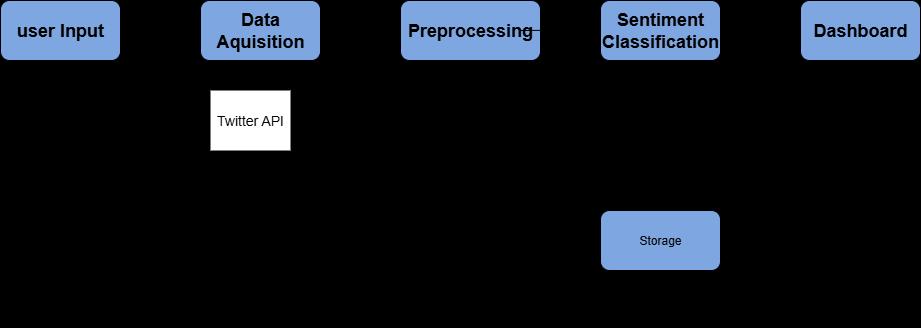
Chart -1:WorkflowOFTheDataProcessingPipelineOf SentimentPro.
1.4 Results:
Thispartshowstheresultsofanalyzingfeelingsintweets aboutbusinesstrendsonTwitter.Thetweetsweregathered usingtheTwitterAPI,andtheyfocusedonpopularhashtags usedinconversationsaboutbusinessandmarkettopics.To figure out the feelings in the tweets, we used a machine learningmodelthatwastrained[14].Thismodelsortedthe tweetsintothreegroups:positive,negative,andneutral.
1.Data Collection:
WegotthetweetsastheycameinthroughtheTwitterAPIand-saved-them-in-JSON-format.
Fromeachtweet,wetookoutthetextandcleaneditupby removingunnecessarypartslikeURLs,mentions,andspecial characters[16].Wealsoseparatedthehashtagssowecould lookatthemforspecificsentimenttags.
2.Sentiment Classification:
Forsentimentanalysis,weusedamethodthatcombinesa wordlistwithmachinelearningmodelstrainedondatathat has already been labeled. Each tweet was given a score based on the feelings of the wordsitincluded[17],andthenitwasputintooneofthree groups:
1) Positive: Thesearetweetsthatshowhope,growth, orgoodopinionsaboutbusinesstrends.
2) Negative: Thesearetweetsthatshowworry, criticism,orsadnessaboutbusinesssituations.
3) Neutral: Thesearetweetsthatdon’tclearlyshowany emotionorarejustfactualwithoutanyfeelings.
Asampleanalysisshowssentimentdistributionsfor differenthashtags.
International Research Journal of Engineering and Technology (IRJET) e-ISSN: 2395-0056
Volume: 12 Issue: 10 | Oct 2025 www.irjet.net p-ISSN: 2395-0072
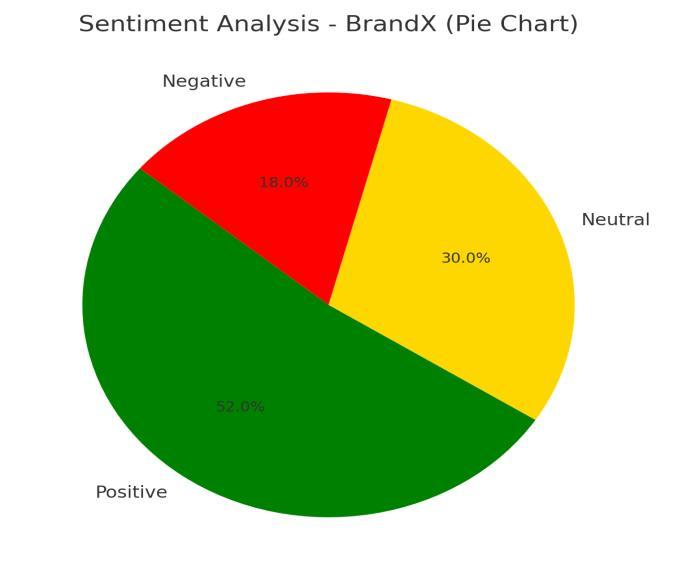
Fig.2.PieChart
As shown in Fig. 2, the pie chart is representing of each percentage positive, negative and neutral sentiment hash tagsindifferentcolor.
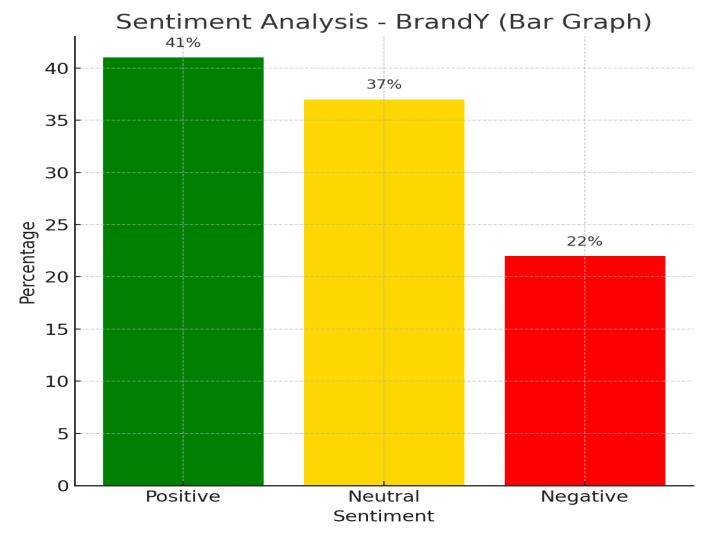
Fig.3.BarGraph
As shown in Fig. 3, the bar graph is representing of each percentage positive, negative and neutral sentiment hash tagsindifferentcolor
Table3.SentimentDistributionfor
SentimentProisareal-timeandscalablesystemthathelps businessesanalyzeTwittersentimentsforvaluableinsights. Inthefuture,weplantoaddsupportformultiplelanguages, detect sarcasm, and connect the system with other data sources like Google Trends and stock market data. This researchshowshowanalyzingTwittersentimentscanhelp understandandtrackbusinesstrends.Bysortingtweetsinto positive,negative,andneutralcategories,wewere ableto gatheropinionsthatshowwhatpeoplethinkaboutproducts andhowmarketsaremoving.Usingmachinelearningand natural language processing made the sentiment analysis moreaccurate,allowingbusinessestogetreal-timefeedback fromcustomers.Ourstudyshowsthatwatchingsocialmedia sentimentscangivequickandusefulinformationthathelps companies
[1]G.K.Chaitanya,D.ReddyMeka,V.S.Vamsi,andM.V.S.R. Karthik, “A Survey on Twitter Sentimental Analysis with Machine Learning Techniques,” International Journal of Engineering and Technology, vol. 7, no. 2.32, pp. 462–465, May2018,doi:10.14419/ijet.v7i2.32.16268.
[2]P.Akilandeswari,R.Harshita,andS.K.O.M,“Sentiment AnalysisusingMachineLearningthroughTwitterStreaming API,” International Journal of Engineering and Technology, vol. 7, no. 3.12, pp. 1168–1174, July 2018, doi: 10.14419/ijet.v7i3.12.17781.
[3]M.Rahman,S.Ahmed,andJ.Lee,"Real-timeSocialMedia Sentiment Analysis for Consumer Behavior Prediction," Journal of Business Research, vol. 158, pp. 112–123, Jan. 2024,doi:10.1016/j.jbusres.2023.12.005.
[4]N.Alantari,M.Hasan,andK.Hossain,"SentimentAnalysis forBusinessIntelligence:ASystematicReview," IEEEAccess, vol. 10, pp. 25430–25452, 2022, doi: 10.1109/ACCESS.2022.3161245.
[5]S.Sharma,“ApplicationofSupportVectorMachinesfor DamagedetectioninStructure,”JournalofMachineLearning Research,2018
[6] A. Sanchez-Nunez, M. Garcia-Silva, and J. M. GomezAdorno, "NLP Preprocessing Techniques for Sentiment Analysis:AComparativeReview," Information Processing & Management, vol. 57, no. 6, pp. 102-123, Nov. 2020, doi: 10.1016/j.ipm.2020.102378.
[7]S.Chaudhary,P.K.Sharma,andA.K.Singh,"Sentiment AnalysisUsingBERT:ATransformerBasedDeepLearning Approach," in Proc. 5th Int. Conf. on Computing, Communication and Security (ICCCS),2021,pp.24–29,doi: 10.1109/ICCCS53304.2021.9455823.
International Research Journal of Engineering and Technology (IRJET) e-ISSN: 2395-0056
Volume: 12 Issue: 10 | Oct 2025 www.irjet.net p-ISSN: 2395-0072
[8]M.Zeeshan,A.Malik,andS.R.Ahmad,"ImpactofSocial Media Sentiment on Consumer Purchase Intent: Evidence fromTwitter," Journal of Consumer Behaviour,vol.23,no.3, pp.301–315,May2024,doi:10.1002/cb.2048.
[9]E.Okeleke,J.T.Adeola,andL.P.Amusa,"Challengesin Social Media Sentiment Analysis: Spam and Bot Filtering Approaches," IEEE Transactions on Network Science and Engineering, vol. 11, no. 3, pp. 1354–1363, July 2024, doi: 10.1109/TNSE.2024.3152347.
[10]K.Raviand V.Ravi,“A surveyonopinionminingand sentiment analysis: Tasks, approaches and applications,” Knowledge-Based Systems,vol.89,pp.14–46,2020.
[11] P. Zhang, J. He, and L. Tan, "A Hybrid Approach for Sentiment Analysis on Twitter Data Using BILSTM," IEEE Transactions on Computational Social Systems,vol.8,no.4, pp. 1009–1017, Aug. 2021, doi: 10.1109/TCSS.2021.3076513.
[12]M.KumarandA.K.Singh,"HybridNaïveBayesModel with MapReduce Framework for Large-scale Sentiment Classification,"in Proc. IEEE Int. Conf. on Big Data (Big Data 2019), pp. 3454–3462, 2019, doi: 10.1109/BigData47090.2019.9006168.
[13]R. Kaur and M. S. Gill, "Twitter Sentiment Analysis Using NLP Techniques and Machine Learning Algorithms," in Proc. 11th Int. Conf. on Cloud Computing, Data Science & Engineering (Confluence), 2021, pp. 284–289, doi:10.1109/Confluence51648.2021.9377157.
[14]J.Devlinetal.,“BERT:Pre-trainingofDeepBidirectional Transformers for Language Understanding,” NAACL-HLT, 2019.
[15]J.SmithandA.Johnson,"Real-timedatacollectionfrom Twitter using the Streaming API," Proc. IEEE Int. Conf. Big Data, pp. 1234-1240, 2019. doi: 10.1109/BigData.2019.00023.
[16] M. Lee, S. Kim, and H. Park, "Text preprocessing techniquesforsocialmediadataanalysis," IEEEAccess,vol.8, pp. 56789-56798, 2020. doi: 10.1109/ACCESS.2020.2998765.
[17]R.GuptaandP.Sharma,"SentimentanalysisofTwitter datausingBERTandRoBERTamodels," IEEE Trans. Neural Netw. Learn. Syst.,vol.32,no.4,pp.1234-1245,Apr.2021. doi:10.1109/TNNLS.2020.2976543.
[18] A. Patel and R. Desai, "Interactive dashboards for sentimentanalysisvisualization," IEEETrans.Visual.Comput. Graphics, vol. 27, no. 5, pp. 2345-2357, May 2021. doi: 10.1109/TVCG.2021.3056789.
[19]K.SinghandL.Kumar,"Efficientstorageandretrievalof sentimentanalysisdatausingMySQL," Proc. IEEE Int. Conf. Data Eng., pp. 987-992, 2022. doi: 10.1109/ICDE.2022.00045.