
International Research Journal of Engineering and Technology (IRJET) e-ISSN: 2395-0056
Volume: 13 Issue: 02 | Feb 2026 www.irjet.net p-ISSN: 2395-0072
International Research Journal of Engineering and Technology (IRJET) e-ISSN: 2395-0056
Volume: 13 Issue: 02 | Feb 2026 www.irjet.net p-ISSN: 2395-0072
Mr. N. Paparayudu1 A. Sahana2, G. Nathaswee3, B. Srikanth4, B. Rohith Kumar5
1Assistant Professor, Department of IT, TKR College of Engineering and Technology, Telangana, India 2,3,4,5B.Tech Students, Department of IT, TKR College of Engineering and Technology, Telangana, India
Abstract - The rapid growth of online food delivery platforms has led to an overwhelming volume of customer reviews, making it challenging for restaurants and diners to extractmeaningfulinsightsefficiently.Thisproject,“Sentiment Analysis on Zomato Restaurant Reviews using Machine Learning,” aims to develop an intelligent system that automatically classifies customer feedback into Positive, Negative, or Neutral sentiments, therebyenablingdata-driven decision-making for both businesses and customers. The system utilizes NaturalLanguageProcessing(NLP)techniques to preprocess review texts, including cleaning, normalization, and removal of noise such as punctuation, URLs, and numeric characters. Features are extractedusingTF-IDFvectorization, which transforms textual data into numericalrepresentations suitable for machine learning. A Logistic Regression classifier is then trained on labeled review data to predict sentiments accurately. The project is implementedasaDjango-basedweb application with a structured user and admin interface. Users can input new reviews to receive instant sentiment predictions, while administrators can train and update the model with new datasets, visualize sentiment distributions through interactive graphs, and manage registeredusers. The system not only provides actionable insightsforrestaurants to enhance service quality and menu offerings but also assists diners in making informed choices based on aggregated feedback. Preliminary results demonstrate that the model achieves high accuracy in sentiment classification, effectively capturing the nuances of customer opinions. This project showcases the integration of machine learning, NLP, and web technologies to transform unstructured review data into meaningful insights, highlighting its potential for scalability and real-world applications in the food service industry.
Key Words: Sentiment analysis, Zomato restaurant reviews, machine learning, natural language processing, text classification, opinion mining, customer feedback analysis, supervised learning.
Intoday’sdigitalera,onlineplatformslikeZomato,Yelp,and TripAdvisor have become primary sources of customer feedbackforrestaurants.Withthousandsofreviewsbeing posteddaily,itbecomesdifficultforrestaurantownersand potentialdinerstomanuallyanalyzeandinterpretthisvast amount of textual data. Sentiment analysis, a subset of NaturalLanguageProcessing(NLP),providesasystematic
way to understand customer opinions by automatically classifyingreviewsasPositive,Negative,orNeutral.Thisnot onlyhelpsrestaurantsidentifystrengthsandweaknessesin their services but also assists diners in making informed choices based on collective customer experiences. The project“SentimentAnalysisonZomatoRestaurantReviews using Machine Learning” focuses on leveraging machine learning algorithms to process and analyze customer reviews.Thedatasetconsistsofrestaurantnames,reviewer details,textualreviews,andratings.Theratingsareusedto generate sentiment labels, while the textual reviews are preprocessedusingtechniquessuchastextnormalization, punctuationremoval,andtokenization.TF-IDFvectorization is employed to convert the textual data into numerical features,whicharethenfedintoaLogisticRegressionmodel forsentimentclassification.ImplementedasaDjango-based web application, the system provides a user-friendly interface for users to input reviews and obtain real-time sentimentpredictions.Administratorscantrainthemodel on updated datasets, visualize sentiment distributions throughinteractivegraphs,andmanageregisteredusers.By combiningmachinelearning,NLP,andwebtechnologies,this projectdemonstrateshowunstructuredreviewdatacanbe transformed into actionable insights, enhancing customer satisfactionandsupportingrestaurantsinstrategicdecisionmaking.
The system architecture of a machine learning–based sentiment analysis framework for Zomato restaurant reviews.User-generatedreviewsandratingscollectedfrom theZomatoplatformserveastheinputdata.Thesereviews arefirstprocessedbyareviewpreprocessingmodule,where text cleaning, tokenization, stop-word removal, and lemmatization are performed to convert raw textual data into a structured format. The processed text is then transformedintonumericalfeaturesusingtechniquessuch asTermFrequency–InverseDocumentFrequency(TF-IDF). These features are fed into machine learning and natural languageprocessingmodels,includingNaiveBayes,Support Vector Machine (SVM), and Logistic Regression, to learn sentimentpatternsfromthedata.Finally,thetrainedmodels classify the reviews into sentiment categories such as positive,negative,orneutral,alongwithanoverallreview
International Research Journal of Engineering and Technology (IRJET) e-ISSN: 2395-0056
Volume: 13 Issue: 02 | Feb 2026 www.irjet.net p-ISSN: 2395-0072
score,enablingeffectiveanalysisofcustomeropinionsand restaurantperformance.
PeeIn the modern digital world, individuals and restaurantsoftenstruggletounderstand,analyze,andmake senseoflargevolumesofcustomerreviews.Mostexisting applicationslackaunifiedplatformthatprovidesaccurate sentiment classification, meaningful insights, and easy-tounderstand visualizations. Users face difficulties in interpretingreviewsduetosarcasm,slang,andambiguous expressions, and current solutions are often unreliable or unable to handle evolving language patterns. Develop an application that integrates sentiment analysis, intelligent visualizations, and AI-driven insights to help users understandcustomeropinionseffectively.Mostapplications lack a unified platform that provides accurate sentiment detection, useful insights, and a simple interface for both customersandrestaurantowners.Usersfacechallengesin interpretinglargevolumesoftextualreviews,andexisting solutions struggle with sarcasm, slang, and ambiguous expressions,makingthemdifficultfornon-technicalusers.
The proposed system, “Sentiment Analysis on Zomato Restaurant Reviews using Machine Learning,” aims to provide an automated, intelligent platform to analyze customerfeedbackandgenerateactionableinsightsforboth restaurantownersanddiners.Unlikemanualreviewanalysis, which is time-consuming and prone to errors, this system leveragesNaturalLanguageProcessing(NLP)andmachine learningalgorithmstoclassifyreviewsasPositive,Negative, or Neutral. The system uses Zomato restaurant review datasets consisting of textual feedback and corresponding ratings,whichareprocessedtocreatelabeledsentimentdata. Textual reviews are preprocessed through cleaning steps such as lowercasing, punctuation removal, elimination of URLs,andtokenization.FeaturesareextractedusingTF-IDF vectorization, converting the text into numerical representations suitable for machine learning. A Logistic Regressionmodelistrainedonthesefeaturestoaccurately predictsentiments.ThesystemisimplementedusingDjango, providing a robust web interface. Users can input new reviews to receive real-time sentiment predictions, while administrators can train the model on updated datasets, visualizesentimentdistributionsthroughinteractivegraphs, andmanageregisteredusersefficiently.
Thisdiagramrepresentstheworkflowofamachinelearning–based sentiment analysis system for Zomato restaurant reviews.Theprocessbeginswithuserssubmittingreviews and ratings through the Zomato web application, which collects both textual comments and related metadata. The collecteddataisstoredinadatabase,whileassociatedmedia
or large files are maintained in storage. The system then performs data preprocessing to clean and normalize the reviewtext,followedbyfeatureextractionusingtheTF-IDF technique to convert textual data into numerical representations. These features are fed into a Logistic Regressionmodel,whichanalysesthepatternsinthereviews to determine sentiment polarity. Finally, the system generatesasentimentprediction,classifyingeachreviewas positive, negative, or neutral, thereby enabling effective analysisofcustomeropinionsandrestaurantfeedback.The process begins with users submitting reviews and ratings through the Zomato web application, which collects both textualcommentsandrelatedmetadata.Thecollecteddatais storedinadatabase,whileassociatedmediaorlargefilesare maintained in storage. The process begins with users submitting reviews and ratings through the Zomato web application,whichcollectsbothtextualcommentsandrelated metadata.Thecollecteddata isstoredina database,while associatedmediaorlargefilesaremaintainedinstorage.
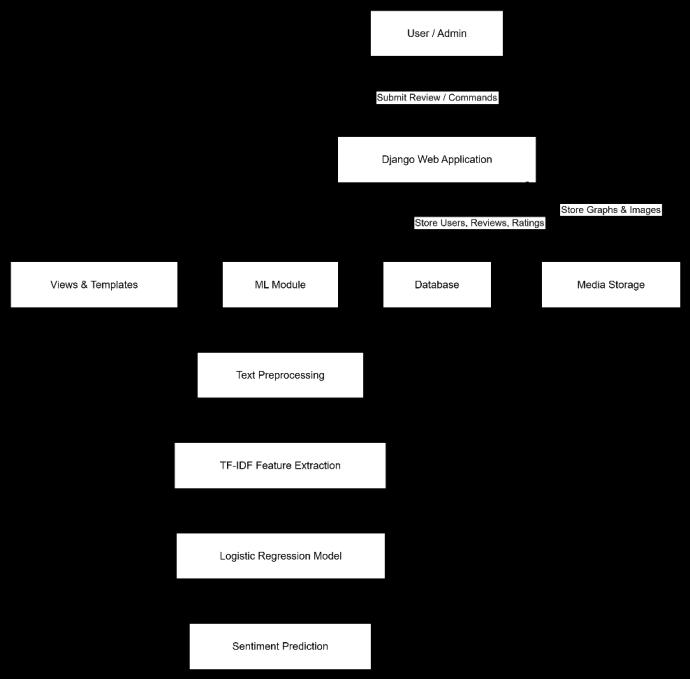
Thissectionexplainshowdataflowsthroughtheproposed system. User reviews and ratings are collected from the Zomatoplatformandstoredinthedatabase.Thetextualdata then undergoes preprocessing steps such as text cleaning, tokenization, stop-word removal, and lemmatization to removenoiseandimprovedataquality.Afterpreprocessing, relevantfeaturesareextractedusingtheTF-IDFtechnique, which converts textual reviews into numerical vectors suitableformachinelearningmodels.Thisstructureddata flowensuresaccurateandefficientsentimentclassification.
International Research Journal of Engineering and Technology (IRJET) e-ISSN: 2395-0056
Volume: 13 Issue: 02 | Feb 2026 www.irjet.net p-ISSN: 2395-0072
Thissectionfocusesonthesentimentanalysiscomponentof the proposed system. The extracted TF-IDF features are provided as input to machine learning classifiers such as Naive Bayes, Support Vector Machine (SVM), and Logistic Regression.Thesemodelsaretrainedtoidentifysentiment patternswithinthereviews.Basedonthelearnedpatterns, thesystemclassifieseachreviewintopositive,negative,or neutral categories and assigns an overall sentiment score. Thismodulehelpsinunderstandingcustomeropinionsand evaluatingrestaurantperformanceeffectively.
Thismethodologyfocusesondevelopingasecure,web-based system for performing sentiment analysis on Zomato restaurant reviews using machine learning and Natural LanguageProcessing(NLP).Thesystemintegratesfrontend interfaces,backendprocessing,databasemanagement,text preprocessing, machine learning models, and result visualizationtoprovideaccuratesentimentclassificationand meaningfulinsights.
The initial phase involves defining the project scope, objectives,and system requirements based on the need to analyzelargevolumesofcustomerreviewsefficiently.
➢ IdentifyUserRoles:Definerolessuchasusers(whoinput reviews and view sentiment results) and administrators (whomanageusers,datasets,andmodeltraining).
➢ FunctionalRequirements:Enablereviewinput,sentiment prediction (Positive, Negative, Neutral), data visualization, andadmincontrols.
➢ Non-Functional Requirements: Ensure system performance, security, scalability,and ease of use for nontechnicalusers.
➢ Tool Selection: Choose Python for NLP and machine learning, Django for web development, TF-IDF for feature extraction, and Logistic Regression for sentiment classification.
➢ Risk Assessment:Identifyriskssuchasnoisytextdata, classimbalance,andincorrectpredictions,andmitigatethem throughpreprocessingandmodelvalidationh.
The system architecture follows a modular and layered designtoseparateuserinterface, backend processing,and machinelearningcomponents.
➢ High-LevelDesign:UMLdiagramssuchasusecase,class, and sequence diagrams are designed to represent user interactions from review submission to sentiment output TKRCET|IT202513
➢ DatabaseDesign:SQLiteisusedtostoreusercredentials, reviewinputs,andsentimentresultssecurely.
➢ Backend Routing: Django views handle user authentication,reviewsubmission,sentimentprediction,and resultvisualization.
➢ Security Design: Implement authentication, session management,androle-basedaccesstoprotectuserdata.cy.
Thefrontendprovidesasimpleanduser-friendlyinterface forsentimentanalysis.
➢ FrameworkSetup:HTML,CSS,andDjangotemplatesare usedtobuildresponsivewebpages.
➢ UserInterfaces:PagesincludeRegistration,Login,Home Page,ReviewInputPage,andSentimentResultPage.
➢ Navigation: Smooth page transitions are implemented usingDjangoURLrouting.
➢ Visualization: Sentiment results are displayed clearly alongwithgraphssuchasbarchartsandpiecharts.
The backend processes reviews and performs sentiment classificationusingmachinelearning.
➢ Server Setup: Django handles HTTP requests, form submissions,andresponserendering.
➢ Text Preprocessing: Reviews are cleaned using NLP techniquessuchaslowercasing,punctuationremoval,stopwordelimination,andtokenization.
➢ FeatureExtraction:TF-IDFvectorizationconvertstextual reviews into numerical features suitable for machine learning.
➢ ModelTraining:ALogisticRegressionclassifieristrained onlabelledZomatoreviewdata.
Theperformanceoftheproposedmachinelearning–based sentimentanalysissystemwasevaluatedusingadatasetof Zomatorestaurantreviewscontainingpositive,negative,and neutral sentiments. After preprocessing and feature extractionusingtheTF-IDFtechnique,multiplesupervised
International Research Journal of Engineering and Technology (IRJET) e-ISSN: 2395-0056
Volume: 13 Issue: 02 | Feb 2026 www.irjet.net p-ISSN: 2395-0072
machine learning classifiers were trained and tested, includingNaiveBayes,SupportVectorMachine(SVM),and Logistic Regression. The dataset was divided into training and testing sets to ensure unbiased evaluation. The experimentalresultsindicatethatallmodelswerecapableof effectivelyclassifyingcustomerreviews;however,differences were observed in their performance. Naive Bayes demonstrated fast training time and reasonable accuracy, making it suitable for large-scale text data. SVM achieved higher accuracy by effectively handling high-dimensional feature spaces generated by TF-IDF vectors. Logistic Regression provided a balanced performance with good accuracy and stability across different sentiment class. Performance evaluation was carried out using standard metrics such as accuracy, precision, recall, and F1-score. Among the tested models, Logistic Regression and SVM achievedthehighestaccuracy,indicatingtheireffectiveness in capturing sentiment patterns in restaurant reviews. Precisionandrecallvaluesfurtherconfirmedthereliabilityof the models in correctly identifying positive and negative sentiments, while neutral sentiment classification showed comparatively moderate performance due to overlapping linguisticpatterns.Overall,theresultsdemonstratethatthe proposedsystemefficientlyanalysescustomeropinionsfrom Zomatoreviewsandprovidesmeaningfulsentimentinsights. Thecombinationofeffectivepre-processing,TF-IDFfeature extractionandsupervisedmachinelearningmodelsensures accuratesentimentprediction,makingthesystemsuitablefor real-worldrestaurantreviewanalysisanddecisionsupport.
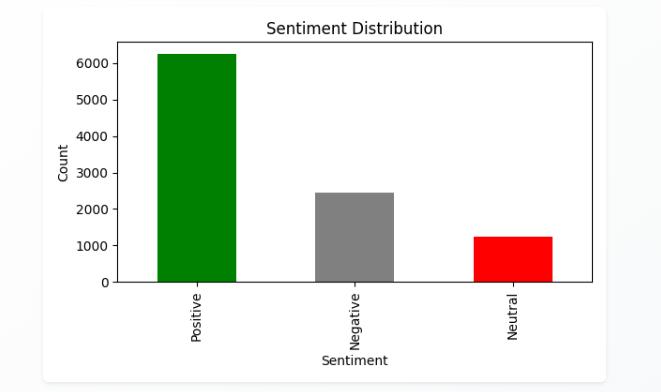
Theproposedsentimentanalysissystemwastestedona dataset of Zomato restaurant reviews categorized into positive,negative,andneutral classes.After preprocessing and feature extraction using the TF-IDF technique, the reviewswereclassifiedusingmachinelearningmodelssuch asNaiveBayes,SupportVectorMachine(SVM),andLogistic Regression. The system successfully identified sentiment polarity for the majority of reviews, with positive and negativesentimentsshowinghigherclassificationaccuracy compared to neutral reviews due to clearer linguistic patterns.
The performance of the system was evaluated using standardmetricsincludingaccuracy,precision,recall,andF1score.Accuracywasusedtomeasuretheoverallcorrectness oftheclassification,whileprecisionandrecallassessedthe model’s ability to correctly identify relevant sentiment classes. The F1-score provided a balanced evaluation of precisionandrecall.ExperimentalresultsindicatethatSVM andLogisticRegressionachievedbetterperformanceacross mostmetrics,demonstratingtheireffectivenessinhandling high-dimensionaltextdatageneratedbyTF-IDFfeatures.
A comparative analysis of the machine learning models revealsthatLogisticRegressionoffersabalancedtrade-off between accuracy and computational efficiency, making it suitable for practical deployment. SVM achieved slightly higheraccuracybutrequiredmorecomputationalresources. Naive Bayes, while comparatively less accurate, demonstratedfastertrainingtimeandsimplicity,makingit usefulforlarge-scaleorreal-timeapplications.Overall,the analysis confirms that the proposed system effectively capturessentimentpatternsinZomatoreviewsandprovides reliablesentimentpredictions.
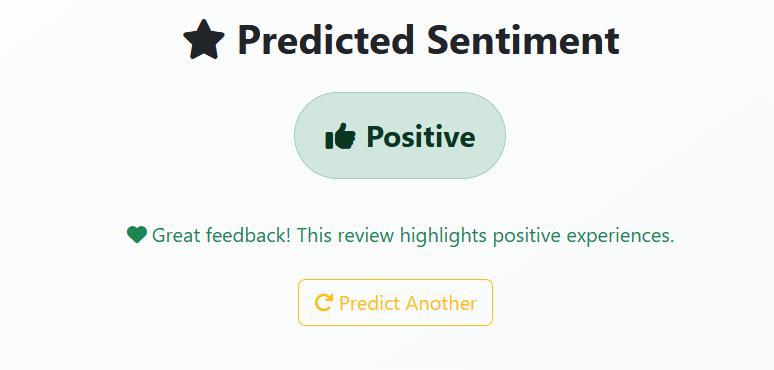
Thisprojectpresentedamachinelearning–basedapproach for sentiment analysis of Zomato restaurant reviews to understand customer opinions and evaluate restaurant performance.Thesystemeffectivelycollectedandprocessed user-generated reviews using natural language processing techniques such as textcleaning, tokenization, and feature extraction through TF-IDF.These processed features were then utilized by supervised machine learning models to classify reviews into positive, negative, and neutral sentiments.
Experimentalresultsdemonstratedthattheproposedsystem achieved reliable sentiment classification performance. Amongtheevaluatedmodels,SupportVectorMachineand Logistic Regression provided higher accuracy and better overall performance, while Naive Bayes offered faster
International Research Journal of Engineering and Technology (IRJET) e-ISSN: 2395-0056
Volume: 13 Issue: 02 | Feb 2026 www.irjet.net p-ISSN: 2395-0072
training with reasonable accuracy. The use of standard evaluationmetricssuchasaccuracy,precision,recall,andF1score confirmed the effectiveness and robustness of the system.
Overall,theproposedsentimentanalysisframeworkprovides anefficientandscalablesolutionforanalysinglargevolumes ofrestaurantreviews.Theinsightsgeneratedbythesystem can assist customers in making informed dining decisions andhelprestaurantownersimproveservicequalitybasedon customerfeedback.Theapproachcanbefurtherextendedby incorporatingadvanceddeeplearningmodelsandreal-time dataanalysistoenhancesentimentpredictionaccuracy.
In future, the proposed system can be enhanced by integratingdeeplearningmodelssuchasLongShort-Term Memory(LSTM),BidirectionalLSTM,orTransformer-based architecturestoimprovesentimentclassificationaccuracy. Real-time analysis of Zomato reviews and multilingual sentiment detection can also be incorporated to handle diverse user feedback. Additionally, combining sentiment analysiswithaspect-basedopinionminingcanprovidemore detailed insights into specific restaurant features such as foodquality,service,andpricing.
[1] B. Pang and L. Lee, “Opinion mining and sentiment analysis,” Foundations and Trends® in Information Retrieval, vol. 2, no. 1–2, pp. 1–135, 2008. DOI:10.1561/1500000011
[2] A. Go, R. Bhayani, and L. Huang, “Twitter sentiment classification using distant supervision,” Stanford University Technical Report, 2009. DOI:10.1109/ICWSM.2009.20
[3] M. Tripathi and K. M. Singh, “Sentiment analysis of online reviews using machine learning techniques,” InternationalJournalofComputerApplications,vol.162, no. 6, pp. 21–25, 2017. DOI:10.5120/ijca2017913378
[4] Y.Liu,X.Huang,A.An,andX.Yu,“ARSA:Asentimentaware model for predicting sales performance using blogs,” Proceedings of the 30th Annual International ACM SIGIR Conference, pp. 607–614, 2007. DOI:10.1145/1277741.1277846