
International Research Journal of Engineering and Technology (IRJET) e-ISSN: 2395-0056
Volume: 13 Issue: 03 | Mar 2026 www.irjet.net p-ISSN: 2395-0072
International Research Journal of Engineering and Technology (IRJET) e-ISSN: 2395-0056
Volume: 13 Issue: 03 | Mar 2026 www.irjet.net p-ISSN: 2395-0072
Sharath DH1 , Dr. Chethan K2
1P.G. Student, department of Civil Engg., Major: Prestressed Concrete, University of Visvesvaraya College of engineering, Karnataka, India, Email: sharath8927@gmail.com 2Associate professor, department of Civil Engg., University of Visvesvaraya College of engineering, Karnataka, India *** - -
Abstract This study evaluates the seismic performance of a 40-storey steel building using finite element analysis (FEA) in accordance with IS 1893:2016 provisions. The building was analysed under fixed-base and base-isolated conditions with Lead Rubber Bearings (LRB), considering Tube-in-Tube, Outrigger, Outrigger with Belt Truss, and a model with a central core. Modal, Equivalent Static, Response Spectrum, and Time History analyses were performed to determine fundamental time period, base shear, displacement, drift, and. Results show that base isolation increases the natural period and significantly reduces seismic forces compared to fixed- base models. The Outrigger with Belt Truss combined with LRB provides the best overall seismic performance, demonstrating improved stability and resilience for high-rise steel buildings in seismic regions.
Keywords: Lead Rubber Bearing (LRB), Outrigger system, Belt truss, Tube-in-tube structure, Response spectrum analysis, Time history analysis, Interior structures, Exterior structures
1. INTRODUCTION
A40-storeysteelbuildingisanefficientsolutionforrapidurbangrowthandlimitedlandavailability,enablingsafevertical development. As height increases, the structure becomes more sensitive to wind and earthquake forces, making lateral stabilityanddynamicbehaviorcriticalindesign.Steeliswidelyusedforhigh-risebuildingsduetoitsstrengthandductility; however,seismicsafetyremainsamajorconcerninearthquake-proneregions.BaseisolationsystemssuchasLeadRubber Bearings(LRBs),whichconsist of layered rubber, steel plates, and a central lead core, help reduce earthquake forces by increasingthenaturaltimeperiodanddissipatingenergy.Thissignificantlyimprovestheseismicperformanceandoverall resilienceoftallsteelbuildings.
1.1 Classification of structural system
Foursteel high-rise buildings with 20, 30, 40, and50storeys and a constant storey height of 3.0 m are modeled using structural analysis software. For each height, different structural systems such as tube-in-tube, outrigger, and outrigger with belt truss withcoreareusedto study their structuralbehavior.Thebuildingsaremodeledandanalysedaccordingto theprovisionsofIS1893(Part1):2016.Allthebuildingsareanalysedunderfixed-baseandbase-isolatedconditions.Inthe base-isolatedmodels,LeadRubberBearings(LRB)areprovidedatthefoundationlevelandmodeledusingnonlinearlink elements to represent their stiffness and damping behavior. This helps to understand how base isolation affects the seismic performance of the buildings. All models have a 30 m × 30 m base plan with 5 × 5bays and are analysed under identicalloadingandseismicconditions.
1.2
This study develops analytical models of 20-, 30-, 40-, and 50-storey steel buildings to understand how building height affects seismic performance. Modal Analysis, Response Spectrum Analysis, and Time History Analysis are carried out to studythedynamicbehaviorofthestructures.ALeadRubberBearing(LRB)baseisolationsystemisdesignedandaddedto themodelstoimproveearthquakeresistance.Theseismicresponseoffixed-baseandbase-isolatedbuildingsiscomparedto checktheeffectivenessofbaseisolation.TheperformanceofTube-in-Tube,Outrigger,andOutriggerwithBeltTrusssystems isalsoevaluatedunderbothconditions.Importantresultssuchasstoreydisplacement,storeydrift,baseshear,timeperiod, andaccelerationarecomparedtoidentifythebeststructuralsystemforseismicsafetyandoverallperformance.
Building Models and Geometry
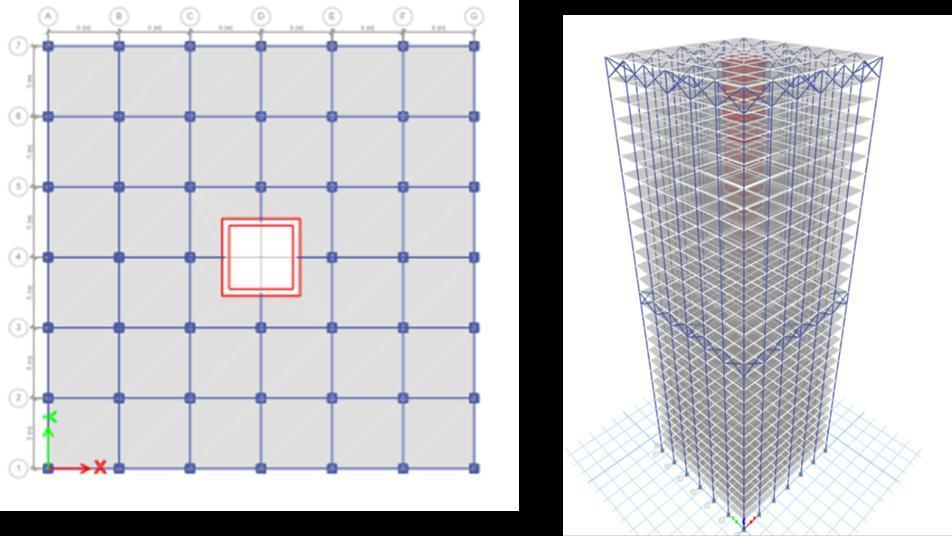
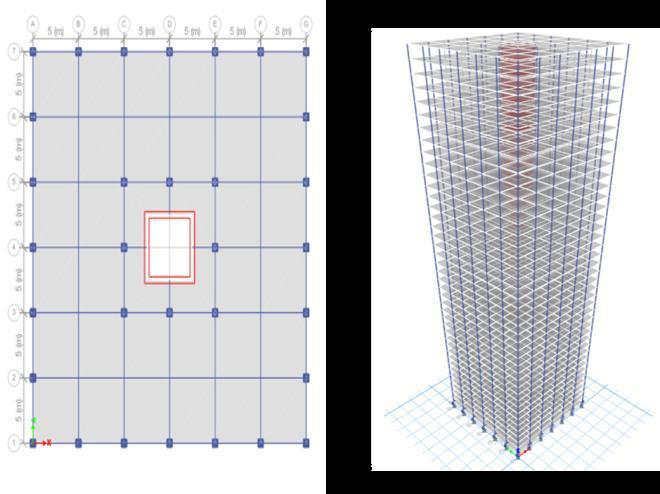
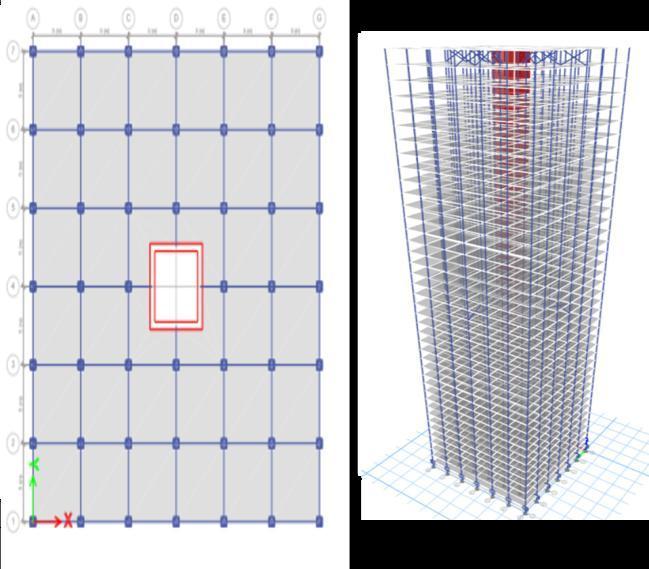
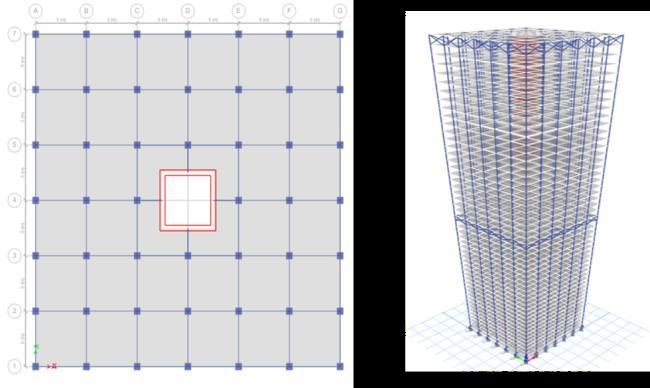
SixSteelbuildingmodelsweredevelopedforthe40-storey(G+40)structure,incorporating,systemswithcoreforbothfixed baseandLRBbasetoassessseismicperformance.
Volume: 13 Issue: 03 | Mar 2026 www.irjet.net
Building Dimensions:
•TotalHeight:120m(40storeys)
•StoreyHeight:3m
•PlanDimension:30m×30m(square)
•BayWidth:5m
Material Properties and Sections
ConcreteandSteelProperties:
•GradeofConcrete:M25
•CompressiveStrengthofConcrete:25N/mm²
•GradeofSteel:Fy345
•YeildStrength:345N/mm2
SectionDimensions(Commonforallsystems):
•Beam:ISWB600
•Column:600x600x50mm
•Slab:150mmthickness
•Core400mmthickness
SpecialElements:
•Steelplate:400×25mmasbuiltsection
•Outrigger(OT):300x300x20mm
•BeltTrussSystem(BTS):300x300x20mm
Loading Conditions
GravityLoads(asperIS875-1987PartI&II):
•SuperImposedDeadLoad:1.5kN/m²
•LiveLoad:3.0kN/m²
•MassSource:100%deadload+25%liveload
International Research Journal of Engineering and Technology (IRJET) e-ISSN: 2395-0056
Volume: 13 Issue: 03 | Mar 2026 www.irjet.net p-ISSN: 2395-0072
SeismicLoadParameters(asperIS1893-2016):
•SeismicZone:ZoneV
•ZoneFactor(Z):0.36
•SoilType:mediumSoil
•ImportanceFactor(I):1
•ResponseReductionFactor(R):5
•DampingRatio:5%
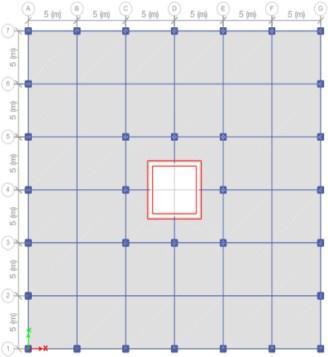
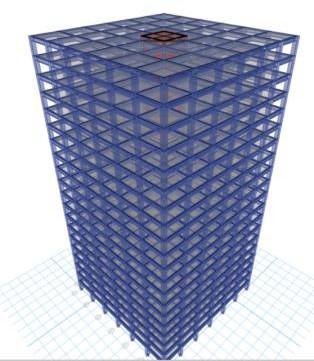
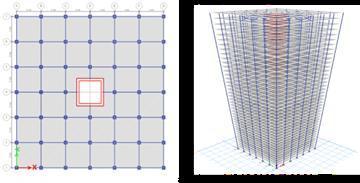
MODELS USED FOR FE ANALYSIS
2026, IRJET | Impact Factor value: 8.315 | ISO 9001:2008
International Research Journal of Engineering and Technology (IRJET) e-ISSN: 2395-0056
Volume: 13 Issue: 03 | Mar 2026 www.irjet.net p-ISSN: 2395-0072
International Research Journal of
Volume: 13 Issue: 03 | Mar 2026 www.irjet.net
RESULTS AND DISCUSSION
3.1 Modal Analysis
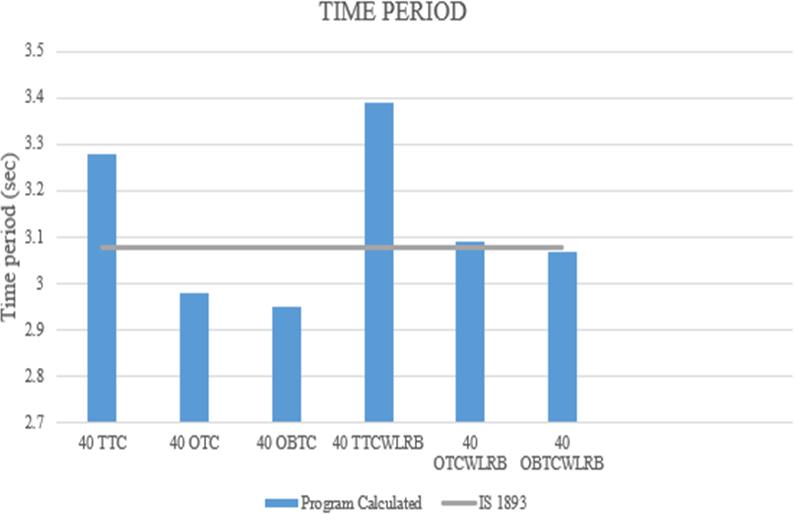
Table-2: MODE 1 TIME PERIOD OF ALL STRUCTURES
3.2 Base Shear from Time History Analysis
-1:Modaltimeperiodofallstructure
Table-3: Corrected Dynamic Base shear for all models (106) IN kN
International Research Journal of Engineering and Technology (IRJET) e-ISSN: 2395-0056
Volume: 13 Issue: 03 | Mar 2026 www.irjet.net p-ISSN: 2395-0072
3.3 Storey Displacement
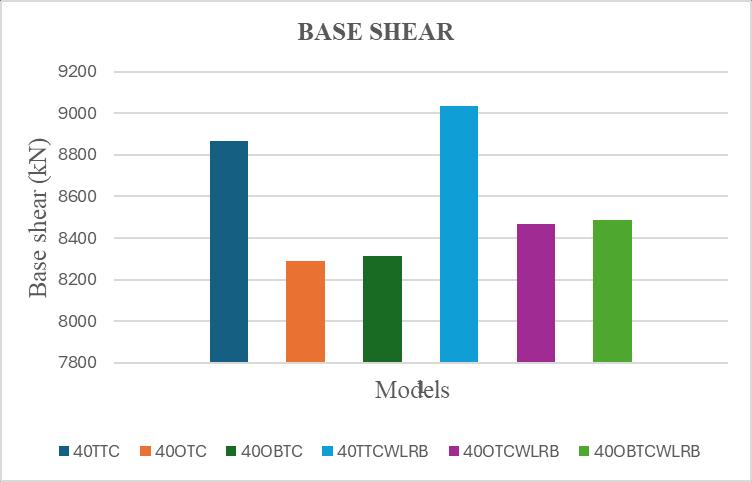
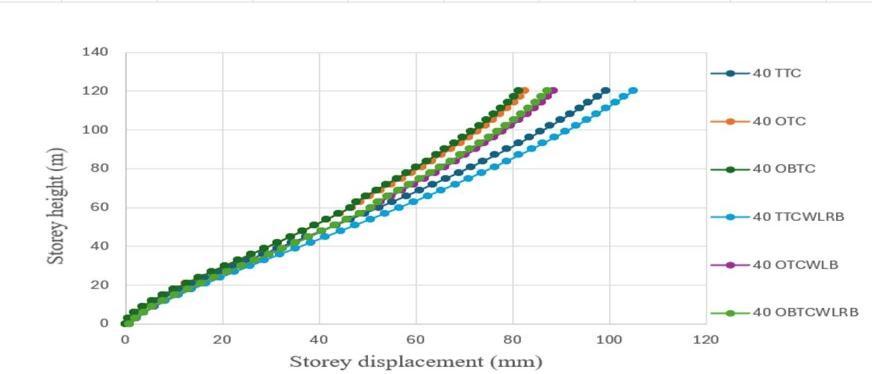
Table-4: MAX STOREY DISPLACEMENT IN (mm)
International Research Journal of Engineering and Technology (IRJET) e-ISSN: 2395-0056
Volume: 13 Issue: 03 | Mar 2026 www.irjet.net p-ISSN: 2395-0072
Volume: 13 Issue: 03 | Mar 2026 www.irjet.net p-ISSN: 2395-0072
Modal Analysis
The tube-in-tube models show slightly higher time periods, with the base-isolated configuration exhibiting the maximum increase of about 10%, indicating greater flexibility. In contrast,theoutriggerandoutriggerwithbelttrusssystems show small reductions of about 3–4%, reflecting improved structural stiffness. Among all models, the base-isolated outrigger systemsperformbetter,astheirtimeperiodsvarybyaround1%fromtheIScodevalue,showingverycloseresultstotheIS codevalueandstablestructuralperformance.
Base Shear Response
Introducing Lead Rubber Bearings (LRB). The 40TTCWLRB model shows an increase of about 1.9% compared to 40TTC. Similarly, 40OTCWLRB increases by about 2.2% compared to 40OTC, and 40OBTCWLRB increases by about 2.1% compared to 40OBTC.Among all models, 40TTCWLRB shows the maximum base shear, while 40OTC shows the minimum value.Ingeneral,theincreaseafterusingLRBissmall(around2%),showingstableseismicperformance.
Lateral Displacement
Thevariationinmaximumstoreydisplacementshowstheinfluenceofdifferentstructuralsystems andtheeffectofLead Rubber Bearings (LRB). The 40OTC and 40OBTC models reduce displacement by about 16.8% and 18.2%, respectively, compared to the 40TTC model, indicating improved stiffness due to the outrigger systems. After implementing LRB, the 40TTCWLRB, 40OTCWLRB, and 40OBTCWLRB models show displacement increases of about 5.8%, 7.0%, and 7.3%, respectively, compared to their corresponding fixed-basemodels,duetoincreasedflexibilityfrom base isolation.Among all configurations, the 40OBTC model shows the least displacement, indicating greater stiffness and better control of lateral movement.
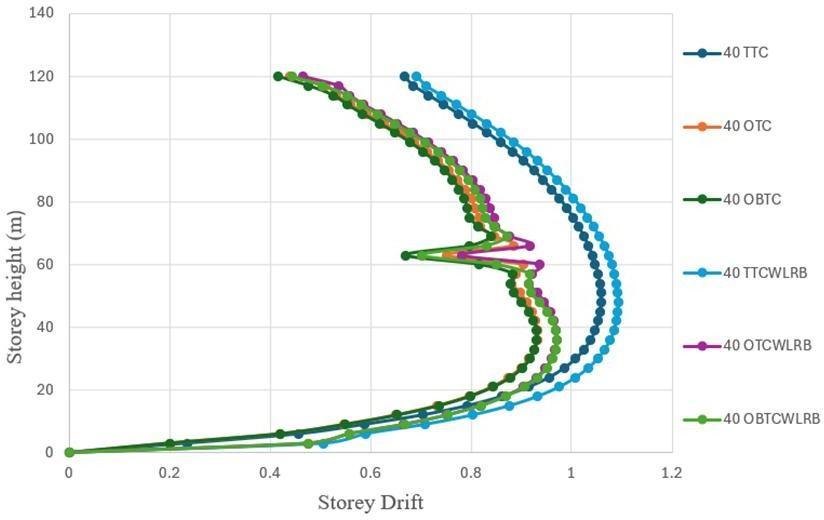
The storey drift results for the G+40 building models show that the outrigger and belt truss systems reduce the drift comparedtotheconventionaltubesystem.The40OTCand40OBTCmodelsreducedriftbyabout12%and13%compared to the 40TTC model, showing better lateral stiffness and improved control of deformation. Among the base-isolated models, the 40OTCWLRB and 40OBTCWLRB models reduce drift by about 11% and 12% compared to the 40TTCWLRB model, indicating improved performance with base isolation. he 40OBTC model shows the lowest drift among the fixedbasesystems,indicatingbettercontroloflateraldeformation.
System Ranking & Performance
AddingLeadRubberBearings(LRB),thetimeperiodincreasesbyabout2%anddisplacementincreasesbyabout6–7%due to increased flexibility, which helps absorb earthquake energy. The increase in base shear is very small around 2%, showing stable seismic performance.The outrigger and belt truss systems improve the seismic performanceoftheG+40 building by increasing stiffness and reducing movement. The 40OTC and 40OBTC models reduce displacement by about 16.8% and 18.2% and reduce storey drift by about 12–13% compared to the 40TTC model, showing better control of lateral movement. The 40OBTC modelperformsthe best,asitshowsminimumdisplacementandstorey drift,givingbetter stabilityduringearthquakes.
[1] A. B. M. Saiful Islam, Mohammed Jameel and Mohd ZaminJummat(2011),"Study onOptimalIsolation Systemand Dynamic Structural Responses in multi- storey buildings", International Journal of the Physical Sciences, Vol. 6(9), pp.2219-2228.
[2] AkshayKhanorkar(2016),“OutriggerandBeltTrussSystemforTallBuildingtoControlDeflection”,GlobalResearch andDevelopmentJournalforEngineeringVolume1.
[3] A.Shruthi and S.Mallikarjun (2022), “A Study on Dynamic Response of High-Rise Buildings using Lead Rubber BearingIsolator”,CVRJournalofScienceandTechnology,Volume23.
[4] Avinash and Lingeshwaran (2024), “Review on base and inter storey seismic isolation systems for high rise buildings”,Researchonengineeringstructuresandmaterials.
[5] Dedeoglu and Yusuf Calayir (2020),” Effectiveness of Outrigger and belt truss systems on the seismic behavior of high-risebuildings”,JournalofStructuralEngineeringandAppliedMechanics,Vol.3,Issue3,180-203.
International Research Journal of Engineering and Technology (IRJET) e-ISSN: 2395-0056
Volume: 13 Issue: 03 | Mar 2026 www.irjet.net p-ISSN: 2395-0072
[6] Gerasimidis,S,Efthymiou,E.,&Baniotopoulos,C.C.(2009),“Optimumoutriggerlocationsofhigh-risesteelbuildings forwindloading”,TheStructuralDesignofTallandSpecialBuildings(Wiley).
[7] Jason A. Cook (2006), “Structural Steel FramingOptionsforMid-andHighRiseBuildings”.
[8] Kamath, K., Shetty, N. Divya, Asha U Rao (2012), “A study on static and dynamic behaviour of outrigger structural system for tall buildings”, Bonfring InternationalJournalofIndustrialEngineeringand Management Science, Vol. 2, No.4
[9] M.R.Jahanshahi,R.Rahgozar,M.Malekinejad,“ASimpleApproachtoStaticAnalysisofTallBuildingswithaCombined Tube-in tube and Outrigger-belt Truss System Subjected to Lateral Loading”, International Journal of Engineering,Vol.25,No.3
[10]Mohammed Babaei, Yaghoub Mohammadi and Amin Ghannadiasl (2021),” Calculation of Vibration Period of Tall Pyramidal Buildings Structures with Tube Systems, Tube in Tube, Bundled Tube and Hybrid Tube Systems with ShearWall,IranianJournalofScienceandTechnology,TransactionsofCivilEngineering
[11]MohammedSarcheshmehpour,HomayoonE.EsteKanchiandHashemMoosavian,“Optimumseismicdesignofsteel framedtubeandtubeintubetallbuildings”.StructuralDesignofTallandSpecialBuildings,e1782
[12]RajKiranNanduriandB Suresh (2020),”Optimum position of outrigger system for High Rise Reinforced Concrete Buildingsunderwindandearthquakeloadings”,AmericanJournalofEngineeringResearch,Vol-02,Issue-08.76-89, e-ISSN:2320-0847.
[13]Fawzia,SandFatima,T.(2010),“Deflectioncontrolincompositebuildingbyusingbelttrussandoutriggerssystems”, theStructuralDesignofTallandSpecialBuildings(Wiley)
[14]Sahil and Eknath laste (2019), “Seismic performance evaluation of multi-storey building with and without base isolation”,InternationalResearchJournalofEngineeringandTechnology.
[15]ShirulePA(2012),“Timehistoryanalysisofbaseisolatedmultistoreybuilding”.