
International Research Journal of Engineering and Technology (IRJET) e-ISSN: 2395-0056
Volume: 13 Issue: 04 | Apr 2026 www.irjet.net p-ISSN: 2395-0072
International Research Journal of Engineering and Technology (IRJET) e-ISSN: 2395-0056
Volume: 13 Issue: 04 | Apr 2026 www.irjet.net p-ISSN: 2395-0072
Ashwini Madke1 , Dr. Sarika Modak2
1 PG Student, Priydarshini College of Engineering, Nagpur, India.
2Assistant Professor, Priydarshini College of Engineering, Nagpur, India.
Abstract - The implementation of Lead Rubber Bearing (LRB) base isolation systems significantly optimizes the seismic performance of multistory reinforced concrete moment-resisting frames, particularly for G+10 structures whereplanirregularities suchasL-shapedconfigurations induce complex torsional effects and non-uniform stiffness distribution. While fixed-base irregular structures exhibit amplified inter-story drift demands and localized force concentrations under seismic excitation, the integration of LRB isolators serves as an advanced passive control strategy that extends the fundamental natural period and enhances energydissipation.ResponseSpectrumAnalysisdemonstrates that base isolation effectively decouples the superstructure from ground-induced inertiaforces,resulting inasubstantial reduction in base shear and lateral displacement profiles comparedtoconventionalfixed-basesystems.Ultimately,this seismic isolation technique mitigates the adverse dynamic response associated with structural asymmetry, ensuring superior structural integrity and serviceability in high-risk seismic zones.
Key Words: Lead Rubber Bearing (LRB), Structural Plan Irregularity, Seismic Base Isolation, Response Spectrum Analysis,Inter-storeyDriftRatio,TorsionalEffectMitigation
Base isolation represents a paradigm shift in performance-basedseismicengineering,evolvingfromearly patentedconceptsintoaprimarystrategyforensuringthe operational continuity of critical infrastructure. While conventional seismic design relies on the ductility of structuralmemberstopreventcollapse oftenresultingin significant residual damage base isolation prioritizes the protection of both structural integrity and sensitive nonstructural components, such as medical equipment and electricalsystems.ByintegratingflexibleinterfaceslikeLead RubberBearings(LRB)orFrictionPendulumSystemsatthe foundation,thesuperstructureiseffectivelydecoupledfrom horizontalgroundmotion.
Thisdecouplingshiftsthebuilding'sfundamentalnatural period away from the high-energy range of earthquake ground motions, leading to a marked reduction in transmittedflooraccelerations,baseshear,andinter-storey drift.Unlikeinternaldampingsystemsthatmanageenergy within the building frame, base isolation mitigates seismic
demandatthesource.Thisensuresthatregularandirregular reinforced concrete structures remain not only stable but fully functional, preserving safety and serviceability in the immediateaftermathofmajorseismicevents.
Base isolation is a sophisticated structural control strategy that introduces a flexible or sliding interface between a building's superstructure and its foundation to decoupleitfromhorizontalgroundmotion.Byextendingthe fundamentalnaturalperiod,thissystemsignificantlylimits the transmission of earthquake-induced inertia forces, protecting both the structural frame and sensitive nonstructuralcomponents.
To be effective, isolation devices must maintain high vertical load-bearing capacity and service-level lateral stiffness(forwindandminortremors)whileexhibitinghigh lateralflexibilityandenergydissipationduringmajorseismic events. Furthermore, an ideal system incorporates selfcentringcapabilitiestominimizeresidualdisplacementpostearthquake.Thisapproachisparticularlycriticalforfacilities requiringimmediateoccupancy suchashospitalsanddata centers asitprioritizesoperationalcontinuityandreduces long-termlife-cyclecostsbyminimizingstructuraldamage andrepairrequirements.
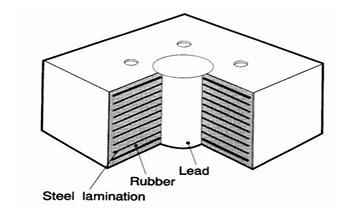
Lead Rubber Bearings (LRBs) have become a predominantsolutioninseismic-resistantdesignduetotheir integrated mechanical efficiency. Structurally, an LRB consistsofalternatinglayersofvulcanizedrubberandsteel reinforcement shims, which provide high vertical axial stiffness to support gravity loads while preventing lateral bulging.
Thedefiningcomponentisthecentrallylocatedleadplug, whichundergoesplasticsheardeformationduringseismic events. This creates a stable bilinear hysteretic response, providingthenecessaryenergydissipationanddampingto control the building's lateral excursions. Because lead recrystallizes at room temperature, it exhibits excellent fatigue resistance and microstructural recovery, ensuring consistentperformanceovermultiplecycles.Bycombining verticalloadsupport,service-levelwindresistance,andhigh seismicflexibilitywithinasinglecompactunit,LRBsoffera technicallyrobustandcost-effectivemethodfordecoupling structuresfromdamaginggroundmotions.
International Research Journal of Engineering and Technology (IRJET) e-ISSN: 2395-0056
Volume: 13 Issue: 04 | Apr 2026 www.irjet.net p-ISSN: 2395-0072
2.1 Aim:
The primary aim of this research is to investigate and compare the seismic performance of regular and irregular multistoreyreinforcedconcretebuildingsunderfixed-base andLeadRubberBearingbase-isolatedconditions,inorder to evaluate the effectiveness of base isolation in reducing earthquake-induced forces, controlling structural deformations, and improving overall safety and functional performanceofbuildingssubjectedtoseismicexcitation.
2.2 Objective:
1. To evaluate the seismic performance of multistorey reinforcedconcretebuildingswithregularandirregular planconfigurations.
2. To investigate the influence of plan irregularity on dynamicresponseparameterssuchasfundamentaltime period, base shear, storey displacement, inter-storey drift,andflooracceleration.
3. Toanalyseandcomparetheseismicbehaviouroffixedbasestructureswithbase-isolatedstructuresusingLead RubberBearing(LRB)isolators.
4. TostudytheeffectivenessofLeadRubberBearingbase isolationsysteminreducingseismicforcetransmission andenhancingoverallstructuralresponse.
5. To determine the improvement in global seismic performanceandstructuralsafetyachievedthroughthe adoptionofbaseisolationtechnique.
3. METHODOLOGY
Forthisresearchwork,ETABSsoftwarewasused.ETABSisa structuralengineeringsoftwareusedformodelling,analysis, anddesignofmultistorybuildingsundergravityandlateral loads such as wind and earthquake. It provides advanced analysis features including response spectrum and time historyanalysis,makingitsuitableforevaluatingtheseismic behaviorandperformanceofregularandirregularbuilding systems.
Building shape Ordinary (Regular) & L-Shaped (Irregular )
BuildingHeight 33m
OverallStory’s G+10
FloorHeight 3m
LineloadConsidered 6.9kN/m,9.0kN/m,3.0kN/m
ArealoadConsidered LL=3.0kN/m2
SDL=1.5kN/m2
BeasSizeassumed 300x500
ColumnSizeassumed 450x50
Slabthickness 125
International Research Journal of Engineering and Technology (IRJET) e-ISSN: 2395-0056
Volume: 13 Issue: 04 | Apr 2026 www.irjet.net p-ISSN: 2395-0072
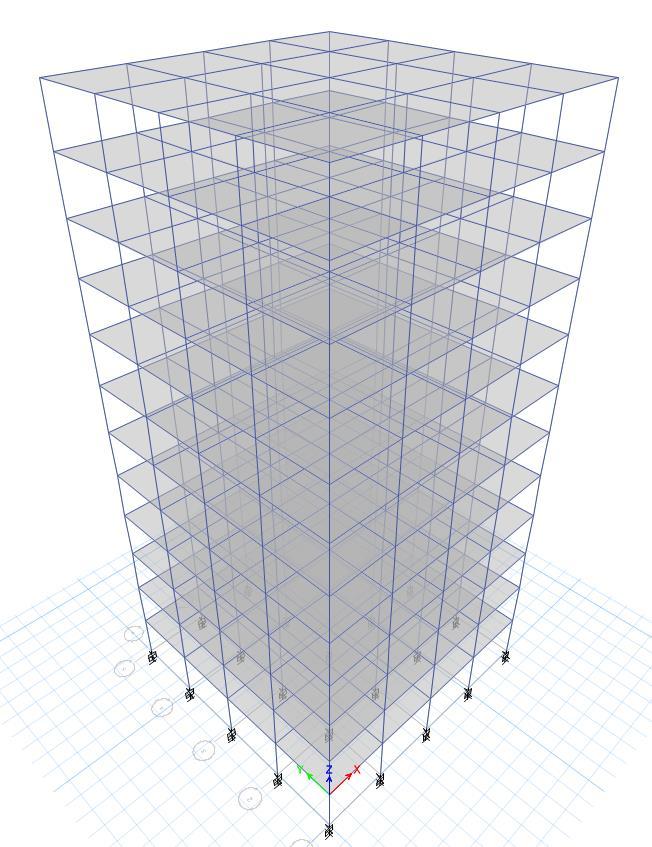
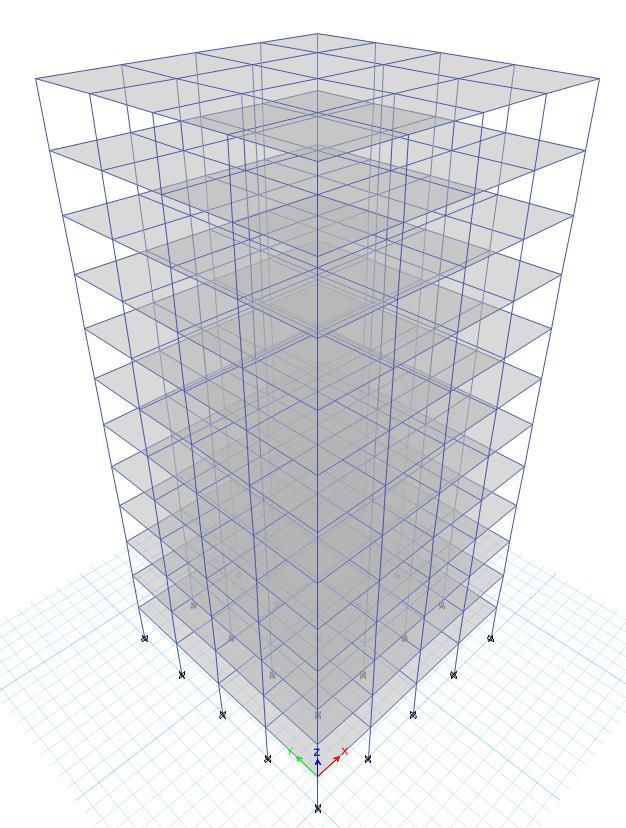
Fig -4:RegularBuildingwithLRB
Table -2: Seismicdataconsideration
Seismiczone III
ZoneFactor 0.16
ImportanceFactor,I 1.2
LineloadConsidered 6.9kN/m,9.0kN/m,3.0kN/m
Soiltype II
ResponseReduction factor,R 5
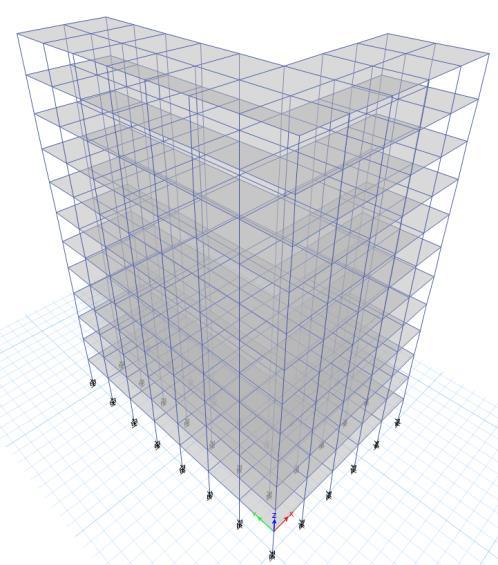
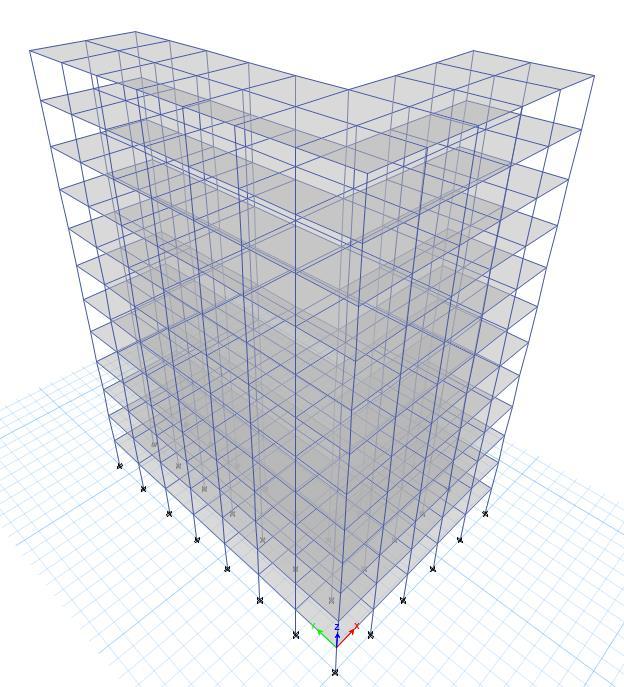
Fig -5:IrregularBuildingwithLRB
Table -3: LRB(LeadRubberBase)Dataconsideration
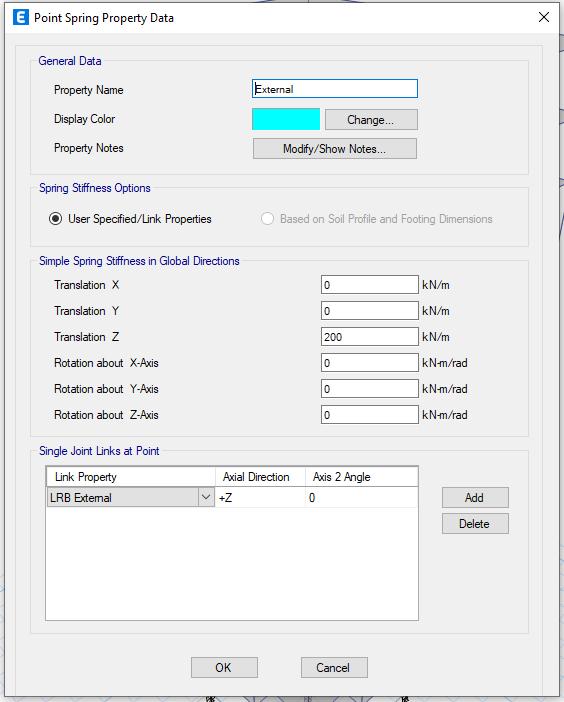
Fig -5:ExternalLRBused
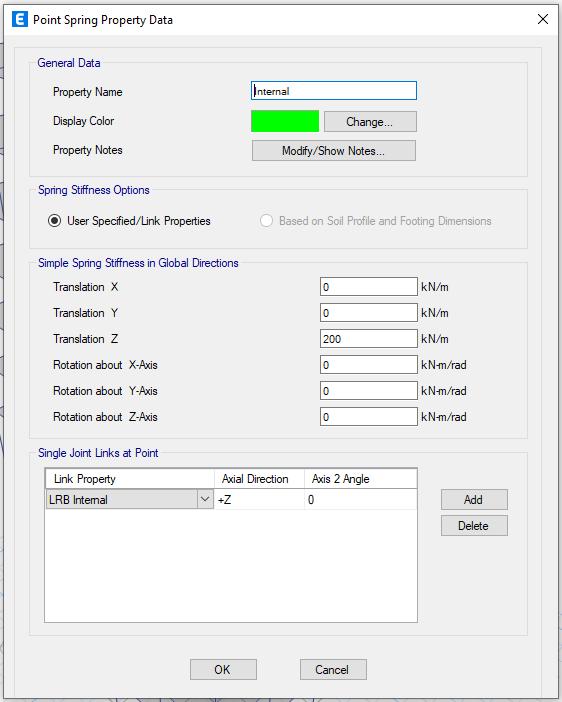
Fig -6:InternalLRBused
International Research Journal of Engineering and Technology (IRJET) e-ISSN: 2395-0056
Volume: 13 Issue: 04 | Apr 2026 www.irjet.net p-ISSN: 2395-0072
4.1 Modal Participation
Table -4: ModalParticipatingMassRatio(RegularBuilding)
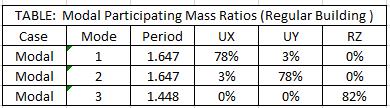
Table -5: ModalParticipatingMassRatio(RegularLRB)
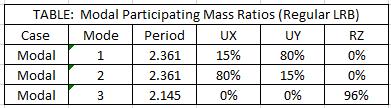
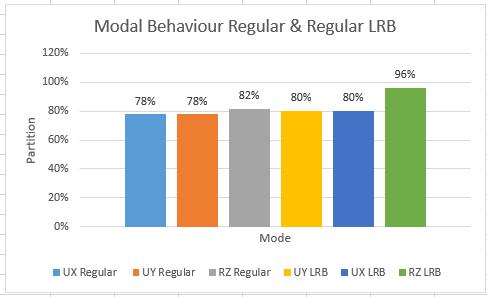
Chart -1:ModalBehaviorregularvsregularLRB
Table -6: ModalParticipatingMassRatio(IrregularBuilding)
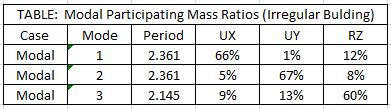
Table -7: ModalParticipatingMassRatio(IrregularLRB)
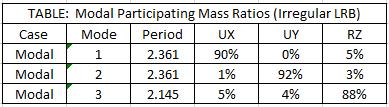
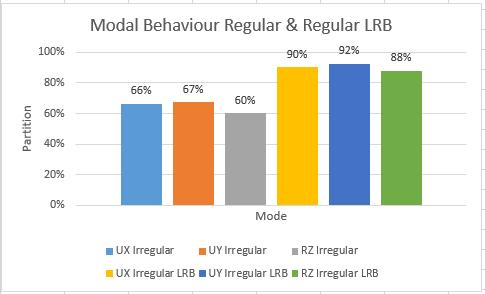
Chart -2:ModalBehaviorirregularvsirregularLRB
4.2 Story Drift
Table -8: StoryDriftregularvsregularLRBbuilding
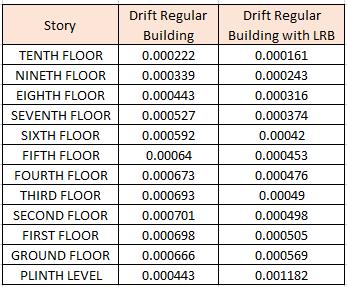
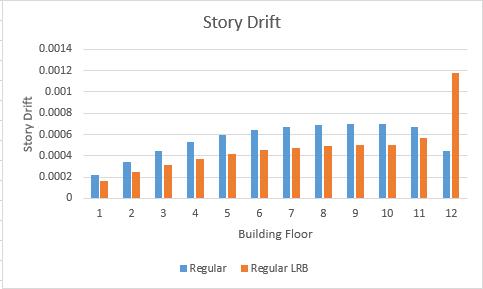
Chart -3:StoryDriftregularvsregularLRB
International Research Journal of Engineering and Technology (IRJET) e-ISSN: 2395-0056
Table -9: StoryDriftirregularvsirregularLRBbuilding
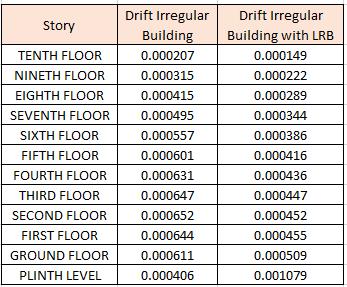
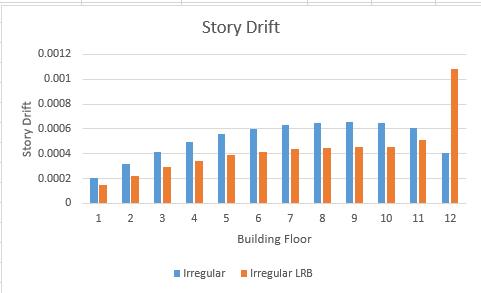
Chart -4:StoryDriftirregularvsirregularLRB
4.3 Story Displacement
Table -10: StorydisplacementregularvsregularLRB building
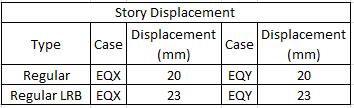
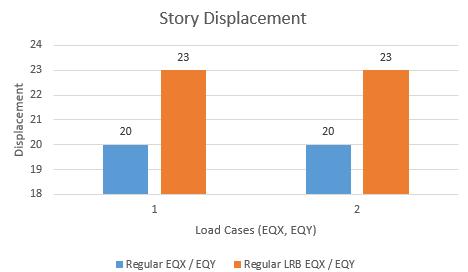
Chart -5:StorydisplacementregularvsregularLRB
Table -11: StorydisplacementirregularvsirregularLRB building
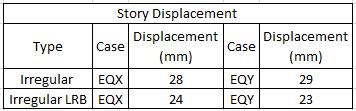
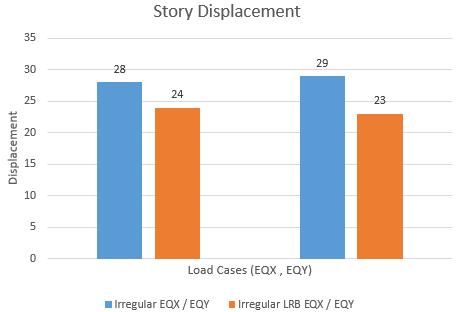
Chart -6:StorydisplacementirregularvsirregularLRB
3. CONCLUSIONS
1.The integrationofLeadRubberBearing(LRB)isolators significantly optimizes the seismic performance of G+10 reinforced concrete frames by mitigating the complex torsional effects and non-uniform stiffness distribution associatedwithplanirregularities.
2. Base isolation effectively decouples the superstructure fromground-inducedinertiaforces,resultinginamarked extension of the fundamental natural period and a substantial reduction in base shear and lateral displacement.
Volume: 13 Issue: 04 | Apr 2026 www.irjet.net p-ISSN: 2395-0072 © 2026, IRJET | Impact Factor value: 8.315 | ISO 9001:2008 Certified
International Research Journal of Engineering and Technology (IRJET) e-ISSN: 2395-0056
Volume: 13 Issue: 04 | Apr 2026 www.irjet.net p-ISSN: 2395-0072
3. The bilinear hysteretic response provided by the LRB’s leadcoreenablesstableenergydissipationanddamping, which limits the transfer of seismic forces and protects bothstructuralandsensitivenon-structuralcomponents.
4.ComparativeanalysisusingResponseSpectrumAnalysisin ETABSconfirmsthatisolatedirregularstructuresexhibit significantly lower inter-storey drift demands and floor accelerationsthantheirfixed-basecounterparts.
5.The system's self-centring capability and the microstructuralrecoveryoftheleadplugensureconsistent mechanical performance and minimal residual displacementacrossmultipleseismiccycles.
6.Byreducingseismicdemandatthesource,baseisolation ensuresthatregularandirregularbuildingsremainfully functional,prioritizingoperationalcontinuityandreducing long-termrepaircosts.
[1] NafisaAnjum,“SeismicPerformanceEvaluationofa10storyRCBuildingUsingPushoverAnalysis&Response SpectrumAnalysis”,January2026.
[2] Md. Saniul Haque Mahi, “Seismic Performance AssessmentofRegularandIrregularRCBuildingsUnder BNBC2020UsingETABS”,July2025.
[3] Vinod vawadra,“ Pushover analysis of G+20 RCC StructurewithHorizontalIrregularity”,June2024.
[4] Walid A. Al-Kutti, “Potential Design of Seismic Vulnerable Buildings Incorporating Lead Rubber Bearing”,February2019.