
International Research Journal of Engineering and Technology (IRJET) e-ISSN: 2395-0056
Volume: 12 Issue: 05 | May 2025 www.irjet.net p-ISSN: 2395-0072
International Research Journal of Engineering and Technology (IRJET) e-ISSN: 2395-0056
Volume: 12 Issue: 05 | May 2025 www.irjet.net p-ISSN: 2395-0072
Aman Shah1 , Aakash Suthar2
AmanShah 1,M.TechStudent,DepartmentofStructuralEngineering,L.J.University,Ahmedabad,India, AakashSuthar 2,AssistanceProfessor,Structuralengineeringdepartment,L.JUniversity,Ahmedabad,India.
ABSTRACT- A comprehensive literature review has been conducted to examine the seismic behavior of structures situated on sloping ground. The review encompasses various building configurations, analytical methodologies, and soil-structure interactions. The studies analyzed include reinforced concrete and steel structures of varying heights, incorporating different bracing systems and slope angles. The findings indicate that step-back setback configurations generally exhibit superior seismic resistance compared to step-back buildings. Additionally, the incorporation of shear walls significantly enhances structural performance. The research underscores the critical importance of considering soil-structure interaction (SSI) and topographiceffectsinseismicanalysis,asthesefactors can substantially alter building responses. Factors such as slope angle, building height, and soil conditions have been identified as significant influencers of seismic parameters, including base shear,displacement,andfundamentaltimeperiodetc. Thereviewalsohighlightsthevulnerabilityofshorter columns on steeper slopes and evaluates the effectiveness of various bracing systems in improving seismic performance. These insights contribute to the advancement of more resilient and economically viable structural designs for buildings situated on slopingterraininseismicallyactiveregions.
Keywords: – Sloping ground, Seismic analysis, Soil Structure Interaction (SSI), Topographic effects, Response spectrum analysis, Time History method, Pushover analysis, Equivalent static method, Slope anglevariations.
Theseismicbehaviorofstructuresbuiltonslopingterrain is a critical concern in earthquake-prone regions. Unlike buildings on flat ground, structures on inclined surfaces experience complex dynamic interactions due to variations in slope angle, soil composition, and structural configurations. These factors significantly influence seismic parameterssuchasbaseshear,displacement,and
fundamental time periods, affecting overall structural stability.
Extensive research has been conducted to analyze the impactofdifferentbuildingconfigurations,includingstepback,step-backsetback,andsetbackstructures,onseismic performance. Studies indicate that step-back setback buildings generally exhibit superior resistance to seismic forces compared to conventional step-back structures. Additionally, the presence of shear walls and bracing systems has been found to enhance lateral stability, reducingdisplacementandtorsionaleffects.
Anothercrucialfactorinfluencingseismicresponseissoilstructure interaction (SSI), which alters load distribution andenergydissipationduringanearthquake.Variationsin soil properties can amplify seismic forces, making it essentialtoaccountfortopographiceffectsandfoundation stability in structural design. Shorter columns on steeper slopes are particularly vulnerable, highlighting the need for optimized engineering solutions tailored to sloping terrains.
This study aims to evaluate the influence of slope angles, soil conditions, and structural configurations on the seismic response of buildings. By integrating advanced analytical techniques such as response spectrum analysis, timehistorymethods,andpushoveranalysis,thisresearch seeks to enhance the understanding of seismic performance and contribute to the development of safer, more resilient structures in hilly and mountainous regions.
I. Birajdar,B.G.,and S.S.Nalawade.“Seismic analysis of buildings resting on sloping ground.” 13th world conference on earthquake engineering. No. 1472. 2004.
This research paper investigates the seismic performance of three distinct building configurations Step-back, Stepback Setback, and Setback constructed on both sloping andplainground.Aresponsespectrumanalysis,conducted in accordance with IS 1893 (Part 1): 2002 guidelines, evaluates key seismic parameters including base shear, fundamentaltimeperiod,andtop-storeydisplacement.The
International Research Journal of Engineering and Technology (IRJET) e-ISSN: 2395-0056
Volume: 12 Issue: 05 | May 2025 www.irjet.net p-ISSN: 2395-0072
analysisconsidersbuildingsranginginheightfrom4to11 storeys (15.75 m to 40.25 m) situated on sloping ground with a 27° incline, as well as comparable structures on levelterrain.
The results indicate that Step-back buildings are the most vulnerable under seismic loading, primarily due to significant torsional effects and uneven shear distribution. In contrast, Step-back Setback configurations demonstrate improved seismic behavior by minimizing torsional moments, making them a more dependable design option for sloped sites. Setback buildings on plain ground exhibit structural stability and are less influenced by seismic forces; however, implementing such designs on sloped terrainoftenrequiressubstantiallevelingwork,whichmay increaseconstructioncosts.
Overall, for seismic design in hilly regions, Step-back Setback configurations offer an effective balance between structuralperformanceandpracticalfeasibility.
II. Deep, V. Mani, and P. Polu Raju. “Pushover analysis of RC building: comparative study on seismic zones of India.” Int. J. Civil Eng. Technol 8.4 (2017): 567-578.
This study presents a comparative pushover analysis of reinforced concrete (RC) buildings with different structural configurations to evaluate their seismic performance. Using ETABS software, three models were developed:abareframe,aframewithmasonryinfill,anda frame with shear walls. Nonlinear static analysis was conducted in accordance with IS 1893:2002 to assess seismic response under gravity and lateral loads. The analysis focused on key parameters such as base shear capacityandroofdisplacement.
The conclusion showed that the model with shear walls exhibitedthehighestbaseshearandlowestdisplacement, indicating superior seismic performance and structural stability. The model with masonry infill provided improved strength over the bare frame but introduced irregularities in force distribution, which could affect reliability during seismic events. In contrast, the bare framemodeldemonstratedthepoorestperformance,with the highest displacements and lowest lateral load resistance. Overall, the inclusion of shear walls significantly enhances the structural resilience of RC buildingsinseismiczones,makingthemthemosteffective option among the configurations studied. Masonry infill offers moderate benefits but may complicate structural behavior under dynamic loading. These findings underscoretheimportanceofselectingappropriatelateral load-resisting systems, particularly for buildings in earthquake-proneareas.
III. Sanjay, Phatale Swarup, and S. R. Parekar. “Seismic analysis of Step-back building resting on sloping ground considering different types of Bracing system.” International Journal for Modern Trends in Science and Technology 5.07 (2019).
This study analyzes the seismic performance of step-back buildings constructed on sloping ground using various bracingsystems,includingX,V,InvertedV,Diagonal,anda BareFrameconfiguration.Responsespectrumanalysiswas performed using ETABS software to assess key seismic parameterssuchasstoreydisplacement,inter-storeydrift, baseshear,andfundamental time period. All models were designed with identical geometry and material properties andplacedona26-degreeinclinedslopeinSeismicZoneV.
The results revealed that the bare frame exhibited the highest top-storey displacement (33.86 mm), while the Inverted V and X bracing systems significantly reduced displacementto16.26mmand16.58mm,respectively,due to their enhanced lateral stiffness. Inter-storey drift was highest at the sixth storey in the bare frame model and lowest in structures with Inverted V and X bracing, which effectively distributed seismic forces and minimized deformation.
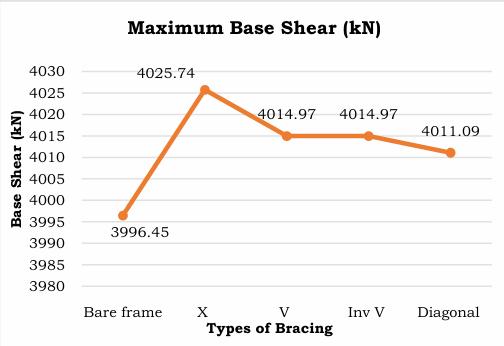
Figure 1: MaximumbaseshearvsTypesofbracing.
In terms of base shear, the X-braced frame showed the highestvalue(4025.74kN),reflectingitssuperiorstiffness and energy absorption capacity, while the bare frame recorded the lowest (3996.45 kN). Regarding the fundamental time period, the bare frame had the longest duration, indicating lower stiffness, whereas V bracing resulted in the shortest time period. Overall, the X and InvertedVbracingsystemsprovedtobethemosteffective for enhancing seismic performance in step-back buildings on sloping terrain, offering increased stiffness, reduced displacements and drift, and improved overall structural responsetoseismicforces.
International Research Journal of Engineering and Technology (IRJET) e-ISSN: 2395-0056
Volume: 12 Issue: 05 | May 2025 www.irjet.net p-ISSN: 2395-0072
IV. Patel, Mohammed Umar Farooque, A. V. Kulkarni, and Nayeemulla Inamdar. “A Performance study and seismic evaluation of RC frame buildings on sloping ground.” IOSR Journal of Mechanical and Civil Engineering (IOSR-JMCE) e-ISSN (2014): 2278-1684.
This study investigates the seismic performance of reinforced concrete (RC) frame buildings constructed on slopingground,whereirregularitiesingeometryandmass distribution significantly affect structural behavior during earthquakes.Using structural modeling and analysis tools, various building configurations differing in height and step-back or setback-step-back arrangements were evaluatedunderseismicloadingconditions.
The study concludes that buildings on sloping ground experienceincreasedlateraldisplacement,storeydrift,and base shear compared to those on flat ground. Among the evaluatedconfigurations,setback-step-backbuildingswere found to be the most vulnerable due to irregular column lengths and mass distribution, leading to concentrated stress and poor energy dissipation. The results emphasize the need for careful design and detailing of RC frame structures on slopes, with particular attention to vertical irregularities, to enhance their seismic resilience and ensurestructuralsafety.
V. Gaikwad, Apurva Arjun, and Atul B. Pujari. “Seismic analysis of low rise, Mid-rise and High-Rise RCC structure on sloping Ground.” International Research Journal of Engineering and Technology 6.7 (2019): 1357-1365.
Thisstudyanalyzestheseismicbehavioroflow-rise(G+5), mid-rise (G+10), and high-rise (G+15) RC structures placed on both plain and sloping ground at varying slope angles using ETABS software. The analysis is conducted using Equivalent Static Method, Response Spectrum Method,andTimeHistoryMethodtoevaluateparameters suchasstoreydisplacement,baseshear,storeydrift,time period, and modal participation factors. Results indicate that structures on sloping ground exhibit greater maximumdisplacementcomparedtothoseonflatterrain, whichcanleadtocriticalstructuralconditions.
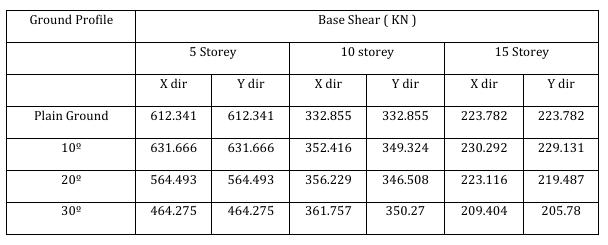
Among all slope angles, the 10° slope showed the highest base shear and storey drift. It was also observed that displacement is consistently higher at the top storey acrossallmodelsinbothXand Y directions.Modeshapes for15-storeybuildingsshowthelongesttimeperiodatthe top and bottom storeys, while the overall mode period tends to decrease as the slope angle increases. Additionally, base shear is more significant in the XdirectionthanintheY-directionforslopedconfigurations. These findings highlight the increased seismic vulnerability of buildings on sloping terrain, especially aroundthe10°incline.
VI. Ghosh, Rahul, and Rama Debbarma. “Effect of slope angle variation on the structures resting on hilly region considering soil–structure interaction.” International Journal of Advanced Structural Engineering 11 (2019): 67-77.
This study investigates the impact of varying slopeangles (0°, 15°, 30°, and 45°) on the seismic performance of structures resting on sloping ground, considering both fixed-baseandflexible-baseconditionstoaccountforsoilstructure interaction (SSI). The analysis is carried out using multiple methods, including the Equivalent Static ForceMethod(ESFM),ResponseSpectrumMethod(RSM), Time History Method (THM), Nonlinear Static Method (NLSM),andNonlinearTimeHistoryMethod(NLTHM).
The results reveal that increasing slope angles generally intensify structural vulnerabilities, with SSI playing a significant role in modifying the seismic response. While higherslopestendtoreducethefundamental timeperiod due to increased stiffness, the inclusion of SSI adds flexibility, leading to longer time periods. Base shear typically increases with slope angle but decreases when SSI is considered, particularly for steeper slopes. Displacementdecreaseswithincreasingslopeangleonthe whole but remains higher on the taller side of the structure; SSI further amplifies overall displacement. Additionally, bending moments are more pronounced in shorter columns situated on the upper side of slopes, and torsional effectsbecome moresevere withbothincreased slopeand SSI. The findings emphasize the critical need to account for both slope geometry and SSI in seismic analysis,astheysignificantlyaffectthestructuralresponse and are essential for the safe and accurate design of buildingsonslopedterrain
VII. Mohammad, Zaid, Abdul Baqi, and Mohammed Arif.“SeismicresponseofRC framed buildings resting on hill slopes.” Procedia engineering 173 (2017): 1792-1799.
This study investigates the seismic performance of reinforced concrete(RC)framed buildingsconstructed on
International Research Journal of Engineering and Technology (IRJET) e-ISSN: 2395-0056
Volume: 12 Issue: 05 | May 2025 www.irjet.net p-ISSN: 2395-0072
hilly terrain, focusing on step-back and step-back setback configurations. Using ETABS v9.0, the research employs Equivalent Static and Response Spectrum Methods to analyze key seismic parameters including fundamental time period, storey displacement, drift, base shear, and torsionaleffects.
The research concludes that step-back buildings exhibit longer time periods and greater flexibility, leading to increased displacements, storey drift, and torsional instability particularly in upper floors and shorter uphill columns. In contrast, step-back setback configurations demonstrate enhanced stiffness, with significantly lower base shear, more uniform force distribution, and reduced torsionalresponse,improvingoverallseismicstability.
The study further emphasizes that seismic behavior varies across and along slopes, necessitating accurate 3D modeling for reliable assessment. Additionally, empirical formulas from IS 1893 (2002) are found insufficient in predicting these behaviors, reinforcing the importance of detailedresponsespectrumanalysis.Overall,theresearch underscores the advantages of step-back setback designs and the need for optimized structural reinforcements and advanced analytical approaches to ensure the seismic resilienceofRCbuildingsonslopedground.
VIII. Manjunath, P., and Yogeendra R. Holebsgilu. “Seismic analysisofmultistoreybuilding with flat slab resting on plain and sloping ground.” Bonfring International Journal of Machine Interface, ISSN (2016): 2277-5064.
This study explores the seismic performance of 10-story flatslabbuildingssituatedonbothflatandslopingterrain, usingResponse SpectrumAnalysisinETABStoassessthe influence of varying slope angles (0°, 10°, 20°, and 30°) and soil types under Zone V seismic conditions. Buildings on sloping ground, due to their irregular and asymmetric geometry, demonstrate increased vulnerability to seismic forces.
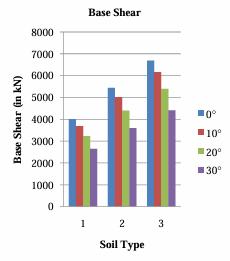
Theresearchconcludesthatasslopeangleincreases,base shear decreases attributed to reduced seismic mass while displacementandtorsionaleffectsincrease,particularlyin buildingson30°slopes.
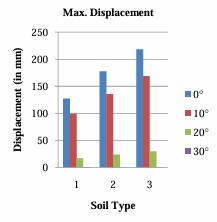
Maximum displacement and acceleration are observed in buildings on flat ground, especially in soft soil, whereas slopedstructuresexhibitreducedaccelerationbutgreater lateral instability. Storey drift is highest at lower floors and diminishes with increasing slope due to enhanced basefixity.
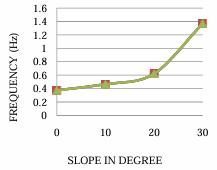
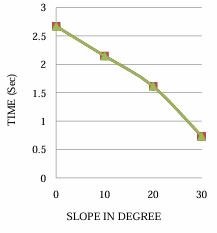
Additionally, as slope angle increases, the natural frequency of the structures rises and the time period shortens, indicating increased stiffness but a higher susceptibility to torsional behavior. The study concludes that while flat ground buildings are more stable due to higherbaseshear,slopedstructuresrequirecarefuldesign considerations, including additional reinforcement and
International Research Journal of Engineering and Technology (IRJET) e-ISSN: 2395-0056
Volume: 12 Issue: 05 | May 2025 www.irjet.net p-ISSN: 2395-0072
attention to soil stiffness, to mitigate increased displacements, drift, and torsional responses during seismicevents.
IX. Zaidi, Sahil Abbas, Tabassum Naqvi, and Syed Muhammad Ibrahim. “Study on the effects of seismic soil-structure interaction of concrete buildings resting on hill slopes.” Materials Today: Proceedings 43 (2021): 2250-2254.
This study investigates the seismic impact of SoilStructure Interaction (SSI) on reinforced concrete (RC) buildings located on varying hill slopes (0°, 15°, and 27°) using nonlinear static pushover analysis in SAP2000. The analysis evaluates base shear, displacement, and structural performance, revealing that SSI plays a crucial roleinreducingseismicforcesthroughenergydissipation inthesoil.
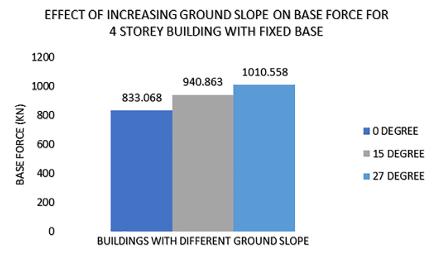
Figure 7: Variationofbaseforcewithincrementinground slopeforbuildingwithfixedbase.
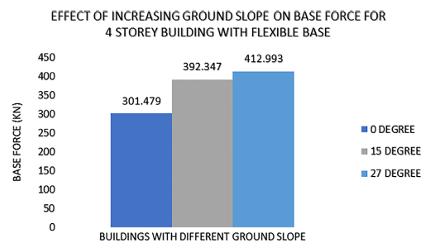
Figure 8: Variationofbaseforceforincrementinground slopeforbuildingwithflexiblebase.
The research concludes that base shear increases with slopeangleby21%infixed-baseand37%inflexible-base buildings while displacement decreases significantly in fixed-base models but only marginally in flexible-base ones,highlightingtheaddedflexibilityanddeformationin SSI-sensitive structures. Soil type also significantly influences structural response, with hard soil offering greaterstabilityandsoftsoilamplifyingdisplacementand vulnerability. Pushover analysis reveals that while fixedbase buildings reach failure thresholds earlier, flexible-
base models exhibit greater deformation yet benefit from reduced base shear due to improved energy dissipation. Overall, the research emphasizes the importance of considering SSI in seismic design, as it not only reduces seismicdemandbutalsosupportsperformance-basedand cost-effective design strategies, especially for buildings in slopedandseismicallyactiveregions.
X. Shabani, Mohammad Javad, and Ali Ghanbari. “Comparison of seismic behavior of steel building adjacent to slope topography by considering fixed-base, SSI and TSSI.” Asian Journal of Civil Engineering 21.7 (2020): 11511169
Thisresearchanalyzestheseismicbehaviorofa10-storey steel moment-frame building situated adjacent to a slope, using fixed-base (FB), soil-structure interaction (SSI), and topographic soil-structure interaction (TSSI) methods through 3D finite element modeling and laboratory shakingtabletests
The study reveals that buildings near the slope crest experience significantly amplified acceleration up to 4.5 times the input motion due to seismic wave reflections, whilethoseat theslopetoe faceloweramplification.TSSI models show more realistic results, incorporating both soil flexibility and topographic effects, with lateral displacements up to seven times greater than FB models and base shear nearly doubling compared to SSI. Steeper slopes (45°) and soft soils further increase displacement, torsion, and base shear, while hard soils offer better seismic stability. Storey drift is highest at lower levels, especially near the slope crest, making short columns more vulnerable to failure. The study concludes that traditionalFBanalysesunderestimateseismicdemandsin slopedterrains,andemphasizestheneedtointegrateTSSI in design to accurately capture the impact of slope angle, soil type, and location on seismic response. Buildings in such regions require advanced reinforcement and dampingstrategiesforenhancedstructuralresilience.
The findings from the reviewed studies demonstrate that buildings on sloping terrain exhibit increased seismic vulnerabilities due to irregular mass, stiffness, and foundation conditions. The key conclusions from the analysesareasfollows:
1. Structures built on inclined terrains exhibit greater vulnerability due to irregular column heights, asymmetrical mass distribution, and the amplification of seismic forces. Step-back and Step-back Setback configurations, particularly on steep slopes, tend to experience increased torsional effects, base shear, and top-story displacements. Among these, Step-back Setback
International Research Journal of Engineering and Technology (IRJET) e-ISSN: 2395-0056
Volume: 12 Issue: 05 | May 2025 www.irjet.net p-ISSN: 2395-0072
buildings demonstrate better structural balance and reduced torsional vulnerability, making them moresuitableforhillyregions.
2. Pushover and response spectrum analyses consistently show that seismic demand including base shear, displacement, and plastic hinge formation intensifies with seismic zone severity (from Zone II to V). Buildings in higher zones require retrofitting, especially of lower-story columns, which bear the brunt of lateral forces. Bracing systems, such as X and Inverted V configurations, and strategically placed shear walls, especially at exterior corners, significantly enhance structural stiffness and minimize displacementanddrift.
3. Additionally,buildingheightandslopeinclination are crucial factors; low-rise buildings tend to exhibit higher base shear due to stiffness, while mid- and high-rise structures show increased flexibility and displacement, particularly on steeper slopes. Base shear peaks around 10° slopes, but torsional effects are more severe at 30°, necessitating tailored reinforcement strategies. Time History Analysis proves especially effective in capturing the complex dynamicbehavioroftallbuildings.
4. Astheslopeangleincreases,buildingsexperience a decrease in base shear because of the reduced seismicweight.However,theyalsofaceincreased lateral displacement, torsional effects, and structural instability. Structures situated on steeper slopes (such as 30° to 45°) are especially susceptibletoinelasticdeformationsandmayfail at an early performance point under seismic loads
5. IncorporatingSSIintoanalysissignificantlyalters seismic response predictions. While fixed-base models overestimate base shear and stiffness, flexible-base models allow greater deformation, revealingincreaseddisplacementandtorsion.SSI dissipates seismic energy through soil damping, thereby reducing base shear but increasing structuralflexibility.
6. Buildingssituatednearslopecrestsareespecially vulnerable due to seismic wave amplification. TSSI analysis demonstrates that both soil flexibility and topography significantly amplify seismicresponses,farbeyondwhatiscapturedby SSIalone.
7. Step-back building configurations suffer from higher storey drift, torsion, and localized failure, especially in shorter uphill columns. In contrast,
step-back setback configurations show improved force distribution, lower torsional effects, and betterseismicperformance.
8. Soft soils increase displacement, drift, and acceleration, reducing structural stability. Conversely,hardsoilsimproveseismicresistance, highlighting the critical need for geotechnical evaluationinseismicdesign.
9. Buildings on sloped terrain typically exhibit shorter time periods and higher natural frequencies due to increased stiffness from shorter columns. However, asymmetrical configurations also result in greater torsional irregularities.
[1] Birajdar,B.G.,andS.S.Nalawade.“Seismicanalysisof buildings resting on sloping ground.” 13th world conference on earthquake engineering. No. 1472. 2004.
https://www.iitk.ac.in/nicee/wcee/article/13_1472.p df
[2] Deep,V. Mani,andP. PoluRaju.“Pushoveranalysisof RC building: comparative study on seismic zones of India.” Int. J. Civil Eng. Technol 8.4 (2017): 567-578. https://www.academia.edu/33287299/PUSHOVER_A NALYSIS_OF_RC_BUILDING_COMPARATIVE_STUDY_O N_SEISMIC_ZONES_OF_INDIA?sm=b
[3] Sanjay, Phatale Swarup, and S. R. Parekar. “Seismic analysis of Step-back building resting on sloping groundconsideringdifferenttypesofBracingsystem.” International Journal for Modern Trends in Science andTechnology5.07(2019).
https://www.academia.edu/40014417/Seismic_analy sis_of_Step_back_building_resting_on_sloping_ground_ considering_different_types_of_Bracing_system
[4] Patel,MohammedUmarFarooque,A.V.Kulkarni,and Nayeemulla Inamdar. “A Performance study and seismic evaluation of RC frame buildings on sloping ground.” IOSR Journal of Mechanical and Civil Engineering(IOSR-JMCE)e-ISSN(2014):2278-1684.
https://www.researchgate.net/publication/3230293 01_A_Performance_study_and_seismic_evaluation_of_ RC_frame_buildings_on_sloping_ground
[5] Gaikwad, Apurva Arjun, and Atul B. Pujari. “Seismic analysis of low rise, Mid-rise and High-Rise RCC structure on sloping Ground.” International Research Journal of Engineering and Technology 6.7 (2019): 1357-1365.
International Research Journal of Engineering and Technology (IRJET) e-ISSN: 2395-0056
Volume: 12 Issue: 05 | May 2025 www.irjet.net p-ISSN: 2395-0072
https://www.academia.edu/40259639/IRJET_SEISMI C_ANALYSIS_OF_LOW_RISE_MID_RISE_AND_HIGH_RIS E_RCC_STRUCTURE_ON_SLOPING_GROUND?sm=b
[6] Ghosh, Rahul, and Rama Debbarma. “Effect of slope angle variation on the structures resting on hilly region considering soil–structure interaction.” International Journal of Advanced Structural Engineering 11 (2019): 67-77. https://doi.org/10.1007/s40091-019-0219-3
[7] Mohammad, Zaid, Abdul Baqi, and Mohammed Arif. “Seismic response of RC framed buildings resting on hill slopes.” Procedia engineering 173 (2017): 17921799.https://doi.org/10.1016/j.proeng.2016.12.221
[8] Manjunath, P., and Yogeendra R. Holebsgilu. “Seismic analysis of multi storey building with flat slab resting on plain and sloping ground.” Bonfring International JournalofMachineInterface,ISSN(2016):2277-5064. https://www.journal.bonfring.org/papers/mmi/volu me4/BIJ-8150.pdf
[9] Zaidi, Sahil Abbas, Tabassum Naqvi, and Syed Muhammad Ibrahim. “Study on the effects of seismic soil-structureinteractionofconcretebuildingsresting on hill slopes.” Materials Today: Proceedings 43 (2021):2250-2254. https://doi.org/10.1016/j.matpr.2020.12.532
[10] Shabani, Mohammad Javad, and Ali Ghanbari. “Comparison of seismic behavior of steel building adjacent to slope topography by considering fixedbase,SSIand TSSI.”Asian Journal of Civil Engineering 21.7(2020):1151-1169. https://doi.org/10.1007/s42107-020-00266-8
2025, IRJET | Impact Factor value: 8.315 |