
International Research Journal of Engineering and Technology (IRJET) e-ISSN: 2395-0056
Volume: 12 Issue: 04 | Apr 2025 www.irjet.net p-ISSN: 2395-0072
SEISMIC PERFORMANCE OF ASYMMETRIC HIGH-RISE RC BUILDINGS WITH AND WITHOUT INFILL WALLS
Harsh Sawant1 , Radhika Jadhav2* , Uday Salunke3, Chirag Shelar4, Neha Sonavane5
1UG Student, Department of Civil Engineering, Datta Meghe College of Engineering, Airoli, Maharashtra, India
2*Assistant Professor, Department of Civil Engineering, Datta Meghe College of Engineering, Airoli, Maharashtra, India
3UG Student, Department of Civil Engineering, Datta Meghe College of Engineering, Airoli, Maharashtra, India
4UG Student, Department of Civil Engineering, Datta Meghe College of Engineering, Airoli, Maharashtra, India
5UG Student, Department of Civil Engineering, Datta Meghe College of Engineering, Airoli, Maharashtra, India
Abstract - This study presents a comprehensive seismic analysis of a high-rise reinforced concrete building, with a particular focus on the influence of infill walls on structural performance during seismic events. A 20-story building is modelled and analysed using ETABS software, in accordance with IS 1893 (Part-1):2016 seismic design guidelines. Three structural configurations are considered: a bare frame, a frame with AAC block infill walls, and a frame with burnt clay brick infillwalls. Keyparameterssuchasstorydriftandlateral displacement under seismic loads are evaluated to assess the seismic behaviour of each configuration. The results demonstrate that the presence of infill walls significantly enhances the lateral stiffness and reduces displacement, thereby improving the overall seismic performance of the structure. Comparatively, the bare frame shows increased lateral displacement and reduced stiffness. Among the infill materials, burntclaybricksprovidegreaterstiffnessthanAAC blocks. The study offers valuable insights into the role of infill walls in seismic design and highlights the importance of considering these elements in high-rise construction within earthquake-prone regions.
Key Words: Infill walls, Push over Analysis, Seismic Structure,Storydisplacement,Storydrift.
1.INTRODUCTION
The seismic behaviour of high-rise buildings remains a criticalfocusinstructuralengineering,especiallyinregions vulnerabletoearthquakes.Duetotheirconsiderableheight, massdistribution,andslendergeometry,high-risebuildings exhibitcomplexresponsestoseismicforces.Thesedynamic lateral forces, if not properly accounted for, can result in severe structural damage or even collapse. Consequently, understandingtheinfluenceofvariousstructuralandnonstructuralcomponentsonseismicperformanceisessential forensuringthesafetyandresilienceofsuchbuildings.
Infill walls,commonlyconstructed from materialssuch as brickorconcreteblocks,aretraditionallyconsiderednonstructural elements used for partitioning interior spaces. However,numerousstudieshaveshownthatinfillwallscan
significantly affect the seismic response of buildings by contributing to lateral stiffness, strength, and energy dissipationcapacity.Theirpresencecanalterthedynamic characteristicsofastructure,reducinglateraldisplacement andstorydriftduringseismicevents.
Despite their potential benefits, infill walls are often neglected in structural analysis, which can lead to overly conservative designs that underestimate stiffness and overestimatedeformations.Conversely,incorporatinginfill walls in seismic analysis can provide a more realistic understandingofastructure’sbehaviourunderearthquake loading.Thetypeofinfillmaterialalsoplaysacrucialrolein determining the extent of these effects. Materials such as AutoclavedAeratedConcrete(AAC)blocksand burntclay bricksdiffersignificantlyindensity,strength,andstiffness, thereby influencing the overall seismic performance in distinctways.
This study aims to investigate and compare the seismic performance of a 20-story reinforced concrete building underthreedifferentconditions:abareframe,aframewith AACblockinfillwalls,andaframewithburntclaybrickinfill walls. The analysis is conducted using ETABS software, followingtheguidelinesoutlinedinIS1893(Part-1):2016. Keyparameterssuchasbaseshear,storydrift,andlateral displacementareevaluatedusingtheEquivalentStaticLoad Method. The findings will contribute to a deeper understandingoftheroleofinfillwallsinseismicdesignand providepracticalinsightsforenhancingstructuralsafetyin high-riseconstruction.
2. CORRESPONDING LITERATURES
The seismic performance of buildings, particularly those withmasonryinfillwalls,hasbeenasignificantfocusofresearch in structural engineering. Numerous studies have exploredtheeffectsofinfillwallsonthedynamicbehaviorof reinforced concrete (RC) frames, highlighting their role in enhancingstructuralintegrityduringseismicevents.
C. Rajesh et.al(2014)[8]examinedtheseismicperformance of reinforced concrete (RC) buildings with and without
International Research Journal of Engineering and Technology (IRJET) e-ISSN: 2395-0056
Volume: 12 Issue: 04 | Apr 2025 www.irjet.net p-ISSN: 2395-0072
masonry infill walls. It uses the equivalent diagonal strut concepttomodeltheinfillwallsandanalyzesthebuildings forseismicloadsusingSAP2000software.Thefindingsshow thatbuildingswithinfillwalls(strutmodel)arestiffer,with shortertimeperiods,higherbaseshear,andlowerweight comparedtobare-framebuildings.Thesepropertiesmake the strut model buildings safer and more resistant to earthquakes, highlighting the importance of considering infillwallstiffnessinseismicdesigntopreventfailures,as seeninthe2001Bhujearthquake.
Wakchaure M.R et.al(2012)[9]investigatedtheimpactof masonryinfillwallsontheseismicperformanceofhigh-rise reinforced concrete (R.C.C.) buildings. Infill walls act as compression struts between columns and beams, transferring forces during an earthquake. The "equivalent strutmethod"isusedtomodelthesewalls.A10-storyR.C.C. framed building is analyzed using ETABS software, with various infill wall configurations tested for base shear, displacement,anddrift.Resultsshowthatinfillwallsreduce top-storey displacement, shorten response time, and increase base shear. The arrangement of the walls affects how forces are distributed, and irregularities such as soft story’scancausemoredamage.Thestudyalsofindsthata higher slenderness ratio increases displacement and base shear. In conclusion, considering masonry infill walls is essentialforaccurateseismicevaluationofhigh-riseR.C.C. buildings.
GAYATHRI R et.al(2022)[10]focusedontheanalysisand designofafour-storybuildingusingETABSsoftware.Multistorybuildingsrequirecarefulconsiderationoffactorslike cost,serviceability,anddurability.Themainelementsofthe building suchasbeams,columns,slabs,andfootings are analyzedanddesignedtoensurestrengthandstability.The paperdiscussestheanalysisofabuilding(G+4)underthe influence of shear forces and bending moments acting on beams and columns. The conclusion emphasizes that building analysis ensures safety, longevity, and economic efficiency. Using automated software like ETABS is more efficientandreliablecomparedtomanualmethods,reducing errors and improving the stability and safety of the structure.
D.Haritha et.al (2021) [11] focused on the structural analysisanddesign of a multi-storybuilding using ETABS software.Structuralanalysisisessentialtounderstandhow different components like beams, columns, and slabs respond to various loads such as dead load, live load, and windload.ETABSisusedtoperformbothstaticanddynamic analysis,providingcrucialdatalikeshearforcesandbending moments before construction, which helps in making informed design decisions regarding materials and dimensions.ThebuildingisdesignedaccordingtoIScodes, including IS 456-2000 for concrete and IS 875 for loads. AutoCADisusedforplanningthebuildingbasedonIndia's National Building Code. The project results include maximumshearforcesandbendingmomentsforbeamsand
columnsunderdifferentloadcombinations,helpingtocreate anefficientandeconomicaldesign.Inconclusion,thestudy providesvaluableinsightsintostructuralanalysisanddesign usingETABS,ensuringsafetyandefficiencyinthebuilding design.
DR.K.Chandrasekhar Reddy et.al (2019)[12]analyzeda 30-story high-rise building (G+30) using ETABS 2016 software,consideringseismic,dead,andliveloads.Themain goalistodeterminetheeffectsoflateralloadsonmoments, shearforce,axialforce,baseshear,displacement,andtensile forces.Theanalysiscomparesresultsforseismiczones2,3, 4, and 5.Key findings include: Lateral displacements are highestinseismiczone5comparedtozones4,3,and2.Story shearisalsogreaterinzone5thaninzone2.Allstructural membersweredesignedusingETABS,andanyinadequate members were identified, with suitable sections recommended by the software. The software provides improved accuracy for structural analysis. In conclusion, ETABS software offers a reliable and efficient method for analyzinganddesigninghigh-risebuildings,ensuringbetter accuracyinstructuralperformance.
Kurapati Durga Prashanth Reddy et.al (2017) [13] comparedthebehaviorofRCCbuildingswithandwithout masonryinfill wallsin differentpositions,usingResponse Spectrum Analysis in ETABS software. It focuses on maximumstorydisplacementandstorydriftforbuildings withmasonryinfillwallslocatedatthecenterandcorners. Thekeyconclusionsare:Asthemodenumberincreases,the building’stimeperioddecreasesanditsfrequencyincreases. As the time period decreases, acceleration in the X and Y directionsincreases,stabilizingfrommode-4tomode-9.The study analyzes buildings in Zone III on medium soil (Soil TypeII).Thepresenceofmasonryinfillwalls,whetheratthe center or corners, makes the building more flexible comparedtoanormalbuildinginZoneIIIwithmediumsoil.
Haroon Rasheed Tamboli et.al(2012)[14]examinedthe seismic performance of reinforced concrete (RC) frame buildingmodels,includingbareframes,infilledframes,and openfirst-storyframes,usingtheEquivalentLateralForce Method. Masonry infill walls, often considered nonstructural, significantly impact structural behavior during seismic events. The Equivalent Diagonal Strut method is employedtomodelinfillpanels,andETABSsoftwareisused foranalysis.Thestudyhighlightstheinfluenceofinfillwalls on stiffness and seismic resistance. Additionally, a shortterminvestigationofMuthukudacoastalwatersrevealshigh phytoplankton productivity in the Pambanar estuary and adjacentPalkBay,supportedbymangrovevegetationand seagrassmeadows.Thesecontributetothebiogeochemistry oftheregion.Thefindingsunderlinetheneedforlong-term studiestounderstandnutrientdynamicsandproductivity for sustainable ecosystem management. Both studies emphasize the critical role of secondary elements in structuralandecologicalsystems.
International Research Journal of Engineering and Technology (IRJET) e-ISSN: 2395-0056
Volume: 12 Issue: 04 | Apr 2025 www.irjet.net p-ISSN: 2395-0072
Hakan Dilmac et.al (2018) [15] studied one of the important factors is the infill walls in the change of the structural rigidity, ductility, dynamic and static characteristics of the structures. The infill walls are not generally included in numerical analysis of reinforced concrete(RC)structuralsystemsduetothelackofsuitable theory and the difficulty of calculating the recommended models. In seismic regions worldwide, the residential structures are generally RC buildings with infill walls. Therefore,understandingthecontributionoftheinfillwalls to the seismic performance of buildings may have vital importance.Thispaperinvestigatestheeffectsofinfillwalls on the seismic performance of existing RC residential buildings by considering the requirements of the Turkish Earthquake Code (TEC). Seismic performance levels of residential RC buildings with and without walls in highhazardzonesweredeterminedaccordingtothenonlinear proceduregiveninthecode.Pushovercurveswereobtained by considering the effect of masonry infill walls on the seismic performance of RC buildings. The analysis results showedthattheinfillwallsbeneficiallyaffectedtherigidity, roofdisplacements,andseismicperformanceofthebuilding.
Kiran Tidke et.al (2016) [16] examined buildings with masonryinfillwallsarethemostcommontypeofstructures usedformulti-storyconstructionsindevelopingcountries. Masonry brick infill walls have been used in reinforced concrete (RC) frame structures as interior and exterior partitionwalls.Infill wallsarenowadays consideredtobe non-load-bearingmembers.Inthedesignandassessmentof buildings, infill wallsareusuallytreatedasnon-structural elementsandareignoredinanalyticalmodelsbecausethey areassumedtobenon-beneficialtothestructuralresponse. However, during wind and earthquakes, these infill walls contribute to the structural response and increase the strengthandstiffnessofthe frame. Thispaperstudiesthe effectofmasonryinfillwallsonbuildings.Dynamicanalysis ofbuildingswithdifferentarrangementsiscarriedout.For theanalysis,aG+7RCframebuildingismodeled.Thewidth of the strut is calculated by the equivalent diagonal strut method. Analysis is carried out using SAP2000 software. Base shear, maximum story drift, and displacement are calculatedandcomparedforallmodels.
K. Satya Narasimha Rao et.al(2015)[17]investigatedthe effectofmasonryinfillpanelsontheresponseofRCframes subjected to seismic action is widely recognized and has beenthesubjectofnumerousexperimentalinvestigations, withseveralattemptstomodelitanalytically.Inanalytical analysis,infillwallsaremodelledusinganequivalentstatic approach, with various formulae derived for their width. Infillbehaveslikeacompressionmemberbetweencolumns and beams, transferring forces from one node to another. Thisstudyinvestigatestheeffectofmasonrywallsonhighrise buildings. Static analysis on high-rise buildings with different arrangements is carried out. A G+9 RCC framed building is modelled, and the width of infill walls is
calculatedusingtheequivalentstaticmethod.Variouscases of analysis are considered, and the analysis is conducted usingSTAAD.Prosoftware.Parameterssuchasaxialforce, shear force, storey drift, nodal displacement, and bending moment are calculated and compared for all models. The resultsindicatethatinfillwallsreducedisplacementandthe time period while increasing base shear. Therefore, it is essentialtoconsidertheeffectofmasonryinfillwallsinthe seismicevaluationofmoment-resistingreinforcedconcrete frames.
3. MODELING AND DETAILS
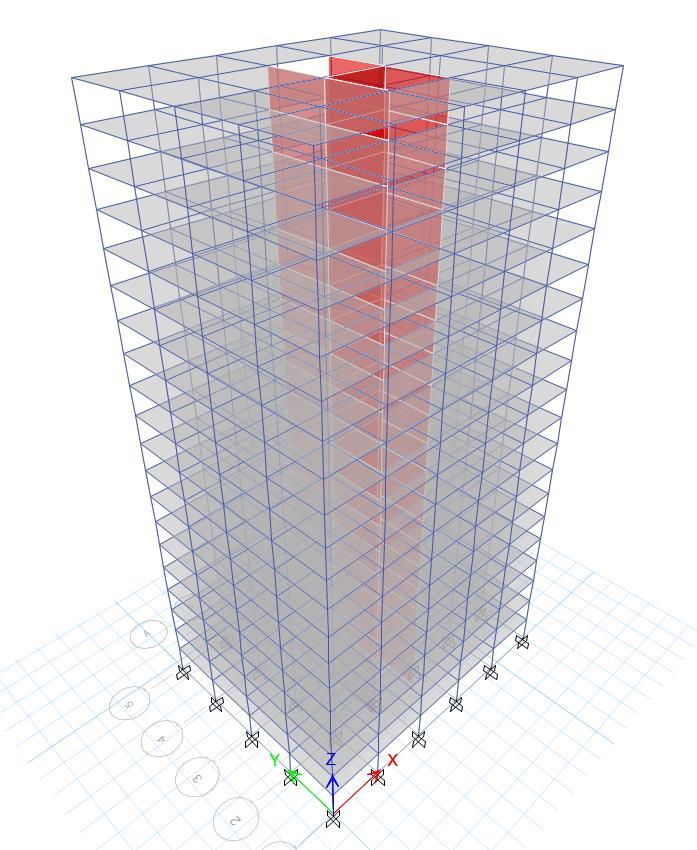
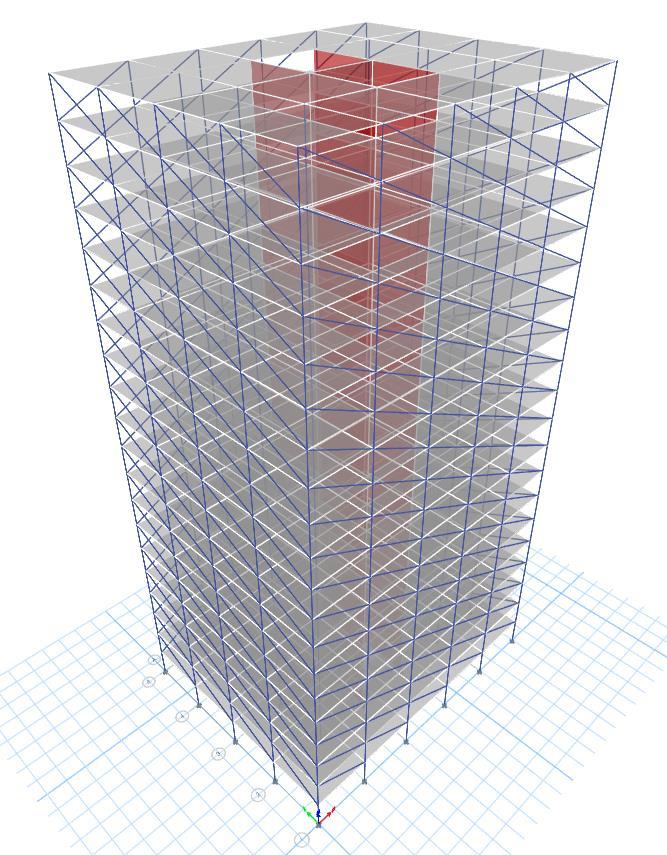
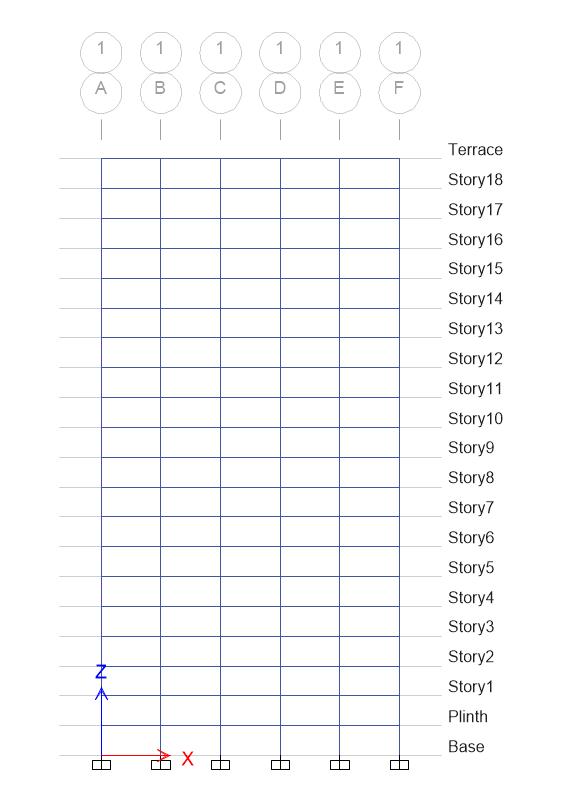
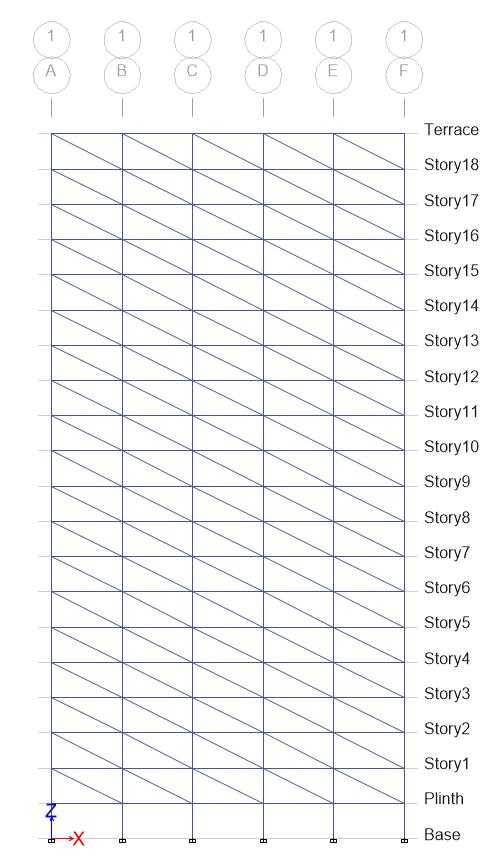
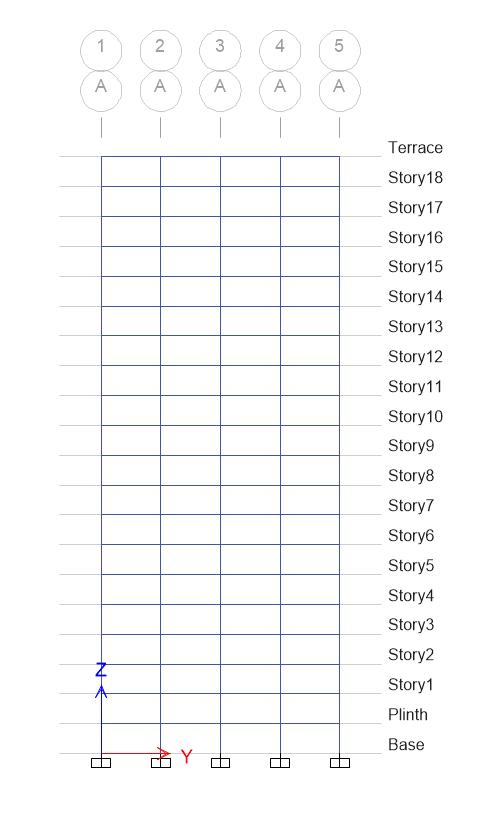
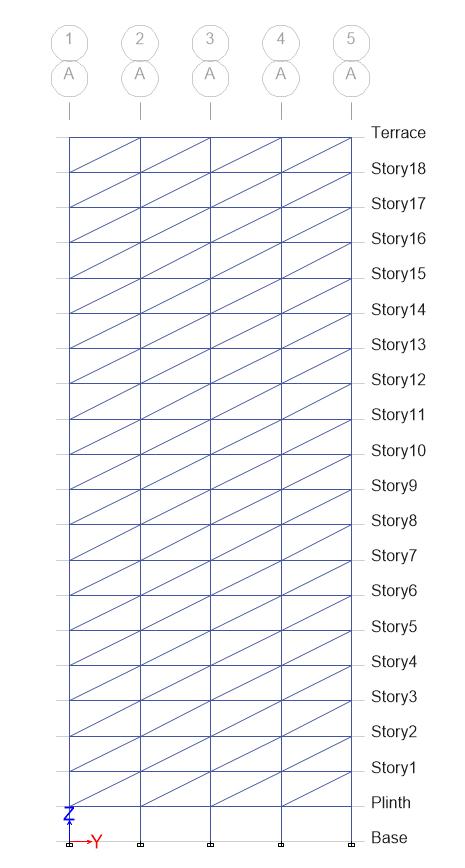
Theseismicanalysisofa high-risebuildingwithoutinfill walls involves several critical parameters and considerations.Thebuildinginquestionisamulti-storey rigidjointedplaneframe,specificallyaspecialreinforced concrete moment resisting frame (SMRF), located in Mumbai, which falls under Seismic Zone-III. The seismic zonefactor(Z)is0.6,indicatingamoderatetohighseismic risk. The importance factor (I) is 1.2, reflecting the building'ssignificance,andtheresponsereductionfactor (R)is5,whichaccountsfortheductilityandoverstrength of the structure. The damping ratio is set at 5%, and the buildingisconstructedonrockorhardsoil(Type-I),which providesastablefoundation.
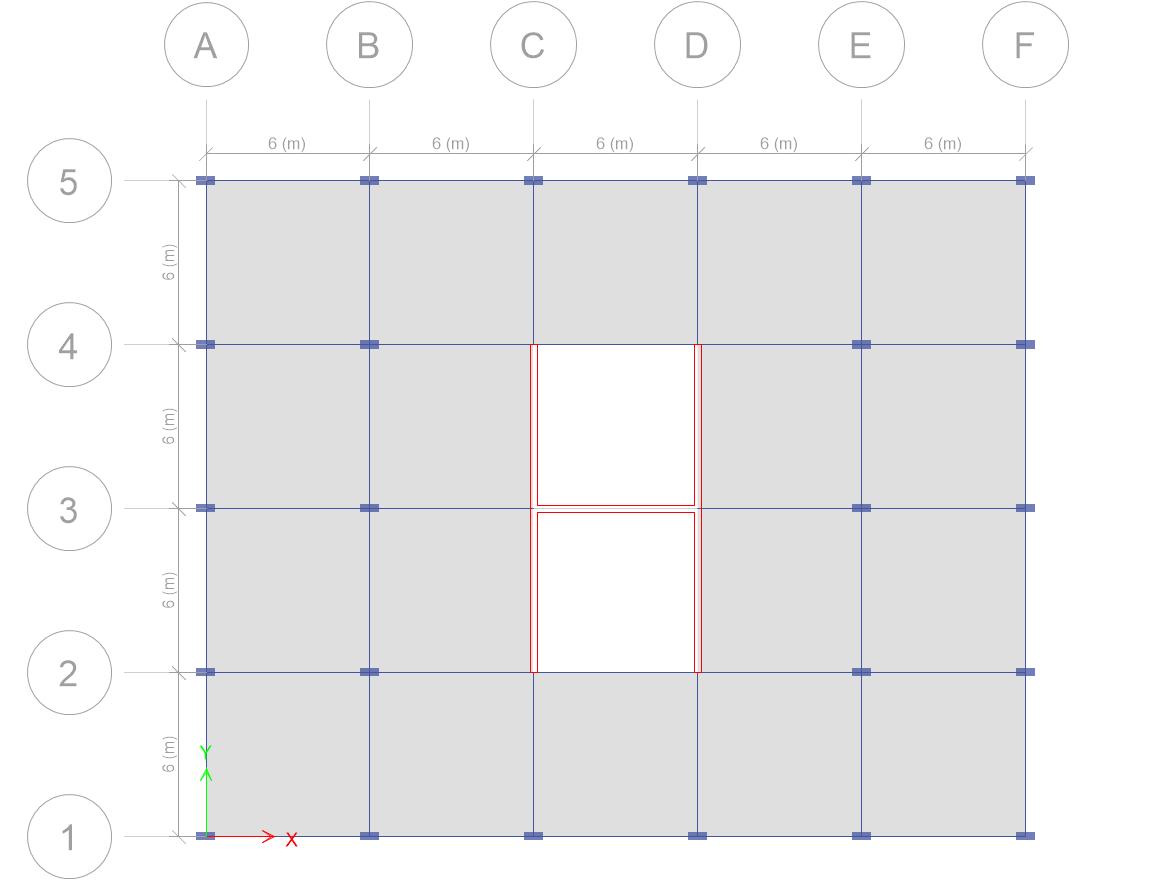
Thebuildinghasanaturalperiodofoscillation(Ta)of1.616 seconds, which is crucial for understanding its dynamic behaviourunderseismicloads.Itconsistsof20storeys,with each floor having a height of 3 meters. The live load is specifiedas3kN/m².Thestructuralelementsincludebeams withasizeof350x550mm,columnswithasizeof300x700 mm, and a slab thickness of 150 mm. Additionally, the buildingfeaturesshearwallswithathicknessof250mmto enhanceitslateralloadresistance.
Thebuilding'sdimensionsare30metersintheX-direction and24metersintheY-direction.Thematerialsusedinthe constructionareofhighstrength:theconcretegradeisM60 with a compressive strength of 60 N/mm², and the steel grade is Fe415 with a yield strength of 415 N/mm². The densities of the materials are as follows: AAC blocks at 9.81kN/m3, burnt clay bricks at 20kN/m3, concrete at 25 kN/m³, and steel at 78.5 kN/m³. The Young's Modulus of steel is 2 x 10⁵ N/mm², and for concrete, it is 38729.63 N/mm².
This comprehensive set of parameters and specifications formsthebasisforconductingadetailedseismicanalysisof thehigh-risebuilding,ensuringthatitcanwithstandseismic forceseffectivelydespitetheabsenceofinfillwalls.
International Research Journal of Engineering and Technology (IRJET) e-ISSN: 2395-0056
Volume: 12 Issue: 04 | Apr 2025 www.irjet.net p-ISSN: 2395-0072
Table -1: MaterialProperties
Description
GradeofConcrete(M60)(N/mm2) 60
GradeofSteel(Fe415)(N/mm2) 415
DensityofAACblocks(kN/m3) 981 DensityofBurntclaybricks
3)
3)
Young'sModulusofSteel(N/mm2) 2x10⁵
Young'sModulusofConcrete(N/mm2) 3872963
Table -2: GeneralDescriptionoftheModelGeometry
Title Description
TypeofStructure
Multistoreyrigidjointed planeframe(specialRC momentresistingframe SMRF)
Region Mumbai(Zone-III)
Seismiczonefactor(Z) 016
Importancefactor(I) 12
Responsereductionfactor (R) 5 Dampingratio 5%
Soiltype Rockorhardsoil(Type-I)
Naturalperiodof oscillation(Ta)(sec) 1616
Numberofstoreys 20
Liveload(kN/m2) 3
F-Fheight(m) 3
Beamsize(mm)
Columnsize(mm)
Slabthickness(mm)
Shearwallthickness(mm)
LengthinX-direction(m)
LengthinY-direction(m)
International Research Journal of Engineering and Technology (IRJET) e-ISSN: 2395-0056
Volume: 12 Issue: 04 | Apr 2025 www.irjet.net p-ISSN: 2395-0072
International Research Journal of Engineering and Technology (IRJET) e-ISSN: 2395-0056
Volume: 12 Issue: 04 | Apr 2025 www.irjet.net p-ISSN: 2395-0072
4. RESULTS AND DISCUSSION
4.1 Maximum Story Displacement:
4.1.1 Displacement due tovibrations in X-direction:
4.1.1.1 Displacement along X-axis:
o Load case: EQ+X
o Output type: Maximum
o Story Range: All Stories
o Top story: 20
o Bottom story: 0
The graph and the table below represents the maximum story displacement data in the X-direction for a 20-story asymmetricreinforcedconcretebuildingundertheseismic load case EQ+X. It compares the lateral displacement behavior of the structure across all story levels for three different wall conditions: without infill walls (WI), with Autoclaved Aerated Concrete (AAC) infill walls, and with Burnt Clay Brick (BCB) infill walls.As expected, the displacement increases with building height for all three models, with the maximum displacement recorded at the 20th story. The bare frame without infill walls shows the highestdisplacements,reaching13.988mmatthetopstory, indicating reduced stiffness and increased flexibility. The inclusionofautoclavedaeratedconcreteblocksandburnt claybricksinfillwallssignificantlyreducesthedisplacement values at each level, demonstrating their contribution to enhancing lateral stiffness. Burnt clay bricks infill walls slightly outperform autoclaved aerated concrete blocks in termsofdisplacementreductionatmoststories,withthetop storydisplacementbeing13.345mmforburntclaybricks and12.973mmforautoclavedaerated concreteblocks.
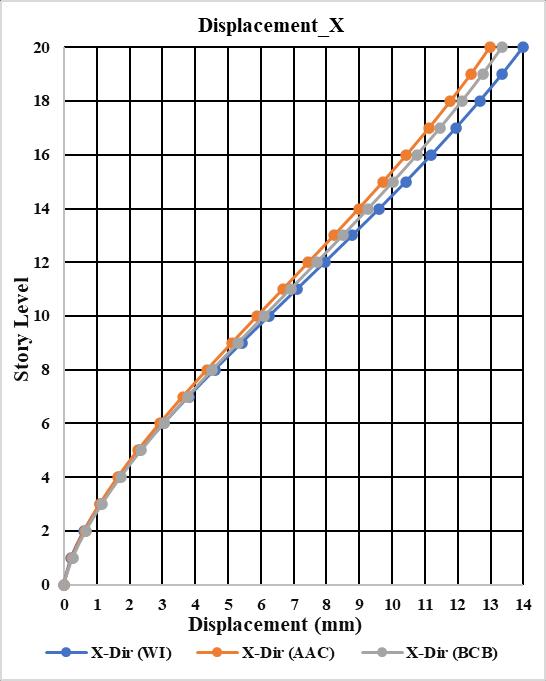
Chart -1:Storydisplacementalong_X
Volume: 12 Issue: 04 | Apr 2025 www.irjet.net p-ISSN: 2395-0072
Table -3: StoryResponseValues
4.1.1.2 Displacement along Y-axis:
o Loadcase:EQ+X
o Outputtype:Maximum
o StoryRange:AllStories
o Topstory:20
o Bottomstory:0
The graph and the table provide the maximum story displacementintheY-directionfora20-storyasymmetric reinforcedconcretebuildingsubjectedtotheEQ+Xseismic load case. It compares the structural performance under threedifferentwallconditions:withoutinfillwalls(WI),with Autoclaved Aerated Concrete (AAC) block infill walls, and with Burnt Clay Brick (BCB) infill walls. As shown in the data,thedisplacementincreaseswiththebuildingheightfor all three configurations, with the maximum displacement occurring at the 20th story. The bare frame without infill walls shows the greatest displacement across all stories, peaking at 3.236 mm at the top, indicating lower stiffness and greater flexibility in the absence of infill walls. In contrast,thestructureswithinfillwallsexhibitsignificantly reduced displacements. At the same top level, the displacement for the autoclaved
modelis1.952mm,andfortheburntclaybrickmodel,itis 1.69mm.
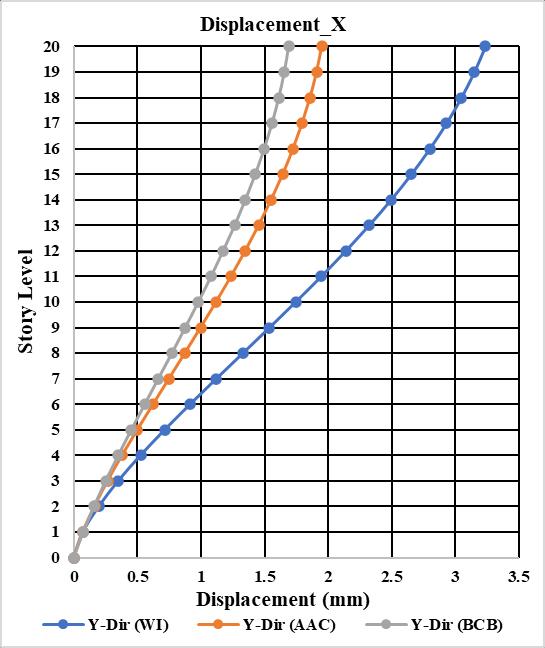
Chart -2:Storydisplacementalong_Y
Table -4: StoryResponseValues
International Research Journal of Engineering and Technology (IRJET) e-ISSN: 2395-0056
Volume: 12 Issue: 04 | Apr 2025 www.irjet.net p-ISSN: 2395-0072
Table -5: StoryResponseValues
4.1.2 Displacement due tovibrations in Y-direction:
4.1.2.1 Displacement along X-axis:
o Loadcase:EQ+Y
o Outputtype:Maximum
o StoryRange:AllStories
o Topstory:20
o Bottomstory:0
Thegraphandthetablebelowillustratethemaximumstory displacementintheX-directionfora20-storyasymmetric reinforced concrete building under the seismic load case EQ+Y.Itevaluatesthreestructuralconditions:abareframe withoutinfillwalls(WI),aframewithAutoclavedAerated Concrete (AAC) block infill walls, and a frame with Burnt ClayBrick(BCB)infillwalls.Thedisplacementprogressively increasesfromthegroundtothetopstoryinallthreecases, which is typical under lateral seismic loading. The bare framewithoutinfillwallsexhibitsthehighestdisplacement valuesthroughout,reachingamaximumof2.776mmatthe 20th story. The inclusion of infill walls, both autoclaved aerated concrete block and burnt clay brick, significantly reducesdisplacementsatalllevels.Theautoclavedaerated concrete block wall configuration limits the top story displacement to 1.695 mm, while the burnt clay brick configurationshowstheleastdisplacementat1.477mm.
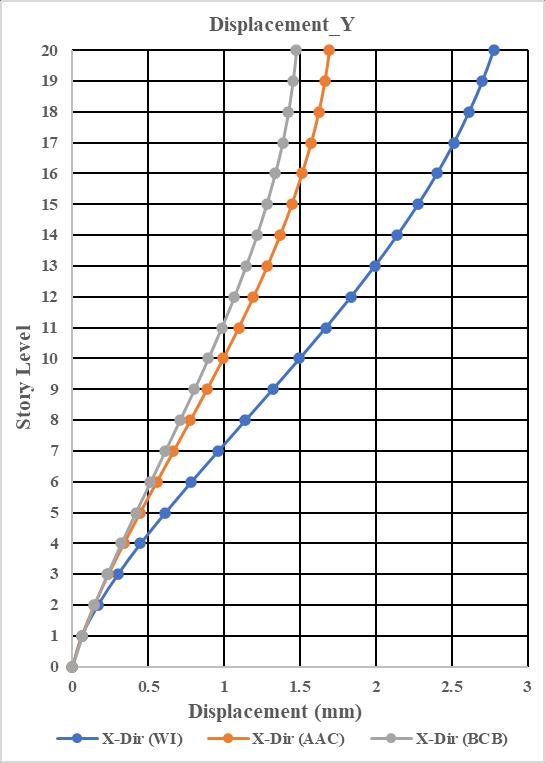
4.1.2.2 Displacement along Y-axis:
o Loadcase:EQ+Y
o Outputtype:Maximum
o StoryRange:AllStories
o Topstory:20
o Bottomstory:0
The graph and the table below summarize the maximum story displacement in the Y-direction for a 20-story asymmetric reinforced concrete building subjected to the EQ+Y seismic load case. It compares the building’s displacement performance across all stories under three configurations: a bare frame without infill walls (WI), a framewithAutoclavedAeratedConcrete(AAC)blockinfill walls,andaframewithBurntClayBrick(BCB)infillwalls.As theheightofthebuildingincreases,thedisplacementinall three configurations rises progressively, with the highest displacement recorded at the top story (60 meters). The bare frame without infill walls shows the greatest lateral displacement,peakingat13.977mm,whiletheautoclaved aerated concrete blocks and burnt clay bricks infill walls reduce this to 12.879 mm and 13.344 mm, respectively. Although both infill types improve the seismic response,
International Research Journal of Engineering and Technology (IRJET) e-ISSN: 2395-0056
Volume: 12 Issue: 04 | Apr 2025 www.irjet.net p-ISSN: 2395-0072
autoclaved aerated concrete blocks are more effective in reducing displacement in the Y-direction than burnt clay bricksinthisparticularcase.
Chart -4:Storydisplacementalong_Y
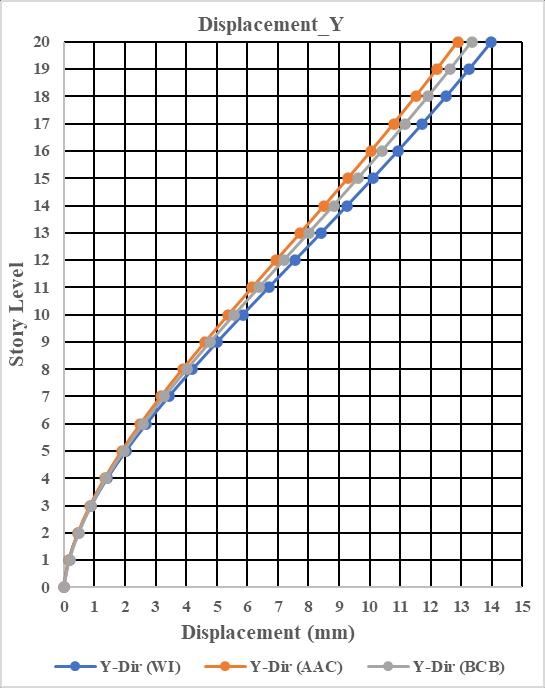
Table -6: StoryResponseValues
4.2 Maximum Story Drift:
4.2.1 Drift due to vibrations in X-direction:
4.2.1.1 Drift along X-axis:
o Loadcase:EQ+X
o Outputtype:Maximum
o StoryRange:AllStories
o Topstory:20
o Bottomstory:0
Thegraphandthetablebelowillustratethemaximumstory driftintheX-directionfora20-storyasymmetricreinforced concrete building subjected to seismic loading under the EQ+X load case. The analysis compares three structural configurations: a bare frame, a frame with Autoclaved AeratedConcrete(AAC)blockinfillwalls,andaframewith BurntClayBrick(BCB)infillwalls.Thedatashowsthatstory driftvaluesincreasewithheight,reachingapeakbetween the 10th and 13th stories, and then gradually decreasing towards the top. This is consistent with typical seismic behaviour,wheremid-heightstoriesexperiencethehighest inter-storydeformations.Amongthethreeconfigurations, thebareframewithoutinfillwallsconsistentlyexhibitsthe highest drift values, indicating lower stiffness and greater lateral deformation. In contrast, the structures with autoclaved aerated concrete blocks and burnt clay bricks infillwallsshowreduceddriftvalues,withburntclaybricks generallyperformingslightlybetterthanautoclavedaerated concreteblocks.
International Research Journal of
Volume: 12 Issue: 04 | Apr 2025 www.irjet.net
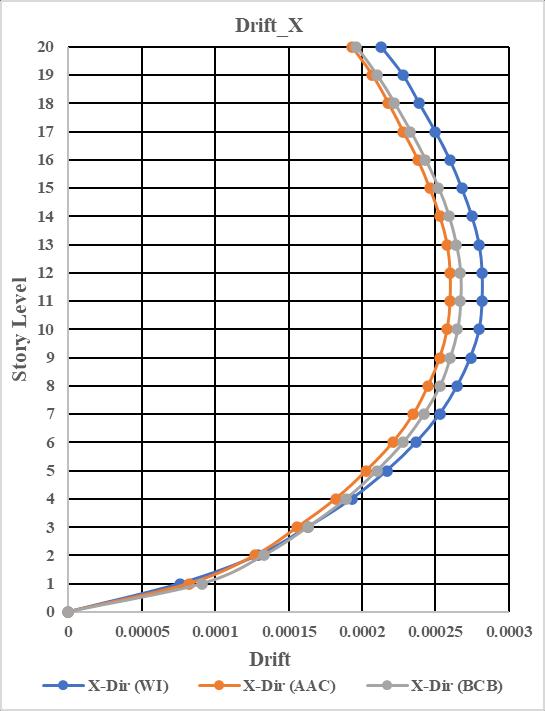
Chart -5:Storydisplacementalong_X
4.2.1.2 Drift along Y-axis:
o Loadcase:EQ+X
o Outputtype:Maximum
o StoryRange:AllStories
o Topstory:20
o Bottomstory:0
Thegraphandthetablebelowrepresentthemaximumstory driftintheY-directionfora20-storyasymmetricreinforced concretebuildingsubjectedtotheEQ+Xseismicloadcase.It evaluatesthedriftresponseforthreestructuralconditions:a bareframewithoutinfillwalls(WI),aframewithAutoclaved AeratedConcrete(AAC)blockinfillwalls,andaframewith BurntClayBrick(BCB)infillwalls.Theresultsindicatethat driftvaluesgenerallyincreasewithheight,peakingaround the mid to upper stories, and then decreasing slightly towardsthetop.Thebareframewithoutinfillwallsexhibits thehighestdriftvaluesacrossalllevels,reflectingitsgreater flexibilityandlowerlateralstiffnessintheabsenceofinfill walls. In comparison, autoclaved aerated concrete blocks andburntclaybricksinfillwallseffectivelyreducethestory driftsateverylevel.Notably,burntclaybrickswallsprovide slightly better performance than autoclaved aerated concreteblocks,especiallyinthemid-heightregionwhere driftismostcritical.
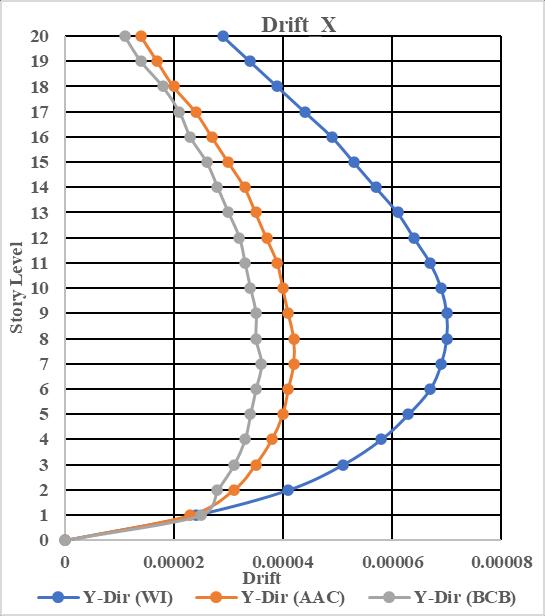
Chart -6:Storydisplacementalong_Y
Volume: 12 Issue: 04 | Apr 2025 www.irjet.net
Table -8: StoryResponseValues
4.2.2 Drift due to vibrations in Y-direction:
4.2.2.1 Drift along X-axis:
o Loadcase:EQ+Y
o Outputtype:Maximum
o StoryRange:AllStories
o Topstory:20
o Bottomstory:0
Thegraphandthetablebelowrepresentthemaximumstory driftintheX-directionfora20-storyasymmetricreinforced concretebuildingsubjectedtotheEQ+Yseismicloadcase.It compares three structural configurations: a bare frame withoutinfillwalls(WI),aframewithAutoclavedAerated Concrete (AAC) block infill walls, and a frame with Burnt ClayBrick(BCB)infillwalls.Theresultsshowthatstorydrift increasesgraduallywithbuildingheight,peakinginthemid toupperlevelsbeforeslightlytaperingoffnearthetop.The bare frame (WI) consistently exhibits the highest drift values, indicating greater lateral flexibility and lower stiffness. For example, themaximum drift for the without infillwallscasereaches0.00006atthe8thand9thstories.In contrast,theautoclavedaeratedconcreteblockandburnt
clay brick infill walls. The results show that story drift increasesinfillwallconfigurationssignificantlyreducethese values, withautoclaved aerated concrete block showing a maximumof0.000037andburntclaybrick evenlowerat 0.000033inthesamestories.Acrossalllevels,theburntclay brick infill walls perform slightly better than autoclaved aeratedconcreteblock,offeringgreaterresistancetolateral deformation. This is likely due to the higher density and stiffnessof BCBcomparedto autoclavedaeratedconcrete block. The consistent reduction in drift for the infill wall models highlights theircontribution toimprovingseismic performance by enhancing lateral stiffness and reducing inter-story movement. Overall, the data underscores the importance of incorporating infill walls in seismic design, particularlyintallbuildingswheredriftcontroliscriticalfor structuralintegrityandoccupantsafety.
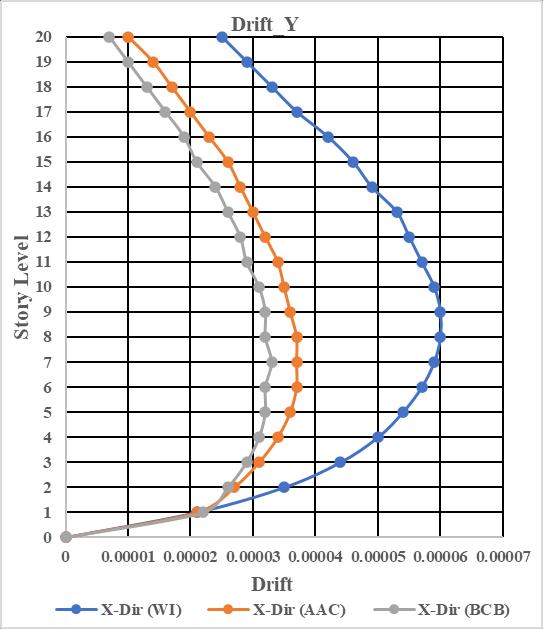
Chart -7:Storydisplacementalong_X
Table -9: StoryResponseValues
International Research Journal of Engineering and Technology (IRJET) e-ISSN: 2395-0056
Volume: 12 Issue: 04 | Apr 2025 www.irjet.net p-ISSN: 2395-0072
10 30 0.000059 0.000035 0.000031
9 27 0.00006 0.000036 0.000032
8 24 0.00006 0.000037 0.000032
7 21 0.000059 0.000037 0.000033
6 18 0.000057 0.000037 0.000032
5 15 0.000054 0.000036 0.000032
4 12 0.00005 0.000034 0.000031
3 9 0.000044 0.000031 0.000029
2 6 0.000035 0.000027 0.000026
1 3 0.000021 0.000021 0.000022 0 0 0 0 0
4.2.2.2 Drift along Y-axis:
o Loadcase:EQ+Y
o Outputtype:Maximum
o StoryRange:AllStories
o Topstory:20
o Bottomstory:0
The graph and the table below show the maximum story driftintheY-directionfora20-storyasymmetricreinforced concrete building under the EQ+Y seismic load case. It comparesthreeconfigurations:abareframewithoutinfill walls(WI),aframewithAutoclavedAeratedConcrete(AAC) blockinfillwalls,andonewithBurntClayBrick(BCB)infill walls.Driftvaluesincreasewithheight,peakingatthe13th story (39 m), where the bare frame reaches 0.000286. Autoclaved aerated concrete block and burnt clay brick reducethisdriftto0.000263and0.000272,respectively.The bare frame shows the highest drifts, indicating greater flexibilityandlowerstiffness.Infillwallssignificantlyreduce drift, with autoclaved aerated concrete block performing slightly better than burnt clay brick in most stories. This highlights the importance of infill walls in enhancing structural stiffness and minimizing deformation. IncorporatingAutoclaved aeratedconcreteblock or burnt clay brick in seismic design improves the lateral performance of high-rise buildings and ensures better compliancewithseismicsafetystandards.
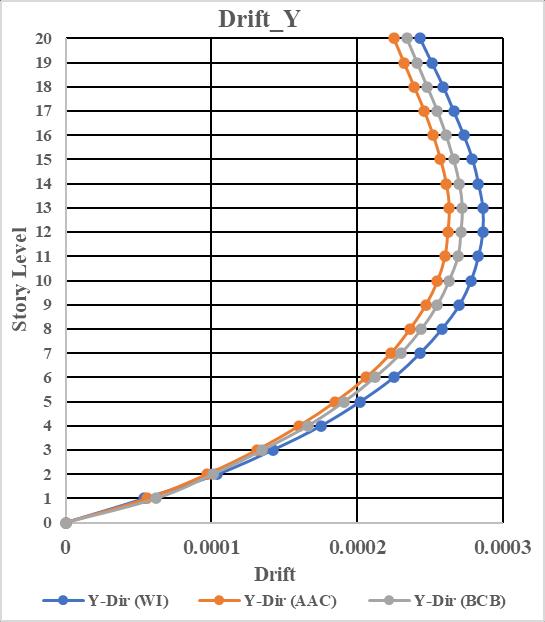
Chart -8:Storydisplacementalong_X
Table -10: StoryResponseValues
International Research Journal of Engineering and Technology (IRJET) e-ISSN: 2395-0056
Volume: 12 Issue: 04 | Apr 2025 www.irjet.net p-ISSN: 2395-0072
5. CONCLUSION
Basedonthecomprehensiveseismicanalysisofthe20-story asymmetric reinforced concrete building, the following conclusions can be drawn regarding the structural performanceofthebuildingwithandwithoutinfillwalls:
Basedonthestorydisplacementdataunderseismicwaves vibratinginXdirectionforbothXandYdirections,itis evident that the presence of infill walls significantly reduceslateraldisplacement acrossallstories.IntheXdirection,thetopstorydisplacementishighestforwithout infillat13.988mm,followedbyburntclaybricksat13.345 mm,andlowestforautoclavedaeratedblocksat12.973 mm.Thistranslatestoa7.26%reductionforautoclaved aerated blocks and 4.60% for burnt clay bricks when compared to without infill. Similarly, in the Y-direction, withoutinfillshowsatopdisplacementof3.236mm,while burntclaybricksandautoclavedaeratedblocksreduceit to 1.69 mm and 1.952 mm, representing a 47.76% reductionforburntclaybricksand39.68%forautoclaved aerated blocks. These findings highlight that while autoclaved aerated blocks provide the most consistent reduction across both directions due to their favorable stiffness-to-weight ratio, energy absorption, and lighter mass, burnt clay bricks perform even better in the Ydirectionduetotheirhigherstiffnessdespitetheirheavier weight. Overall, both infill types greatly enhance the building’s lateral performance, but autoclaved aerated blocksaremoreeffectiveinbalancingstiffnessandmass. These reductions highlightthevital rolethatinfill walls playinimprovingseismicresponsebyincreasinglateral stiffness and reducing story drift. While material properties of the infill can influence the extent of improvement, the overall conclusion is clear structures withinfillwallsperformsubstantiallybetterunderseismic loadingthanbareframes,resultinginsafer,moreresilient buildings.
Examiningthestructuralresponseunderseismicwaves vibratinginYdirectionrevealsanotableimpactofinfill walls on reducing lateral displacements across both directions.IntheX-direction,themaximumdisplacement at the top story is 2.776 mm for the structure without infill, which reduces to 1.695 mm with autoclaved aeratedconcreteand1.477mmwithburntclaybricks. This corresponds to a reduction of approximately 38.93% with autoclaved aerated concrete and 46.80% withburntclaybrickscomparedtothebareframe.Inthe Y-direction, the top story displacement is 13.977 mm without infill, which reduces to 12.879 mm with autoclavedaeratedconcreteand13.344mmwithburnt claybricks,resultinginreductionsof7.84%and4.53%, respectively. These results show that infill walls considerably enhance structural performance under seismicexcitation,especiallyintheorthogonaldirection (X-directioninthiscase),wherethestiffnesscontribution
is more pronounced. While both types of infill offer improvedresistance,thekeyconclusionisthatstructures with infill walls experience substantially lower displacements than those without, underscoring the criticalroleofinfillinenhancingseismicresilience.
Analyzing the structural drift behavior under seismic waves vibrating in X direction reveals the important contribution of infill walls in controlling lateral deformations.IntheX-direction,themaximumstorydrift forthestructurewithoutinfillis0.000282,whichreduces to 0.00026 with autoclaved aerated concrete and 0.000267 with burnt clay bricks, resulting in a drift reduction of approximately 7.80% and 5.32%, respectively.IntheY-direction,themaximumdriftwithout infill is 0.00007, which significantly drops to 0.000042 withautoclavedaeratedconcreteand0.000036withburnt claybricksasubstantialreductionof40.00%and48.57%, respectively. These results confirm that infill walls enhancelateralstiffnessandeffectivelylimitstorydrift, particularlyintheorthogonaldirection(Y-directioninthis case), where the reduction is more pronounced. While both AAC and BCB show beneficial effects, the broader conclusionisthattheinclusionofinfillwallssignificantly improves drift performance, making the structure safer andmorereliableduringseismicexcitation.
The behavior of the structure under seismic waves vibratinginYdirectionhighlightstheeffectivenessofinfill walls in reducing story drift across both principal directions.IntheX-direction,themaximumstorydriftfor thestructurewithoutinfillis0.00006,whichdecreasesto 0.000037withautoclavedaeratedconcreteand0.000033 withburntclaybricks.Thiscorrespondstoapercentage reduction of approximately 38.33% and 45.00%, respectively. In the Y-direction, the peak drift value withoutinfillis0.000286,whichdropsto0.000263with autoclavedaeratedconcreteand0.000272withburntclay bricks, indicating a reduction of 8.04% and 4.90%, respectively.Thesefindingsemphasizethecriticalroleof infillwallsincontrollinglateraldeformation,especiallyin theorthogonal(X)directionwheretheircontributionto stiffness is more significant. While both infill types enhance seismic performance, the broader conclusion remains that structures with infill walls demonstrate markedly better drift control compared to bare frames, ultimately leading to improved resilience and safety duringseismicevents.
Theseismicperformanceassessmentofasymmetrichigh-rise reinforced concrete (RC) buildings with and without infill wallsclearlydemonstratesthatinfillwallsplayapivotalrole in enhancing structural behavior during seismic events. AcrossallcasesofseismicwavespropagatinginbothXandY
International Research Journal of Engineering and Technology (IRJET) e-ISSN: 2395-0056
Volume: 12 Issue: 04 | Apr 2025 www.irjet.net p-ISSN: 2395-0072
directions, the presence of infill walls significantly reduced storydisplacementanddriftvalueswhencomparedtobare frames.Notably,thereductionsweremorepronouncedinthe directionorthogonaltothewavepropagation,confirmingthe stiffeningeffectofinfillwallsacrosstheframe.Theseresults underlinethesubstantialcontributionofinfillwallstolateral stiffnessandseismicresistance.Overall,structureswithinfill walls consistently outperformed those without, showing improved stability, reduced deformation, and enhanced resilience.Therefore,incorporatinginfillwallsinstructural modelingandseismicdesignisessentialforachievingsafer and more reliable performance of high-rise RC buildings underearthquakeloading.
6. REFERENCES
[1] Bureau of Indian Standards (BIS), IS 1893 (Part 1):2016 – Criteria for Earthquake Resistant Design of Structures – Part 1: General Provisions and Buildings, NewDelhi:BureauofIndianStandards,2016.
[2] Bureau of Indian Standards (BIS), IS 456:2000 – Plain and Reinforced Concrete – Code of Practice,NewDelhi: BureauofIndianStandards,2000.
[3] Bureau of Indian Standards (BIS), IS875(Part1):1987 – Code of Practice for Design Loads (Other Than Earthquake) for Buildings and Structures – Part 1: Dead Loads – Unit Weights of Building Materials and Stored Materials,NewDelhi:BureauofIndianStandards,1987.
[4] Bureau of Indian Standards (BIS), IS875(Part2):1987 – Code of Practice for Design Loads (Other Than Earthquake) for Buildings and Structures – Part 2: Imposed Loads,NewDelhi:BureauofIndianStandards, 1987.
[5] Bureau of Indian Standards (BIS), IS1905:1987 – Code of Practice for Structural Use of Unreinforced Masonry, NewDelhi:BureauofIndianStandards,1987.
[6] Bureau of Indian Standards (BIS), IS 2185 (Part 3):1984 – Concrete Masonry Units – Part 3: Autoclaved Cellular (Aerated) Concrete Blocks – Specification,New Delhi:BureauofIndianStandards,1984.
[7] Bureau of Indian Standards (BIS), IS 1077:1992 –Common Burnt Clay Building Bricks – Specification,New Delhi:BureauofIndianStandards,1992
[8] Rajesh, C., Kumar, R. P., & Kandru, S. (2014). Seismic performance of RC framed buildings with & without infillwalls.IntJEngResTechnol,3(10),2278-0181.
[9] Wakchaure, M. R., & Ped, S. P. (2012). Earthquake analysisofhighrisebuildingwithandwithoutinfilled walls. International Journal of Engineering and InnovativeTechnology(IJEIT)Volume,2.
[10] Gayathri, R., Harshitha, & Malleshiah, T.S. (2022). Analysis and design of multi-storey building using ETABS. International Journal of Engineering and Techniques,8(5),70-73.
[11] Haritha, D., Kumar, P. A.,Nagaraju, K.,Gopi, P.S., Nagaragu,S.,&Rajesh,M.(2021).Analysisofmulti-story buildingusingETABSsoftware.JournalofEngineering SciencePublication,12(7),610-620.
[12] REDDY,D.K.C.,&KUMAR,G.L.InternationalJournalof TechnicalInnovationinModernEngineering&Science (IJTIMES).
[13] Reddy,K.D.P.,&Rao,N.S.(2017).Seismicevaluationofa high-rise building with & without infill walls. InternationalJournalofResearch,4(9),1747-1761.
[14] Tamboli, H. R., Karadi, U. N., & Tamboli, H. R. (2012). SeismicanalysisofRCframestructurewithandwithout masonryinfillwalls.IndianJournalofNaturalSciences InternationalBimonthlyISSN,0976-0997.
[15] Dilmac,H.,Ulutas,H.,Tekeli,H.,&Demir,F.(2018).The investigation of seismic performance of existing RC buildingswithandwithoutinfillwalls.Computersand Concrete,22(5),439-447.
[16] Tidke, K., & Jangave, S. (2016). Seismic analysis of buildingwithandwithoutinfillwall.IntJInnovResSci EngTechnol,5(7),12646-52.
[17] Rao, K. S. N., Gottala, A., & Yajdani, S. Behavior of a Multistoried Building with and without infill Walls underSeismicForcesusingSTAAD.PRO.