
International Research Journal of Engineering and Technology (IRJET) e-ISSN: 2395-0056
Volume: 13 Issue: 03 | Mar 2026 www.irjet.net p-ISSN: 2395-0072

International Research Journal of Engineering and Technology (IRJET) e-ISSN: 2395-0056
Volume: 13 Issue: 03 | Mar 2026 www.irjet.net p-ISSN: 2395-0072
Md Taufique Alam1, Prof. Akil Ahmed2
1Phd Scholar, Dept. of Civil Engineering, Jamia Millia Islamia, New Delhi, India
Abstract - Earthquakes stand as one of the most devastating and unpredictable natural phenomena, inflicting severe destruction on both human lifeandbuiltinfrastructure. The forces unleashed during seismic events can critically damage structural components, often leading to their complete failure. Concurrently, rapid urbanization has made available land for construction increasingly scarce and expensive, thereby driving the growing popularity of tall buildings. A beam-column is a structural element designed to resist both axial forces and bending moments. In practice, all members within a frame experience these combined effects, though for simplicity, a member is typically classified as a beam when the axial force is negligible relative to the bending moment, and as a column when the bending moment is insignificant compared to the axial load. In beam-columns, bending moments and deflections arise from two sources: primary effects, caused by applied loads andtransverseforces, and secondary effects, known as the P-Delta effect, which result from axial loads acting through lateral displacements.
This study analyzed tworeinforcedconcrete(RC)modelsusing SAP2000 software, introducing asymmetry in both, while incorporating a lift core in one model to assess its influenceon structural behaviour. Vertical and seismic loads were applied to evaluate parameters such as displacements andbaseshear. Primary momentswereexaminedusingtheresponsespectrum method, while secondary moments were assessed through second-order P-Delta analysis, quantifying the percentage increase in secondarymomentsrelativetofirst-ordermoments across all columns. Regression analysis was subsequentlyused to establish relationships between this percentage increase and the number of stories. The results revealed that the asymmetric lift core induces localized stress concentrations, affecting the distribution of internal forces and deformations. For a G+9 building with a lift core, the maximum storey displacement reached 25.5 mmintheX-directionand20.3mm in the Y-direction, with P-Delta effects contributing an approximate 10% increase. In contrast, the model without a lift core exhibited higher displacements of 41.3 mm (X) and 41.7 mm (Y), with a 5% increase from P-Delta effects. Maximum storey drift for the model with a lift core was 3.3 mm (X) and 2.6 mm (Y), compared to 5.9 mm in both directions for the model without it. A strong correlation was observed between the maximum displacements of the two models under lateral loads, with correlation coefficients of approximately 0.9934 in the X-direction and 0.98836 in the Ydirection.
Key Words: Storeydrift,Storeydisplacement,P-Delta, Correlation,BaseShearetc
1.INTRODUCTION
Theseismicstabilityofastructuralsystemwhensubjected to probable earthquake ground motions can be assessed through a seismic evaluation of the building. Seismic performance refers to a structure's ability to preserve its essential functions namely safety and usability both during and after a specified level of seismic exposure. A buildingistypicallyconsideredsafeifitdoesnotendanger the lives and well-being of its occupants or nearby individualsthroughpartialortotalcollapse.
Due to their distinctive characteristics in terms of seismic response, asymmetric structural configurations have garneredsignificantattentionwithinthefieldofearthquake engineering.Asymmetriesinstructuralsystemsrefertothe uneven distribution of mass, stiffness, and strength throughout a building. These can arise from variations in floor heights, irregular floor plans, differing column dimensions,andotherfactors.Suchasymmetriesleadtoan uneven distribution of seismic forces among structural elements, potentially causing localized or global irregularities in response. In the present study, a lift core was incorporated into an asymmetric reinforced concrete (RC)mid-riseframe.Theinclusionofaliftcoreintroduces complexity to the building design and can influence its seismic performance. The interaction between inherent asymmetriesandthepresenceofaliftcorecansubstantially affectthedynamicbehaviourandseismicresponseofthese structures.
Theadditionofaliftcore,whichtypicallyhousesabuilding’s vertical transportation system, further accentuates the structural asymmetry. As a concentrated element of both massandstiffness,theliftcorecansignificantlyinfluencethe distribution of seismic forces throughout the building. Dependingonitsconfigurationandtheexistingasymmetries within the structural system, this interaction may either amplifyormitigatetheoverallseismicresponse.Structural engineers and designers must understand the seismic implicationsassociatedwithintegratingaliftcoreintoRC mid-rise frames. Such understanding enables informed decision-making during design, leading to safer and more resilientstructures.Byanalyzingthedynamicbehaviourof these systems, engineers can identify potential vulnerabilities and develop effective design strategies to enhanceseismicperformance.Thisstudyaimstoinvestigate
International Research Journal of Engineering and Technology (IRJET) e-ISSN: 2395-0056
Volume: 13 Issue: 03 | Mar 2026 www.irjet.net p-ISSN: 2395-0072
theseismiceffectsandresponsecharacteristicsofRCmidrise frames incorporating a lift core. Through a detailed examination of various structural properties and configurations,theinfluenceofbothinherentasymmetries andthoseintroducedbytheliftcoreonseismic behaviour willbeexplored.Thefindingswillcontributetotheexisting bodyofknowledgeinearthquakeengineeringandsupport the development of guidelines and recommendations for designingmorerobustandresilientmid-risebuildings.
Overall,thisresearchseekstoclarifythecomplexinterplay betweenasymmetriesandtheintegrationofaliftcoreinRC frames. By comprehensively evaluating their seismic implications, this study aims to deepen understanding of thesestructuralsystemsandoffervaluableinsightsforthe designofsafer,moreefficientbuildingsinseismicallyactive regions.
These effects can be briefly summarized as follows: a.Buildingscharacterizedbyanasymmetricdistributionof stiffnessandstrengthinplanexperiencecoupledlateraland torsionalmotionsduringearthquakes.Torsionaleffectsare minimizedbyreducingthedistancebetweenthecentreof massandthecentreofstiffness.Thedynamicresponseofa buildingstructureisgovernedbyitsstiffnesscharacteristics. b.Thestiffnesscharacteristicsdictatethedynamicbehaviour of the building structure. Selecting appropriate stiffness properties is a crucial step during the conceptual design phase. A well-distributed lateral load-resisting system ensuresfavourablestructuralperformance.
1. Toanalyzeandcompareresponse-spectrumandPDeltaeffectsusingSAP2000models.
2. To evaluate displacement, storey drift, and base shear inRC buildings withand withouta liftcore, consideringP-Deltaeffects.
3. To establish regression relationships between the twomodeltypes.
1.2 Literature Review
1.2.1
1.Pintucchiet.al.(2008) Reviewedseismicbehavior of plan and vertically irregular buildings. Pushover proceduresemergedaseffectivealternatives.Baseisolation anddampersreducetorsionalresponse.Discontinuitiesin mass,stiffness,orstrengthdonotalwayscausepoorseismic performance.
2.Soniet.al.(2018) Analyzedregularandirregularflatslab buildings with mass irregularities. Edge and corner locationsexhibitedreducedbendingmomentswithoutmass irregularity.Basesheardecreasedtowardthetopwhenno massirregularityexistedatcorners.Verticalirregularityat cornersinfluenceddynamicperformance.
3. Kumar et. al. (2020) Studied lateral load behavior of irregular residential buildings across five offset configurations. Linear analysis produced 70% higher displacementthannonlinearanalysis.Baseshearincreased 30% from Zone 2 to Zone 5. Static analysis yielded 40% higherstoreyshearthanpushoveranalysis.
1. Yahyaei et al. (2012) Compared static and dynamic analysis of 20-story irregular buildings in Zone V. Static analysis produced greater displacement than dynamic analysis, with differences becoming significant at upper stories. Center of mass displacement was lower than at maximum displacement points. Dynamic analysis yielded higher displacement values, making static results uneconomical.
2.Singhet.al(2021) Analyzedsymmetricandasymmetric buildings with and without shear walls across six models. Storey shear increased by 64–75% in models with shear walls. Displacement reduced by 35–40% and storey drift reducedby43–50%inshearwallmodels.Model2(regular withshearwall)wasthemoststable.
3. Subash (2017) Studied P-Delta effects on vertically irregular30-storyRCbuildings.Displacementincreasedwith irregularity level. Regular frames exhibited minimal displacement. Seismic parameters were lower without PDelta effects than with. Irregularities are damaging but unavoidable;designsshouldmitigateseismiceffects.
4. Yerekar Sir et al. (2016) Examined lift core location effects on G+5 and G+10 buildings in Zone V. Corner lift coresincreasedstoreydriftduetotorsionalmode.Hardsoil strata provided optimal safety. Lift cores enable costeffectivedesignwithadequatesafety.
5. Azizan et. al. (2017) Assessed lift core placement sensitivity in T-shaped RC buildings. Lift core position significantlyinfluencedtorsionalmomentacrossallbuilding heights. Central areas showed pronounced differences. Placingtwoliftcoresatthefarendofthetopwingeffectively reducedtorsion.
1. R. Vijayalakshmi et al (2017) Investigated P-Delta effectsin10to40-storyhigh-risebuildings.Analysisshowed P-Delta effects were more pronounced in upper stories basedonload-deflectioncurvecomparisons.
2. D. Yousuf et al (2013) Studied global slenderness effectsonP-DeltaanalysisusingSTAADProv8iacrossfour slendernessratios.P-Deltaanalysisisrequiredforstructures exceeding seven stories due to significant displacement variationwithincreasingslenderness.
Volume: 13 Issue: 03 | Mar 2026 www.irjet.net p-ISSN: 2395-0072
1.Two building models symmetric and asymmetric (the latter featuring an added lift core) with identical dimensions(G+9,24mx20mplan,5mbayspacing,3mstorey height) were analyzed using SAP-2000 finite element software.
2.A linear dynamic response spectrum analysis was conducted on both models to compare base shear, storey drift,lateraldisplacement,andirregularlocations.
3.The P-Delta effect, whichcauses second-order moments anddeflectionsthatincreasememberinstability,dependson appliedloads,materialproperties,andgeometricfactorssuch asheight,stiffness,andasymmetry.
4.Thisstudyfocusesontheelasticrangeignoringmaterial yielding, and numerical methods (unlike closed-form solutions) can effectively capture P-Delta effects in both elasticandinelasticranges.
5.Thefiniteelementmethod,widelyacceptedinengineering, derives the stiffness matrix by minimizing total potential energybasedontheprincipleofstationarypotentialenergy, whereequilibriumoccurswhenpotential energyvariation vanishes.
1. Two building models symmetric and asymmetric (the latterincorporatingaliftcore) withidenticaldimensions (G+9, 24m x20m plan, 4mbay spacing, 3m storey height) weremodelledusingSAP-2000finiteelementsoftware.
2. Alineardynamicanalysiswasconductedonbothmodels toevaluatetheirseismicbehaviour.
3. A comparative assessment was performed focusing on base shear, storey drift, lateral displacement, and identificationofirregularlocationswithineachmodel.
2.2.1
Responsespectrumanalysis(RSA)simplifiesmodalanalysis byprovidingquickpeakresponseestimateswithoutsolving differentialequationsovertime,makingitfarmoreefficient than time history analysis while conveniently describing seismic hazard through response spectra. Modal analysis transformsacoupledN-degree-of-freedomproblemintoN uncoupled single-degree-of-freedom problems, whose individual solutions are superimposed to obtain the final result. Structural engineers widely use RSA to evaluate dynamicreactionsunderearthquakes,relyingonresponse spectra graphicalrepresentationsofmaximumstructural responses (displacement, acceleration, or velocity) across various natural periods. The general process involves defining the design earthquake, modeling structural characteristicstoidentifyperiodsandmodeshapes,deriving theresponsespectrumfromgroundmotiondataappliedto
single-degree-of-freedom systems, and comparing results againstdesigncriteriaorcodalrequirements.Thissystematic approach is especiallyvaluable in earthquake engineering, enabling informed design decisions that ensure structural safetyandreliability.
TheP-Deltaeffectisasecond-ordernonlinearphenomenon occurring in structures under axial loads and bending moments,becomingmoresignificantintallbuildingswhere gravityload(P)actingthroughfirst-orderdisplacement(Δ₁) producesadditionaloverturningmomentsanddeflections.Its magnitudedependsonaxialload,stiffness,andslenderness ofbothindividualmembersandtheoverallstructure,making itespeciallycriticalforhigh-risebuildings.Twodistincttypes exist: member P-δ effect, caused by axial force acting on a deflected individual member between endpoints, and structuralP-∆effect,causedbyverticalloadsactingonthe laterallydisplacedstructureasa whole.Bothtypesinduce additionalstressesanddestabilizingeffects,thereforeseismic design of multi-storey structures mustaccount for P-Delta considerations.InSAP2000,P-Deltaanalysisperformsafirstorderlinearanalysistoderivejointforces,thenrecalculates forcesanddisplacements ina second-orderanalysis when specified,anddynamicanalysisiscarriedoutifaresponse spectrumisdefinedwithinaloadcase.
Thebuildinghasa total planarea of24mx20m,withall structuralmembers(slab,columns,andbeams)constructed using M30 grade concrete. The slab thickness is 125 mm, beamsinbothXandYdirectionsmeasure450mmx250mm, and column sizes vary by storey: 700 mm x 700 mm for storeys1to4,and500mmx500mmforstoreys5to6.
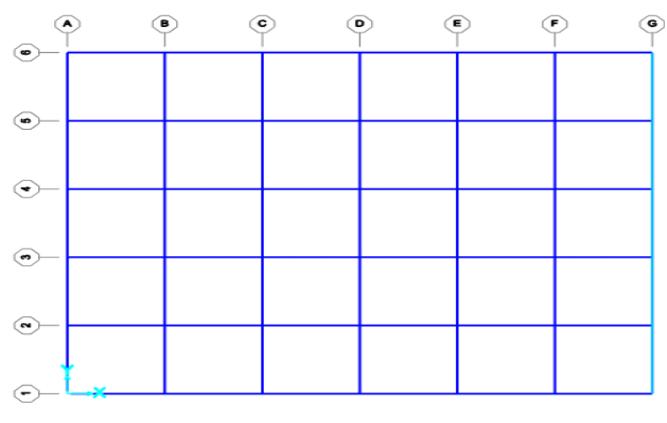
Fig-1:PlanofModel Table-1: SeismicZonefactor
International Research Journal of Engineering and Technology (IRJET) e-ISSN: 2395-0056
Volume: 13 Issue: 03 | Mar 2026 www.irjet.net p-ISSN: 2395-0072
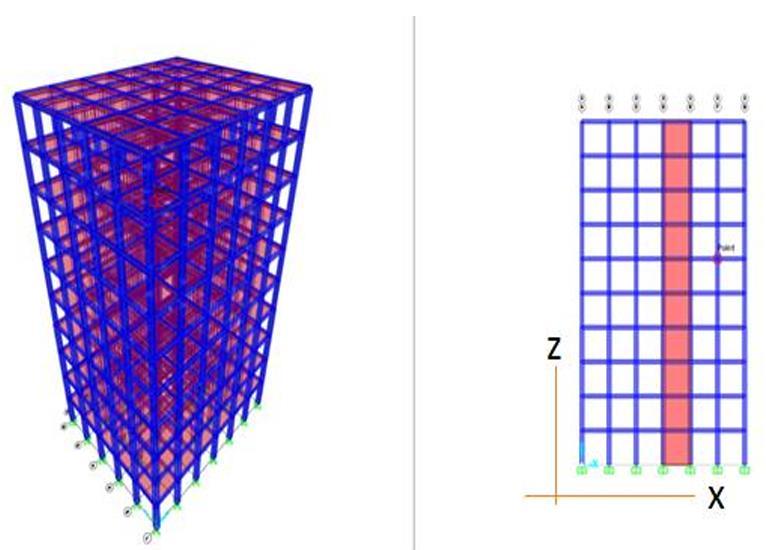
:3DrenderedmodelwithliftcoreinX-Zplane.
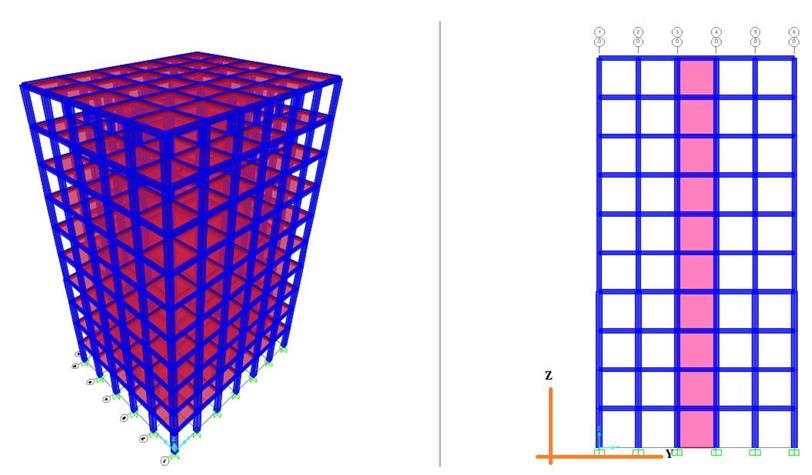
Fig-3:3DrenderedmodelwithliftcoreinY-Zplane.
Figure2andfigure3indifferentplanesrepresents3D renderedmodelofG+9building.asprepareinsap2000.
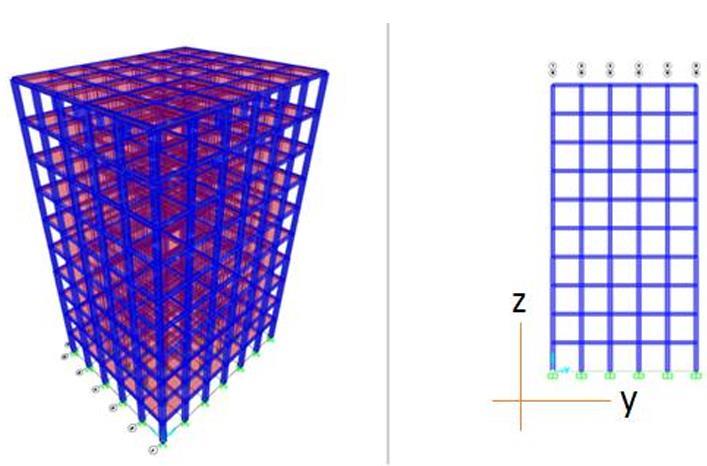
Fig 4:3DrenderedmodelofG+9withoutliftcore
LoadvalueshavebeentakenfromIS:875(PartI)-1987,and IS:875(PartII)-1987
Dead, live, and seismic loads were assigned per IS codes. Dead load (IS 875:1987) included beam (2.81 kN/m), column(12.25kN/mfor0.7m,9kN/mfor0.6m),slab(3.125 kN/m²),andfloorfinish(1.5kN/m²,roof0.9kN/m²).Live load (IS 875 Part 2:1987) was 3 kN/m². Seismic loads (IS 1893Part1:2016)usedZoneIV(zonefactor0.24),softsoil (TypeIII),importancefactor1.2(residential),andreduction factor3(OMRF).
4. Result and Discussion.
4.1.2 Displacement Observed with Response Spectrum Method
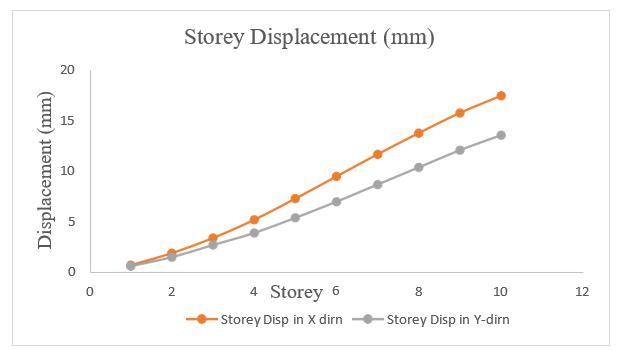
Fig-5: StoreyDisplacementforG+9Modelwithliftcore
AccordingtothestoreydisplacementforG+9Modelwithlift coregraph,thevalueofstoreydisplacementhasincreased fromthebottomstoreytothetopstoreyandisgreateston the top-most level. additionally, storey displacement is greater in the X- direction and much less so in the Ydirection as shown in figure 5. Presence of lift core will causedifferentstoreydisplacementinbothdirections
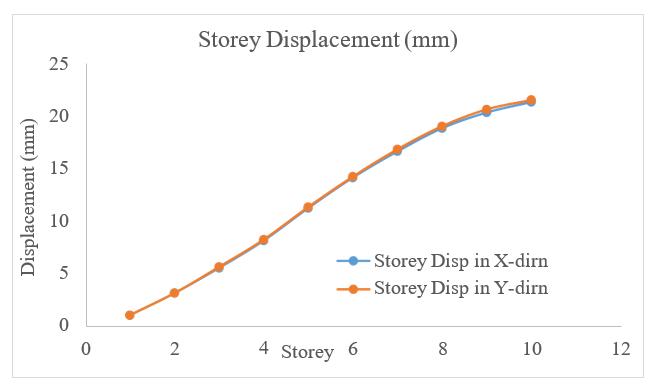
Fig-6: StoreyDisplacementforG+9Modelwithoutliftcore
International Research Journal of Engineering and Technology (IRJET) e-ISSN: 2395-0056
Volume: 13 Issue: 03 | Mar 2026 www.irjet.net p-ISSN: 2395-0072
Itisdeterminedthatthemaximumstoreydisplacementis 21.3mmintheX-directionand21.5mmintheY-direction. and the topmost story in both directions experiences the most storey displacement as we can observed in figure 6 Thestoreydisplacementobservedsamebecausenoresisting elementusedinthemodel.
4.1.2 Displacement observed with P-Delta effect
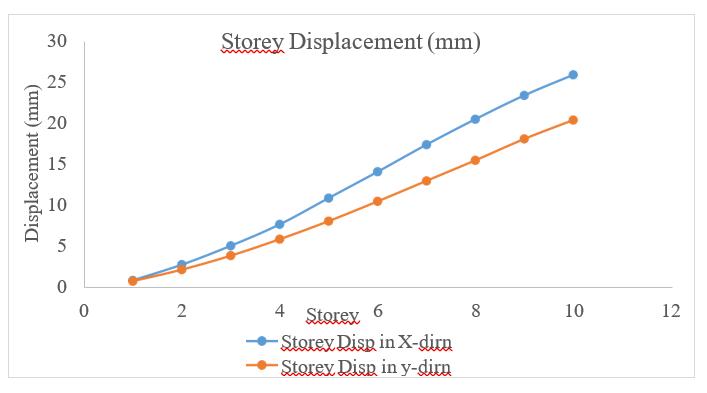
After P-Delta analysis, the maximum storey displacement was 25.82 mm in the X-direction and 20.3 mm in the Ydirection,bothoccurringatthetopstorey.Theliftcoreacted asashearwall,significantlyreducinglateraldisplacement comparedtothemodelwithoutaliftcore,whichlackedsuch aresistingelement.
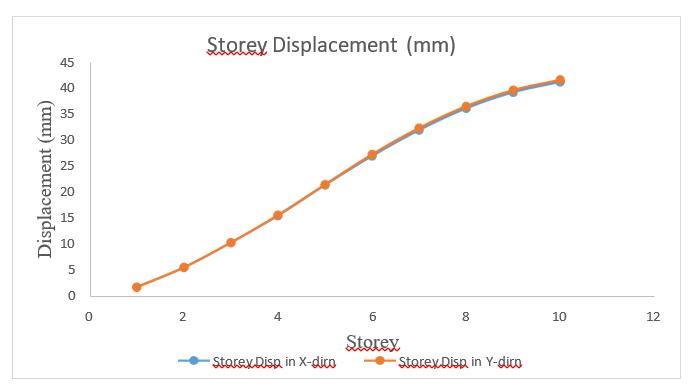
Accordingtothefiguredisplayedin8,themaximumstorey displacementis41.3mmintheX-directionand41.7mminthe Y-direction. Also, we can see from the graph that the maximumstoreydisplacementisattopinbothdirections.
4.2.1 Storey Drift with Response Spectrum Method
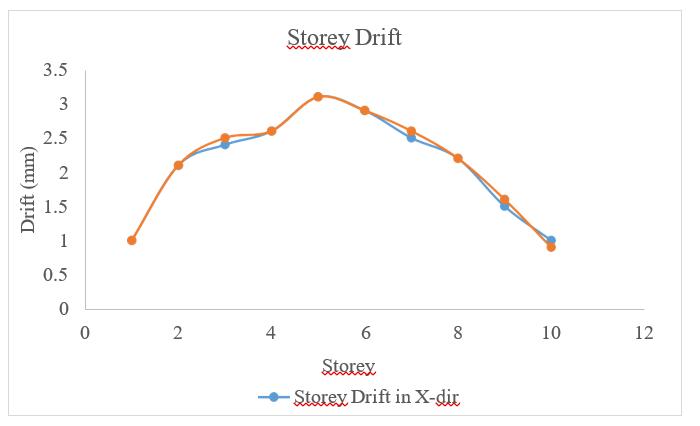
Fig-9: StoreyDriftforG+9Modelwithoutliftcore
Maximumstoreydriftismeasuredtobe3.1mmintheX and3.1mmintheYdirections.thesixthstoreyiswhere the maximum storey drift occurs in both X and Y directions as shown in figure 5-5. The storey drift observedsamebecausenoresistingelementusedinthe model.
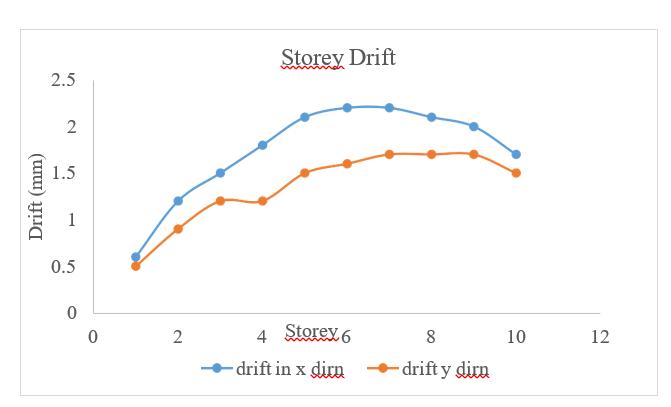
Fig-10: StoreyDriftforG+9Modelwithliftcore
For the G+9 model under X-direction loading, storey drift rises from ground to the sixth storey and then decreases toward the eighth storey. Under Y-direction loading, the highest drift occursat the eighth, ninth, andtenthstoreys, withaminimumvalueof0.5mm.Thepresenceoftheliftcore reducesstoreydriftinbothdirections.Asshowninfigure10.
4.2.1 Storey Drift with P-Delta effect
Asshowninfigure11,themaximumstoreydriftmagnitudeis 5.9mmintheX-directionand5.9mmintheY-direction.The maximumstorydriftisonthesixthstoreyinboththeXandY directions,asseeninfigure11.
International Research Journal of Engineering and Technology (IRJET) e-ISSN: 2395-0056
Volume: 13 Issue: 03 | Mar 2026 www.irjet.net p-ISSN: 2395-0072
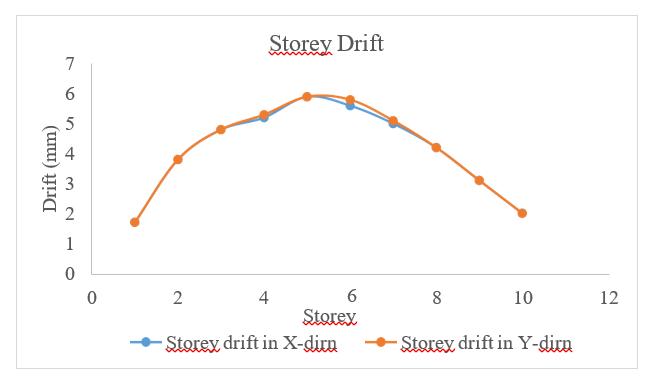
Fig-12: StoreyDriftforG+9Modelwithoutliftcore
Maximumstoreydriftisdeterminedtohaveanamplitude of 3.3 mm in the X-direction and 2.6 mm in the Ydirection.Thefigure12showsthatthemaximumstorey driftoccursattheeighthlevelwhentheloadisconsidered tobeintheX-directionandatthetenthstoreywhenthe forceisconsideredtobeintheY-direction.
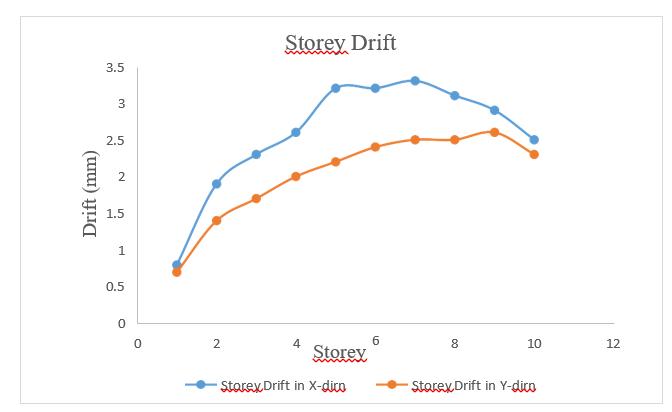
Fig-12: StoreyDriftforG+9Modelwithliftcore
4.3 Time Period and Frequency as Per P-Delta Analysis
Thetimeperiod(ornaturalperiod)ofastructureisthe duration tocomplete one full vibrationcycle, primarily influenced by the building's height, stiffness, and mass distribution.Buildingswithshortertimeperiodsoscillate quickly under seismic motion, while those with longer periods oscillate slowly. To avoid resonance which amplifies structural response buildings should be designed with time periods that do not match typical earthquakegroundmotionfrequencies.
Table-2: ResultsobtainedofTimePeriodandFrequency for12Modes
Frequency,measuredinHertz(Hz),isthereciprocal of thetimeperiodandrepresentsoscillationsperunittime, with different structural elements possessing distinct natural frequencies. Low-frequency ground motions (longerperiods)tendtodamagetaller,flexiblestructures more, while high-frequency motions (shorter periods) moreseverelyaffectshorter,stifferbuildings.Damping refers to the energy loss within a structure during oscillation, and engineers must consider the frequency contentofseismicloadstoensurestructuralcomponents canwithstandforcesacrossvariousfrequencies.
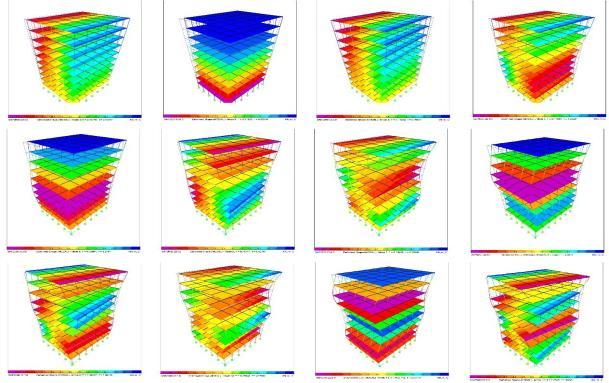
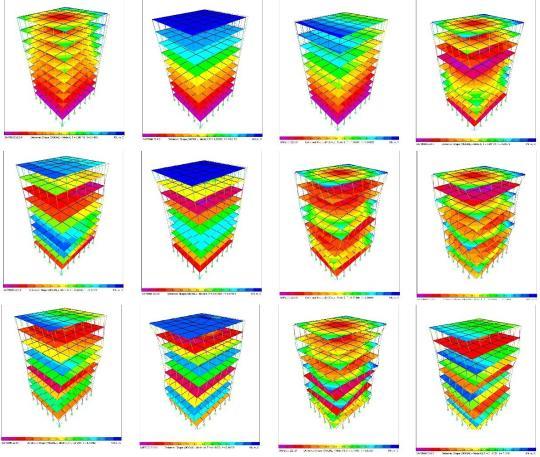
Fig-13:Modeshapesformodelwithoutliftcore.
International Research Journal of Engineering and Technology (IRJET) e-ISSN: 2395-0056
Volume: 13 Issue: 03 | Mar 2026 www.irjet.net p-ISSN: 2395-0072
The Model Load Participation Ratio (MLPR) is a helpful metricfordetermininghowthevariousvibrational modes affect the structure's overall response. The level of each vibration mode's contribution to conveying the supplied loadsorexcitationsisindicatedbytheMLPR.
Table-3: Model Participationfactorforbuildingswithand withoutliftcore
Thecorrelationfactorisadimensionlessvaluebetween0and 1 that quantifies the relationship between lateral displacements and member axial forces or moments in PDelta analysis. A value of 1 indicates perfect correlation where lateral displacements fully influence axial forces or moments, while 0 indicates no influence. This factor is particularly significant for tall, flexible structures and systems vulnerable to lateral loads or stability issues. By introducingthecorrelationfactor,engineerscanaccurately model theP-Delta phenomenonduringstructural analysis. Consequently, it produces more reliable and trustworthy resultsforstructuraldesignandevaluation.
4.5.1 G+9 Modal with and Without Lift Core
The correlation between the maximum displacementforG+9withandwithoutliftcoreisy = 0.9934x when considering displacement in Xdirectionasthetrendchartshowninfigure14.
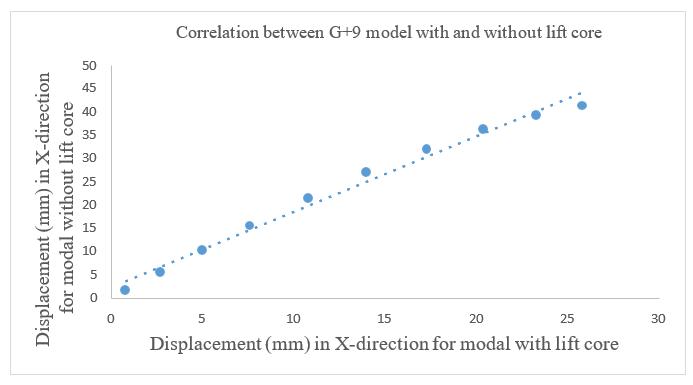
Fig-14: CorrelationbetweenG+9modelwithand withoutliftcorefordisplacementinX-direction
The correlation between the maximum displacementforG+9withandwithoutliftcoreisy = 0.98836x when considering displacement in Ydirectionasthetrendchartshowninfigure15.
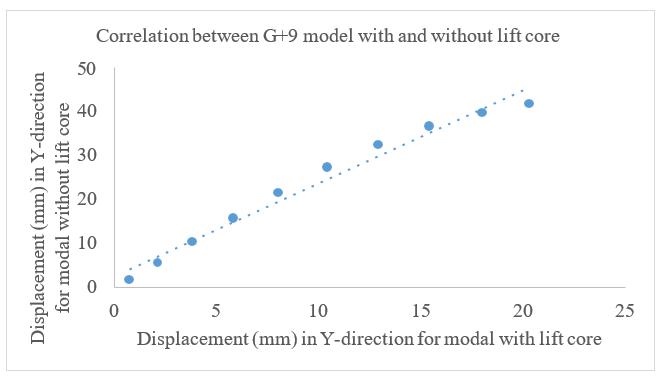
Fig-15: CorrelationbetweenG+9modelwithand withoutliftcorefordisplacementinY-direction.
5 Conclusion
Inthisstudy,threedistinctmodelsofexistingstructuresare studied in the high seismic zone and are analyzed using SAP2000 software while taking the p–delta analysis into accountthefollowinginformationisrecorded:
1)MaximumDisplacement:
a)MaximumstoreydisplacementmeasuredforG+9model with lift core is 25.5 mm in X direction and 20.3 mm in Y direction. The P-delta analysis resulted in a 9.68% or approximately 10% increase in the maximum storey displacement.
b)MaximumstoreydisplacementmeasuredforG+9model withoutaliftcoreis41.3mminXdirectionand41.7mminY direction. The P-delta analysis resulted in a 4.84% or approximately 5% increase in the maximum storey displacement
2)MaximumStoreyDrift:
a)MaximumstoreydriftmeasuredforG+9model withlift coreis3.3mminXdirectionand2.6mminYdirection.
b)MaximumstoreydriftmeasuredforG+9modelwithlift coreis5.9mminboththeXandYdirection.
3)CorrelationFactor:
a)Thecorrelationbetweenthemaximumdisplacementfor G+9 with and without lift core is y = 0.9934x while consideringlateralloadinX-direction.
b)Thecorrelationbetweenthemaximumdisplacementfor G+9 with and without lift core is y = 0.98836x while consideringlateralloadinY-direction.
International Research Journal of Engineering and Technology (IRJET) e-ISSN: 2395-0056
Volume: 13 Issue: 03 | Mar 2026 www.irjet.net p-ISSN: 2395-0072
[1] AbulHasnat,MRifatIbteshamRahim“Responseof Building Frames with Vertical and Stiffness Irregularity due to Lateral Loads”. International Journal of Engineering Research & Technology (IJERT)ISSN:2278-0181Vol.2Issue12,December –2013.
[2] Abdul Tawfiq Pouya “P-Delta Effects on Tall ConcreteBuildings”.KardanJournalofEngineering andTechnology1(1)58–68©2019.
[3] Asra Fathima , Shashi Kumar N V “Behavior Of Vertical Irregular Building In Different Seismic Zones”. European Journal of Molecular & Clinical Medicine ISSN 2515-8260. Volume 07, Issue 08, 2020.
[4] A.S. Moghadam and A. Aziminejad “Interaction Of TorsionAndP-DeltaEffectsInTallBuildings”13th World Conference on Earthquake Engineering Vancouver,B.C.,CanadaAugust1-6,2004PaperNo. 799.
[5] Bahador Bagheri, Ehsan Salimi Firoozabad, and MohammadrezaYahyaei“ComparativeStudyofthe Static and Dynamic Analysis of Multi-Storey Irregular Building”.World Academy of Science, EngineeringandTechnologyInternationalJournal ofCivil,Environmental,Structural,Constructionand ArchitecturalEngineeringVol:6,No:11,2012.
[6] BanerjeeP,BürgmannR.“Convergenceacrossthe northwest Himalaya from GPS measurements ”.EuropeanJournalofMolecular&ClinicalMedicine ISSN2515-8260.Volume07,Issue08,2020.Nature 1997;386:61–4.
[7] Bhavani Shankar , Dheekshith K , Naveen Kumar “Study On Effects Of P- Delta Analysis On Rc Structures”. International Research Journal of Engineering and Technology (IRJET) Volume: 04 Issue:08|Aug-2017p-ISSN:2395-0072.
[8] Bilham R, Gaur VK, Molnar P. Himalayan seismic hazard. Science 2001;293:1442–4. International Research Journal of Engineering and Technology (IRJET)GeophysResLett1994;21:2191–4.
[9] Bilham R, Larson K, Freymueller J. GPS.“ measurementsofpresentdayconvergenceacross theNepalHimalaya”.EuropeanJournalofMolecular & Clinical Medicine ISSN 2515-8260.Volume 08,Issue08,2020.Nature1997;386:61–4.
[10] BilhamR,WallaceK..“FutureMw>8earthquakesin the Himalaya: implications from the 26 Dec 2004 Mw=9.0earthquakeonIndia'seasternplatemargin ”.Geological Survey of India Special Publication 2005;85:1–14.
[11] Bettinelli P, Avouac JP, Fouzat M, Jouanne F, BollingerL,WillisP,etal.“PlatemotionofIndiaand interseismicstrainintheNepalHimalayafromGPS andDORISmeasurements”.InternationalResearch Journal of Engineering and Technology (IRJET) GeophysResLett1994;21:2191–4.
[12] DeMetsC,GordonRG,ArgusDF,SteinD.“Effectof recentrevisionstothegeomagneticreversaltime scale and estimates of current plate motions”. InternationalResearchJournalofEngineeringand Technology (IRJET).Geophys Res Lett 1994;21: 2191–4.
[13] J. Abdullah, S. S. Zaini1, N. Z. N. Azizan.2017. “Sensitivity of Lift core positions for T-Shaped ReinforcedConcreteBuildingsSubjectedtoSeismic Loads”.InternationalJournalofCivilEngineering& Geo-Environmental (Special Publication for NCWE2017).
[14] Kamalroop Kaur and Balwinder Singh “Seismic AnalysisofSymmetricandAsymmetricStructures withandwithoutShearwallusingEtabssoftware”. 2021IOPConf.Ser.:EarthEnviron.Sci.88901204.
[15] Lakshmi Subash “Seismic Behaviour of Vertically Irregular Reinforced Concrete Buildings with PDelta Effect”. International Research Journal of EngineeringandTechnology(IRJET).e-ISSN:23950056, p-ISSN: 2395-0072. Volume: 04 Issue: 04 | Apr-2017.
[16] LakshmiSubash,SruthiKChandran“InfluenceOfPDeltaEffectOnReinforcedConcreteBuildingsWith Vertical Irregularity - A Review” . International Research Journal of Engineering and Technology (IRJET)p-ISSN:2395-0072Volume:04Issue:02| Feb-2017.
[17] ManikRao,RajendrakumarSHarsoor“EffectOfPDeltaInSeismicAnalysisOfMultistoreyBuildings”. IJRET: International Journal of Research in Engineering and Technology eISSN: 2319-1163 | pISSN:2321-7308.
[18] Mario De Stefano, Barbara Pintucchi “A review of researchonseismicbehaviourofirregularbuilding structuressince2002”.BullEarthquakeEng.(2008) 6:285–308,DOI10.1007/s10518-007-9052-3.
[19] Pierre Bettinelli · Jean-Philippe Avouac Mireille Flouzat · François Jouanne Laurent Bollinger · PascalWillisGyaniRajaChitrakar“Platemotionof IndiaandinterseismicstrainintheNepalHimalaya from GPS and DORIS measurements”. Received: 4 November 2005 / Accepted: 27 January 2006 © Springer-Verlag2006.
[20] PravinNemade,PushkrajAdmile“AssessmentofPDelta effect on high rise buildings”. International
2026, IRJET | Impact Factor value: 8.315 | ISO 9001:2008 Certified Journal | Page1874
International Research Journal of Engineering and Technology (IRJET) e-ISSN: 2395-0056
Volume: 13 Issue: 03 | Mar 2026 www.irjet.net p-ISSN: 2395-0072
Journal On Recent And Innovation Trends In Computing And Communication ISSN: 2321-8169 Volume:3Issue:53231-3236,09June2015.
[21] S. Arunkuma, Dr. G. Nandini Devi “A Review on StudyonStrengtheningofSoftStoreyBuildingfor Seismic Resistance”. International Journal of Innovative Research in Science, Engineering and TechnologyISSN(Online):2319-8753.Vol.4,Issue 10,October2015
[22] SardashtSardar,AkoHama“Evaluationofp-delta effectinstructuralseismicresponse”.MATECWeb ofConferences162,04019(2018).
[23] SKShanawaz,S.AmareshBabu“EffectOfCombined Plan, Vertical And Mass Irregularity On Torsional Performance Of High Raised Buildings”. International journal ofEngineeringdevelopment and research(IJEDR) 2019 | Volume 7, Issue 4 | ISSN:2321-9939.
[24] ShashwatiSanjayVahadaneetel,AshokW.Yerekar Sir “Study of Earthquake Forces By Changing the Location of Lift Core”.Int. Journal of Engineering ResearchandApplication.SSN:2248-9622,(Part4)June2016,pp.23-29.
[25] Subodhkumar V. Dhoke, Mohd. Abdul Rehman “Seismic Response of Stepped Setback Building StiffenedwithReinforcedConcreteShearwallsand Braces” International Journal of Innovative Research in Science, Engineering and Technology ISSN(Print):2347-6710.
[26] Tanmaykumar Dhorajiya ,Ujjaval Shah “Seismic Analysis of Braced Steel Frames in Multistory BuildingswithMassIrregularity”ParulUniversity International Conference on Engineering & Technology(PiCET-2020)August28,2020.
[27] Vikas Joshi, Vinay Dhakad & Correspondence Author Niraj Soni “Dynamic Analysis of vertical varying irregular Building with Response spectrum”.IOSRJournalofEngineering(IOSRJEN), ISSN(e):2250-3021,ISSN(p):2278-8719,Vol.08, Issue01(January,2018),||V1||PP27-32.
[28] YousufDinar,SamiulKarim,AyanBarua,Ashraf Uddin. “P- Delta Effect in Reinforced Concrete Structures of Rigid joint”. IOSR Journal of Mechanical and Civil Engineering (IOSR-JMCE) eISSN: 2278-1684,p-ISSN: 2320-334X, Volume 10, Issue4(Nov.-Dec.2013),PP42-49.
2026, IRJET | Impact Factor value: 8.315 | ISO 9001:2008