
International Research Journal of Engineering and Technology (IRJET) e-ISSN: 2395-0056 p-ISSN: 2395-0072

Volume: 12 Issue: 06 | June 2025 www.irjet.net

International Research Journal of Engineering and Technology (IRJET) e-ISSN: 2395-0056 p-ISSN: 2395-0072
Volume: 12 Issue: 06 | June 2025 www.irjet.net
Chaitanya A. Khotare1 , Aniket G Dond2 , Rohit J Aware3 , Aniket V. Barve4 , Prof. N.N Shewale5
1234First Department of Civil Engineering, Sanghavi College of Engineering-Nashik, Maharashtra, India 5Professor, Dept. of Civil Engineering, Sanghavi college of Engineering-Nashik, Maharashtra, India
Abstract - The response spectrum method has long served asacriticaltoolforresearchersandengineeringprofessionals in understanding structural behavior under seismic loading. Withevolvingconstructionpracticesandincreasedemphasis on seismic resilience, response spectrum analysis is gaining prominence in the design of modern multi-storey buildings. This research aims to discuss the principles and practical application of the method for structural engineers, particularlywithinthe frameworkofIS1893(Part1):2002.A 30-storeyreinforcedconcrete(RC)buildingisanalyzedusing ETABS2016 under dead,live,andseismicloads.Thebuilding is evaluated across seismic zones II, III, IV, and V to assess variations in base shear, axial force, bending moment, displacement, and tensile forces. The study highlights the importanceofseismiczoning andtheintegrationofresponse spectrum analysis in high-rise building design for improved strength, stability, andserviceability.
Key Words: Response Spectrum Analysis, Seismic Zones, High-Rise Building Design, ETABS 2016, IS 1893 (Part 1): 2002
Seismicanalysisevaluateshowstructuresrespondtoground shaking during earthquakes, considering inertia and resultinglateralforces.Sincereal-timeearthquakerecords aren’t always available, the response spectrum method is widelyusedforestimatingpeakresponses.Equivalentstatic analysis is suitable for simple structures, while dynamic analysisisneededforcomplexones.Concrete'sversatility makesitapreferredmaterial,butdurabilityfactorsmustbe considered. Structural design should account for building components like slabs, beams, columns, and footings. Modern tools support performance-based design, though complexitylimitstheiruse.Manualverificationofsoftware outputsremainsessentialforsafeandreliabledesigns.
1. Toperformseismicevaluationofthestructure.
2. Toanalyzethestructuralresponsesunderseismic loadingconditions.
3. Tocomparetheseismicresponseresultsofthe structureacrossdifferentseismiczones(Zone-II, Zone-III,Zone-IV)usingE-TABSsoftware.

4. Toinvestigatea12-storybuildingmodelwitha uniformstoreyheightof10ft.
1. Perform seismic evaluation of a 12-story building withuniformstoryheightusingE-TABSsoftware.
2. Analyze structural responses under seismic loads acrossZone-II,Zone-III,andZone-IV.
3. Useequivalentstaticlateralloadanalysistoestimate seismicforcesandmodecontributions.
4. Compareseismicresponsesacrosszonestoassessthe building’sseismicreliabilityanddesignimplications.
1. Thismethodprovidesatechniqueforperformingan equivalentstaticlateralloadanalysis.
2. Itenablesaclearunderstandingofthecontributions ofdifferentvibrationmodes.
3. It offers a simplified approach for determining designforcesforstructuralmemberssubjectedto earthquakeloads.
4. Itisusefulfortheapproximateevaluationofthe seismicreliabilityofstructures.
RinkeshR.Bhandarkar(2012)-Studiedseismic analysisof multistory buildings with plan and vertical irregularities using ETABS. Found buildings on sloping ground more vulnerabletoearthquakesthanthoseonplainground.
Rahul Ghosh & Debbarma (2017)-Used equivalent static, response spectrum, and time history methods to analyze setback buildings and suggested techniques (infill walls, RCFSTcolumns,shearwalls)tomitigatesoftstoreyeffects.
Kolasani Rajasekhar & Maganti Janardhana (2019)Compared dynamic responses of RC framed buildings on plainandslopinggroundconsideringinfillwallstiffness.
GAjay&AGouthami(2019)-Analyzedseismicperformance of regular and vertical irregular RC frames with/without shear walls on sloping and plain ground using response spectrumandtimehistorymethods.

Volume: 12 Issue: 06 | June 2025 www.irjet.net
Das et al. (2020)-Reviewed seismic behavior of irregular structureswithplanandverticalirregularities,notingfailure risksduetoasymmetryinpastearthquakes.
Anirudh Raajan et al. (2021)-Studied mass irregularity effectsonstoreydriftanddisplacementacrossseismiczones III,IV,andV.
DR. K. Chandrasekhar Reddy & G. Lalith Kumar (2019) Analyzeda30-floorhigh-riseunderseismicandwindloads usingETABS,notinghigherlateraldisplacementsandstory shearinhigherseismiczones.
Mindala Rohini& T.Venkat Das(2019) -Comparedstorey displacement and drift in Zones III and V using response spectrumandtimehistorymethods;foundhighervaluesin ZoneV.
SagarJamleetal.(2018)-StudiedwindeffectsonirregularLshaped buildings, noting drift reduction and need for detailedwindanalysisduetostructuralprojections.
Imad Shakir et al. (2021)-Reviewed structural stability, safety, and analysis methods of high-rise buildings under wind and seismic loads, emphasizing innovations for sustainablemegastructures.
SushilAdhikarietal.(2020)-AnalyzedtorsionaleffectsinLshapedbuildingswithdifferentliftcorelocations;concluded coreplacementsignificantlyaffectstorsionanddrift.
3.METHODOLOGY
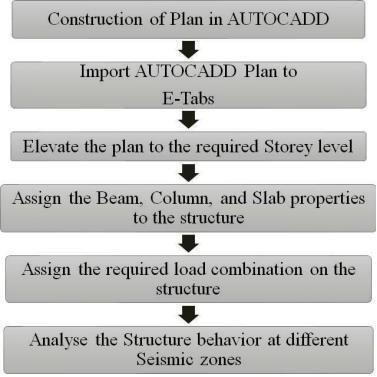
Table -2: Details of Square Building
InXDirection.(DynamicLoading)
EarthquakeInYDirection.(DynamicLoading)
Table -3: Grade Use for The Structure
4.1
1- DeadLoad-Selfwt.ofstructurecalculatedbysoftware
2- ParapetWallLoad-WidthXheightXdensityofbricks XPerm.
=0.23 X 1 X18X1
=4.14kN/m
3- WallLoad-WidthXheightXdensityofbricksXPerm.
=0.23 X 3 X18X1
=12.42kN/m
4- FloorFinished–01kN/m2
5- LiveLoad–02kN/s
International Research Journal of Engineering and Technology (IRJET) e-ISSN: 2395-0056 p-ISSN: 2395-0072
Volume: 12 Issue: 06 | June 2025 www.irjet.net
4.2. Manually Calculations Seismic Load Calculations
DirectionandEccentricity
Direction=X
Factors and Coefficients
SeismicZoneFactor,Z Z=0.16
ResponseReductionFactor,R R=5
ImportanceFactor,I I=1
SiteType=II
Seismic Response
SpectralAccelerationCoefficient,Sa/g
Sa/g=1.36/T, Sa/g=1.069973
Equivalent Lateral Forces
SeismicCoefficient,Ah Ah=(ZI*Sa/g)/2R
Table -4: Calculated Base Shear for x direct
Direction=Y
Factors and Coefficients
SeismicZoneFactor,Z Z=0.16
ResponseReductionFactor,R R=5
ImportanceFactor,I I=1
SiteType=II
Seismic Response
SpectralAccelerationCoefficient,Sa/g
Sa/g=1.36/T Sa/g=1.069973
Equivalent Lateral Forces
SeismicCoefficient,Ah Ah=(ZI*Sa/g)/2R
Table -5: Calculated Base Shear for Y direct
4.3. Define Concrete Property
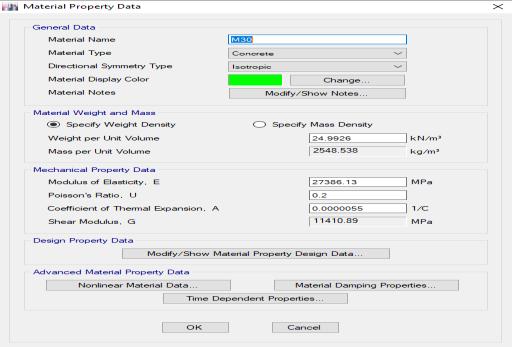
Fig -1:ConcreteProperty
4.4. Define Steel (HYSD) Property
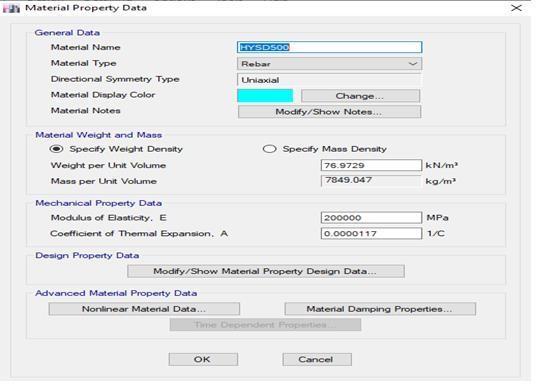
-2:SteelHYSDProperty
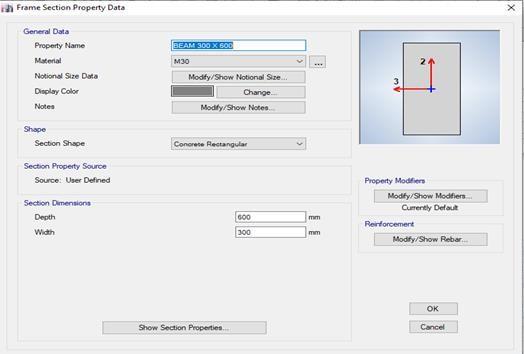
Fig -3:BeamProperty
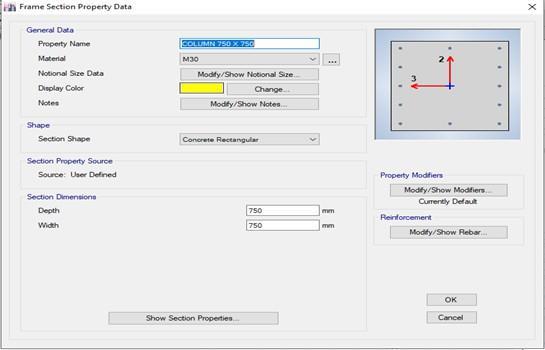
4.6. Define Column Property Fig -4:ColumnSectionProperty
International Research Journal of Engineering and Technology (IRJET) e-ISSN: 2395-0056 p-ISSN: 2395-0072
Volume: 12 Issue: 06 | June 2025 www.irjet.net
4.7. Define Load Pattern
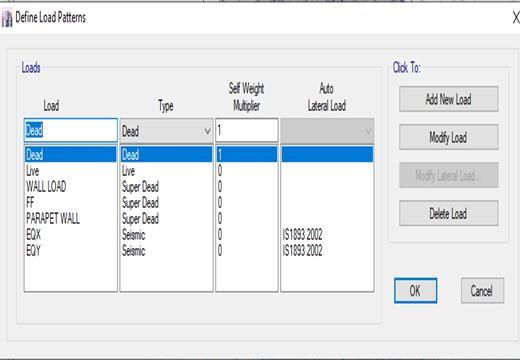
Fig -5:LoadSetup
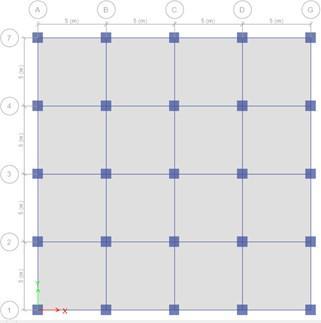
4.8. Square Building
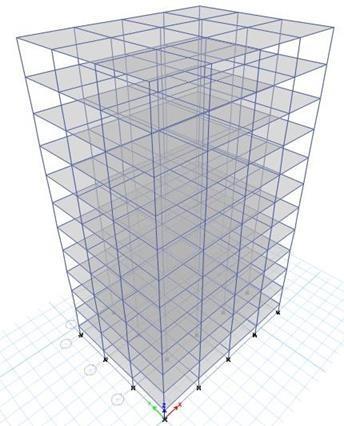
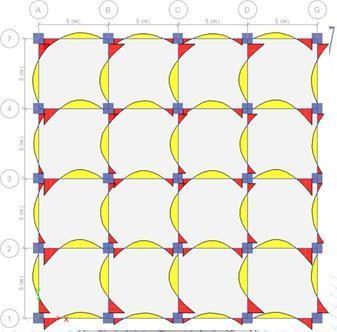
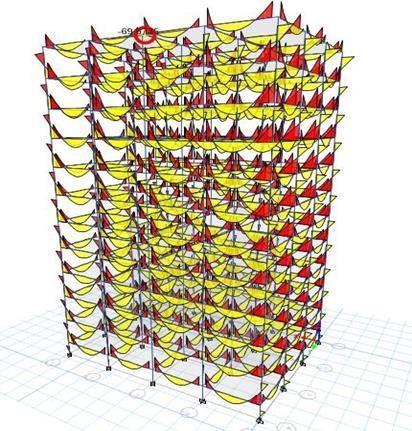
5.RESULT AND DISCUSSION
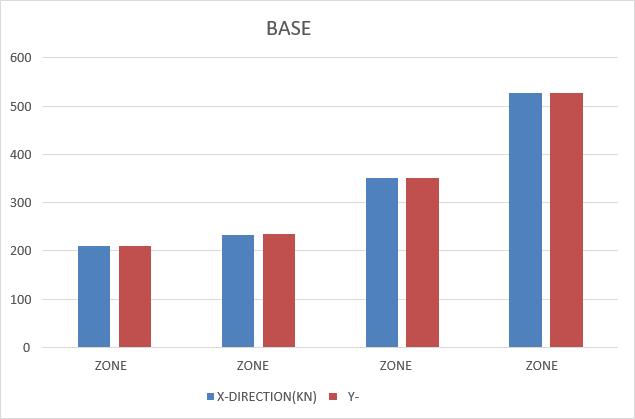
-1:BaseShearComparison
2395-0056 p-ISSN: 2395-0072
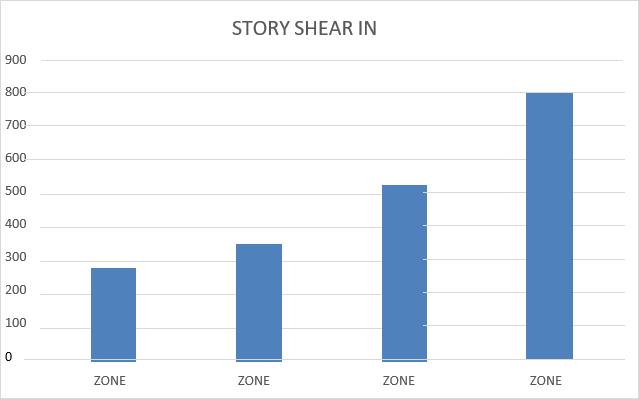
3:ComparisonofstoryShear
5.1. Results:
Increasing Trend: The base shear values rise progressivelyfromZone1toZone4,indicatinggreater structuralforcerequirementsaszoneschange.
Directional Consistency: In every zone, the XDIRECTION and Y-DIRECTION values remain nearly equal,suggestingbalancedstructuralresponsesinboth directions.
Maximum Base Shear: The highest base shear values (~500KN)areobservedinZone4,meaningstructures inthiszoneexperiencethegreatestforces.
5.2. Discussion:
Theincreasingshearforceacrosszonesmightbedueto varyingseismicconditionsorstructuralloads.
Since both directions show similar shear values, it implies that the design maintains symmetry and stabilityacrossdifferentloadconditions.
Theresultscanbeusedforengineeringdecisions,such as reinforcement needs and structural safety assessments, especially for areas with higher base shear.
Base shear increases gradually with the change in seismiczone,fromZoneIItoZoneV.
Zone II shows the least base shear, while Zone V exhibitsthehighest,indicatinggreaterseismicimpact.
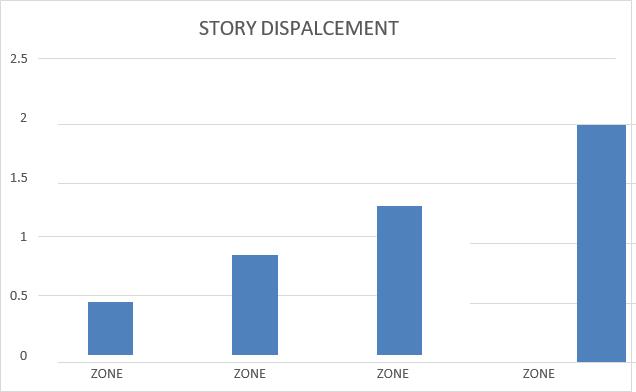
Story displacement increases with higher seismic zones;ZoneVexperiencesmaximumdisplacement.
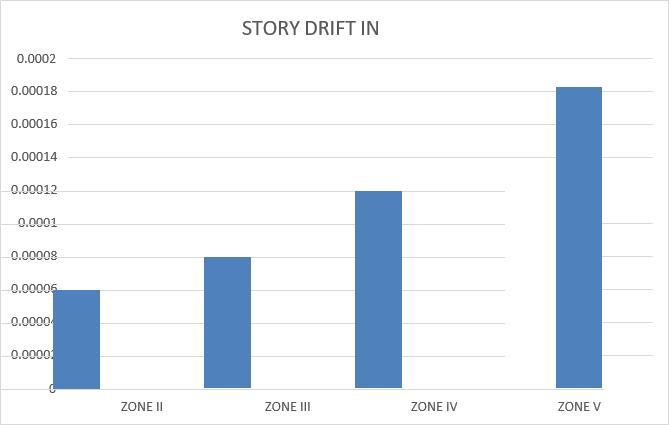
Story drift also increases from Zone II to Zone V, showing greater structural deformation in higher zones.
Seismicparameterslikebaseshear,storydisplacement, story drift, and story shear all increase with zone severity.
Theprojectprovidedhands-onexperienceinanalyzing seismicloadsonamultistorybuildingstructure.
International Research Journal of Engineering and Technology (IRJET) e-ISSN: 2395-0056 p-ISSN: 2395-0072
Volume: 12 Issue: 06 | June 2025 www.irjet.net
It reinforced understanding of structural behaviour underlateralforcesandtheapplicationofengineering principles.
Both manual and ETABS-based analyses were performedasperIS1893(Part1):2002and2016.
ETABSsoftwareprovedeffectiveinsavingtimewhile delivering accurate results comparable to manual calculations.
Themanualbaseshearvaluewas19271.03kN,while the ETABS value was 18271.89 kN, showing minor variance.
Lateral loadsincreasedgraduallyfromthe bottom to thetopfloorsinthesoftwareanalysis.
Seismicweightofthestructurewasapproximatelythe sameinbothmanualandsoftware-basedmethods.
We sincerely thank our Head of Department, Prof. T. H. Boraste,andourinternalguide,Prof.N.N.Shewale,fortheir valuable guidance, constant supervision, and support throughout the completion of our project titled "Seismic AnalysisofMulti-StoryBuildingusingETABSSoftware."We alsoappreciatetheencouragementandassistancefromProf. Puspendu Biswas, Principal of Sanghavi College of Engineering,aswellasthecooperationoftheDepartmentof CivilEngineeringstaff.Finally,wearegratefultoeveryone whodirectlyorindirectlycontributedtothesuccessofthis project.
[1] SeismicAnalysis&DesignofMultistoryBuildingUsing Etabs Rinkesh R Bhandarkar, Utsav M Ratanpara, MohammedQureshi:(2017IJEDR,Volume5,Issue
[2] Comparsion seismic analysis perormance of MultiStoried RCC Building with Plan irregularity Gaurav Kumar,121Prof.V.K.Singh:(Vol3,Issue5,May2018)
[3] Effect of building shape, orientation, window to wall ratios and zones on energy efficiency and thermal comfort of naturally ventilated houses in tropical climate Shakila Pathirana, Asanka Rodrigo, Rangika Halwatura:(Received:10October2018/Accepted:24 December2018/Publishedonline:3January2019)
[4] Architectural and Structural Analysis of Selected Twisted Tall Buildings Hanna Golas Szolomicka and JerzySzolomicki:(2019IOPConf.Ser:Mater.Sci.)
[5] SeismicAnalysisofHigh-RiseBuildings(G+30)byUsing ETABDR.K. CHANDRASEKHARREDDY1&G.LALITH KUMAR:(Volume5,Issue03March-2019)
[6] Seismic Analysis of Residential Building for Different Zones using Etabs Mindala Rohini, T. Venkat Das:( Volume-7,Issue-6C2,April2019)
[7] ResponseofMultistoryIrregularLShapeBuildingunder Basic Wind Speed of 39 m/s Sagar Jamle,Ashish Sadh,AnkitPal:(Received6Sept2018,Accepted10Nov 2018,Vol.8,(Nov/Dec2018)
[8] SeismicAnalysis&DesignofMultistoryBuildingUsing Etabs Rinkesh R Bhandarkar, Utsav M
Ratanpara,MohammedQureshi:(2017IJEDR|Volume5, Issue
[9] Analysis ofL-Shapebuildingwithliftcoreat different locations and its torsional effect Sushil Adhikari, Tek BahadurKatuwal,DipakThapa,SurajLamichhaneand DhurbaAdhikari(Vol2,No.1,October2020)
[10] Acquisition ofT-shapedexpertise:anexploratorystudy Rider Foley,Michael E. Gorman's, Jessica Denham's:( February2017)
[11] Analysis ofEarthquakeResistanceStructureByUsing ETABS Asst. Prof. Nikhil Ingawale,Aishwarya Ashok Magar, Rahul Shashikant Jadhav, Kunal Mahadev Gaikwad,Deepak Bhikaji Pawar :( IJSART - Volume 4 Issue6-JUNE2018)
[12] Differentofbuildingshape,orientation,windowtowall ratios and zones on energy efficiency and thermal coEffectmfortofnaturallyventilatedhousesintropical climate Shakila Pathiran, Asanka Rodrigo, Rangika Halwatura :(Received: 10 October 2018/Accepted: 24 December 2018/Published online: 3 January 2019 © TheAuthor(s)2019)
[13] Wind and Seismic Analysis of Building Using ETABS YASHASHRIANKALKHOPE,VAISHNAVIGHALE,PRATIK HARMALKAR, MAHESH GIRI,NIKHIL MHASKE:(JUN 2021|IREJournals|Volume4Issue12|ISSN:24568880)
[14] SeismicAnalysisOfaBuildingWithFloatingColumnsBy EtabsNagalakshmiD,drRBbalamurugan:(Vol9,Issue4, 2018)
[15] Analysis of L-Shape building with lift core at different locations and its torsional effect Sushil Adhikari, Tek Bahadur Katuwal, Dipak Thapa, Suraj Lamichhane and Dhurba Adhikari (Vol 2, No.1, October 2020)




KhotareChaitanyaA, SanghaviCOENashik,Pune University,DepartmentofCivil Engineering.
DondAniketG.
SanghaviCOENashik,Pune University,DepartmentofCivil Engineering.
Aware RohitJ. SanghaviCOENashik,Pune University,DepartmentofCivil Engineering.
BarveAniketV.
SanghaviCOENashik,Pune University,DepartmentofCivil Engineering.