
International Research Journal of Engineering and Technology (IRJET) e-ISSN: 2395-0056
Volume: 13 Issue: 04 | Apr 2026 www.irjet.net p-ISSN: 2395-0072

International Research Journal of Engineering and Technology (IRJET) e-ISSN: 2395-0056
Volume: 13 Issue: 04 | Apr 2026 www.irjet.net p-ISSN: 2395-0072
Prof. Prini Rastogi 1 , Samruddhi Pathare 2 , Shravani Pathare 3
1Assistant Professor, Department of Computer Application
2BCA, Student, Department of Computer Application
3BCA, Student, Department of Computer Application Ajeenkya D Y Patil University, Maharashtra, India
Abstract - Access to prompt and dependable healthcare information continues to pose a significant obstacle, especially for individuals residing in rural and semi-urban areas where medical services are limited. To mitigate this deficiency,thisresearch introducesSehat-GuideAI,awebbasedintelligent healthcare assistantdesignedto offerrealtime guidance through the application of Artificial Intelligence (AI). This system integrates a variety of healthcaresupportfeatures,suchasanintelligent chatbot, a symptom checker, a physician locator, a vaccination center finder, medication reminders, and health alerts. The chatbot utilizes Natural Language Processing (NLP) techniques to comprehend user inquiries and formulate preciseandcontextuallyappropriate responses. SehatGuide AI, in addition to offering conversational assistance, provides information concerning local medical professionals, vaccination facilities, and preventative healthstrategies,leveragingstructuredhealthcaredatasets. Integrated notification reminders further assist in improving medication adherence and sustaining user engagement. The system is developed using contemporary web technologies and follows a modular three-layer architecture, consisting of the frontend, backend, and AI processinglayers.
Experimental evaluation indicates that SehatGuide AI achieves an average response time of 2–3 seconds and demonstrates an accuracy rate between 80% and 88% for general health care inquiries. These results underscore the potential of the system to enhance accessibility to health care services and provide timely support, particularly in under-resourcedcommunities.
Key Words: AI Chatbot, Public Health Informatics, Preventive Healthcare, Vaccination Awareness, Doctor Appointment Discovery, Multilingual Health Assistant.
Accessibility to healthcare remains a significant challenge in many developing countries due to limited medical infrastructure, high treatment costs, and low public
awareness [1], [2]. As a result, many individuals rely on unreliable online sources or delay consultations with healthcare professionals, often leading to incorrect selfdiagnosisandworseninghealthconditions[3],[4].
Inadditiontogeographicalbarriers,theshortageofskilled healthcare professionals and the presence of multiple languages across different regions further complicate access to appropriate medical services [5], [6]. These challenges highlight the need for an effective and accessible solution that can assist individuals in making informedhealthcaredecisions[7],[8].
The advent of Artificial Intelligence (AI) has enabled modernhealthcaresystemstodelivertimely,reliable,and personalized support [9], [10]. AI-powered platforms can help bridge gaps in healthcare accessibility by providing immediateguidance, continuousmonitoring,andalertsin areaslacking adequatephysicalinfrastructure[11],[12].
To address these challenges, SehatGuide AI has been developed as a multi-functional healthcare platform. The system integrates AI-driven communication with structured healthcare services, offering features such as real-timechatbotassistance,symptom-based disease prediction, doctor and vaccination center search, medication reminders, and multilingual support for diversecommunities.
By integrating all these features into a single platform, SehatGuide AI serves as a personal health assistant, encouraging users to engage proactively with their own well-being.
SehatGuide AI was developed to address several realworldchallengesinhealthcare.
Lackofreliablehealthcareinformationsources
Difficulty in locating nearby doctors and vaccinationcenters
International Research Journal of Engineering and Technology (IRJET) e-ISSN: 2395-0056
Volume: 13 Issue: 04 | Apr 2026 www.irjet.net p-ISSN: 2395-0072
Poor medication adherence due to missed reminders
Language barriers in healthcare communication
Delayinreceivingpreventivehealth guidance
Most existing healthcare software solutions focus on a single function and do not offer comprehensive services. Consequently, there is a need for an integrated platform that leverages artificial intelligence to provide a wide rangeofhealthcare support.
Recent progress in Artificial Intelligence (AI) and Natural Language Processing (NLP) has helped create smarter healthcarechatbots.These chatbotsaredesignedto make healthcare more accessible, encourage users to get involved,andofferreal-timemedicalsupport.
Passananteetal.[1]reviewedhowconversationalAIhelps share information about vaccinations. Their study shows thatAIchatbotscanboostpatientawarenessandsupport vaccination campaigns, making them useful for sharing accuratehealthinformation.
Sawad et al. [2] investigated how conversational agents can assist patients in managing chronic diseases. They found that these systems support ongoing patient monitoring and can provide recommendations for healthcare services. Still, the authors pointed out challengesinintegratingdifferenthealthcareservicesinto asingleplatform.
Mohamed Jasim et al. [3] reviewed different healthcare chatbot applications. They found that AI chatbots help makehealthcaremoreaccessibleand efficient.However, most current systems only answer user questions and do notofferfeaturessuchasfindingdoctorsorassistingwith vaccinations.
Milne-Ives et al. [10] examined the effectiveness of AIbased conversational agents in healthcare and reported that chatbots can enhance patient engagement while providing reliable preliminary guidance. However, the authors emphasized that these systems cannot replace professional medical consultations, particularly in complexclinicalscenarios.
Shaikh et al. [11] developed an AI-driven healthcare chatbot capable of performing basic symptom evaluation
and delivering general healthcare information. While the system generates responses efficiently, it lacks advanced functionalities such as multilingual support and integrationwithbroaderhealthcareservices.
Kurian[15]highlightedtheroleofAI-poweredchatbotsin improving healthcare access in rural regions of India. The study suggests that suchchatbots can help bridge the gap between patients and healthcare professionals by facilitatingreal-timeconsultations.
Table-1: Functional Comparison Of Healthcare Chatbot Systems
Feature Existing Systems SehatGuide AI
Chatbot Yes Yes
Doctor Search No Yes Vaccination Info Limited
The literature review indicates that most existing healthcare chatbots are limited to a single functionality,suchasanswering general health queries or providing basic symptom analysis. Few systems integrate multiple healthcare services, including physiciansearch,vaccinationinformation, andmedication reminders, within a single platform. This limitation underscorestheneedforamorecomprehensivesolution.
To address this gap, the SehatGuide AI system has been developed as a holistic healthcare platform. It combines chatbot-based interaction, symptom analysis, healthcare service exploration, and reminder notifications into a single integrated system. The platform is designed to provide comprehensive, real-time healthcare assistance while promoting accessibility and user engagement, particularlyinruralandsemi-urbanregions.
International Research Journal of Engineering and Technology (IRJET) e-ISSN: 2395-0056
Volume: 13 Issue: 04 | Apr 2026 www.irjet.net p-ISSN: 2395-0072
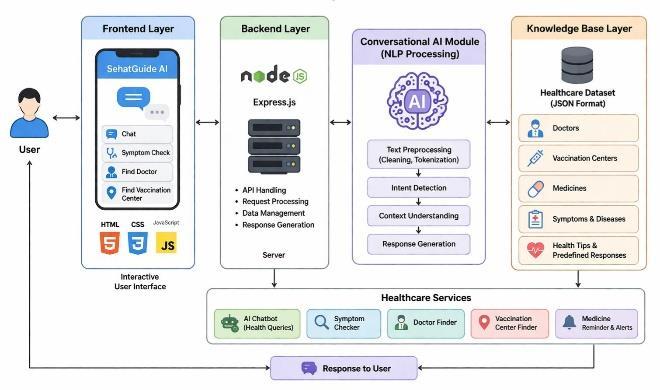
SehatGuide AI is built on a layered architecture that leverages Artificial Intelligence (AI), Natural Language Processing (NLP), and structured healthcare datasets to deliver real-time health assistance. The system is engineered to ensure rapid response times, accurate information, and accessible healthcare guidance for users acrossdiverselocations[1],[3],[10].
SehatGuideAIisdevelopedusingathree-layer architecture,integratingaconversationalAIsystemto enableintelligentinteractionswithinthehealthcare domain.Thearchitectureensuresscalabilityandefficient communicationbetweenitslayers.
Frontend Layer:
The frontend is implemented using HTML, CSS, and JavaScript, providing an interactive and user-friendly interface.Itallowsuserstocommunicatewiththechatbot, search for healthcare services, and receive real-time responses[9].
Backend Layer:
The backend is built with Node.js and Express.js frameworks. It handles requests from the frontend, manages API communication, interfaces with the chatbot, and connects the frontend with datasets and AI systems [11],[14].
Knowledge Base Layer:
Healthcare information is stored in JSON-formatted datasets, including details about physicians, vaccination centers,andpredefinedhealthcareresponses[12].
Conversational AI Module:
The chatbot leverages Natural Language Processing (NLP) techniques to interpret user queries, identify intents, and provide context-aware healthcare responses. Userrequestsareprocessedbythebackendandroutedto theAImoduletogenerateappropriatereplies[1],[2],[3].
This layered architecture supports efficient data flow, modularity, and the potential for future expansion, ensuring that SehatGuide AI can deliver responsive and reliablehealthcareassistance.
4.2. System Implementation
The implementation of SehatGuide AI is divided into independent modules to improve flexibility and maintainability.
4.2.1 Chatbot Implementation
ThechatbotisintegratedusingaconversationalAIAPIfor healthcarequeryhandling.
Userqueriesareenteredthroughthefrontend
Input text is preprocessed using NLP techniquessuchascleaningandtokenization
QueryisforwardedtotheAIprocessing module
A context-aware response is generated and returnedtotheuser
This improves interaction quality and supports real-time healthcareassistance[2],[10].
4.2.2. User Interface Implementation
The user interface is designed for simplicity and accessibility.
Interface developed using HTML, CSS, and JavaScript
Chat window integrated for live communication
Backend API connected for dynamic response generation
Multilingual support added for wider accessibility
This improves usability for users from different languagebackgrounds[4],[15].
4.2.3.
International Research Journal of Engineering and Technology (IRJET) e-ISSN: 2395-0056
Volume: 13 Issue: 04 | Apr 2026 www.irjet.net p-ISSN: 2395-0072
The system classifies user input to improve response accuracy.
Userinputiscleanedandanalyzed
Query intent is identified (symptom, doctor search,vaccination,medicinereminder)
RoutedtoAImoduleorhealthcaredataset
Responseformattedanddisplayedtotheuser
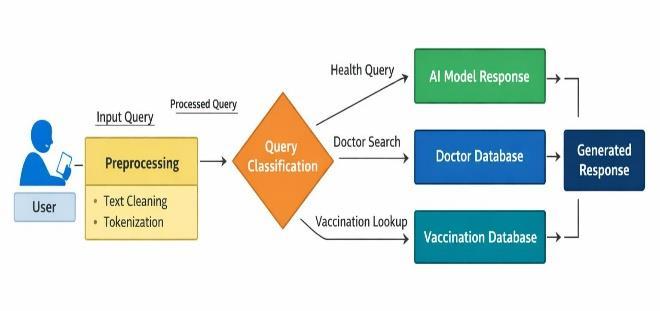
This approach enhances the relevance of responses while alsoimprovingtheoverallefficiencyofthesystem[8],[9].
Fig-2: QueryProcessingFlowofSehatGuideAI
4.2.4. Dataset Management
Healthcare information is maintained in lightweight databasestoensureefficientstorageandquickaccess.
JSON datasets prepared for doctor details and vaccinationcenters
Predefinedfallbackhealthcareresponsesstored
Dataretrievaloptimizedforfastresponse
Periodicupdatesensuredatareliability
This approach supports both the scalability and the stabilityofsystemperformance[5],[12].
4.2.5. Backend Processing
The backend layer ensures seamless communication betweenthedifferentmodules.
HandlesfrontendAPIrequests
ConnectsAImoduleandhealthcaredatasets
Processesresponsesefficiently
Returnsoutputwithlowlatency
This improves responsiveness and integration quality [11],[14].
Theplatformprovidesaccesstolocation-basedhealthcare services.
Searchesnearbydoctorsandvaccination centers
Generatesnavigationlinks
Displaysaccessiblehealthcareoptionsto users
This feature enhances access to healthcare services, particularlyinremoteandunderservedregions[4],[15].
Thesystem’smodulardesignallowsforscalabilityandthe integration of new healthcare services without affecting othercomponents.
For performance evaluation, SehatGuide AI was assessed across several functional modules, including the chatbot interface,symptomchecker,healthcareservicesearch,and overallsystemefficiency.
The AI-powered chatbot generates natural conversational responses, enabling users to interact using everyday language. It provides accurate healthcare information regarding symptoms, preventive measures, and other relevant medical guidance. The average response time is 2–3seconds,facilitatingreal-timeinteraction.
The symptom checker analyzes user-reported symptoms and suggests possible causes along with recommended actions. This feature helps users better understand their condition and make informed decisions about seeking medicalconsultation.
The doctor search module allows users to locate physicians in their area based on specialization, while the vaccination module provides information about nearby vaccinationcenters.
Additional features, such as medication reminders and healthinformationupdates,enhanceuserengagementand support proper adherence to prescribed treatments. Furthermore, outbreak alerts inform users about prevailing diseases in their region, helping them take timelypreventivemeasures.
Generally, the system performs consistently with an accuracyrateofabout80–88%.
International Research Journal of Engineering and Technology (IRJET) e-ISSN: 2395-0056
Volume: 13 Issue: 04 | Apr 2026 www.irjet.net p-ISSN: 2395-0072
(Results are illustrated in Fig. 3–Fig. 6.)
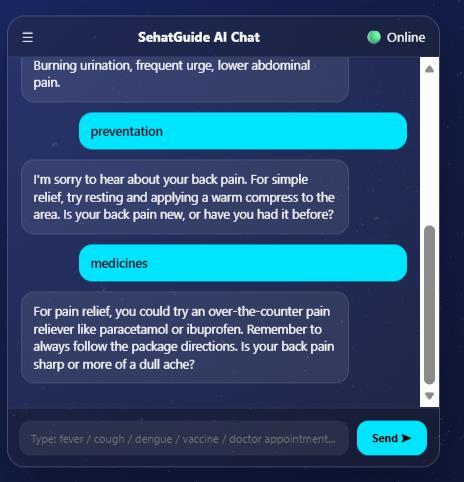
ChatbotResponse
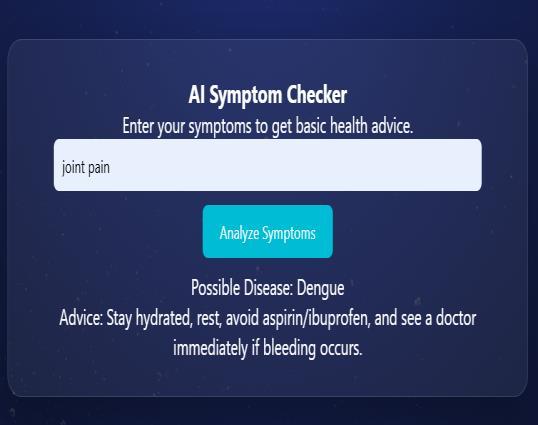
Fig-4: AISymptomChecker
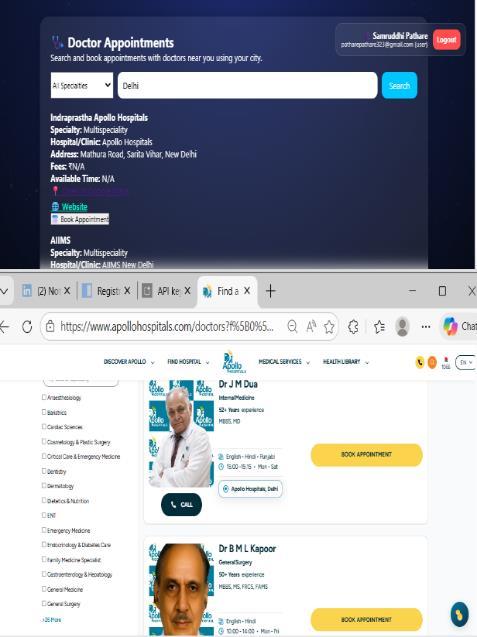
DoctorSearchandAppointmentInterface
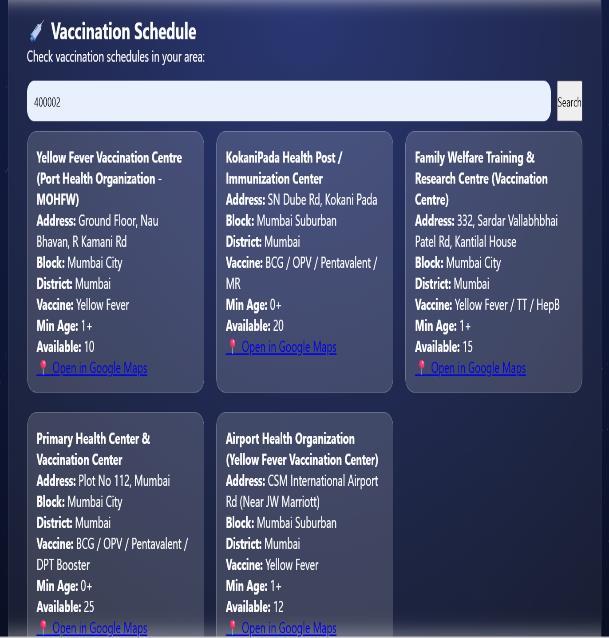
Fig-6: VaccinationCenterSearch
The evaluation of the systeminvolved the use ofdifferent user searches in various healthcare situations to determine the accuracy, efficiency, and reliability of the system.
International Research Journal of Engineering and Technology (IRJET) e-ISSN: 2395-0056
Volume: 13 Issue: 04 | Apr 2026 www.irjet.net p-ISSN: 2395-0072
Table-2: SystemPerformanceEvaluation
Metric Value
Average Response Time 2–3seconds
QueryAccuracy 80–88%
MultilingualSupport 5majorlanguages
Facility Discovery
Accuracy 90%
SystemUptime >99%
A. Observations
The chatbot offers precise answers to queries aboutgeneralhealthcare
Symptom checker facilitates early identificationofdiseases
The doctor and vaccination modules enhance accessibilitytoessentialhealthcareservices.
The system operates efficiently, with minimal responsedelays.
Support for multiple languages increases usability
6. DISCUSSION
The findings prove the capability of SehatGuide AI as an effective AI-based health care assistant that can improve access to essential information about health care.IntegrationoftheNLP-basedchatbottechnology with structured data sets makes it possible for the system to offer timely relevant and context-aware answerstoinquiries.
The system performs well in providing general informationconcerninghealthcare,withitsefficiency estimated at 80-88%, which is enough for providing preliminary guidance and raising people's awareness. Timely feedback (within 2-3 seconds) provides users with a satisfactory experience while using the platform.
Moreover, inclusion of multiple modules (such as symptom checking, doctor finder, vaccination, and
medicine reminders) makes the system more universal than other single-module health applicationscurrentlyavailableonthemarket.
However, there are several disadvantages associated with this system. Firstly, it should be noted that it doesnotprovideasubstituteforprofessionalmedical help and consultations, especially in complicated cases. Secondly, its effectiveness largely depends on the quality of both the database and the NLP model used in the application. Thirdly, it works online, so Internetconnectionisrequired.
This paper introduced SehatGuide AI, an AIenabled healthcare guidance system combining chatbotinteraction,symptomanalysis,andhealthcare servicediscoveryinonesinglesystem.
It offers accurate healthcare guidance with excellent accuracy and quick response times. The system is especially helpful for rural and semi-urban communities.
Integrationwithreal-timehealthcare databases
UseofadvancedAImodelsforhigher accuracy
Mobileapplicationdevelopment
Enhanceddataprivacyandsecurity
SehatGuide AI can make a significant contribution towards improving the availability and awarenessinthehealthcaresector.
The suggested system showcases the ability of an AIdriven solution to increase awareness among the public and close the gulf between the user and healthcarefacilities.
Further advancements can increase the effectiveness of the system and make it scalable for large-scaledeployment.
[1] A. Passanante, M. Severino, P. Bergamini, et al., “Conversational AI and vaccine communication: Systematic review of the evidence,” J. Med. Internet Res.,vol. 25, 2023.Available: https://doi.org/10.2196/42758
International Research Journal of Engineering and Technology (IRJET) e-ISSN: 2395-0056
Volume: 13 Issue: 04 | Apr 2026 www.irjet.net p-ISSN: 2395-0072
[2] B. Sawad, M. Alim, S. Raza, et al., “A systematic review on healthcare AI conversational agents for chronic conditions,” Sensors, vol. 22, no. 7, p. 2625, 2022.Available:https://www.mdpi.com/14248220/22/7/2625
[3] K. Mohamed Jasim, A. Malathi, S. Bhardwaj, and E. C.Aw,“AsystematicreviewofAIbasedchatbotusages in healthcare services,” J. Health Organ. Manage.,2024.Available: https://doi.org/10.1108/JHOM-12-2023-0376
[4] PubMed, “Feasibility of using an artificially intelligent chatbot to increase access to information and sexual and reproductive health services,” 2024. Available:https://doi.org/10.1177/20552076241308
[5] “The effects of AI chatbots on women’s health: A systematicreviewandmeta-analysis,”Healthcare,vol. 12, no. 5, p. 534, 2024Available: https://www.mdpi.com/2227-9032/12/5/534
[6] E. Parviainen and T. Rantala, “Chatbot breakthrough in the 2020s? An ethical reflection on healthcare chatbots,” Med. Health Care Philos., 2021. [Online]. Available: https://link.springer.com/article/10.1007/s11019021-10049-w
[7]H.Liu,T.Yamaguchi,S.Fujimoto,etal. “ Japanese AI agent system on human papillomavirus vaccination: System design,”arXiv preprint, arXiv:2601.10718,2026Available: https://arxiv.org/abs/2601.10718
[8] D. Bhatt, S. Ayyagari, and A. Mishra, “Benchmarking the in conversation differential diagnostic accuracy of a health AI,” arXiv preprint, arXiv:2412.12538,2024.Available: https://arxiv.org/abs/2412.12538
[9] K. B. R. Kavitha and C. R. Murthy, “Chatbot for healthcare system using artificial intelligence, ” International Journal of Advance Research, Ideas and Innovations in Technology (IJARIIT), vol. 5, no.3,2019.Available: https://www.ijariit.com/manuscript/chatbot-forhealthcare-system-using-artificial-intelligence/
[11] U. Shaikh, S. Mustafa, S. Mujawar, H. Shaikh, and Z. Pathan, “AI-based healthcare chatbot system,” IJRASET,2025.Available: https://doi.org/10.22214/ijraset.2025.69526
[12] S. Sirpurwar, V. Umare, B. Umare, R. Rathod, and C. Jogekar, “AI-based chatbot for healthcare,” Int. J. Eng. Res. Technol. (IJERT), 2026. Available: https://www.ijert.org/ai-based-chatbot-forhealthcare
[13] S. Biradar and S. Shastri, “Medical chatbot: AI based infectious disease prediction model,” J. Sci. Res. Technol., doi:10.61808/jsrt147,2025. Available: https://doi.org/10.61808/jsrt147
[14] S. M. Patil, S. Sneha, V. Varshini, U. Joshi, and M. Kavya, “Design & implementation of healthcare chatbot using artificial intelligence,” Int. J. Eng. Res. Technol. (IJERT), vol. 10, no. 12, 2022. Available: https://www.ijert.org/design-implementation-ofhealthcare-chatbot-using-artificial-intelligence
[15] S. Kurian, “The role of AI-driven health chatbots inimprovingruralhealthcareaccessinIndia,”Int.J.
[10] M. Milne-Ives, C. de Cock, E. Lim, M. Harper Shehadeh, N. de Pennington, G. Mole, E. Normando, and E. Meinert, “The effectiveness of artificial intelligence conversational agents in health care: Systematic review,” Journal of Medical Internet Research, vol. 22, no. 10, p. e20346,2020.Available: https://www.jmir.org/2020/10/e20346