
International Research Journal of Engineering and Technology (IRJET) e-ISSN: 2395-0056
Volume: 13 Issue: 04 | Apr 2026 www.irjet.net p-ISSN: 2395-0072
International Research Journal of Engineering and Technology (IRJET) e-ISSN: 2395-0056
Volume: 13 Issue: 04 | Apr 2026 www.irjet.net p-ISSN: 2395-0072
Vaibhav Ravindra Ahire1 , Dr. Mohammad Muqeem2 , Prof. Pavan Bhaladhare3
1 M.Tech Scholar, School of Computer Science and Engineering, Sandip University, Nashik, Maharashtra, India.
2 Guide, SOCSE, Sandip University, Nashik, Maharashtra, India.
3Dean, SOCSE, Sandip University, Nashik, Maharashtra, India.
Abstract - Steganography is widely applied by informationsecuritysystems.Theaimofsteganographyis tocreate a secret and securechannel betweenthe sender and receiver. Steganography is basically performed in different data types, such as image and video. Given the rapid growth of digital systems and imaging tools, the numberofimagesandtransmissionofsecretinformationis alsogrowing.JPEGimagesareverypopularbecauseoftheir smallersizethatmakesthemsuitableforthetransmission. The steganography procedure in an image can usually be performed in two domain, space domains and transform domain such as Fourier. In this preliminary study, a text steganographytechniqueinJPEGimagesispresented.The textsteganographyiscarriedoutonthebitswiththeleast significantvalueinthediscretematrix;thustheembedded messageinsertionhaslessimpactontheimagequality.In theproposedmethod,twolesssignificantbitsofpixelsare usedtohidetheembeddedmessageintheimage.InJPEG compression procedure before encoding, the steganography operation is applied on the imageafterits transformation from time into the frequency space and exactly(or right away) after the discretization of transformed data. The experimental results suggest that ourapproachhashigh-capacityperformanceincomparison withtheconventionalmethods.
Key Words: Steganography; Steganalysis; Image compression; JPEG image . 1.
The burgeoning reliance on digital communication platforms underscores the critical necessity for robust encryption techniques to safeguard sensitive information. In the realm of image data transfer, where visual content formsa significantcomponentofmoderncommunication, ensuring privacy and security is paramount. Traditional encryption methods have provided a foundation for data protection,yettheyoftengrapplewiththeintricatenature ofimagedata.Inresponsetothesechallenges,researchers and technologists have turned to the transformative capabilities of artificial intelligence (AI) to bolster encryption techniques tailored specifically for image data
transfer.Byharnessingthepowerofneuralnetworks,deep learning algorithms, and advanced cryptographic principles, a new frontier in encryption is being explored, one that seeks to fortify security while simultaneously optimizingefficiency.
Thispaper delvesinto the evolvinglandscapeofAI-based encryption techniques designed explicitly for image data transferapplications.IttraversestheintersectionofAIand cryptography,chartingacoursetoaddressthemultifaceted challengesinherent in securing image data during transit. By melding the strengths of AI and cryptographic methodologies, these advanced techniques aim to transcend the limitations of conventional encryption paradigms, heralding a new era of secure image communication. Through an exhaustive exploration of cutting-edge methodologies and innovative approaches, this paper endeavours to offer insights into the development,implementation,andevaluationofadvanced AI-basedencryptiontechniquesforimagedatatransfer.
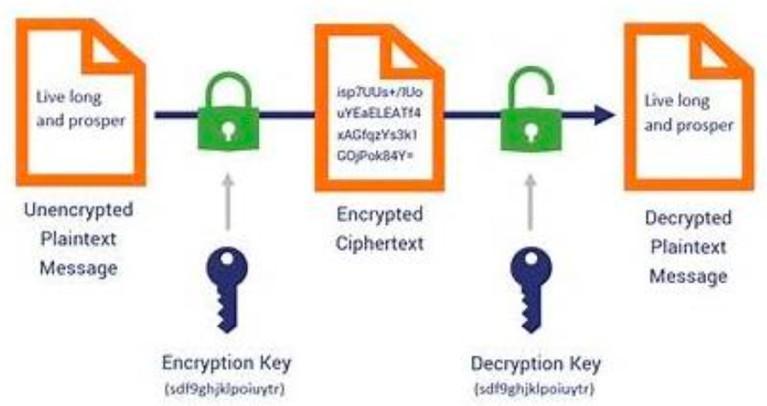
Following are some key challenges associated with traditionalencryptionmethodswhenitcomestosecuring imagedatatransfer:
• Scalability: Traditionalencryptionmethodsmaystruggle to efficiently handle the large volumes of data associated with high-resolution images. As image file sizes increase, encryption and decryption processes may become computationally intensive, leading to delays and
International Research Journal of Engineering and Technology (IRJET) e-ISSN: 2395-0056
Volume: 13 Issue: 04 | Apr 2026 www.irjet.net p-ISSN: 2395-0072
performanceissues.
• Data Complexity: Image data is inherently complex, containing rich visual information with intricate patterns and structures. Traditional encryption methods may not fully account for the unique characteristics of image data, potentially leading to suboptimal security or increased vulnerabilitytoattacks.
• Lossy Compression Compatibility: Many traditional encryption techniques are not compatible with lossy compression algorithms commonly used to reduce image filesizes.Encryptingcompressedimagesmaycompromise the effectiveness of compression techniques, resulting in largerencryptedfilesandslowertransmissionspeeds.
• Robustness Against Attacks: Traditional encryption methodsmaylackrobustnessagainstsophisticatedattacks targeting specific featuresofimage data.Techniquessuch as chosen-plaintext attacks or statistical analysis of encryptedimagescanpotentiallycompromisethesecurity oftraditionalencryptionschemes.
• Key Management: Traditionalencryptionmethodsmay facechallengesinkeygeneration,distribution,andstorage, particularly in scenarios involving large-scale image data transferandmultipleencryptionkeys.
• Adaptability to Dynamic Environments: In dynamic network environments where image data transfer occurs overheterogeneousnetworkswithvaryingbandwidthand latency characteristics, traditional encryption methods maystruggletoadaptandoptimizeencryptionparameters for optimal performance and security. These techniques aim to overcome the limitations of traditional encryption methods and enhance the security, efficiency, and robustnessofimagedatacommunicationinmoderndigital ecosystems.
The integration of artificial intelligence (AI) and cryptographypresentsacompellingavenuetoaddressthe limitations of traditional encryption methods and bolster the security of digital communication, particularly in the contextofimagedatatransfer.ByharnessingAItechniques such as neural networks and deep learning, encryption algorithms can be enhanced to generate more robust encryption keys and adaptively adjust encryption parameters based on contextual information and security requirements. AI-driven feature extraction methods, notably using convolutional neural networks (CNNs), enable the preservation of important visual information while securing image data against unauthorized access. Moreover,AIcanplayapivotalroleindevelopingdefense mechanismsagainstadversarialattacksonencrypteddata, ensuring the resilience of communication channels. Additionally, AI-driven encryption systems can continuously learn from new data, dynamically adjusting
encryption strategies to evolving threats and security needs. Furthermore, the synergy between AI and cryptography enables the development of privacypreserving techniques for image data transfer, such as differentialprivacyandhomomorphicencryption,ensuring secure data sharing while preserving privacy. Overall, the integration of AI and cryptography represents a powerful paradigm shift in securing image data transfer, promising enhanced security, privacy, and efficiency in digital communicationecosystems.
Theoriginofvisualcryptographyisin1994developedby MoniNaorandAdiShamir[4].Theobjectiveofthemethod is to encrypt the images while transferring through the networks. Over the years various developments have occurredinthefieldofvisualcryptography.Differentvisual cryptographic schemes design overcomes the shortcomings of the other visual cryptographic schemes(VCS). Various reviews conducted in the past regardingvisualcryptography,onesuchstudyis[7]Many oftheschemespresentedworkexceptionallywellandthe currentstateofthearttechniquesarebeneficialformany applications, such as verification and authentication. The followingtrendsidentifiedwithinvisualcryptography:
1.Contrastimprovement.
2.Reducingthesizeofshares.
3. Increase the range of appropriate images (binary, grey andcolourimages).
4.Efficiencyenhancement.
5.Multiplesecretsharing.
Agreyscaleisanimageintensityscalinginwhichasample is the value of each pixel, i.e. it only carries information aboutintensity.Blackisthedarkestpossibleshade,which isthetotalabsenceofvisibleorreflectedlight,andwhiteis the lightest possible shade. This scheme of cryptography techniqueusessecretimagesinthegreyscaleformat.The paper [14] discusses the basics of a grey scale VCS, and reconstruction/decryption of the image shared and introducedathresholdforVCS.Thereconstructionquality improves through pixel expansion. The grayscale VCS has donethedecodingprocessdirectlybyhumanvisualsystem previously it was restricted to processing binary images, but here different shades of grey are considered. In the paper[15],anewconceptcalledggreylevelsisintroduced which ranges from 0 to g-1 for better clarity in black and white imaging. The grey scale VCS is also developed to identify the contrasts of the reconstructed image but reproducesintheformofdifferentscalesofgrey.Thepaper also proposed binary secret imaging which allows participantstoperformreversingoperations
International Research Journal of Engineering and Technology (IRJET) e-ISSN: 2395-0056
Volume: 13 Issue: 04 | Apr 2026 www.irjet.net p-ISSN: 2395-0072
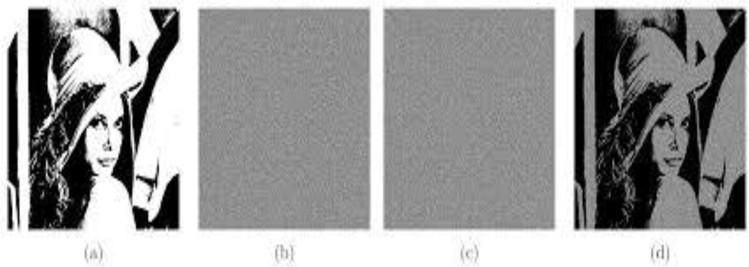
Fig-2. ImagesharingthroughgrayscaleVCS
(a)Originalimage
(b)imageshare1
(c)imageshare2
(d)decryptedimage
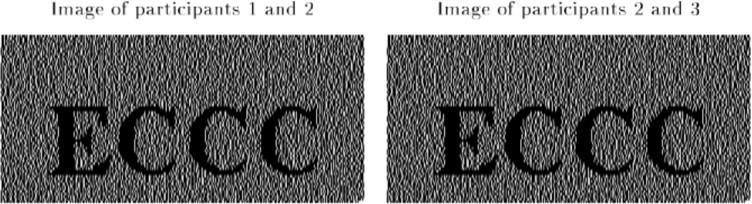
A VCS for General Access Structures (GAS) splits the Informationintoasubsetofrestrictedandforbiddensetof participants,whereinonlytheparticipantsbelongingtothe qualifiedsetcanrevealtheinformationencoded.Different types of VCS based on GAS addressed in this section. GAS VCSanalysesthestructureofVCSandshowsthelimitations on the size of the shares allocated to all the scheme’s participants. The proposed method shows a novel technique for realising k out of n threshold VCS. [39] ProvidesanovelmethodforrealisingkoutofnVCSwhich isbetterthanthemethodproposedby M.Naor & A. Shamir. Given below is the diagrammatical explanation for the imageencryptionanddecodingprocess.
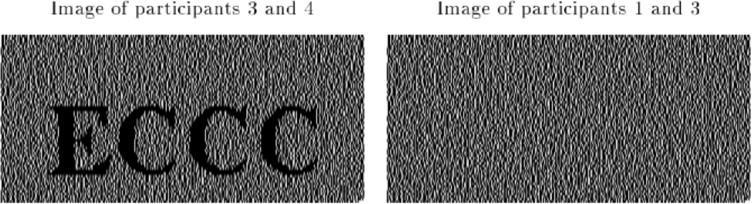
3
The halftone VCS discussed in [16]. It introduces the concept of Halftone where the colours are toned down to reducethepixelsize.Ifthegreylevelsarereducedbytwo, the image that appears does not have a much spatial resolutiontodescribe thedetails.Ditheringistheprocess ofcreatingillusionsofthecolourthatarenotpresent.The random pixel arrangement does it. The Floyd Steinberg
dithering is a method for colour correction. The dithering getsperformedthrougherrordiffusionwhichmeansthatit pushes the quantisation error of a pixel into the neighbouringpixeltodealwithitlater.Theditheredeffect is creating a check board pattern when the original pixel values are exactly halfway between the nearest available colours. For example, as a black-and-white check board pattern, 50% grey data could be dithered. For optimum dithering the quantification error count should be precise enough to prevent rounding errors affecting the results. Theconceptofbluenoiseditheringusedfortheproposed method use the void and cluster algorithm to transform a hiddenbinaryimageintocommonimageswithsubstantial visual information in n halftone. It expands the pixel size hence the area of the image gets enlarged in the visual cryptography by the addition of halftoning techniques, a secret image encoded into halftone shares meaningful visual information. The hidden image getsembedded as binary valued shares while the shares gethalftoned.The advantageoferrordiffusionisthatthatithaslowcomplexity and halftone shares have excellent image quality. Other dithering techniques used for Halftone VCS are Floyd, Jarvis. Shared image quality and the contrast of the reconstructedimagediscussedin.
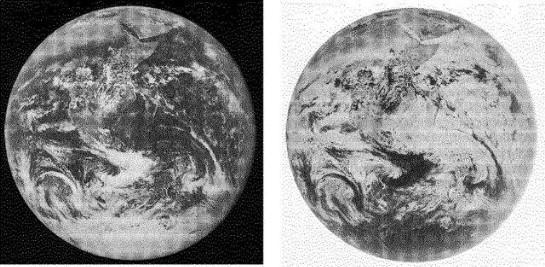
The above figure representsthe original image on the left andcomplimentaryHalftone VCscheme decryptedimage. The decrypted image contrast is precisely opposite to the original.
Albalawi et al. (2024), Protecting sensitive information using encryption ensured its accuracy, privacy, and integrity. Information was safeguarded by making it unavailable to those who shouldn't have had access to it. Symmetricandasymmetricencryptionwerethetwomost common forms of data security; steganography, in which data was concealed within another item to prevent unauthorized access, was another method. Their study presented a novel symmetric encryption method that safeguarded data via the integration of steganography, encryption,andfacialrecognitionalgorithmsdevelopedby artificialintelligence.
International Research Journal of Engineering and Technology (IRJET) e-ISSN: 2395-0056
Volume: 13 Issue: 04 | Apr 2026 www.irjet.net p-ISSN: 2395-0072
Mukhopadhyay et al. (2021). Everydaylifeusedtorelyon sensors, and those same sensors were fundamental to systemsbuiltontheInternetofThings(IoT)becausethey allowed the IoT to gather data for intelligent decisionmaking.NumerousAI-basedsensorsusedtobolsterrecent developments in Internet of Things (IoT) systems, apps, andtechnology,suchasindustrialCyber-PhysicalSystems (CPSs).Inmostcases,thoseintelligentAI-poweredsensors couldconnectwithoneanotherorwiththeoutsideworld viatheInternetandhadintelligencebuiltrightintothem. Nodes that contained sensors needed to be smart, connected, dependable, accurate, efficient, and aware of their context in order to accomplish the high degree of automationneededbymodernsmartIoTapplications.For those sensors to be useful, they needed to be secure, and theyneededtoconsidertheusers'righttoprivacy.Withthe use of insights gleaned from large-scale sensor datasets, businesses could boost product innovation, enhance operational level, and unlock new avenues for business model development. In order to facilitate the implementation of AI-based sensors for next-generation InternetofThingsapplications,theexaminationofsensors, smart data processing, communication protocols, and artificialintelligencewasundertaken.
Kumar et al. (2021), Edge computing has become an essential component of smart city and future intelligent transportation systems because of its capacity to analyse dataneartheuser'slocationontheedgeofthecloudserver. In smart cities, where entities were spread out and had access to computer resources, critical situations often emerged as a result of data transmission caused by excessive latency. Its subpar learning ability persisted as datawasreceivedfromthecloudserver,eventhoughthere was a profusion of technologies meant to improve data communication among devices located in different geographicallocations.Inordertooptimizenewapproach basedonartificialintelligencecalledanedgenode(E-Node) wasusedtoovercomethesedifficulties.Forastart,togeta good edge node, we used AI-K-means neural networks (KNN) and convolutional neural networks (CNN) to preprocessandfilterit.Usingedge-to-edgecomputing,the proposed E-Node technique outperformed the optimisationmethod.
Abduljabbar et al. (2022), Thisstudypresentedamethod for quickly encrypting and scrambling colour images that madeuseofseveralkindsofchaoticmapsandanS-boxthat was based on the notion of hyperchaotic maps. As a first phase, in the scrambling stage, the bits' locations were changed according to a suggested swapping procedure, converting the colour picture values from decimal to binary. So, the pixels in the color picture could have had their positions switched thanks to this S-box. The results revealed that the suggested technique prevented a broad varietyofcryptographicattacksandwasthemostefficient intermsofreducingcomputingcost.
Ahmed et al. (2020). This study presented a method for quickly encrypting and scrambling colour images that made use of several kinds of chaotic maps and an S-box basedonhyperchaoticmaps.Inthescramblingstage,bits' locationswerechangedaccordingtoasuggestedswapping procedure, converting colour picture values from decimal to binary. Results showed that this technique effectively prevented various cryptographic attacks while being efficientintermsofreducingcomputingcosts.
Shankar & Eswaran (2016), Visual encryption evolved into a method fortransmittinginteractive visual data in a completely secure and legitimate manner. With an abundance of picture encryption algorithms at our disposal,secretphotoscouldbe communicatedwithease. Among them, ellipstic curve cryptography (ECC) emerged as an intriguing method capable of keeping picture data private and safe. Images were securely encrypted and decrypted using the public and private keys generated during the key creation procedure of the ECC technique. The public key was created at random during encryption. Thedecryptionprocedureofthesuggestedmethodbegan withgeneratingthe private key(H)usinganoptimization strategy based on genetic algorithms (GAs). The picture quality was assessed using the PSNR value as a fitness metric for optimization. Consequently, when compared withotherapproaches,thesuggestedoneprovidedthebest PSNRvalue.
Radanliev (2024), Recent technical developments, especially in the fields of artificial intelligence (AI) and quantum computing, resulted in substantial shifts in technological norms. A new danger, known as the "quantum threat," emerged with the advent of quantum computers,however,anditposedaproblemforcurrent security procedures. Notwithstanding these obstacles, therewereencouragingwaystoincorporateAIbasedon neuralnetworksintocryptography,whichgreatlyaffected the paradigms of digital security in the future. This overview focused on the major points in the field where quantum cryptography and artificial intelligence met, including the possible advantages of AI-driven cryptography,theobstaclesthathadtobeovercome,and thefutureofthismultidisciplinaryfieldofstudy.
Mehmood et al. (2024). Strongandeffectivecybersecurity measureswereofutmostrelevanceinthescenarioofthat time,wheremassiveamountsofdataplayedacrucialrole. Quantum steganography, secure quantum picture transmission, watermarking using quantum methods, and quantum random numbergeneration were all included in the suggested overview of cybersecurity strategies. Their attention went beyond only showcasing developments in studyingweaknessesincurrentcryptographymethods.
Hamza (2023), Homomorphic encryption presents a groundbreaking approach to computations with encrypted
International Research Journal of Engineering and Technology (IRJET) e-ISSN: 2395-0056
Volume: 13 Issue: 04 | Apr 2026 www.irjet.net p-ISSN: 2395-0072
data,ensuringbothprivacyandsecuritywithouttheneed for decryption. Its application in AI holds significant promise, particularly in domains prioritizing data confidentiality. Nonetheless, the integration of homomorphic encryption into AI systems poses complex challenges and opportunities for software engineering. While it offers immense potential, unresolved questions persist, demanding further exploration and research to fullyrealizeitscapabilitiesandaddresspotentialthreatsin thisevolvingfield.
Only because the performance of visual cryptography is reliable, the methodology gets used in the encryption of dataintheaboveexamples,whichareextremelycriticalof data security. The performance of cryptographic schemes gets analysed in [45]. The analysis results show that asymmetrickeyencryptionhashighencryptionratio,while Triple DES has average encryption ratio and RC4 has low encryption ratio, and the remaining symmetric key encryption has high encryption ratio. The paper analyses the performance of XOR-based cryptography has been exploitedandtwovariantsofXOR-basedcryptographygets introduced namely XOR-based VC for GAS and adaptive region incrementing XOR based VC. The paper further concludes that complicated sharing strategy by using GeneralAccessStructure(GAS)implementedinXORbased VCforGAS. Proposedamethodtogivethealgorithmthatis ranked as per the visual cryptography standards and the capabilities to understand the implementation method to evaluate the algorithm development and provide image reconstruction information. The paper presents a good discussionon visual cryptographyalgorithms.The review shows that visual cryptography has been useful in data encryption especially in the field of image processing and has evolved and improved the image transfer quality by innovativemethods.
Ithasalsoshownthroughtheapplications,theuseofvisual cryptographycangetappliedinourdailybasisforvarious requirements which proves that visual cryptography is a reliable method of implementation of network and data security. Another review is presented in [11] which tabulatesvariousauthorscontributionswhichhavecreated milestones in the field of visual cryptography. The tabulation created considering the image format, pixel expansion,thenumberofsecretimagesandtypesofshares generated.
Biometricauthenticationsgivethesecurityenhancementof visual cryptography. One such authentication used is Iris mentioned in where different approaches adopted by researcherstosecuretherawbiometricdataandtemplate in the database discussed in this paper. The method proposedistostoreiristemplatesecurelyinthedatabase
using visual cryptography. Iris should get matched for authentication,buttheproblemwiththissystemistheiris authenticationspeedisslow.
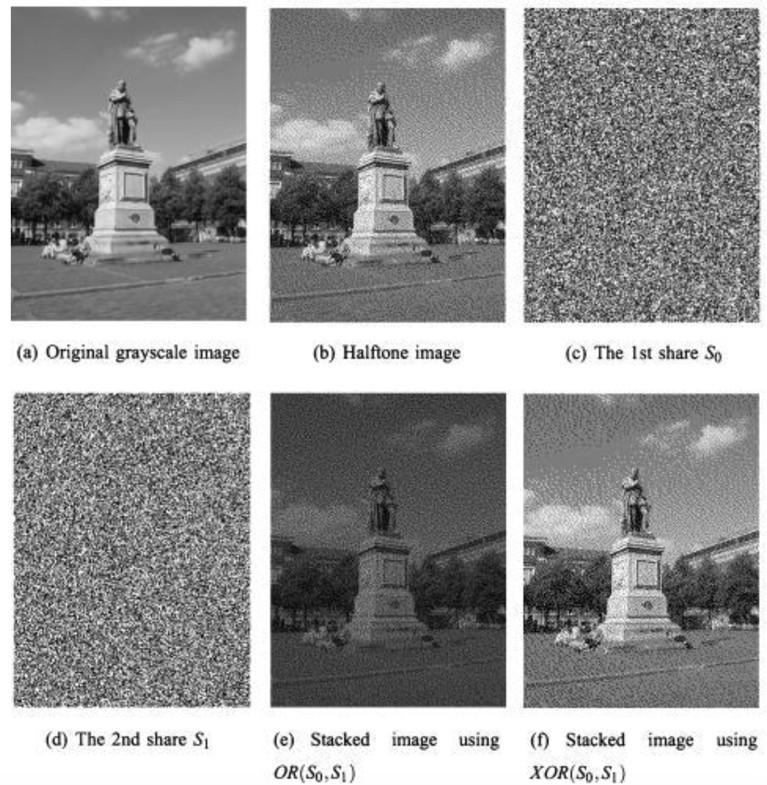
Fig.-4 ComparisonofGreyscalecryptographywith Half-tone,ORandXOR
This paper discussed the various technologies in cryptography and addressed their setbacks and advantages. Each technique gets determined according to therequiredspecificationconcerningtheparametersused. Also,thepaperpresentsthestudyofcomparativeanalysis of all types of visual cryptography with advantages. This research study serves as beneficial knowledge for future research direction. Visual cryptography can only protect fromtheinterceptionofdataflowbutdoesnotprotectdata fromsnooping.Snoopingcanaccessdatadirectlyontothe nodes.Butthe encryptionis done while transmittingdata only.So,thevisualcryptographycouldgetextendedtothe protectionofnodes.
[1] D’Arco, Paolo, Roberto De Prisco, and Yvo Desmedt. "Private visual share-homomorphic computation and randomness reduction in visual cryptography." In International Conference on Information Theoretic Security,Springer,Cham,pp.95-113,2016.
[2] Sandhya .N, Jyothi R. “A brief introduction to visual cryptography”. International Journal of Engineering ResearchandTechnology(IJERT)Vol.3,Issue3,24882491,2014
[3] Cimato S, Yang C.N, “Visual Cryptography and secret imagesharing”,CRCpress1stEdition,2017.
International Research Journal of Engineering and Technology (IRJET) e-ISSN: 2395-0056
Volume: 13 Issue: 04 | Apr 2026 www.irjet.net p-ISSN: 2395-0072
[4] Naor,M.,A.Shamir."Visualcryptography.Advancesin CryptologyEUROCRYPT’94LectureNotesinComputer Science."InWorkshop on the Theoryand Application of Cryptographic Techniques, May 9C12, pp. 1-12. 1995.
[5] Liu, F., Yan, W. Q. “Visual Cryptography for Image Processing and Security” Vol. 2. New York: Springer, 2014
[6] ChandramathiS,RameshKumarR,SureshR,HarishS “An overview of visual cryptography” International JournalofComputationalIntelligenceTechniques,Vol 1Issue1,pp32-37,2010.
[7] Weir, J. P. Visual cryptography and its applications. Bookboon,2012.
[8] Lou,Der-Chyuan,Hao-KuanTso,andJiang-LungLiu."A copyright protection scheme for digital images using visualcryptographytechnique."ComputerStandards& InterfacesVol.29,no.1pp.125-131,2007.
[9] Hwang,Ren-Junn."Adigitalimagecopyrightprotection scheme basedonvisual cryptography." 淡江理工學刊 Vol.3,no.2,pp97-106,2000.
[10] Weir, Jonathan, and WeiQi Yan. "A comprehensive study of visual cryptography." Transactions on data hiding and multimedia security V, Springer, Berlin, Heidelberg,vol.5pp.70-1052010.
[11] Revenkar,PravinS.,AnisaAnjum,andW.Z.Gandhare. "Surveyofvisualcryptographyschemes."International Journal of Security and Its Applications Vol 4, no. 2 pp49-56,2010.
[12] CaiJ. Ashort survey on visual cryptographyschemes. Department of Computer Science, University of Toronto.2004.
[13] Shyu, Shyong Jian, Shih-Yu Huang, Yeuan-Kuen Lee, Ran-Zan Wang, and Kun Chen. "Sharing multiple secrets in visual cryptography." Pattern Recognition Vol.40,no.12pp.3633-3651,2007
[14] Blundo,Carlo,AnnalisaDeBonis,andAlfredoDeSantis. "Improvedschemesforvisualcryptography."Designs, Codes and Cryptography Vol. 24, no. 3 pp. 255-278, 2001.
[15] Blundo, Carlo, Alfredo De Santis, and Moni Naor. "Visual cryptography for grey level images." InformationProcessingLetters2000Vol.75,no.6255259,2000.
[16] ZhouZhi,GonzaloR.Arce,andGiovanniDiCrescenzo. "Halftone visual cryptography." IEEE transactions on imageprocessing15,no.8,2441-2453,2006.
[17] Wang, Zhongmin, Gonzalo R. Arce, and Giovanni Di Crescenzo. "Halftone visual cryptography via error diffusion."IEEEtransactionsoninformation forensics andsecurity4,no.3,pp383-396,2009.
[18] Wu, Hsien-Chu, Hao-Cheng Wang, and Rui-Wen Yu. "Color visual cryptography scheme using meaningful shares." IEEE Eighth International Conference on Intelligent Systems Design and Applications, ISDA'08, vol.3,pp.173-178,2008.
[19] Krishna, Murali, and M. Jaya Ram. "Chaotic Based Enhanced Keyless Color Image Visual CryptographySystem." Journal of Innovation in Computer Science and Engineering Vol. 6, no. 1 pp.26-28,2016.
[20] Yan, Xuehu, Xin Liu, and Ching-Nung Yang. "An enhanced threshold visual secret sharing based on random grids." Journal ofReal-TimeImageProcessing 14,no.1pp.61-73,2018